

成都四环路内工业废弃地自生植物生境及物种多样性
|
包钰婷/女/西南交通大学建筑学院在读硕士研究生/研究方向为园林生态与植物景观规划设计 |
|
李晓鹏/女/博士/西南交通大学建筑学院讲师、硕士生导师/研究方向为园林植物与生物多样性 |
|
黄瑞/女/博士/西南交通大学建筑学院副教授/研究方向为生态与可持续景观规划设计 |
Copy editor: 王一兰
收稿日期: 2023-07-05
修回日期: 2023-11-16
网络出版日期: 2025-12-11
基金资助
国家自然科学基金青年科学基金项目“成都城区自生植物的分布格局及其对绿地异质性的响应”(52108065)
版权
The Habitat and Diversity of Spontaneous Plants in Industrial Wasteland in the Fourth Ring Road of Chengdu
|
BAO Yuting is a master student in the School of Architecture, Southwest Jiaotong University. Her research focuses on landscape ecology and plantscape planning and design |
|
LI Xiaopeng, Ph.D., is a lecturer and master supervisor in the School of Architecture, Southwest Jiaotong University. Her research focuses on garden plants and biodiversity of landscape |
|
HUANG Rui, Ph.D., is an associate professor in the School of Architecture, Southwest Jiaotong University. Her research focuses on planning and design of ecological and sustainable landscape |
Received date: 2023-07-05
Revised date: 2023-11-16
Online published: 2025-12-11
Copyright
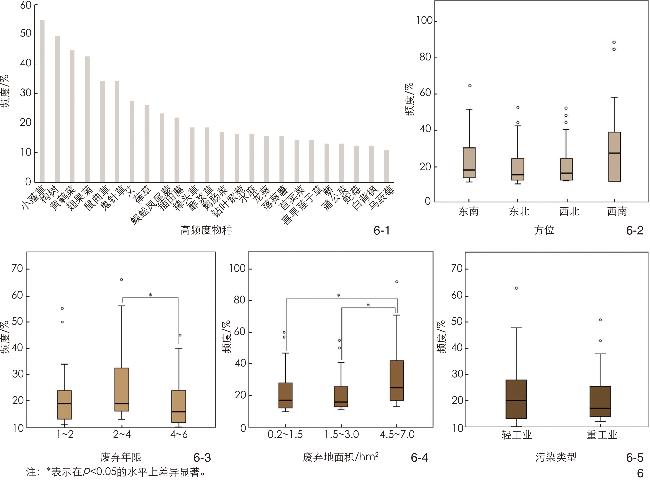
【目的】城市工业废弃地是自生植物重要的栖息地之一。揭示此类特殊生境中自生植物的物种组成和多样性特征,可以指导低维护植物景观的营建。【方法】采用网格布样法结合典型样点方法,选取成都市四环路内不同方位的10个重工业和轻工业废弃地,共584个样方展开自生植物调研,根据场地特征将工业废弃地生境分为荒置生境、半硬质生境、水湿生境和建筑生境四大类,在此基础上,细分出自生草地、砖石地、洼地等14种微生境,并分析不同生境和微生境中的自生植物物种组成和多样性特征。【结果】共记录到237种自生植物,隶属69科、186属。自生植物的生活型以多年生草本为主,占总物种数的30.80%。在自生植物群落多样性上,不同废弃年限和不同面积废弃地中的物种频度存在显著性差异,生境与微生境的物种丰富度差异不显著,但各生境间和微生境间的群落多样性呈极显著差异。【结论】为未来工业废弃地再利用的低维护植物规划提供了新思路,通过科学保留和利用自生植物,形成规划—“自然”设计—再规划的过程,激发工业废弃地自然恢复能力与潜力,并能最大化发挥再野化对工业废弃地生态修复和自然景观营造的作用。
包钰婷 , 李晓鹏 , 黄瑞 . 成都四环路内工业废弃地自生植物生境及物种多样性[J]. 风景园林, 2024 , 31(1) : 103 -111 . DOI: 10.3724/j.fjyl.202307050301
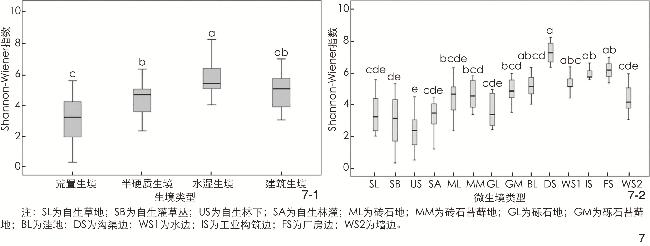
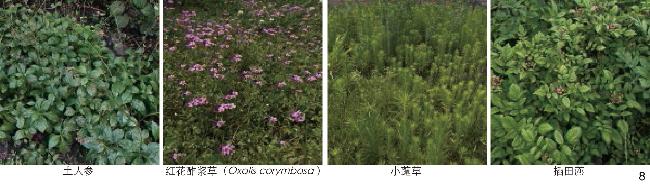
[Objective] In cities, there is a category of plants given little attention, the so-called spontaneous plants. Although being “indigenous urban inhabitants”, such plants are often seen as targets for removal due to their rough and messy appearance, strong breeding and settlement capabilities, and competitive advantage over cultivated plants. However, in the current context of ecological sustainability, people are gradually realizing that large-scale homogenized landscapes are not the optimal solution for the healthy development of urban ecosystems. It is necessary to explore other beneficial solutions, and spontaneous plants, the inconspicuous “urban weeds”, may be the “key” to such new solutions. Urban industrial wasteland is one of the important habitats for spontaneous plants. Revealing the species composition and diversity characteristics of spontaneous plants in such special habitats may guide the construction of low-maintenance plantscape. [Methods] This research focuses on the central urban area within the Fourth Ring Road (Chengdu Ring Expressway) in Chengdu City, Sichuan Province. The area is divided into the four parts of southeast, northeast, northwest, and southwest parts, based on the lines connecting the four entrances and exits of the Chengdu Ring Expressway to Tianfu Square. Through stratified random sampling, the research determines the potential for reusing wasteland as green space based on land use planning, surrounding water systems, and people’s usage needs. Subsequently, the research selects from within the Fourth Ring Road 10 typical industrial wastelands, including the lands for both light and heavy industries, based on their distribution, size, and industrial type. In total, 584 quadrats are recorded, and the habitat types of spontaneous plants are categorized into four major types: abandoned habitat, semi-hard habitat, wetland habitat, and building habitat. Furthermore, 14 micro-habitat types including spontaneous grassland, spontaneous shrub grassland, and spontaneous underwood are classified based on different stages of plant succession and environmental substrates, and the species composition and diversity characteristics of spontaneous plants in different habitats and micro-habitats are analyzed. [Results] This research records a total of 237 spontaneous plant species, belonging to 183 genera within 70 families, with 84.9% thereof found in the built-up areas of Chongqing. In terms of dominant families, Asteraceae and Poaceae are prominent, and perennial herbaceous plants constitute 30.80% of the total species. Significant differences are found in the frequency of species among wastelands varying in abandonment duration and area, while the species richness of habitats and micro-habitats show no significant differences. The absence of clear boundaries between different habitats in unmanaged abandoned areas may promote species exchange, resulting in little variation in spontaneous plant species among different habitats. However, there are significant differences in community diversity between habitats and micro-habitats, with the diversity of communities along channels, water edges, industrial structures, and factory edges being higher in micro-habitats. Despite the limitations of sample size, it can be found that heterogeneous habitats can promote community diversity. In undisturbed industrial wasteland, spontaneous plants tend to settle and grow in areas beyond obvious hard surface. With the change in the duration of disuse of wasteland, spontaneous plants in different succession stages form a multi-layered wild vegetation structure, thus creating abandoned habitats in various “soft” areas of wasteland. In areas formed after the demolition of roads, pavements, and buildings, a small amount of soil can provide rooting space for spontaneous plants, which can gradually cover most of the original hard grounds, forming a semi-hard habitat. In addition, despite the small number of quadrats recorded in wet habitats formed in depressions, ditches, and ponds, such habitats support a diverse range of species. There are more typical quadrats along the edges of factories and industrial structures, which are important building habitats in industrial wastelands. [Conclusion] This research is a rare exploration focusing on the distribution pattern of spontaneous plant species and the diversity characteristics of communities on urban industrial wastelands. Spontaneous plants are the most natural component of urban biodiversity, making them ideal material for studying the interaction mechanism between urbanization and urban ecosystem. Urban industrial wastelands, as urban wilderness, are important habitats for spontaneous plants, which can preserve natural wilderness forms and maintain rich biodiversity. In spring alone, 237 species of spontaneous plants were recorded on 10 industrial wastelands within the Fourth Ring Road of Chengdu, showing extremely high species richness. Species frequency varies significantly with the abandonment duration and area of wastelands, reflecting the dominant characteristics of different species. In terms of community diversity, different habitats present significantly different and distinctive communities, forming natural and interesting plantscape with various ornamental benefits. In future planning and design, it is necessary to scientifically preserve and utilize dominant species and spontaneous plants in industrial wastelands, and formulate reasonable plant zoning plans according to the different levels of pollution in the wastelands. Furthermore, it is essential to appropriately plant cultivated plants based on the distribution patterns of different species and the structure of community components in various habitats, in order to construct a habitat that supports the survival of diverse species while maximizing aesthetic and ecological benefits. However, further research is needed to provide more comprehensive and scientific guidance for low-maintenance plants, predominantly spontaneous plants.
表1 各方位工业废弃地概况Tab. 1 Overview of industrial wastelands in various orientations |
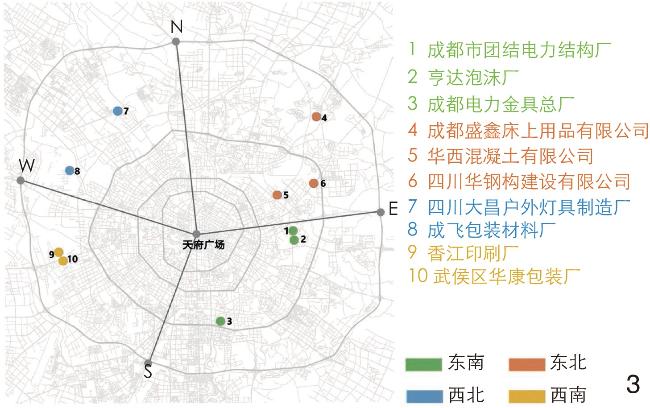
| 序号 | 废弃地名称 | 方位 | 工业类型 | 面积/hm2 | 样点数 |
| 1 | 成都市团结电力结构厂 | 东南 | 重工业 | 0.77 | 12 |
| 2 | 亨达泡沫厂 | 东南 | 轻工业 | 0.26 | 9 |
| 3 | 成都电力金具总厂 | 东南 | 重工业 | 6.40 | 24 |
| 4 | 成都盛鑫床上用品有限公司 | 东北 | 轻工业 | 2.01 | 14 |
| 5 | 华西混凝土有限公司 | 东北 | 重工业 | 2.70 | 20 |
| 6 | 四川华钢构建设有限公司 | 东北 | 重工业 | 2.20 | 16 |
| 7 | 四川大昌户外灯具制造厂 | 西北 | 轻工业 | 0.52 | 11 |
| 8 | 成飞包装材料厂 | 西北 | 重工业 | 0.95 | 14 |
| 9 | 香江印刷厂 | 西南 | 轻工业 | 2.00 | 14 |
| 10 | 武侯区华康包装厂 | 西南 | 轻工业 | 0.92 | 12 |
表2 生境与微生境类型特征及样方数Tab. 2 Characteristics of and number of quadrats in different types of habitats and micro-habitats |
| 生境类型 | 微生境类型 | 特征描述 | 样方数 |
| 荒置生境 | 自生草地 | 自然演替形成的草本群落 | 12 |
| 自生灌草丛 | 自然演替形成的草本和灌木的复层群落 | 27 | |
| 自生林下 | 自然演替形成的乔木群落 | 7 | |
| 自生林灌 | 自然演替形成的灌木和乔木的复层群落 | 10 | |
| 半硬质生境 | 砖石地 | 有砖块堆积的土地 | 26 |
| 砖石苔藓地 | 砖块堆积且有苔藓生长的土地 | 6 | |
| 砾石地 | 有砾石堆积的土地 | 9 | |
| 砾石苔藓地 | 砾石堆积且有苔藓生长的土地 | 8 | |
| 水湿生境 | 洼地 | 中间低四周高且土壤较为湿润的地形 | 8 |
| 沟渠边 | 人工修建且用于引、排水的渠道 | 4 | |
| 水边 | 人工修建的池、塘、湖或自然形成的水域 | 5 | |
| 建筑生境 | 工业构筑边 | 工业生产中一些辅助的生产设施、设备 | 5 |
| 厂房边 | 进行工业生产活动的房屋 | 3 | |
| 墙边 | 由砖石垒成的垂直墙体 | 16 |
表3 自生植物生活型组成情况Tab. 3 Composition of life forms of spontaneous plants |
| 生活型 | 物种数 | 比例/% | 代表物种 |
| 一年生草本 | 58 | 24.47 | 斑种草(Bothriospermum chinense)、尖头叶藜(Chenopodium acuminatum) |
| 二年生草本 | 7 | 2.95 | 草木樨(Melilotus suaveolens)、野胡萝卜(Daucus carota) |
| 一或二年生草本 | 18 | 7.59 | 附地菜、荔枝草(Salvia plebeia) |
| 多年生草本 | 73 | 30.80 | 牛至(Origanum vulgare)、商陆(Phytolacca acinosa) |
| 一或多年生草本 | 4 | 1.69 | 天蓝苜蓿(Medicago lupulina)、窃衣(Torilis scabra) |
| 二或多年生草本 | 4 | 1.69 | 旱芹(Apium graveolens)、蛇含委陵菜(Potentilla kleiniana) |
| 多年生水生草本 | 2 | 0.84 | 豆瓣菜(Nasturtium officinale) |
| 一年生草质藤本 | 4 | 1.69 | 拉拉藤(Galium spurium)、薯蓣(Dioscorea polystachya) |
| 多年生草质藤本 | 13 | 5.49 | 海金沙(Lygodium japonicum)、茜草(Rubia cordifolia) |
| 木质藤本 | 5 | 2.11 | 蛇葡萄(Ampelopsis glandulosa)、地果(Ficus tikoua) |
| 灌木幼苗 | 3 | 1.27 | 黄花倒水莲(Polygala fallax)、火炬树(Rhus typhina) |
| 半灌木 | 4 | 1.69 | 喀西茄(Solanum aculeatissimum)、牛皮消(Cynanchum auriculatum) |
| 藤状灌木 | 2 | 0.84 | 铁包金(Berchemia lineata)、鸡屎藤(Paederia foetida) |
| 灌木 | 16 | 6.75 | 插田藨、水麻 |
| 乔木幼苗 | 10 | 4.22 | 榆树(Ulmus pumila)、白背枫(Buddleja asiatica) |
| 乔木 | 5 | 2.11 | 构树、朴树 |
| 蕨类 | 6 | 2.53 | 蜈蚣凤尾蕨(Pteris vittata)、贯众(Cyrtomium fortunei) |
| 竹类 | 2 | 0.84 | 麻竹(Dendrocalamus latiflorus)、箬竹(D. latiflorus) |
| 一年生寄生 | 1 | 0.42 | 菟丝子 |
表4 各生境与微生境间自生植物物种丰富度差异比较Tab. 4 Comparison of differences in species richness of spontaneous plants between habitats and micro-habitats |
| 生境类型 | 微生境类型 | Patrick指数 | |
| 注:数据为平均值及标准差,a表示差异显著(p<0.05)。 | |||
| 荒置生境 | 自生草地 | 9.95±5.13a | 10.75±4.00a |
| 自生灌草丛 | 10.31±5.76a | ||
| 自生林下 | 8.57±5.88a | ||
| 自生林灌 | 8.90±4.07a | ||
| 半硬质生境 | 砖石地 | 10.27±4.55a | 9.44±4.59a |
| 砖石苔藓地 | 12.17±6.52a | ||
| 砾石地 | 9.44±2.01a | ||
| 砾石苔藓地 | 12.38±4.50a | ||
| 水湿生境 | 洼地 | 12.81±4.71a | 11.14±4.63a |
| 沟渠边 | 12.25±2.22a | ||
| 水边 | 15.60±5.68a | ||
| 建筑生境 | 工业构筑边 | 11.92±5.76a | 12.60±4.45a |
| 厂房边 | 16.67±8.51a | ||
| 墙边 | 10.81±5.47a | ||
表5 各生境与微生境间自生植物群落多样性差异比较Tab. 5 Comparison of differences in community diversity of spontaneous plants between different habitats and micro-habitats |
| 生境类型 | 微生境类型 | Shannon-Wiener指数 | |
| 注:数据为平均值及标准差,不同上标字母表示差异显著(p<0.001)。 | |||
| 荒置生境 | 自生草地 | 3.02±1.34c | 3.38±1.18cde |
| 自生灌草丛 | 2.96±1.47de | ||
| 自生林下 | 2.31±1.36e | ||
| 自生林灌 | 3.24±1.05cde | ||
| 半硬质生境 | 砖石地 | 4.36±1.05b | 4.44±1.04bcde |
| 砖石苔藓地 | 4.57±0.95bcd | ||
| 砾石地 | 3.56±1.02cde | ||
| 砾石苔藓地 | 4.86±0.82bcd | ||
| 水湿生境 | 洼地 | 5.73±1.18a | 5.16±0.88abcd |
| 沟渠边 | 7.25±0.79a | ||
| 水边 | 5.31±0.73abc | ||
| 建筑生境 | 工业构筑边 | 4.90±1.10ab | 5.93±0.43ab |
| 厂房边 | 6.15±0.81ab | ||
| 墙边 | 4.34±0.86bcde | ||
① 《成都市城市总体规划(2003—2020)》中的中心城区即为成都绕城高速公路以内的用地范围。最新版《成都市城市总体规划(2016—2035年)》将中心城区扩大为所有市辖区。
| [1] |
QIAN S H, QI M, HUANG L, et al. Biotic Homogenization of China’s Urban Greening: A Meta-analysis on Woody Species[J]. Urban Forestry & Urban Greening, 2016, 33(18): 25-33.
|
| [2] |
李晓鹏, 董丽. 北京不同公园自生植物物种组成特征及群落类型[J]. 风景园林, 2020, 27(4): 42-49.
LI X P, DONG L. Species Composition and Community Types of Spontaneous Plants in Various Parks of Beijing[J]. Landscape Architecture, 2020, 27(4): 42-49.
|
| [3] |
KÜHN N. Intentions for the Unintentional: Spontaneous Vegetation as the Basis for Innovative Planting Design in Urban Areas[J]. Journal of Landscape Architecture, 2006, 1(2): 46-53.
|
| [4] |
WOODWARD S L. Spontaneous Vegetation of the Muray Springs Area, San Pedro Valley, Arizona[J]. Journal of the Arizona Academy of Science, 1972, 7(1): 12-16.
|
| [5] |
JARITZ C. Manurial Experiments on Fallows of Long or Several Years’ Duration with Spontaneous Pasture Vegetation in North-West-Tunisia and Their Importance for Elaborating Measures for Pasture Improvement[J]. Zeitschrift Fuer Acker und Pflanzenbau, 1974, 139(4): 273-306.
|
| [6] |
MARSHALL E J P, BROWN V K, BOATMAN N D, et al. The Role of Weeds in Supporting Biological Diversity Within Crop Fields[J]. Weed Research, 2003, 43(2): 77-89.
|
| [7] |
GIBSON R H, NELSON I L, HOPKINS G W, et al. Pollinator Webs, Plant Communities and the Conservation of Rare Plants: Arable Weeds as a Case Study[J]. Journal of Applied Ecology, 2006, 43(2): 46-257.
|
| [8] |
REQUIER F, ODOUX J, TAMIC T, et al. Honey Bee Diet in Intensive Farmland Habitats Reveals an Unexpectedly High Flower Richness and a Major Role of Weeds[J]. Ecological Applications, 2015, 25(4): 881-890.
|
| [9] |
BOECHAT C L, PISTÓIA V C, GIANELO C, et al. Accumulation and Translocation of Heavy Metal by Spontaneous Plants Growing on Multi-Metal-Contaminated Site in the Southeast of Rio Grande do Sul State, Brazil[J]. Environmental Science and Pollution Research, 2016, 23(3): 2371-2380.
|
| [10] |
CAVALCA L, CORSINI A, CANZI E, et al. Rhizobacterial Communities Associated with Spontaneous Plant Species in Long-Term Arsenic Contaminated Soils[J]. World Journal of Microbiology and Biotechnology, 2015, 31(5): 735-746.
|
| [11] |
WANG J, ZHANG C B, KE S S, et al. Different Spontaneous Plant Communities in Sanmen Pb/Zn Mine Tailing and Their Effects on Mine Tailing Physico-Chemical Properties[J]. Environmental Earth Sciences, 2011, 62(4): 779-786.
|
| [12] |
TREDICI P D. Spontaneous Urban Vegetation: Reflections of Change in a Globalized World[J]. Nature and Culture, 2010, 5: 299-315.
|
| [13] |
LOSOSOVÁ Z, CHYTRÝ M, TICHÝ L, et al. Native and Alien Floras in Urban Habitats: A Comparison Across 32 Cities of Central Europe[J]. Global Ecology and Biogeography, 2012, 21(5): 545-555.
|
| [14] |
MURATET A, MACHON N, JIGUET F, et al. The Role of Urban Structures in the Distribution of Wasteland Flora in the Greater Paris Area, France[J]. Ecosystems, 2007, 10(4): 661-671.
|
| [15] |
丁建清. 农田杂草的生物防治[J]. 中国生物防治, 1995, 11(3): 129-133.
DING J Q. Biological Control of Crop Weeds[J]. Chinese Journal of Biological Control, 1995, 11(3): 129-133.
|
| [16] |
左忠, 王峰, 温学飞, 等. 宁夏盐池县农田杂草种类及防治技术[J]. 草业科学, 2004, 21(8): 71-77.
ZUO Z, WANG F, WEN X F, et al. Farmland Weeds and Prevention Techniques in Ningxia Salt Bay Prefecture[J]. Pratacultural Science, 2004, 21(8): 71-77.
|
| [17] |
吴海荣, 强胜. 南京市秋季外来杂草定量调查研究[J]. 生物多样性, 2003, 11(5): 432-438.
WU H R, QIANG S. Quantitative Survey on Exotic Weeds in Autumn in Nanjing[J]. Biodiversity Science, 2003, 11(5): 432-438.
|
| [18] |
KATTWINKEL M, BIEDERMANN R, KLEYER M. Temporary Conservation for Urban Biodiversity[J]. Biological Conservation, 2011, 144: 2335-2343.
|
| [19] |
陈晓双, 梁红, 宋坤, 等. 哈尔滨城区杂草群落多样性及其分类体系[J]. 应用生态学报, 2014, 25(8): 2221-2228.
CHEN X S, LIANG H, SONG K, et al. Diversity and Classification System of Weed Community in Harbin City, China[J]. Chinese Journal of Applied Ecology, 2014, 25(8): 2221-2228.
|
| [20] |
QIAN S H, QIN D Y, WU X, et al. Urban Growth and Topographical Factors Shape Patterns of Spontaneous Plant Community Diversity in a Mountainous City in Southwest China[J]. Urban Forestry & Urban Greening, 2020, 55: 126814
|
| [21] |
CERVELLI E W, LUNDHOLM J T, DU X. Spontaneous Urban Vegetation and Habitat Heterogeneity in Xi’an, China[J]. Landscape and Urban Planning, 2013, 120: 25-33.
|
| [22] |
李晓鹏, 董丽, 关军洪, 等. 北京城市公园环境下自生植物物种组成及多样性时空特征[J]. 生态学报, 2018, 38(2): 581-594.
LI X P, DONG L, GUAN J H, et al. Temporal and Spatial Characteristics of Spontaneous Plant Composition and Diversity in A Beijing Urban Park[J]. Acta Ecologica Sinica, 2018, 38(2): 581-594.
|
| [23] |
陈程, 李林, 和太平. 广西大学校园自生植物多样性调查与分析[J]. 热带农业科学, 2023, 43(2): 83-89.
CHEN C, LI L, HE T P. Investigation and Analysis of Spontaneous Vegetation Resources at Guangxi University[J]. Chinese Journal of Tropical Agriculture, 2023, 43(2): 83-89.
|
| [24] |
陈春谛. 被遗忘的城市“生境”: 重庆市墙体自生植物调查分析[J]. 生态学报, 2020, 40(2): 473-483.
CHEN C D. Forgotten Urban Habitats: Analysis of Spontaneous Vegetation on the Urban Walls of Chongqing City[J]. Acta Ecologica Sinica, 2020, 40(2): 473-483.
|
| [25] |
金亚璐, 楼晋盼, 姚兴达, 等. 京杭大运河(杭州主城区段)河岸带不同生境自生植物物种组成与多样性特征[J]. 中国园林, 2022, 38(10): 110-115.
JIN Y L, LOU J P, YAO X D, et al. Species Composition and Diversity Characteristics of Spontaneous Vegetation in Different Habitats in the Riparian Zone of Urban Channelized Rivers: A Case Study of the Beijing − Hangzhou Grand Canal in the Main Section of Hangzhou[J]. Chinese Landscape Architecture, 2022, 38(10): 110-115.
|
| [26] |
张庆费, 贾熙璇, 郑思俊, 等. 城市工业区野境植物多样性与群落结构研究: 以原上海溶剂厂再野化为例[J]. 中国园林, 2021, 37(12): 14-19.
ZHANG Q F, JIA X X, ZHENG S J, et al. Research on Plant Diversity and Plant Community Structure of Wildness in Urban Industrial Area: Taking the Rewilding of Shanghai Solvent Factory as an Example[J]. Chinese Landscape Architecture, 2021, 37(12): 14-19.
|
| [27] |
尤其, 商妞, 代挽玉, 等. 城市闲置地自生植物种间联结及土壤因子分析: 以郑州北龙湖公园为例[J]. 西北林学院报, 2023, 38(5): 270-278.
YOU Q, SHANG N, DAI W Y, et al. Analysis of Interspecific Associations and Soil Factors of Voluntary Plants in Urban Idle Land: A Case Study of Zhengzhou Beilonghu Park[J]. Journal of Northwest Forestry University, 2023, 38(5): 270-278.
|
| [28] |
BONTHOUX S, BRUN M, PIETRO F D, et al. How Can Wastelands Promote Biodiversity in Cities? A Review[J]. Landscape and Urban Planning, 2014, 132: 79-88.
|
| [29] |
赵娟娟, 孙小梅, 陈珊珊, 等. 城市野生草本植物种类构成的特征: 以宁波市为例[J]. 生态环境学报, 2016, 25(1): 43-50.
ZHAO J J, SUN X M, CHEN S S, et al. Characteristics of Species Composition for Urban Spontaneous Herbs, with Ningbo, China as A Case Study[J]. Ecology and Environmental Sciences, 2016, 25(1): 43-50.
|
| [30] |
田志慧, 蔡北溟, 达良俊. 城市化进程中上海植被的多样性、空间格局和动态响应(Ⅷ): 上海乡土陆生草本植物分布特征及其在城市绿化中的应用前景[J]. 华东师范大学学报(自然科学版), 2011(4): 24-34.
TIAN Z H, CAI B M, DA L J. Diversity, Spatial Pattern and Dynamics of Vegetation under Urbanization in Shanghai (Ⅷ): Distribution of Native Terrestrial Wild Plants and Their Applications to Urban Greening in Shanghai[J]. Journal of East China Normal University (Natural Science), 2011(4): 24-34.
|
| [31] |
李晓鹏, 张思凝, 冯黎, 等. 成都城区河流廊道自生植物的生境及物种多样性[J]. 风景园林, 2022, 29(1): 64-70.
LI X P, ZHANG S N, FENG L, et al. Habitat and Species Diversity of Spontaneous Plants on Both Sides of River Corridor in Chengdu Urban Area[J]. Landscape Architecture, 2022, 29(1): 64-70.
|
| [32] |
郭佳琦, 陈俊辰, 黄旬, 等.喜旱莲子草入侵群落主要物种生态位和种间联结研究[J].生态环境学报, 30(8): 1607-1616.
GUO J Q, CHEN J C, HUANG X, et al. Niche Characteristics and Interspecific Associations of the Dominant Species of the Communities Invaded by Alternanthera philoxeroides[J]. Ecology and Environmental Sciences, 30(8): 1607-1616.
|
| [33] |
于泽, 张云路. 基于植被演替理论的城市废弃地植物景观营造策略[J]. 中国城市林业, 2020, 18(2): 20-24.
YU Z, ZHANG Y L. Plants Landscaping Strategy on Urban Wasteland Based on Vegetation Succession Theory[J]. Journal of Chinese Urban Forestry, 2020, 18(2): 20-24.
|
| [34] |
盘远方, 李娇凤, 黄昶吟, 等. 桂林岩溶石山不同坡向灌丛植物多样性与土壤环境因子的关系[J]. 广西植物, 2019, 39(8): 1115-1125.
PAN Y F, LI J F, HUANG C Y, et al. Relationship Between Plant Diversity of Shrubs and Soil Environmental Factors along with Slope Aspects in Karst Hills of Guilin, Southwest China[J]. Guihaia, 2019, 39(8): 1115-1125.
|
| [35] |
曹越, 马丁, 杨锐. 城市野境: 城市区域中野性自然的保护与营造[J]. 风景园林, 2019, 26(8): 20-24.
CAO Y, MARTIN V G, YANG R. Urban Wildness: Protection and Creation of Wild Nature in Urban Areas[J]. Landscape Architecture, 2019, 26(8): 20-24.
|
| [36] |
朱育帆. 历史对象与后工业景观[J]. 中国园林, 2020, 36(3): 6-14.
ZHU Y F. Historical Objects and Post-Industrial Landscape[J]. Chinese Landscape Architecture, 2020, 36(3): 6-14.
|
/
| 〈 |
|
〉 |