

花园城市背景下北京市中心城区城市公园花卉植物感知评价
|
张艺菲/女/北京林业大学园林学院在读硕士研究生/研究方向为风景园林规划与设计 |
|
纪雨含/女/北京林业大学园林学院在读硕士研究生/研究方向为风景园林规划与设计 |
|
吕英烁/女/北京林业大学园林学院博士研究生/研究方向为风景园林规划设计与理论 |
|
郑曦/男/博士/北京林业大学园林学院教授、博士生导师/本刊主编/研究方向为风景园林规划与设计 |
Copy editor: 刘颖
收稿日期: 2024-12-30
修回日期: 2025-09-17
网络出版日期: 2025-12-10
版权
Evaluation on Perception of Flower Plants in Urban Parks within the Central Urban Area of Beijing Under the Background of Garden City
|
ZHANG Yifei is a master student in the School of Landscape Architecture, Beijing Forestry University. Her research focuses on landscape planning and design |
|
JI Yuhan is a master student in the School of Landscape Architecture, Beijing Forestry University. Her research focuses on landscape planning and design |
|
LYU Yingshuo is a Ph.D. graduate in the School of Landscape Architecture, Beijing Forestry University. Her research focuses on landscape planning design and theory |
|
ZHENG Xi, Ph.D., is a professor and doctoral supervisor in the School of Landscape Architecture, Beijing Forestry University, and editor-in-chief of this journal. His research focuses on landscape planning and design |
Received date: 2024-12-30
Revised date: 2025-09-17
Online published: 2025-12-10
Copyright
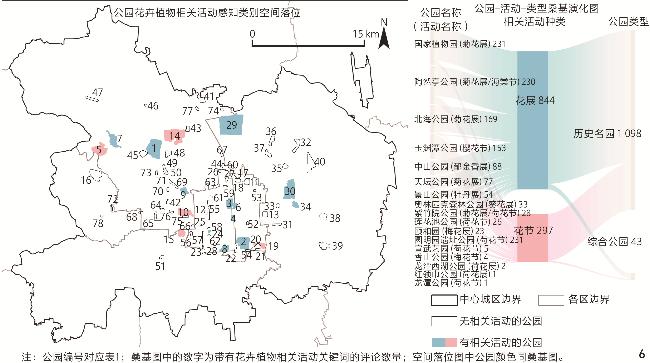
【目的】《北京花园城市专项规划(2023年—2035年)》要求“将北京建设成为一个大花园”,评价公众对花卉植物的感知情况以精准把握当前植物景观规划成效,为促进花园城市高质量发展提供有力支撑。 【方法】 以北京市中心城区中78个一级公园为研究对象,基于从大众点评网站爬取的2023年与花卉植物相关评论,构建花卉植物感知语料库,利用内容分析(content analysis, CA)法、隐含狄利克雷分布(latent Dirichlet allocation, LDA)主题聚类法和重要性-满意度分析(importance-performance analysis, IPA)法,对公众感知情况进行评价。【结果】1)总体感知情况上,各类公园感知程度及空间分布相差较大,时间规律明显,感知程度高的时段集中在3—5月及9—11月,荷花、桃花、樱花最易被公众感知,且17个公园存在与花卉相关的文化活动;2)感知主题上,共得到4个类别,其中公众更关注“花卉体验的多元功能”,对“花卉景点的文化价值”的关注最少;3)感知IPA评价上,各类型公园的优势花卉有所不同,且感知主题差别较大,公众对历史名园各主题感知满意度普遍较高,对综合公园“花卉体验的多元功能”主题的感知突出,但感知满意度较低,社区公园各感知主题满意度总体较低。【结论】揭示了公众对花卉植物感知具有显著的时空差异,明确了花卉植物在物种、主题及公园类型上的感知特征,为北京市花园城市建设中公园花卉配置与管理提供依据。
张艺菲 , 纪雨含 , 吕英烁 , 郑曦 . 花园城市背景下北京市中心城区城市公园花卉植物感知评价[J]. 风景园林, 2025 , 32(11) : 101 -109 . DOI: 10.3724/j.fjyl.LA20240164
[Objective] With the rapid advancement of urbanization and the rising expectations of citizens for high-quality living environments, the Beijing Municipal People’s Government officially promulgated the Special Plan for Beijing Garden City (2023−2035) in May 2024, in response to these emerging needs. This comprehensive urban planning initiative outlines the strategic objective of achieving “overall colorization” centered around the development and enhancement of urban parks. The policy emphasizes the central role of flowers in landscape construction, ecological restoration, and promoting livable, beautiful, and culturally vibrant urban habitats. Beyond their ecological and visual value, flowers also serve as cultural symbols and contribute to residents’ emotional well-being. However, the effectiveness of floral landscape construction depends heavily on public perception, which influences the usage of these green spaces. This research investigates public perceptions of floral landscapes in urban parks across the central urban area of Beijing, with a view to identifying key themes, species, and perception patterns across different park types, thereby offering practical insights for improving landscape planning and supporting the broader goals of garden city development.
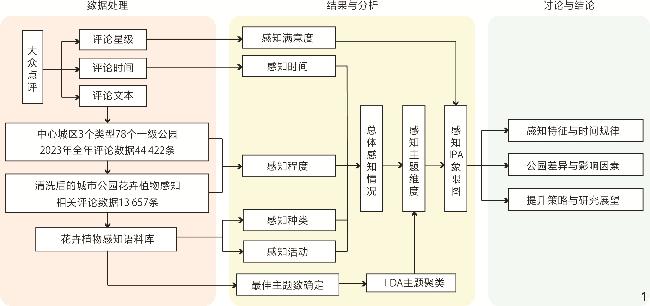
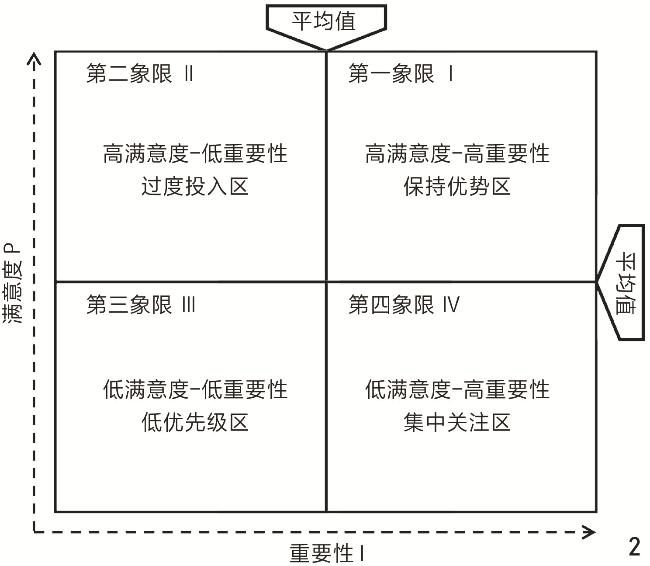
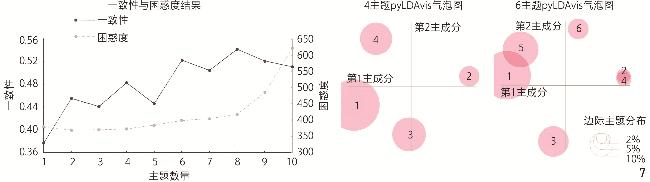
[Method] Taking 78 urban parks in the central urban area of Beijing as the research objects, this research uses Python to collect annual reviews for each park from dianping.com in 2023, yielding 13,657 valid entries, and a combination of content analysis (CA), latent Dirichlet allocation (LDA) topic modeling and importance − performance analysis (IPA) is employed to examine and evaluate public perceptions of floral landscapes in urban parks across Beijing. The specific process involves the following steps: Constructing a customized lexicon and segmenting the review data; establishing a flower plant perception corpus and performing CA and word frequency analysis to assess the overall perception of flower plants; applying the LDA model to extract thematic clusters and corresponding keywords, and summarizing the perception themes in alignment with the Garden City planning framework; evaluating the importance and satisfaction levels of the identified perception themes using the IPA method; and finally, categorizing and discussing the findings to propose strategies for enhancing public perception of floral landscapes.
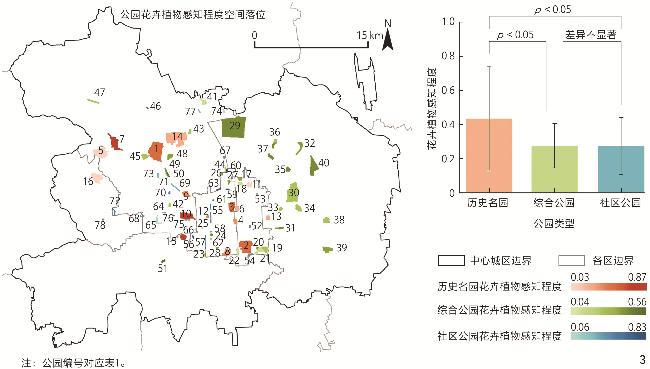
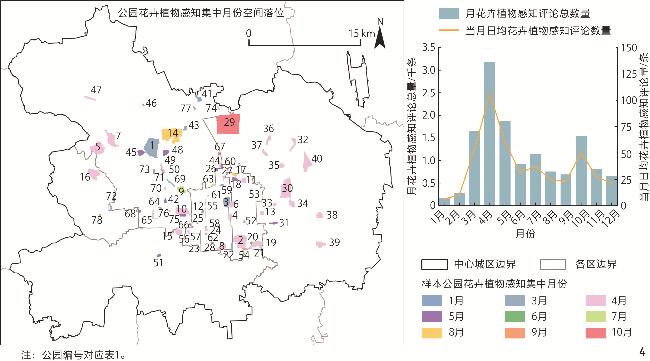
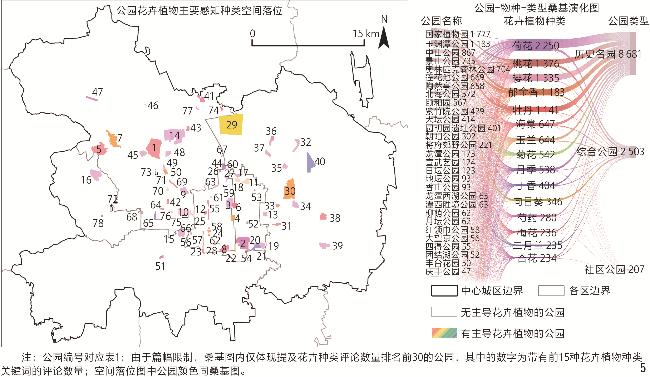
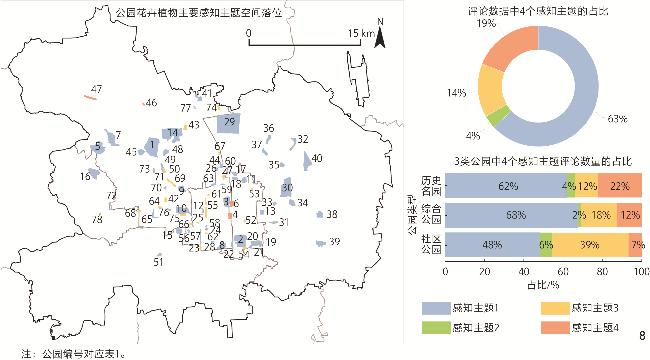
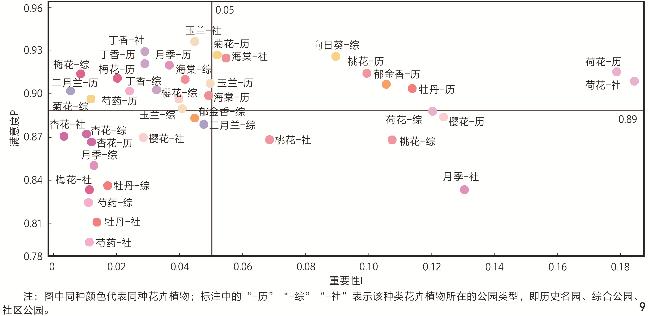
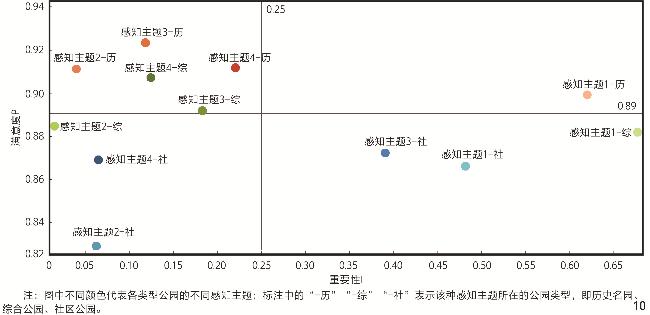
[Result] A list of the top 15 flower plant species based on public perception is compiled, and four flower perception themes are identified. Significant differences are found in public perceptions across different park types. 1) In terms of overall perception, there are considerable differences in the degree of public perception and spatial distribution among various types of parks. Time patterns are clearly defined, with perception levels peaking primarily between March and May and September and November. A wide variety of flower species are employed, with lotus (2,250 mentions), peach blossom (1,376 mentions), and cherry blossom (1,335 mentions) being the most prominently perceived by the public. Additionally, 17 parks host flower-related cultural activities. 2) In terms of perception themes, the multiple functions of flower experiences (63%) are most prominent, followed by the aesthetic use of flower species (19%), the livelihood benefits of floral resources (14%), and the cultural value of floral attractions (4%). Public perception is more focused on functional aspects, such as photography and outings, while cultural values receive less attention. Among the three park types, the aesthetic use of flower species (22%) ranks second in historical parks, but is low in comprehensive and community parks, showing a negative correlation with livelihood benefits. In comprehensive parks, the multiple functions of flower experiences (68%) are more prominent, whereas in community parks, the livelihood benefits of floral resources (39%) are most noticeable. 3) In terms of the perception importance − satisfaction performance, advantageous flowers vary by park type, and the perception performance of various flower plant species is generally good. Lotus and chrysanthemums in historical parks are highly satisfactory, sunflowers in comprehensive parks are recognized, while chinese rose and peach blossom in community parks need to be upgraded. Besides, some flowers are highly rated while failing to attract enough attention, and limited resources need to be optimized. The perception theme performance of different types of parks varies greatly. The perception theme performance of historical famous parks is generally high. For comprehensive parks, the “multiple functions of flower experiences” stand out (68%), but the perception satisfaction is relatively low and in urgent need of enhancement. The overall satisfaction of each perception theme in community parks is relatively low.
[Conclusion] This research clarifies the primary species, thematic dimensions, and public performance evaluations related to floral landscapes across different types of urban parks in Beijing. It demonstrates that floral landscape design must be tailored to park functions, public usage patterns, and seasonal cycles to enhance user satisfaction and fulfill the goals of the Beijing Garden City initiative. The proposed perception evaluation model, not only aids local government and planners in refining floral landscape strategies but also provides a scalable methodological framework for evaluating similar projects in other cities pursuing green and livable urban transformations. Moreover, by highlighting gaps in satisfaction and underutilized floral resources, this research offers targeted recommendations for improving biodiversity, cultural engagement, and ecological value in urban landscape planning.
Key words: urban park; Garden City; landscape perception; network text analysis; flower plant
表1 公园类型、序号与公园名称Table 1 Type of park, serial number and park name |
| 公园类型 | 序号与公园名称 |
| 历史名园 | 1颐和园、2天坛公园、3北海公园、4中山公园、5香山公园、6景山公园、7国家植物园、8陶然亭公园、9紫竹院公园、10玉渊潭公园、11地坛公园、12月坛公园、13日坛公园、14圆明园遗址公园、15莲花池公园、16八大处公园 |
| 综合公园 | 17柳荫公园、18青年湖公园、19龙潭公园、20龙潭西湖公园、21龙潭中湖公园、22永定门公园、23金中都公园、24宣武艺园、25白云叠翠公园、26双秀公园、27人定湖公园、28万寿公园、29奥林匹克森林公园、30朝阳公园、31庆丰公园、32大望京公园、33团结湖公园、34红领巾公园、35四得公园、36北小河公园、37望和公园、38兴隆公园、39古塔公园、40将府郊野公园、41西小口公园、42玲珑公园、43荷清园公园、44马甸公园、45北坞公园、46百旺公园、47温泉公园、48海淀公园、49巴沟山水园、50长春健身园、51丰台花园 |
| 社区公园 | 52东单公园、53南馆公园、54玉蜓公园、55顺城公园、56莲花河城市休闲公园、57北京滨河公园、58翠芳园、59德胜公园、60玫瑰公园、61官园公园、62广宁公园、63潭西胜境公园、64定慧公园、65五棵松奥林匹克文化公园、66会城门公园、67北极寺公园、68阳光星期八公园、69南长河公园、70车道沟公园、71金源娱乐园、72田村城市休闲公园、73蓝靛厂公园、74东升文体公园、75中华世纪坛公园、76翠微烟雨公园、77碧水风荷公园、78古城公园 |
表2 数据清洗的目标词汇与噪声词汇Table 2 Target and noise vocabulary for data cleaning |
| 类别 | 关键词 |
| 目标词汇 | 花、北京市常见花卉植物种类(玉兰、郁金香、蜡梅、山桃、山杏、碧桃、芍药、牡丹、鸢尾、玫瑰、丁香、海棠、连翘等) |
| 噪声词汇 | 雪花、花钱、花费、花销、花了、花生、花纹、棉花、火花、烟花、印花、冰花、花猫、花时间、花力气、天花板、青花瓷、万花筒、火树银花、花花世界、走马观花等 |
表3 感知主题与核心高频词Table 3 Perceived theme and core high-frequency words |
| 感知主题序号 | 感知主题名称 | 评论总数 | 核心高频词 |
| 1 | 花卉体验的多元功能 | 8 617 | 摄影、交通、美丽、水景、景点、休闲、环境、鸟类、赏景、设施、四季、花朵、舒服方便、免费、夏季、打卡、喜欢、树木、多彩 |
| 2 | 花卉景点的文化价值 | 483 | 景点、历史、皇帝、古建筑、祈年殿、中轴线、回音壁、古树、遗址、建筑群、名人、神武门、景区、山景、乾隆、文化、明清两代、象征、院落、节气 |
| 3 | 花卉资源的民生福祉 | 1 968 | 水景、休闲、赏景、园林、美丽、设施、景点树木、荷花、环境、建筑、大自然、健身、开花、景观花香、植物、秋季、幸福、美景 |
| 4 | 花卉种类的审美运用 | 2 589 | 郁金香、牡丹、多彩、开花、美丽、摄影、花朵、花展、菊花、品种、海棠、月季、花香、赏花、蜡梅、鲜艳、向日葵、丁香、芍药、花 |
| [1] |
北京市人民政府.北京市人民政府关于印发《北京花园城市专项规划(2023年—2035年)》的通知[EB/OL].(2024-04-22)[2024-12-19]. https://www.beijing.gov.cn/zhengce/gfxwj/sj/202404/t20240425_3638156.html.
Beijing Municipal People’s Government. Notice of the Beijing Municipal People’s Government on the Issuance of the Special Plan for the Garden City of Beijing (2023−2035)[EB/OL]. (2024-04-22) [2024-12-19]. https://www.beijing.gov.cn/zhengce/gfxwj/sj/202404/t20240425_3638156.html.
|
| [2] |
高敏, 陈玲玲. 花卉植物基因组学研究进展与展望[J]. 基因组学与应用生物学, 2023, 42(3): 223-232.
GAO M, CHEN L L. Advances and Prospects of Genomics in Floral Plants[J]. Genomics and Applied Biology, 2023, 42(3): 223-232.
|
| [3] |
MOJET J, KÖSTER E P, HOLTHUYSEN N T E, et al. The Emotional Influence of Flowers on Social Perception and Memory: An Exploratory Study[J]. Food Quality and Preference, 2016, 53: 143-150.
|
| [4] |
叶林, 江伦, 韩贵锋. 基于文本情感分析的城市公园使用感知评价研究: 以重庆36个公园为例[J]. 西部人居环境学刊, 2022, 37(4): 147-154.
YE L, JIANG L, HAN G F. Research on User Perception Evaluation of Urban Parks Based on Text Sentiment Analysis: Taking 36 Parks in Chongqing as an Example[J]. Journal of Human Settlements in West China, 2022, 37(4): 147-154.
|
| [5] |
干靓, 唐艺源, 尹杰. 沿江型湿地公园景观环境特征对人群自然感知及感知复愈性的影响: 以上海后滩公园为例[J]. 中国园林, 2024, 40(1): 26-32.
GAN J, TANG Y Y, YIN J. Effects of Landscape and Environmental Characteristics of Riverine Wetland Park on People’s Perception of Nature and Perceived Restorativeness: Case Study of Shanghai Houtan Park[J]. Chinese Landscape Architecture, 2024, 40(1): 26-32.
|
| [6] |
南佳博, 周庆华, 高元, 等. 城市历史文化空间的“情”“景”感知与提升策略: 以西安大雁塔历史街区为例[J]. 规划师, 2023, 39(9): 109-116.
NAN J B, ZHOU Q H, GAO Y, et al. The Emotion and Scene Perception and Promotion Strategy of Urban Historical and Cultural Space: The Case of Dayan Pagoda Historic Block, Xi’an[J]. Planners, 2023, 39(9): 109-116.
|
| [7] |
米夏原, 吴作民, 邹宁, 等. 基于社交媒体数据的北京市历史名园景观感知与评价研究[J]. 城市建筑, 2023, 20(23): 1-8.
MI X Y, WU Z M, ZOU N, et al. Research on Landscape Perception and Evaluation of Beijing Famous Historic Gardens Based on Social Media Data[J]. Urbanism and Architecture, 2023, 20(23): 1-8.
|
| [8] |
AL-SAEDI D F S, CHAMANI A. Integrating Public Perception and Quantitative Metrics for Improved Urban Park Planning in Isfahan, Iran[J]. Trees, Forests and People, 2024, 18: 100729.
|
| [9] |
汪鑫, 张宇翔, 赵俊威, 等. 城市公园生态系统文化服务感知满意度评价与提升策略: 以成都市成华区为例[J]. 城市发展研究, 2024, 31(11): 120-127.
WANG X, ZHANG Y X, ZHAO J W, et al. Evaluation of Perceived Satisfaction with Cultural Services in Urban Park Ecosystems and Improvement Strategies: A Case Study of Chenghua District, Chengdu City[J]. Urban Development Studies, 2024, 31(11): 120-127.
|
| [10] |
雷泽鑫, 罗俊杰, 冯雅茹, 等. 基于网络点评数据的天津北宁公园文化感知分析[J]. 风景园林, 2023, 30(S2): 99-105.
LEI Z X, LUO J J, FENG Y R, et al. Cultural Perception Analysis of Beining Park in Tianjin Based on Online Review Data[J]. Landscape Architecture, 2023, 30(S2): 99-105.
|
| [11] |
WANG Z F, ZHU Z W, XU M, et al. Fine-Grained Assessment of Greenspace Satisfaction at Regional Scale Using Content Analysis of Social Media and Machine Learning[J]. Science of The Total Environment, 2021, 776: 145908.
|
| [12] |
申世广, 李灿柳, 苏露. 基于视觉感知的植物色彩景观研究进展[J]. 世界林业研究, 2021, 34(1): 1-6.
SHEN S G, LI C L, SU L. Research Progress in Plant Colorscape Based on Visual Perception[J]. World Forestry Research, 2021, 34(1): 1-6.
|
| [13] |
季春悦, 黄硕, 成林莉, 等. 基于视觉感知的夏季城市公园植物景观情绪影响机制[J]. 中国城市林业, 2022, 20(2): 8-14.
JI C Y, HUANG S, CHENG L L, et al. Emotion Affecting Mechanism of Plant Landscape in Urban Parks in Summer Based on Visual Perception[J]. Journal of Chinese Urban Forestry, 2022, 20(2): 8-14.
|
| [14] |
王芳, 邹馨仪, 牛方曲. 城市民族文化景观对居民地方依恋的塑造: 以呼和浩特大召寺为例[J]. 人文地理, 2024, 39(5): 44-52.
WANG F, ZOU X Y, NIU F Q. The Shaping of Residents’ Local Attachment by Urban Ethnic Cultural Landscapes: A Case Study of Dazhao Temple in Hohhot[J]. Human Geography, 2024, 39(5): 44-52.
|
| [15] |
李晓颖, 牟津瑶. 传统村落文化景观基因感知信息链构建及发展研究: 基于游客感知视角[J]. 南方建筑, 2024, (9): 58-67.
LI X Y, MU J Y. Construction and Development of Cultural Landscape Genetic Information Chains of Traditional Villages Based on the Perspectives of Tourists[J]. South Architecture, 2024, (9): 58-67.
|
| [16] |
BAI J Q, TANG Z X, YAN L Q. Research on Tourism Spatial Justice Based on Residents’ Perception: A Case Study on Babao Town of Qilian Mountain National Park (Qinghai Area)[J]. Journal of Outdoor Recreation and Tourism, 2024, 47: 100801.
|
| [17] |
BRINDLEY P, CAMERON R W, ERSOY E, et al. Is more Always Better? Exploring Field Survey and Social Media Indicators of Quality of Urban Greenspace, in Relation to Health[J]. Urban Forestry & Urban Greening, 2019, 39: 45-54.
|
| [18] |
支凤稳, 彭兆祺, 赵梦凡, 等. 基于内容分析法的我国科学数据引用研究述评[J]. 情报科学, 2024, 42(11): 208-215.
ZHI F W, PENG Z Q, ZHAO M F, et al. Review of Scientific Data Citation Studies Based on Content Analysis Method[J]. Information Science, 2024, 42(11): 208-215.
|
| [19] |
MA J, WANG L, ZHANG Y R, et al. An Integrated Latent Dirichlet Allocation and Word2vec Method for Generating the Topic Evolution of Mental Models from Global to Local[J]. Expert Systems with Applications, 2023, 212: 118695.
|
| [20] |
韩秋晨, 乌铁红, 王珏, 等. 民族地区历史文化街区多元文化景观感知与景观认同研究: 以呼和浩特市大召历史文化街区为例[J]. 干旱区资源与环境, 2022, 36(3): 195-201.
HAN Q C, WU T H, WANG J, et al. Multicultural Landscape Perception and Landscape Identity in Historical and Cultural Block in Ethnic Areas[J]. Journal of Arid Land Resources and Environment, 2022, 36(3): 195-201.
|
| [21] |
王敏, 邱明, 汪洁琼, 等. 基于重要性-绩效表现分析的上海苏州河滨水空间文化性生态系统服务供需关系分析与优化[J]. 风景园林, 2019, 26(10): 107-112.
WANG M, QIU M, WANG J Q, et al. The Supply-Demand Relation Analysis and Improvements Based on Importance-Performance Analysis of Cultural Ecosystem Services in Waterfront Areas Along the Suzhou Creek in Shanghai[J]. Landscape Architecture, 2019, 26(10): 107-112.
|
| [22] |
北京市园林绿化局. 北京市园林绿化局关于印发《北京市公园分类分级管理办法》的通知[EB/OL].(2022-06-02)[2024-12-19]. https://www.beijing.gov.cn/zhengce/gfxwj/202210/t20221008_2830137.html.
Beijing Municipal Bureau of Landscape Architecture and Greening. Beijing Municipal Bureau of Landscape Architecture and Greening on the Issuance of the Measures for the Classification and Grading Management of Beijing Municipal Parks[EB/OL]. (2022-06-02) [2024-12-19]. https://www.beijing.gov.cn/zhengce/gfxwj/202210/t20221008_2830137.html.
|
| [23] |
张天洁, 张晶晶, 师宇豪. 基于网络评论的女性游园者历史景观感知研究: 以天津中心城区历史公园为例[J]. 中国园林, 2016, 32(3): 30-36.
ZHANG T J, ZHANG J J, SHI Y H. Studies on Female Park-Goers’ Perceptions of Historical Landscape Based on Internet Reviews: Taking Historical Parks in Tianjin’s Central Area as Cases[J]. Chinese Landscape Architecture, 2016, 32(3): 30-36.
|
| [24] |
MOU N X, WANG J H, ZHENG Y H, et al. Flowers as Attractions in Urban Parks: Evidence from Social Media Data[J]. Urban Forestry & Urban Greening, 2023, 82: 127874
|
| [25] |
朱旭峰, 赵静. 社交媒体时代中国智库发展面临的机遇与挑战[J]. 治理研究, 2021, 37(1): 90-97.
ZHU X F, ZHAO J. Think Tank Development in the Social Media Era: Opportunities and Challenges[J]. Governance Studies, 2021, 37(1): 90-97.
|
| [26] |
朱雅婧, 曹锐. 社交媒体中基于UGC结构的公共叙事机制研究: 以网红城市的话题讨论为例[J]. 当代传播, 2024, 6 86-92.
ZHU Y J, CAO R. Research on the Public Narrative Mechanism Based on UGC Structure in Social Media: Taking the Topic Discussion in Online Celebrity as an Example[J]. Contemporary Communication, 2024, 6 86-92.
|
| [27] |
戴菲, 章俊华. 规划设计学中的调查方法6: 内容分析法[J]. 中国园林, 2009, 25(4): 72-77.
DAI F, ZHANG J H. The Survey Methods in Planning and Design 6: Content Analysis[J]. Chinese Landscape Architecture, 2009, 25(4): 72-77.
|
| [28] |
CAMPBELL J C, HINDLE A, STROULIA E. Latent Dirichlet Allocation: Extracting Topics from Software Engineering Data[M/OL]// BIRD C, MENZIES T, ZIMMERMANN T. The Art and Science of Analyzing Software Data. Amsterdam: Morgan Kaufmann, 2015, 139-159.[2024-12-19]. https://www.sciencedirect.com/science/article/pii/B9780124115194000069.
|
| [29] |
周宁, 马莉, 徐轲. 融合粗糙数据推理的短文本主题建模方法: 以中医药论文摘要为例[J]. 数据分析与知识发现, 2025, 9(5): 125-135.
ZHOU N, MA L, XU K. Topic Modeling for Short Texts with Rough Data Reasoning: Case Study on Abstracts of Traditional Chinese Medicine Papers[J]. Data Analysis and Knowledge Discovery, 2025, 9(5): 125-135.
|
| [30] |
YU D J, FANG A R, XU Z S. Topic Research in Fuzzy Domain: Based on LDA Topic Modelling[J]. Information Sciences, 2023, 648: 119600.
|
| [31] |
ESMAILPOUR J, AGHABAYK K, ABRARI VAJARI M, et al. Importance-Performance Analysis (IPA) of Bus Service Attributes: A Case Study in a Developing Country[J]. Transportation Research Part A: Policy and Practice, 2020, 142: 129-150.
|
| [32] |
于群, 英启昊, 曹娜, 等.基于属性数学理论的电网停电事故网络舆情风险评估[J].电网技术, 2025, 49(2): 719-726.
YU Q, YING Q H, CAO N, et al. Risk Assessment of Online Public Opinion on Power Grid Outage Incidents Based on Attribute Mathematical Theory[J]. Power System Technology, 2025, 49(2): 719-726.
|
| [33] |
SHANG Z Y, CHENG K X, JIAN Y Q, et al. Comparison and Applicability Study of Analysis Methods for Social Media Text Data: Taking Perception of Urban Parks in Beijing as an Example[J]. Landscape Architecture Frontiers, 2023, 11(5): 8.
|
| [34] |
CHEN Y Y, LIU X P, GAO W X, et al. Emerging Social Media Data on Measuring Urban Park Use[J]. Urban Forestry & Urban Greening, 2018, 31: 130-141.
|
/
| 〈 |
|
〉 |