

公园城市绿色低碳发展路径探索——基于空间、产业、交通与能源结构调整的成都实践
|
杨潇/男/硕士/成都市规划设计研究院院长/研究方向为空间治理与规划政策 |
|
李果/男/硕士/成都市规划设计研究院总工助理/研究方向为城乡规划与设计方法 |
|
刘欣/男/硕士/成都市规划设计研究院总工助理/研究方向为城乡规划与设计方法 |
|
肖竹韵/女/硕士/成都市规划设计研究院高级工程师/研究方向为城乡系统与规划技术 |
Copy editor: 刘颖 王一兰
收稿日期: 2025-07-04
修回日期: 2025-08-04
网络出版日期: 2025-12-10
版权
Exploration of Green and Low-Carbon Development Pathway for Park City: Based on Chengdu’s Practice in Spatial, Industrial, Transportation and Energy Structure Adjustments
|
YANG Xiao, Master, is president of Chengdu Institute of Planning & Design. His research focuses on spatial governance and planning policy |
|
LI Guo, Master, is chief engineer assistant of Chengdu Institute of Planning & Design. His research focuses on urban-rural planning and design methodology |
|
LIU Xin, Master, is chief engineer assistant of Chengdu Institute of Planning & Design. His research focuses on urban-rural planning and design methodology |
|
XIAO Zhuyun, Master, is a senior engineer in Chengdu Institute of Planning & Design. Her research focuses on urban-rural systems and planning technology |
Received date: 2025-07-04
Revised date: 2025-08-04
Online published: 2025-12-10
Copyright
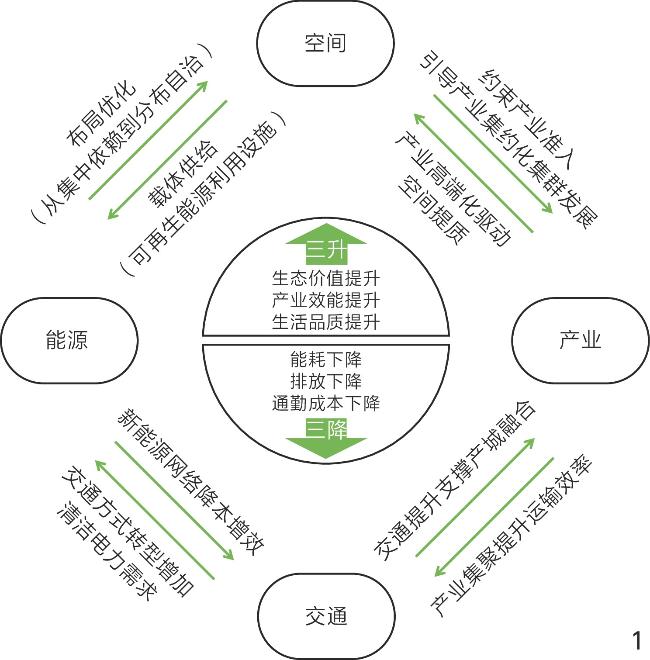
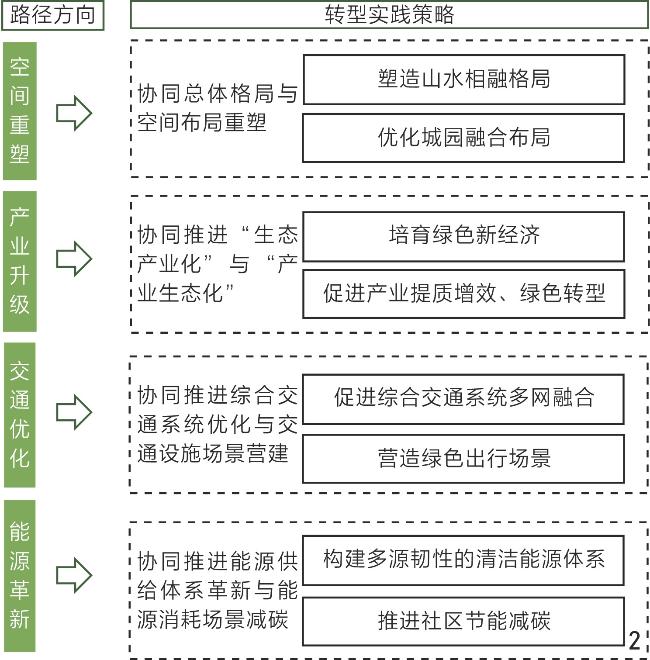
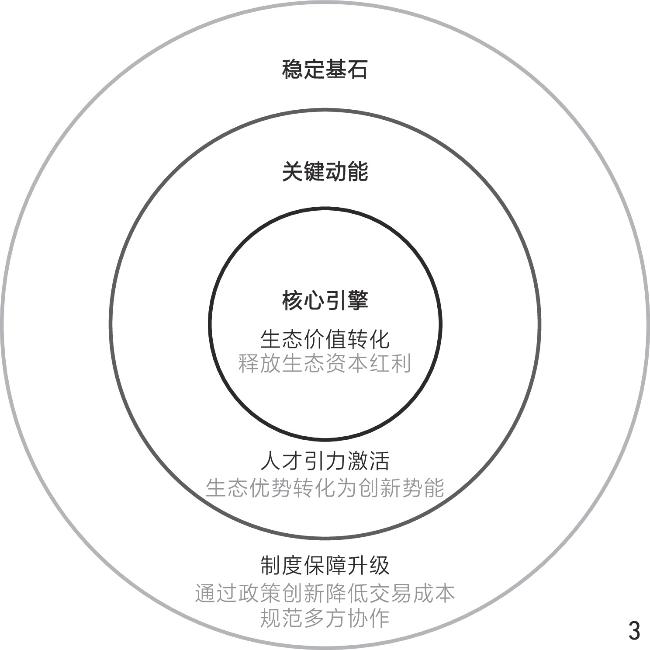
【目的】 在当今全球气候灾害风险增大与资源约束加剧的宏观大背景下,城市作为人类的活动中心,其绿色低碳转型发展已然成为人类社会实现可持续发展目标的关键环节。【方法/过程】 聚焦成都公园城市建设实践,通过理论分析与实证研究,探讨如何通过空间、产业、交通、能源结构调整,推动城市绿色低碳转型发展。【结果/结论】 1)明确了公园城市建设与绿色低碳发展的内在统一性,提出“空间筑基—产业减碳—交通控排—能源替代”的绿色低碳发展闭环,以及生态价值转化、人才引力激活、制度保障升级的三元协同内核机制,为城市绿色低碳发展提供了系统的理论支撑。2)从空间重塑、产业升级、交通优化、能源革新四大结构调整入手,详细介绍了成都近年来在绿色低碳发展方面的具体实践策略,构建“两山、两网、三环”的生态格局,建设“轨道-公交-慢行”三网融合的绿色交通体系,形成了可操作的实践路径,为其他城市提供了生动的实践范例。
杨潇 , 李果 , 刘欣 , 肖竹韵 . 公园城市绿色低碳发展路径探索——基于空间、产业、交通与能源结构调整的成都实践[J]. 风景园林, 2025 , 32(9) : 74 -80 . DOI: 10.3724/j.fjyl.LA20250402
[Objective] Against the escalating global climate crisis and intensifying resource constraints, this research aims to elucidate the theoretical framework and practical pathways for achieving green and low-carbon development within the context of Chengdu’s pioneering Park City initiative. Recognizing China’s critical shift from high-speed growth to high-quality development, where green transformation is the essential solution to resource and environmental constraints and the sole pathway to sustainable development (as emphasized in the Report to 20th CPC National Congress), the research positions cities — especially mega-cities like Chengdu — as the focal and most challenging arenas for this comprehensive socio-economic green transition. Building on President Xi Jinping’s concept of “Park City” first proposed in 2018 and Chengdu’s subsequent designation as a National Park City Demonstration Zone in 2022, the research investigates how Chengdu operationalizes Xi Jinping’s thought on ecological civilization at the urban scale. The core objective is to analyze Chengdu’s integrated approach, encapsulated in its “four-dimensional mutually reinforcing transition model” (spatial remodeling, industrial upgrading, transportation optimization, and energy innovation) and “triadic synergistic core mechanism” (ecological value realization, talent attraction activation, institutional safeguard upgrading), to overcome the historical legacy of extensive, inefficient urban development characterized by ecological space compression, industrial stagnation, transportation congestion, and soaring energy consumption. Ultimately, the research seeks to extract transferable insights and a replicable theoretical – practical framework for green and low-carbon transformation in other mega and large cities globally.
[Methods/process] Employing a mixed-methods approach, this research combines theoretical frameworks with empirical validation. 1) Policy synthesis & institutional analysis: The research examines Chengdu’s regulatory ecosystem, including the Policies on Green and Low-Carbon Development of Key Industries, the Guidelines on Near-Zero-Carbon Pilot Communities, and cross-departmental governance structures. 2) Case-based grounded theory: The research conducts longitudinal monitoring (2020–2025) of 29 near-zero-carbon pilot communities (e.g., Changshouyuan Community, Xinqiao Community), documenting interventions like district photovoltaic (PV) systems, low-carbon mobility retrofits, and circular economy projects. The research adopts a comprehensive case study methodology, deeply analyzing Chengdu’s systematic implementation of its Park City strategy since the issuance of the pivotal Decision of the CPC Chengdu Municipal Committee on Promoting Urban Green and Low-Carbon Development by Optimizing Spatial, Industrial, Transportation, and Energy Structures to Achieve Carbon Peaking and Carbon Neutrality Goals. This research forms a closed loop of green and low-carbon development, namely spatial foundation building – industrial decarbonization – transportation emission control – energy substitution, and accordingly summarizes its four-dimensional mutually reinforcing transition model as follows. 1) Spatial remodeling focuses on restructuring the coupled relationship of production – living – ecological spaces (PLE). At the macro-scale, numerous eco-friendly measures are implemented, such as protecting green ecological spaces and enabling the organic integration of natural landscapes with urban areas. At the micro-layout level, active promotion of industry – city integration has fostered intensive, efficient, green, and healthy urban operations. 2) Industrial upgrading is committed to synergizing “ecological industrialization” and “industrial ecologization”. On one hand, it abandons the “pollute first, treat later” model, vigorously developing green industries like energy conservation, environmental protection, and ecotourism. On the other hand, it drives the transformation and upgrading of traditional industries. 3) Transportation optimization at the systemic level is integrated within the comprehensive transportation system to enhance the convenience of green mobility. At the infrastructure level, the functionality and quality of slow-mobility scenes like greenways are improved to guide citizens towards choosing low-carbon travel modes (walking, cycling, etc.), thereby reducing transportation carbon emissions from the demand side. 4) Energy innovation addresses both the supply side, by building a multi-source complementary clean energy system to reduce reliance on traditional fossil fuels, and the consumption side, by bringing community-based energy conservation and low-carbon transition closer to citizens’ life, fostering a green transformation atmosphere with public participation.
[Results/conclusion] Chengdu’s integrated approach — spatially compact development, industrial symbiosis, electrified multimodal transportation, and distributed renewables — demonstrates a viable blueprint for mega-city decarbonization. Research results are mainly summarized as follows. 1) Systemic synergy is critical. Fragmented interventions (e.g., isolated renewable projects) yield suboptimal results, while spatial – energy – transportation – industrial coordination unlocks compound benefits. Institutional innovation drives transition. Polycentric governance (blending top-down targets with community participation) and mission-oriented finance de-risk green investments. The Chengdu model proves replicable in peer cities facing similar growth – climate dilemmas. 2) People-centered design ensures sustainability. Embedding co-benefits — cost savings (Xinqiao), health improvements (reducing PM2.5 by 22%), and circular lifestyles — builds public buy-in, turning climate action into a “new normal”. The results validate that Park City construction, as a concrete manifestation of green and low-carbon development guided by Xi Jinping’s thought on ecological civilization, effectively reconciles economic growth with environmental protection. It achieves a harmonious integration of park morphology and urban space, balancing ecology, lifestyle, and production, and realizing the symbiotic coexistence of humans and nature within an urban setting. Chengdu’s experience highlights that successful transformation requires systematic integration across space, industry, transportation, and energy, underpinned by innovative mechanisms for value realization, talent attraction, and institutional guarantee. This integrated approach facilitates a fundamental shift from extensive expansion to connotative development. As green and low-carbon development is a long-term endeavor, sustained efforts are crucial. Chengdu’s case, particularly as a mega-city model, offers valuable “Chinese Wisdom” and a practical “Chinese Solution” for global urban sustainability, providing a replicable reference for cities worldwide seeking to tailor similar transformations based on their unique resource endowments and developmental stages.
表1 成都市结构性蓝绿空间保护地方性法规及政策文件Tab. 1 Review of local regulatory and policy documents on structural blue-green space protection in Chengdu |
| 区域 | 地方性法规及政策 |
| 龙泉山区域 | 《成都市龙泉山城市森林公园保护条例》《成都市三岔湖水环境保护条例》 |
| 龙门山区域 | 《四川省大熊猫国家公园管理条例》 |
| 环城生态区 | 《成都市环城生态区保护条例》《成都市环城生态区国土空间用途管制实施办法》《成都市环城生态区设施农用地项目管理办法》《成都市环城生态区土地综合整治与生态修复项目立项监管验收管理办法》《成都市环城生态区拆迁工作及工程实施保障目标任务考核办法》等 |
| 第二绕城高速田园生态区 | 《成都市第二绕城高速公路田园生态区土地利用和规划管理技术规定》 |
| 都江堰精华灌区 | 《成都市都江堰灌区保护条例》 |
| 兴隆湖区域 | 《成都市兴隆湖区域生态保护条例》 |
文中图表均由作者绘制。
| [1] |
成都市公园城市建设领导小组.公园城市: 城市建设新模式的理论探索[M].成都: 四川人民出版社, 2019.
Chengdu Park City Construction Leading Group. Park City: Theoretical Exploration of a New Model for Urban Construction[M]. Chengdu: Sichuan People’s Publishing House, 2019.
|
| [2] |
廖茂林, 占妍泓, 周灵, 等. 习近平生态文明思想对公园城市建设的指导价值[J]. 中国人口·资源与环境, 2021, 31(12): 140-148.
LIAO M L, ZHAN Y H, ZHOU L, et al. Guiding Values of Xi Jinping Thought on Ecological Civilization to “Park City” Construction[J]. China Population, Resources and Environment, 2021, 31(12): 140-148.
|
| [3] |
中国共产党成都市第十三届委员会第十次全体会议决议[J].先锋, 2021(12): 12-15.
Resolution of the 10th Plenary Session of the 13th Chengdu Municipal Committee of the Communist Party of China[J]. Vanguard, 2021(12): 12-15.
|
| [4] |
潘家华, 姚凯, 廖茂林, 等.公园城市发展报告(2021): 迈向碳中和的城市解决方案[M].北京: 社会科学文献出版社, 2021.
PAN J H, YAO K, LIAO M L, et al. 2021 Park City Development Report: Urban Solutions Toward Carbon Neutrality[M]. Beijing: Social Sciences Academic Press, 2021.
|
| [5] |
刘书豪, 李望月, 李娇, 等. 成都探索山水人城和谐相融新实践研究[J]. 数字经济, 2024(7): 72-77.
LIU S H, LI W Y, LI J, et al. Research on the New Practice of Chengdu’s Exploration of Harmonious Integration of Landscape, People and City[J]. Digital Economy, 2024(7): 72-77.
|
| [6] |
李磊. 关于宜居城市、公园城市和未来城市的比较讨论[J]. 资源与人居环境, 2025(2): 47-51.
LI L. Comparative Discussion on Livable City, Park City and Future City[J]. Resources and Habitant Environment, 2025(2): 47-51.
|
| [7] |
李晓江, 吴承照, 王红扬, 等. 公园城市, 城市建设的新模式[J]. 城市规划, 2019, 43(3): 50-58.
LI X J, WU C Z, WANG H Y, et al. Urban Park: A New Model of Urban Construction[J]. City Planning Review, 2019, 43(3): 50-58.
|
| [8] |
彭楠淋, 王柯力, 张云路, 等. 新时代公园城市理念特征与实现路径探索[J]. 城市发展研究, 2022, 29(5): 21-25.
PENG N L, WANG K L, ZHANG Y L, et al. A New Proposition of Urban Development in the Context of Ecological Civilization: Exploring the Path of Park City Construction in New Age[J]. Urban Development Studies, 2022, 29(5): 21-25.
|
| [9] |
吴岩, 王忠杰, 束晨阳, 等. “公园城市”的理念内涵和实践路径研究[J]. 中国园林, 2018, 34(10): 30-33.
WU Y, WANG Z J, SHU C Y, et al. Discussion on the Concept & Practice Approach of “Park City”[J]. Chinese Landscape Architecture, 2018, 34(10): 30-33.
|
| [10] |
TEIXEIRA J V S, BARACHO R M A, SOERGEL D. Smart Cities, Sustainability, and Quality of Life: A Comparison of Indexes and the Indicators They Include[J]. Journal of Systemics, Cybernetics and Informatics, 2022, 20(2): 80-90.
|
| [11] |
曾九利, 唐鹏, 彭耕, 等. 成都规划建设公园城市的探索与实践[J]. 城市规划, 2020, 44(8): 112-119.
ZENG J L, TANG P, PENG G, et al. Exploration and Practice of Planning and Building Park City in Chengdu[J]. City Planning Review, 2020, 44(8): 112-119.
|
| [12] |
曾九利, 董建华, 唐鹏, 等. 以公园城市为特色的成都市国土空间总体规划探索[J]. 城乡规划, 2021(4): 107-116.
ZENG J L, DONG J H, TANG P, et al. Exploration on the Overall Territory Spatial Planning of Chengdu City with the Characteristics of Park City[J]. Urban and Rural Planning, 2021(4): 107-116.
|
| [13] |
成都市人民政府.2025年成都市人民政府工作报告[R/OL].(2025-02-26)[2025-03-14].https://www.chengdu.gov.cn/.
Chengdu Municipal People’s Government. 2025 Chengdu Municipal People’s Government Work Report[R/OL]. (2025-02-26)[2025-03-14]. https://www.chengdu.gov.cn/.
|
| [14] |
朱勇, 杨潇, 徐勤怀. 公园城市理念下公园生态价值转化规划研究[J]. 城市规划, 2022, 46(10): 78-88.
ZHU Y, YANG X, XU Q H. Research on the Transformation of Ecological Value of Parks Under the Concept of Park City from a Planning Perspective[J]. City Planning Review, 2022, 46(10): 78-88.
|
| [15] |
杨碧波, 姚南, 刘杰希. 公园城市背景下的未来社区特征与场景营造路径研究: 以《成都市未来公园社区规划导则》为例[J]. 上海城市规划, 2024(2): 89-96.
YANG B B, YAO N, LIU J X. Research on Future Community Characteristics and Scene Construction Path Under the Background of Park City: A Case Study of Chengdu Future Park Community Planning Guidelines[J]. Shanghai Urban Planning Review, 2024(2): 89-96.
|
| [16] |
宋绍繁. 成都市培育完善新经济应用场景的思考与建议[J]. 资源与人居环境, 2022(1): 37-40.
SONG S F. Thoughts and Suggestions on Cultivating and Perfecting New Economic Application Scenarios in Chengdu[J]. Resources and Habitant Environment, 2022(1): 37-40.
|
| [17] |
谢瑞武. 推进绿色低碳产业发展的思考: 以成都绿色低碳产业建圈强链实践为例[J]. 世界环境, 2024(3): 49-52.
XIE R W. Thoughts on Promoting the Development of Green and Low-Carbon Industries[J]. World Environment, 2024(3): 49-52.
|
| [18] |
田程晨.轨道公交慢行三网融合 实现城市交通向绿色低碳转变[EB/OL].(2021-07-02)[2025-07-03]. https://cds.sczwfw.gov.cn/art/2021/7/2/art_15395_147982.html?areaCode=510100000000.
TIAN C C. The Integration of Rail Transit, Public Transport and Slow Traffic Networks Realizes the Transformation of Urban Transportation Towards Green and Low-Carbon[EB/OL]. (2021-07-02) [2025-07-03]. https://cds.sczwfw.gov.cn/art/2021/7/2/art_15395_147982.html?areaCode=510100000000.
|
| [19] |
刘文豪, 于儒海. 国土空间治理视角下的区域绿道规划实践创新探索: 以成都市天府绿道七河绿带为例[J]. 城乡规划, 2021(4): 91-98.
LIU W H, YU R H. Regional Greenway Planning Practice and Innovative Exploration from the Perspective of Territorial Space Governance: A Case Study on Chengdu Tianfu Greenway Qihe Greenbelt[J]. Urban and Rural Planning, 2021(4): 91-98.
|
| [20] |
中华人民共和国生态环境部.关于2025年绿色低碳典型案例征集活动获选名单的公示[EB/OL].(2025-05-26)[2025-06-26]. https://www.mee.gov.cn/ywgz/ydqhbh/wsqtkz/202505/t20250526_1120125.shtml.
Ministry of Ecology and Environment of the People’s Republic of China. Public Notice on the Selected List of 2025 Green and Low-Carbon Case Collection Activities[EB/OL]. (2025-05-26) [2025-06-26]. https://www.mee.gov.cn/ywgz/ydqhbh/wsqtkz/202505/t20250526_1120125.shtml.
|
/
| 〈 |
|
〉 |