

文化线路视角下南江古道沿线聚落景观特征及影响因素
|
宁彩玉/女/华南农业大学林学与风景园林学院在读硕士研究生/研究方向为历史文化景观遗产保护与更新、城乡人居环境可持续发展 |
|
赵建华/女/博士/华南农业大学林学与风景园林学院副教授/研究方向为历史文化景观遗产保护与更新、城乡人居环境可持续发展 |
|
邱丽/女/博士/广州筑源建筑工程设计咨询有限公司高级工程师/研究方向为历史文化景观遗产保护与更新、传统建筑保护与修缮 |
Copy editor: 刘颖 王一兰
收稿日期: 2025-01-16
修回日期: 2025-07-20
网络出版日期: 2025-12-10
基金资助
2023年度教育部人文社会科学研究规划基金“文化生态视域下粤北瑶族村寨景观评价及传承路径研究”(23YJA850006)
广东省哲学社会科学规划2023年度一般项目“文化融合视域下广东传统客侨聚落空间演化机理与现代转译模式研究”(GD23CYS04)
版权
Landscape Characteristics of Settlements Along Nanjiang Ancient Waterway and Influencing Factors Thereof from the Perspective of Cultural Routes
|
NING Caiyu is a master student in the College of Forestry and Landscape Architecture, South China Agricultural University. Her research focuses on the protection and renewal of historical and cultural landscape heritage, and sustainable development of urban and rural human settlement environment |
|
ZHAO Jianhua, Ph.D., is an associate professor in the College of Forestry and Landscape Architecture, South China Agricultural University. Her research focuses on the protection and renewal of historical and cultural landscape heritage, and sustainable development of urban and rural human settlement environment |
|
QIU Li, Ph.D., is a senior engineer in Guangzhou Zhuyuan Architectural Engineering Design Consulting Co., Ltd. Her research focuses on the protection and renewal of historical and cultural landscape heritage, and the protection and restoration of traditional buildings |
Received date: 2025-01-16
Revised date: 2025-07-20
Online published: 2025-12-10
Copyright
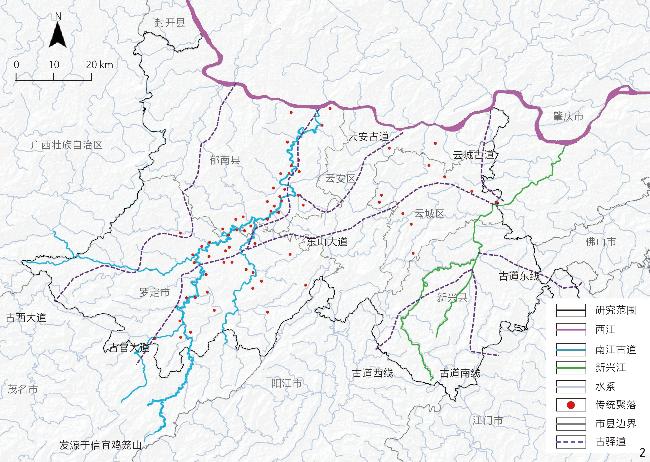
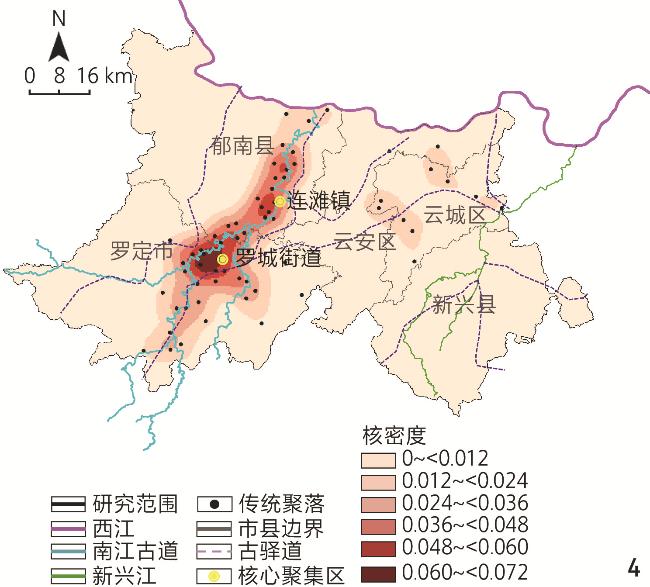
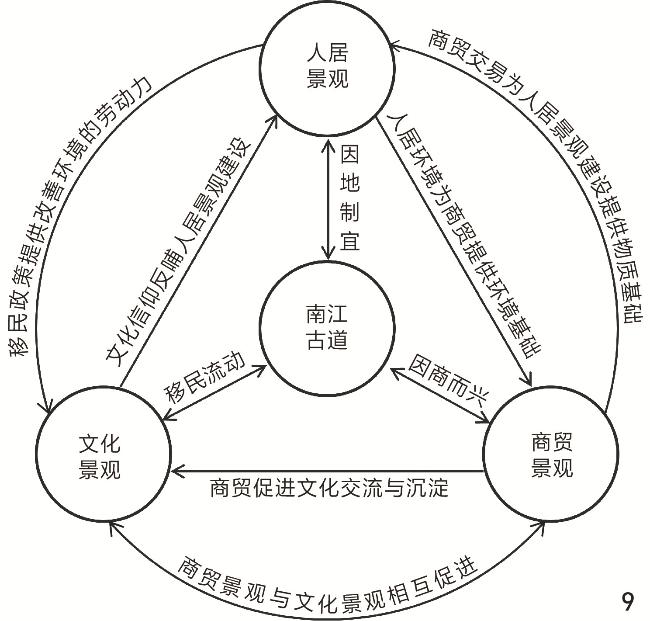
【目的】 南江古道是南粤古驿道中唯一的古水路,沿线聚落形成独特的多元景观。从文化线路宏观视角探索聚落景观特征及影响因素,突破“就村论村”的点状研究局限,有助于挖掘聚落多维价值,为南江古道沿线地区的文化传承与可持续发展提供支撑。【方法】 基于文化地理学“人-地-产”理论框架,结合实地调研踏勘和GIS空间分析,运用类型学分析方法,从人居、商贸、文化3个功能维度凝练65处聚落的景观特征。【结果】 在“募民占籍”政策驱动、古道商贸往来、多元文化融合的影响下,南江古道沿线聚落景观呈现3个方面特征。1)人居景观呈现出“层次丰富,山水相拥”“因形就势,理风顺水”“渠网纵横,堤坝环绕”的特征;2)商贸功能与聚落商贸景观形成具有互促关系,形成“水陆通济,津渡交织”“临水营墟,因街成市”的商贸景观;3)移民文化相互交流,形成了“居祠分立,风格杂糅”“泛神崇拜,借水筑景”的文化景观。【结论】 聚落景观重构中,应秉持文化线路保护的整体性、动态性与可持续性原则,构建南江古道聚落保护的整体空间管控体系,打造融生态、文化、产业于一体的文化线路游径,促进聚落的振兴发展。
宁彩玉 , 赵建华 , 邱丽 . 文化线路视角下南江古道沿线聚落景观特征及影响因素[J]. 风景园林, 2025 , 32(9) : 131 -138 . DOI: 10.3724/j.fjyl.LA20250044
[Objective] The Nanjiang Ancient Waterway is a uniquely distinctive ancient waterway among the ancient post roads in southern Guangdong, with settlements along it flourishing in history. Although the scale and prosperity of individual settlements are not comparable to those in other parts of Lingnan, under the influence of multicultural integration, the value of the multicultural landscape characteristics presented by these settlements is prominent. Exploring the landscape characteristics of settlements along the Nanjiang Ancient Waterway and influencing factors thereof from the macro perspective of “cultural routes” can break through the limitations of the point-like research model of “studying individual villages in isolation” and help tap the multi-dimensional value of settlements.
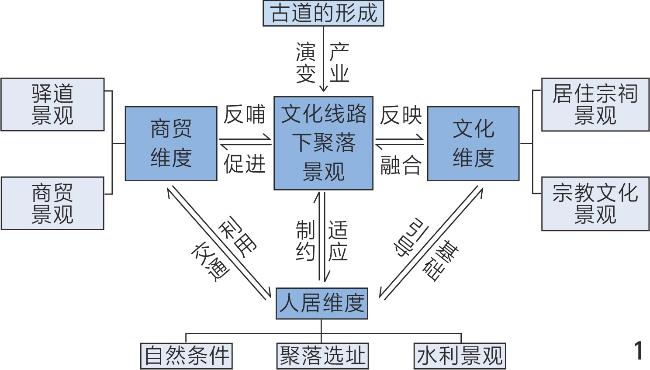
[Methods] The cultural routes focus on integrity and emphasizes the cognition of cultural phenomena through dynamic and historical functions, which provides a holistic research perspective for the research on settlement landscape along the Nanjiang Ancient Waterway. Therefore, based on the theoretical framework of “human – land – property” of cultural geography in combination with field investigation and GIS spatial analysis, 65 traditional settlements along the Nanjiang Ancient Waterway are selected as the research object by typology analysis method from the three functional dimensions of human settlement, commerce and culture of cultural routes, and the landscape characteristics of settlements along the ancient waterway and the influencing factors thereof are analyzed.
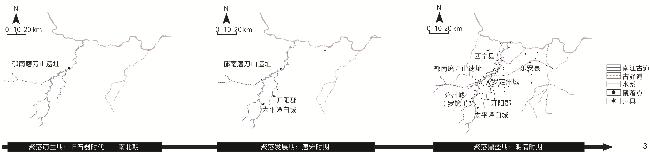
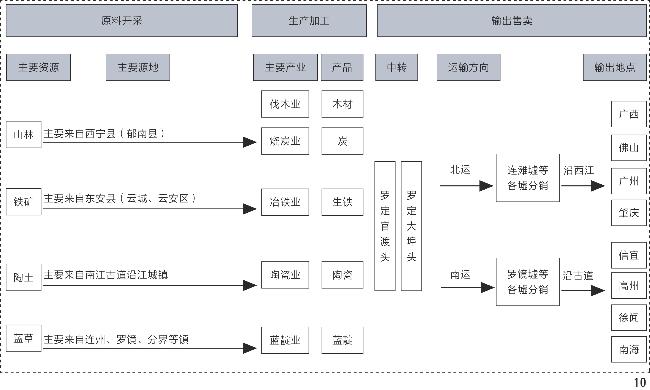
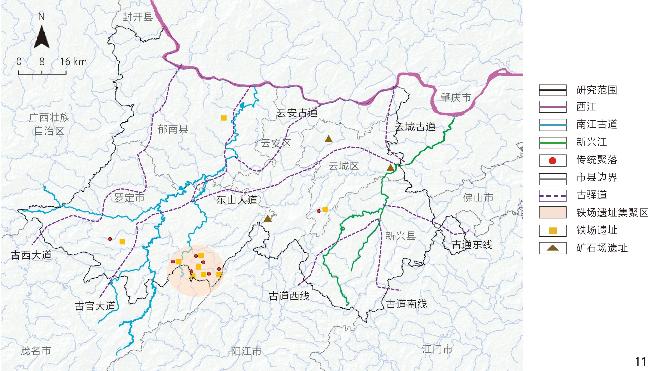
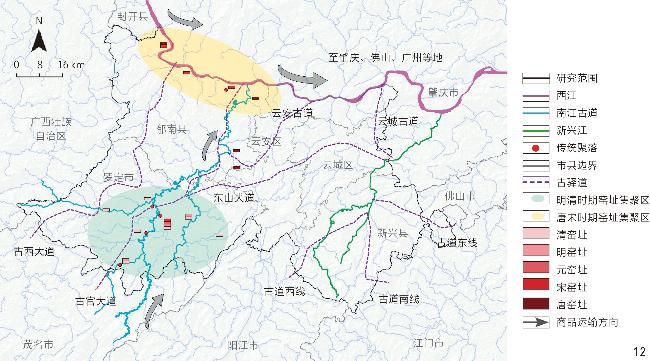
[Results] 1) As an important traffic foundation for the formation and development of settlements, ancient waterway have a significant impact on the differentiation of landscape types. The settlement landscape along Nanjiang Ancient Waterway can be divided into three categories: Human settlement landscape, commercial landscape and cultural landscape, with different spatial distribution, morphological characteristics and cultural characteristics. The settlements along the Nanjiang Ancient Waterway present characteristics of “being rich in layers, mountains and waters embracing each other”, “adapting to the terrain and following the natural flow of wind and water”, and “a crisscross network of canals with dikes and dams encircling”. 2) The commercial function of the Nanjiang Ancient Waterway and the formation of the commercial landscape of settlements have a mutually promoting relationship, forming commercial landscape characteristics of “interconnecting land and water routes, with ferries and crossings interwoven”, and “setting up fairs by the water, and forming markets along streets”. 3) During Ming and Qing dynasties, the “policy of recruiting people to settle and be registered” spurred a large number of immigrants to move in along the Nanjiang Ancient Waterway, and establish clans and set up villages there. The mutual exchange of immigrant cultures gave rise to cultural landscapes featuring “separation of residences and ancestral halls with mixed styles” and “pantheistic worship, and water-based landscape creation”. In Ming and Qing dynasties, the Ming government encouraged people to migrate there, and the policy of granting household registration prompted a large number of immigrants to move in along the Nanjiang Ancient Waterway, and establish clans and set up villages there. This led to the formation of diversified and mixed-style landscapes of residences and ancestral halls as well as religious cultural landscapes, boasting unique regional cultural characteristics of Nanjiang.
[Conclusion] The settlements along the Nanjiang Ancient Waterway, are the spatial carriers of human settlement landscape, commerce, culture and other functions. The population base provided by the immigration policy is the starting point of settlement development. As a key factor, immigration policy provides the necessary population base for the formation of settlements along the ancient waterway, and is the starting point of settlement development. The distribution and rise of immigrant settlements along the Nanjiang Ancient Waterway, benefited from the efficient water transportation system constructed by the ancient waterway network, and the flourishing commercial development of settlements along the ancient Waterway. The mutual fostering between population mobility and trade greatly promotes the exchange and integration of immigrant culture, giving birth to Nanjiang regional cultural landscape. Revealing the landscape characteristics of settlements along the cultural routes and the influencing factors thereof from the perspective of integrity and dynamics can provide a basis for the overall protection of settlements along the Nanjiang Ancient Waterway. Under the background of rapid urbanization, the protection of settlement landscape along the Nanjiang Ancient Waterway has encountered severe challenges such as the decline of traditional features and the imbalance of development. In the reconstruction of settlement landscape, we should adhere to the principles of integrity, dynamics and sustainability of cultural route protection, integrate natural and human landscape resources, and rationally activate and utilize settlement landscape. The researches advocates to well protect the Nanjiang Ancient Waterway through the chain of beads, the implementation of zoning – subsection – grading differentiation development, the establishment of the overall spatial control system for the protection of settlements along the Nanjiang Ancient Waterway, the construction of cultural routes for the integration of ecology, culture and industry, the creation of nostalgic settlement memory scene, and the promotion of the revitalization and development of settlements.
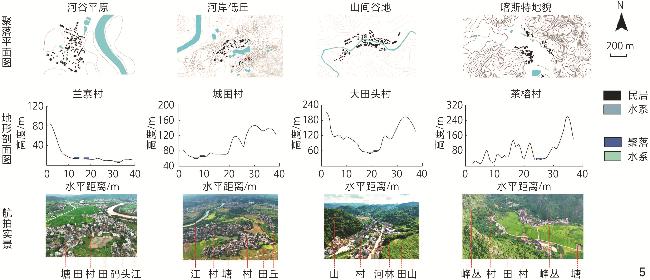
表1 聚落选址类型及特征Tab. 1 Types and characteristics of settlement site selection |
| 选址类型 | 地貌特征 | 聚落分布位置 | 聚落特征 |
| 河谷平原 | 地势平坦,用地宽阔平缓 | 南江及其支流两侧冲积而成的平原上,傍水而生 | 规模较大,建筑布局规整、紧凑对外,通常有码头 |
| 河岸低丘 | 地形起伏较小,顺丘陵地势而建 | 靠近河岸的低山丘陵或山脚地带 | 顺地势延伸,通常呈带状分布 |
| 山间谷地 | 地势平坦,用地面积有限 | 坐落于两处或多处山脉之间的平坦地段,山间或有河流 | 通常呈团块状分布 |
| 喀斯特地貌 | 地表岩石出落,峰林石山耸立 | 峰丛之间的平坦或山脚地带 | 规模通常不大,因用地面积受限,常呈散点式分布 |
表2 商贸景观解析Tab. 2 Analysis of commercial landscape |
| 类型 | 范围 | 商贸地点 | 典型案例 | 示意 |
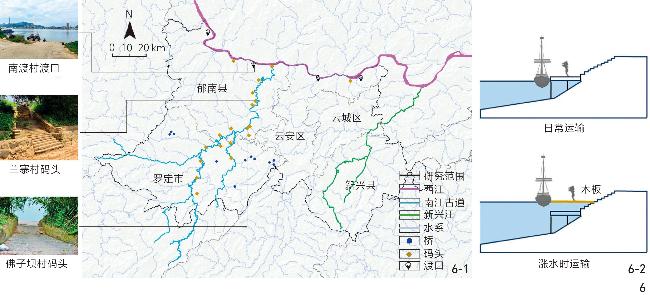
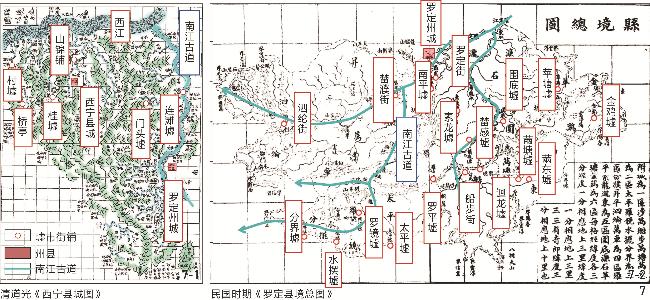
| 圩镇的圩集 | 码头—商业街—圩镇中心 | 骑楼 | 连滩圩集 | ① |
| 乡村商贸市集 | 驿道单侧线性分布商贸建筑 | 驿站、当铺等堂横屋形式的商贸建筑 | 兰寨村市集 | ② |
| 驿道两侧线性分布商贸建筑 | 三间两廊或底商上住的单开间店铺 | 村头村市集 | ③ | |
| 码头之间的点状定期市集 | 无固定建筑,灵活设立摊位 | 榃濮村市集 | ④ | |
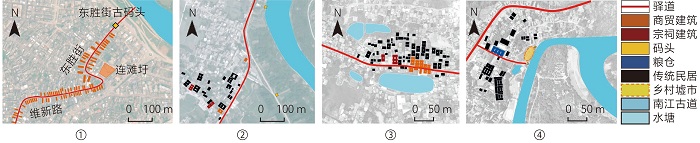 | ||||
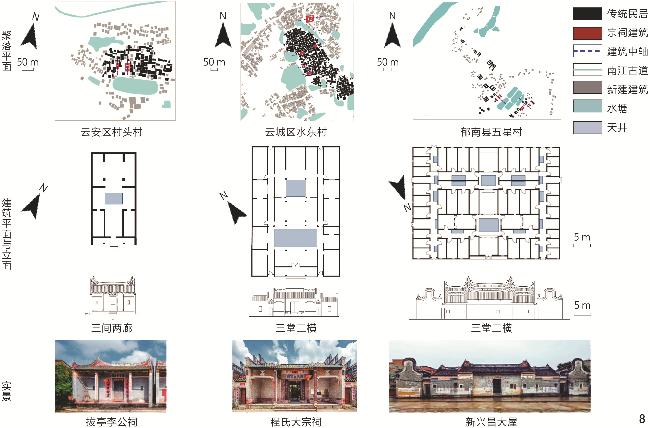
表3 多元文化影响下的南江古道聚落居住宗祠景观布局及建筑特点Tab. 3 Layout and architectural characteristics of residential and ancestral hall landscapes of settlements along Nanjiang Ancient Waterway under the influence of multiculturalism |
| 文化类型 | 布局 | 布局特点 | 典型聚落 | 建筑形制 | 建筑特点 |
| 广府文化 | 梳式布局 | 以宗祠为核心,“水塘-禾坪-宗祠- 民居-风水林”的空间序列 | 云安区都杨镇村头村 | 三间两廊 | 以三间两廊为原型,中有门廊和小天井 |
| 中原文化 | 云城区腰古镇水东村 | 三堂二横 | 高敞开阔,体现徽派民居风格,以天井为中心、 中轴对称,与粉墙黛瓦、马头墙结合 | ||
| 广府、客家文化融合 | 大屋形式,分散分布 | 聚族而居,炮楼筑围,居祠分立 | 郁南县大湾镇五星村 | 三堂二横 | 以客家堂横屋为原型扩展,立面多有镬耳墙,边 界清晰、较为封闭、防御性强 |
| [1] |
ICOMOS. Charter on Cultural Routes[EB/OL]. (2008-10-04)[2025-01-15]. https://publ.icomos.org/publicomos/jlbSai?html=Pag&page=Pml/Not&base=technica&ref=B65FC325D92099FA19BF9864E6561F27.
|
| [2] |
李霂芝, 张定青. 中国文化线路沿线聚落研究进展: 基于知网数据的文献综述[J]. 小城镇建设, 2021, 39(11): 50-56.
LI M Z, ZHANG D Q. Research Progress of Settlements Along Cultural Routes in China: Literature Review Based on CNKI Data[J]. Development of Small Cities & Towns, 2021, 39(11): 50-56.
|
| [3] |
焦红霞.秦蜀古道沿线传统聚落景观特征研究: 以金牛道广元段为例[D].雅安: 四川农业大学, 2022.
JIAO H X. Research on the Landscape Characteristics of Traditional Settlements Along the Ancient Qin-Shu Road: Taking the Guangyuan Section of Jinniu Road as an Example[D]. Ya’an: Sichuan Agricultural University, 2022.
|
| [4] |
杜春兰, 陈丹阳. 嘉陵江沿线古城“山-水-城”景观特征研究[J]. 中国园林, 2024, 40(6): 6-14.
DU C L, CHEN D Y. Research on the “Mountain-Water-City” Landscape Characteristics of Ancient Cities Along Jialing River[J]. Chinese Landscape Architecture, 2024, 40(6): 6-14.
|
| [5] |
王子尧, 林箐, 王向荣. 太行八陉古道沿线的传统景观特征与景观体系研究[J]. 中国园林, 2024, 40(6): 28-34.
WANG Z Y, LIN Q, WANG X R. Study on Traditional Landscape Characteristics and Landscape System Along the Eight Taihang Passages[J]. Chinese Landscape Architecture, 2024, 40(6): 28-34.
|
| [6] |
林祖锐, 仝凤先, 周维楠. 文化线路视野下岩崖古道传统村落历史演进研究[J]. 现代城市研究, 2017, 32(11): 18-24.
LIN Z R, TONG F X, ZHOU W N. Research on Historical Evolution of Yanya Ancient Road in View of Cultural Routes[J]. Modern Urban Research, 2017, 32(11): 18-24.
|
| [7] |
朱雪梅, 程建军, 林垚广, 等. 粤北古道传统村落形态特色比较研究[J]. 南方建筑, 2014(1): 38-45.
ZHU X M, CHENG J J, LIN Y G, et al. A Comparative Study of Morphological Characteristics of the Traditional Village in Northern Guangdong[J]. South Architecture, 2014(1): 38-45.
|
| [8] |
潘莹, 黄悦, 施瑛. 移民视角下西京古道乐昌段沿线聚落形态解析[J]. 南方建筑, 2022(2): 55-63.
PAN Y, HUANG Y, SHI Y. Analysis of Traditional Settlement Forms Along the Lechang Section of Xijing Ancient Path from the Perspective of Immigration[J]. South Architecture, 2022(2): 55-63.
|
| [9] |
徐慧丹, 汤朝晖. 东江—韩江古驿道沿线聚落分布时空规律研究[J]. 南方建筑, 2021(4): 67-73.
XU H D, TANG C H. Research on the Temporal and Spatial Law of Settlement Distribution Along Dongjiang − Hanjiang Ancient Post Road Based on Big Data[J]. South Architecture, 2021(4): 67-73.
|
| [10] |
许桂灵, 司徒尚纪. 郁南磨刀山旧石器遗址与岭南文化的起源[J]. 岭南文史, 2021(2): 21-27.
XU G L, SITU S J. Palaeolithic Site on Mo Dao Shan in Yunan County and the Origins of Lingnan Culture[J]. Lingnan Culture and History, 2021(2): 21-27.
|
| [11] |
曾昭璇, 曾新, 曾宪珊. 西江流域南江水系的人文地理概述[J]. 广东史志, 2002(3): 3-10.
ZENG Z X, ZENG X, ZENG X S. Overview of the Human Geography of the Nanjiang River System in the Xijiang River Basin[J]. Guangdong Historical Records, 2002(3): 3-10.
|
| [12] |
陈玮婷, 赵建华, 邱丽. 南江流域传统聚落景观特征及影响因素研究: 以云浮郁南近江村落为例[J]. 南方建筑, 2024(6): 44-55.
CHEN W T, ZHAO J H, QIU L. Research on Features and Influencing Factors of Traditional Settlements in Nanjiang River Basin: A Case Study Based on Riverside Villages in Yunan County, Yunfu City[J]. South Architecture, 2024(6): 44-55.
|
| [13] |
倪韵捷. 南江流域传统民居的文化特征探析[J]. 客家文博, 2024(2): 50-55.
NI Y J. An Analysis of the Cultural Characteristics of Traditional Dwellings in the Nanjiang River Basin[J]. Hakka Cultural Heritage Vision, 2024(2): 50-55.
|
| [14] |
陈俊宇. 盘王在南江: 非物质文化遗产在民族变迁中的流变与创新思考[J]. 肇庆学院学报, 2021, 42(6): 19-26.
CHEN J Y. The King of Pan is in Nanjiang River Basin: Reflections on the Change and Innovation of Intangible Cultural Heritage in National Change[J]. Journal of Zhaoqing University, 2021, 42(6): 19-26.
|
| [15] |
周永卫, 冯小莉.汉晋南江古道的隙地贸易及其扩展[C]//王元林, 刘炳权.罗定: 南江古道与“一带一路”文化论坛论文集.广州: 广东旅游出版社, 2017: 134-147.
ZHOU Y W, FENG X L. The Gap Trade and Its Expansion of the Ancient Nanjiang Road in the Han and Jin Dynasties[C]//WANG Y L, LIU B Q. Luoding City: Nanjiang Ancient Road and Proceedings of “The Silk Road Economic Belt and The 21st-Century Maritime Silk Road” Cultural Forum. Guangzhou: Guangdong Tourism Publishing House, 2017: 134-147.
|
| [16] |
陈大远.罗定春秋[M].广州: 羊城晚报出版社, 2012.
CHEN D Y. History Books About What Happened in Luoding[M]. Guangzhou: Yangcheng Evening News Publishing House, 2012.
|
| [17] |
刘元禄.罗定直隶州志[M].上海: 上海书店出版社, 2013.
LIU Y L. Chronicles of Luoding Zhili Prefecture[M]. Shanghai: Shanghai Bookstore Publishing House, 2013.
|
/
| 〈 |
|
〉 |