

人因导向下的街道空间关键要素阈值测定——基于虚拟现实和可穿戴生理传感器的循证研究
|
方雪丽/女/博士/上海市交通委员会交通指挥中心高级工程师/研究方向为交通工程 |
|
于瀚婷/女/同济大学建筑与城市规划学院硕士研究生/高密度人居环境与生态节能教育部重点实验室研究助理/研究方向为计算性城市设计 |
|
李燕/女/博士/同济大学建筑与城市规划学院在站博士后/研究方向为计算性城市设计 |
|
张华丽/女/土家族/同济大学建筑与城市规划学院硕士研究生/高密度人居环境与生态节能教育部重点实验室研究助理/研究方向为计算性城市设计 |
|
叶宇/男/博士/同济大学建筑与城市规划学院长聘教授/建成环境技术中心副主任/高密度人居环境与生态节能教育部重点实验室副主任/研究方向为计算性城市设计 |
Copy editor: 刘昱霏
收稿日期: 2025-03-21
修回日期: 2025-07-12
网络出版日期: 2025-12-10
基金资助
国家自然科学基金面上项目“基于多源数据和深度学习的公共空间品质评价模型与设计支持研究”(52078343)
上海市青年科技启明星项目(23QB1404300)
中国博士后科学基金第69批面上项目(2021M692142)
版权
Threshold Determination of Key Street Space Elements Under Human-Factor Guidance: An Evidence-Based Research Using Virtual Reality and Wearable Biosensors
|
FANG Xueli, Ph.D., is a senior engineer in the Traffic Command Center, Shanghai Municipal Transport Commission. Her research focuses on traffic engineering |
|
YU Hanting is a Master graduate in the College of Architecture and Urban Planning (CAUP), Tongji University, and a research assistant in the Key Laboratory of Ecology and Energy Saving Study of Dense Habitat, Ministry of Education. Her research focuses on computational urban design |
|
LI Yan, Ph.D., is a postdoctoral researcher in the College of Architecture and Urban Planning (CAUP), Tongji University. Her research focuses on computational urban design |
|
ZHANG Huali (Tujia), is a Master graduate in the College of Architecture and Urban Planning (CAUP), Tongji University, and a research assistant in the Key Laboratory of Ecology and Energy Saving Study of Dense Habitat, Ministry of Education. Her research focuses on computational urban design |
|
YE Yu, Ph.D., is a tenured professor in the College of Architecture and Urban Planning (CAUP), Tongji University, deputy director of Built Environment Technology Center, Tongji University, and deputy director of the Key Laboratory of Ecology and Energy Saving Study of Dense Habitat, Ministry of Education. His research focuses on computational urban design |
Received date: 2025-03-21
Revised date: 2025-07-12
Online published: 2025-12-10
Copyright
【目的】 在城市建设存量优化的背景下,街道空间品质提升成为城市提质增效的重要抓手。支持人本尺度的精细化设计与精细管理,开展街道空间关键要素品质效应区间的实证研究,推动街道空间设计从经验驱动向循证设计转型。【方法】 基于国内外学者经典研究、现行导则和规范,明确了街道空间设计中的4类典型街道类型、2种道路等级及4项关键空间要素,并提取其对应的指导区间。以8条典型街道为空间原型,根据要素梯度分布构建251个虚拟现实场景,并招募185名被试者进行主观偏好和生理监测相结合的具身循证感知实验。先通过心理数据初步收缩现行导则中关键要素的阈值区间,为后续生理数据中异常值剔除提供参考;再进一步运用窗口式变点检测算法(window-based change point detection)处理生理数据,精细化测定关键要素的阈值区间。【结果】 分析结果表明:1)在心理评价维度,人行道宽度、设施带宽度值区间呈现“适中效应”,而界面通透性与感知评价正相关;2)在生理测度维度,不同类型街道的人行道宽度阈值区间差值最小,而商业型街道对设施带宽度和界面通透性需求较高;3)生理监测数据可精细化界定并补充现有导则中要素的指导区间范围,阈值范围收缩幅度可达20%~80%。【结论】 搭建了一套可操作、易推广的街道空间要素阈值区间精细化分析框架,实现了虚拟现实、可穿戴生理传感器技术与设计实践需求的有效对接,探索了街道空间品质提升研究的新路径。
方雪丽 , 于瀚婷 , 李燕 , 张华丽 , 叶宇 . 人因导向下的街道空间关键要素阈值测定——基于虚拟现实和可穿戴生理传感器的循证研究[J]. 风景园林, 2025 , 32(9) : 104 -113 . DOI: 10.3724/j.fjyl.LA20250189
[Objective] Under the background of the optimization of urban construction stock, the improvement of street space quality has become an important leverage for urban quality and efficiency enhancement. Although the importance of human-centered street space quality enhancement has been widely recognized at theoretical and cognitive levels, there is still a lack of practical guidance and operational frameworks in actual design practice. Existing research mainly focuses on measuring street space elements and analyzing their influence weights, but still lacks the refined determination of the optimal threshold intervals for street space indicators. This gap makes it difficult to translate theoretical findings into specific spatial design standards and interventions. Additionally, current guidelines provide limited guidance on street space elements, with broad or missing element intervals and insufficient support from evidence-based practice. Therefore, this research, rooted in human perception, employs VR and wearable biosensors for embodied perception experiments to refine the threshold intervals of street space elements, thus enabling more precise and operational improvements in street space quality.
[Methods] In this research, based on classical research and current guidelines, 4 functional types, 2 classification levels, 4 key elements, and their corresponding guidance thresholds for street spaces are identified. Then, 8 typical streets are used as spatial prototypes, and 251 virtual reality scenes are constructed based on the threshold of each key element, 185 participants are recruited to conduct an embodied, evidence-based perception experiment integrating subjective preferences and wearable biosensors. Based on measurement data, the analysis begins with assessing psychological comfort of key street space elements using a grouped scatter plot from ChiPlot. This helps to verify the validity of the experimental data and optimize the empirical guidance intervals in the current guidelines, providing a reference for eliminating physiological data outliers and determining effective physiological threshold intervals. Then, the window-based change point detection algorithm is used to process the physiological data, and the threshold intervals of the key elements of different types of street spaces are further determined. Finally, the physiological threshold intervals are compared with the guidance intervals to evaluate the influence of physiological data on the refinement of threshold interval.
[Results] In psychological dimension, different street types have similar comfort intervals in terms of interface permeability and utility area width, and sidewalk width threshold exhibits “moderate effect”. Physiological analysis shows that sidewalk width threshold is not significantly affected by cycle parking, and the difference is between 0.6 − 1.2 m for most street types. The sidewalk width interval in traffic streets is significantly affected by road grade, with the main road ranging from 4.2 m to 5.1 m and the secondary road ranging from 2.4 m to 3.2 m. Participants have a higher demand for sidewalk width and interface permeability on main road in commercial streets. People generally feel more comfortable when the utility area width is between 3.7 m and 4.1 m, and interface permeability is between 74% and 86%. Finally, through the embodied evidence-based perception experiment, the research reveals that the quantitative results of physiological data are highly consistent with the participants’ subjective perception. Furthermore, physiological data can refine and supplement the guidance thresholds for elements in the current guidelines, with the threshold range contraction reaching 20% − 80%.
[Conclusion] This research proposes a systematic framework for analyzing the threshold interval of street space elements. Compared to previous analyses, this method refines the quality utility intervals of street space elements, breaking through the inherent paradigm of traditional research which is limited to the perception comfort measurement of street space quality. Additionally, this research combines virtual reality and wearable biosensor technologies to establish a comprehensive and easily applicable measurement framework. With this method, the rapid refinement of measurements for existing representative street types and the threshold intervals of spatial elements is achieved. This research also formulates specific design strategies and index recommendations from a quantitative perspective, thereby providing scientific basis and practical support for the accurate improvement of the built environment quality and design guidance and control.
表1 街道类型、名称及要素区间分布Tab. 1 Distribution of street types, names, and element intervals |
| 街道类型 | 街道名称 | 关键要素 | 要素指导区间 | 梯度 | 场景数量 |
| 生活型主干道 | 大学路 | 界面通透性 | 50%~90% | 4% | 11 |
| 设施带宽度 | 1.0~3.0 m | 0.2 m | 11 | ||
| 人行道宽度(有非机动车停放) | 2.0~5.0 m | 0.3 m | 11 | ||
| 人行道宽度(无非机动车停放) | 2.0~5.0 m | 0.3 m | 11 | ||
| 智星路 | 人行道宽度(无非机动车停放) | 2.4~4.0 m | 0.2 m | 11 | |
| 人行道宽度(有非机动车停放) | 2.4~4.0 m | 0.2 m | 11 | ||
| 商业型主干道 | 南京东路 | 界面通透性 | 50%~90% | 4% | 11 |
| 设施带宽度 | 2.5~5.5 m | 0.3 m | 11 | ||
| 人行道宽度(无非机动车停放) | 6.0~10.0 m | 0.2 m | 20 | ||
| 南京西路 | 界面通透性 | 50%~90% | 4% | 11 | |
| 人行道宽度(无非机动车停放) | 2.4~4.4 m | 0.2 m | 9 | ||
| 人行道宽度(有非机动车停放) | 2.4~4.4 m | 0.2 m | 9 | ||
| 景观型主干道 | 九江路 | 设施带宽度 | 1.0~3.0 m | 0.2 m | 11 |
| 人行道宽度(无非机动车停放) | 2.0~6.0 m | 0.4 m | 11 | ||
| 人行道宽度(有非机动车停放) | 2.0~6.0 m | 0.4 m | 11 | ||
| 普安路 | 人行道宽度(无非机动车停放) | 2.0~6.0 m | 0.4 m | 11 | |
| 人行道宽度(有非机动车停放) | 2.0~6.0 m | 0.4 m | 11 | ||
| 交通型主干道 | 淞沪路 | 界面通透性 | 50%~90% | 4% | 11 |
| 设施带宽度 | 1.0~2.5 m | 0.2 m | 8 | ||
| 人行道宽度(无非机动车停放) | 1.8~2.4 m | 0.2 m | 11 | ||
| 人行道宽度(有非机动车停放) | 1.8~2.4 m | 0.2 m | 11 | ||
| 政民路 | 人行道宽度(无非机动车停放) | 2.0~5.6 m | 0.3 m | 9 | |
| 人行道宽度(有非机动车停放) | 2.0~5.6 m | 0.3 m | 9 |
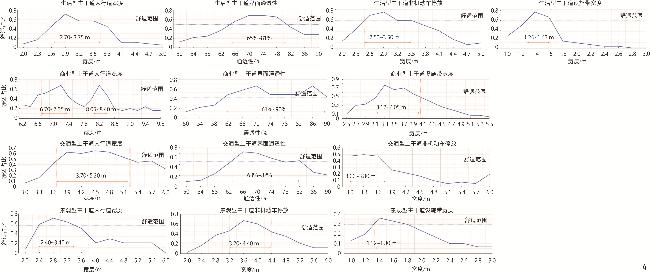
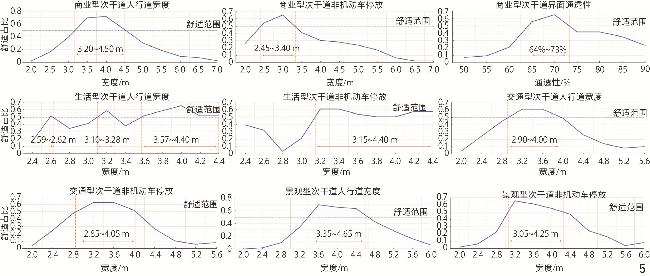
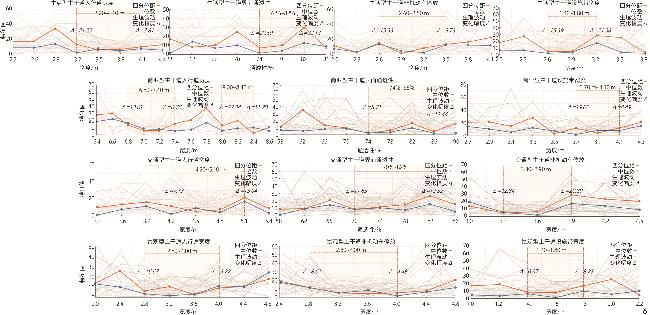
图6 主干道街道空间要素心理舒适性区间Fig. 6 Physiological comfort intervals of street space elements along main roads |
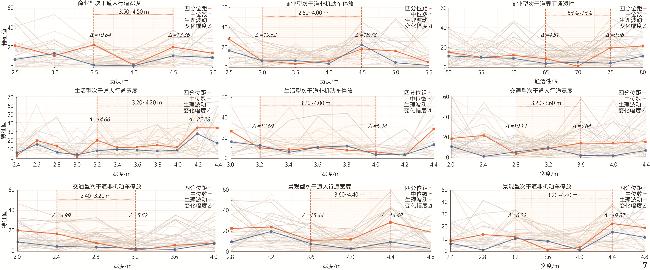
图7 次干道街道空间要素心理舒适性区间Fig. 7 Physiological comfort intervals of street space elements along secondary roads |
文中所有图表均由作者绘制。
| [1] |
龙瀛, 叶宇. 人本尺度城市形态: 测度、效应评估及规划设计响应[J]. 南方建筑, 2016(5): 41-47.
LONG Y, YE Y. Human-Scale Urban Form: Measurements, Performances, and Urban Planning & Design Interventions[J]. South Architecture, 2016(5): 41-47.
|
| [2] |
SOUTHWORTH M, BEN-JOSEPH E. Streets and the Shaping of Towns and Cities[M]. Washington: Island Press, 2013.
|
| [3] |
邱书杰. 作为城市公共空间的城市街道空间规划策略[J]. 建筑学报, 2007(3): 9-14.
QIU S J. Street Planning Tactics for Urban Public Space[J]. Architectural Journal, 2007(3): 9-14.
|
| [4] |
叶宇, 张昭希, 张啸虎, 等. 人本尺度的街道空间品质测度: 结合街景数据和新分析技术的大规模、高精度评价框架[J]. 国际城市规划, 2019, 34(1): 18-27.
YE Y, ZHANG Z X, ZHANG X H, et al. Human-Scale Quality on Streets: A Large-Scale and Efficient Analytical Approach Based on Street View Images and New Urban Analytical Tools[J]. Urban Planning International, 2019, 34(1): 18-27.
|
| [5] |
唐婧娴, 龙瀛. 特大城市中心区街道空间品质的测度: 以北京二三环和上海内环为例[J]. 规划师, 2017, 33(2): 68-73.
TANG J X, LONG Y. Metropolitan Street Space Quality Evaluation: Second and Third Ring of Beijing, Inner Ring of Shanghai[J]. Planners, 2017, 33(2): 68-73.
|
| [6] |
龙瀛, 唐婧娴. 城市街道空间品质大规模量化测度研究进展[J]. 城市规划, 2019, 43(6): 107-114.
LONG Y, TANG J X. Large-Scale Quantitative Measurement of the Quality of Urban Street Space: The Research Progress[J]. City Planning Review, 2019, 43(6): 107-114.
|
| [7] |
NORMAN DONALD A. The Design of Everyday Things[M]. Cambridge, MA: MIT Press, 2013.
|
| [8] |
WILSON J R. Fundamentals of Ergonomics in Theory and Practice[J]. Applied Ergonomics, 2000, 31(6): 557-567.
|
| [9] |
BARTLETT F C. Remembering: A Study in Experimental and Social Psychology[M]. Cambridge: Cambridge University Press, 1995.
|
| [10] |
KAPLAN R, KAPLAN S. The Experience of Nature: A Psychological Perspective[M]. Cambridge: Cambridge University Press, 1989.
|
| [11] |
ULRICH R S. View Through a Window May Influence Recovery from Surgery[J]. Science, 1984, 224(4647): 420-421.
|
| [12] |
张利, 邓慧姝, 梅笑寒, 等. 城市人因工程学: 一种关于人的空间体验质量的设计科学[J]. 科学通报, 2022, 67(16): 1744-1756.
ZHANG L, DENG H S, MEI X H, et al. Urban Ergonomics: A Design Science on Spatial Experience Quality[J]. Chinese Science Bulletin, 2022, 67(16): 1744-1756.
|
| [13] |
LYNCH K. The Image of the City[M]. Cambridge, MA: The MIT Press, 1960.
|
| [14] |
GEHL J. Life Between Buildings: Using Public Space[M]. Washington: Island Press, 1987.
|
| [15] |
OSGOOD C E. The Nature and Measurement of Meaning[J]. Psychological Bulletin, 1952, 49(3): 197-237.
|
| [16] |
BRADLEY M M, LANG P J. Measuring Emotion: The Self-Assessment Manikin and the Semantic Differential[J]. Journal of Behavior Therapy and Experimental Psychiatry, 1994, 25(1): 49-59.
|
| [17] |
HARTIG T, MANG M, EVANS G W. Restorative Effects of Natural Environment Experiences[J]. Environment and Behavior, 1991, 23(1): 3-26.
|
| [18] |
STEUER J, BIOCCA F, LEVY M R. Defining Virtual Reality: Dimensions Determining Telepresence[J]. Communication in the Age of Virtual Reality, 1995, 33 37-39 1
|
| [19] |
LAUMANN K, GÄRLING T, STORMARK K M. Selective Attention and Heart Rate Responses to Natural and Urban Environments[J]. Journal of Environmental Psychology, 2003, 23(2): 125-134.
|
| [20] |
GEHL J. Cities for People[M]. Washington: Island press, 2013.
|
| [21] |
SOUTHWORTH M. Designing the Walkable City[J]. Journal of Urban Planning and Development, 2005, 131(4): 246-257.
|
| [22] |
EWING R, HANDY S, BROWNSON R C, et al. Identifying and Measuring Urban Design Qualities Related to Walkability[J]. Journal of Physical Activity & Health, 2006, 3 S1 S223 S240
|
| [23] |
陈志敏, 黄鎔, 黄莹, 等. 街道空间宜步行性的精细化测度与导控: 基于虚拟现实与可穿戴生理传感器的循证分析[J]. 中国园林, 2022, 38(1): 70-75.
CHEN Z M, HUANG R, HUANG Y, et al. The Measurements of Fine-Scale Street Walkability and Precise Design Control: An Evidence-Based Approach Based on Virtual Reality and Wearable Bio-Sensors[J]. Chinese Landscape Architecture, 2022, 38(1): 70-75.
|
| [24] |
徐磊青, 孟若希, 黄舒晴, 等. 疗愈导向的街道设计: 基于VR实验的探索[J]. 国际城市规划, 2019, 34(1): 38-45.
XU L Q, MENG R X, HUANG S Q, et al. Healing Oriented Street Design: Experimental Explorations via Virtual Reality[J]. Urban Planning International, 2019, 34(1): 38-45.
|
| [25] |
徐磊青, 施婧. 步行活动品质与建成环境: 以上海三条商业街为例[J]. 上海城市规划, 2017(1): 17-24.
XU L Q, SHI J. Walking Activity Quality and Built Environment: Take Three Commercial Streets in Shanghai as Examples[J]. Shanghai Urban Planning Review, 2017(1): 17-24.
|
| [26] |
JIANG B, CHANG C Y, SULLIVAN W C. A Dose of Nature: Tree Cover, Stress Reduction, and Gender Differences[J]. Landscape and Urban Planning, 2014, 132: 26-36.
|
| [27] |
苑思楠, 张玉坤. 基于虚拟现实技术的城市街道网络空间认知实验[J]. 天津大学学报(社会科学版), 2012, 14(3): 228-234.
YUAN S N, ZHANG Y K. Experiment of Urban Space Cognition Using VR Technology[J]. Journal of Tianjin University (Social Sciences), 2012, 14(3): 228-234.
|
| [28] |
SCHANDRY R. Heart Beat Perception and Emotional Experience[J]. Psychophysiology, 1981, 18(4): 483-488.
|
| [29] |
施澄, 袁琦, 潘海啸, 等. 街道空间步行适宜性测度与设计导控: 以上海静安寺片区为例[J]. 上海城市规划, 2020(5): 71-79.
SHI C, YUAN Q, PAN H X, et al. Measuring Walkability of Street Space and Its Design Control in the Context of New Analytical Techniques: A Case Study of Shanghai Jing’an Temple Area[J]. Shanghai Urban Planning Review, 2020(5): 71-79.
|
| [30] |
LI Y, DU H W. Research on the Restorative Benefits of Sky Gardens in High-Rise Buildings Based on Wearable Biosensors and Subjective Evaluations[J]. Building and Environment, 2024, 260: 111691.
|
| [31] |
BURDEA G, COIFFET P. Virtual Reality Technology[M]. Hoboken, N.J: John Wiley & Sons, 2003.
|
| [32] |
NOLD C. Emotional Cartography: Technologies of the Self[M]. London: Space Studios, 2009.
|
| [33] |
叶宇, 戴晓玲. 新技术与新数据条件下的空间感知与设计运用可能[J]. 时代建筑, 2017(5): 6-13.
YE Y, DAI X L. Spatial Perception and Design Potentials in the Context of New Analytical Techniques and New Data[J]. Time + Architecture, 2017(5): 6-13.
|
| [34] |
李红军, 刘晓娜. 论文下载频次、引用频次和下载转化率关系的研究: 以Web of Science数据库中图情学科为例[J]. 情报探索, 2022(9): 64-70.
LI H J, LIU X N. Research on the Relationship Between Paper Download Frequency, Citation Frequency and Download Conversion Rate: Case Study of Information Science & Library Science in Web of Science[J]. Information Research, 2022(9): 64-70.
|
| [35] |
马强, 韦笑, 任冠南. 街道设计导则与城市道路系统的优化提升: 从通行能力到空间品质的转变[J]. 城市交通, 2021, 19(5): 1-16.
MA Q, WEI X, REN G N. Street Design Guide and Urban Roadway System Improvement: From Capacity to Space Quality[J]. Urban Transport of China, 2021, 19(5): 1-16.
|
| [36] |
冯树民, 李政, 张伟. 城市人行道设置宽度研究[J]. 哈尔滨工业大学学报, 2008, 40(4): 585-588.
FENG S M, LI Z, ZHANG W. Width of Pavement in the City[J]. Journal of Harbin Institute of Technology, 2008, 40(4): 585-588.
|
/
| 〈 |
|
〉 |