

复杂适应系统视角下环城绿带“主体-环境”演进机制——以北京市绿隔为例
|
刘颂/女/博士/同济大学建筑与城市规划学院教授、博士生导师/全国风景园林专业学位研究生教育指导委员会副主任委员/研究方向为城乡绿地系统规划、景观规划技术方法 |
|
沈培宇/女/同济大学建筑与城市规划学院在读博士研究生/研究方向为风景园林规划与设计 |
|
柳迪子/男/同济大学建筑与城市规划学院在读博士研究生/研究方向为城乡绿地系统规划 |
|
白钊成/男/同济大学建筑与城市规划学院在读博士研究生/研究方向为数字景观 |
Copy editor: 李清清
收稿日期: 2024-12-12
修回日期: 2025-04-13
网络出版日期: 2025-12-10
基金资助
国家自然科学基金“基于生态系统服务权衡与协同的市级生态空间多目标优化研究”(52178050)
版权
“Agent – Environment” Evolution Mechanism of Greenbelt from the Perspective of Complex Adaptive System: A Case Study of Beijing’s Greenbelts
|
LIU Song, Ph.D., is a professor and doctoral supervisor in the College of Architecture and Urban Planning (CAUP), and deputy director of the National Master of Landscape Architecture Eduation Steering Committee. Her research focuses on urban and rural green space system planning, and technical approach to landscape planning |
|
SHEN Peiyu is a Ph.D. candidate in the College of Architecture and Urban Planning (CAUP), Tongji University. Her research focuses on landscape planning and design |
|
LIU Dizi is a Ph.D. candidate in the College of Architecture and Urban Planning (CAUP), Tongji University. His research focuses on urban and rural green space system planning |
|
BAI Zhaocheng is a Ph.D. candidate in the College of Architecture and Urban Planning (CAUP), Tongji University. His research focuses on digital landscape |
Received date: 2024-12-12
Revised date: 2025-04-13
Online published: 2025-12-10
Copyright
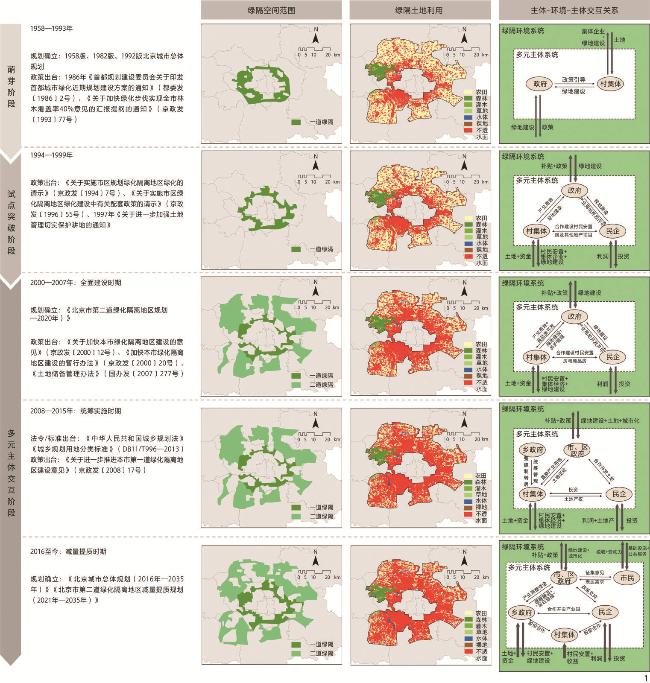
【目的】环城绿带的演化除了受外部环境中快速城市化的强力干扰外,多元利益主体对于土地、资金等资源的长期相互博弈与协调统筹也是重要的影响因素。借助复杂适应系统理论中“自下而上”的研究范式,探索多元主体推动环城绿带系统演化的适应过程。【方法】以复杂适应系统理论为基础,从基本特征、结构构成和适应机制等视角分析环城绿带的系统特征。以北京市绿隔为例,基于复杂适应系统的7个特性,梳理其中多元主体与环境的交互作用及演化过程。【结果】环城绿带由多元主体系统、地域空间系统、社会文化系统及自然生态系统4个子系统构成,各子系统互为环境;多元主体子系统是环城绿带系统演变的核心动力,具有决策能力的主体间的相互作用推动绿带发展,各主体互为环境。北京市绿隔演化经历3个阶段:萌芽阶段建设主体单一,政府与村集体由权力关系主导的信息流连接;试点突破阶段民企新主体加入,资源流动加快;有序实施阶段乡政府主体与市民主体先后涌现,多元主体频繁交互。【结论】北京市绿隔演进的动力机制由早期的政策引导、快速城市化强力干扰,逐渐转变为多元主体交互主导、政策驱动。环城绿带仍将持续演变,为了绿带的可持续发展,未来应当增强政府主体主动性、重视多元利益主体协同治理及创造性及提升多元利益主体适应能力。复杂适应系统基本概念框架也可作为其他绿带系统治理的思维框架。
刘颂 , 沈培宇 , 柳迪子 , 白钊成 . 复杂适应系统视角下环城绿带“主体-环境”演进机制——以北京市绿隔为例[J]. 风景园林, 2025 , 32(6) : 78 -85 . DOI: 10.3724/j.fjyl.LA20240121
[Objective] Since the first successful practice in London in the 1930s, greenbelt has become an important land control and land use planning idea. Greenbelts help solve problems related to urban sprawl and provide multiple ecological, social and economic functions that have profound impact on sustainable regional development. In the past century, the construction of greenbelts have been on the rise in the world, but some greenbelts have also encountered a lot of resistance and destruction in the implementation process, and the gap between planning and implementation is large. On the surface, the obstruction of greenbelt construction is the contradiction between green space protection and development and construction, between ecological land and construction land. In essence, greenbelt construction is a long-term game and coordination of land, capital and other resources among multiple stakeholders such as local governments, citizens, economic organizations and social groups. At present, greenbelt is seldom researched from the perspective of “agent – agent” and “agent – environment” interaction and adaptation mechanism between multiple stakeholders and greenbelt system. This research takes Beijing’s greenbelts (the first greenbelt and the second greenbelt) as an example to, according to the “bottom-up” research paradigm of complex adaptive system theory (CAS), depict the adaptation process of multiple agents to promote the evolution of the greenbelt system, and explore the evolution mechanism of greenbelt, so as to seek targeted solutions to optimize greenbelt planning and promote the implementation of greenbelt policies. [Methods] Based on the theory of complex adaptive system, the characteristics of the greenbelt system are analyzed from the perspectives of basic characteristics, structural composition and adaptive mechanism. Taking Beijing’s greenbelts as an example, the evolution process of greenbelt is divided into different stages according to the degree of agent emergence, structure complexity and system maturity. At the same time, based on the four characteristics of complex adaptive systems (aggregation, non-linearity, flow and diversity) and three mechanisms (identification, internal model, and block mechanisms), the interaction between multiple agents and the environment is explored. [Results] The research results show that the construction of the greenbelt system involves the multi-agent system. In the evolution process of Beijing’s greenbelts, multiple agents such as municipal and district governments, village collectives, private enterprises, township governments and citizens have emerged and interacted with each other more frequently. In the embryonic stage, the main agent of greenbelt construction is single, and rapid urbanization in the macro external environment becomes the biggest hindrance of greenbelt construction. In the experiment breakthrough stage, in 1993, Beijing Municipal Government proposed to introduce market mechanism in greenbelt construction. This macro-level external force and rapid urbanization jointly promoted the self-organization process of greenbelt. Private enterprises spontaneously joined the greenbelt construction and interacted with the government and village collective entities to promote the system evolution. In the orderly implementation stage, both external environmental forces and self-organizing forces play a strong role in the evolution of greenbelt. Major social and cultural events, “urban and rural integration”, “quantity reduction and quality and greening improvement” policies, and diversified citizen participation have all promoted the improvement of the self-organizing capability of greenbelt. Top-down macro planning, policy, bottom-up micro agent interaction and self-organization jointly promote the evolution of the greenbelt system. [Conclusion] The construction of greenbelt can rely on not only the “top-down” greenbelt policy, but also the self-organization law, namely “guiding” individuals to change their own behavior rules through the external environment in a “bottom-up” manner, thus achieving the goal of greenbelt construction. In order to realize the sustainable development of greenbelt, it is necessary to enhance the initiative and creativity of the government, attach importance to the collaborative governance of multiple agents and enhance the adaptability of multiple stakeholders. Although the implications of the sustainable development of the greenbelt proposed in this research are relevant to Beijing’s greenbelts, the basic conceptual framework of CAS can also be used as the thinking framework for the governance of other greenbelts. At present, the research of greenbelt system based on CAS theory is still in the exploratory stage with many shortcomings. On the one hand, the evolution process of the greenbelt system is only discussed qualitatively, and has not been discussed quantitatively. On the other hand, it mainly discusses the interaction between the agents of the multi-agent system, and the other three subsystems are less discussed. Future research needs to continue to explore the above limitations in order to more comprehensively understand the complexity of the greenbelt system.
表1 环城绿带系统与复杂适应系统的兼容性诠释Tab. 1 Interpretation of the compatibility between greenbelt system and complex adaptive system |
| CAS特征 | 注释 | 兼容性诠释 |
| 聚集 (aggregation) | 物以类聚,将相似之物聚集成类,简化复杂系统;简单的主体聚集并相互作用,涌现出更复杂行为 | 环城绿带内相似的单一主体聚集成类;多元主体的聚集会涌现一系列社会文化、生态、空间格局等绿带环境变化 |
| 非线性 (non-linearity) | 系统特性与各部分值不能建立线性关系 | 环城绿带主体适应过程中有诸多的不确定性,聚集行为不是各主体行为的简单求和或平均 |
| 流 (flow) | 主体间、主体与环境间通过各种类型的流等实现相互作用,过程遵循再循环效应和乘数效应 | 环城绿带多元主体间、多元主体与外部环境之间存在信息流、资金流等资源流动,在某些节点注入更多资源会产生乘数效应,某些资源在网络中循环流动,可以提高资源利用效率 |
| 多样性 (diversity) | 任何单一主体的存在都依赖于其他主体提供的环境,每种主体都位于以该主体为中心的相互作用所限定的生态位上 | 环城绿带内如果出现生态位的缺失,就会吸引新的主体加入,提供新的相互作用机会,使得主体系统和外部环境更加趋于多样性 |
| 标识 (tagging) | 允许主体在一些不易分辨的主体或目标中进行选择,促进选择性相互作用;是为了聚集和边界生成而存在的一个机制 | 环城绿带的多元主体会因为接收到同样的信息(如绿隔政策)而聚集、合作,这种促使主体相互作用的机制即标识 |
| 内部模型 (inter model) | 主体的认知模式和行为动机,内部模型(本能)使得主体能够预知再次遇到某种情况时会发生什么样的后果 | 环城绿带系统各主体相互作用过程中,会形成自身的行为机制和本能,面对类似情景时能预判行为的后果 |
| 积木 (blocks) | 通过自然选择和学习,寻找到已经被检验过能够再使用的元素(即积木),就能将复杂事物进行分解;当面对新情况,将经过检验且相关的积木重新组合,然后采取切实行动 | 环城绿带各主体在相互作用过程中能将积累的经验作为积木,面对新情况时,可以将之前被证明有效的行为组合,使用积木生成内部模型 |
| [1] |
张怀振, 姜卫兵. 环城绿带在欧洲的发展与应用[J]. 城市发展研究, 2005, 12(6): 36-40.
ZHANG H Z, JIANG W B. A Study on the Development and Application of Greenbelt Around City in Europe[J]. Urban Studies, 2005, 12(6): 36-40.
|
| [2] |
AMATI M, YOKOHARI M. Temporal Changes and Local Variations in the Functions of London’s Green Belt[J]. Landscape and Urban Planning, 2006, 75(1/2): 125-142.
|
| [3] |
王阳, 刘琳, 李知然. 德国“欧洲绿色之都” 汉堡市营建经验及其对我国公园城市规划的启示[J]. 国际城市规划, 2023, 38(6): 113-123.
WANG Y, LIU L, LI Z R. The Construction Experience of Hamburg, the “European Green Capital” in Germany, and Its Enlightenment to China’s Park City Planning[J]. Urban Planning International, 2023, 38(6): 113-123.
|
| [4] |
LEE S, YOON H. Effects of Greenbelt Cancellation on Land Value: The Case of Wirye New Town, South Korea[J]. Urban Forestry & Urban Greening, 2019, 41: 55-66.
|
| [5] |
LI T, JIA B, LI X, et al. From “Separation” to “Integration”: Analyzing the Functional Transformation of the Urban Greenbelt in Beijing from the Perspective of “Parkization”[J]. Ecological Indicators, 2023, 154: 110915
|
| [6] |
王红兵, 陈家宽. 环城绿带格局与大城市规模的相关性[J]. 科学通报, 2014, 59(15): 1429-1436.
WANG H B, CHEN J K. Greenbelt Development: Correlation Between Greenbelt Patterns and Metropolitan Areas[J]. Chinese Science Bulletin, 2014, 59(15): 1429-1436.
|
| [7] |
文萍, 吕斌, 赵鹏军. 国外大城市绿带规划与实施效果: 以伦敦、东京、首尔为例[J]. 国际城市规划, 2015, 30(S1): 57-63.
WEN P, LYU B, ZHAO P J. Planning and Practice of Urban Green Belts: Cases of London, Tokyo and Seoul[J]. Urban Planning International, 2015, 30(S1): 57-63.
|
| [8] |
阮智杰, 陈景, 张尔薇, 等. 国内外城市绿带观察(上)[J]. 北京规划建设, 2023(2): 152-157.
RUAN Z J, CHEN J, ZHANG E W, et al. Observation on Urban Green Belt at Home and Abroad (Ⅰ)[J]. Beijing Planning Review, 2023(2): 152-157.
|
| [9] |
谢欣梅. 北京、伦敦、首尔绿带政策及城市化背景对比[J]. 北京规划建设, 2009(6): 68-70.
XIE X M. Comparison of Green Belt Policies and Urbanization Background Among Beijing, London and Seoul[J]. Beijing Planning Review, 2009(6): 68-70.
|
| [10] |
吴纳维. 北京绿隔产业用地规划实施现状问题与对策: 以朝阳区为例[J]. 城市规划, 2014, 38(2): 76-84.
WU N W. Land-Use Planning for Green Belt Industries in Chaoyang District of Beijing: Its Effects, Dilemmas, and Solutions[J]. City Planning Review, 2014, 38(2): 76-84.
|
| [11] |
王旭东, 王鹏飞, 杨秋生. 国内外环城绿带规划案例比较及其展望[J]. 规划师, 2014, 30(12): 93-99.
WANG X D, WANG P F, YANG Q S. A Comparative Study of Green Belt Planning Cases[J]. Planners, 2014, 30(12): 93-99.
|
| [12] |
徐勤政, 石晓冬, 胡波, 等. 利益冲突与政策困境: 北京城乡结合部规划实施中的问题与政策建议[J]. 国际城市规划, 2014, 29(4): 52-59.
XU Q Z, SHI X D, HU B, et al. Interest Conflicts and Policy Dilemma: Problems and Suggestions of Planning Implementation of Beijing’s Rural-Urban Fringe[J]. Urban Planning International, 2014, 29(4): 52-59.
|
| [13] |
BOENTJE J P, BLINNIKOV M S. Post-Soviet Forest Fragmentation and Loss in the Green Belt Around Moscow, Russia (1991−2001): A Remote Sensing Perspective[J]. Landscape and Urban Planning, 2007, 82(4): 208-221.
|
| [14] |
FITZSIMONS J, PEARSON C J, LAWSON C, et al. Evaluation of Land-Use Planning in Greenbelts Based on Intrinsic Characteristics and Stakeholder Values[J]. Landscape and Urban Planning, 2012, 106(1): 23-34.
|
| [15] |
李玏, 刘家明, 宋涛, 等. 城市绿带及其游憩利用研究进展[J]. 地理科学进展, 2014, 33(9): 1252-1261.
LI L, LIU J M, SONG T, et al. Research Progress of Urban Green Belt and Recreational Use[J]. Progress in Geography, 2014, 33(9): 1252-1261.
|
| [16] |
李强, 戴俭. 规划制度安排与“绿带” 政策的绩效: 伦敦与北京的比较[J]. 城市发展研究, 2005, 12(6): 32-35.
LI Q, DAI J. Urban Planning Institutional Arrangement and Green Belt Performance: The Comparison Between London and Beijing[J]. Urban Studies, 2005, 12(6): 32-35.
|
| [17] |
NELSON A C. An Unifying View of Greenbelt Influences on Regional Land Values and Implications for Regional Planning Policy[J]. Growth and Change, 1985, 16(2): 43-48.
|
| [18] |
LONGLEY P, BATTY M, SHEPHERD J, et al. Do Green Belts Change the Shape of Urban Areas? A Preliminary Analysis of the Settlement Geography of South East England[J]. Regional Studies, 1992, 26(5): 437-452.
|
| [19] |
葛韵宇, 李雄. 基于碳汇和游憩服务协同提升的北京市第二道绿化隔离地区郊野公园环空间布局优化[J]. 北京林业大学学报, 2022, 44(10): 142-154.
GE Y Y, LI X. Spatial Layout Optimization of Country Parks in the Second Green Belt of Beijing Municipality Area Based on the Coordinated Improvement of Carbon Sequestration and Recreational Services[J]. Journal of Beijing Forestry University, 2022, 44(10): 142-154.
|
| [20] |
周向频, 韩佳憓. 面向有机更新的新城绿环精细化调控: 以上海市青浦新城绿环为例[J]. 园林, 2022, 39(12): 73-79.
ZHOU X P, HAN J H. Elaborate Regulation of Greenbelt in New Town for Organic Renewal: A Case Study of Greenbelt in Qingpu New Town, Shanghai[J]. Landscape Architecture Academic Journal, 2022, 39(12): 73-79.
|
| [21] |
霍兰. 隐秩序: 适应性造就复杂性[M]. 周晓牧, 韩晖, 译.上海: 上海科技教育出版社, 2000.
HOLLAND J Y. Hidden Order[M]. ZHOU X M, HAN H, translated. Shanghai: Shanghai Scientific & Technological Education Publishing House, 2000.
|
| [22] |
李伯华, 曾荣倩, 刘沛林, 等. 基于CAS理论的传统村落人居环境演化研究: 以张谷英村为例[J]. 地理研究, 2018, 37(10): 1982-1996.
LI B H, ZENG R Q, LIU P L, et al. Human Settlement Evolution of Traditional Village Based on Theory of Complex Adaptive System: A Case Study of Zhangguying Village[J]. Geographical Research, 2018, 37(10): 1982-1996.
|
| [23] |
刘春成. 城市隐秩序: 复杂适应系统理论的城市应用[M]. 北京: 社会科学文献出版社, 2017.
LIU C C. Hidden Order of Cities: Urban Applications of Complex Adaptive Systems Theory[M]. Beijing: Social Sciences Literature Publishing House, 2017.
|
| [24] |
HOLLING C S, GUNDERSON L H. Resilience and Adaptive Cycles[M]//GUNDERSON L H, HOLLING C S. Panarchy: Understanding Transformations in Human and Natural Systems. Washington, D.C.: Island Press, 2002.
|
| [25] |
贾晓辉. 基于复杂适应系统理论的产业集群创新主体行为研究[D]. 哈尔滨: 哈尔滨工业大学, 2016.
JIA X H. Research on Subject Behavior of Industrial Cluster Innovation Based on Complex Adaptive System Theory[D]. Harbin: Harbin Institute of Technology, 2016.
|
| [26] |
刘青, 杨天姣. 北京城市总体规划与第一道绿化隔离地区空间演进研究[J]. 北京规划建设, 2021(4): 71-74.
LIU Q, YANG T J. Study on Beijing Urban Master Plan and Spatial Evolution of the First Green Isolated Area[J]. Beijing Planning Review, 2021(4): 71-74.
|
| [27] |
张豪, 冯长春, 郭永沛, 等. 绿隔政策背景下北京市村庄改造特征及规划策略[J]. 规划师, 2022, 38(4): 78-84.
ZHANG H, FENG C C, GUO Y P, et al. The Reconstruction Characters and Planning Strategies of Villages in Greenbelt Development, Beijing[J]. Planners, 2022, 38(4): 78-84.
|
| [28] |
文萍, 吕斌, 赵鹏军.北京城市“绿隔”的绩效评价[C]//中国城市规划学会.城乡治理与规划改革: 2014中国城市规划年会论文集(11—规划实施与管理).北京: 中国建筑工业出版社, 2014: 180-192.
WEN P, LYU B, ZHAO P J. Performance Evaluation of Beijing’s Greenbelt[C]//Urban-Rural Governance and Planning Reform: Proceedings of the 2014 China Urban Planning Annual Conference (No. 11: Planning Implementation and Management). Beijing: China Architecture & Building Press, 2014.
|
| [29] |
吴纳维. 北京绿化隔离地区土地利用演变及规划实施机制研究[D]. 北京: 清华大学, 2016.
WU N W. Research on the Land Use Changes and Plan Implementation Mechanism of Beijing’s Green Belts[D]. Beijing: Tsinghua University, 2016.
|
| [30] |
贾家妹. 北京二道绿隔内乡镇土地利用与社会经济演变研究: 以崔各庄乡为例(2010—2020年)[D]. 北京: 北京林业大学, 2021.
JIA J M. Study on Land Use and Socio-Economic Evolution of Villages and Towns in Erdaolvge, Beijing: Taking Cuigezhuang Township as an Example (2010−2020)[D]. Beijing: Beijing Forestry University, 2021.
|
| [31] |
严亚瓴. 20世纪80年代至今北京城市绿色空间演变及机制研究[D]. 北京: 北京林业大学, 2017.
YAN Y L. Evolvement and Mechanism of Urban Green Space in Beijing Since the 1980s[D]. Beijing: Beijing Forestry University, 2017.
|
| [32] |
谢欣梅. 绿隔十年谈: 记朝阳区绿隔实施情况调研[J]. 北京规划建设, 2008(5): 112-115.
XIE X M. Ten Years’ Talk About Green Partition: Investigation on the Implementation of Green Partition in Chaoyang District[J]. Beijing Planning Review, 2008(5): 112-115.
|
| [33] |
郭竹梅, 徐波, 钟继涛. 对北京绿化隔离地区“公园环” 规划建设的思考[C]//北京园林学会, 北京市园林绿化局, 北京市公园管理中心.2008北京奥运园林绿化的理论与实践.北京: 中国林业出版社, 2009: 57-61.
GUO Z M, XU B, ZHONG J T. Reflections on the Planning and Construction of the “Park Ring” in Beijing’s Green Isolation Zone[C]//Beijing Society of Landscape Architecture, Beijing Municipal Bureau of Parks and Forestry, Beijing Park Administration Center. Theory and Practice of Garden Greening for the 2008 Beijing Olympic Games. Beijing: China Forestry Publishing House, 2009: 57-61.
|
| [34] |
北京市规划和自然资源委员会.朝阳区平房乡城市化试点实施方案规划调整公示反馈意见采信情况的通告[EB/OL].(2017-12-27)[2025-02-04]. https://ghzrzyw.beijing.gov.cn/chengxiangguihua/ghlgg/cy_ghlgg/201912/t20191212_1732895.html.
Beijing Municipal Commission of Planning and Natural Resources. Notice on the Adoption of Public Feedback Regarding Planning Adjustments for the Urbanization Pilot Implementation Plan in Pingfang Township, Chaoyang District[EB/OL]. (2017-12-27)[2025-02-04]. https://ghzrzyw.beijing.gov.cn/chengxiangguihua/ghlgg/cy_ghlgg/201912/t20191212_1732895.html.
|
| [35] |
胡建兵, 李鑫欣. “百园百师工作营” 为绿隔公园补短板[J]. 绿化与生活, 2023(10): 26
HU J B, LI X X. “Hundred Parks and Hundred Teachers’ Work Camp” Supplements the Shortcomings of Lvge Park[J]. Greening and Life, 2023(10): 26
|
| [36] |
陈彦光. 中国城市发展的自组织特征与判据: 为什么说所有城市都是自组织的?[J]. 城市规划, 2006, 30(8): 24-30.
CHEN Y G. Self-Organized Characteristics and Criteria of the Development of Chinese Cities[J]. City Planning Review, 2006, 30(8): 24-30.
|
| [37] |
孙小涛, 徐建刚, 张翔, 等. 基于复杂适应系统理论的城市规划[J]. 生态学报, 2016, 36(2): 463-471.
SUN X T, XU J G, ZHANG X, et al. Urban Planning Adapted to Nature Based on Complex Adaptive Systems[J]. Acta Ecologica Sinica, 2016, 36(2): 463-471.
|
| [38] |
连洁. 英国城市规划公众参与之经验启示[J]. 北京规划建设, 2024(6): 83-85.
LIAN J. Experience and Enlightenment of Public Participation in British Urban Planning[J]. Beijing Planning Review, 2024(6): 83-85.
|
| [39] |
王凯, 赵燕菁, 张京祥, 等. “新质生产力与城乡规划” 学术笔谈[J]. 城市规划学刊, 2024(4): 1-10.
WANG K, ZHAO Y J, ZHANG J X, et al. Symposium on New Quality Productive Forces and Urban-Rural Planning[J]. Urban Planning Forum, 2024(4): 1-10.
|
/
| 〈 |
|
〉 |