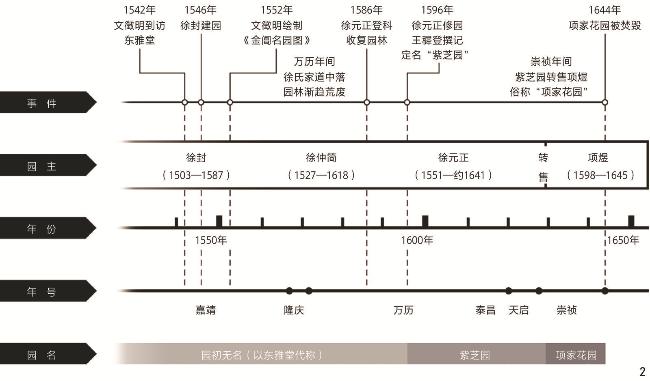


从《金阊名园图》论16世纪中叶江南园林艺术特征
|
庞世源/男/北京林业大学园林学院在读博士研究生/研究方向为风景园林规划与设计 |
|
黄晓/男/博士/北京林业大学园林学院副教授、博士生导师/研究方向为风景园林历史与理论、园林绘画 |
Copy editor: 刘昱霏
收稿日期: 2024-07-11
修回日期: 2025-03-18
网络出版日期: 2025-12-10
基金资助
国家自然科学基金面上项目“互动演进视角下的明代私家园林与绘画研究”(52078039)
国家自然科学基金青年项目“基于多重证据法的湮废园林复原方法及其评价体系研究”(52008302)
版权
Artistic Features of Jiangnan Gardens During the Mid-16th Century as Reflected in the Picture of a Famous Garden in Jinchang
|
PANG Shiyuan is a Ph.D. candidate in the School of Landscape Architecture, Beijing Forestry University. His research focuses on landscape planning and design |
|
HUANG Xiao, Ph.D., is an associate professor and doctoral supervisor in the School of Landscape Architecture, Beijing Forestry University. His research focuses on history and theory of landscape architecture, and garden paintings |
Received date: 2024-07-11
Revised date: 2025-03-18
Online published: 2025-12-10
Copyright
【目的】16世纪中叶是明中后期江南私家造园转型的关键节点,但学界对当时园林的典型艺术特征尚未展开进一步讨论。文徵明《金阊名园图》描绘的徐封园(后称紫芝园)是16世纪中叶新建江南园林的代表,对其展开案例研究有助于获取佐证明中后期造园转型的论据,梳理和归纳假山、水体、植物和建筑等造园要素发生的具体变化。【方法】基于图文互证的研究方法对《金阊名园图》所绘园林进行复原,阐析此图展示的造园要素及设计手法,并与16世纪中叶前后其他明代江南园林进行比较,探寻明嘉靖以降造园转型的主要趋势。【结果】《金阊名园图》描绘的徐封园以奢丽风格和社交功能而著称,园内假山、水体、植物和建筑等造园要素既存在异于16世纪中叶以前传统文人园林的特征,也有顺接16世纪中叶至17世纪初造园全盛时期设计语言的现象。【结论】徐封园的局部平面复原与造园要素分析揭示了明嘉靖以降造园转型的2个主要趋势:叠山、理水的程式运用表明江南地区的造园者历经长期探索后逐渐确立广受认可并广泛运用的设计范式;植物、建筑的功能转变源自商品经济推动下园林社交功能的强化。16世纪中叶江南私家造园转型源自社会演变与艺术发展的共同作用,推动该时期江南私家园林的个案研究上升到群像调查,有助于宏观把握明中后期江南造园艺术的时代特征。
庞世源 , 黄晓 . 从《金阊名园图》论16世纪中叶江南园林艺术特征[J]. 风景园林, 2025 , 32(5) : 133 -140 . DOI: 10.3724/j.fjyl.202407110378
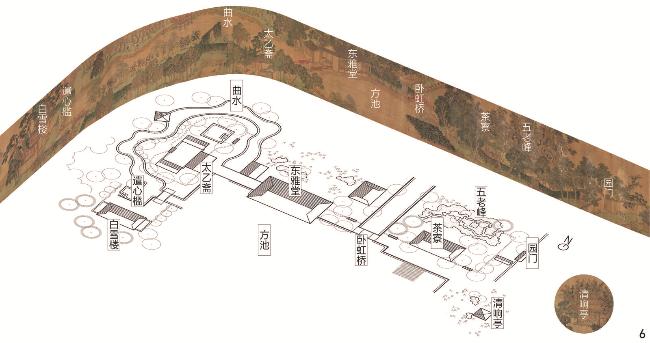
[Objective] The mid-16th century is a critical period in the transformation of Jiangnan gardens during the mid-to-late Ming Dynasty. This period is characterized by a gradual weakening of the connection between garden making and agricultural economy, the enhancement of social functions of private gardens, and the infiltration of social atmosphere of entertainment and extravagance into the life of literati. Based on clarifying the overall trend of the transformation of Jiangnan gardens, it is necessary to further explore specific changes in garden elements such as rockeries, waterscape, plants, and buildings by combining them with specific examples. The private garden of Xu Feng, a wealthy merchant from Suzhou, is representative of the newly constructed Jiangnan gardens in the mid-16th century. The scenery of this garden is depicted in Wen Zhengming’s Picture of a Famous Garden in Jinchang (“Jinchangmingyuantu”). This painting vividly reflects many garden design techniques that were popular during the Jiajing period and provides intuitive evidence to support the argument of the transformation of Jiangnan gardens in the mid-to-late Ming Dynasty. It also helps to form a clearer understanding of the typical artistic features of Jiangnan gardens in the mid-16th century. [Methods] The research method of mutual verification of literature and image is employed to reconstruct the garden depicted in the Picture of a Famous Garden in Jinchang. Combining visual and textual information to identify the correspondence between the painting and the Record of Zizhi Garden (Zizhiyuanji), in order to determine the orientation of buildings and the layout of garden. This process ultimately yields a partial plan of Xu Feng’s Garden, making the visual image of this renowned Jiangnan garden in the mid-16th century more intuitive. Furthermore, by analyzing the garden elements and design techniques based on the plan restoration of Xu Feng’s Garden, and comparing it with other Jiangnan gardens in the mid-16th century and its surrounding periods, the main trends in the transformation of Jiangnan gardens since the Jiajing period can be explored. [Results] The Picture of a Famous Garden in Jinchang does not include the panorama of Xu Feng’s Garden, and Wen Zhengming chose to depict the core area of the garden. This painting depicts scenic spots such as the garden gate, Five Old Men Peaks (“Wulaofeng”), teahouse, Wohong Bridge (Wohongqiao), square pool, Dongya Hall (“Dongyatang”), Taiyi Study (“Taiyizhai”), curving stream, Qianxin Railing (“Qianxinjian”), Baixue Tower (“Baixuelou”), and Qingxiang Pavilion (“Qingxiangting”) from right to left. This garden was renowned for its luxurious style and served as a place for celebrities to engage in social activities. The garden elements such as rockeries, waterscape, plants, and buildings exhibit artistic features that are distinct from the traditional literati gardens before the mid-16th century, while also showing continuity with the design techniques from the mid-16th century to the early 17th century. The Five Old Men Peaks, which rose during the Jiajing period, continued to be popular until the late Ming Dynasty. Ornamental plants detached from agricultural economy reflected the changes in the livelihood of garden owners from farming to commerce. Buildings with increasing number and diverse forms were gradually replacing plants as the main scene of gardens. In addition, this painting shows the combination of square pool and curving stream, providing valuable visual documentation for distinguishing the differences in waterscape design during the mid-to-late Ming Dynasty. [Conclusion] The comparison of Xu Feng’s Garden with other Jiangnan gardens in the mid-16th century and its surrounding periods reveals the major trends in the transformation of garden making since the Jiajing period. The application of standardized techniques in rockery construction and waterscape design reflects the gradual maturation of garden making after the mid-16th century, indicating that garden designers had gradually established a widely recognized and used design paradigm after long-term exploration. As a representative of the design paradigm at that time, the combination of the Five Old Men Peaks and square pool reveals the convergence of garden designers’ aesthetic concepts within a specific historical period. The functional shift of plants and buildings can be seen as a manifestation of the transformation of social trend from frugality to luxury in the mid-to-late Ming Dynasty. In the early 16th century, Jiangnan gardens were primarily used for the daily life and literary gatherings of literati, while also accommodating self-sufficient agricultural production. The development of commodity economy highlighted the social attributes of gardens as venues for social interaction, stimulating garden owners’ attention to the aesthetic functions of their gardens. The transformation of Jiangnan gardens in the mid-16th century originats from the combined effects of social evolution and artistic development. In subsequent research, extending case studies to group surveys can help to macroscopically grasp the characteristics of Jiangnan gardens in the mid-to-late Ming Dynasty.
表1 《金阊名园图》与《紫芝园记》[3]的信息互证Tab. 1 Mutual information verification between the Picture of a Famous Garden in Jinchang and the Record of Zizhi Garden [3] |
| 景名 | 《紫芝园记》文本信息 | 《金阊名园图》图像信息 | 方位分析 |
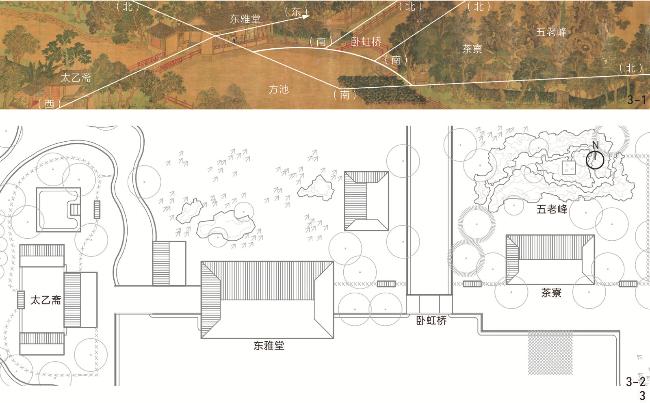
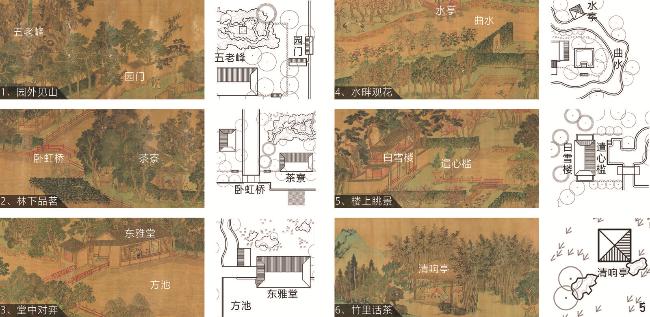
| 五老峰、入林门、卧虹桥 | 紫芝桥南叠石为峰,曰“五老”……稍西折而南,经一门,名“入林”,梁石而渡,名“卧虹” | ① | 五老峰西南方向有入林门,经过此门即可到达卧虹桥。图中假山南侧还有茶寮及葡萄架 |
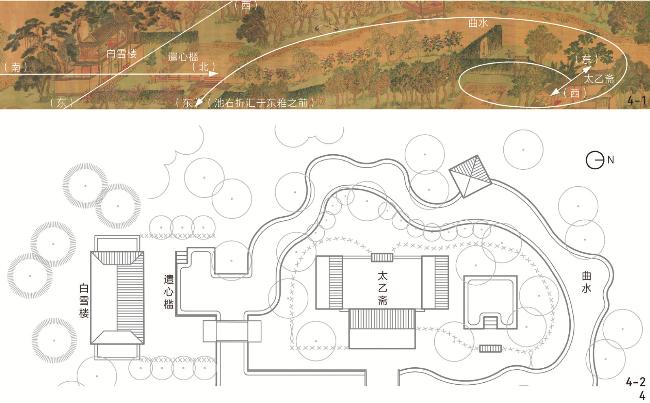
| 东雅堂、太乙斋 | 堂曰“东雅”……堂西书室,余名写“太乙斋” | ② | 自东向西经过卧虹桥到达东雅堂,堂南有方池,堂西为太乙斋,东雅堂和太乙斋之间向北引出曲水 |
| 白雪楼、遣心槛 | 循池而右,楼名“白雪”,水槛名“遣心”……池右折汇于东雅之前 | ③ | 太乙斋附近的曲水尽端有白雪楼和遣心槛,曲水最终汇入东雅堂南侧方池 |
| 清响亭 | 折而上,东向一亭,三峰在侧,曰“清响”,亭西皆竹也,石梁琴台在焉 | ④ | 园林东侧有一片面积不小的竹林及清响亭 |
 | |||
① 准确地说,《金阊名园图》是紫芝园前身、明嘉靖年间徐封园的写照。
② 文徵明楷体《千字文》题识:“嘉靖壬寅岁春二月九日,徵明书于东雅堂。”
③ “紫芝桥南叠石为峰,曰‘五老’……左轩右楼,楼小于轩,轩名‘迎旭’,楼名‘延熏’,轩在东,楼在南也。”王穉登所见“左轩”在五老峰东侧,为人行视角下的方位描述。
④ 郭明友指出,营建楼阁是弘治以降苏州地区兴起的造园潮流,尤以阊门一带最为盛行,参见参考文献[
| [1] |
顾凯. 明代江南园林研究[M]. 南京: 东南大学出版社, 2010.
GU K. Gardens of the Jiangnan Area in the Ming Period[M]. Nanjing: Southeast University Press, 2010.
|
| [2] |
郭明友. 明代苏州园林史[D]. 苏州: 苏州大学, 2011.
GUO M Y. The Art History Research on Ming Dynasty Gardens of Suzhou[D]. Suzhou: Soochow University, 2011.
|
| [3] |
徐树丕.识小录: 卷4[M].刻本.上海: 商务印书馆, 1916: 19-23.
XU S P. Miscellaneous Things: Volume 4[M]. Block-Printed Edition. Shanghai: Commercial Press, 1916: 19-23.
|
| [4] |
张朋川. 文徵明《金阊名园图》是紫芝园的写照[J]. 美术大观, 2022(9): 106-112.
ZHANG P C. Wen Zhengming’s Picture of a Famous Garden in Jinchang Is a Portrayal of Zizhi Garden[J]. Art Panorama, 2022(9): 106-112.
|
| [5] |
李秉星. 明代苏州下塘徐氏家世艺文考[J]. 苏州科技大学学报(社会科学版), 2021, 38(3): 81-87.
LI B X. An Artistic and Literary Study on the Xu’s Family Genealogy in Xiatang, Suzhou in Ming Dynasty[J]. Journal of Suzhou University of Science and Technology (Social Science Edition), 2021, 38(3): 81-87.
|
| [6] |
范允临.输寥馆集: 卷5[M].刻本.[出版地不详: 出版者不详], [1644—1661](顺治年间): 24-30.
FAN Y L. Collection of Shuliao Pavilion: Volume 5[M]. Block-Printed Edition. [S.l.: s.n.], [1644−1661] (Shunzhi Period): 24-30.
|
| [7] |
申时行.赐闲堂集: 卷31[M].刻本.[出版地不详: 出版者不详], 1616: 19-22.
SHEN S X. Collection of Cixian Hall: Volume 31[M]. Block-Printed Edition. [S.l.: s.n.], 1616: 19-22.
|
| [8] |
申时行.赐闲堂集: 卷6[M].刻本.[出版地不详: 出版者不详], 1616: 24-25.
SHEN S X. Collection of Cixian Hall: Volume 6[M]. Block-Printed Edition. [S.l.: s.n.], 1616: 24-25.
|
| [9] |
范允临.输寥馆集: 卷4[M].刻本.[出版地不详: 出版者不详], [1644—1661](顺治年间): 17-20.
FAN Y L. Collection of Shuliao Pavilion: Volume 4[M]. Block-Printed Edition. [S.l.: s.n.], [1644−1661] (Shunzhi period): 17-20.
|
| [10] |
王世贞.弇州山人续稿: 卷46[M].刻本.苏州: [出版者不详], 1599: 3.
WANG S Z. Continuation of Wang Shizhen’s Collected Works: Volume 46[M]. Block-Printed Edition. Suzhou: [s.n.], 1599: 3.
|
| [11] |
文徵明.文徵明集[M].周道振, 辑校.上海: 上海古籍出版社, 1987.
WEN Z M. Collected Works of Wen Zhengming[M]. ZHOU D Z, edited and proofread. Shanghai: Shanghai Classics Publishing House, 1987.
|
| [12] |
徐一书, 云嘉燕. 晚明苏州徐景文紫芝园营造考[J]. 广东园林, 2021, 43(3): 26-30.
XU Y S, YUN J Y. A Restoration Research of Xu Jingwen’s Zizhi Garden in Suzhou in the Late Ming Dynasty[J]. Guangdong Landscape Architecture, 2021, 43(3): 26-30.
|
| [13] |
曹汛. 略论我国古代园林叠山艺术的发展演变[C]//中国建筑学会建筑历史学术委员会.建筑历史与理论(第一辑). 南京: 江苏人民出版社, 1980: 74-85.
CAO X. A Brief Discussion on the Development and Evolution of Rockery Art in Ancient Chinese Gardens[C]//Academic Committee on Architectural History of Architectural Society of China. Architectural History and Theory: Volume 1. Nanjing: Jiangsu People's Publishing House, 1980: 74-85.
|
| [14] |
王世贞.弇州山人续稿: 卷63[M].刻本.苏州: [出版者不详], 1599: 6.
WANG S Z. Continuation of Wang Shizhen’s Collected Works: Volume 63[M]. Block-Printed Edition. Suzhou: [s.n.], 1599: 6.
|
| [15] |
祝圣培.长洲县志: 卷33[M].刻本.[出版地不详: 出版者不详], 1684: 36.
ZHU S P. Changzhou County Annals: Volume 33[M]. Block-Printed Edition. [S.l: s.n.], 1684: 36.
|
| [16] |
文含.文氏族谱续集: 历世第宅坊表志[M].刻本.苏州: 曲石精庐, 1929: 26.
WEN H. Continuation of the Wen Family's Genealogy: Residences and Memorial Archway of the Generations[M]. Block-Printed Edition. Suzhou: Qushi House, 1929: 26.
|
| [17] |
计成.园冶注释[M].2版.陈植, 注释.杨超伯, 校订.陈从周, 校阅.北京: 中国建筑工业出版社, 1988: 206.
JI C. The Craft of Gardens[M]. 2nd ed. CHEN Z, annotated. YANG C B, revised. CHEN C Z, proofread. Beijing: China Architecture & Building Press, 1988: 206.
|
| [18] |
陈鹏, 钱翀, 金云峰. 方池与曲水之辨: 晚明江南园林审美思想对比研究[J]. 古建园林技术, 2021(4): 53-56.
CHEN P, QIAN C, JIN Y F. The Differences Between Square Pools and Curved Pools: A Comparative Study on the Aesthetic Thoughts of Jiangnan Gardens in the Late Ming Dynasty[J]. Traditional Chinese Architecture and Gardens, 2021(4): 53-56.
|
| [19] |
顾凯. 重新认识江南园林: 早期差异与晚明转折[J]. 建筑学报, 2009(S1): 106-110.
GU K. New Understandings on Jiangnan Gardens: Difference in the Earlier History and Transition in the Late Ming[J]. Architectural Journal, 2009(S1): 106-110.
|
| [20] |
吴伟业.梅村家藏藳: 卷52[M].刻本.北京: 董氏诵芬室, 1911: 5.
WU W Y. Collected Works of Wu Weiye: Volume 52[M]. Block-Printed Edition. Beijing: Dong’s Songfen Chamber, 1911: 5.
|
| [21] |
CLUNAS C. Fruitful Sites: Garden Culture in Ming Dynasty China[M]. London: Reaktion Books, 1996.
|
| [22] |
潘逸炜, 张春彦. 石崇金谷园及其园林历史想象: 人造自然的观念再造[J]. 风景园林, 2024, 31(2): 120-128.
PAN Y W, ZHANG C Y. Shi Chong’s Jingu Garden and Its Historical Imagination: Conceptual Reconstruction of Man-made Nature[J]. Landscape Architecture, 2024, 31(2): 120-128.
|
| [23] |
郭明友. 关于晚明苏州徐氏紫芝园的几点补充探讨与考论[J]. 苏州园林, 2024(9): 35-41.
GUO M Y. Several Supplementary Discussions and Textual Criticism on Xu's Zizhi Garden in Suzhou During the Late Ming Dynasty[J]. Suzhou Garden, 2024(9): 35-41.
|
| [24] |
张潮.虞初新志[M].王根林, 校点.上海: 上海古籍出版社, 2012: 101.
ZHANG C. New Records of Yu Chu[M]. WANG G L, proofread and punctuated. Shanghai: Shanghai Classics Publishing House, 2012: 101.
|
/
| 〈 |
|
〉 |