

面向运动视觉的环境视觉信息分析与感知测度方法研究进展
|
朱海鹏/女/博士/东南大学建筑学院讲师/研究方向为建筑设计及理论、环境行为学 |
|
孔宇航/男/博士/天津大学建筑学院教授/研究方向为建筑设计及理论 |
|
(日)大野隆造/男/博士/东京科学大学名誉教授/研究方向为环境行为学 |
Copy editor: 边紫琳
收稿日期: 2024-11-28
修回日期: 2025-03-24
网络出版日期: 2025-12-10
基金资助
国家自然科学基金“路径结构演变视角下的古典园林游观空间‘表征-感知’时序模型与优化设计项目名称”(52408006)
2024年度教育部人文社会科学研究基金“近代路径结构演变视角下的苏州古典园林游观体验机制研究”(24YJCZH475)
国家自然科学基金“基于中华语境‘建筑-人-环境’融贯机制的当代营建体系重构研究”(52038007)
版权
Research Progress on Ambient Visual Information Analysis and Perception Measurement Methods for Motion Vision
|
ZHU Haipeng, Ph.D., is a lecturer in the School of Architecture, Southeast University. Her research focuses on architectural design and theory, and environment-behavior studies |
|
KONG Yuhang, Ph.D., is a professor in the School of Architecture, Tianjin University. His research focuses on architectural design and theory |
|
(JPN) OHNO Ryuzo, Ph.D., is an emeritus professor in the Institute of Science Tokyo. His research focuses on environment-behavior studies |
Received date: 2024-11-28
Revised date: 2025-03-24
Online published: 2025-12-10
Copyright
【目的】人们对周围环境的认知在很大程度上依赖于运动过程中的视觉感知,系统评述运动过程中视觉信息获取与主观感知反馈间的动态关联性,为以人为本的城市公共空间设计优化提供技术路径。【方法】以环境视觉信息分析和主观感知测度为核心,系统综述环境视觉信息分析方法、运动视觉模拟技术及序列主观感知测度方法。【结果】全景图像能够完整记录环境视觉信息、准确标定“视点-环境”空间关系,在全景绿视率、天空率等静态视觉信息量化方面应用成熟,但在光流、运动视差等动态视觉信息分析方面,仍需要提高量化精度、实现动态视觉信息的快速识别与实时计算。运动视觉模拟方法强调将虚拟现实(virtual reality, VR)技术与运动传感设备相结合,以提升运动视觉体验的真实性与沉浸感;序列主观感知测度可结合心理物理学方法与可穿戴传感器,实现对环境刺激的毫秒级响应;机器学习技术在视觉感知评价中展现出巨大潜力。【结论】未来研究应提升动态视觉信息分析精度,强化序列感知测度中的多模态数据融合技术,优化机器学习模型的情境适应性与泛化能力,为运动视觉感知研究提供更有效的技术路径。
朱海鹏 , 孔宇航 , (日)大野隆造 . 面向运动视觉的环境视觉信息分析与感知测度方法研究进展[J]. 风景园林, 2025 , 32(5) : 12 -21 . DOI: 10.3724/j.fjyl.LA20240083
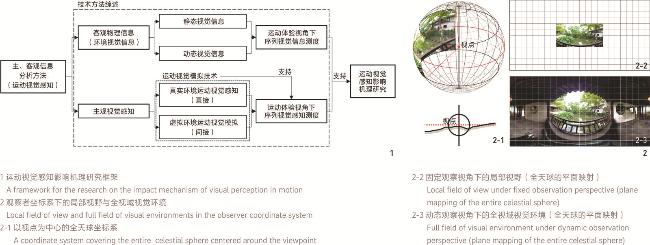
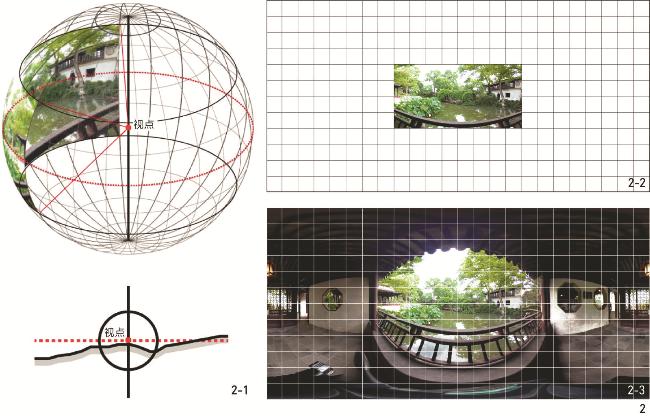
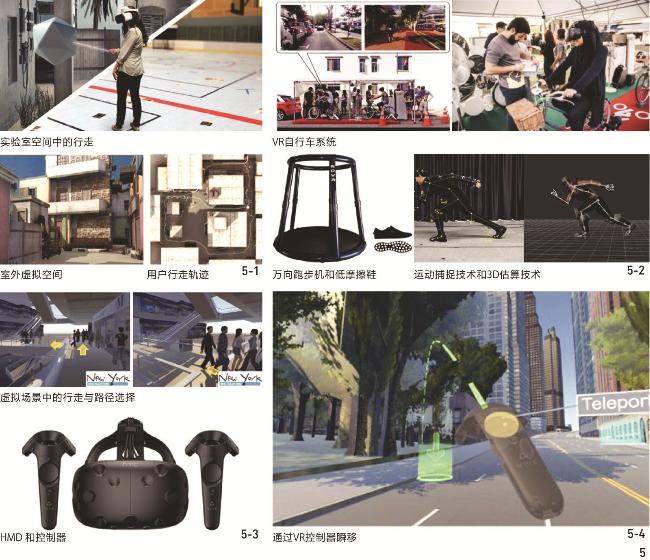
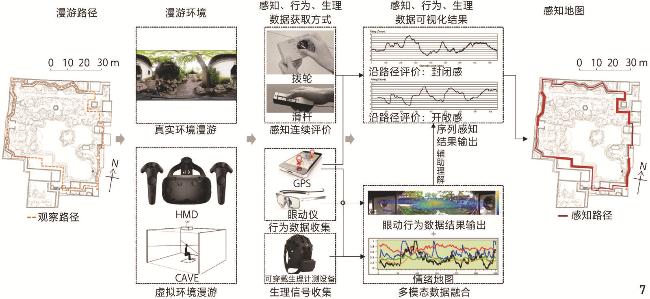
[Objective] Rapid urbanization has prioritized functional and efficient architectural and urban space design, often at the expense of human-centered spatial experience. As China’s urbanization shifts toward optimizing existing spaces, the focus of public space design is evolving to emphasize ambiance and user experience. Evidence-based design, rooted in the “human – space – experience” relationship, has become essential for understanding how people perceive and engage with spaces, offering a foundation for creating more humanized environments. Cognition of built environments, including urban spaces and landscapes, relies on dynamic visual exploration rather than static observation. Visual information, continuously changing during movement, plays a critical role in spatial cognition and environmental experience. Dynamic perception enables a more comprehensive understanding of spaces, making it vital for improving design quality and user satisfaction. Emerging technologies such as panoramic imaging, virtual reality (VR), and wearable sensors provide new opportunities to quantify visual information, simulate dynamic perception, and evaluate subjective experience. These advancements have made the dynamic visual perception in urban public spaces a key research focus. This research reviews the methods for analyzing environmental visual information and dynamic perception. By integrating objective physical environment analysis with subjective perception evaluation, the research proposes a unified framework to explore the mechanisms linking built environments with spatial cognition, and predicts future research directions. [Methods] This research employs a comprehensive review methodology to examine the mechanisms of dynamic visual perception in urban public spaces. By integrating insights from environmental psychology, urban design, and visual perception studies, the research systematically explores both objective and subjective dimensions of spatial cognition. For the analysis of objective physical environments, the research reviews advancements in panoramic imaging, skyline and greenery visibility assessments, and dynamic visual metrics such as optical flow and motion parallax. These methods are evaluated based on their accuracy, computational efficiency, and applicability to real-world environments. In terms of subjective visual perception, the research reviews the methods for simulating dynamic experience through VR, including immersive navigation, motion tracking, and behavior re-creation. This review highlights approach for designing realistic visual experience and capturing human responses to dynamic environments. Additionally, techniques for quantifying subjective perceptions are explored. These include real-time emotion evaluation using wearable sensors, physiological measurements, and machine learning models for multimodal data analysis. Challenges such as data annotation, contextual dependency, and ethical considerations are critically examined to address the complexity of perception assessment. By synthesizing the aforesaid methods, the research establishes a structured framework that supports the evaluation and simulation of dynamic visual perception in built environments, providing a robust foundation for future research and practical applications. [Results] Environmental visual information analysis methods: Panoramic imaging has been shown to offer significant advantages in environmental visual information analysis, enabling comprehensive capture of 360° three-dimensional environmental data centered around the human viewpoint. This method provides a more accurate and reliable representation of the “viewpoint – environment” relationship, overcoming limitations such as shooting angle and lens distortion. Current research primarily focuses on static visual information, such as greenery visibility and sky visibility, using street view data or panoramic images. The primary research trends include improving the accuracy of visual element recognition and enhancing the ability to recognize specific scene elements. While pedestrian trajectory tracking and space syntax-based visual fields are well-developed in dynamic visual information, there is still a gap in the quantification and visualization of motion-induced visual cues, such as optical flow and motion parallax. Motion perception simulation technology: Studies indicate a clear difference in the motion perception results between sequences of images and films. Sequential images fail to effectively convey dynamic visual cues, making them inadequate for simulating motion perception. VR environments, combined with omnidirectional treadmills and handheld controllers, provide more accurate motion simulation by allowing users to simulate physical movements and choose walking paths freely and replicating real-world tour behaviors. Subjective perception quantification methods: Wearable sensors, capable of forming millisecond-level physiological responses to environmental stimuli, have become an effective tool in evaluating subjective environmental experience. However, the challenge remains in using physiological data to precisely identify emotions and understand the dynamic process of perception. Adding sequential descriptive sensors to traditional measurement methods can enhance the accuracy of subjective perception evaluation. Despite the promising applications of machine learning in subjective perception research, challenges such as data annotation difficulties, context dependence, and privacy concerns still persist. [Conclusion] The research demonstrates the advantages of using panoramic images in capturing comprehensive visual information in both static and dynamic environments, offering a more accurate representation of spatial relationships and overcoming traditional limitations. However, there is a need for further development in the quantification and visualization of dynamic visual cues, such as motion parallax and optical flow, as well as in the real-time analysis of dynamic visual information using machine learning. Motion perception simulation methods have highlighted the limitations of traditional sequential images and emphasized the benefits of virtual reality environments for more accurate and immersive experience. Additionally, wearable sensors provide an effective method for quantifying subjective perception, though challenges related to data annotation, context dependence, and privacy must be addressed. Future research directions include improving multimodal fusion techniques, developing personalized perception models, and enhancing the interpretability and transparency of machine learning models, all while ensuring privacy protection.
表1 视野与视觉世界的差异Tab. 1 Differences between visual field and visual world |
| 特征类别 | 边界特性 | 空间感知范围 | 中心清晰度分布 | 信息获取机制 | 知觉表现形式 |
| 视野 | 具有边界但边界模糊,整体呈椭圆形(水平约180°,垂直约150°) | 受生理视域限制 | 中心区域细节丰富,向边缘锐度递减 | 静态注视下的被动接收 | 近似于二维图像帧 |
| 视觉世界 | 无边界,围绕观察者360°范围的全景特征(水平360°,垂直360°) | 超越生理视域限制,通过身体与环境交互扩展 | 无固定中心,通过眼动扫视获得区域性清晰认知 | 动态扫视、主动探索 | 基于实体交互的三维空间体验 |
| 分类 | 文献 | 年份 | 方法 | 特点 |
| 序列图片 | Appleyard[25] | 1964 | 道路上的景观 | 1)由于相机参数和镜头焦距的限制,传统拍摄手段难以全面捕捉完整的环境视觉信息; 2)拍摄角度与照片畸变等因素会影响环境信息属性的准确记录,例如空间方位和视域面积,这种不准确性在一定程度上降低了环境视觉信息量化分析的精确性 |
| Cullen[20] | 1961 | 连续视景 | ||
| 注记系统 | Halprin[21] | 1965 | 运动注记法 | |
| Thiel[22] | 1961 | 序列环境注记法 | ||
| 影片视频 | Bosselmann[23] | 2012 | 采用影片视频模拟物理环境 | 视频作为运动体验的模拟媒介参与规划设计 |
| 采用内窥镜拍摄模型影片视频 | ||||
| Heft[24] | 2000 | 对比序列图片感知与影片视频感知 | 视频区别于序列图片,可以呈现动态视觉信息 |
| 分析方法 | 文献 | 数据类型 | 工具和原理 | 可视化表达 |
| 二维等视域分析 | Turner等[34] | 平面图 | 空间句法、图论 | 二维视域多边形 |
| 三维等视域分析 | Chang等[35] | 平面图结合立面或剖面图 | 空间句法、图论 | 平面和立面热力图 |
| Varoudis等[36] | 3D模型 | 多层空间网格 | 多层平面热力图 | |
| Lu等[37] | 3D模型 | 均匀空间网格 | 三维空间网格点的可见度 | |
| Fisher-Gewirtzman等[38] | 3D模型 | 射线投射法 | 三维视域体积 | |
| Morello等[39] | 3D点云 | 射线投射法 | 视域动画 | |
| 具身等视域分析 | 王浩峰等[40] | 平面图 | 空间句法、图论 | 二维平面热力图 |
| Fisher-Gewirtzman[41] | 3D模型 | 射线投射法 | 三维视域体积 | |
| Krukar等[42] | 3D模型 | 射线投射法 | 三维视域体积 |
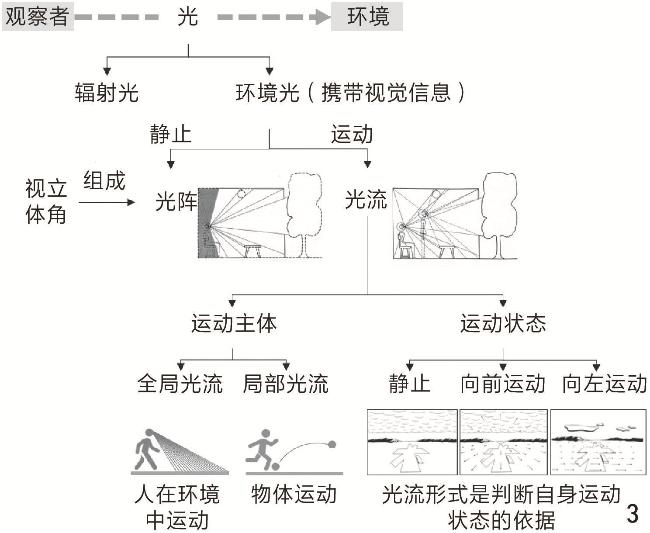
①视点运动与环境界面交互生成光流、运动视差、光学遮掩与显现3类核心运动视觉线索。光流导致观察者前移时环境界面呈现逆向流动;运动视差导致物体运动速率由于相对距离不同存在差异;光学遮掩与显现导致距离近的物体轮廓渐次覆盖或显露远端物体。
| [1] |
周庆华, 王一睿. 基于感知维度的城市设计思考[J]. 规划师, 2021, 37(16): 73-77.
ZHOU Q H, WANG Y R. Perception Oriented Urban Design[J]. Planners, 2021, 37(16): 73-77.
|
| [2] |
成实, 王建国. 基于动态观览评价的视觉景观研究探索: 以南京市滨江型公共空间为例[J]. 中国园林, 2021, 37(11): 57-62.
CHENG S, WANG J G. Visual Landscape Research on Dynamic Viewing Evaluation: A Case Study of Nanjing Riverside Public Viewing Space[J]. Chinese Landscape Architecture, 2021, 37(11): 57-62.
|
| [3] |
刘滨谊, 杨轶伦. 城市街景动态环视旷奥度评价[J]. 风景园林, 2022, 29(8): 64-70.
LIU B Y, YANG Y L. Evaluation of Kuang-Ao Degree in Dynamic Circular Viewing of Urban Streetscape[J]. Landscape Architecture, 2022, 29(8): 64-70.
|
| [4] |
陈筝, 刘颂. 基于可穿戴传感器的实时环境情绪感受评价[J]. 中国园林, 2018, 34(3): 12-17.
CHEN Z, LIU S. Real-Time Environmental Affective Experience Assessment via Wearable Sensors[J]. Chinese Landscape Architecture, 2018, 34(3): 12-17.
|
| [5] |
GIBSON J J. The Perception of the Visual World[M]. Boston: Houghton Mifflin, 1950.
|
| [6] |
GIBSON J J. The Ecological Approach to Visual Perception[M]. Boston: Houghton Mifflin, 1979.
|
| [7] |
潘静, 张慧远, 陈东濠, 等. 动、静态视觉信息在真实世界视觉搜索中的作用[J]. 心理科学进展, 2020, 28(8): 1219-1231.
PAN J, ZHANG H Y, CHEN D H, et al. Visual Search in Real World: The Role of Dynamic and Static Optical Information[J]. Advances in Psychological Science, 2020, 28(8): 1219-1231.
|
| [8] |
PAN J S, BINGHAM N, BINGHAM G P. Embodied Memory: Effective and Stable Perception by Combining Optic Flow and Image Structure[J]. Journal of Experimental Psychology Human Perception and Performance, 2013, 39(6): 1638-1651.
|
| [9] |
THIEL P. People, Paths, and Purpose: Notations for a Participatory Envirotecture[M]. Seattle: University of Washington Press, 1997.
|
| [10] |
OHNO R. Concept of Ambient Vision and Description Method of Ambient Visual Information: A Study on Description Method of Ambient Visual Information and Its Application (Part 1)[J]. Journal of Architecture, Planning and Environmental Engineering (Transactions of AIJ), 1993, 451: 85-92.
|
| [11] |
乐志, 梁晓娜, 范榕. 苏州古典园林中的视觉质量评价分析[J]. 中国园林, 2017, 33(1): 113-118.
YUE Z, LIANG X N, FAN R. The Application of Landscape Visual Quality Assessment Theory in Classical Gardens of Suzhou[J]. Chinese Landscape Architecture, 2017, 33(1): 113-118.
|
| [12] |
INAGAMI M, OHNO R. Anisotropy of Environmental Perception Caused by Spatial Changes During Locomotion[J]. Journal of Environmental Psychology, 2010, 30(2): 258-266.
|
| [13] |
OHNO R, HATA T, KONDO M. Experiencing Japanese Gardens: Sensory Information and Behavior[M]//DEMICK J, TAKAHASHI T, WAPNER S, et al. Handbook of Japan-United States Environment-Behavior Research: Toward a Transactional Approach. New York: Plenum Press, 1997: 163-182.
|
| [14] |
OHNO R, UDAGAWA A, SOEDA M. Effects of Emerging Scenes from the Occluding Edges on Visual Attention and Evaluation of the Landscape[J]. Journal of Architecture and Planning (Transactions of AIJ), 2002, 67(556): 197-203.
|
| [15] |
叶宇, 张灵珠, 颜文涛, 等. 街道绿化品质的人本视角测度框架: 基于百度街景数据和机器学习的大规模分析[J]. 风景园林, 2018, 25(8): 24-29.
YE Y, ZHANG L Z, YAN W T, et al. Measuning Street Greening Quality from Humanistic Perspective: A Large-Scale Analysis Based on Baidu Street View Images and Machine Learning Algorithms[J]. Landscape Architecture, 2018, 25(8): 24-29.
|
| [16] |
张炜, 周昱杏, 杨梦琪. 全景绿视率自动识别和计算研究[J]. 风景园林, 2019, 26(10): 89-94.
ZHANG W, ZHOU Y X, YANG M Q. Research on Automatic Identification and Measurement of Panoramic Visible Green Index[J]. Landscape Architecture, 2019, 26(10): 89-94.
|
| [17] |
KI D, LEE S. Analyzing the Effects of Green View Index of Neighborhood Streets on Walking Time Using Google Street View and Deep Learning[J]. Landscape and Urban Planning, 2021, 205: 103920
|
| [18] |
XIA Y X, YABUKI N, FUKUDA T. Sky View Factor Estimation from Street View Images Based on Semantic Segmentation[J]. Urban Climate, 2021, 40: 100999
|
| [19] |
李鑫, 吴丹子, 李倞, 等. 基于深度学习的城市滨河绿道景观视觉感知评价研究[J]. 北京林业大学学报, 2021, 43(12): 93-104.
LI X, WU D Z, LI L, et al. Research on Visual Perception Evaluation of Urban Riverside Greenway Landscape Based on Deep Learning[J]. Journal of Beijing Forestry University, 2021, 43(12): 93-104.
|
| [20] |
CULLEN G. The Concise Townscape[M]. London: The Architectural Press, 1961.
|
| [21] |
HALPRIN L. Motation[J]. Progressive Architecture, 1965: 126-133.
|
| [22] |
THIEL P. A Sequence-Experience Notation[J]. Town Planning Review, 1961, 32(1): 33
|
| [23] |
BOSSELMANN P. The Berkeley Environmental Simulation Laboratory: A 12 Year Anniversary[J]. Berkeley Planning Journal, 2012, 1(1): 150-160.
|
| [24] |
HEFT H, NASAR J L. Evaluating Environmental Scenes Using Dynamic Versus Static Displays[J]. Environment and Behavior, 2000, 32(3): 301-322.
|
| [25] |
APPLEYARD D, LYNCH K, MYER J R. The View from the Road[J]. Economic Geography, 1964, 42(3): 119-124.
|
| [26] |
胡一可, 丁梦月, 王志强, 等. 计算机视觉技术在城市街道空间设计中的应用[J]. 风景园林, 2017, 24(10): 50-57.
HU Y K, DING M Y, WANG Z Q, et al. The Application Potential Research on Computer Vision Technology in Urban Street Spaces[J]. Landscape Architecture, 2017, 24(10): 50-57.
|
| [27] |
杨柳, 胡一可. 城市型风景名胜区入口空间构成与人群行为研究[J]. 中国园林, 2018, 34(S2): 134-139.
YANG L, HU Y K. The Space Composition and Crowd Behavior Study on Entrances of Urban Scenic Area[J]. Chinese Landscape Architecture, 2018, 34(S2): 134-139.
|
| [28] |
吴韶集, 胡一可. 基于深度学习的公共空间人群行为可视化研究: 以天津大学卫津路校区为例[J]. 风景园林, 2022, 29(2): 106-111.
WU S J, HU Y K. A Visualized Research of Human’s Behavior in Public Spaces Based on Deep Learning: A Case Study of Weijin Road Campus, Tianjin University[J]. Landscape Architecture, 2022, 29(2): 106-111.
|
| [29] |
邓慧姝. 基于运动轨迹追踪和压力传感器网络分析公共空间界面的体感交互机制[J]. 世界建筑, 2023(7): 72-77.
DENG H S. Analysis of Somatosensory Interaction Mechanisms in Public Space Interfaces Based on Motion Trajectory Tracking and Pressure-sensor Network[J]. World Architecture, 2023(7): 72-77.
|
| [30] |
朱海鹏, 孔宇航, 大野隆造. 基于全景技术的园林游观体验视觉分析方法: 以留园为例[J]. 风景园林, 2021, 28(12): 77-84.
ZHU H P, KONG Y H, OHNO R. Visual Analysis Method of Garden Tour Experience Based on Panoramic Images: A Case Study of the Lingering Garden[J]. Landscape Architecture, 2021, 28(12): 77-84.
|
| [31] |
ZHU H, GU Z. A Method of Estimating the Spatiotemporal Distribution of Reflected Sunlight from Glass Curtain Walls in High-Rise Business Districts Using Street-View Panoramas[J]. Sustainable Cities and Society, 2022, 79: 103671
|
| [32] |
朱海鹏.基于环境视觉信息分析的建筑游观空间设计优化方法研究[D].天津: 天津大学, 2022.
ZHU H P. Research on Architectural Sequential Space Based on Ambient Visual Information Analysis and Its Application for Design Assistance[D]. Tianjin: Tianjin University, 2022.
|
| [33] |
BENEDIKT M L. To Take Hold of Space: Isovists and Isovist Fields[J]. Environment and Planning B: Planning and Design, 1979, 6(1): 47-65.
|
| [34] |
TURNER A, DOXA M, O’SULLIVAN D, et al. From Isovists to Visibility Graphs: A Methodology for the Analysis of Architectural Space[J]. Environment and Planning B: Planning and Design, 2001, 28(1): 103-121.
|
| [35] |
CHANG D K, PARK J H. Exploration of Isovist Fields to Model 3D Visibility with Building Facade[J]. Architectural Research, 2011, 13(3): 19-29.
|
| [36] |
VAROUDIS T, PSARRA S. Beyond Two Dimensions: Architecture Through Three Dimensional Visibility Graph Analysis[J]. Journal of Space Syntax, 2014, 5: 91-108.
|
| [37] |
LU Y, GOU Z, YE Y, et al. Three-Dimensional Visibility Graph Analysis and Its Application[J]. Environment and Planning B: Urban Analytics and City Science, 2019, 46(5): 948-962.
|
| [38] |
FISHER-GEWIRTZMAN D, WAGNER I A. Spatial Openness as a Practical Metric for Evaluating Built-Up Environments[J]. Environment and Planning B: Planning and Design, 2003, 30(1): 37-49.
|
| [39] |
MORELLO E, RATTI C. A Digital Image of the City: 3D Isovists in Lynch’s Urban Analysis[J]. Environment and Planning B: Planning and Design, 2009, 36(5): 837-853.
|
| [40] |
王浩锋, 吴昆, 金珊, 等. 一种改进的空间句法视域关系分析方法[J]. 新建筑, 2022(4): 78-82.
WANG H F, WU K, JIN S, et al. An Improved Visibility Graph Analysis Method of Space Syntax[J]. New Architecture, 2022(4): 78-82.
|
| [41] |
FISHER-GEWIRTZMAN D. Integrating ‘Weighted Views’ to Quantitative 3D Visibility Analysis as a Predictive Tool for Perception of Space[J]. Environment and Planning B: Urban Analytics and City Science, 2018, 45(2): 345-366.
|
| [42] |
KRUKAR J, MANIVANNAN C, BHATT M, et al. Embodied 3D Isovists: A Method to Model the Visual Perception of Space[J]. Environment and Planning B: Urban Analytics and City Science, 2021, 48(8): 2307-2325.
|
| [43] |
DÍAZ-VILARIÑO L, GONZÁLEZ-DESANTOS L, VERBREE E, et al. From Point Clouds to 3D Isovists in Indoor Environments[J]. International Archives of the Photogrammetry, Remote Sensing and Spatial Information Sciences, 2018, 624: 149-154.
|
| [44] |
张冠亭, 彭予洋, 奈豪斯. 基于LiDAR点云的中国传统园林视觉空间定量分析方法: 以寄畅园为例[J]. 风景园林, 2024, 31(7): 108-114.
ZHANG G T, PENG Y Y, NIJHUIS S. Method for Quantitative Analysis of Visual Space of Chinese Traditional Gardens Based on LiDAR Point Cloud: A Case Study of Jichang Garden[J]. Landscape Architecture, 2024, 31(7): 108-114.
|
| [45] |
张利, 谢祺旭, 邓慧姝, 等. 空间体验实证的人因分析技术路径[J]. 世界建筑, 2022(9): 42-47.
ZHANG L, XIE Q X, DENG H S, et al. An Ergonomic Analysis Approach for Spatial Experience Proof[J]. World Architecture, 2022(9): 42-47.
|
| [46] |
HEFT H. The Participatory Character of Landscape[J]. Open Space: People Space, 2007, 2: 1-7.
|
| [47] |
SUGITA S, NISHINA D, KOBAYASHI R, et al. A Study on Alternative Possibility of Psychological Evaluation of Exterior Space by Whole Sky Image Evaluation[J]. Journal of Environmental Engineering (Transactions of AIJ), 2018, 83(745): 235-245.
|
| [48] |
AKIYAMA M, NISHINA D, SUGITA S, et al. A Study on Alternative Possibility of Whole Sky Image in Psychological Evaluation of Indoor Space[J]. Journal of Environmental Engineering (Transactions of AIJ), 2018, 83(748): 503-513.
|
| [49] |
WU X, LAI I K W. The Use of 360-Degree Virtual Tours to Promote Mountain Walking Tourism: Stimulus-Organism-Response Model[J]. Information Technology & Tourism, 2022, 24(1): 85-107.
|
| [50] |
KIM S N, LEE H. Capturing Reality: Validation of Omnidirectional Video-Based Immersive Virtual Reality as a Streetscape Quality Auditing Method[J]. Landscape and Urban Planning, 2022, 218: 104290
|
| [51] |
ZHANG R X, ZHANG L M. Panoramic Visual Perception and Identification of Architectural Cityscape Elements in a Virtual-Reality Environment[J]. Future Generation Computer Systems, 2021, 118: 107-117.
|
| [52] |
SAYYAD E, SRA M, HOLLERER T. Walking and Teleportation in Wide-Area Virtual Reality Experiences[C]// IEEE Xplore. 2020 IEEE International Symposium on Mixed and Augmented Reality. Porto de Galinhas: IEEE, 2020: 608-617.
|
| [53] |
LI H, THRASH T, HÖLSCHER C, et al. The Effect of Crowdedness on Human Wayfinding and Locomotion in a Multi-level Virtual Shopping Mall[J]. Journal of Environmental Psychology, 2019, 65: 101320
|
| [54] |
BOGACZ M, HESS S, CHOUDHURY C F, et al. Cycling in Virtual Reality: Modelling Behaviour in an Immersive Environment[J]. Transportation Letters, 2021, 13(8): 608-622.
|
| [55] |
JIA H. The Application and Impact of Artificial Intelligence in the Field of Animation as Well as the Existing Disadvantage[J]. Transactions on Computer Science and Intelligent Systems Research, 2024, 5: 660-671.
|
| [56] |
LI H, MAVROS P, KRUKAR J, et al. The Effect of Navigation Method and Visual Display on Distance Perception in a Large-Scale Virtual Building[J]. Cognitive Processing, 2021, 22(2): 239-259.
|
| [57] |
FECHNER G T. Elements of Psychophysics, 1860[J]. Readings in the History of Psychology, 2007: 206-213.
|
| [58] |
STEVENS S S. On the Psychophysical Law[J]. Psychological Review, 1957, 64(3): 153-181.
|
| [59] |
中野靖久. 心理物理測定法[J]. Vision, 1995, 7(1): 17-27.
NAKANO Y. Psychophysical Measurement Methods[J]. Vision, 1995, 7(1): 17-27.
|
| [60] |
BIOCCA F, DAVID P, WEST M. Continuous Response Measurement (CRM): A Computerized Tool for Research on the Cognitive Processing of Communication Messages[M]//LANG A. Measuring Psychological Responses to Media Messages. London: Routledge, 2014: 15-64.
|
| [61] |
OHNO R. Studies on Environmental Perception During Locomotion: A Review of Empirical Studies by the Ohno Laboratory[J]. Japan Architectural Review, 2018, 1(2): 194-206.
|
| [62] |
ASPINALL P, MAVROS P, COYNE R, et al. The Urban Brain: Analysing Outdoor Physical Activity with Mobile EEG[J]. British Journal of Sports Medicine, 2015, 49(4): 272-276.
|
| [63] |
LARSEN J T, BERNTSON G G, POEHLMANN K M, et al. The Psychophysiology of Emotion[M]//LEWIS M, HAVILAND-JONES J M, BARRETT L F, et al. Handbook of Emotions. New York: Guilford Press, 2008: 180-195.
|
| [64] |
KREIBIG S D. Autonomic Nervous System Activity in Emotion: A Review[J]. Biological Psychology, 2010, 84(3): 394-421.
|
| [65] |
MAUSS I B, ROBINSON M D. Measures of Emotion: A Review[J]. Cognition & Emotion, 2009, 23(2): 209-237.
|
| [66] |
OGAWA Y, OKI T, ZHAO C, et al. Evaluating the Subjective Perceptions of Streetscapes Using Street-View Images[J]. Landscape and Urban Planning, 2024, 247: 105073
|
/
| 〈 |
|
〉 |