

森林疗愈的影响因素及产业化进展研究综述
|
孙震/女/同济大学建筑与城市规划学院在读硕士研究生/研究方向为森林康养 |
|
吴承照/男/博士/同济大学建筑与城市规划学院教授/研究方向为景观游憩学、国家公园管理规划与AI技术应用 |
收稿日期: 2024-12-14
修回日期: 2025-06-17
网络出版日期: 2025-12-09
基金资助
国家自然科学基金“自然景观游憩健康资源评价方法与疗愈模式谱系”(32071835)
版权
A Review of Research on the Influencing Factors and Industrialization Progress of Forest Healing
|
SUN Zhen is a master student in the College of Architecture and Urban Planning (CAUP), Tongji University. Her research focus on forest therapy |
|
WU Chengzhao, Ph.D., is a professor in the College of Architecture and Urban Planning (CAUP), Tongji University. His research focuses on landscape recreation studies, national park management and planning, and AI technology application |
Received date: 2024-12-14
Revised date: 2025-06-17
Online published: 2025-12-09
Copyright
针对森林疗愈理论基础碎片化、实证证据不一致、政策协同不足等制约因素,旨在系统解析森林疗愈的影响因素及作用机制,且分析其产业化路径 ,为构建中国特色的森林疗愈科学支撑体系提供参考。
系统检索WoS和中国知网数据库文献5 173篇,筛选并纳入46篇作为研究数据库,采用叙述性文献综述的方法对森林疗愈的影响因素与产业化路径进行系统分析和归纳总结。
系统揭示了森林疗愈的三维作用机制:1)环境基底机制——森林生物、物理及景观环境通过调节神经内分泌、免疫及心血管功能,触发生理-心理协同响应;2)体验转化机制——结构化游憩活动(静态/低强度/中高强度)将环境资源转化为健康效益;3)制度保障机制——科学森林经营(如树种配置、认证标准)通过资源优化维持疗效可持续性。三者形成闭环系统,为产业化奠定基础。并证实了森林环境对人体健康产生显著的四重效应:生理健康、心理健康、精神健康与社会福祉。
提出森林疗愈的“环境-体验-制度”闭环机制,揭示环境基底、体验转化与制度保障三者的协同规律,阐述了其带来的生理、心理、精神和社会四重健康效益,为康养产品标准化提供设计准则,破解资源转化效率低、政策医疗协同不足等产业瓶颈。建议通过“政-产-学-研”联合构建剂量-效应模型,推动数字疗法(VR/AI)赋能,实现从生态资源到健康经济的价值转化。
孙震 , 吴承照 . 森林疗愈的影响因素及产业化进展研究综述[J]. 风景园林, 2025 , 32(8) : 93 -101 . DOI: 10.3724/j.fjyl.LA20240123
Forest healing, as an interdisciplinary practice, has become an important strategy to address the escalating global burden of health crises caused by urbanization, including chronic stress, cardiovascular disease, and mental health disorders. Against the backdrop of China’s “Healthy China 2030" initiative, forest-based health practices are increasingly recognized as a cost-effective non pharmacological intervention that can improve human health and reduce healthcare costs. However, the industrialization of forest healing is still constrained by fragmented theoretical frameworks, inconsistent empirical evidence, and a lack of policy consistency with international best practices. This research synthesizes international and domestic research to: 1) Identify the key factors shaping forest healing effects, 2) elucidate underlying physiological and psychological mechanisms, and 3) assess the current status and future directions of forest healing industrialization.
This research systematically retrieves 5,173 papers from the Web of Science (WoS) and China National Knowledge Infrastructure (CNKI) databases spaning the period from 1990 to 2023. Based on strict inclusion and exclusion criteria, namely clear research content, integrated research methods combining on-site experiments and questionnaire interviews, measurable health indicators, and clear intervention measures, a total of 46 papers are selected and analyzed in detail. The research adopts a narrative review method to synthesize and summarize research results, with a focus on the synergistic effects of forest environment, recreational activities, and forest management practices. Analysis includes both quantitative and qualitative data, emphasizing the identification of key mechanisms and existing gaps in existing research to guide future research priorities. In addition, case studies are conducted on Japan and Germany to extract best practices in certification systems, related industries, and medical integration.
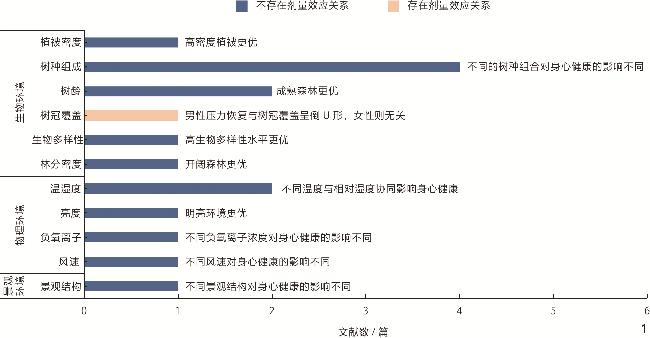
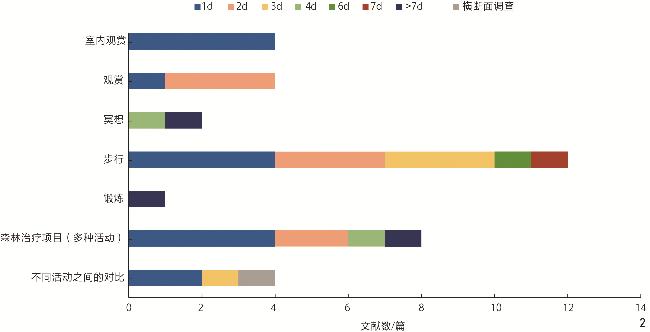
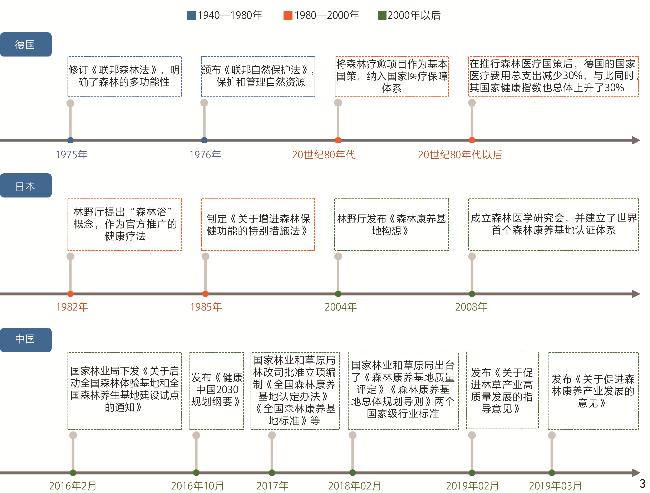
Forest healing takes place through the interaction of three core elements. 1) Environmental factors: The healing effects of forests are moderated through three environmental dimensions: biological dimension (biodiversity, tree age, canopy density, etc.), physical dimension (microclimate, light intensity, negative air ions, etc.) and landscape dimension (aesthetic value, seasonal variation, etc.). For example, Compared with young forests, mature broad-leaved forests have better health improvement effects. High biodiversity levels are associated with improved mental health indicators. 2) Recreational activities: Activities are categorized as static activities (meditation, watching, etc.), low-intensity activities (walking, yoga, etc.), and moderate to vigorous activities (cycling, jogging, etc.). Walking in the forest may reduce the level of salivary cortisol, while enhancing the activity of natural killer (NK) cell. 3) Forest management: Scientific forest management, including sustainable resource allocation and certification systems, is essential to maintain healing effects. The health outcomes are as follows. 1) Physiological benefits: Significant improvements are observed in five systems: Cardiovascular system (decreased blood pressure), endocrine system (decreased serum cortisol), immune system (increased NK cell activity), respiratory system (improved respiratory function), and nervous system (increased parasympathetic activity). 2) Psychological benefits: Forest therapy reduces stress, depression and anxiety while improving mood, concentration and cognitive function. Forest bathing has produced sustained psychological benefits, including relieving stress, restoring attention, improving mood, enhancing sleep quality and cognitive function, while also reducing levels of anxiety and depression, among others. 3) Spiritual benefits: Forests have a moderating effect on internal mental state. In the forest experience, people may feel a sense of awe towards nature, deeper calmness, and inner harmony, which helps to adjust their mental state. 4) Social benefits: Forest welfare includes providing ecological products, ecosystem services, and environmental education, while promoting social interaction, enhancing social cohesion and connections, and helping to achieve social empowerment and reduce social crime rates and violent incidents. This research also highlights successful industrialization models from countries such as Japan and Germany, which have incorporated forest healing into national welfare programs. These models emphasize healthcare, tourism, and education, and are supported by strong policy frameworks and certification standards. In contrast, China’s forest healing industry is still in its infancy and has tremendous potential for growth through policy support, scientific research, and innovative product development.
This research integrates the closed-loop system of “environmental foundation −experience transformation − institutional guarantee”, emphasizing the synergistic effect of forest environment, recreational activities, and forest management in promoting industrialization. The main gaps include insufficient dose − response models, individual heterogeneity (such as gender and specific stress recovery patterns), and clinical validation of therapeutic products. To promote the development of this field, the research proposes the following suggestions. 1) Accurate quantification of forest design: Establish interdisciplinary collaboration, quantify environmental exposure thresholds, prioritize dose − response modeling, and optimize forest configuration design for specific diseases such as hypertension and depression. 2) Policy − industry collaboration: Develop a “government − industry − academia − research” collaboration system to align forest theraph with national health policies, including insurance coverage and medical referrals. 3) Technological innovation: Utilizing digital technology tools such as VR-based forest therapy and AI-driven health monitoring to improve the popularity and economic feasibility of the forest health industry. By addressing these challenges, forest therapy can evolve from a niche health practice into a scalable, evidence-based public health intervention that serves as the cornerstone of a global health strategy aimed at coordinating human well-being and ecosystem resilience, thus contributing to global sustainable development and the United Nations Sustainable Development Goals.
表1 森林游憩活动类型Table 1 Types of forest recreation activities |
| 活动大类 | 定义 | 具体活动类型 |
| 静态活动 | 任何清醒状态下坐、倚、卧的行为,能量消耗为1.5×3.5 mL/(kg·min)或更低 | 观赏/室内观赏、冥想、放松等 |
| 低强度活动 | 是静坐能耗的1.5~3倍,不会导致心率或呼吸频率大幅增加 | 步行、瑜伽、园艺疗法等 |
| 中高强度活动 | 是静坐能耗的3倍以上,会导致心率明显变化[31] | 骑自行车、球类运动、慢跑等 |
表2 森林疗愈的生理效应与测量指标Table 2 Physiological effects and measurement indicators of forest healing |
| 生理系统 | 可测量生理指标 |
| 神经系统 | 血压、脉搏率、心率变异性、前额叶皮层的总血红蛋白浓度、前额叶皮层的氧合血红蛋白浓度 |
| 内分泌系统 | 唾液皮质醇浓度、血糖水平、唾液淀粉酶、血清皮质醇、肾上腺素、去甲肾上腺素 |
| 免疫系统 | 血清炎性因子、自然杀伤细胞活性、自然杀伤细胞数量、外周血淋巴细胞中T细胞、粒细胞、穿孔素和粒酶A/B表达细胞的比例 |
| 心血管系统 | 血压、心率、动脉血压、甘油三酯水平、总胆固醇水平 |
| 呼吸系统 | 第1秒用力呼气容积(forced expiratory volume in one second, FEV1)、6秒用力呼气容积(forced expiratory volume in six second, FEV6) |
表3 森林疗愈的心理效应评估维度与测量方法Table 3 Dimensions and measurements for assessing the psychological effects of forest healing |
| 心理效应评估维度 | 测量方法(问卷量表) |
| 心情 | 情绪状态问卷(Profile of Mood States, POMS)、正负情绪量表(Positive and Negative Affect Scale, PANAS)、瑞典核心情感量表(Swedish Core Affect Scale, SCAS) |
| 抑郁 | 汉密顿抑郁量表(Hamilton Depression Rating Scale, HDRS)、蒙哥马利-阿斯伯格抑郁症评定量表(Montgomery-Asberg Depression Rating Scale, MADRS)、贝克抑郁自评量表(Beck Depression Inventory, BDI)、抑郁自评量表(Self-Rating Depression Scale, SDS) |
| 焦虑 | 状态特质焦虑量表(State-Trait Anxiety Inventory, STAI)、焦虑自评量表(Self-Rating Anxiety Scale, SAS) |
| 活力 | 主观活力量表(Subjective Vitality Scale, SVS) |
| 精神恢复 | 恢复结果量表(Restoration Outcome Scale, ROS)、恢复性成分量表(Restorative Components Scale, RCS)、感知复愈性量表(Perceived Recovery Scale, PRS)、感知环境复愈性量表(Perceived Environmental Restorativeness, RES) |
| 注意力 | 斯特鲁普颜色-单词测试(Stroop Color and Word Test, SCWT)、持续注意力反应任务(Sustained Attention to Response Task, SART)、数字广度测试(Digit Span Test, DST)、符号数字转换测验(Symbol Digit Modalities Test, SDMT) |
| 睡眠质量 | 匹兹堡睡眠质量指数(Pittsburgh Sleep Quality Index, PSQI) |
| 压力 | 感知压力量表(Perceived Stress Scale, PSS) |
| 疲劳 | 疲劳自评量表(Fatigue Self-Assessments Scale, FSAS) |
| 主观感受 | 语义差异法(Semantic Differential, SD) |
| 心理健康 | 华威-爱丁堡心理健康量表(Warwick-Edinburgh Mental Well-Being Scale, WEMWBS) |
表5 日本和德国的森林康养产业体系Table 5 Forest therapy industry systems in Japan and Germany |
| 国家 | 直接产业 | 间接产业 | 产业链 | 产业机制 | 核心特色 |
| 日本 | 康养基地(温泉/禅修)、生态旅游(观光/伴手礼)、健康监测服务、自然教育课程 | 智能穿戴设备、康养师认证、森林文化传播推广 | 上游(森林资源管理)、中游(体验运营)、下游(手工艺品) | “政府主导+企业运营+社区参与”的体系(政策驱动乡村振兴) | 以文化体验与自然资源结合为特色,注重通过森林浴缓解压力、促进健康,同时推动地方经济振兴[55] |
| 德国 | 气候疗法中心、森林运动康复、健康管理定制、城堡疗养体验 | 康养治疗仪器、康养建筑设计、森林疗法认证 | 上游(医疗技术研发)、中游(疗养服务)、下游(国际推广) | 以“医疗体系+森林资源+产业协同”为特色(医疗体系协同) | 专注于科学化和医疗化,强调森林环境在健康管理中的应用[56] |
文中图表均由作者绘制。
| [1] |
LI Q, KOBAYASHI M, KUMEDA S, et al. Effects of Forest Bathing on Cardiovascular and Metabolic Parameters in Middle-Aged Males[J]. Evidence-Based Complementary and Alternative Medicine, 2016, 2016(1): 2587381.
|
| [2] |
JIA B B, YANG Z X, MAO G X, et al. Health Effect of Forest Bathing Trip on Elderly Patients with Chronic Obstructive Pulmonary Disease[J]. Biomedical and Environmental Sciences, 2016, 29(3): 212-218.
|
| [3] |
王仕奇. 森林康养模式下不同环境的正念干预对大学生情绪及注意力的影响研究[D]. 福州: 福建农林大学, 2022.
WANG S Q. Effective of Mindfulness Intervention in Different Environments on Emotion and Attention of University Students Under Forest Therapy Mode[D]. Fuzhou: Fujian Agriculture and Forestry University, 2022.
|
| [4] |
杨帅杰. 不同城市森林环境下的森林康养活动对大学生健康效益的比较研究[D]. 福州: 福建农林大学, 2022.
YANG S J. A Comparative Study of the Effects of Forest Therapy Activities on University Students in Different Urban Forest Environments[D]. Fuzhou: Fujian Agriculture and Forestry University, 2022.
|
| [5] |
LI Q, MORIMOTO K, NAKADAI A, et al. Forest Bathing Enhances Human Natural Killer Activity and Expression of Anti-Cancer Proteins[J]. International Journal of Immunopathology and Pharmacology, 2007, 20(S2): 3-8.
|
| [6] |
HAN J W, CHOI H, JEON Y H, et al. The Effects of Forest Therapy on Coping with Chronic Widespread Pain: Physiological and Psychological Differences Between Participants in a Forest Therapy Program and a Control Group[J]. International Journal of Environmental Research and Public Health, 2016, 13(3): 255.
|
| [7] |
ADEWUYI F A, KNOBEL P, GOGNA P, et al. Health Effects of Green Prescription: A Systematic Review of Randomized Controlled Trials[J]. Environmental Research, 2023, 236: 116844.
|
| [8] |
CHUN H R, CHOI Y Y, CHO I, et al. Indicators of the Psychosocial and Physiological Effects of Forest Therapy: A Systematic Review[J]. Forests, 2023, 14(7): 1407.
|
| [9] |
GRILLI G, SACCHELLI S. Health Benefits Derived from Forest: A Review[J]. International Journal of Environmental Research and Public Health, 2020, 17(17): 6125.
|
| [10] |
谢中, 付甫永, 申修洪, 等. 基于森林健康理念的森林康养产业发展研究[J]. 绿色科技, 2020, 22(3): 135-137.
XIE Z, FU F Y, SHEN X H, et al. Industry Study on the Development of Forest Health Care Industry Based on the Concept of Forest Health[J]. Journal of Green Science and Technology, 2020, 22(3): 135-137.
|
| [11] |
KAPLAN R, KAPLAN S. The Experience of Nature: A Psychological Perspective[M]. London: Cambridge University Press, 1989.
|
| [12] |
ULRICH R S. View Through a Window May Influence Recovery from Surgery[J]. Science, 1984, 224(4647): 420-421.
|
| [13] |
LÓPEZ-POUSA S, BASSETS PAGÈS G, MONSERRAT-VILA S, et al. Sense of Well-Being in Patients with Fibromyalgia: Aerobic Exercise Program in a Mature Forest: A Pilot Study[J]. Evidence-Based Complementary and Alternative Medicine, 2015, 2015: 614783.
|
| [14] |
SIMKIN J, OJALA A, TYRVÄINEN L. Restorative Effects of Mature and Young Commercial Forests, Pristine Old-Growth Forest and Urban Recreation Forest: A Field Experiment[J]. Urban Forestry & Urban Greening, 2020, 48: 126567.
|
| [15] |
TOMAO A, SECONDI L, CARRUS G, et al. Restorative Urban Forests: Exploring the Relationships Between Forest Stand Structure, Perceived Restorativeness and Benefits Gained by Visitors to Coastal Pinus Pinea Forests[J]. Ecological Indicators, 2018, 90: 594-605.
|
| [16] |
AN B Y, WANG D, LIU X J, et al. The Effect of Environmental Factors in Urban Forests on Blood Pressure and Heart Rate in University Students[J]. Journal of Forest Research, 2019, 24(1): 27-34.
|
| [17] |
洪志猛, 兰思仁, 战韵竹. 城市生态风景林公众康养效益评价[J]. 中国城市林业, 2023, 21(6): 91-97.
HONG Z M, LAN S R, ZHAN Y Z. Evaluation on Public Health Benefits of Urban Landscape Ecological Forest[J]. Journal of Chinese Urban Forestry, 2023, 21(6): 91-97.
|
| [18] |
LIU Q H, WANG X P, LIU J L, et al. Physiological and Psychological Effects of Nature Experiences in Different Forests on Young People[J]. Forests, 2021, 12(10): 1391.
|
| [19] |
苏久丹. 不同森林景观空间对大学生身心恢复效果的影响研究[D]. 沈阳: 沈阳农业大学, 2020.
SU J D. The Effect of Different Forest Landscape Spaces on the Physical and Mental Recovery of College Students[D]. Shenyang: Shenyang Agricultural University, 2020.
|
| [20] |
JIANG B, CHANG C Y, SULLIVAN W C. A Dose of Nature: Tree Cover, Stress Reduction, and Gender Differences[J]. Landscape and Urban Planning, 2014, 132: 26-36.
|
| [21] |
NGHIEM T P L, WONG K L, JEEVANANDAM L, et al. Biodiverse Urban Forests, Happy People: Experimental Evidence Linking Perceived Biodiversity, Restoration, and Emotional Wellbeing[J]. Urban Forestry & Urban Greening, 2021, 59: 127030.
|
| [22] |
CHIANG Y C, LI D Y, JANE H A. Wild or Tended Nature? The Effects of Landscape Location and Vegetation Density on Physiological and Psychological Responses[J]. Landscape and Urban Planning, 2017, 167: 72-83.
|
| [23] |
LI C, SUN C G, SUN M K, et al. Effects of Brightness Levels on Stress Recovery When Viewing a Virtual Reality Forest with Simulated Natural Light[J]. Urban Forestry & Urban Greening, 2020, 56: 126865.
|
| [24] |
PARK B J, FURUYA K, KASETANI T, et al. Relationship Between Psychological Responses and Physical Environments in Forest Settings[J]. Landscape and Urban Planning, 2011, 102(1): 24-32.
|
| [25] |
Bielinis E, Omelan A, Boiko S S, et al. The Restorative Effect of Staying in a Broad-Leaved Forest on Healthy Young Adults in Winter and Spring[J]. Baltic Forestry, 2018, 24(2): 218-227.
|
| [26] |
COON J T, BODDY K, STEIN K, et al. Does Participating in Physical Activity in Outdoor Natural Environments have a Greater Effect on Physical and Mental Wellbeing than Physical Activity Indoors? A Systematic Review[J]. Environmental Science & Technology, 2011, 45(5): 1761-1772.
|
| [27] |
OLAFSDOTTIR G, CLOKE P, SCHULZ A, et al. Health Benefits of Walking in Nature: A Randomized Controlled Study Under Conditions of Real-Life Stress[J]. Environment and Behavior, 2020, 52(3): 248-274.
|
| [28] |
OHTSUKA Y, YABUNAKA N, TAKAYAMA S. Shinrin-Yoku (Forest-Air Bathing and Walking) Effectively Decreases Blood Glucose Levels in Diabetic Patients[J]. International Journal of Biometeorology, 1998, 41(3): 125-127.
|
| [29] |
JANECZKO E, GÓRSKI J, WOŹNICKA M, et al. Physical Activity in Forest and Psychological Health Benefits: A Field Experiment with Young Polish Adults[J]. Forests, 2023, 14(9): 1904.
|
| [30] |
HANSMANN R, HUG S M, SEELAND K. Restoration and Stress Relief Through Physical Activities in Forests and Parks[J]. Urban Forestry & Urban Greening, 2007, 6(4): 213-225.
|
| [31] |
World Health Organization. Guidelines on Physical Activity and Sedentary Behaviour[EB/OL]. (2020)[2024-12-10]. https://www.who.int/publications/i/item/9789240015128
|
| [32] |
LEE K J, HUR J, YANG K S, et al. Acute Biophysical Responses and Psychological Effects of Different Types of Forests in Patients with Metabolic Syndrome[J]. Environment and Behavior, 2018, 50(3): 298-323.
|
| [33] |
MARTENS D, GUTSCHER H, BAUER N. Walking in “Wild” and “Tended” Urban Forests: The Impact on Psychological Well-Being[J]. Journal of Environmental Psychology, 2011, 31(1): 36-44.
|
| [34] |
TAKAYAMA N, FUJIWARA A, SAITO H, et al. Management Effectiveness of a Secondary Coniferous Forest for Landscape Appreciation and Psychological Restoration[J]. International Journal of Environmental Research and Public Health, 2017, 14(7): 800.
|
| [35] |
PARK B J, et al. Physiological Effects of Shinrin-Yoku (Taking in the Atmosphere of the Forest) in a Mixed Forest in Shinano Town, Japan[J]. Scandinavian Journal of Forest Research, 2008, 23(3): 278-283.
|
| [36] |
OCHIAI H, IKEI H, SONG C, et al. Physiological and Psychological Effects of Forest Therapy on Middle-Aged Males with High-Normal Blood Pressure[J]. International Journal of Environmental Research and Public Health, 2015, 12(3): 2532-2542.
|
| [37] |
MAO G X, LAN X G, CAO Y B, et al. Effects of Short-Term Forest Bathing on Human Health in a Broad-Leaved Evergreen Forest in Zhejiang Province, China[J]. Biomedical and Environmental Sciences, 2012, 25(3): 317-324.
|
| [38] |
MAO G X, CAO Y B, LAN X G, et al. Therapeutic Effect of Forest Bathing on Human Hypertension in the Elderly[J]. Journal of Cardiology, 2012, 60(6): 495-502.
|
| [39] |
LEE J Y, LEE D C. Cardiac and Pulmonary Benefits of Forest Walking Versus City Walking in Elderly Women: A Randomised, Controlled, Open-Label Trial[J]. European Journal of Integrative Medicine, 2014, 6(1): 5-11.
|
| [40] |
RICHARDSON E A, MITCHELL R. Gender Differences in Relationships Between Urban Green Space and Health in the United Kingdom[J]. Social Science & Medicine, 2010, 71(3): 568-575.
|
| [41] |
KIM W, LIM S K, CHUNG E J, et al. The Effect of Cognitive Behavior Therapy-Based Psychotherapy Applied in a Forest Environment on Physiological Changes and Remission of Major Depressive Disorder[J]. Psychiatry Investigation, 2009, 6(4): 245-254.
|
| [42] |
YU C P, LIN C M, TSAI M J, et al. Effects of Short Forest Bathing Program on Autonomic Nervous System Activity and Mood States in Middle-Aged and Elderly Individuals[J]. International Journal of Environmental Research and Public Health, 2017, 14(8): 897.
|
| [43] |
李博, 聂欣. 疗养期间森林浴对军事飞行员睡眠质量影响的调查分析[J]. 中国疗养医学, 2014, 23(1): 75-76.
LI B, NIE X. Investigation and Analysis on the Influence of Forest Bath on the Sleep Quality of Military Pilots During Convalescence[J]. Chinese Journal of Convalescent Medicine, 2014, 23(1): 75-76.
|
| [44] |
FERGUSON T W, TAMBURELLO J A. The Natural Environment as a Spiritual Resource: A Theory of Regional Variation in Religious Adherence Free[J]. Sociology of Religion, 2015, 76(3): 295-314.
|
| [45] |
WILLIAMS K, HARVEY D. Transcendent Experience in Forest Environments[J]. Journal of Environmental Psychology, 2001, 21(3): 249-260.
|
| [46] |
FREDRICKSON L M, ANDERSON D H. A Qualitative Exploration of the Wilderness Experience as a Source of Spiritual Inspiration[J]. Journal of Environmental Psychology, 1999, 19(1): 21-39.
|
| [47] |
KAMITSIS I, FRANCIS A J P. Spirituality Mediates the Relationship Between Engagement with Nature and Psychological Wellbeing[J]. Journal of Environmental Psychology, 2013, 36: 136-143.
|
| [48] |
李敏菁, 王姿懿, 刘雅涵, 等. 乡村振兴战略背景下森林康养产业对当地农民福祉提升的影响路径研究[J]. 经济师, 2021(9): 145-146.
LI M J, WANG Z Y, LIU Y H, et al. Study on the Influence Path of Forest Health Industry on the Promotion of Local Farmers’ Well-Being Under the Background of Rural Revitalization Strategy[J]. China Economist, 2021(9): 145-146.
|
| [49] |
COLEY R L, SULLIVAN W C, KUO F E. Where Does Community Grow? The Social Context Created by Nature in Urban Public Housing[J]. Environment and Behavior, 1997, 29(4): 468-494.
|
| [50] |
JAY M, SCHRAML U. Understanding the Role of Urban Forests for Migrants: Uses, Perception and Integrative Potential[J]. Urban Forestry & Urban Greening, 2009, 8(4): 283-294.
|
| [51] |
BOCCI C, MISHRA K. Forest Power: The Impact of Community Forest Management on Female Empowerment[J]. Ecological Economics, 2021, 187: 107105.
|
| [52] |
ESCOBEDO F J, CLERICI N, STAUDHAMMER C L, et al. Trees and Crime in Bogota, Colombia: Is the Link an Ecosystem Disservice or Service?[J]. Land Use Policy, 2018, 78: 583-592.
|
| [53] |
LEE J, TSUNETSUGU Y, TAKAYAMA N, et al. Influence of Forest Therapy on Cardiovascular Relaxation in Young Adults[J]. Evidence-Based Complementary and Alternative Medicine, 2014, 2014(1): 834360.
|
| [54] |
MITCHELL R. Is Physical Activity in Natural Environments Better for Mental Health than Physical Activity in Other Environments?[J]. Social Science & Medicine, 2013, 91: 130-134.
|
| [55] |
曹璞渊, 唐玲, 刘华周, 等. 日本森林康养产业发展及其对中国的启示: 以日本长野县信州信浓町森林康养基地为例[J]. 林草政策研究, 2023, 3(4): 88-94.
CAO P Y, TANG L, LIU H Z, et al. Forest Therapy Development in Japan and Its Enlightenment for China: A Case Study of Forest Therapy Base in Shinano, Nagano Prefecture[J]. Journal of Forestry and Grassland Policy, 2023, 3(4): 88-94.
|
| [56] |
刘立军. 森林康养理论与实践[M]. 北京: 中国林业出版社, 2023.
LIU L J. Theory and Practice of Forest Health Care[M]. Beijing: China Forestry Publishing House, 2023.
|
| [57] |
吴后建, 但新球, 刘世好, 等. 森林康养: 概念内涵、产品类型和发展路径[J]. 生态学杂志, 2018, 37(7): 2159-2169.
WU H J, DAN X Q, LIU S H, et al. Health Rehabilitation and Recreation in Forests: Concept Connotation, Product Type and Development Route[J]. Chinese Journal of Ecology, 2018, 37(7): 2159-2169.
|
| [58] |
陆献峰. 德国乡村振兴与森林康养的启示[J]. 浙江林业, 2018(9): 40-41.
LU X F. Enlightenment of Rural Revitalization and Forest Health in Germany[J]. Zhejiang Forestry, 2018(9): 40-41.
|
| [59] |
张胜军. 国外森林康养业发展及启示[J]. 中国林业产业, 2018(5): 76-80.
ZHANG S J. The Development of Foreign Forest-Based Wellness Industry and Its Enlightenment[J]. China Forestry Industry, 2018(5): 76-80.
|
| [60] |
周孜予, 马晓伟. 日本、美国、瑞典森林法框架及启示[J]. 世界林业研究, 2016, 29(5): 77-81.
ZHOU Z Y, MA X W. Forestry Law Framework in Japan, USA and Sweden and Their Inspiration[J]. World Forestry Research, 2016, 29(5): 77-81.
|
| [61] |
German National Tourist Board. Healing forests & nature therapy[EB/OL]. (2023)[2024-11-20]. https://www.germany.travel/en/nature-health-wellness. https://www.germany.travel/en/nature-health-wellness.
|
| [62] |
胡楠, 王培严. 日本森林康养基地营造模式探析[J]. 世界林业研究, 2023, 36(1): 103-109.
HU N, WANG P Y. Mode of Forest Therapy Base Construction in Japan[J]. World Forestry Research, 2023, 36(1): 103-109.
|
| [63] |
束怡, 楼毅, 张宏亮, 等. 我国森林康养产业发展现状及路径探析: 基于典型地区研究[J]. 世界林业研究, 2019, 32(4): 51-56.
SHU Y, LOU Y, ZHANG H L, et al. Development Path of Forest-Based Wellness Industry in China: Based on Typical Cases Study[J]. World Forestry Research, 2019, 32(4): 51-56.
|
| [64] |
刘照, 王屏. 国内外森林康养研究进展[J]. 湖北林业科技, 2017, 46(5): 53-58.
LYU Z, WANG P. The Forest Health Care Research Progress at Home and Abroad[J]. Hubei Forestry Science and Technology, 2017, 46(5): 53-58.
|
| [65] |
钟乐, 张毅, 杨胜兰, 等. 健康公园健康人: 依托自然保护地促进公共健康的国际经验[J]. 风景园林, 2023, 30(1): 38-44.
ZHONG L, ZHANG Y, YANG S L, et al. Healthy Parks Healthy People: Global Experience in Promoting Public Health Through Protected Areas and the Inspirations to China[J]. Landscape Architecture, 2023, 30(1): 38-44.
|
/
| 〈 |
|
〉 |