



|
李智(1998-),女,硕士研究生,主要从事生态产品理论研究. E-mail: lizhi199898@163.com |
收稿日期: 2024-09-13
修回日期: 2024-12-10
网络出版日期: 2026-03-11
基金资助
国家社会科学基金项目(23BGL214)
Static-dynamic matching of ecosystem service supply and demand and ecological management zoning in northwest China
Received date: 2024-09-13
Revised date: 2024-12-10
Online published: 2026-03-11
李智 , 苏洋 , 舒芹 . 基于生态系统服务供需匹配的西北地区生态管理分区[J]. 干旱区地理, 2025 , 48(6) : 1115 -1126 . DOI: 10.12118/j.issn.1000-6060.2024.552
Accurately identifying the spatial characteristics of ecosystem service supply and demand, as well as delineating ecological management zones, is crucial for guiding regional ecosystem management and restoration efforts. This study focuses on the overall ecosystem of northwest China, quantifying the spatial matching of water production, carbon sequestration, and food services from 2000 to 2022 using the water-energy-food nexus as a framework. Ecological management zones are delineated based on the surplus and sustainable characteristics that align supply with demand. The results indicate that (1) The spatial matching of supply and demand for ecosystem services in northwest China varies. Specifically, the supply and demand for water production and food services either fluctuate or remain stable, whereas the demand for carbon sequestration services increases. This rise in demand, coupled with declining supply and demand-supply ratios, leads to a gradual imbalance in matching supply and demand. (2) Food production services are primarily sustainable, whereas water production and carbon sequestration services tend to be unsustainable. (3) Classification and management of ecological zones that consider both ecological and human well-being are necessary, with the aim of enhancing the supply of ecosystem services. The findings of this study provide valuable scientific insights into the rational allocation of basic resources and the precise management of ecosystem services in northwest China.
表1 数据来源Tab. 1 Data source |
| 数据类型 | 空间分辨率 | 数据来源 |
|---|---|---|
| 土地利用数据 | 30 m | 杨杰、黄昕教授发布的中国30 m土地利用数据集(https://zenodo.org/records/8176941) |
| 归一化植被指数(NDVI) | 1 km | NASA地球数据MOD13A3数据集(https://search.earthdata.nasa.gov/search) |
| 高程 | 500 m | 全球海陆数据库(GEBCO)(http://www.gebco.net/) |
| 夜间灯光数据 | 500 m | 文献[23] |
| 气象数据 | 1 km | 国家青藏高原科学数据中心 |
| 土壤数据 | 1 km | 世界土壤数据库(HWSD) |
| 人口密度 | 1 km | LandScan数据集(https://landscan.ornl.gov) |
| GDP数据 | 1 km | 资源环境科学与数据中心 |
| 社会经济数据 | - | 研究区相关统计年鉴、水资源公报、中国能源统计年鉴 |
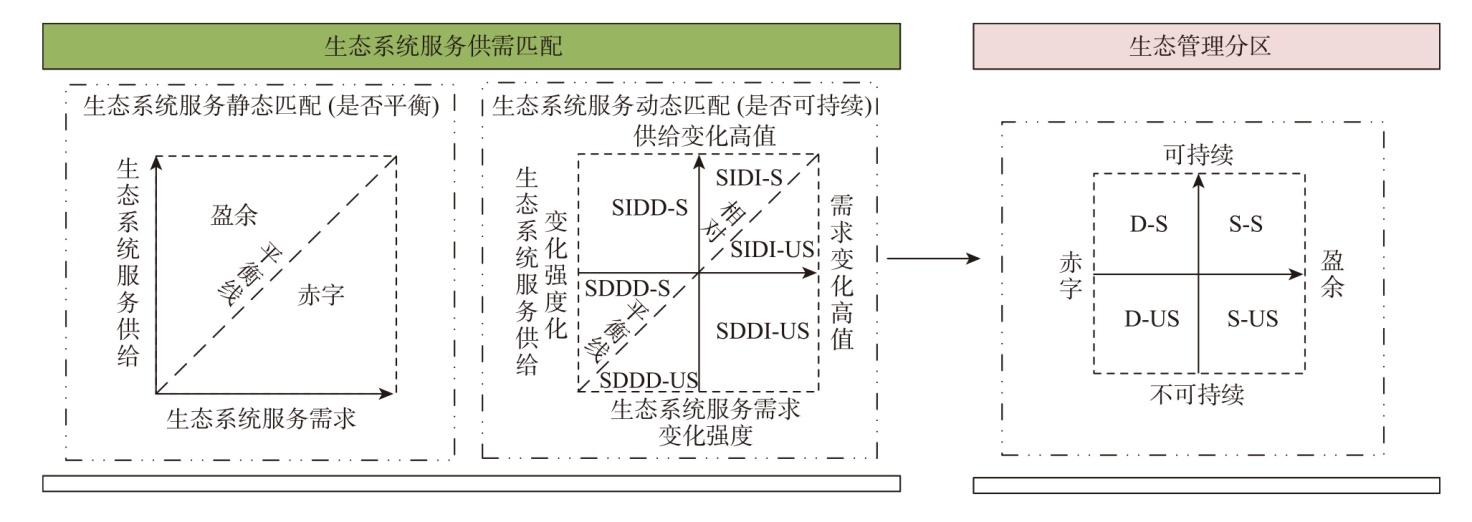
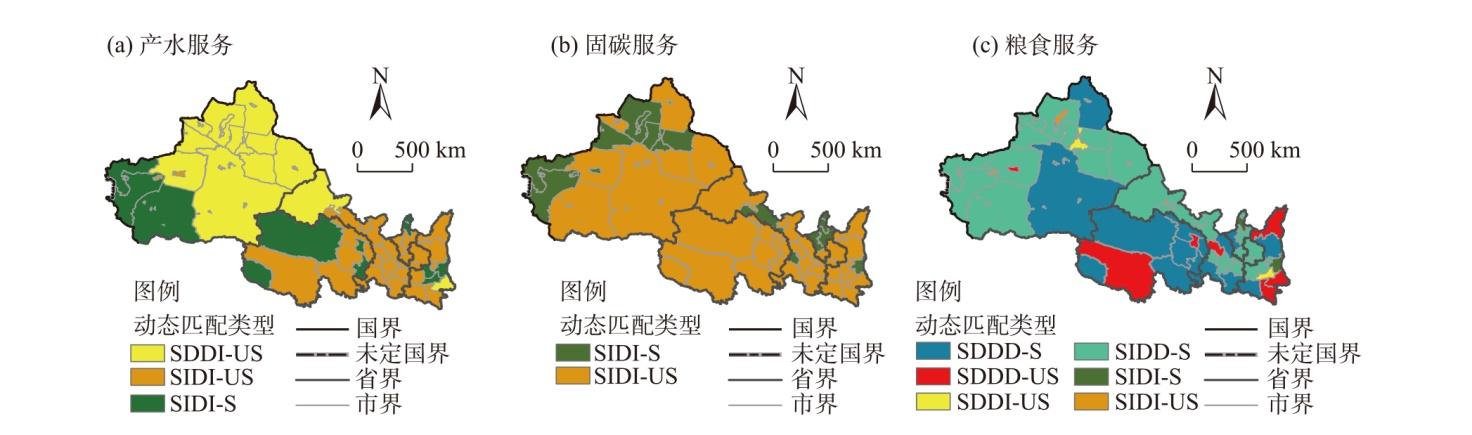
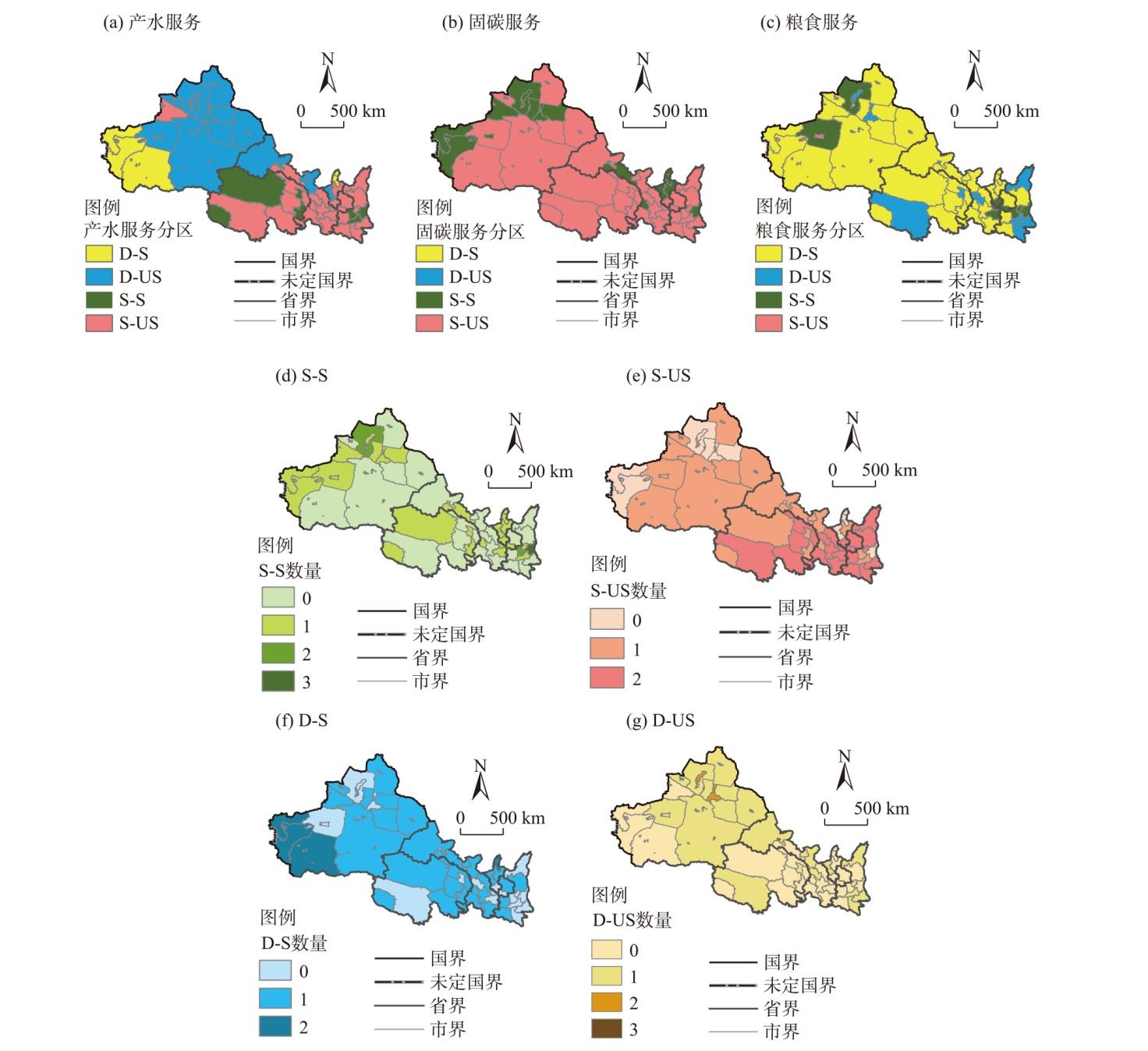
图2 生态系统服务供需匹配与生态管理分区示意图注:SIDI-S为供给增长大于需求增长-可持续型;SIDI-US为供给增长小于需求增长-不可持续型;SIDD-S为供给增加需求减少-可持续型;SDDD-S为供给减少小于需求减少-可持续型;SDDD-US为供给减少大于需求减少-不可持续型;SDDI-US为供给减少和需求增加-不可持续型;S-S为生态系统盈余-可持续型;S-US为生态系统盈余-不可持续型;D-S为生态系统赤字-可持续型;D-US为生态系统赤字-不可持续型。下同。 Fig. 2 Schematic diagram of matching supply and demand for ecosystem services and zoning with ecological management |
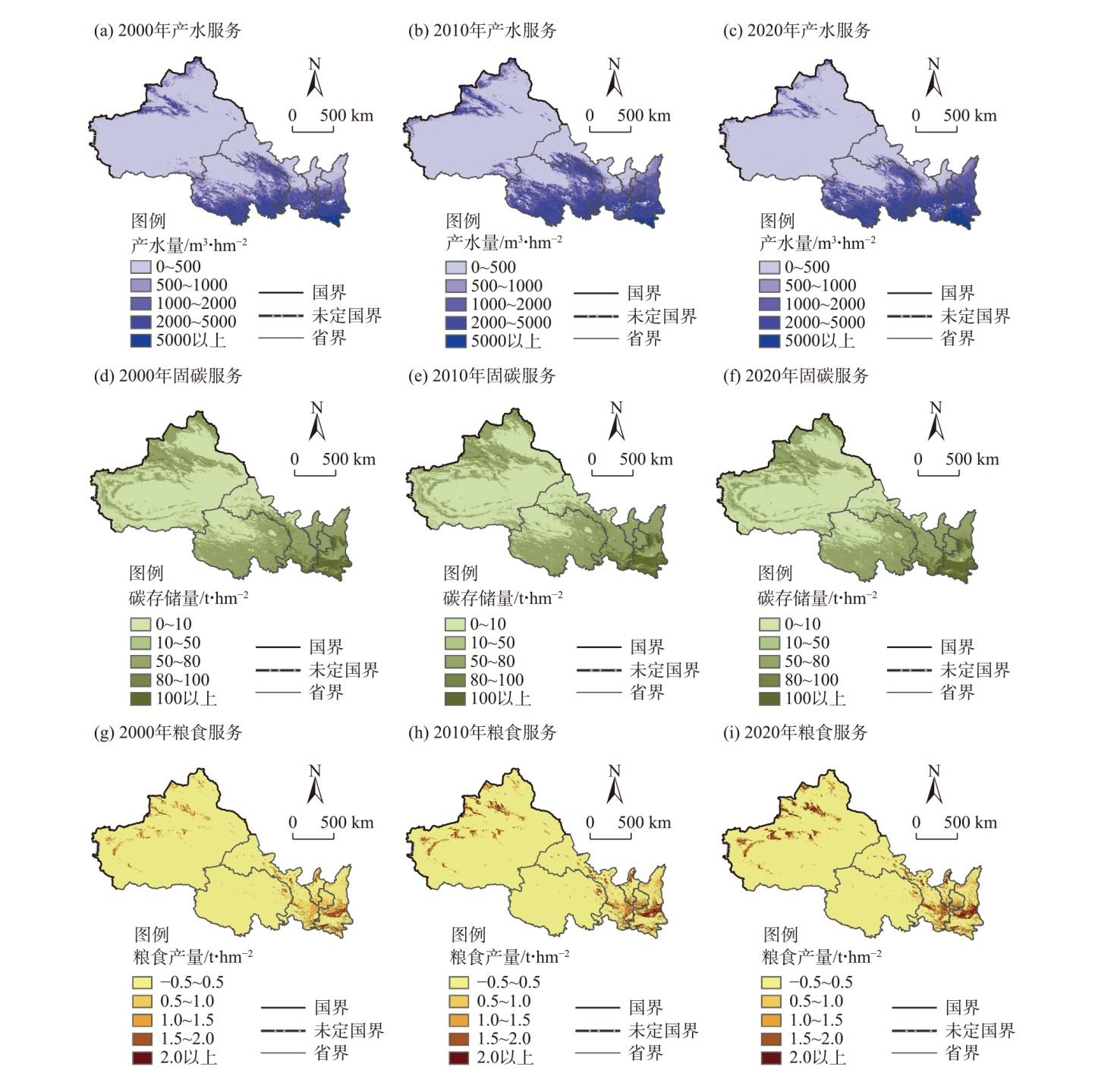
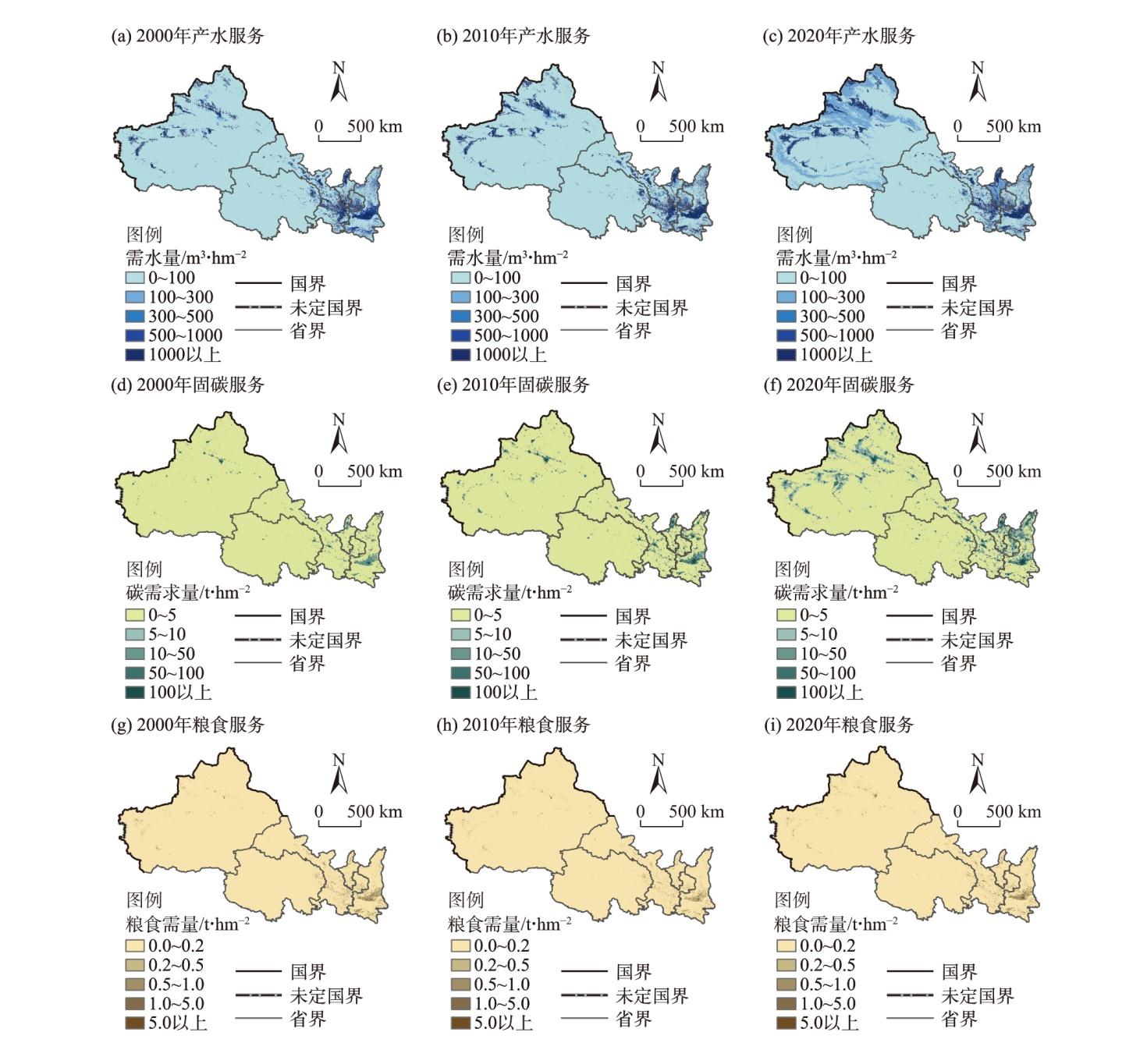
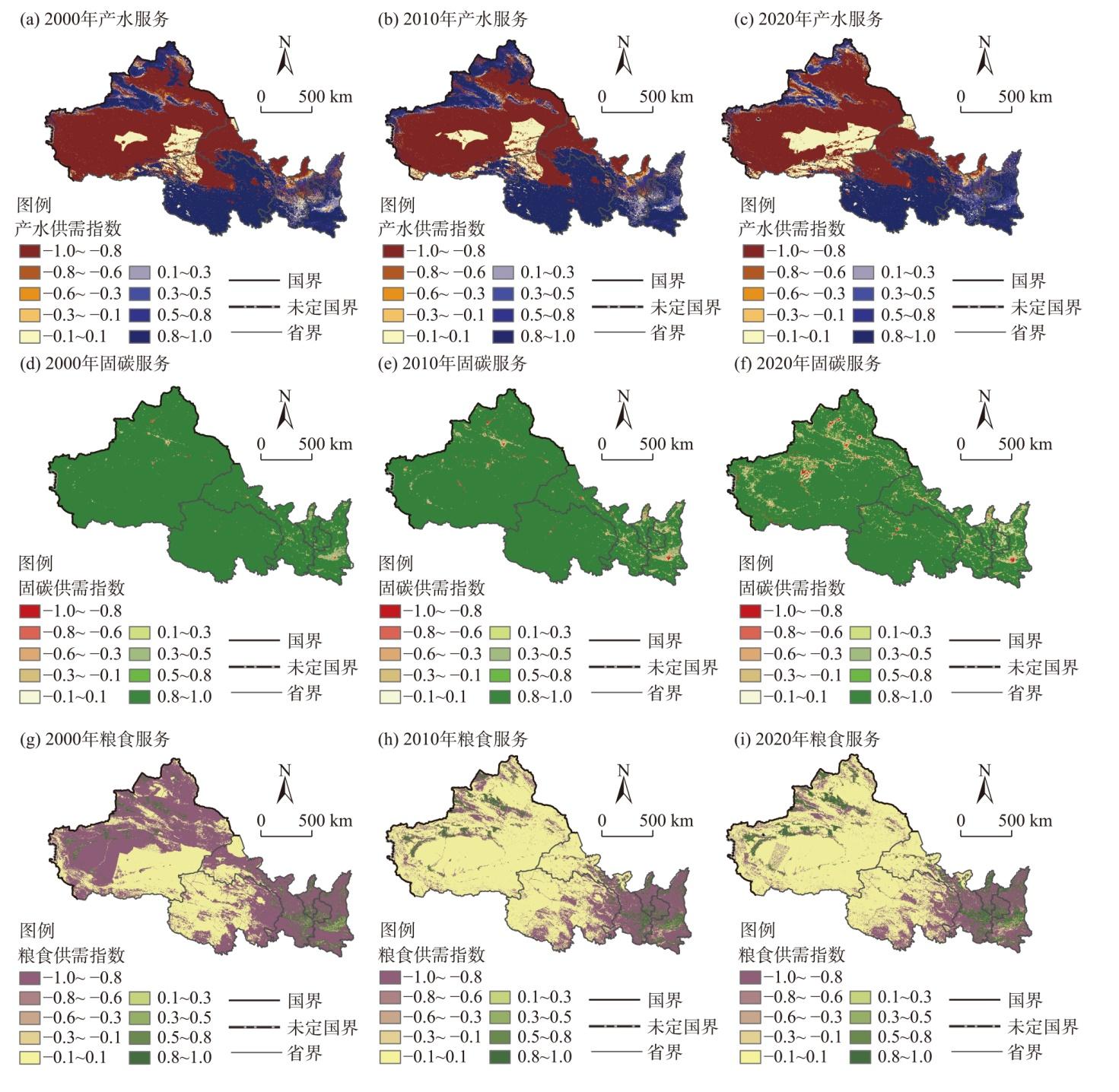
表2 2000—2020年西北地区生态系统服务供需演变Tab. 2 Evolution of supply and demand of ecosystem services in northwest China from 2000 to 2020 |
| 年份 | 产水服务 | 固碳服务 | 粮食服务 | ||||||||
|---|---|---|---|---|---|---|---|---|---|---|---|
| 供给/m3·hm-2 | 需求/m3·hm-2 | 供需指数 | 供给/t·hm-2 | 需求/t·hm-2 | 供需指数 | 供给/t·hm-2 | 需求/t·hm-2 | 供需指数 | |||
| 2000 | 656.86 | 260.78 | 0.72 | 39.33 | 1.03 | 0.95 | 0.10 | 0.04 | 0.43 | ||
| 2005 | 820.14 | 269.85 | 0.75 | 39.61 | 1.25 | 0.94 | 0.11 | 0.03 | 0.57 | ||
| 2010 | 832.72 | 275.52 | 0.75 | 40.02 | 3.21 | 0.85 | 0.13 | 0.03 | 0.63 | ||
| 2015 | 622.54 | 291.27 | 0.68 | 40.14 | 3.21 | 0.85 | 0.15 | 0.03 | 0.67 | ||
| 2020 | 815.37 | 282.17 | 0.74 | 39.86 | 5.25 | 0.77 | 0.16 | 0.03 | 0.68 | ||
| [1] |
|
| [2] |
|
| [3] |
张立伟, 傅伯杰. 生态系统服务制图研究进展[J]. 生态学报, 2014, 34(2): 316-325.
[
|
| [4] |
马琳, 刘浩, 彭建, 等. 生态系统服务供给和需求研究进展[J]. 地理学报, 2017, 72(7): 1277-1289.
[
|
| [5] |
|
| [6] |
刘雨婷, 覃盟琳, 欧阳慧婷, 等. 基于生态系统服务供需平衡的国土空间资源配置优化[J]. 自然资源学报, 2024, 39(6): 1358-1383.
[
|
| [7] |
李成, 赵洁. 长三角城市群生态系统服务供需格局与影响因素研究[J]. 生态经济, 2022, 38(9): 160-169, 187.
[
|
| [8] |
安志英, 孙才志, 郝帅. 我国东北生态系统服务供需匹配关系——基于水-能源-粮食纽带视角[J]. 生态学报, 2024, 44(10): 4170-4186.
[
|
| [9] |
|
| [10] |
管青春, 郝晋珉, 许月卿, 等. 基于生态系统服务供需关系的农业生态管理分区[J]. 资源科学, 2019, 41(7): 1359-1373.
[
|
| [11] |
|
| [12] |
苏伯儒, 刘某承. 基于生态系统服务权衡的生态系统管理策略研究进展[J]. 自然资源学报, 2023, 38(7): 1848-1862.
[
|
| [13] |
|
| [14] |
熊昕莹, 孟梅. 基于生态系统服务供需关系及空间流动的新疆生态管理分区与优化策略[J]. 应用生态学报, 2023, 34(8): 2237-2248.
[
|
| [15] |
李潇飞, 龚健, 叶菁, 等. 生态系统服务权衡协同下的甘肃省生态功能分区优化[J/OL]. 干旱区地理. [2025-01-16].
[
|
| [16] |
|
| [17] |
刘春芳, 王韦婷, 刘立程, 等. 西北地区县域生态系统服务的供需匹配——以甘肃古浪县为例[J]. 自然资源学报, 2020, 35(9): 2177-2190.
[
|
| [18] |
朱瑷嫒, 殷颂葵, 刘琼慧. 中国西北地区农业生态效率时空分异及影响因素研究[J]. 干旱区地理, 2024, 47(7): 1210-1219.
[
|
| [19] |
马泽钰, 李鹏, 肖列, 等. 青海省生态修复关键区识别及修复分区划分[J]. 水土保持学报, 2024, 38(3): 252-265.
[
|
| [20] |
岳文泽, 侯丽, 夏皓轩, 等. 基于生态系统服务供需平衡的宁夏固原生态修复分区与优化策略[J]. 应用生态学报, 2022, 33(1): 149-158.
[
|
| [21] |
张春悦, 白永平, 杨雪荻, 等. 多情景模拟下宁夏平原生态系统服务簇识别研究[J]. 地理研究, 2022, 41(12): 3364-3382.
[
|
| [22] |
孙才志, 魏亚琼, 赵良仕. 干旱区水-能源-粮食纽带系统协同演化——以中国西北地区为例[J]. 自然资源学报, 2022, 37(2): 320-333.
[
|
| [23] |
|
| [24] |
周波, 许源溪, 冯田. 成渝城市群碳平衡空间分异与优化对策[J]. 长江流域资源与环境, 2024, 33(8): 1650-1662.
[
|
| [25] |
赵先超, 彭竞霄, 胡艺觉, 等. 基于夜间灯光数据的湖南省县域碳排放时空格局及影响因素研究[J]. 生态科学, 2022, 41(1): 91-99.
[
|
| [26] |
|
| [27] |
陈宁, 辛存林, 唐道斌, 等. 中国西北地区多情景土地利用优化与碳储量评估[J]. 环境科学, 2023, 44(8): 4655-4665.
[
|
| [28] |
李秀花, 吴纯渊. 中国西北五省区水资源利用的协调性分析[J]. 干旱区地理, 2022, 45(1): 9-16.
[
|
| [29] |
冯起, 白光祖, 李宗省, 等. 加快构建西北地区生态保护新格局[J]. 中国科学院院刊, 2022, 37(10): 1457-1470.
[
|
| [30] |
陕西省人民政府. 陕西省国土空间规划(2021—2035年)[EB/OL]. [2024-06-21]. http://www.shaanxi.gov.cn/zfxxgk/fdzdgknr/ghxx/gtzygh/202406/P020240622343901996974.
[Shaanxi Provincial People’s Government. Shaanxi Province land space planning (2021—2035)[EB/OL]. [2024-06-21]. http://www.shaanxi.gov.cn/zfxxgk/fdzdgknr/ghxx/gtzygh/202406P020240622343901996974.]
|
| [31] |
青海省人民政府. 青海省国土空间规划(2021—2035年)[EB/OL]. [2024-05-27].http://www.qinghai.gov.cn/zwgk/system/2024/05/27/030045305.shtml.
[Qinghai Provincial People’s Government. Spatial planning of Qinghai Province land (2021—2035)[EB/OL]. [2024-05-27]. http://www.qinghai.gov.cn/zwgk/system/2024/05/27/030045305.shtml.]
|
/
| 〈 |
|
〉 |