



|
王生霞(1983-),女,博士,副教授,主要从事旅游地理研究. E-mail: wangshx@lzufe.edu.cn |
收稿日期: 2024-11-04
修回日期: 2025-01-02
网络出版日期: 2026-03-11
基金资助
国家自然科学基金项目(41501076)
甘肃省基础研究计划——软科学专项项目(23JRZA421)
甘肃省基础研究计划——软科学专项项目(24JRZA079)
甘肃省高校青年博士支持项目(2023QB-069)
兰州财经大学校级重点科研项目(Lzufe2023B-001)
甘肃省教育厅高校教师创新基金项目(2024A-070)
Spatiotemporal evolution and obstacle factors of the coupling coordination degree of tourism efficiency and urbanization: A case of the core section of the “Belt and Road”
Received date: 2024-11-04
Revised date: 2025-01-02
Online published: 2026-03-11
王生霞 , 李茂兰 , 刘芮廷 . 旅游业效率与城镇化耦合协调度的时空演变及障碍因素分析——以“一带一路”核心段为例[J]. 干旱区地理, 2025 , 48(11) : 2053 -2061 . DOI: 10.12118/j.issn.1000-6060.2024.679
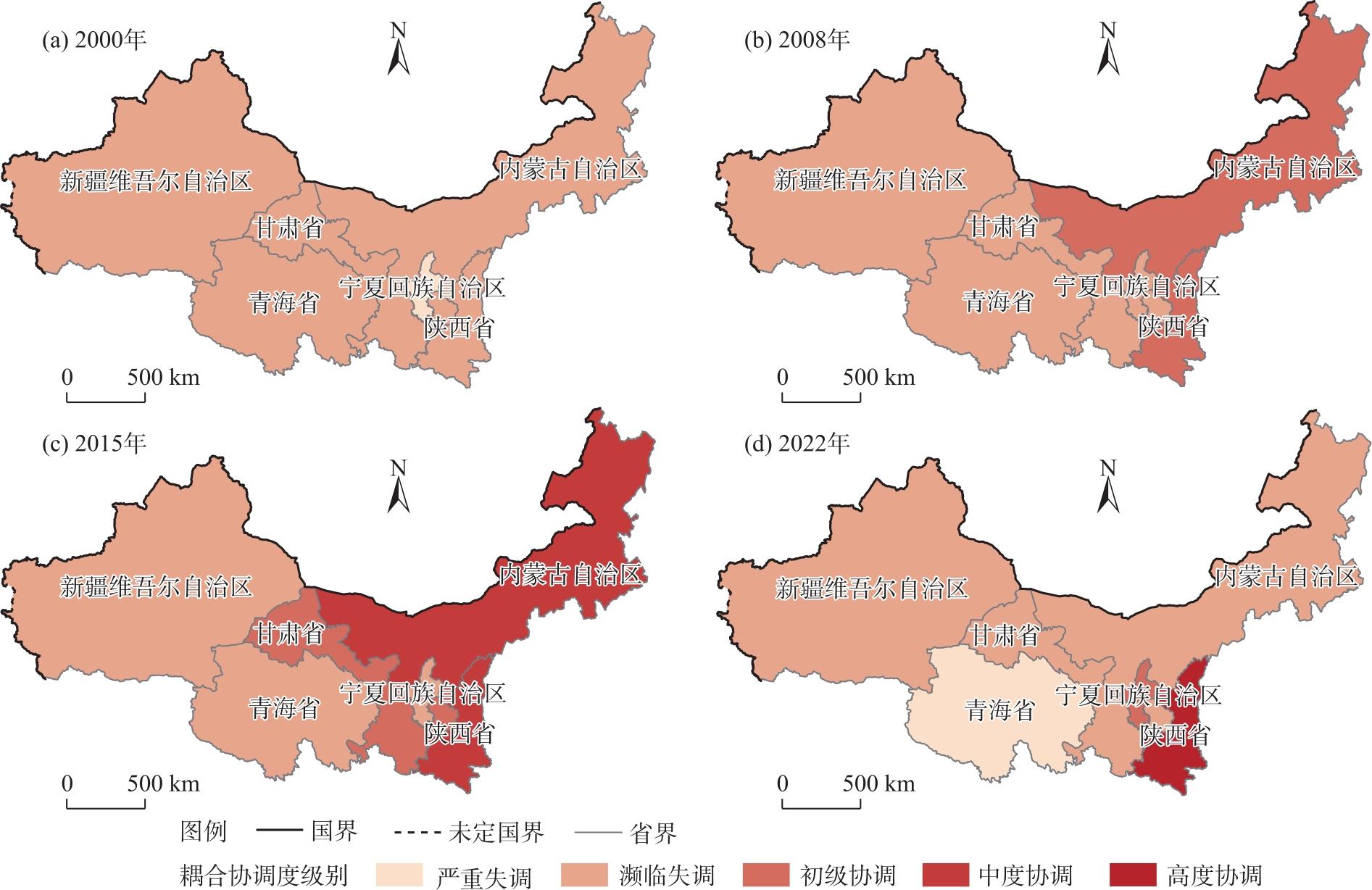
The interaction between tourism and urbanization has become increasingly significant, and the coupling coordination of tourism and urbanization is crucial for the promotion of the high-quality development of regional tourism economies. Using the coupling mechanism of tourism efficiency and urbanization with the Super-SBM model, the entropy method, the coupling coordination degree model, and the obstacle degree model, this study explores the spatiotemporal evolution characteristics and the obstacle factors of the coupling of tourism efficiency and urbanization in a core section of the Belt and Road (six provinces, including Shaanxi, Gansu, Qinghai, Ningxia, Xinjiang, and Inner Mongolia) from 2000 to 2022. The results show that: (1) The average tourism efficiency of the six provinces is 0.73, which is low; the overall level of urbanization is growing steadily, with obvious inter-provincial differences. (2) The coupling coordination degree of tourism efficiency and urbanization in the six provinces has evolved from a near imbalance to primary coordination, with a spatial pattern of distribution that is higher in the southeast and lower in the northwest, and with a center of gravity showing an offset southeast-northeast-southwest pattern, with the degree of agglomeration to the southeast region gradually increasing. (3) The key obstacle factors constraining the degree of coupling coordination of tourism efficiency and urbanization are total tourism revenue, total number of tourists, total postal and telecommunication businesses, number of students in general higher education institutions, and the amount of employees in the tourism industry. The results of the study provide a scientific basis for the high-quality synergistic development of regional tourism and urbanization.
表1 旅游业效率与城镇化水平评价指标体系Tab. 1 Evaluation index system of tourism efficiency and urbanization level |
| 目标层 | 准则层 | 指标层 | 属性 |
|---|---|---|---|
| 旅游业 效率 | 旅游投入 | 旅游业从业人员(X1)/人 | + |
| 旅行社数量(X2)/家 | + | ||
| 星级饭店数量(X3)/家 | + | ||
| 旅游产出 | 旅游总人次(X4)/104人 | + | |
| 旅游总收入(X5)/108元 | + | ||
| 城镇化 | 人口城镇化 | 城镇人口(X6)/104人 | + |
| 城镇人口比重(X7)/% | + | ||
| 第三产业从业人员比重(X8)/% | + | ||
| 经济城镇化 | 人均GDP(X9)/元 | + | |
| 第三产业占GDP比重(X10)/% | + | ||
| 城镇居民人均可支配收入(X11)/元 | + | ||
| 社会城镇化 | 卫生技术人员(X12)/104人 | + | |
| 每万人拥有公共交通车辆数(X13)/标台 | + | ||
| 普通高等学校在校人数(X14)/104人 | + | ||
| 空间城镇化 | 邮电业务总量(X15)/104元 | + | |
| 建成区面积(X16)/km2 | + | ||
| 人均城市道路面积(X17)/m2 | + | ||
| 人均公园绿地面积(X18)/m2 | + |
注:“+”表示正向指标。 |
表2 2000—2022年6省区旅游业效率与城镇化耦合协调度标准差椭圆相关参数Tab. 2 Related parameters of standard deviation ellipse of the coupling coordination of tourism efficiency and urbanization in six provinces from 2000 to 2022 |
| 年份 | 重心坐标 | 面积 /104 km2 | 长轴 /km | 短轴 /km | 方位角 /(°) | 扁率 |
|---|---|---|---|---|---|---|
| 2000 | 100.88°E,39.48°N | 207.56 | 1180.02 | 559.95 | 93.99 | 0.53 |
| 2008 | 103.99°E,39.01°N | 180.70 | 1014.05 | 567.26 | 88.51 | 0.44 |
| 2015 | 104.50°E,39.18°N | 178.49 | 991.85 | 572.86 | 88.30 | 0.42 |
| 2022 | 104.26°E,38.49°N | 159.23 | 1024.52 | 494.75 | 103.25 | 0.52 |
表3 制约6省区旅游业效率与城镇化耦合协调的主要障碍因子Tab. 3 Main obstacles to constrain the coupling and coordination of tourism efficiency and urbanization in six provinces |
| 省区 | 障碍因子(障碍度/%) | ||||
|---|---|---|---|---|---|
| 第一 | 第二 | 第三 | 第四 | 第五 | |
| 内蒙古 | X4(16.96) | X15(16.82) | X5(15.46) | X14(7.73) | X1(7.28) |
| 陕西 | X15(17.21) | X5(15.86) | X4(13.47) | X1(7.67) | X9(6.21) |
| 甘肃 | X5(15.77) | X15(15.34) | X4(14.01) | X14(6.70) | X1(6.64) |
| 青海 | X5(15.02) | X15(14.43) | X4(14.37) | X14(8.03) | X1(6.75) |
| 宁夏 | X5(15.24) | X4(14.51) | X15(14.43) | X14(7.81) | X1(6.78) |
| 新疆 | X5(16.31) | X4(16.02) | X15(15.84) | X14(7.75) | X1(6.65) |
| [1] |
林爽, 赵磊. 城镇化进程对旅游产业竞争力的门槛效应研究[J]. 旅游学刊, 2020, 35(11): 27-41.
[
|
| [2] |
杨山, 杨虹霓, 季增民, 等. 快速城镇化背景下乡村居民生活圈的重组机制——以昆山群益社区为例[J]. 地理研究, 2019, 38(1): 119-132.
[
|
| [3] |
黄震方, 陆林, 肖飞, 等. “双循环”新格局与旅游高质量发展: 理论思考与创新实践[J]. 中国名城, 2021, 35(2): 7-18.
[
|
| [4] |
|
| [5] |
|
| [6] |
秦学. 我国城市旅游研究的回顾与展望[J]. 人文地理, 2001, 16(2): 73-78.
[
|
| [7] |
陶慧, 刘家明, 虞虎, 等. 旅游城镇化地区的空间重构模式——以马洋溪生态旅游区为例[J]. 地理研究, 2017, 36(6): 1123-1137.
[
|
| [8] |
甄翌, 王彩霞. 旅游城镇化驱动活跃性测度及影响因素研究[J]. 旅游学刊, 2020, 35(7): 61-72.
[
|
| [9] |
麻学锋, 刘玉林. 基于三要素的张家界旅游城镇化响应测度及影响机制[J]. 地理科学, 2018, 38(8): 1346-1356.
[
|
| [10] |
高楠, 马耀峰, 李天顺, 等. 基于耦合模型的旅游产业与城市化协调发展研究——以西安市为例[J]. 旅游学刊, 2013, 28(1): 62-68.
[
|
| [11] |
钟家雨, 柳思维, 熊曦. 旅游业与城镇化协同发展的区域差异分析[J]. 经济地理, 2014, 34(2): 187-192.
[
|
| [12] |
方叶林. 中国省域旅游业效率及演化机理研究[D]. 南京: 南京师范大学, 2014.
[
|
| [13] |
刘佳, 陆菊, 刘宁. 基于DEA-Malmquist模型的中国沿海地区旅游产业效率时空演化、影响因素与形成机理[J]. 资源科学, 2015, 37(12): 2381-2393.
[
|
| [14] |
|
| [15] |
宋明珍, 谢家平, 马腾, 等. 我国西部地区旅游业效率水平与空间差异[J]. 桂林理工大学学报, 2022, 42(1): 265-272.
[
|
| [16] |
王兆峰, 刘庆芳. 长江经济带旅游生态效率时空演变及其影响因素[J]. 长江流域资源与环境, 2019, 28(10): 2289-2298.
[
|
| [17] |
朱承亮, 岳宏志, 严汉平, 等. 基于随机前沿生产函数的我国区域旅游产业效率研究[J]. 旅游学刊, 2009, 24(12): 18-22.
[
|
| [18] |
夏赞才, 邹泉, 罗文斌, 等. 中国省域旅游业效率时空演变分析[J]. 统计与决策, 2020, 36(8): 62-66.
[
|
| [19] |
王兆峰, 李琴. 长江中游城市群旅游效率时空演变及其与生态环境的交互响应[J]. 陕西师范大学学报(自然科学版), 2023, 51(2): 24-35.
[
|
| [20] |
徐晓亮, 黄丹, 刘旭义, 等. 中国省域旅游效率时空演变特征及影响因素研究[J]. 干旱区地理, 2023, 46(12): 2052-2060.
[
|
| [21] |
贾国栋, 王立国, 张典, 等. “双碳”目标下江西省旅游业碳排放效率时空特征及其影响因素[J]. 湖南师范大学自然科学学报, 2023, 46(1): 10-19.
[
|
| [22] |
陈园园, 冯娟, 谢双玉. 长江经济带旅游业效率比较及其时空演化特征研究[J]. 华中师范大学学报(自然科学版), 2019, 53(5): 782-791.
[
|
| [23] |
王兆峰, 谢佳亮. 新型城镇化与旅游效率的耦合协调研究——以张家界为例[J]. 福建农林大学学报(哲学社会科学版), 2022, 25(3): 53-63.
[
|
| [24] |
王凯, 何静, 徐小凡, 等. 新型城镇化对旅游效率的空间溢出与门槛效应[J]. 热带地理, 2022, 42(8): 1275-1287.
[
|
| [25] |
唐鸿, 刘雨婧, 麻学锋. 旅游业与新型城镇化协调发展效应评价——以张家界为例[J]. 经济地理, 2017, 37(2): 216-223.
[
|
| [26] |
赵磊, 潘婷婷, 方成, 等. 旅游业与新型城镇化——基于系统耦合协调视角[J]. 旅游学刊, 2020, 35(1): 14-31.
[
|
| [27] |
黄剑锋, 杨德才, 操彬. 旅游业与城镇化共同演化的时空过程及交互机制——以长三角地区为例[J]. 经济地理, 2021, 41(6): 213-222.
[
|
| [28] |
|
| [29] |
|
| [30] |
赵静, 郭佩云, 汪辉. 陕西省旅游生态效率的时空差异及影响因素[J]. 华南师范大学学报(自然科学版), 2024, 56(2): 71-81.
[
|
| [31] |
|
| [32] |
刘苗苗, 吴卫东. 陕西省新型城镇化与乡村振兴耦合性实证研究[J]. 干旱区地理, 2024, 47(8): 1420-1430.
[
|
| [33] |
王淑佳, 孔伟, 任亮, 等. 国内耦合协调度模型的误区及修正[J]. 自然资源学报, 2021, 36(3): 793-810.
[
|
| [34] |
邵海琴, 吴卫, 王兆峰. 长江经济带旅游资源绿色利用效率与新型城镇化的时空耦合协调[J]. 经济地理, 2021, 41(8): 204-213.
[
|
| [35] |
程慧, 游珊. 长三角城市群城市韧性与旅游发展的协调关系[J]. 陕西师范大学学报(自然科学版), 2023, 51(2): 59-69.
[
|
| [36] |
郭向阳, 明庆忠, 丁正山. 中国旅游业与城镇质量协调度空间特征及驱动力识别[J]. 四川师范大学学报(社会科学版), 2020, 47(2): 72-82.
[
|
/
| 〈 |
|
〉 |