|
孟凡兴,男,1987年生,高级工程师,主要从事核与辐射事故应急,辐射环境监测等方面的工作。E-mail:mfx703@163.com; |
收稿日期: 2025-03-03
修回日期: 2025-03-11
网络出版日期: 2025-11-06
基金资助
科学技术部国家重点研发计划项目(2020YFC1806600)
Study on quantitative evaluation of emergency plan of nuclear emergency rescue team
|
MENG Fanxing,male,born in 1987,senior engineer,focusing on nuclear and radiation accident emergency response,radiation environmental monitoring, and related areas of work. E-mail:mfx703@163.com |
Received date: 2025-03-03
Revised date: 2025-03-11
Online published: 2025-11-06
Supported by
National Key Research and Development Program of the Ministry of Science and Technology(2020YFC1806600)
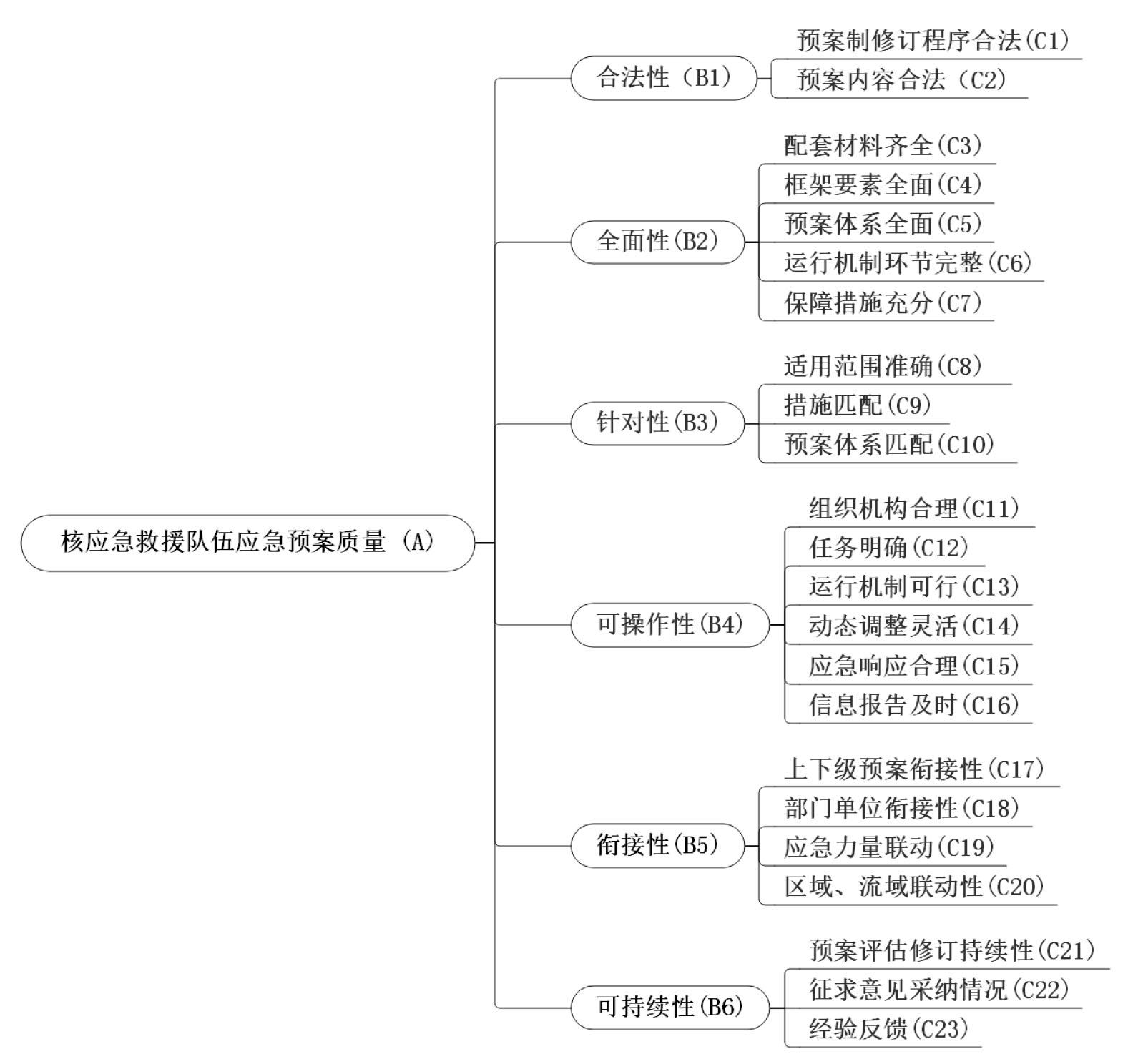
当前核应急预案量化评估研究存在系统性评估框架缺失与方法论局限,国内外尚未建立兼具科学性与可操作性的评价体系。针对核应急救援队伍应急预案评估中存在的指标离散化、评价主观性强等问题,通过多源数据融合与模型集成优化,构建面向应急预案质量的多层次量化评估体系。基于对既往应急预案量化评估实践的梳理与剖析,深度整合核应急救援队伍预案编制的专业特征与运行机制,结合其常态化运维工作的实证数据,系统解构核应急救援预案量化评估的多维要素。通过系统归纳核应急救援全周期管理中应急准备、响应机制、救援实施及效能评估等关键环节的核心评估参数,构建多层次评估体系。该量化评估模型以核应急救援队伍应急预案编制体系为核心基准,系统整合预案编制的规范性原则、结构完整性要求及内容覆盖度等核心评估维度,形成以“应急预案质量优化”为导向的层级化评估框架。模型构建采用结构化指标体系设计方法,确立包含6项一级指标(涵盖制度架构、响应流程和资源配置等关键领域)及23项二级指标(具体化操作标准)的递阶式评价系统。通过AHP建立判断矩阵完成指标权重分配,结合FCE构建隶属度函数实现定性-定量转换,最终形成具有双重验证机制(专家论证与实证检验)的评估算法,可精准量化评估核应急预案在科学性、适用性及可操作性等维度的综合效能水平。实例验证表明:该模型具有良好的适用性。评估结论可直观展现核应急预案各层级指标的状况,为后续我国各级核应急救援队伍开展应急预案量化评估工作提供重要参考。
关键词: 层次分析法(AHP); 模糊综合评价法(FCE); 核应急救援队伍; 应急预案; 量化评估
孟凡兴 , 武明洋 , 李超 , 常腾宇 , 王浩然 , 宋振涛 , 王瑞军 . 核应急救援队伍应急预案量化评估研究[J]. 世界核地质科学, 2025 , 42(3) : 676 -685 . DOI: 10.3969/j.issn.1672-0636.2025.03.018
The current research on quantitative assessment of nuclear emergency response plans suffers from the lack of a systematic assessment framework and methodological limitations,which are manifested in the fragmentation of assessment dimensions,weak relevance of the indicators,and significant subjective cognitive bias,resulting in serious constraints on the comparability and reproducibility of the results of the assessment. The current assessment situation is difficult to meet the urgent needs of nuclear emergency rescue teams for the continuous improvement of plan quality, especially the lack of effective quantitative tools for key performance indicators,such as the timeliness of plan response and the rationality of resource allocation. To address the kennel problems of discrete index system and strength the subjectivity in the evaluation of nuclear emergency rescue teams’emergency plans,this study constructs a multi-level quantitative assessment system for emergency plan quality based on the theory of complex adaptive systems,and the fusion of heterogeneous data from multiple sources and optimisation strategy of model integration. At the level of theoretical construction,this study firstly deconstructs the professional characteristics and operation mechanism in the process of nuclear emergency plan preparation. Combined with the empirical data accumulated during the regular operation and maintenance of nuclear emergency rescue teams,a three-dimensional assessment framework was innovatively proposed. The framework systematically integrates the core assessment dimensions such as normative principles,structural integrity requirements and content coverage,forming a hierarchical assessment system oriented to continuous quality improvement. In terms of methodological innovation,this study adopted the deep coupling strategy of hierarchical analysis method (AHP) and fuzzy comprehensive evaluation method (FCE) to construct a hybrid assessment model with dynamic correction function. Through the structured indicator system design method,a stepwise evaluation system containing 6 first-level indicators (system architecture, response process,resource allocation,training and rehearsal,information management,and continuous improvement) and 23 second-level indicators (e.g.,completeness of command system,timeliness of emergency response,and rate of equipment configuration up to the standard,etc.) has been established. Among them,the AHP module completes the allocation of indicator weights by constructing a 1-9 scale judgement matrix,focusing on solving the problem of quantifying the structural relationship between multi-level indicators;while the FCE module applies the trapezoidal affiliation function to achieve the quantitative conversion of qualitative indicators,effectively reducing the bias of subjective judgement. The model validation process adopts a dual testing mechanism:the theoretical level is to test the structural validity of the indicator system through expert argumentation; the practical level is to select a national nuclear emergency rescue team to carry out empirical research. Example analyses show that the model can accurately identify the weak links of the preplanning system.The quantitative assessment system constructed in this study has gotten breakthroughs in three aspects:First,the establishment of a multi-dimensional evaluation framework of ‘standard compliance-process rationality-performance compliance. Second,the development of a hybrid AHP-FCE algorithm; and third,the innovation of a dynamic correction mechanism,so that the model can automatically optimise the indicator structure with the changes in the emergency environment. The study provides methodological support for the construction of China’s modern assessment system of nuclear emergency response capability,which has important theoretical value and practical guidance significance. Subsequent research will focus on expanding the applicability of the assessment model in the scenarios of nuclear emergency response collaboration and new reactor applications,and continue to improve the universality and accuracy of the model.
表1 核应急救援队伍应急预案质量评估备选指标体系Table 1 An alternative index system for evaluating the quality of emergency plans for nuclear emergency rescue teams |
| 总目标 | 评估要素 | 评估内容 |
|---|---|---|
| 核应急救援队伍应急预案质量 | 合法性 | 预案制、修订程序合法 |
| 预案内容合法 | ||
| 全面性 | 配套材料齐全 | |
| 框架要素全面 | ||
| 事件分类完整 | ||
| 预案体系全面 | ||
| 运行机制、环节完整 | ||
| 保障措施充分 | ||
| 附件附录完备 | ||
| 针对性 | 适用范围准确 | |
| 应急资源、能力、措施与事件类别、风险匹配 | ||
| 预案体系与事件类别、组织机构匹配 | ||
| 可操作性 | 组织机构设置符合实际 | |
| 任务分工职责明确 | ||
| 运行机制明确可行 | ||
| 响应环节动态灵活 | ||
| 分级应对和应急响应措施匹配 | ||
| 信息报告迅速、及时 | ||
| 衔接性 | 上下级预案衔接性 | |
| 组织机构、部门单位衔接性 | ||
| 应急力量联动性 | ||
| 区域、流域联动性 | ||
| 对下级应急预案的政策指导性 | ||
| 持续性 | 预案评估修订持续性 | |
| 征求意见采纳情况 | ||
| 经验教训总结反馈 |
表2 比例标度表Table 2 Scale list |
| 标度 | 定义 | 意义 |
|---|---|---|
| 1 | 同样重要 | 指标i与指标j重要性相同 |
| 3 | 稍微重要 | 指标i的重要性稍微高于指标j |
| 5 | 明显重要 | 指标i的重要性明显高于指标j |
| 7 | 强烈重要 | 指标i的重要性强烈高于指标j |
| 9 | 极端重要 | 指标i的重要性极端高于指标j |
| 2,4,6,8 | 上述判断的中值 | |
表3 RI(平均随机一致性指标)取值表Table 3 List of RI(Randomised Indicator of Average Consistency) values |
| 阶数 | RI | 阶数 | RI |
|---|---|---|---|
| 1 | 0 | 6 | 1.26 |
| 2 | 0 | 7 | 1.36 |
| 3 | 0.52 | 8 | 1.41 |
| 4 | 0.89 | 9 | 1.46 |
| 5 | 1.12 | 10 | 1.49 |
表4 评估指标体系权重计算结果Table 4 Results of weighting of the assessment indicator system |
| 总目标 (A层) | 一级指标 (B层) | 权重 | 一级指标 一致性检验 | 二级指标(C层) | 二级指标 一致性检验 | 权重 | 总权重 |
|---|---|---|---|---|---|---|---|
| 核应急救援队伍应急预案质量 | 合法性 (B1) | 0.044 6 | λmax=6.5934 CI=0.118 7 CR=0.094 2 | 预案制修订程序合法(C1) | - | 0.333 3 | 0.014 9 |
| 预案内容合法(C2) | 0.666 7 | 0.029 7 | |||||
| 全面性 (B2) | 0.120 8 | 配套材料齐全(C3) | λmax=5.018 9 CI=0.004 7 CR=0.018 8 | 0.069 8 | 0.008 4 | ||
| 框架要素全面(C4) | 0.123 3 | 0.014 9 | |||||
| 预案体系全面(C5) | 0.386 5 | 0.046 7 | |||||
| 运行机制环节完整(C6) | 0.160 8 | 0.019 4 | |||||
| 保障措施充分(C7) | 0.259 6 | 0.031 4 | |||||
| 针对性 (B3) | 0.253 2 | 适用范围准确(C8) | λmax=3.071 0 CI=0.035 5 CR=0.026 6 | 0.238 5 | 0.060 4 | ||
| 措施匹配(C9) | 0.136 5 | 0.034 6 | |||||
| 预案体系匹配(C10) | 0.625 0 | 0.158 3 | |||||
| 可操作性(B4) | 0.399 7 | 组织机构合理(C11) | λmax=6.027 4 CI=0.005 5 CR=0.023 8 | 0.373 7 | 0.149 4 | ||
| 任务明确(C12) | 0.161 3 | 0.064 5 | |||||
| 运行机制可行(C13) | 0.1012 | 0.040 5 | |||||
| 动态调整灵活(C14) | 0.121 3 | 0.048 5 | |||||
| 应急响应合理(C15) | 0.121 3 | 0.048 5 | |||||
| 信息报告及时(C16) | 0.121 3 | 0.048 5 | |||||
| 衔接性 (B5) | 0.070 7 | 上下级预案衔接性(C17) | λmax=4.104 6 CI=0.034 9 CR=0.058 8 | 0.491 4 | 0.034 7 | ||
| 部门单位衔接性(C18) | 0.116 5 | 0.008 2 | |||||
| 应急力量联动(C19) | 0.243 8 | 0.017 2 | |||||
| 区域、流域联动性(C20) | 0.148 3 | 0.016 5 | |||||
| 可持续性 (B6) | 0.111 1 | 预案评估修订持续性(C21) | λmax=3.053 6 CI=0.026 8 CR=0.051 6 | 0.332 5 | 0.036 9 | ||
| 征求意见采纳情况(C22) | 0.139 6 | 0.015 5 | |||||
| 经验反馈(C23) | 0.527 8 | 0.058 6 |
表5 赋分标准Table 5 Criteria for assigning points |
| 评价级别 | 优秀 | 良好 | 一般 | 合格 | 不合格 |
|---|---|---|---|---|---|
| 分值 | 90.00~100 | 80.00~89.99 | 70.00~79.99 | 60.00~69.99 | 0~59.99 |
表6 各级评估指标综合得分Table 6 Combined scores for assessment indicators at all levels |
| 总目标(A层) | 综合得分 | 一级指标(B层) | 分值 | 二级指标(C层) | 分值 |
|---|---|---|---|---|---|
| 核应急救援队伍应急预案质量 | 86.54 | 合法性(B1) | 86.52 | 预案制修订程序合法(C1) | 89.06 |
| 预案内容合法(C2) | 85.25 | ||||
| 全面性(B2) | 84.95 | 配套材料齐全(C3) | 81.77 | ||
| 框架要素全面(C4) | 83.22 | ||||
| 预案体系全面(C5) | 90.51 | ||||
| 运行机制环节完整(C6) | 85.59 | ||||
| 保障措施充分(C7) | 77.95 | ||||
| 针对性(B3) | 87.18 | 适用范围准确(C8) | 91.44 | ||
| 措施匹配(C9) | 92.88 | ||||
| 预案体系匹配(C10) | 84.32 | ||||
| 可操作性(B4) | 87.09 | 组织机构合理(C11) | 90.51 | ||
| 任务明确(C12) | 88.13 | ||||
| 运行机制可行(C13) | 81.43 | ||||
| 动态调整灵活(C14) | 79.74 | ||||
| 应急响应合理(C15) | 86.69 | ||||
| 信息报告及时(C16) | 87.62 | ||||
| 衔接性(B5) | 86.56 | 上下级预案衔接性(C17) | 87.62 | ||
| 部门单位衔接性(C18) | 92.88 | ||||
| 应急力量联动(C19) | 82.87 | ||||
| 区域、流域联动性(C20) | 84.15 | ||||
| 可持续性(B6) | 84.86 | 预案评估修订持续性(C21) | 86.69 | ||
| 征求意见采纳情况(C22) | 86.69 | ||||
| 经验反馈(C23) | 83.22 |
| 1 |
谷业凯. 我国在建核电机组数量和总装机容量保持全球第一[N]. 人民日报, 2024-04-17 (3). doi:10.28655/n.cnki.nrmrb.2024.003888.
|
| 2 |
|
| 3 |
张彦, 杨端节, 乔清党, 等. 辐射事故应急预案管理现状及对策研究[J]. 辐射防护, 2021, 41(3):260-263.
|
| 4 |
张建岗, 李国强, 杨亚鹏, 等. 核与辐射应急准备分类及相应的管理要求[J]. 辐射防护, 2021, 41(6):542-549.
|
| 5 |
孙延浩, 张琦, 张芸鹏. 基于模糊层次分析法和证据推理的铁路应急预案评价研究[J]. 中国安全生产科学技术, 2020, 16(1):123-129.
|
| 6 |
崔利杰, 曹志远, 陈浩然, 等. 基于物元分析法的航空事故应急预案评估方法[J]. 火力与指挥控制, 2020, 45(4):115-119+124.
|
| 7 |
马恒, 王苏. 煤矿应急预案评估研究及在常村煤矿中的应用[J]. 矿业安全与环保, 2017, 44 (4): 115-119.
|
| 8 |
孙路军, 丁鹏堃, 房鑫炎, 等. 基于权重自适应的电力应急预案指标评价方法[J]. 电力系统保护与控制, 2019, 47(16):27-33.doi:10.19783/j.cnki.pspc.181173.
|
| 9 |
彭恒明, 王铁骊. 基于犹豫模糊语言集的核电厂场内应急预案评估研究[J]. 科技管理研究, 2021, 41 (1): 181-186.
|
| 10 |
张立国, 曲静原, 童节娟, 等. 核电厂营运单位应急响应能力评估软件平台[J]. 科技导报, 2015, 33 (4): 97-103.
|
| 11 |
李健, 徐艺, 刘亦文. 京津冀突发事件总体应急预案量化评价[J]. 灾害学, 2022, 37(1):147-150+157.
|
| 12 |
孟凡兴, 王瑞军, 赵丛, 等. 中国核应急领域发展态势研究[J]. 环境科学与管理, 2024, 49 (3): 78-82+88.
|
| 13 |
朱兴林, 温喜梅. 基于前景理论与理想解法的应急预案评估模型[J]. 科学技术与工程, 2020, 20(29):12125-12130.
|
| 14 |
刘春年, 王敏. 我国档案部门应急预案的要素提取与模型构建—基于国家层级应急预案文本的内容分析[J]. 档案学研究, 2021(4):62-71.doi:10.16065/j.cnki.issn1002-1620.2021.04.009.
|
| 15 |
张振海, 李红亮, 王晴雯, 等. 地铁应急预案知识本体建模及案例库的构建[J]. 城市轨道交通研究, 2022, 25(8):17-22.doi:10.16037/j.1007-869x.2022.08.004.
|
| 16 |
袁鑫. 基于层次分析法的舰船修理标准实施评估方法研究[J]. 船舶标准化与质量, 2022(2):6-12.
|
| 17 |
孟凡兴, 杨明, 王浩然, 等. 核应急航空辐射监测能力量化评估模型[J]. 核科学与工程, 2024, 44 (2):472-479.
|
| 18 |
孟凡兴, 杨明, 王浩, 等. 基于AHP-FCE的辐射事故应急演习评估研究[J]. 核技术, 2022, 45(11):68-77.110501 doi: 10.11889/j.0253-3219.2022.hjs.45.110501.
|
/
| 〈 |
|
〉 |