|
蔡定雍,男,1999年生,硕士研究生,主要从事地热地质研究。E-mail:1927248483@qq.com |
收稿日期: 2024-12-12
修回日期: 2025-01-30
网络出版日期: 2025-11-07
基金资助
云南省盈江至陇川高温热水带地热资源专项调查(D201709)
Hydrochemical characteristics and genesis of the Lianhuashan geothermal anomalies in Yingjiang of Yunnan
|
CAI Dingyong,male,born in 1999,master,focusing on geothermal geology research. E-mail:1927248483@qq.com |
Received date: 2024-12-12
Revised date: 2025-01-30
Online published: 2025-11-07
Supported by
Special Survey on Geothermal Resources in the High-Temperature Hot Water Belt from Yingjiang to Longchuan in Yunnan Province(D201709)
蔡定雍 , 徐世光 , 张兵 . 云南盈江莲花山地热异常区水化学特征及成因[J]. 世界核地质科学, 2025 , 42(1) : 96 -109 . DOI: 10.3969/j.issn.1672-0636.2025.01.008
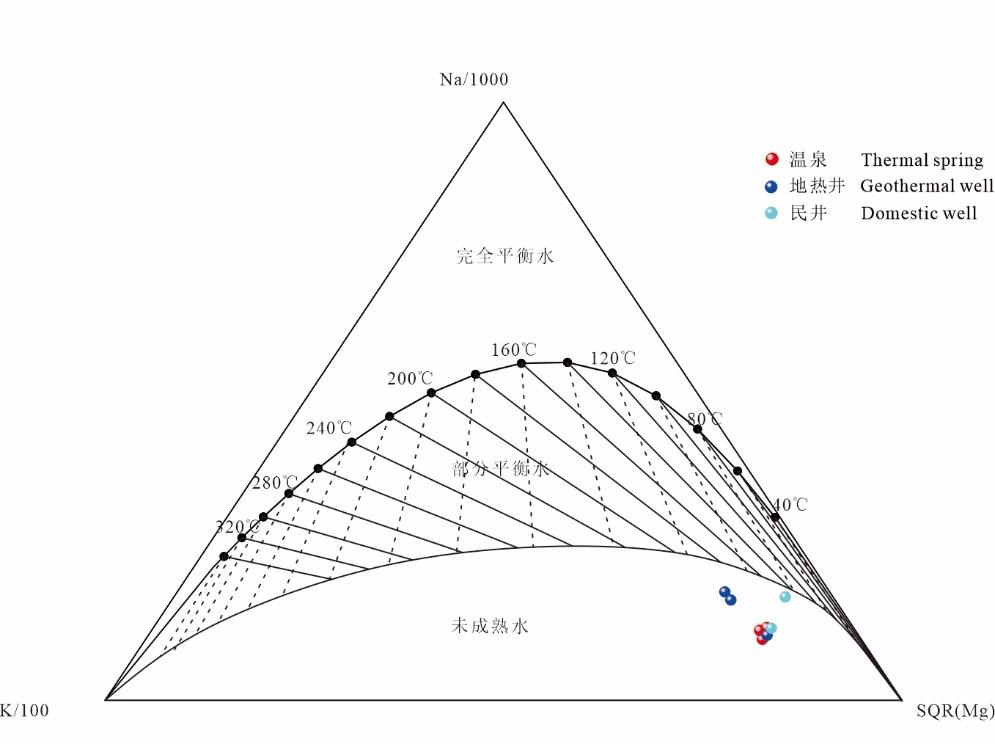
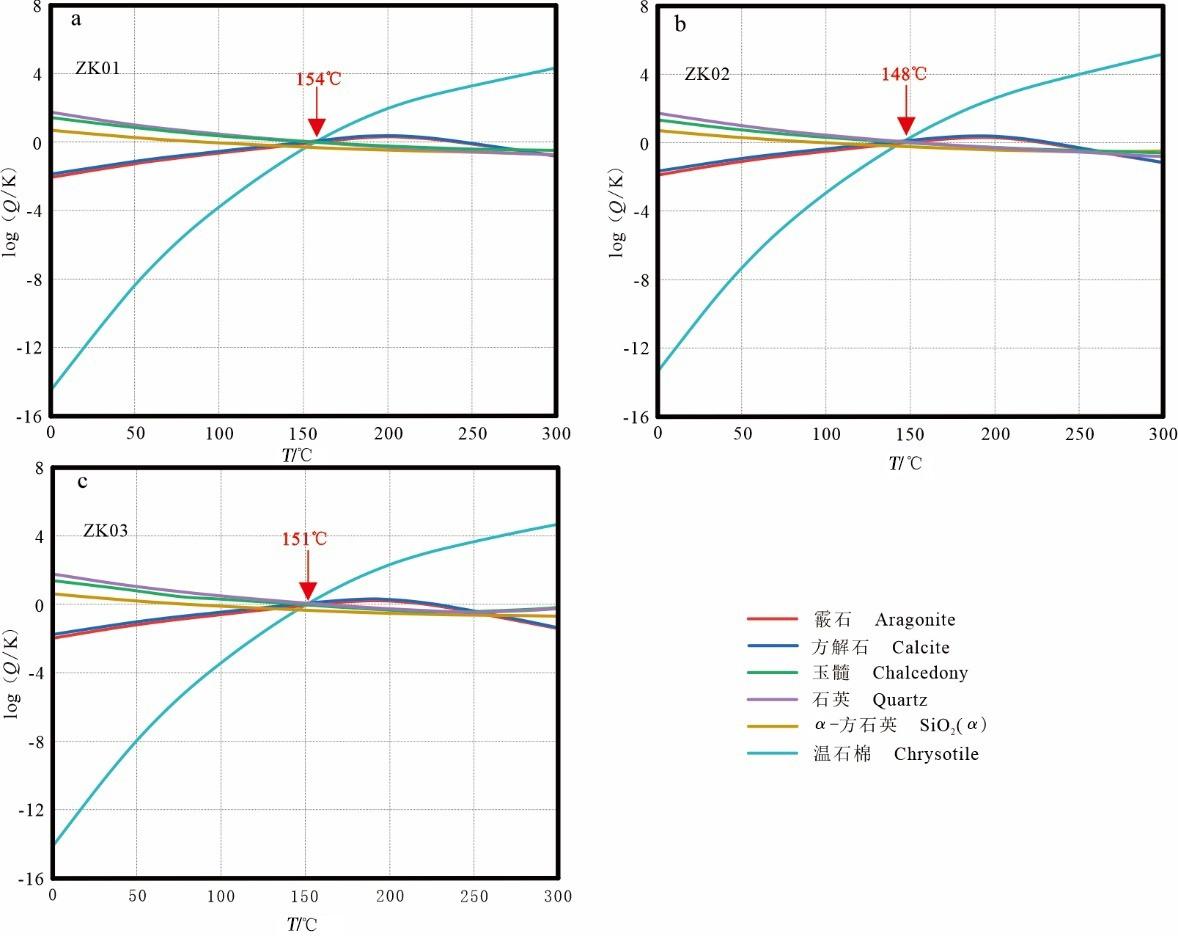
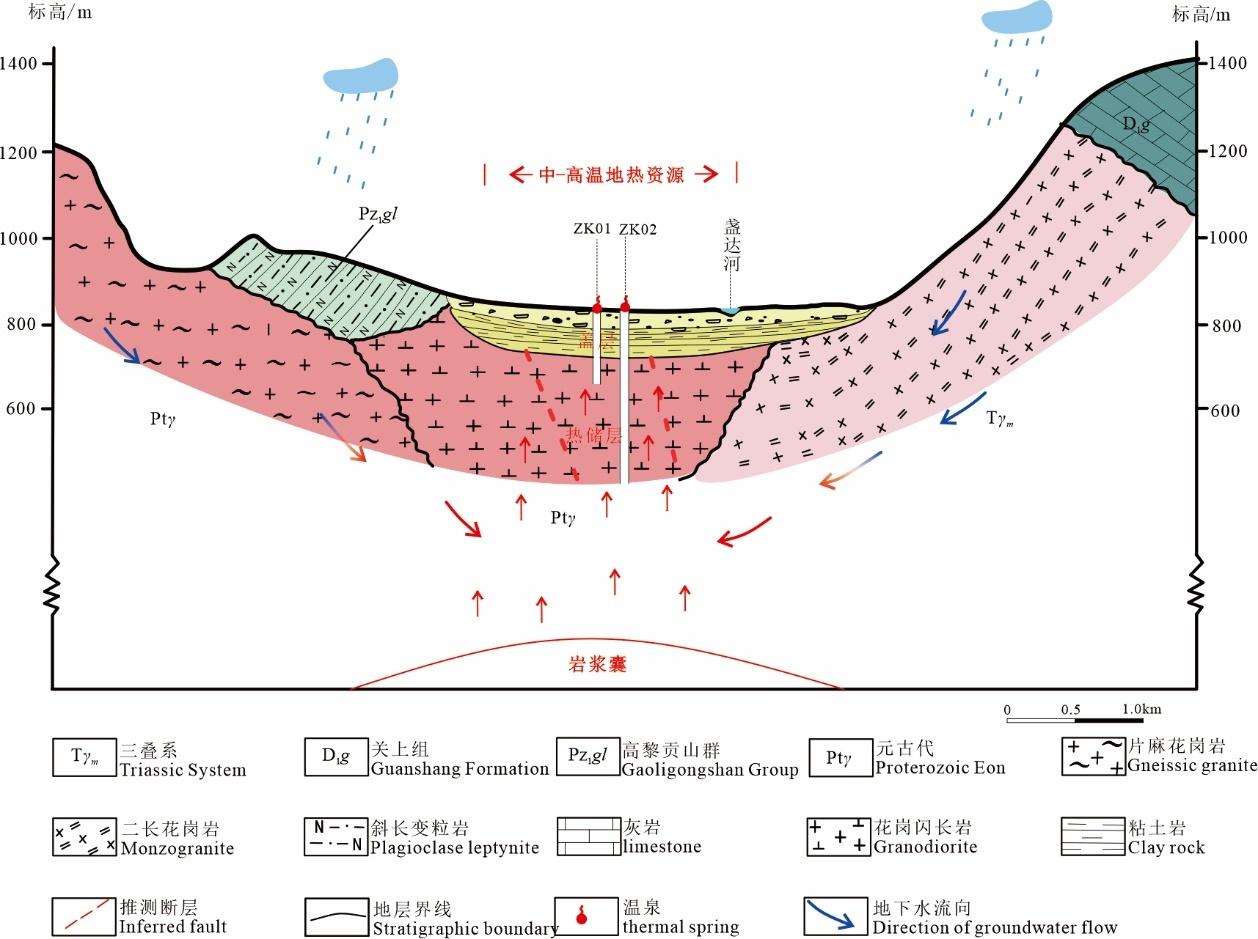
The Lianhua Mountain area in Yingjiang county,Yunnan province,is one of the several w regions in Yunnan that contains medium-high temperature geothermal resources. Previous geothermal research was more focused on meeting the actual production needs, lack of the in-depth exploration in aspects such as the sources of geothermal water chemical components,water-rock interactions,multi-method evaluations of reservoir temperatures,and the genetic mechanisms of geothermal systems. Based on hydro-geochemical methods,this paper aims to identify the circulation process of geothermal water and clarify the formation mechanism of the geothermal system. Through mathematical statistics and correlation analysis of hydrochemical indicators,Piper diagrams,Schoeller diagrams,diagrams of the relationships between anions and cations,hydrogen and oxygen isotope analysis,SiO2 geothermal temperature scale,and the multi-mineral equilibrium method,a systematic study was carried out on the geothermal water chemical types,sources of major ionic components,recharge sources of geothermal water,reservoir temperatures,and circulation depths in the Yingjiang basin. Subsequently,the origin of geothermal water was inferred. The results show that the hydrochemical type of the geothermal fields in the Yingjiang basin is HCO3-Na type. The major ionic components in the geothermal water originate from the dissolution of halide minerals,feldspars,fluorides,gypsum,and other minerals,and are influenced by cation-exchange reactions. The geothermal water is mainly recharged by mountainous atmospheric precipitation at an altitude between 1 348-1 571 m. The deep reservoir temperature is 168.2 °C. During the upwelling process,the geothermal water undergoes water-rock interactions and cation-exchange reactions with the surrounding rocks,resulting in the changes of its hydrochemical components. The heat source of the reservoir mainly comes from the magma chamber in the deep crust. Part of the heat is transferred upward in the form of heat convection through the connection of the Sudian-type fault zone,and the other part is transferred upward through rocks in the form of heat conduction. Atmospheric precipitation infiltrates and circulates along the water-conducting structure,absorbs the heat transferred upward by the magma chamber,and heated. Eventually,a convective-conductive composite hydrothermal system dominated by HCO3-Na type water formed near the fault zone.
表1 研究区地热水样主要离子浓度表Table 1 Table of main ion concentrations of geothermal water samples in the study area |
| 样品编号 | HY01 | HY02 | HY03 | ZK01 | ZK02 | ZK03 | MJ01 | MJ02 | |
|---|---|---|---|---|---|---|---|---|---|
| 类型 | 温泉 | 温泉 | 温泉 | 地热井 | 地热井 | 地热井 | 民井 | 民井 | |
| 取样温度/℃ | 54.3 | 53.8 | 72.3 | 94.2 | 124 | 94.8 | 62.7 | 47.0 | |
| 流量/(m3·d-1) | 104.5 | 127.0 | 178.0 | 268.7 | 345.6 | 172.8 | 31.1 | 11.8 | |
| 阳离子质量浓度/(mg·L-1) | Na+ | 104.11 | 123.92 | 120.04 | 124.75 | 178.47 | 164.78 | 147.93 | 117.24 |
| K+ | 10.74 | 10.27 | 10.51 | 9.62 | 13.14 | 13.17 | 6.48 | 9.72 | |
| Ca2+ | 14.52 | 23.39 | 9.68 | 4.03 | 10.48 | 6.45 | 11.29 | 7.26 | |
| Mg2+ | 0.49 | 0.23 | 0.31 | 0.44 | 0.39 | 0.40 | 0.12 | 0.25 | |
| 阴离子质量浓度/(mg·L-1) | Cl- | 27.83 | 35.32 | 35.72 | 36.87 | 50.97 | 53.62 | 36.15 | 33.89 |
| SO42- | 37.97 | 52.58 | 21.60 | 25.01 | 52.58 | 20.25 | 75.99 | 33.22 | |
| HCO3- | 220.01 | 272.67 | 247.93 | 189.04 | 322.18 | 297.47 | 235.53 | 219.95 | |
| CO32- | 0.00 | 0.00 | 0.00 | 21.33 | 12.19 | 18.28 | 12.19 | 0.00 | |
| F- | 9.09 | 10.72 | 11.18 | 12.00 | 17.29 | 18.92 | 12.05 | 12.44 | |
| SiO2/(mg·L-1) | 126.47 | 180.30 | 176.60 | 185.35 | 221.82 | 194.54 | 168.66 | 176.60 | |
| pH | 8.0 | 7.7 | 8.9 | 9.2 | 9.1 | 8.3 | 8.5 | 8.0 | |
| TDS/(mg·L-1) | 532.09 | 683.36 | 597.90 | 580.50 | 847.63 | 764.78 | 679.76 | 576.23 | |
| 水化学类型 | HCO3-Na | HCO3-Na | HCO3-Na | HCO3-Na | HCO3-Na | HCO3-Na | HCO3-Na | HCO3-Na | |
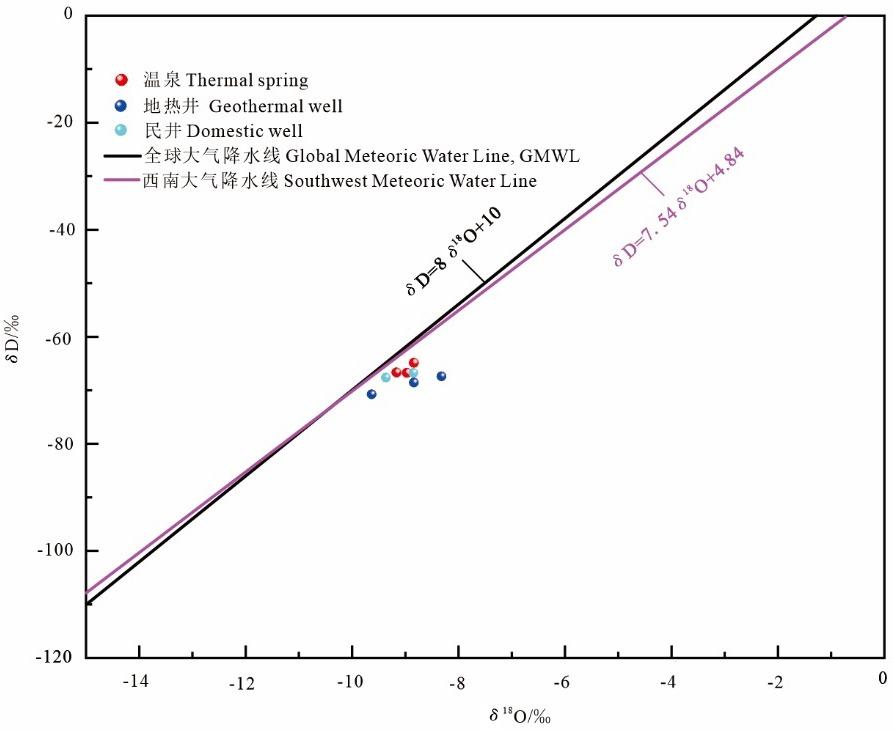
表2 研究区水样氢氧同位素与补给高程结果表Table 2 Results table of hydrogen and oxygen isotopes in water samples and recharge elevation in the study area |
| 编号 | 取样点高程/m | δD/‰ | δ18O/‰ | 补给高程/m |
|---|---|---|---|---|
| HY01 | 842 | -66.79 | -8.97 | 1 410 |
| HY02 | 839 | -66.75 | -9.16 | 1 405 |
| HY03 | 852 | -64.88 | -8.84 | 1 348 |
| ZK01 | 853 | -68.55 | -8.84 | 1 489 |
| ZK02 | 848 | -70.79 | -9.63 | 1 571 |
| ZK03 | 852 | -67.43 | -8.32 | 1 445 |
| MJ01 | 845 | -66.77 | -8.85 | 1 413 |
| MJ02 | 859 | -67.64 | -9.36 | 1 460 |
表3 热储温度计算与热循环深度结果表Table 3 Results table of geothermal reservoir temperature calculation and thermal circulation depth |
| 样品 编号 | SiO2/ (mg·L-1) | 井口温度/ ℃ | 石英温标(无蒸汽损失)/ ℃ | 石英温标(最大蒸汽损失)/℃ | 玉髓温标/ ℃ | 多矿物平衡法/ ℃ |
|---|---|---|---|---|---|---|
| HY01 | 126.47 | 54.3 | 150.8 | 144.1 | 125.6 | |
| HY02 | 180.30 | 53.8 | 173.0 | 162.5 | 150.8 | |
| HY03 | 176.60 | 72.3 | 171.6 | 161.3 | 149.3 | |
| ZK01 | 185.35 | 94.2 | 174.8 | 164.0 | 152.9 | 154 |
| ZK02 | 221.80 | 124.0 | 187.1 | 174.0 | 167.1 | 148 |
| ZK03 | 194.50 | 94.8 | 178.1 | 166.6 | 156.7 | 151 |
| MJ01 | 168.66 | 62.7 | 168.6 | 158.9 | 145.9 | |
| MJ02 | 176.60 | 47.0 | 171.6 | 161.3 | 149.3 |
对编辑及审稿专家致以诚挚的感谢,他们在百忙之中抽出时间审阅论文,并给出宝贵的建设性意见,让研究有了更坚实的改进。
| 1 |
陈墨香, 汪集旸. 中国地热研究的回顾和展望[J]. 地球物理学报, 1994, 37(增刊1):320-338.
|
| 2 |
王贵玲, 张薇, 梁继运, 等. 中国地热资源潜力评价[J]. 地球学报, 2017, 38(4):449-450+134+451-459.
|
| 3 |
孙双振, 朱炎, 赵青松, 等. 河北平泉低温地热资源水文地球化学特征及成因[J]. 世界核地质科学, 2024, 41(5):919-934.
|
| 4 |
王贵玲, 蔺文静. 我国主要水热型地热系统形成机制与成因模式[J]. 地质学报, 2020, 94(7):1923-1937.
|
| 5 |
姜光政, 王亚奇, 胡杰, 等. 中国中-高温地热资源勘探方向与优选靶区[J]. 科技导报, 2022, 40(20):76-82.
|
| 6 |
梅超, 胡志华. 川西巴塘地区措纳柯温泉水成分及微量元素特征[J]. 世界核地质科学, 2024, 41(4):756-764.
|
| 7 |
|
| 8 |
|
| 9 |
吴慧慧. 滇西大盈江流域河流阶地特征及其对新构造运动响应研究[D]. 北京: 中国地质大学, 2013.
|
| 10 |
安晓文, 常祖峰, 石静芳. 大盈江断裂西南段晚第四纪活动研究[J]. 地震研究, 2009, 32(2):193-197+222.
|
| 11 |
全国国土资源标准化技术委员会.地热资源地质勘查规范:GB/T 11615—2010[S]. 北京: 中国标准出版社, 2010.
National Technical Committee for Standardization of Land and Resources.Geologic exploration standard of geothermal resources:GB/T 11615—2010[S]. Beijing: Standards Press of China, 2010 (in Chinese).
|
| 12 |
|
| 13 |
郝伟林, 谢迎春, 周鹏, 等. 谷露地热田水文地球化学特征[J]. 世界核地质科学, 2022, 39(2):321-329.
|
| 14 |
|
| 15 |
高杨, 徐荣华, 高柏, 等. 龙南市南部某断裂带地热水文地球化学特征及成因分析[J/OL]. 地学前缘,https://doi.org/10.13745/j.esf.sf.2024.7.57.
|
| 16 |
符海转, 王世军, 黄泽佼, 等. 海南省陵水县高峰地热田水文地球化学特征与成因分析[J]. 世界核地质科学, 2024, 41(3):508-521.
|
| 17 |
|
| 18 |
|
| 19 |
赵子锐, 张薇, 王贵玲, 等. 冀中坳陷高阳地热田水文地球化学特征及其对地热成因的约束[J]. 中国地质, 2024, 52(1):1-23.
|
| 20 |
|
| 21 |
刘进达, 赵迎昌, 刘恩凯, 等. 中国大气降水稳定同位素时-空分布规律探讨[J]. 勘察科学技术, 1997(3):34-39.
|
| 22 |
柳鉴容, 宋献方, 袁国富, 等. 中国东部季风区大气降水δ18O的特征及水汽来源[J]. 科学通报, 2009, 4(22):3521-3531.
|
| 23 |
|
| 24 |
|
| 25 |
|
| 26 |
李佳乐, 孙占学, 王驹, 等. 水热型地热系统水文地球化学研究进展[J]. 世界核地质科学, 2024, 41(4):765-779.
|
| 27 |
|
| 28 |
黄小龙, 吴中海, 赵小艳, 等. 2014年5月云南盈江MS5.6、MS6.1地震发震构造分析[J]. 地球学报, 2015, 36(6):760-769.
|
| 29 |
张艳凤, 常祖峰, 彭永中. 2014年云南盈江6.1级地震宏观异常及其与构造关联性讨论[J]. 地震研究, 2018, 41(1):148-156.
|
| 30 |
蓝江波. 滇西高黎贡-腾梁-盈江带中新生代岩浆作用及其构造意义[D]. 广州: 中国科学院广州地球化学研究所, 2009.
|
| 31 |
肖常先. 云南腾冲-盈江地区地质构造与矿产资源分布[J]. 云南地质, 2015, 34(1):7-11.
|
/
| 〈 |
|
〉 |