|
欧开发,男,1997年生,硕士研究生,主要从事核数据处理与计算机视觉的研究。E-mail: oukaifa@163.com |
收稿日期: 2025-01-13
修回日期: 2025-01-24
网络出版日期: 2025-11-07
基金资助
国家自然科学基金项目(12165001)
A rapid identification method for nuclide spectra based on MobileNetV3
|
OU Kaifa,male,born in 1997,master,focusing on nuclear data processing and computer vision. E-mail:oukaifa@163.com |
Received date: 2025-01-13
Revised date: 2025-01-24
Online published: 2025-11-07
Supported by
National Natural Science Foundation of China(12165001)
(12165001)
放射性核素的快速识别是核材料检测系统的关键组成部分,对于提高放射性检测的性能和效率至关重要。然而,传统的核素能谱识别方法通常需要经历去噪、本底扣除和特征提取等多个复杂步骤,这些过程计算复杂度高、耗时较长且识别效率有限,难以满足实际应用中的快速响应需求。针对这些问题,提出一种基于MobileNetV3神经网络的核素能谱快速识别算法,通过改进数据处理与模型训练方法,实现对核素的高效识别。利用蒙特卡罗(MCNP)模拟软件生成一系列仿真数据,包括不同放射源及粒子数、NaI探测器与放射源的距离,以及混合核素场景下的能谱数据。这些多样化的数据用于训练和验证网络模型,增强模型的泛化能力。为更有效地处理γ能谱中的全能峰特性,设计一种基于滑动窗口的预处理方法,将一维能谱数据逐道进行变换。随后,采用希尔伯特曲线对经过滑动窗口处理的能谱数据进行二维映射,将其转换为灰度图像形式输入到MobileNetV3模型中进行训练和预测。实验结果表明,构建的神经网络模型在快速处理滑动窗口后的能谱数据方面表现优异,能够在高效学习的同时实现对不同核素的高精度识别。在模型性能方面,选用滑动窗口大小为23和25时,模型不仅收敛速度更快,还显著提高识别的准确率。
关键词: MobileNetV3; 神经网络; 滑动窗口; 希尔伯特曲线; 核素识别
欧开发 , 周书民 , 陈锐 . 基于MobileNetV3的核素能谱快速识别方法[J]. 世界核地质科学, 2025 , 42(1) : 203 -210 . DOI: 10.3969/j.issn.1672-0636.2025.01.018
The rapid identification of radionuclides is a critical component of nuclear material detection systems,essential for improving the performance and efficiency of radiation detection. Traditional nuclide spectrum recognition methods typically involve multiple complex steps,such as noise reduction,background subtraction,and feature extraction,which are computationally intensive,time-consuming,and inefficient,making them unsuitable for rapid response in practical applications. To address these issues,this paper proposed a rapid nuclide spectrum recognition algorithm based on the MobileNetV3 neural network,which achieved efficient nuclide recognition by optimizing data processing and model training methods. A series of simulated datasets were generated using Monte Carlo (MCNP) simulation software,including scenarios with different radioactive sources and particle counts,varying distances between NaI detectors and the sources,and mixed nuclide environments. These diverse datasets were used to train and validate the network model,enhancing its generalization capability. To better process the full-energy peak characteristics of gamma spectra,this study designs a preprocessing method based on a sliding window approach,which incrementally transforms one-dimensional spectral data. Subsequently,the transformed spectral data is mapped into two-dimensional grayscale images using Hilbert curves and input into the MobileNetV3 model for training and prediction. Experimental results demonstrate that the proposed neural network model performs exceptionally well in rapidly processing spectrum data handled by the sliding window method,achieving high-precision recognition of different nuclides while maintaining efficient learning. In terms of model performance,using sliding window sizes of 23 and 25 results in faster convergence and significantly improved recognition accuracy. This study highlights the effectiveness of integrating deep learning with nuclide spectral characteristics,providing a novel and efficient solution for nuclear material detection systems.
Key words: MobileNetV3; neural networks; sliding window; Hilbert; nuclide identification
表1 MobileNetV3网络模型Table 1 MobileNetV3 network model |
| Input | Operator | exp size | #out | SE | NL | s |
|---|---|---|---|---|---|---|
| 322×1 | conv2d,3×3 | - | 16 | - | HS | 2 |
| 162×16 | bneck,3×3 | 72 | 24 | - | RE | 2 |
| 82×24 | bneck,3×3 | 72 | 24 | √ | RE | 1 |
| 82×24 | bneck,3×3 | 120 | 48 | √ | HS | 2 |
| 42×48 | bneck,3×3 | 144 | 48 | √ | HS | 1 |
| 42×48 | bneck,3×3 | 288 | 96 | √ | HS | 2 |
| 22×96 | bneck,1×1 | 576 | 96 | √ | HS | 1 |
| 22×96 | bneck,1×1 | 576 | 96 | √ | HS | 1 |
| 22×96 | conv2d,1×1 | - | 576 | √ | HS | 1 |
| 22×576 | pool,2×2 | - | - | - | - | 1 |
| 12×576 | conv2d,1×1,BN | - | 1 024 | - | HS | 1 |
| 12×1 024 | conv2d,1×1,BN | - | k | - | - | 1 |
注:-—未使用;√—使用;k—类别数;RE—表示ReLU激活函数;HS—h-swish激活函数。 |
表2 评价指标Table 2 Multiple classification evaluation indicators |
| 指标名称 | 计算公式 |
|---|---|
| Macro-P | Macro-P=n-1·∑Pi(i=1,2,…,n) |
| Macro-R | Macro-R=n-1·∑Ri(i=1,2,…,n) |
| Macro-F1 | Macro-F1=(2×Macro-P×Macro-R)/(Macro-P+Macro-R) |
注:n—类别数。 |
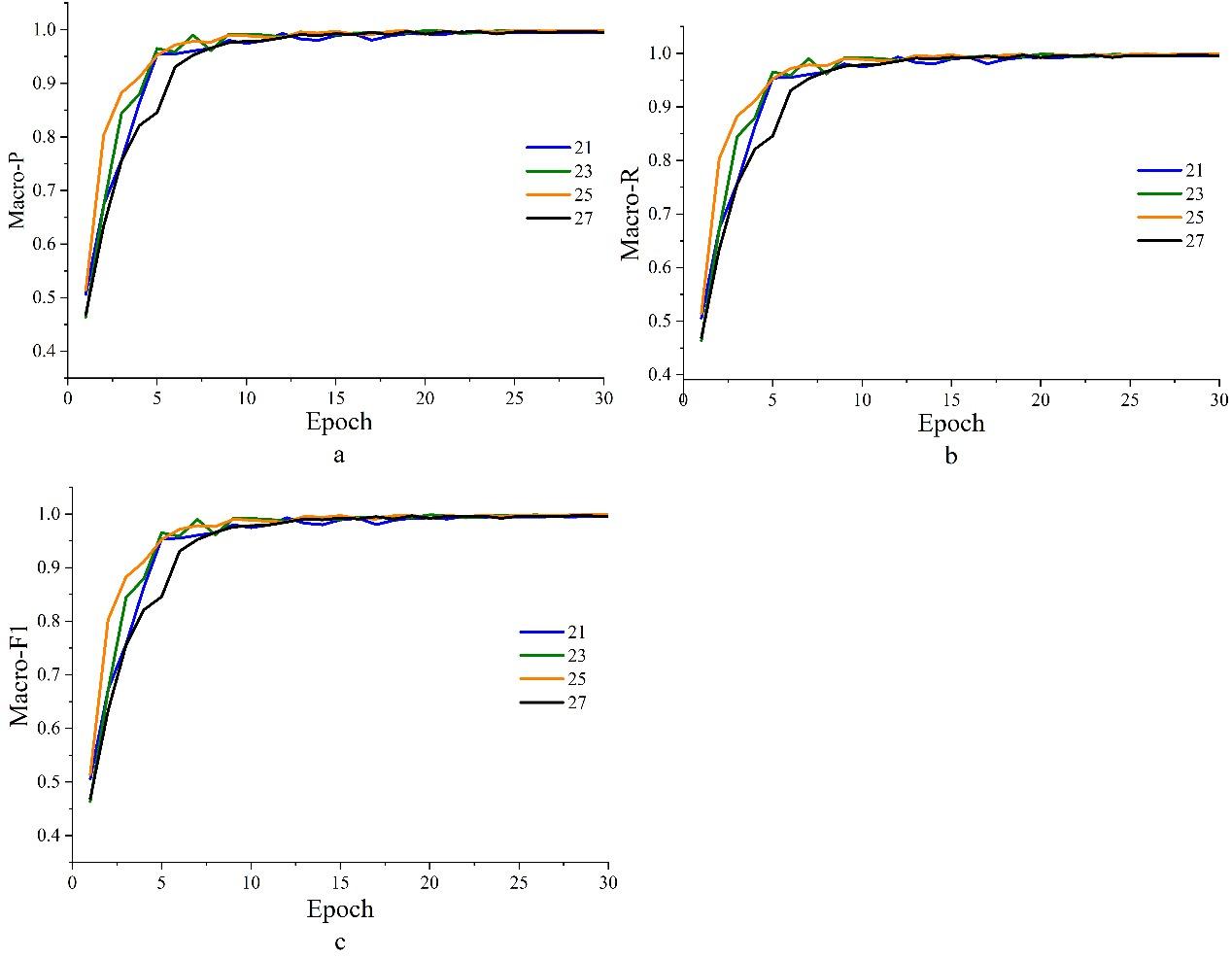
图6 不同大小的滑动窗口在训练集上的评价指标结果Fig. 6 Evaluation index results of sliding windows of different sizes on training sets a—Macro-P;b—Macro-R;c—Macro-F1。 |
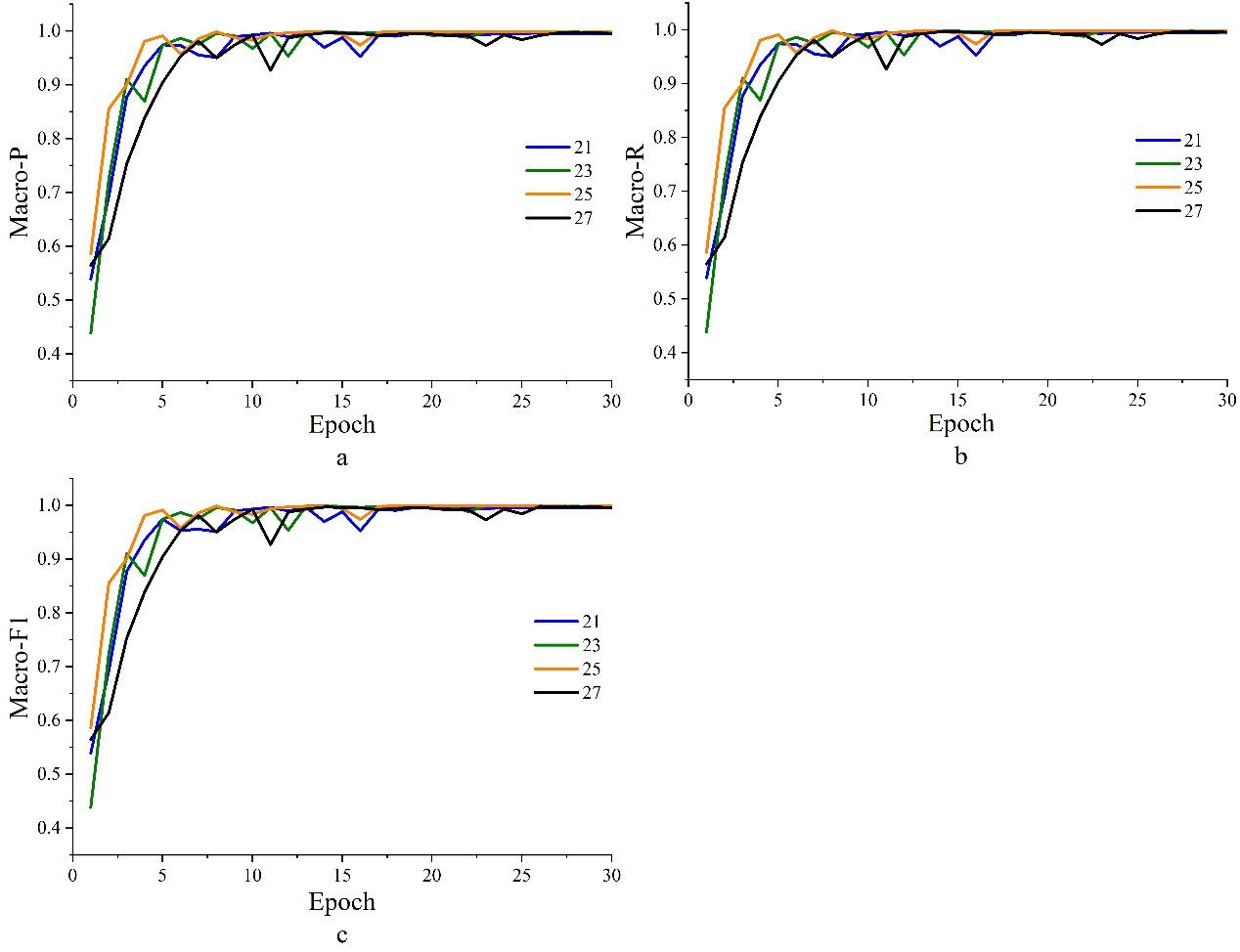
图7 不同大小的滑动窗口在验证集上的评价指标结果Fig. 7 Evaluation index results of sliding windows of different sizes on verification sets a—Macro-P;b—Macro-R;c—Macro-F1。 |
表3 不同大小的滑动窗口在验证集上的最优评价指标结果Table 3 Different sizes of sliding windows in the verification set of optimal evaluation index results |
| 窗口大小 | 11 | 13 | 15 | 17 | 19 | 21 | 23 | 25 | 27 | 29 |
|---|---|---|---|---|---|---|---|---|---|---|
| Macro-P | 0.983 | 0.987 | 0.993 | 0.991 | 0.984 | 0.995 | 0.998 | 0.998 | 0.996 | 0.995 |
| Macro-R | 0.983 | 0.987 | 0.993 | 0.991 | 0.984 | 0.995 | 0.998 | 0.998 | 0.996 | 0.995 |
| Macro-F1 | 0.983 | 0.987 | 0.993 | 0.991 | 0.984 | 0.995 | 0.998 | 0.998 | 0.996 | 0.995 |
表4 最优大小的滑动窗口在测试集的评价指标结果Table 4 The evaluation index results of the optimal size sliding window on the test set |
| 窗口大小 | acc | Macro-P | Macro-R | Macro-F1 |
|---|---|---|---|---|
| 23 | 0.999 | 0.999 | 0.999 | 0.999 |
| 25 | 0.999 | 0.999 | 0.999 | 0.999 |
| 1 |
|
| 2 |
|
| 3 |
|
| 4 |
|
| 5 |
|
| 6 |
|
| 7 |
|
| 8 |
|
| 9 |
祝美英, 袁成前, 刘艳芳, 等. 基于BP神经网络的核素快速识别算法[J]. 核电子学与探测技术, 2018, 38(2):284-288.
|
| 10 |
王瑶, 刘志明, 万亚平, 等. 基于长短时记忆神经网络的能谱核素识别方法[J]. 强激光与粒子束, 2020, 32(10):154-161.
|
| 11 |
杜晓闯, 涂红兵, 黎岢, 等. 基于径向基神经网络仿真γ能谱模板库的核素识别方法[J]. 清华大学学报(自然科学版), 2021(11):1308-1315.
|
| 12 |
QIS,
|
| 13 |
卢大宇, 周书民, 陈锐. 基于Resnet神经网络的地层核素能谱快速识别方法研究[J]. 世界核地质科学, 2023, 40(2):360-367.
|
| 14 |
|
| 15 |
|
| 16 |
|
| 17 |
|
/
| 〈 |
|
〉 |