研究论文

偏高岭土基地聚合物在处理低水平放射性废液中的应用研究

  • 成建峰 , 1, 2 ,
  • 张奇 , 1, 2 ,
  • 宗自华 1, 2 ,
  • 董艳辉 3 ,
  • 曹胜飞 1, 2 ,
  • 彭立园 1, 2
展开
  • 1 核工业北京地质研究院,北京 100029
  • 2 中国国家原子能机构高放废物地质处置创新中心,北京 100029
  • 3 中国科学院地质与地球物理研究所,北京 100029
张奇,男,1991年生,高级工程师,博士,主要从事高放废物地质处置缓冲材料多物理场耦合理论与数值模拟研究。E-mail:

成建峰,男,1989年生,博士,主要从事高放废物地质处置环境化学研究。E-mail:

收稿日期: 2024-12-25

  修回日期: 2025-01-23

  网络出版日期: 2025-11-07

基金资助

科技部国家重点研发计划资助项目(2022YFE0120500)

Application of metakaolin based polymer in the treatment of low level radioactive waste liquid

  • Jianfeng CHENG , 1, 2 ,
  • Qi ZHANG , 1, 2 ,
  • Zihua ZONG 1, 2 ,
  • Yanhui DONG 3 ,
  • Shengfei CAO 1, 2 ,
  • Liyuan PENG 1, 2
Expand
  • 1 Beijing Research Institute of Uranium Geology, Beijing 100029,China
  • 2 CAEA Innovation Center for Geological Disposal of High-Level Radioactive Waste,Beijing 100029,China
  • 3 Key Laboratory of Shale Gas and Geoengineering,Institute of Geology and Geophysics, Chinese Academy of Sciences, Beijing 100029, China
ZHANG Qi,male,born in 1991,senior engineer,PhD,focusing on the research of multi- physical field coupling theory and numerical simulation of buffer materials for geological disposal of high-level radioactive waste. E-mail:

CHENG Jianfeng,male,born in 1989,PhD,focusing on the environmental chemistry of geological disposal of high-level radioactive waste. E-mail:

Received date: 2024-12-25

  Revised date: 2025-01-23

  Online published: 2025-11-07

Supported by

National Key R&D Program of China(2022YFE0120500)

摘要

随着核能的快速发展,放射性废液的有效处理与处置是目前亟需解决的问题,地聚合物是一种很有前途的放射性废物固化材料。137Cs是低放废液中主要的辐射源,用偏高岭土作为基材,合成偏高岭土基地聚合物,通过抗压强度、孔隙度、微观结构和浸出行为等试验研究地聚合物对Cs的固化行为。在探明偏高岭土基地聚合物对Cs固化行为的基础上,将所制备的偏高岭土基地聚合物用于真实放射性废液的固化,通过在真实地下水环境中的浸出试验,评价偏高岭土基地聚合物在放射性废液固化领域的应用。研究结果表明:偏高岭土基地聚合物具有较高的抗压强度,孔隙度较小,微观结构稳定,并且对Cs有较好的固化性。在42 d时,真实低水平放射性废液地聚合物固化体中的137Cs在去离子水和真实地下水中均具有较低的浸出率和累积浸出分数,且优于国标中规定的值。说明偏高岭土基地聚合物在固化核素方面是一种非常有应用潜力的材料。

本文引用格式

成建峰 , 张奇 , 宗自华 , 董艳辉 , 曹胜飞 , 彭立园 . 偏高岭土基地聚合物在处理低水平放射性废液中的应用研究[J]. 世界核地质科学, 2025 , 42(1) : 123 -133 . DOI: 10.3969/j.issn.1672-0636.2025.01.010

Abstract

The development of nuclear energy is inseparable from the treatment and disposal of radioactive waste. Geopolymer is a promising radioactive waste solidification material. In this study,metakaolin was used as the substrate to prepare metakaolin polymer, which was used to solidify Cs and real radioactive waste. The properties of metakaolin geopolymer were investigated by characterization and leaching experiments. Characterization experiments show that metakaolin geopolymer with three-dimensional network structure has high compressive strength, which can meet the strength requirements of radioactive waste solidified body. At the same time, the solidification of Cs in metakaolin polymer is uniform. However, the incorporation of Cs will hinder the growth of silicon and aluminum network skeleton and reduce the gel structure of the system,resulting in the increase of porosity and the decrease of compressive strength of geopolymer cured body. The leaching experiments of Cs and real waste water in deionized water and real groundwater show that metakaolin polymer has excellent Cs retention ability,and has low leaching rate and cumulative leaching fraction,which is better than the value specified in the national standard. In general,metakaolin geopolymer performs well in physical compression resistance and Cs retention,and is a material with great application potential.

目前,社会对清洁能源的需求不断增长。核能由于其高能量密度的特点受到重点关注[1]。然而,核能的运用不可避免地会产生大量放射性废物,截至2023年底,全球共有437座运行的商业反应堆,发电总量25.440亿千瓦时,占总发电量的9 %,由此产生的大量放射性废物需要进行妥善处理和处置。中低放废物占到了总废物的97 %,这些放射性废物的安全处置已成为一项重大挑战[2]。中低放废物通常被固化为固体形式进行近地表处置,以防止放射性核素及危险废物向环境迁移[3-5]。水泥材料成本低、易于处理,并且能够满足严格的加工和性能要求[6],是应用最早、使用时间最长、研究最多的固化材料[7],目前被许多国家用作放射性废物处置工程中的固化工程屏障[8]
然而,水泥固化过程中会产生大量的CO2,工业废料或副产品生产环保固化材料代替水泥的方案受到广泛关注。地聚合物作为一种可由工业废料生产的新型铝硅酸盐胶凝材料[9],被认定为一种很有前途的水泥材料替代品[10]。与普通水泥材料相比,地聚合物在制备过程中的碳排放量显著降低,并具有快速硬化和早期强度高等特性。其特殊而稳定的机械性能、热性能、耐腐蚀性和耐辐射性,为放射性核废料的安全处置提供有利条件。目前大量研究表明地聚合物在多种环境因素作用下稳定性良好。相关研究证实地聚合物混凝土的孔隙结构和界面特性明显优于传统混凝土[11],对核废物的固化性有积极影响。由于持续的地聚合反应,地聚合物试件的抗压强度也有所提高[12-13]。同时,一些文献表明,地聚合物相较于传统的混凝土粘度高,凝固时间减少,不渗透性也有所增加[14-15]。此外,相关研究也证实聚合物对多种核素均有较好的固化能力[16-17]
然而,地聚合物的最终特性可能会因其成分的不同而有很大差异[18-20]。通常用于地聚合物制备的工业废料的成分差异很大,导致地聚合物性能不稳定。偏高岭土具有高活性和稳定的化学成分,可产生相对稳定的地聚合物[21]。偏高岭土基地聚合物在放射性废物固化方面展现出巨大潜力。Shin等[22]制备偏高岭土基地聚合物用于固化模拟放射性废物,并评估其作为放射性废物固化基体的性能。实验结果表明,所制备的地聚合物废料在7 d内固化,且满足废物验收标准(WAC),同时显示良好的抗浸出性能。Kim等[23]探讨不同Si/Al比例(1.0~1.4)和固化温度(26和60 °C)的偏高岭土基地聚合物固化模拟放射性硼酸盐废物。研究发现,适量的硅和较高的固化温度对于实现高抗压强度和高废物负载量至关重要。所有地聚合物的抗压强度均高于废物验收标准规定的3.445 MPa,硼的浸出指数高于6.0,表明浸出机制为扩散。Tan等[24]通过调整磷酸铝摩尔比(P/A)制备了磷酸活化偏高岭土基地聚合物(PAMG),用于固化模拟放射性核素Sr。研究发现,P/A显著影响PAMG的水合动力学和微观结构,P/A为1.8时PAMG展现出最高的致密性和抗压强度(98.1 MPa)。PAMG能有效固化Sr,但模拟核素的加入会降低其力学性能。
大量工作证实偏高岭土基地聚合物在放射性废物固化方面的运用前景[25-27]。然而,目前的相关研究多基于实验室环境及模拟废物,偏高岭土基地聚合物对真实放射性废液的固化性能有待考量。本文采集某厂放射性废液储存池的低放废液,分析其成分表明137Cs是废液中主要的放射性核素。基于此,本文以偏高岭土作为基体制备地聚合物,通过表征和浸出试验研究偏高岭土基地聚合物对Cs的固化性能。同时,将偏高岭土基地聚合物用于固化真实放射性废液,通过在去离子水和地下水中的浸出实验,探究地聚合物固化真实放射性废液面对地下水入渗这种极端情况下对137Cs的固化性能。相关研究结论将有助于偏高岭土基地聚合物固化研究的发展,并为解决放射性废液污染问题提供新的研究思路。

1 实验材料与方法

1.1 实验材料

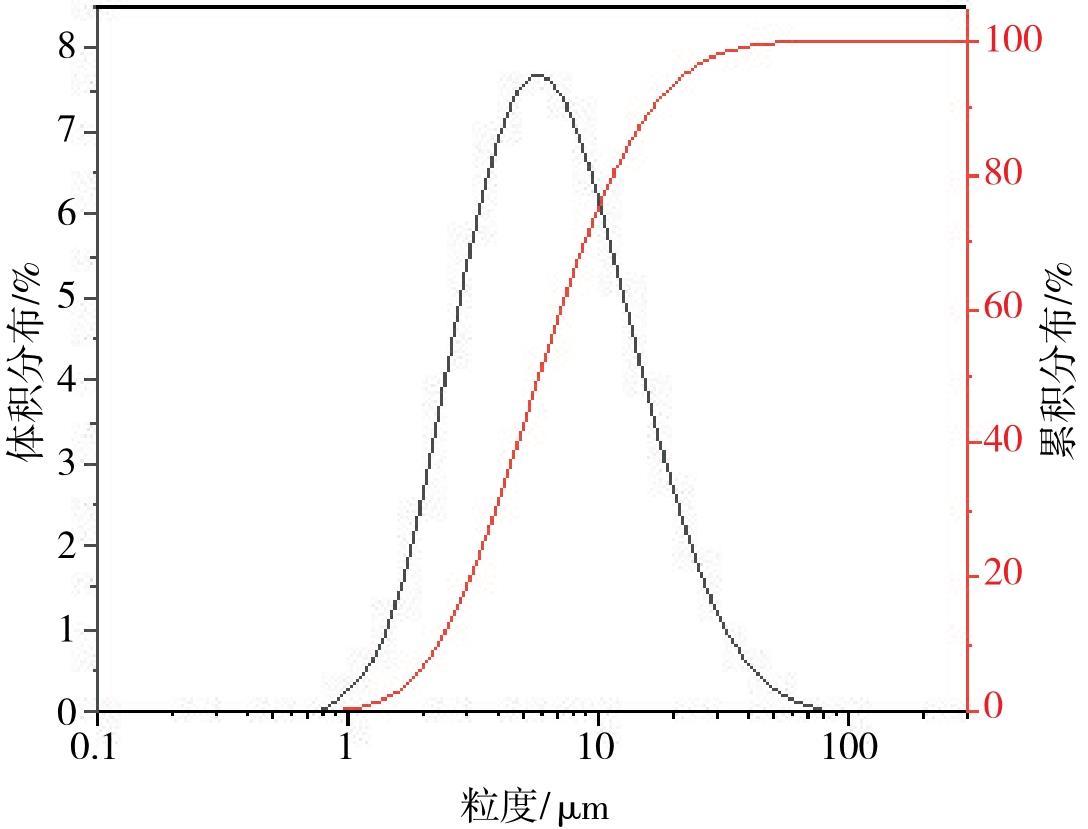
偏高岭土是最常用的硅铝酸盐前体之一,是一种火山灰质材料,有良好的火山灰活性。本文用于制备地聚合物的偏高岭土由巩义市辰义耐材磨料有限公司提供。经过XRF测试,试验所用偏高岭土的主要化学组成如表1所示,本文选用的偏高岭土主要由二氧化硅和氧化铝组成,w(SiO2)/w(Al2O3)质量比为1.02。图1为偏高岭土的激光粒度分布,偏高岭土的平均粒径D(50)为5.82 μm。
表1 偏高岭土的化学组成

Table 1 Chemical composition of metakaolin

成分/ SiO2 Al2O3 CaO Fe2O3 TiO2 Na2O MgO K2O 其他
wt% 49.41 48.645 0.097 0.835 0.206 0.087 0.041 0.545 0.11
图1 偏高岭土的激光粒度分布

Fig. 1 Laser particle size distribution of metakaolin

本实验中所用的水玻璃为钠水玻璃,购自河南铂润铸造材料有限公司,用氢氧化钠调节水玻璃模量,采用模量w(SiO2)w(Na2O)为1.4的水玻璃溶液作为碱性激发剂。氯化铯(CsCl)和氢氧化钠(NaOH)购自上海阿拉丁生化科技股份有限公司。低水平放射性废液取自某放射性废液储存池,外观为无色透明溶液,总的比活度为3.42×10⁴ Bq·L-1,主要的化学成分见表2。地下水取自甘肃北山,北山地下水的主要成分参考前期研究[28]
表2 某厂低水平放射性废液成分表

Table 2 Composition of low level radioactive waste liquid of a plant

密度/(g·cm-3) pH 含盐量/(g·L-1) 初始比活度/(Bq·L-1)
137Cs 241Am Σβ
1.13 7.45 297 3.13×10⁴ 3.13×101 3.42×10⁴
主要仪器:X射线衍射分析(XRD,Panalytical X’Pert PRO)、傅里叶变换红外光谱仪(FTIR,Nicolet 6700)、扫描电子显微镜(Nova Nano SEM450)、压汞测试(MIP,AutoPore IV9500)、抗压强度测试(CS,TYE-300D)、高纯锗γ谱仪(HPGe,GEM-S9030)和电感耦合等离子体质谱仪(ICP-MS,Agilent 7700x)。

1.2 地聚合物的制备

基于前期试验[29],配置合适碱性激发剂(模数1.4),称量试验所需要的去离子水,分别把CsCl按照质量比为0 %、1 %、5 %和10 %溶解于去离子水中,将静置好的碱激剂、称量好的偏高岭土和配置好的不同质量浓度核素溶液充分地混合均匀,放到搅拌机上搅拌均匀;对塑料模进行刷油处理,将搅拌好的浆体浇筑到40 mm×40 mm×40 mm三联模中和φ20 mm×20 mm可拆卸模具中,再放到振动台上震动,直到密实成型,并进行表面刮均处理,并在25 ℃和95 %相对湿度的固化室中固化24 h,然后在相同条件下脱模固化28 d。偏高岭土基地聚合物固化低放射性废液的制备流程相同,把去离子水溶液换成低放废液。

1.3 分析和测试

抗压强度测试参照《水泥胶砂强度检验方法(ISO 法):GB/T 17671—2021》,取40 mm×40 mm×40 mm块体,分别在3 、7 、14 和28 d取试块进行抗压强度测试;其他表征试验为固化28 d后的块体;抗浸出性能测试按照标准《低、中水平放射性废物固化体标准浸出试验方法:GB 41930—2022》和《低、中水平放射性废物固化体标准浸出试验方法:GB/T 7023—2011》,取φ20 mm×20 mm进行浸出试验,把试验样品用尼龙丝悬挂于装有去离子水的聚乙烯塑料容器中,从浸出开始至1、3、7、10、14、21、28、35和42 d后更换浸出溶剂,取浸出溶液加硝酸酸化,用ICP-MS或高纯锗γ谱仪测量溶液中核素浓度。浸出率由式(1)计算和累积浸出分数由式(2)计算。
R n = a n / A 0 S / V · Δ t n
P n = a n / A 0 S / V
式(1)和(2)中:Rn—在第n浸出周期中Cs+的浸出速率,cm·d-1Pt—在时间t时Cs+的累积浸出分数,cm;an—在第n浸出周期中浸出的Cs+的活度或质量,Bq或g;A0—在浸出样品中Cs+的初始活度或质量,Bq或g;S—样品的几何表面积,cm2V—样品的体积,cm3;(Δt)n—相邻周期间隔天数,d。

2 结果与讨论

2.1 地聚合物的物理化学性能分析

2.1.1 抗压强度分析

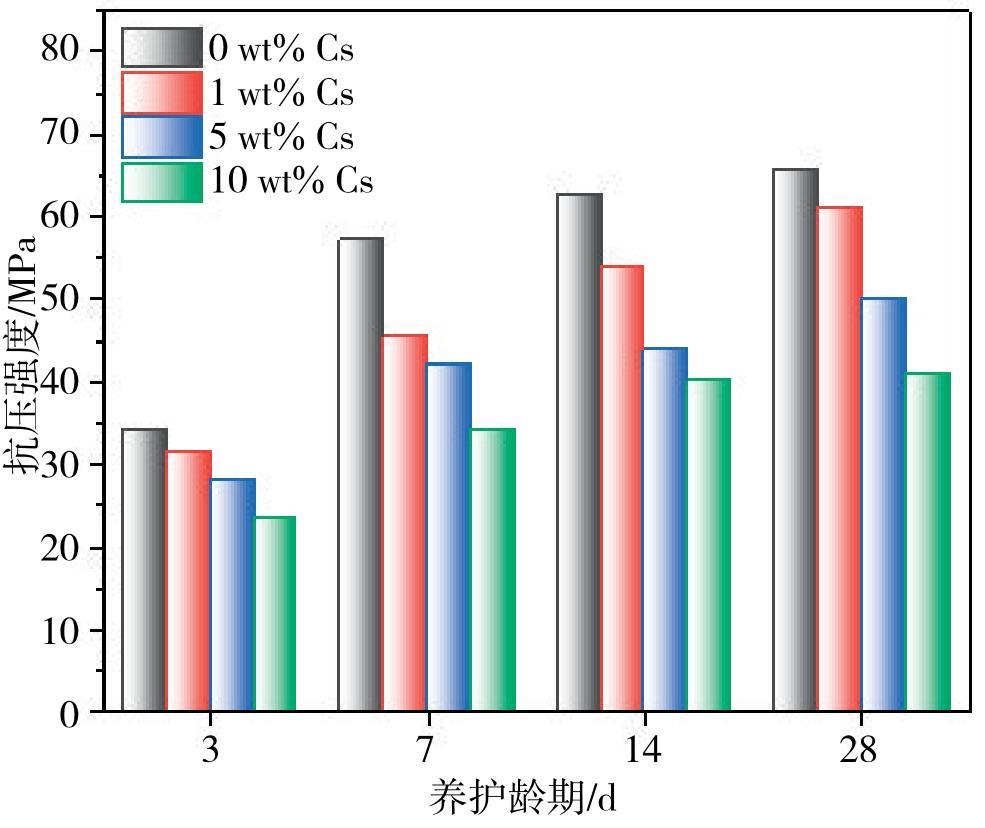
图2可见,各龄期的偏高岭土基地聚合物固化体的抗压强度随Cs+浓度的增加逐步下降。同一Cs+浓度下,随着龄期的增加,地聚合物内部反应的逐渐完全,碱激发作用也越来越彻底,与之相对应的,固化体的强度也越来越高。由表3数据可知,3 d时不同掺量偏高岭土基地聚合物的抗压强度分别为34.18、31.54、28.28和23.58 MPa,都远高于GB14569.1—2011中规定的低放废物固化体最低强度要求(7 MPa)。28 d时不同掺量偏高岭土基地聚合物的抗压强度分别为65.47、61.04、50.13和41.08 MPa。随着Cs+掺量的增加,抗压强度降低,分析其原因,可能因为Cs+的引入,会在一定程度上抑制聚合反应的进行或者在内部结构上产生一定影响。
图2 不同Cs掺量偏高岭土基地聚合物在不同时间的抗压强度

Fig. 2 Compressive strength of metakaolin base polymer with different Cs content at different times

表3 不同Cs掺量偏高岭土基地聚合物在不同时间的抗压强度

Table 3 Compressive strength of metakaolin base polymers with different Cs contents at different times

Cs+含量/wt% 3 d抗压强度/MPa 7 d抗压强度/MPa 14 d抗压强度/MPa 28 d抗压强度/MPa
0 34.18 57.08 62.52 65.47
1 31.54 45.33 53.78 61.04
5 28.28 42.26 43.82 50.13
10 23.58 34.31 40.07 41.08

2.1.2 MIP分析

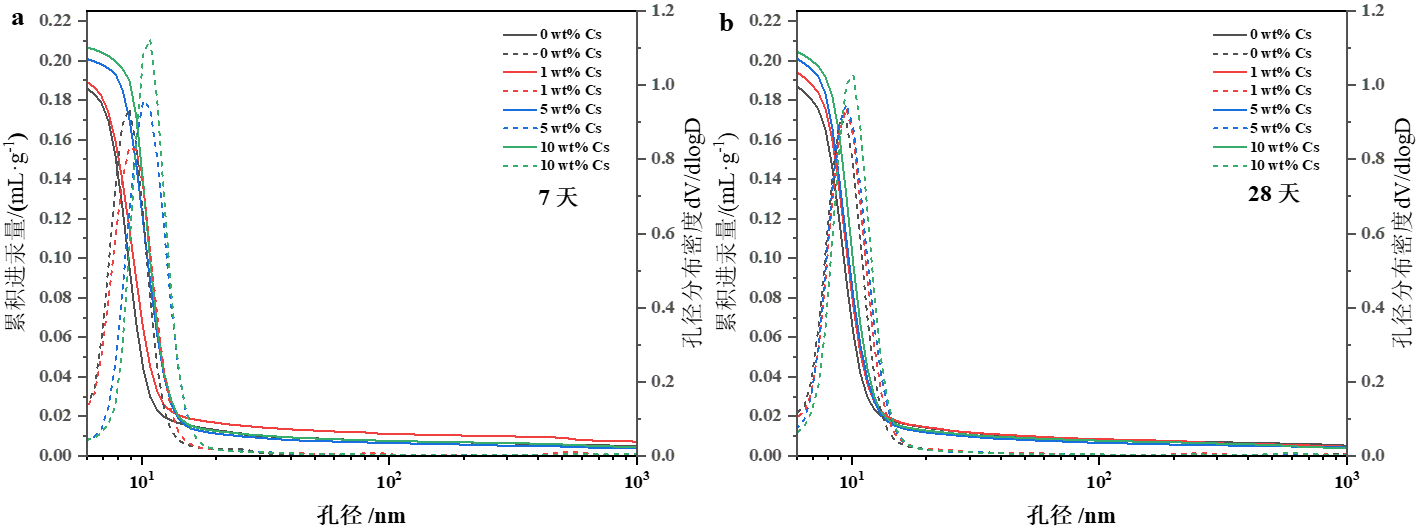
地聚合物的孔径大小对核素的固化能力及聚合物的力学性能起着至关重要的作用,分别对不同Cs+掺量偏高岭土基地聚合物在7和28 d时的累积进汞曲线和孔径分布曲线进行绘制。图3a显示固化7 d时不同Cs掺量偏高岭土基地聚合物的累积进汞曲线和孔径分布曲线。压汞测试分析结果表明,随着Cs掺量的增加,累积进汞量增加,地聚合物样品总孔隙率也呈增加趋势,这与地聚合物固化体的力学性能结果一致。在7 d时,不同Cs掺量偏高岭土基地聚合物的孔径分别为8.92、9.47、10.12和10.83 nm。由图3b可知,到28 d时偏高岭土基地聚合物的孔隙度降低,这是因为偏高岭土中的二氧化硅和氧化铝迅速进入溶液并反应形成二次水合产物,降低样品的孔隙度[30-31]。地聚合物为类沸石相结构,由环状分子链构成,聚合物中的环状分子交织聚合构成致密的笼状空腔,可将Cs+包裹在空腔中或被吸附包裹在聚合物中,且不破坏地聚合物的整体结构[32]。随着Cs+掺量的增加,进一步阻碍硅和铝网络骨架的生长,减少系统的凝胶结构,从而导致地聚合物固化体孔隙率增加,抗压强度降低。
图3 不同Cs掺量偏高岭土基地聚合物压汞曲线

Fig. 3 Mercury intrusion curves of polymers in different territories with high Cs content

2.1.3 XRD分析

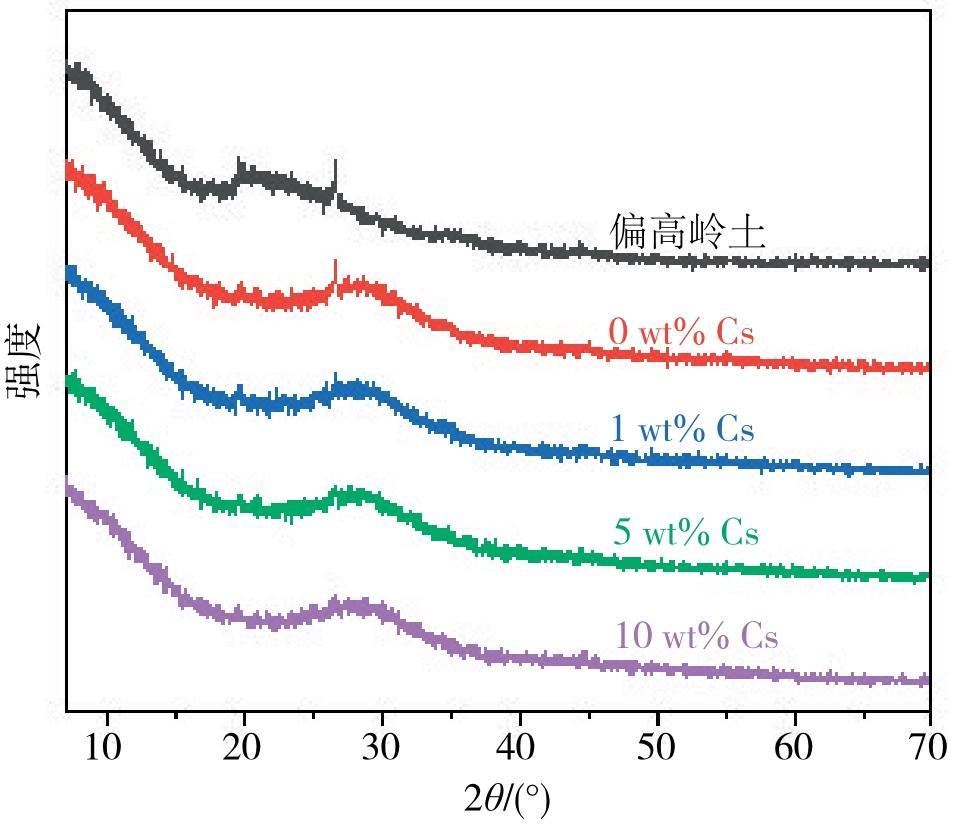
图4可见,偏高岭土主要由无定型硅酸铝组成,加一定量碱性激发剂固化28 d后,形成的物质在25°~35°(2θ)之间出现弥散峰,研究表明这是地聚合物的形成标志[33],标志偏高岭土基地聚合物的形成,这通常与地聚合物体系中的无定形铝硅酸盐凝胶有关[34]。偏高岭土基地聚合物的XRD曲线与偏高岭土相比,整体比较平缓,说明反应程度较高,原料中的硅铝质材料与碱激发剂的聚合反应比较充分,可以使得地聚合物强度良好。值得注意的是,随着Cs+浓度的增加,色散峰强度有相应的降低。峰面积的大小反映凝胶产物的数量,更大的面积与地聚合物的性能增强相关。这表明,Cs+含量的升高可能会影响地聚合物内的聚合过程。
图4 不同Cs掺量偏高岭土基地聚合物XRD

Fig. 4 XRD of metakaolin base polymer with different Cs content

2.1.4 SEM分析

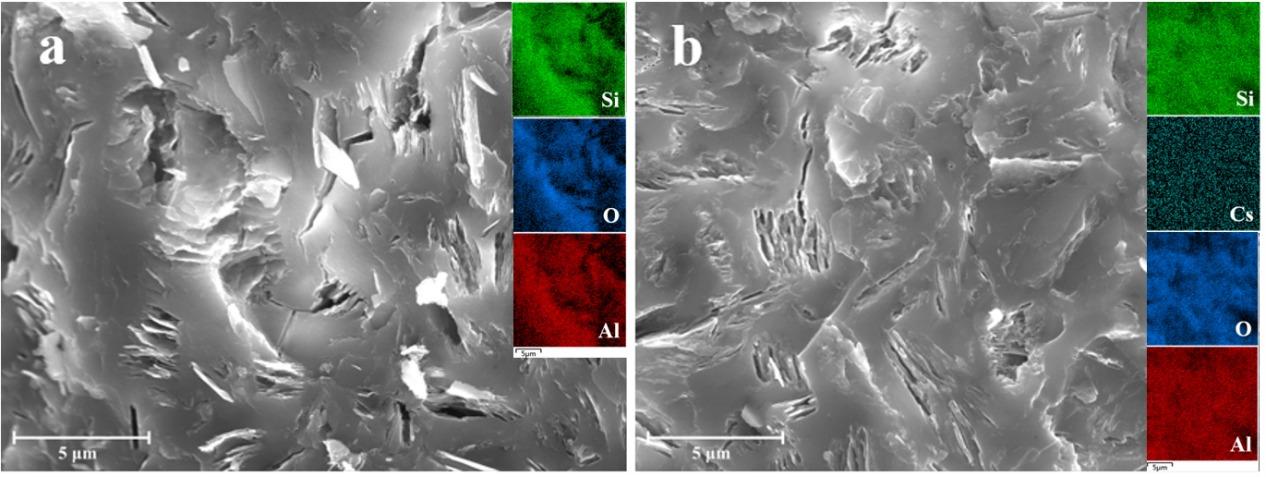
图5是反应28 d时0 wt%和10 wt% Cs掺量偏高岭土基地聚合物SEM-EDS图。由图5a可知,偏高岭土在经过与碱激发剂的聚合反应后生成非常致密的地聚合物凝胶状物质(硅铝酸盐凝胶),其外表面呈现出均匀致密,无定形的状态。由图5b可知,随着Cs的掺入,地聚合物的微观结构未发生明显变化,表面也没有新的结晶出现,说明Cs+的掺入并未改变地聚物的结构。地聚合物对核素的固化主要通过硅铝酸盐在碱性环境下溶解[35],Si和Al通过缩聚反应生成无定形三维网状结构[36],从而将Cs包裹在地聚合物基质的结构中,另外通过结构吸附达到对Cs的有效固化。图5列出固化28 d时 0 wt%和10 wt% Cs掺量偏高岭土基地聚合物元素分布图,由图5可知,未固化核素的地聚合物主要以O、Si和Al元素为主,表面分布较为均匀。固化质量浓度10 wt%的Cs后,Cs被均匀地固化在地聚合物中。
图5 偏高岭土基聚合物SEM-EDS图

a—未固化Cs;b—固化10 wt% Cs。

Fig. 5 SEM-EDS of metakaolin based polymer

a-uncured Cs;b-curing 10 wt% Cs

2.1.5 FTIR分析

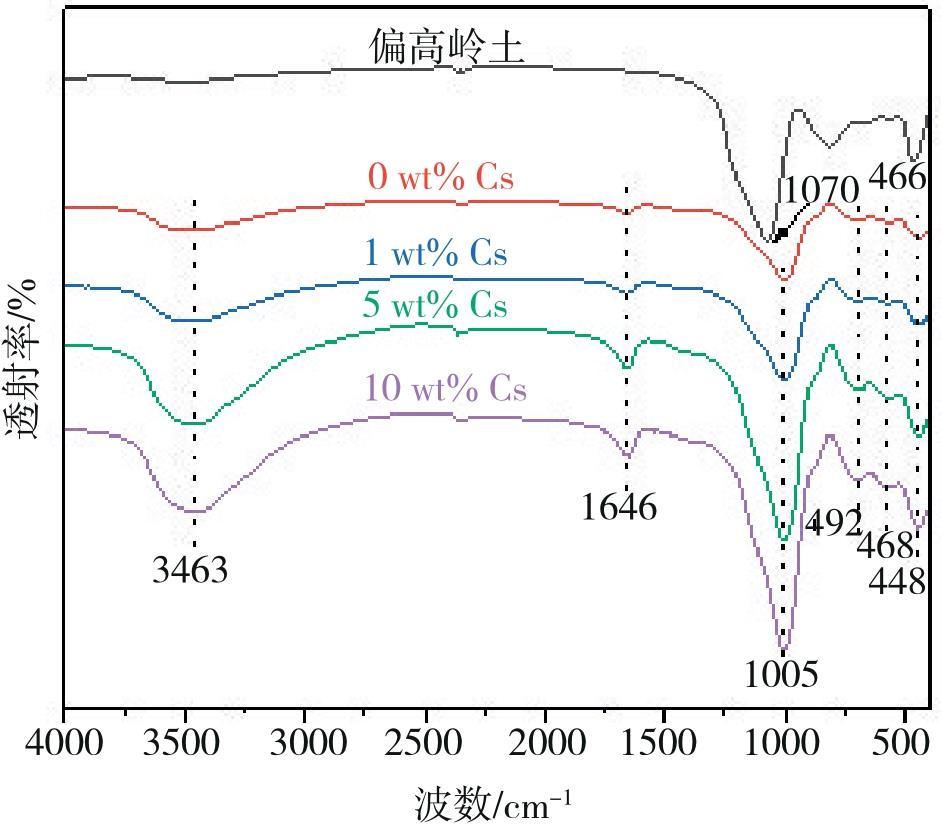
图6可知,3 463 cm-1处为H2O的O-H羟基伸缩振动峰,1 646 cm-1处与H结合的羟基(OH)弯曲振动峰有关,这些峰表征地聚合反应历程中产生的化学结合水[24,37];1 005 cm-1处为Si-O-T(T = Si或Al)的伸缩振动峰,与Si、Al四面体的内部结构有关[34],偏高岭土1 070 cm-1处的峰位置发生变化,说明偏高岭土在与碱性激发剂相互作用后发生聚合物反应,受不同掺量Cs影响,峰面积发生变化;692 cm-1处的峰代表[AlO4]和[SiO4]四面体基团[38];448 cm-1处的峰代表铝氧四面体和硅氧四面体中T-O键的弯曲振动峰。
图6 偏高岭土和不同Cs掺量偏高岭土基地聚合物FTIR

Fig. 6 FTIR of metakaolin and metakaolin base polymers with different Cs content

2.2 地聚合物对Cs的固化浸出试验

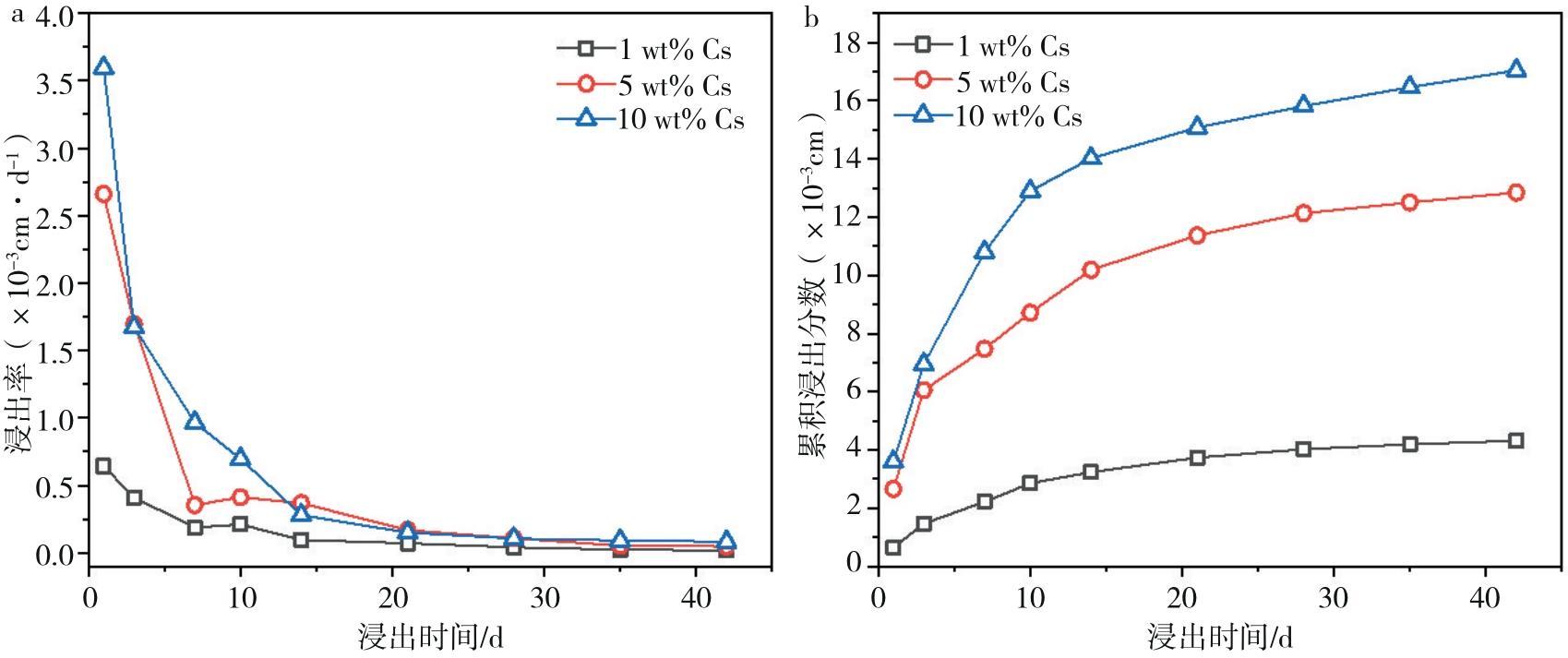
为了验证偏高岭土基地聚合物对核素的固化效果,用偏高岭土基地聚合物固化质量浓度分别为1 wt%、5 wt%和10 wt%的Cs,根据GB 41930—2022的要求,以去离子水作为浸出溶剂,测得不同Cs掺量偏高岭土基地聚合物在去离子水中的浸出率和累积浸出分数如图7所示。从图7a可知,不同Cs掺量偏高岭土基地聚合物在去离子水中的长期浸出行为表现出相似规律。在最开始的7d,不同掺量地聚合物浸出速率较快,这是因为地聚合物对核素的固化有部分以物理吸附为主,在与去离子水溶液接触时,这部分核素在地聚合物表面,会与液体接触并扩散进溶液中。随着溶出的进行,聚合物表面Cs减少,内部固化稳定的Cs向溶液中溶出变得困难,并随着时间的增加,浸出率降低。不同Cs掺量(1 wt%、5 wt%和 10 wt%)在42 d的浸出率分别为1.79×10⁻⁵、4.86×10⁻⁵和8.29×10⁻⁵ cm·d-1图7b可知,随着时间的增加,不同Cs掺量偏高岭土基地聚合物累积浸出分数逐渐加大,主要表现出Cs掺量越大,Cs的累积浸出分数越大。不同Cs掺量(1 wt%、5 wt%和10 wt%)在42 d的累积浸出分数分别为4.31×10⁻³、1.28×10⁻²和1.70×10⁻² cm。将本研究制得的偏高岭土基地聚合物浸出数据和传统水泥及其他地聚合物的浸出数据进行对比分析,如表4所示。本研究制得的地聚合物对Cs具有优良的保留能力,最大累积浸出分数仅为1.70×10⁻² cm,远远均低于《低、中水平放射性废物固化体性能要求-水泥固化体:GB 14569.1—2011》规定的 2.6×10⁻¹ cm,且优于传统水泥1~2个数量级。但其累积浸出分数与其他学者制备的粉煤灰地聚合物对比优势并不显著,说明偏高岭土和粉煤灰均是制备地聚合物固化体的优良原料,本研究的偏高岭土地聚合物有进一步改性优化的空间。
图7 不同Cs掺量偏高岭土基地聚合物在去离子水中的浸出率(a)和累积浸出分数(b)

Fig. 7 Leaching rate (a) and cumulative leaching fraction (b) of metakaolin based polymers with different Cs contents in deionized water

表4 水泥及地聚合物累积浸出分数比较

Table 4 Comparison of cumulative leaching fractions of cement and geopolymer

样品 尺寸 最大累积浸出分数 参考文献
本实验 偏高岭土基地聚合物 40 mm×40 mm×40 mm 1.70×10⁻² cm
水泥 普通硅酸盐水泥 20 mm×20 mm×20 mm 1.28×10⁻¹ cm [39]
普通硅酸盐水泥 h = 40 mm, d = 40 mm 1.66×10⁻¹ cm [40]
地质水泥 50 mm×50 mm×50 mm 1.15×10⁻¹ cm [41]
磷酸镁水泥 20 mm×20 mm×20 mm 7.01×10⁻² cm [42]
地聚合物 粉煤灰地聚合物 20 mm×20 mm×20 mm 8.17×10⁻² cm [43]
磷酸活化地聚合物 20 mm×20 mm×20 mm 1.31×10⁻² cm [44]
粉煤灰地聚合物 h = 25 mm,d = 50 mm 2.03×10⁻² cm [45]
粉煤灰基沸石固化体 20 mm×20 mm×20 mm 2.00×10⁻² cm [46]
粉煤灰地聚合物 20 mm×20 mm×20 mm 2.87×10⁻² cm [47]
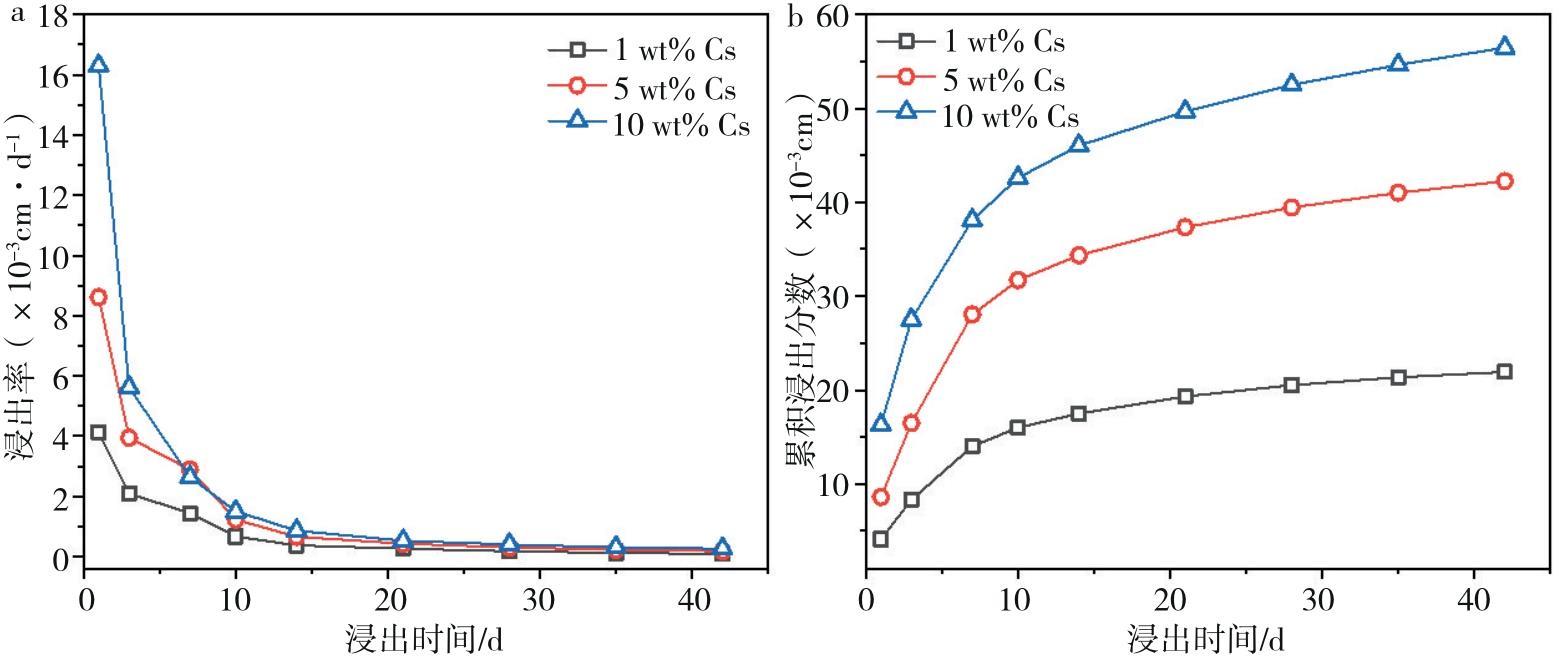
放射性废物的处理处置需要先进行固化处理,然后将固化后的放射性废物进行地质处置,固化体在长期地质处置过程中,可能与地下水接触。图8显示了不同Cs掺量偏高岭土基地聚合物在地下水中的浸出率和累积浸出分数。从图8a可知,不同Cs掺量偏高岭土基地聚合物在地下水中的长期浸出行为表现出相似规律。前14 d的浸出率变化较大,随着时间的增加浸出率变得平稳。地下水溶液中浸出率较大,是因为地下水溶液中的离子,加速未完全固化在地聚合物中的Cs浸出,导致浸出率较大。由于偏高岭土基地聚合物是一种三维网状结构,能够有效地对核素进行固化,因此不同Cs掺量偏高岭土基地聚合物的浸出率在后期基本一致。在42 d时,不同Cs掺量(1 wt%、5 wt%和10 wt%)的浸出率分别为8.22×10⁻⁵、1.76×10⁻⁴和2.62×10⁻⁴ cm·d-1。从图8b可以看出,随着时间的增加Cs的累积浸出分数增加,固化核素的浓度越高,累积分数越大。不同Cs掺量(1 wt%、5 wt%和10 wt%)在42 d的累积浸出分数分别为2.19×10⁻²、4.22×10⁻²和5.64×10⁻² cm。
图8 不同Cs掺量偏高岭土基地聚合物在北山地下水中的浸出率(a)和累积浸出分数(b)

Fig. 8 Leaching rate (a) and cumulative leaching fraction (b) of metakaolin based polymers with different Cs contents in Beishan groundwater

2.3 地聚合物对真实废液的固化浸出试验

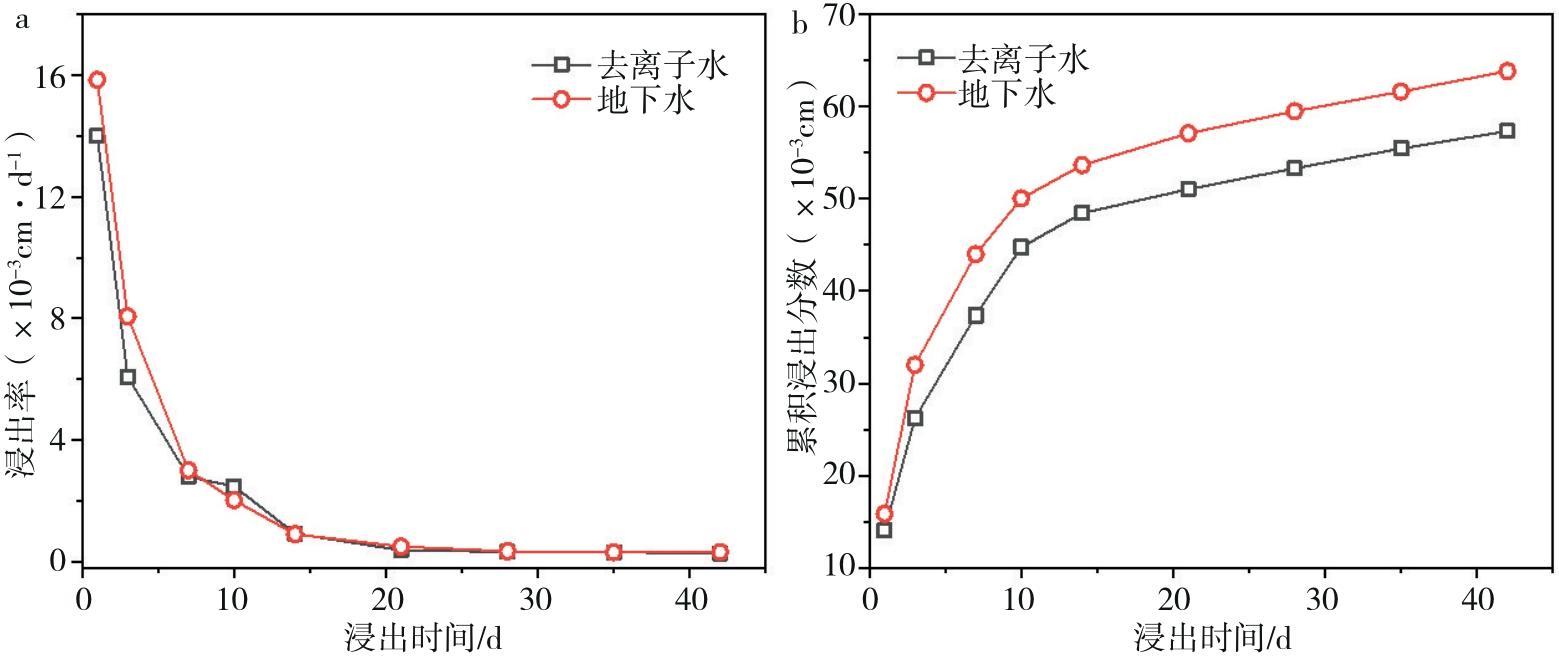
图9a可知,偏高岭土基地聚合物固化放射性废液后,在去离子水和地下水溶液中的浸出率的变化趋势相似。地下水中由于含有较高的阴阳离子,使得部分被固化的核素更容易浸出到溶液中,但偏高岭土基地聚合物由于形成三维网状结构,可以对放射性废液实行有效固化,因此,不论在去离子水还是地下水溶液中,偏高岭土基地聚合物都表现出良好的固化能力。在42 d时,偏高岭土基地聚合物中137Cs在去离子水和地下水中的浸出率分别为2.69×10⁻⁴和3.13×10⁻⁴ cm·d-1,优于GB 14569.1—2011中规定的137Cs≤4×10⁻³ cm·d-1的要求。从图9b可知,在42 d时,偏高岭土基地聚合物中137Cs在去离子水和地下水中的累积浸出分数分别为5.7×10⁻²和6.38×10⁻² cm,优于国标中规定的137Cs ≤ 0.26 cm。
图9 偏高岭土基地聚合物固化低放废液在不同溶液中的浸出率(a)和累积浸出分数(b)

Fig. 9 Leaching rate (a) and cumulative leaching fraction (b) of polymer solidified low-level liquid waste in different solutions at metakaolin base

3 结论

1)偏高岭土基地聚合物呈三维网状结构,具有较高的抗压强度。Cs在偏高岭土基地聚合物中的固化是均匀的,Cs的掺入会阻碍硅和铝的网络骨架的生长,减少系统的凝胶结构,从而导致地聚合物固化体孔隙率增加,抗压强度降低。
2)偏高岭土基地聚合物对Cs有较好的固化能力。不同Cs掺量(1 wt%、5 wt%和10 wt%)的偏高岭土基地聚合物在去离子水和地下水中的浸出率基本一致,随着时间增加Cs的累积浸出分数增加,固化Cs浓度越高,累积浸出分数越大。
3)偏高岭土基地聚合物对低水平放射性废液固化性能优良。固化体在去离子水和地下水中137Cs的浸出率的变化趋势相似,累积浸出分数分别为5.7×10⁻² cm和6.38×10⁻² cm,优于国标规定,是一种很有潜力的固化基材。
1
Zhan L, Bo Y, Lin T, et al. Development and outlook of advanced nuclear energy technology[J]. Energy Strategy Reviews, 2021,34:100630.

2
Mccloy J B. J. Riley, Dixon M, et al. International perspectives on glass waste form development for low-level and intermediate-level radioactive waste[J]. Materials Today, 2024, 80: 594-618.

3
Barbhuiya S, Das B, Qureshi T, et al. Cement-based solidification of nuclear waste: Mechanisms, formul-ations and regulatory considerations[J]. Journal of Environmental Management, 2024, 356: 120712.

4
Touite A, Labied S, El T, et al. Ghailassi, Treatment of organic radioactive waste by stabilization/solidifica-tion into a cement/alumina based mortar[J]. Materials Today: Proceedings, 2022, 58: 1485-1489.

5
Li J, Chen L, Wang J, Solidification of radioactive wastes by cement-based materials[J]. Progress in Nuclear Energy, 2021, 141: 103957.

6
Kearney S, Yorkshire A S, Geddes D A, et al. Chapter 25-Cement-based stabilization/solidification of rad-ioactive waste[M]// TSANG D C W, WANGL. Low Carbon Stabilization and Solidification of Hazardous Wastes, Amsterdam: Elsevier, 2022:407-431.

7
Zhang Q, Cao X, Ma R, et al. Solid waste-based magnesium phosphate cements: preparation, perform-ance and solidification/stabilization mechanism[J]. Construction and Building Materials, 2021, 297: 123761.

8
Jo Y, Han S, Ok S, et al. Radiotoxicity flux and concentration as complementary safety indicators for the safety assessment of a rock-cavern type LILW repository[J]. Nuclear Engineering and Technology, 2018, 50(8):1324-1329.

9
Provis J L, Walls P A, van Deventer J S J. Geopoly merisation kinetics. 3. Effects of Cs and Sr salts[J]. Chemical Engineering Science, 2008, 63(18):4480-4489.

10
Grant Norton M, Provis J L. 1000 at 1000: Geopoly-mer technology:The current state of the art[J]. Journal of Materials Science, 2020, 55(28):13487-13489.

11
Bao W, Yin Y, Mi W, et al. Assessing performance, economic costs and environmental benefits of high-performance ecological geopolymer concrete incorpora-ting excavated rock and soil from tunnelling, fly ash and slag as reclaimed raw materials[J]. Journal of Building Engineering, 2024,95:110351.

12
Ge X, Hu X, Shi C. The long-term development in the micro- and macro-properties of geopolymers made from different fly ashes[J]. Cement and Concrete Composites, 2024,152:105637.

13
Wardhono A, Gunasekara C, Law D W, et al. Comparison of long term performance between alkali activated slag and fly ash geopolymer concretes[J]. Construction and Building Materials, 2017,143:272-279.

14
Savoye S, Legrand L, Sagon G, et al. Experimental investigations on iron corrosion products formed in bicarbonate/carbonate-containing solutions at 90°C[J]. Corrosion Science, 2001, 43(11):2049-2064.

15
Shahedan N F, Hadibarata T, Al Bakri Abdullah M M, et al. Potential of fly ash geopolymer concrete as repairing and retrofitting solutions for marine infrastru-cture: A review[J]. Case Studies in Construction Materials, 2024,20:e03214.

16
Chen Y, Chen F, Zhou F, et al. Early solidification/stabilization mechanism of heavy metals (Pb, Cr and Zn) in shell coal gasification fly ash based geopolymer[J]. Science of the Total Environment, 2022,802:149905.

17
Jain S, Banthia N, Troczynski T. Conditioning of simulated cesium radionuclides in NaOH-activated fly ash-based geopolymers[J]. Journal of Cleaner Produc-tion, 2022,380:134984.

18
Singh B, Ishwarya G, Gupta M, et al. Geopolymer concrete: A review of some recent developments[J]. Construction and Building Materials, 2015,85:78-90.

19
Tian Q, Nakama S, Sasaki K. Immobilization of cesium in fly ash-silica fume based geopolymers with different Si/Al molar ratios[J]. Science of the Total Environment, 2019,687:1127-1137.

20
Xu H, Van Deventer J S J. Geopolymerisation of multiple minerals[J]. Minerals Engineering, 2002, 15(12):1131-1139.

21
Kim B, Lee S. Review on characteristics of metakaolin-based geopolymer and fast setting[J]. Journal of the Korean Ceramic Society, 2020, 57(4):368-377.

22
Shin Y, Kim B, Kang J, et al. Estimation of radionuclides leaching characteristics in different sized geopolymer waste forms with simulated spent ion-exchange resin[J]. Nuclear Engineering and Tech-nology, 2023, 55(10):3617-3627.

23
Kim B, Kang J, Shin Y, et al. Effect of Si/Al molar ratio and curing temperatures on the immobilization of radioactive borate waste in metakaolin-based geopoly-mer waste form[J]. Journal of Hazardous Materials, 2023,458:131884.

24
Tan G, Liu Z, Ma X, et al. Phosphoric acid-activated metakaolin-based geopolymer: Optimizing P/A molar ratio to solidify Cs+ and Sr2+ in nuclear waste[J]. Nuclear Engineering and Design, 2024,424:113300.

25
Zhao S, Yang H, Liu X, et al. Effect of PFDS on the immobilization of Cs+ by metakaolin-based geopoly-mers in complex environments[J]. Journal of Environ-mental Management, 2024,356:120616.

26
Arbel-Haddad M, Ofer-Rozovsky E, Goldbourt A. Facile formation of pollucite in geopolymers: Implications for radioactive Cs immobilization[J]. Ceramics International, 2023, 49(18):30881-30885.

27
Hasnaoui A, Reeb C, De Campos M, et al. Controlling the properties of metakaolin-based geopolymer/liquid organic waste emulsions: A rheological approach[J]. Applied Clay Science, 2023,245:107160.

28
Zhou Z, Wang J, Su R, et al. Hydrogeochemical and isotopic characteristics of groundwater in Xinchang preselected site and their implications[J]. Environmental Science and Pollution Research, 2020, 27(28):34734-34745.

29
Li Y, Yanhui Dong, Mohamed R. El-Naggar, et al. The influence of particle size and calcium content on performance characteristics of metakaolin- and fly-ash-based geopolymer gels[J]. Gels, 2024, 10(10):639.

30
吴浩. 偏高岭土基地聚合物微观及性能研究[D]. 哈尔滨: 东北林业大学, 2022.

WU Hao. Study on the microstructure and properties of polymer in metakaolin soil base[D]. Harbin: Northeast Forestry University, 2022.

31
浦少云, 土木工程, 岩土工程. 磷酸基地聚合物固化剂研发与固化铅污染土的应用研究[D]. 南京: 东南大学, 2021.

PU Shaoyun. Development of phosphoric acid-based geopolymer binder and its application of solidification/ stabilization of lead contaminated soil[D]. Nanjing: Southeast University, 2021 (in Chinese).

32
Xiang Y, Hou L, Liu J, et al. Adsorption and enrichment of simulated 137Cs in geopolymer foams[J]. Journal of Environmental Chemical Engineering, 2021, 9(4):105733.

33
He P, Cui J, Wang M, et al. Interplay between storage temperature, medium and leaching kinetics of hazardous wastes in Metakaolin-based geopolymer[J]. Journal of Hazardous Materials, 2020,384:121377.

34
Lei H, Muhammad Y, Wang K, et al. Facile fabrication of metakaolin/slag-based zeolite micros-pheres (M/SZMs) geopolymer for the efficient remedi-ation of Cs+ and Sr2+ from aqueous media[J]. Journal of Hazardous Materials, 2021,406:124292.

35
王睿飞. 铝硅酸盐聚合物对模拟放射性核素133Cs+的固封研究[D]. 哈尔滨: 哈尔滨工业大学, 2018.

WANG Ruifei. Adsorption behavior of Cs+&Sr2+ by geopolymer and its derivate zeolites[D]. Harbin: Harbin Institute of Technology, 2018 (in Chinese).

36
朱修羽, 结构工程. 偏高岭土基地聚合物早期反应机理研究[D]. 杭州: 浙江大学, 2022.

ZHU Xiuyu. Study on the early reaction mechanism of metakaolin-based geopolymers[D]. Hangzhou: Zhejiang University (in Chinese).

37
Goo J, Choi S, Kim B, et al. Effects of EDTA on the leaching behaviors of Cs(I) and Co(II) from cement waste forms[J]. Journal of Hazardous Materials, 2024,463:132830.

38
雷辉叶. 偏高岭土-矿渣基地聚物微球的制备及其对-(90)Sr/-(137)Cs吸附和固化性能的研究[D]. 南宁: 广西大学. 2021.

LEI Huiye. Preparation of metakaolin-slag based geopolymer microspheres and study on the adsorption and solidification properties for 90Sr/137Cs[D]. Nanning: Guangxi University, 2021.

39
Zheng Z, Li Y, Sun H, et al. Coupling effect of naoh and nano3 on the solidified fly ash-cement matrices containing Cs+: Reaction products, microstructure and leachability[J]. Journal of Nuclear Materials, 2020, 539: 152252.

40
Papadokostaki K GSavidou A, Study of leaching mechanisms of caesium ions incorporated in ordinary portland cement[J]. Journal of Hazardous Materials, 2009, 171(1): 1024-1031.

41
王文文, 谢华, 王烈林. 地质水泥固化体中Sr( Ⅱ)、Cs( Ⅰ)、U(Ⅵ)的长期浸出行为研究[J]. 原子能科学技术, 2018, 52(10): 1740-1747.

WANG Wenwen, XIe Hua, WANG Lielin, Study on long-term leaching behavior of Sr (Ⅱ), Cs (Ⅰ), U(Ⅵ) in solidified geological cement[J]. Atomic Energy Science and Technology, 2018, 52 (10): 1740-1747 (in Chinese).

42
梁攀, 赖振宇, 卢忠远. 磷酸盐水泥对137Cs的固化性能[J]. 西南科技大学学报, 2011, 26(3): 27-31.

LIANG Pan, LAI Zhenyu, LU Zhongyuan, Curing properties of 137Cs with phosphate cement[J]. Journal of Southwest University of Science and Technology, 2011, 26 (3): 27-31 (in Chinese).

43
Li Q, Sun Z, Tao D, et al. Immobilization of simulated radionuclide 133Cs+ by fly ash-based geopolymer[J]. Journal of Hazardous Materials, 2013, 262: 325-331.

44
Tan G, Liu Z, Ma X, et al. Phosphoric acid-activated metakaolin-based geopolymer: Optimizing p/a molar ratio to solidify Cs+ and Sr2+ in nuclear waste[J]. Nuclear Engineering and design, 2024, 424: 113300.

45
Jang J G, Park S M, Lee H K, Physical barrier effect of geopolymeric waste form on diffusivity of cesium and strontium[J]. Journal of Hazardous material, 2016, 318: 339-346.

46
罗洁, 廖蓉, 王亚举. 粉煤灰基沸石固化体中Sr2+、Cs+的浸出行为[J]. 核化学与放射化学. 2017, 39(1): 95-102.

LUO Jie, LIAO Rong, WANG Yaju. Leaching behavior of Sr2+ and Cs+ in fly ash based zeolite[J]. Nuclear Chemistry and Radiochemistry, 2017, 39 (1): 95-102 (in Chinese).

47
Deng N, An H, Cui H, et al. Effects of gamma-ray irradiation on leaching of simulated 133Cs+ radionuclides from geopolymer wasteforms[J]. Journal of Nuclear Materials, 2015, 459: 270-275.

文章导航

/