



Simulation of potential spatial-temporal distribution of Black Storks and their responses to future climate change scenarios in China
Received date: 2024-04-25
Revised date: 2025-07-20
Online published: 2026-03-12
Copyright
Black Stork (Ciconia nigra), a globally rare wetland aquatic ecologically pivotal indicator species, plays an irreplaceable role in maintaining wetland ecosystem balance. This study utilized the Kuenm package to optimize the parameters of the MaxEnt model, created an optimal habitat suitability simulation. By employing 839 filtered occurrence records and 14 environmental variables, we modeled the potential suitable habitats for Black Stork under current climatic conditions and two future periods (2041-2060 and 2061-2080), each with two climate scenarios (BCC-CSM2-MR-SSP126 and BCC-CSM2-MR-SSP585). This study simulated the spatiote-mporal distribution patterns of Black Storks in China and their responses to future climate change scenarios, and further identified the directional shifts of high suitability centroids under future climate change scenarios. The findings indicated that the potential geographical distribution of Black Stork in China was a synergistic outcome influenced by multifarious factors, including anthropogenic activities, elevation, wetland habitat types, transportation networks, vegetation and precipitation. Anthropogenic activities emerged as the primary determinant of Black Stork’s geographic distribution in China, acting in concert with altitudinal gradients and wetland habitat types to predominantly shape its distribution patterns. From the current climate to the period of 2061-2080, the highly suitable areas for Black Stork in China exhibit a moderate expansion or slight contraction. Overall, the geographic range of Black Stork remains relatively stable under future climate change scenarios, indicating a certain degree of adaptability to climatic shifts. Compared to the current climate scenario, the centroids of highly suitable areas for Black Stork under future SSP126 and SSP585 climate scenarios initially migrate towards the northwest and subsequently towards the south. Future highly suitable areas exhibit an overall tendency to shift towards warmer and wetter northwestern regions. This research provides insights and implications for understanding the large-scale migration processes, patterns, and mechanisms of Black Stork under the influence of climate change and anthropogenic activities.
Cao Enhuan , Jiang Zhengquan , Luo Yunchao . Simulation of potential spatial-temporal distribution of Black Storks and their responses to future climate change scenarios in China[J]. Wetland Science, 2025 , 23(5) : 915 -926 . DOI: 10.13248/j.cnki.wetlandsci.20240115
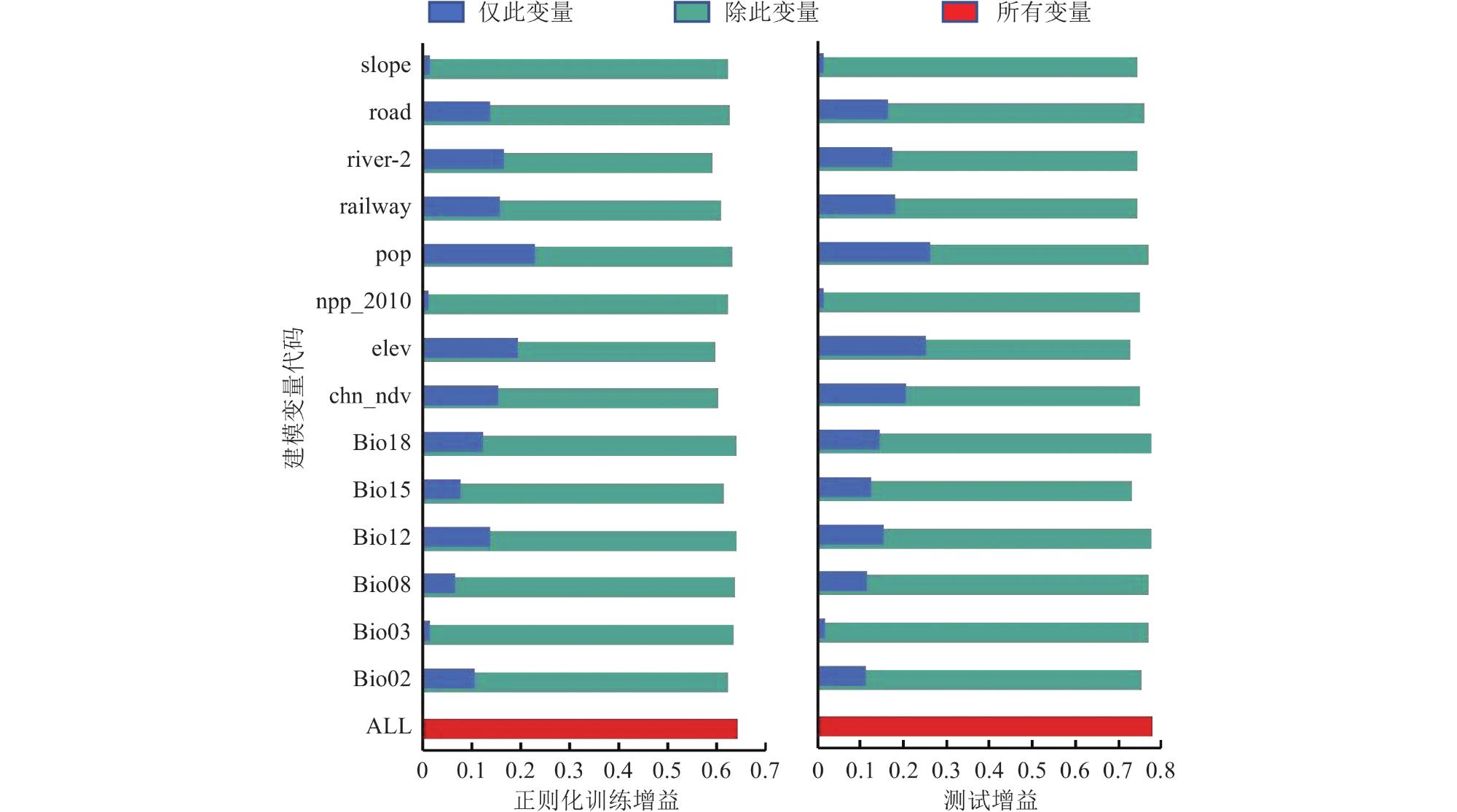
1 Environmental variables and corresponding importance parameters for simulating the potential spatiotemporal distribution of Ciconia nigra in China黑鹳在中国潜在时空分布模拟的环境变量及其重要性参数 |
| 建模变量代码 | 对应环境变量 | 贡献率/% | 置换重要性 |
| railway | 距铁路距离/m | 16.9 | 8.2 |
| elev | 海拔/m | 16 | 27.9 |
| river-2 | 距二级河流距离/m | 14.6 | 12.4 |
| Bio12 | 年降水量/mm | 14.3 | 0.8 |
| pop | 人类足迹指数 | 10 | 3.6 |
| chn_ndv | 归一化植被指数(NDVI,来自SPOT_Vegetation植被指数数据集(www.gisrs.cn)) | 9.8 | 11.6 |
| road | 距道路距离/m | 5.8 | 4.3 |
| Bio15 | 降水量季变异系数(CV) | 3.7 | 4 |
| npp_2010 | 2010年全国净初级生产力(NPP) | 3.1 | 5.2 |
| Bio02 | 昼夜温差月均值/℃ | 2.2 | 13.3 |
| Bio03 | 等温性[(Bio2/Bio7)×100] | 2.1 | 1.6 |
| Bio08 | 最湿季度平均温度/℃ | 0.8 | 1.7 |
| slope | 坡度/° | 0.6 | 3.8 |
| Bio18 | 最暖季度降水量/mm | 0.3 | 1.5 |
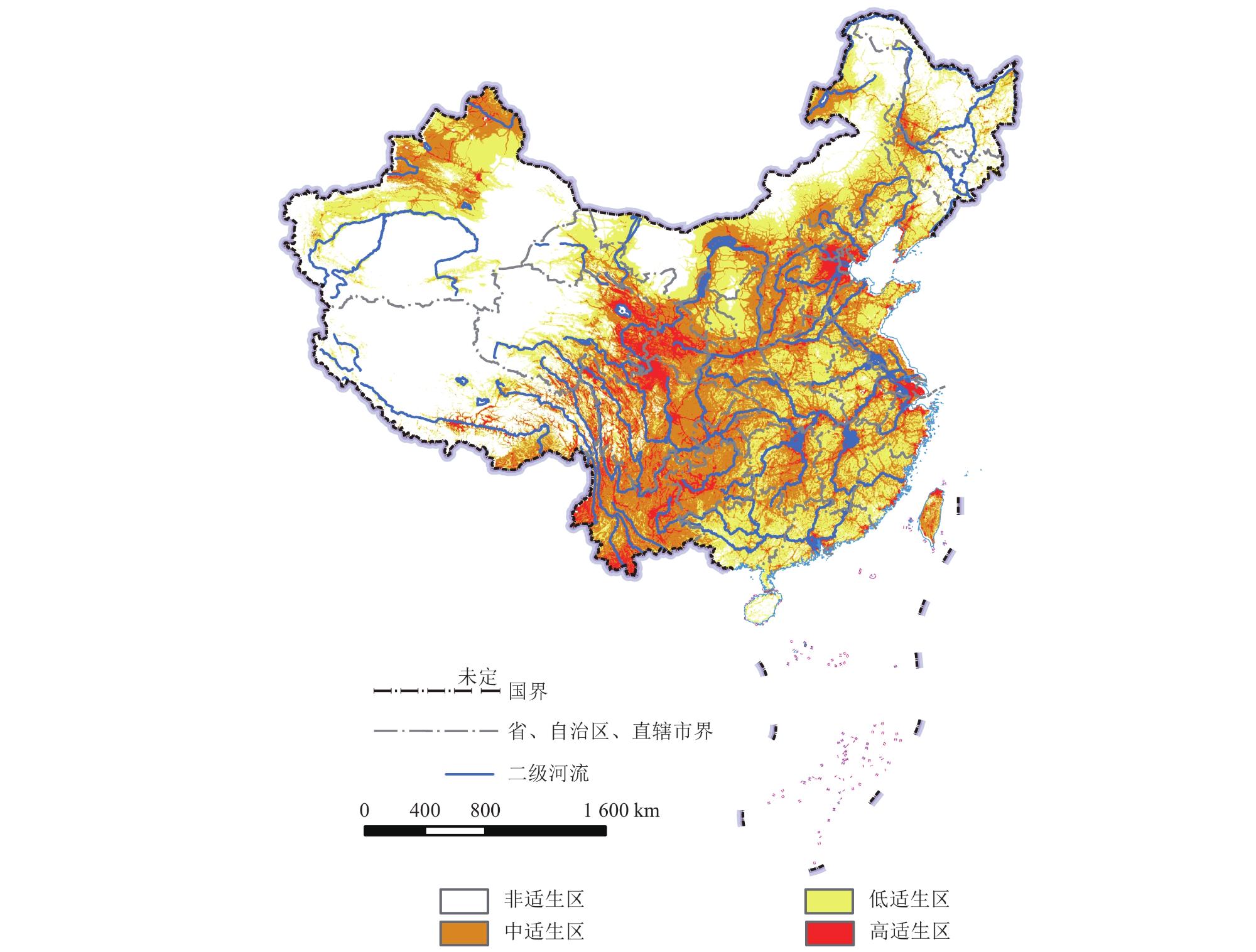
2 Suitable areas distribution of Ciconia nigra in China under current climate scenarios当前气候情景下黑鹳在中国的适生区分布
|
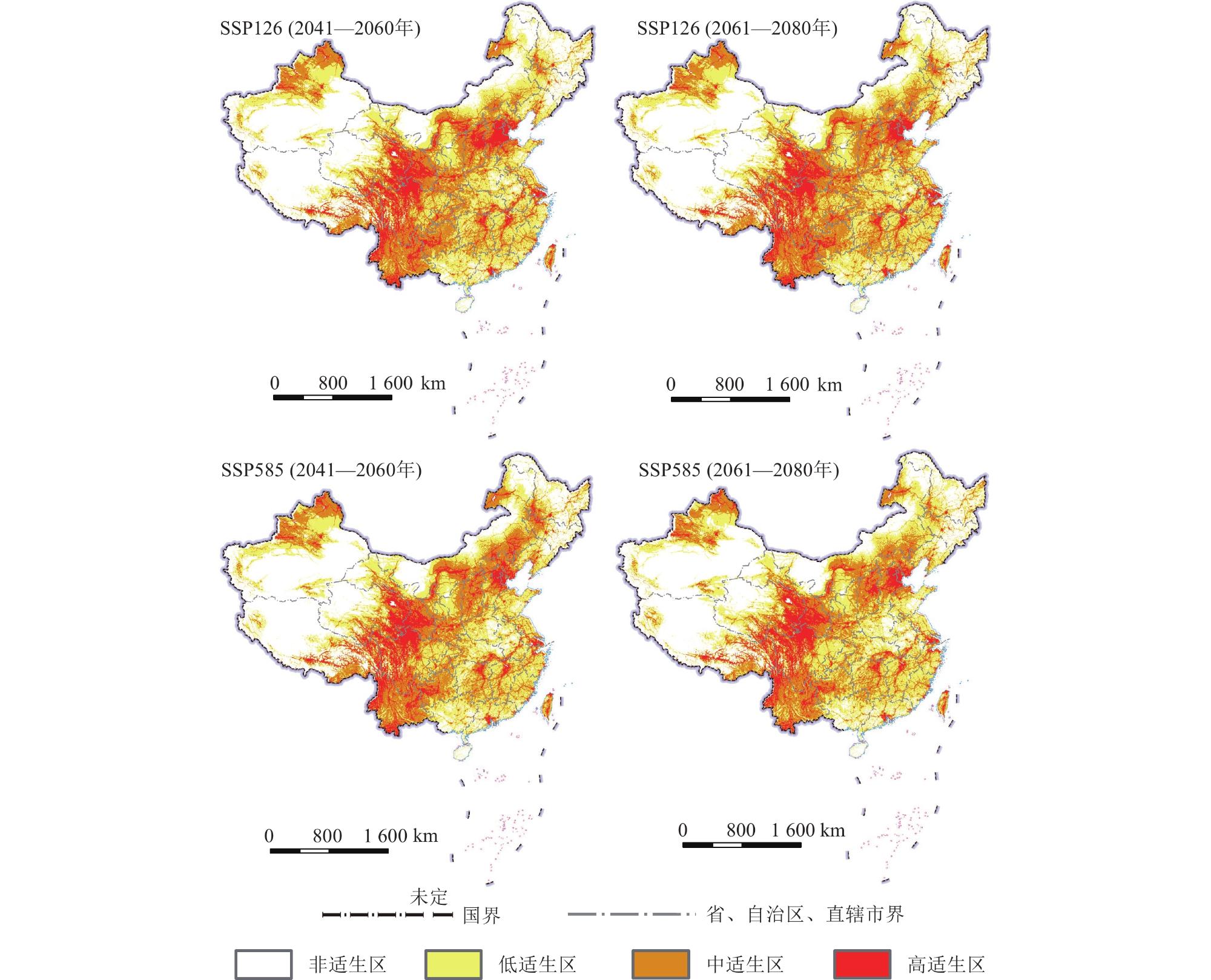
2 Area and proportion of suitable areas for Ciconia nigra in China under different climate scenarios不同气候情境下黑鹳在中国适生区面积及占比 |
| 气候情景 | 高适生区 | 中适生区 | 低适生区 | 非适生区 | |||||||
| 占比/% | 面积/(104 km2) | 占比/% | 面积/(104 km2) | 占比/% | 面积/(104 km2) | 占比/% | 面积/(104 km2) | ||||
| 当前气候(基准气候) | 9.44 | 90.59 | 27.55 | 264.51 | 26.89 | 258.11 | 36.12 | 346.79 | |||
| SSP126(2041—2060年) | 11.44 | 109.86 | 24.44 | 234.60 | 28.44 | 272.99 | 35.68 | 342.55 | |||
| SSP585(2041—2060年) | 11.22 | 107.68 | 25.34 | 243.28 | 28.57 | 274.30 | 34.87 | 334.74 | |||
| SSP126(2061—2080年) | 11.27 | 108.23 | 26.37 | 253.16 | 27.72 | 266.11 | 34.64 | 332.51 | |||
| SSP585(2061—2080年) | 10.21 | 98.03 | 23.39 | 224.52 | 30.17 | 289.59 | 36.24 | 347.86 | |||
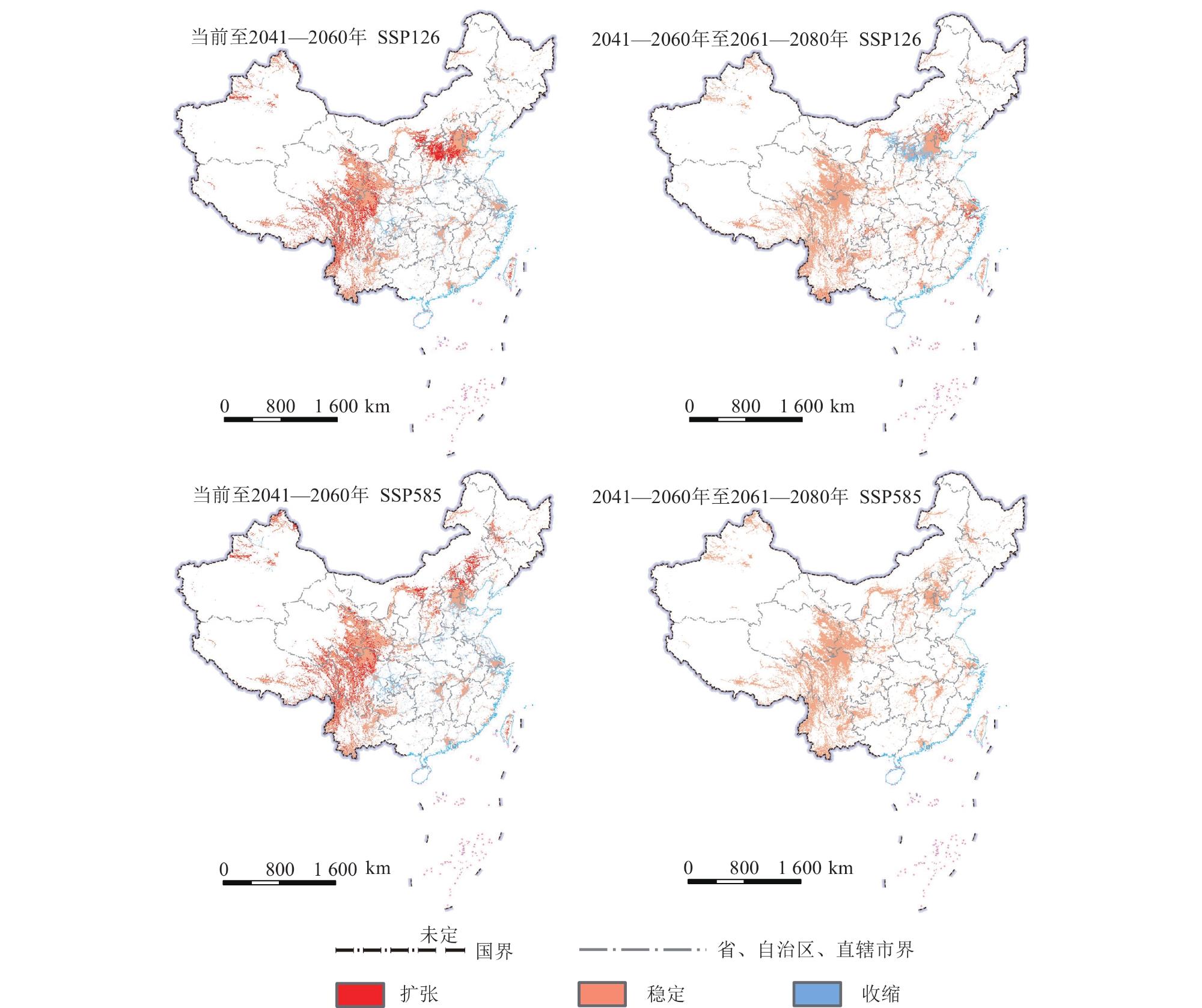
3 Changes of suitable areas spatial-temporal distribution of Ciconia nigra in China under future climate scenarios未来气候情景下黑鹳在中国适生区的时空变化
|
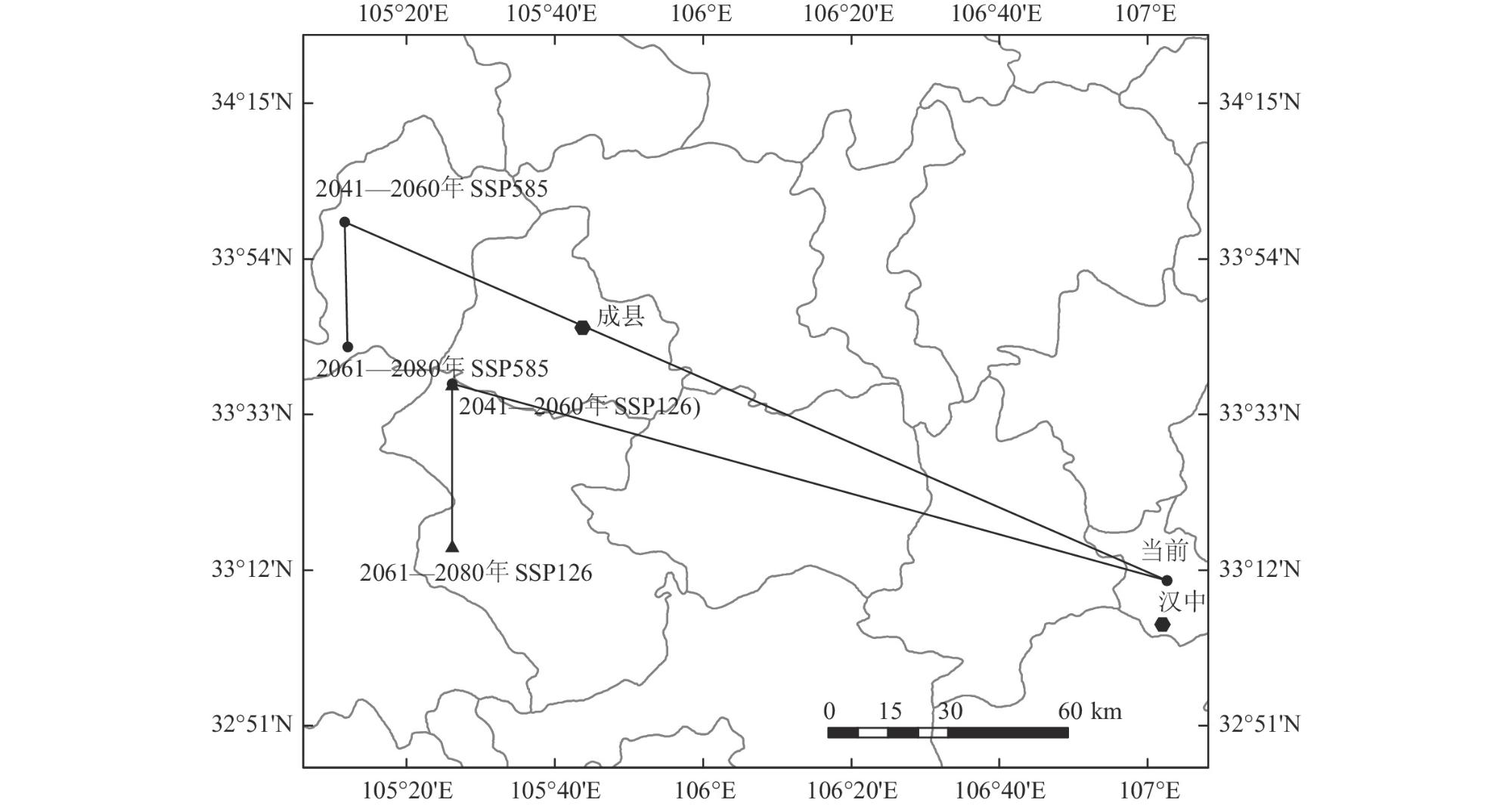
5 Gravity center moving trajectory of most suitable area of Ciconia nigra in China under different climate scenarios不同气候情景下黑鹳在中国高适生区的质心及其迁移轨迹 |
3 Moving distance and direction of gravity center of most suitable area of Ciconia nigra in China under different climate scenarios不同气候情景下黑鹤在中国高适生区质心迁移距离和方向 |
| 时期 | SSP126气候情景 | SSP585气候情景 | |||
| 迁移距离/m | 方向 | 迁移距离/m | 方向 | ||
| 当前至2041—2060年 | 9 131 | 西北 | 11 284 | 西北 | |
| 2041—2060年至2061—2080年 | 2 390 | 南 | 1 814 | 南 | |
| 1 |
| 2 |
| 3 |
| 4 |
| 5 |
| 6 |
| 7 |
| 8 |
| 9 |
| 10 |
| 11 |
| 12 |
| 13 |
| 14 |
| 15 |
| 16 |
| 17 |
| 18 |
| 19 |
| 20 |
| 21 |
| 22 |
| 23 |
| 24 |
| 25 |
| 26 |
| 27 |
| 28 |
| 29 |
| 30 |
| 31 |
| 32 |
| 33 |
| 34 |
| 35 |
| 36 |
| 37 |
| 38 |
| 39 |
| 40 |
| 41 |
| 42 |
| 43 |
| 44 |
| 45 |
| 46 |
| 47 |
| 48 |
| 49 |
| 50 |
| 51 |
| 52 |
| 53 |
| 54 |
| 55 |
| 56 |
| 57 |
| 58 |
| 59 |
| 60 |
| 61 |
| 62 |
| 63 |
| 64 |
| 65 |
| 66 |
| 67 |
| 68 |
| 69 |
| 70 |
/
| 〈 |
|
〉 |