



Population resource evaluation and fishing management strategies of Protosalanx hyalocranius in the Lianhuan Lake
Received date: 2024-04-19
Revised date: 2024-08-09
Online published: 2026-03-12
Copyright
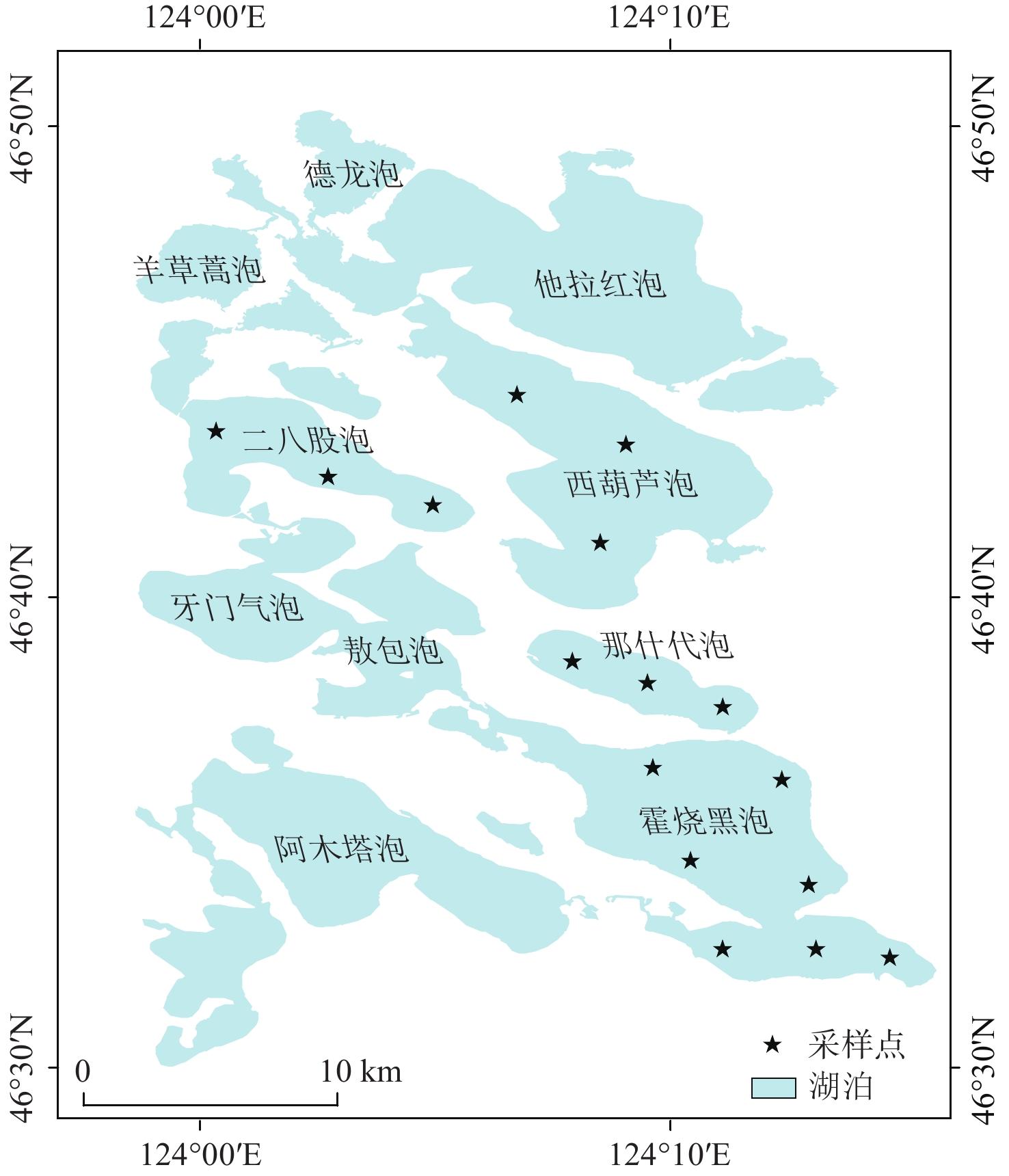
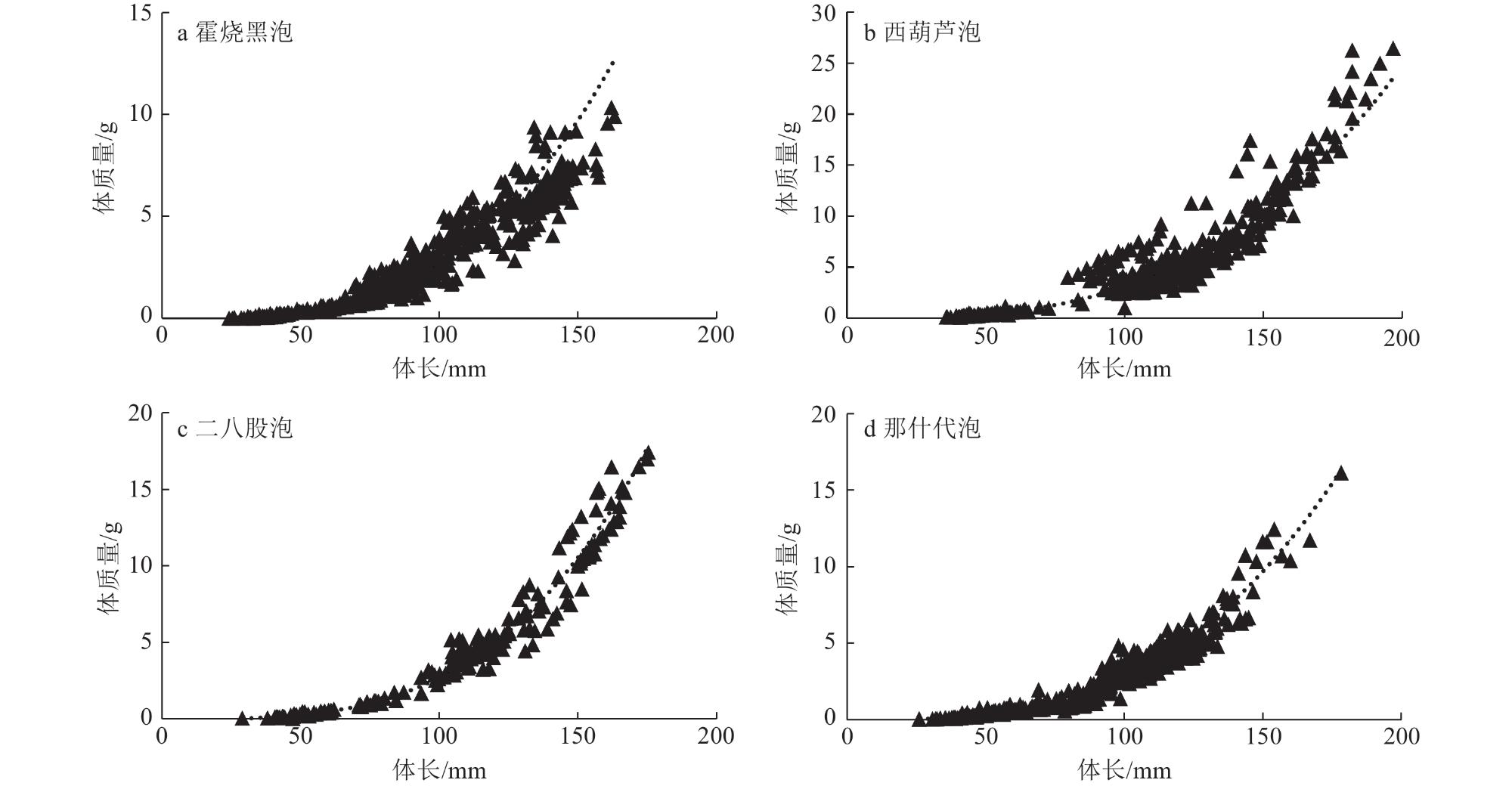
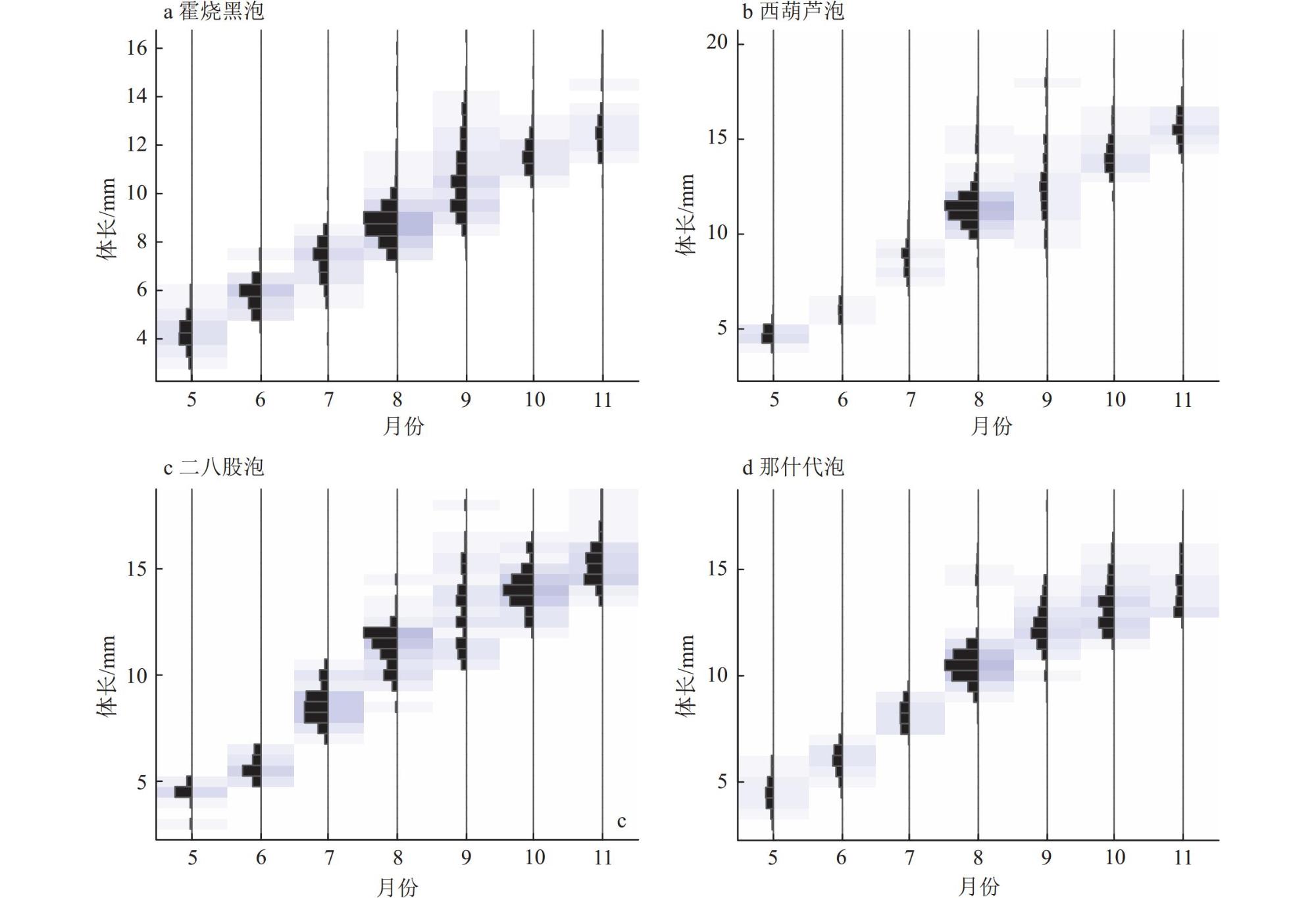
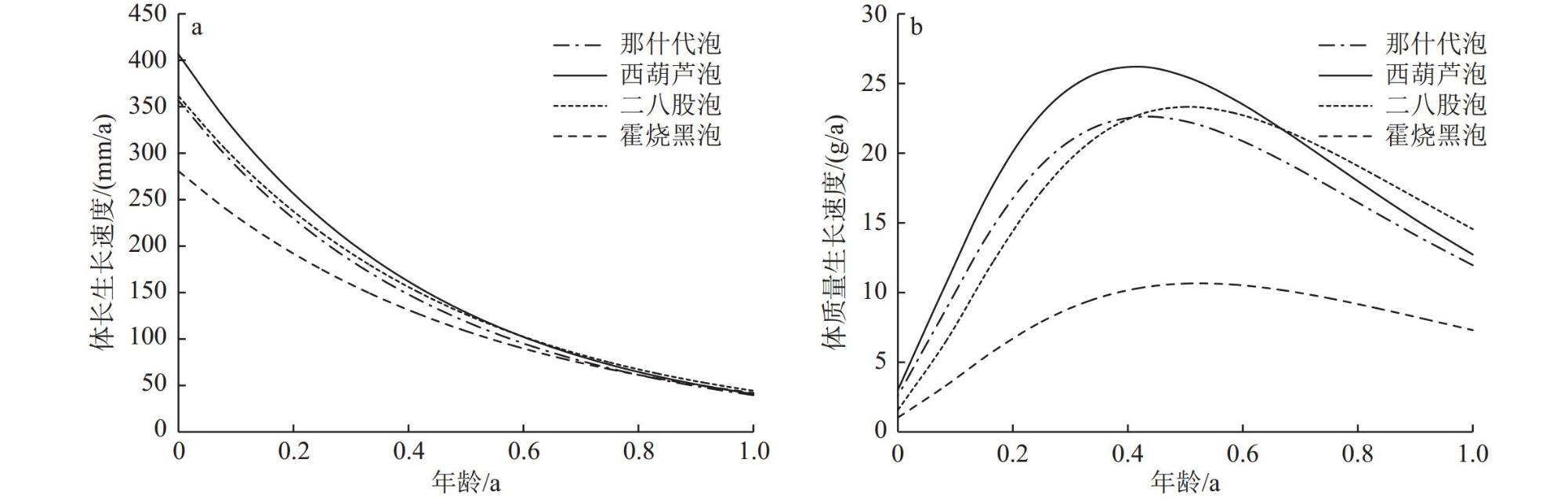
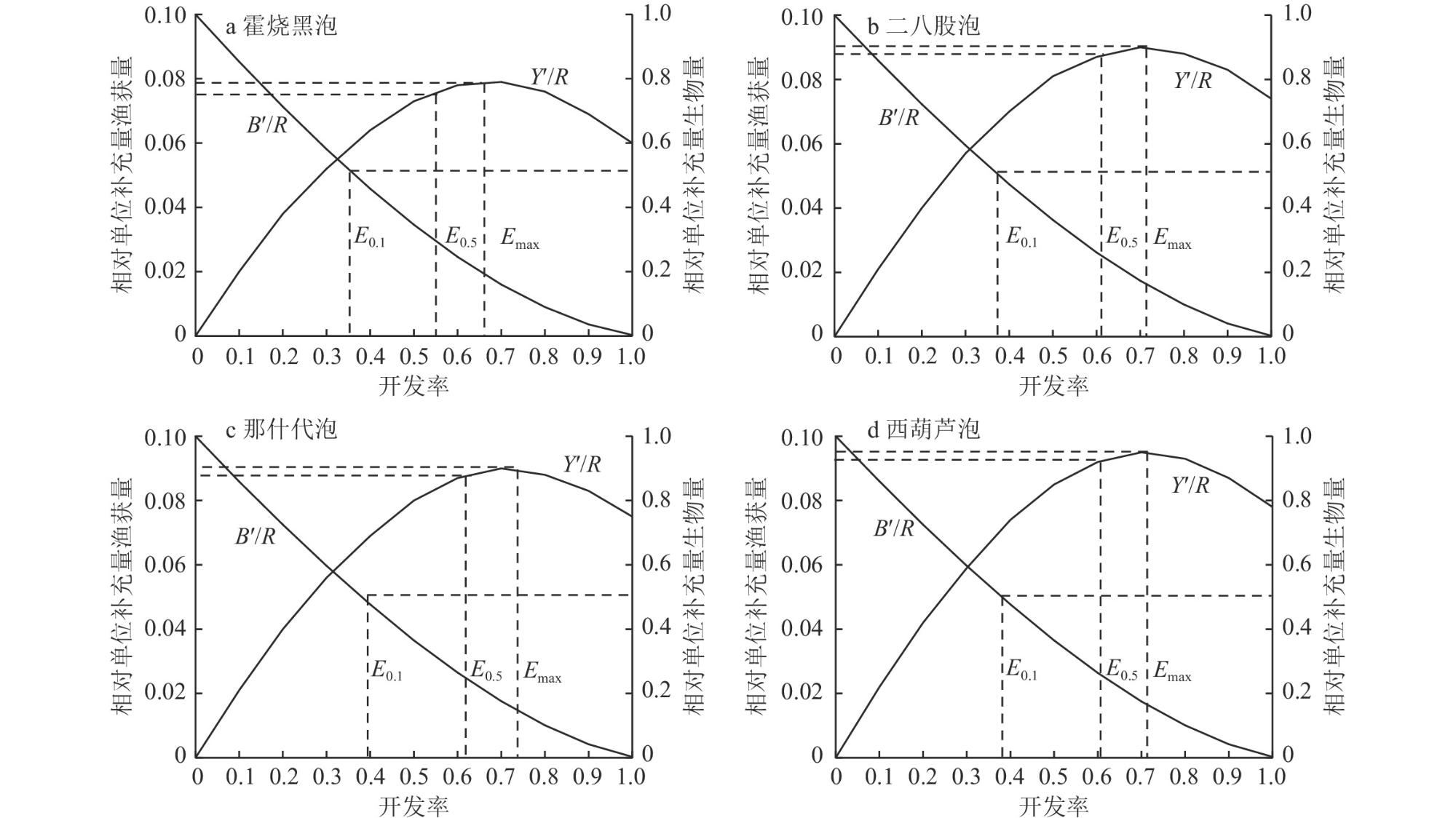
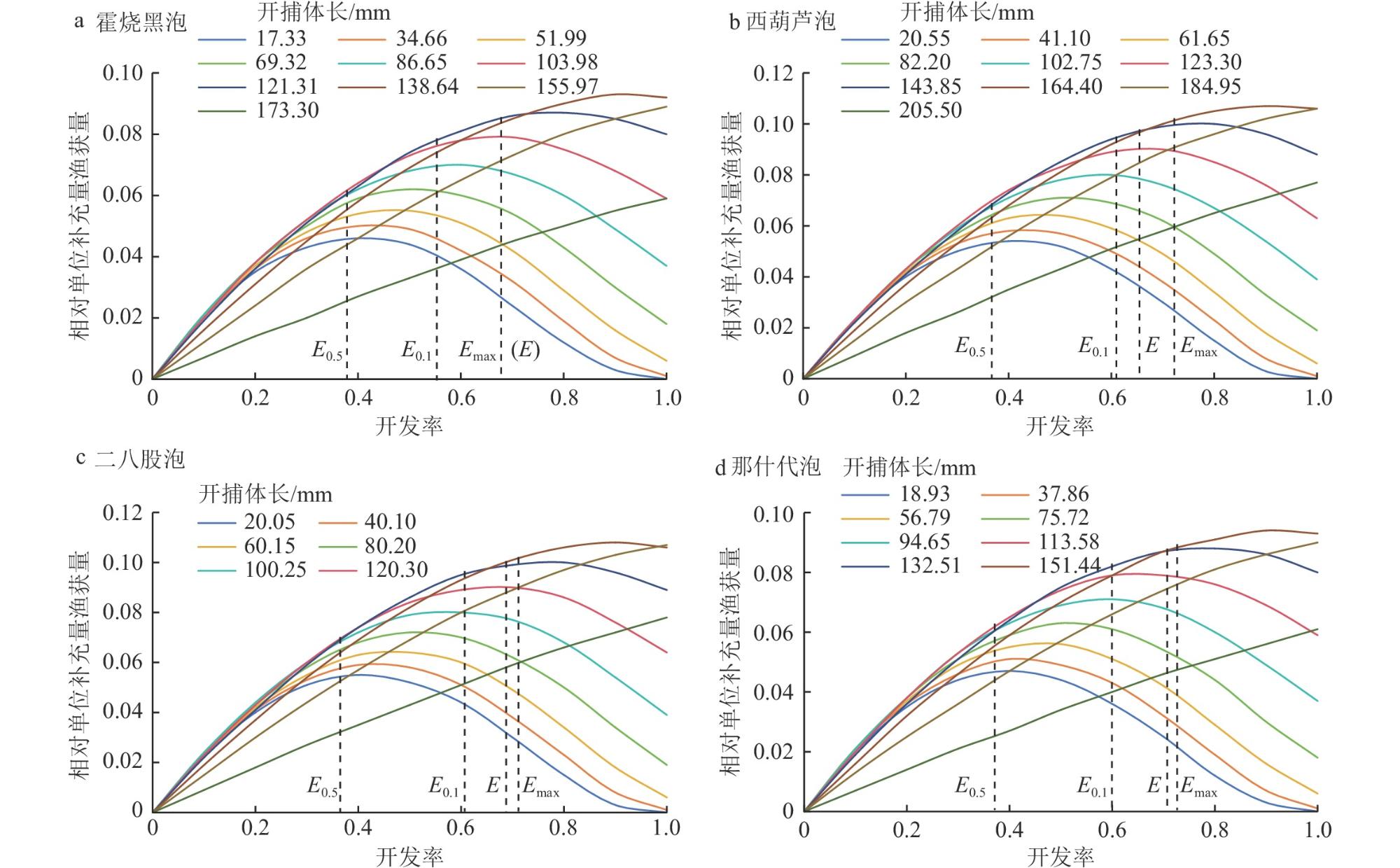
In order to investigate the differences in population characteristics of Protosalanx hyalocranius in different lakes of Lianhuan Lake, Heilongjiang, we estimated key growth and mortality parameters of P. hyalocranius by using the electronic body length frequency method based on fish samples (n=2 801) collected from May to November 2022 in four primary P. hyalocranius-producing lakes of Lianhuan Lake. The current status of P. hyalocranius resource utilization was assessed by constructing the Beverton-Holt dynamic integrated model, and the trend of P. hyalocranius population resources under different fishing strategies was analyzed, so as to formulate a scientific fishing management strategy for P. hyalocranius in Lianhuan Lake. The results showed that there were both supplementary and residual populations of the second age in the Lianhuan Lake. The ELEFAN_SA method yielded an asymptotic length (L∞) ranging from 173.3 mm to 205.5 mm, an asymptotic body mass (W∞) from 12.78 g to 25.64 g, and a growth coefficient (k) from 1.9 to 2.3 per year. The total coefficient of mortality (Z) was from 6.32/a to 7.63/a, the coefficient of natural mortality (M) was from 2.07/a to 2.27/a, the coefficient of fishing mortality (F) was from 4.18/a to 5.36/a, and the exploitation rate (E) was from 0.65 to 0.70. Based on the Beverton-Holt dynamic model, the biomass of the residual breeding population accounted for approximately 18%-21% of the total resource. Comparison of the living environment and population resource status indicated that population density and food abundance were the primary factors contributing to growth retardation and miniaturization in P. hyalocranius. By constructing the relative Y'/R of P. hyalocranius in relation to exploitation rate and body length, the results showed that the mean capture body length of HSH Lake, XHL Lake, EBG Lake and NSD Lake were adjusted to 103.98 mm, 123.30 mm, 120.30 mm, 113.58 mm, and the Y'/R value increased by an average of 12.25%. When the exploitation rate of P. hyalocranius was maintained at E0.1, the residual breeding population biomass could be guaranteed. When the exploitation rate was close to or exceeded the Emax, it was necessary to consider appropriate releases of fertilized eggs. The key factors for the sustainable development of P. hyalocranius resources include adequate food organisms, balanced intraspecific and interspecific relationships, and rational control of resource quantity. The results of this study can be used as a reference for managing P. hyalocranius aquaculture in northern cold-region waters.
Zhao Chen , Wang Le , Wang Huibo , Song Dan , Du Xue , Dou Qianming , Sun Jiawei , Huo Tangbin . Population resource evaluation and fishing management strategies of Protosalanx hyalocranius in the Lianhuan Lake[J]. Wetland Science, 2025 , 23(5) : 1076 -1086 . DOI: 10.13248/j.cnki.wetlandsci.20240112
1 Monthly fluctuations in body length and body weight for Protosalanx hyalocranius in different lakes of Lianhuan Lake连环湖水域不同湖泊大银鱼体长、体质量逐月变化 |
| 采集 月份 | 霍烧黑泡 | 西葫芦泡 | 二八股泡 | 那什代泡 | |||||||||||
| 尾数 | 体长/mm | 体质量/g | 尾数 | 体长/mm | 体质量/g | 尾数 | 体长/mm | 体质量/g | 尾数 | 体长/mm | 体质量/g | ||||
| 注:体长、体质量数据为范围及“平均值±标准差”。数据上标字母相同或没有上标表示差异不显著 (p>0.05),上标字母不同表示差异显著(p<0.05)。 | |||||||||||||||
| 5月 | 77 | 24.18~59.78 (39.94±7.05)a | 0.03~0.64 (0.17±0.12)a | 64 | 35.78~57.06 (44.70±3.76)b | 0.10~1.14 (0.30±0.16)b | 15 | 28.89~47.34 (42.19±4.35)b | 0.04~0.22 (0.13±0.05)a | 44 | 25.98~59.78 (42.24±7.22)b | 0.04~0.64 (0.21±0.13)a | |||
| 6月 | 102 | 44.05~71.41 (55.72±5.77) | 0.18~1.14 (0.49±0.15)a | 33 | 40.52~142.30 (57.34±6.41)a | 0.17~7.81 (0.77±1.24)b | 25 | 46.36~61.09 (53.62±4.29)b | 0.21~0.73 (0.47±0.11)a | 52 | 41.52~76.06 (57.67±7.00)a | 0.28~1.28 (0.64±0.20)a | |||
| 7月 | 99 | 52.00~95.51 (70.49±8.35)a | 0.30~2.23 (0.83±0.33)a | 71 | 67.38~113.83 (85.83±9.73)b | 0.41~2.51 (1.43±0.43)b | 60 | 67.38~101.70 (83.65±8.38)b | 0.79~2.76 (1.22±0.25)b | 53 | 67.79~93.55 (79.25±5.90)c | 0.83~2.71 (1.74±0.25)b | |||
| 8月 | 332 | 66.12~160.72 (86.68±11.85)a | 0.98~9.58 (1.96±1.56)a | 345 | 83.24~166.11 (113.94±13.47)b | 1.03~16.22 (4.93±2.68)b | 70 | 83.73~142.96 (110.99±9.66)b | 1.75~6.92 (3.96±1.18)b | 191 | 79.97~156.90 (104.91±12.64)c | 1.58~13.84 (3.84±1.97)b | |||
| 9月 | 187 | 71.48~162.12 (104.75±15.58)a | 1.45~10.35 (3.71±1.66)a | 160 | 79.53~186.84 (127.04±24.13)bc | 2.79~26.28 (7.92±4.97)b | 47 | 102.27~175.42 (128.34±16.88)bd | 2.99~17.43 (6.50±2.69)b | 115 | 86.60~178.29 (121.01±12.07)de | 2.72~16.16 (4.98±1.55)a | |||
| 10月 | 72 | 94.74~149.37 (114.83±9.17)a | 3.50~9.19 (5.37±1.56)a | 118 | 111.85~188.75 (140.28±12.24)b | 3.84~27.14 (9.05±3.94)b | 70 | 116.15~163.30 (138.15±9.34)b | 4.23~14.68 (8.19±1.93)c | 128 | 112.68~163.30 (131.37±11.51)c | 3.64~14.21 (7.07±2.88)c | |||
| 11月 | 54 | 103.45~150.78 (122.19±8.82)a | 2.30~10.35 (5.61±1.33)a | 103 | 128.80~196.74 (154.67±9.82)b | 5.18~28.34 (10.66±4.11)b | 49 | 132.69~173.34 (149.31±8.77)c | 7.08~19.15 (10.52±2.18)b | 65 | 123.62~167.05 (139.16±10.61)d | 4.39~15.31 (8.15±2.54)c | |||
| 合计 | 923 | 24.18~162.12 (85.17±26.44)a | 0.03~10.35 (3.01±2.09)a | 894 | 35.78~196.74 (115.02±32.46)b | 0.10~28.34 (6.51±3.88)b | 336 | 28.89~175.42 (112.33±33.17)b | 0.04~19.15 (5.56±2.76)c | 648 | 25.98~178.29 (106.21±30.35)c | 0.04~16.16 (4.07±2.27)c | |||
2 Growth parameters for Protosalanx hyalocranius in different lakes of Lianhuan Lake连环湖不同湖泊大银鱼生长参数 |
| 湖泊 | 渐进体长/mm | 生长系数 | 初始年龄 | 拐点年龄 | 生长特征指数 | 体长生长方程 | 体质量生长方程 |
| 霍烧黑泡 | 173.30 | 1.9 | −0.08 | 0.52 | 4.76 | Lt=173.3×[1−e−1.9(t+0.08)] | Wt=12.78×[1−e−1.9(t+0.08)] |
| 西葫芦泡 | 205.50 | 2.3 | −0.06 | 0.41 | 4.99 | Lt=205.5×[1−e−2.3(t+0.06)] | Wt=25.64×[1−e−2.3(t+0.06)] |
| 二八股泡 | 200.50 | 2.2 | −0.07 | 0.50 | 4.93 | Lt=200.5×[1−e−2.2(t+0.07)] | Wt=25.55×[1−e−2.2(t+0.07)] |
| 那什代泡 | 189.30 | 2.1 | −0.07 | 0.43 | 4.90 | Lt=189.3×[1−e−2.1(t+0.07)] | Wt=23.18×[1−e−2.1(t+0.07)] |
3 Population parameters for Protosalanx hyalocranius in different lakes of Lianhuan Lake连环湖不同湖泊大银鱼种群特征参数 |
| 采集水域 | 自然死亡系数 | 总死亡系数 | 捕捞死亡系数 | 开发率 | 临近年龄 | Emax | E0.1 | E0.5 | L25/mm | L50/mm | L75/mm |
| 注:Emax为最大渔获量下大银鱼资源开发率;E0.1为最大渔获量下减少10%的资源开发率;E0.5为生物量下降到原始水平50%的大银鱼资源开发率;L25、L50、L75分别表示留存率为25%、50%、75%所对应的体长。 | |||||||||||
| 霍烧黑泡 | 2.07 | 6.32 | 4.25 | 0.67 | 0.61 | 0.67 | 0.55 | 0.37 | 63.80 | 78.55 | 93.30 |
| 西葫芦泡 | 2.25 | 6.43 | 4.18 | 0.65 | 0.54 | 0.72 | 0.61 | 0.38 | 96.84 | 102.73 | 107.37 |
| 二八股泡 | 2.14 | 6.84 | 4.70 | 0.69 | 0.54 | 0.71 | 0.61 | 0.38 | 103.15 | 109.28 | 114.18 |
| 那什代泡 | 2.27 | 7.63 | 5.36 | 0.70 | 0.55 | 0.72 | 0.60 | 0.38 | 95.20 | 99.46 | 103.87 |
5 Relationships between relative yield per recruit (Y’/R), relative biomass per recruit (B’/R) and exploitation ratio (E) of Protosalanx hyalocranius in different lakes of Lianhuan Lake连环湖大银鱼相对单位补充量渔获量(Y'/R)、相对单位补充量生物量(B'/R)与开发率(E)的关系 Emax为最大渔获量下大银鱼资源开发率;E0.1为最大渔获量下减少10%的资源开发率;E0.5为生物量下降到原始水平50%的大银鱼资源开发率;Y'/R为相对单位补充量渔获量;B'/R为相对单位补充量生物量。]]> |
4 Comparison of growth parameters of Protosalanx hyalocranius in different lakes不同湖泊大银鱼生长参数对比 |
| 种群参数 | 洪泽湖[15] | 小兴凯湖[20] | 太湖[21] | 大龙湖[22] | 阿木塔湖[22] | 连环湖(本研究) |
| 注:−表示文献中无该指标的数据。 | ||||||
| 异速生长指数(b) | ||||||
| 生长系数(k) | 1.97 | 2.40 | − | 2.10 | 2.50 | 1.90~2.30 |
| 渐近体长(L∞)/mm | 173.35 | 204.75 | 219.86 | 183.75 | 169.10 | 173.30~205.50 |
| 渐近体质量(W∞)/g | 23.75 | 42.51 | 28.56 | 29.29 | 28.72 | 12.78~25.64 |
| 生长特征指数(Φ) | 4.77 | 5.00 | − | 4.85 | 4.85 | 4.76~4.99 |
| 开发率(E) | 0.72 | 0.68 | − | 0.61 | 0.60 | 0.65~0.70 |
| 1 |
| 2 |
| 3 |
| 4 |
| 5 |
| 6 |
| 7 |
| 8 |
| 9 |
| 10 |
| 11 |
| 12 |
| 13 |
| 14 |
| 15 |
| 16 |
| 17 |
| 18 |
| 19 |
| 20 |
| 21 |
| 22 |
| 23 |
| 24 |
| 25 |
| 26 |
| 27 |
| 28 |
| 29 |
| 30 |
| 31 |
| 32 |
| 33 |
| 34 |
| 35 |
| 36 |
| 37 |
/
| 〈 |
|
〉 |