青海东达布逊湖湖泊面积和水量的变化研究
|
周玉静(1999-),女,硕士研究生,主要从事生态水文地质与水环境遥感等研究。Email:zhou19991203@163.com。 |
Copy editor: 陈庆
收稿日期: 2024-05-31
修回日期: 2024-08-18
网络出版日期: 2026-06-03
基金资助
国家自然科学基金项目“干旱区大尺度地下水蒸发排泄机理及遥感计算方法研究”(41372250)
Variations in area and water volume of East Dabuxun Lake,Qinghai Province
Received date: 2024-05-31
Revised date: 2024-08-18
Online published: 2026-06-03
周玉静 , 金晓媚 , 马靖宣 , 李晴 . 青海东达布逊湖湖泊面积和水量的变化研究[J]. 自然资源遥感, 2025 , 37(5) : 15 -23 . DOI: 10.6046/zrzyyg.2024195
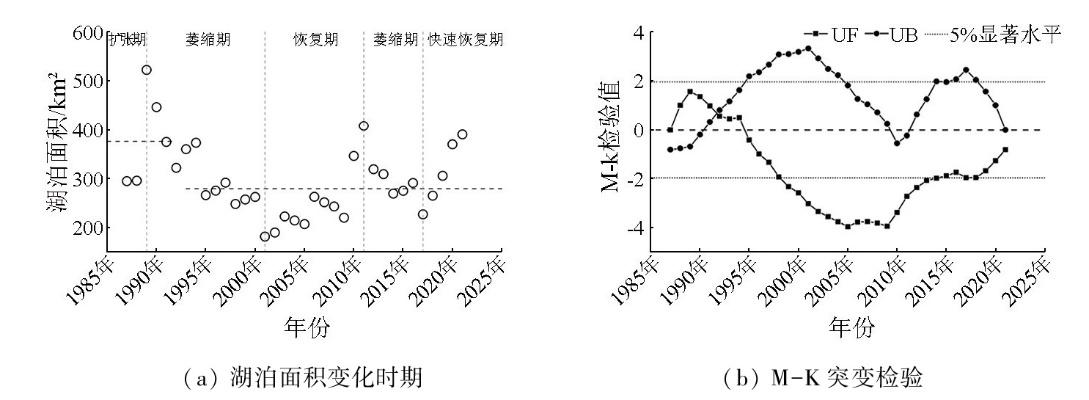
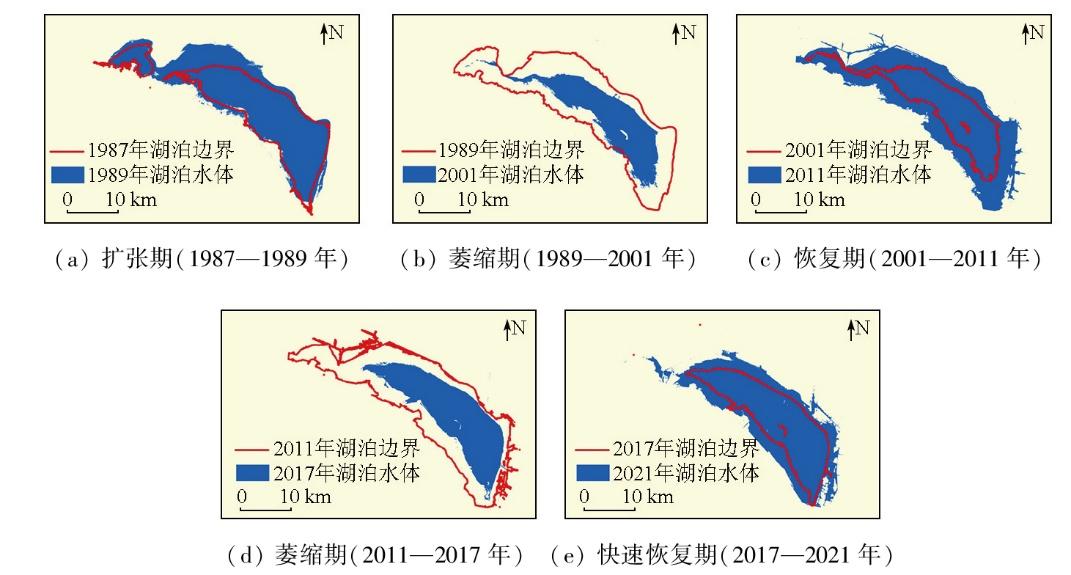
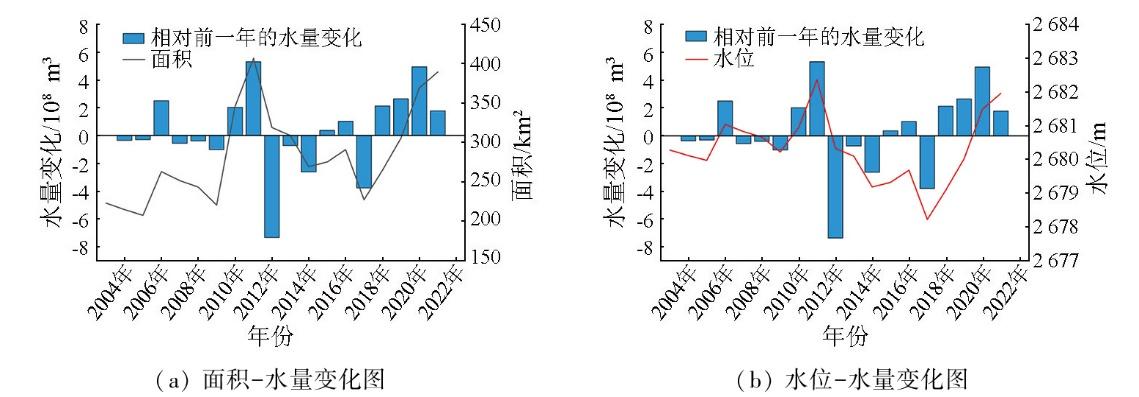
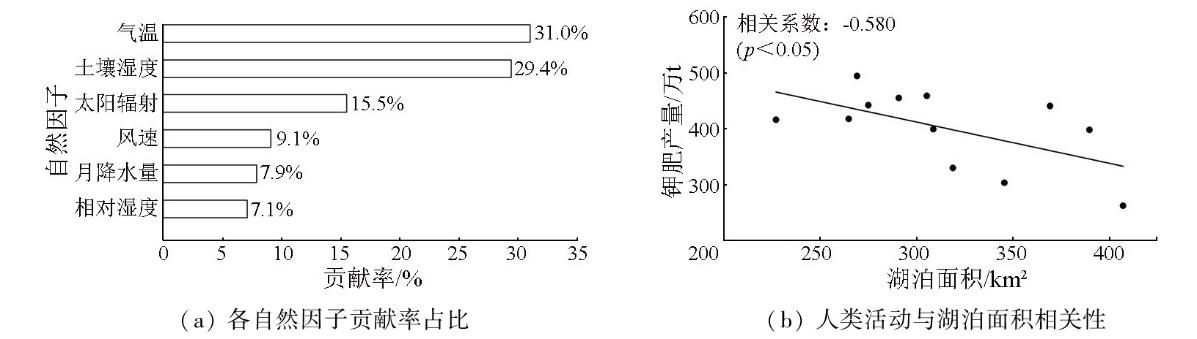
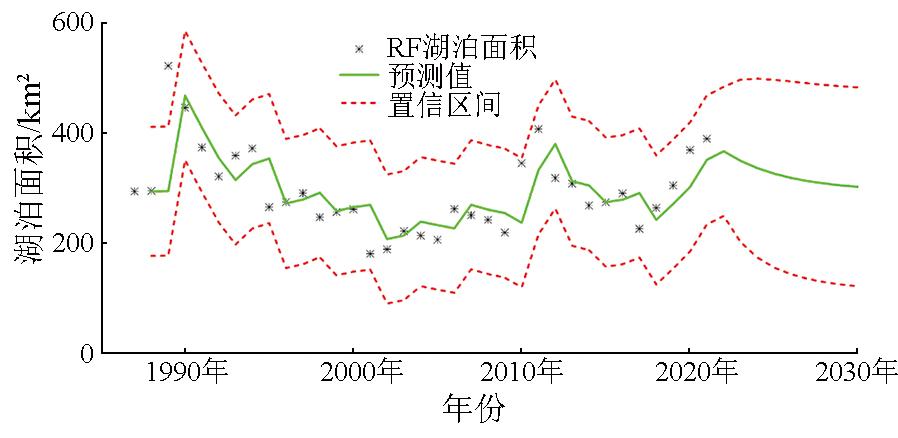
Changes in lake area and water volume exert significant impacts on the ecological environment of arid regions. Targeting East Dabuxun Lake,Golmud River Basin,Qinghai Province,this study developed a multi-index random forest algorithm based on the Google Earth Engine (GEE) cloud platform and Landsat imagery to extract the lake area from 1987 to 2021. Then,an area-water level relationship was established using laser altimetry data from ICESat and CryoSat satellites to estimate changes in water volume. Finally,the impacts of natural factors and human activities on the lake were evaluated,using ERA5-Land climate data and records of potash mining,along with correlation analysis and random forest-based contribution assessment. The results indicate that the temporal changes in lake area over time can be divided into five stages:expansion,shrinkage,recovery,re-shrinkage,and rapid recovery. Spatially,the lake exhibited a pattern of shrinkage in the south and expansion towards the northwest. From 2003 to 2021,the water volume of East Dabuxun Lake showed an upward trend. Temperature,glacier and permafrost melting,and solar radiation were identified as the main natural factors influencing lake area,with contribution rates of 31.0%,29.4%,and 15.5%,respectively. In terms of human activities,potash mining emerged as a major driver of lake area changes after 2010. Based on predictions by the auto-regressive moving average model (ARIMA),the lake area is projected to decline to 302.78 km2 by 2030.
表1 数据信息表Tab.1 Data information |
| 数据类型 | 数据名称 | 数据来源 | 空间分辨率/m | 时间分辨率 |
|---|---|---|---|---|
| 光学遥感数据与产品 | Landsat5,7,8,9 | NASA | 30 | 16 d |
| Sentinel-2 | ESA | 10 | 5 d | |
| 地表高程 | SRTM DEM产品 | 90 | 静态数据 | |
| 全球水体产品(JRC) | Global Surface Water Explorer | 30 | 月 | |
| 气象和土壤数据 | 气温、降水量、相对湿度、风速、太阳辐射、土壤湿度 | ERA5-Land再分析产品 | 11 132 | 月 |
| 数据类型 | 数据名称 | 数据来源 | 测高精度/cm | 重访周期/d |
| 卫星测高数据 | ICESat/GLA14 | NSIDC | 2~5 | 183 |
| CryoSat-2/SIRAL GDR | ESA | 1~3 | 369 | |
| 其他数据 | 钾肥产量(折纯) | 格尔木市人民政府网站 | — | — |
表2 各时期湖泊面积变化量及方向Tab.2 The quantity and direction of changes in lake area in different periods |
| 湖泊变化时期 | 湖泊面积变化/km2 | 湖泊面积年均变化/km2 | 湖泊面积年均变化率/% | 变化方向 |
|---|---|---|---|---|
| 扩张期(1987—1989年) | 227.155 | 113.578 | 50.00 | 向西北扩张 |
| 萎缩期(1989—2001年) | -339.885 | -28.324 | -8.33 | 从东部、西北部萎缩 |
| 恢复期(2001—2011年) | 225.381 | 22.538 | 10.00 | 向四周扩张 |
| 萎缩期(2011—2017年) | -180.016 | -30.003 | -16.67 | 从南部萎缩 |
| 快速恢复期(2017—2021年) | 162.523 | 40.631 | 25.00 | 向四周扩张 |
表3 单因素皮尔逊分析Tab.3 Single factor Pearson analysis |
| 自然因素 | 气温 | 降水量 | 相对 湿度 | 风速 | 太阳 辐射 | 土壤 湿度 |
|---|---|---|---|---|---|---|
| 相关系数 | -0.351*① | -0.159 | -0.136 | 0.103 | 0.149 | 0.275 |
| 显著性 (双尾) | 0.039 | 0.360 | 0.435 | 0.554 | 0.393 | 0.110 |
①*为0.05显著水平的相关系数。 |
表4 模型比较Tab.4 Model comparison |
| p | d | q | AIC | BIC |
|---|---|---|---|---|
| 1 | 1 | 1 | 376.29 | 379.35 |
| 0 | 1 | 1 | 378.97 | 380.50 |
| 1 | 1 | 0 | 379.34 | 380.87 |
| 0 | 1 | 0 | 377.61 | 377.61 |
| [1] |
|
| [2] |
李丹, 吴保生, 陈博伟, 等. 基于卫星遥感的水体信息提取研究进展与展望[J]. 清华大学学报(自然科学版), 2020, 60(2):147-161.
|
| [3] |
|
| [4] |
|
| [5] |
徐涵秋. 水体遥感指数研究进展[J]. 福州大学学报(自然科学版), 2021, 49(5):613-625.
|
| [6] |
|
| [7] |
|
| [8] |
|
| [9] |
|
| [10] |
|
| [11] |
张国庆, 王蒙蒙, 周陶, 等. 青藏高原湖泊面积、水位与水量变化遥感监测研究进展[J]. 遥感学报, 2022, 26(1):115-125.
|
| [12] |
马山木, 甘甫平, 吴怀春, 等. ICESat-2数据监测青藏高原湖泊2018—2021年水位变化[J]. 自然资源遥感, 2022, 34(3):164-172.doi:10.6046/zrzyyg.2021329.
|
| [13] |
王晓雪. 青海达布逊湖面积变化及湖泊蒸发量的计算[D]. 北京: 中国地质大学(北京), 2019.
|
| [14] |
田华, 魏超, 宁世雄, 等达布逊湖面积变化及其影响因素研究[J]. 河南科技, 2018(29):89-91.
|
| [15] |
|
| [16] |
郑绵平. 中国盐湖资源与生态环境[J]. 地质学报, 2010, 84(11):1613-1622.
|
| [17] |
|
| [18] |
王妍, 刘帅, 邱丽莎, 等. 1990—2021年蒙古高原年度丰水期水体数据集[J]. 中国科学数据, 2023, 8(1):69-82.
|
| [19] |
王嘉诚, 李渊, 施坤, 等. 1987—2022年新安江水库(千岛湖)水面面积时空变化及其与水位、蓄水量的响应关系[J]. 湖泊科学, 2024, 36(3):913-926.
|
| [20] |
|
| [21] |
陈妙金, 汪小钦, 吴思颖. 基于随机森林算法的水土流失影响因子重要性分析[J]. 自然灾害学报, 2019, 28(4):209-219.
|
| [22] |
徐涵秋. 利用改进的归一化差异水体指数(MNDWI)提取水体信息的研究[J]. 遥感学报, 2005, 9(5):589-595.
|
| [23] |
|
| [24] |
|
| [25] |
|
| [26] |
马靖宣, 金晓媚, 张绪财, 等. 基于InVEST模型的张承地区水源涵养功能时空变化特征[J]. 水文地质工程地质, 2023, 50(3):54-64.
|
| [27] |
刘志林, 丁银平, 角媛梅, 等. 滇中城市群不透水表面时空变化与反常气候现象研究[J]. 地理学报, 2022, 77(7):1775-1793.
|
| [28] |
王鹏飞, 郭云艳, 周康, 等. 1961—2018年呼伦湖水面面积变化特征及其对气候变化的响应[J]. 环境科学研究, 2021, 34(4):792-800.
|
| [29] |
马生玉, 徐亮. 2010年夏季格尔木河流域汛情及气候成因分析[J]. 青海科技, 2011, 18(1):38-41.
|
| [30] |
陈军, 刘延昭, 曹立国, 等. 青藏高原湖泊变化遥感监测及水量平衡定量估算研究进展[J]. 冰川冻土, 2022, 44(4):1203-1215.
|
| [31] |
魏善蓉, 金晓媚, 王凯霖, 等. 基于遥感的柴达木盆地湖泊面积变化与气候响应分析[J]. 地学前缘, 2017, 24(5):427-433.
|
| [32] |
杜玉娥, 刘宝康, 贺卫国, 等. 1976—2017年柴达木盆地湖泊面积变化及其成因分析[J]. 冰川冻土, 2018, 40(6):1275-1284.
|
| [33] |
卢娜. 柴达木盆地湖泊面积变化及影响因素分析[J]. 干旱区资源与环境, 2014, 28(8):83-87.
|
/
| 〈 |
|
〉 |