用于植被变化归因的区域机器学习残差趋势法
|
胡博洋(1997-),男,硕士研究生,主要从事植被变化归因等研究。Email: hxby1258@163.com。 |
Copy editor: 陈昊旻
收稿日期: 2023-08-22
修回日期: 2024-02-01
网络出版日期: 2026-06-03
基金资助
甘肃省科技计划项目“甘肃省地表覆盖变化自动监测关键技术”(20YF3GA013)
兰州交通大学优秀平台(201806)
Residual trend method based on regional modeling and machine learning for attribution of vegetation changes
Received date: 2023-08-22
Revised date: 2024-02-01
Online published: 2026-06-03
胡博洋 , 孙建国 , 张倩 , 杨云睿 . 用于植被变化归因的区域机器学习残差趋势法[J]. 自然资源遥感, 2025 , 37(1) : 46 -53 . DOI: 10.6046/zrzyyg.2023258
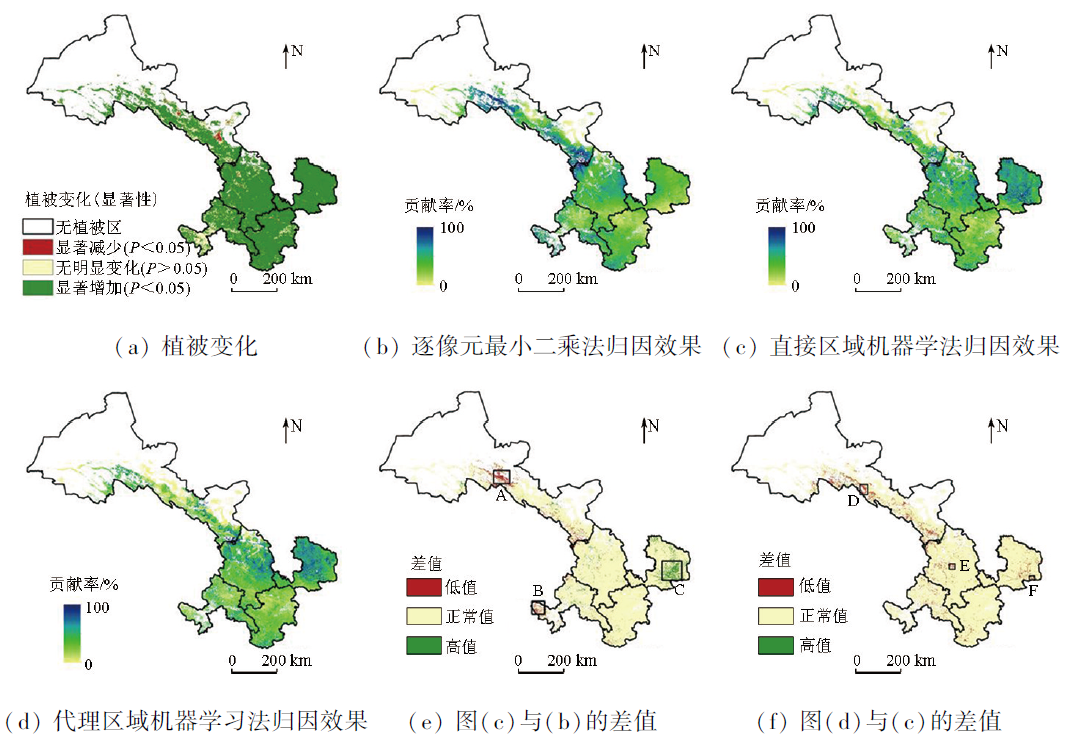
Existing residual trend methods utilize a pixel-by-pixel modeling strategy, in which the ordinary least squares method is employed. These methods suffer certain limitations. On the one hand, the pixel-by-pixel modeling strategy causes each model to contain signal interference from human activities in local space. On the other hand, the ordinary least squares method is unfavorable for simulating commonly observed nonlinear characteristics. This study proposed an entirely new residual trend method based on regional modeling and machine learning. Besides, this study compared two types of environmental variables used to express spatial heterogeneity: ①direct-environmental variables (DEVs) such as terrain, hydrology, and land use; and ②proxy-environmental variables (PEVs) that combine the spatiotemporal series of vegetation and climate. First, a regional modeling strategy was adopted. After DEVs and PEVs were introduced individually, models for the vegetation-climate relationship were built using machine learning. Second, residuals were determined based on the definition of the residual trend method. Finally, the contributions of anthropogenic and climatic factors to vegetation change were assessed. The results indicate that compared to the previous pixel-by-pixel residual trend method that utilizes ordinary least squares, the new residual trend method can simulate the nonlinear features of the vegetation-climate relationship and exhibits enhanced resistance to human signal interference. For the new method, significantly higher performance can be achieved using PEVs compared to DEVs. PEVs can fully utilize the original modeling data, without increasing difficulties with data acquisition and avoiding additional data errors. The residual trend method based on regional modeling and machine learning proposed in this study allows for more effective attribution of vegetation changes.
表1 区域机器学习法中的DEVsTab.1 DEVs in regional machine learning method |
| 变量类 | 简称 | 数据源 | 空间分辨率 |
|---|---|---|---|
| 高程 | DEV1 | www.resdc.cn | 90 m |
| 坡度 | DEV2 | www.resdc.cn | 90 m |
| 到道路的距离 | DEV3 | www.openstreetmap.org | 矢量 |
| 到水体的距离 | DEV4 | www.geodata.cn | 矢量 |
| 夜间灯光 | DEV5 | www.ngdc.noaa.gov | 1 km |
| 地表覆盖类型 | DEV6 | data.casearth.cn | 30 m |
| 初期植被状态 | DEV7 | ladsweb.modaps.eosdis.nasa.gov | 1 km |
| [1] |
孙红雨, 王长耀, 牛铮, 等. 中国地表植被覆盖变化及其与气候因子关系──基于NOAA时间序列数据分析[J]. 遥感学报, 1998, 2(3):204-210.
|
| [2] |
Intergovernmental Panel on Climate Change (IPCC). Climate change 2013:The physical science basis working group I contribution to the fifth assessment report of the intergovernmental panel on climate change[M]. Cambridge: Cambridge University Press, 2014.
|
| [3] |
|
| [4] |
|
| [5] |
|
| [6] |
|
| [7] |
|
| [8] |
|
| [9] |
|
| [10] |
|
| [11] |
金凯, 王飞, 韩剑桥, 等. 1982—2015年中国气候变化和人类活动对植被NDVI变化的影响[J]. 地理学报, 2020, 75(5):961-974.
|
| [12] |
|
| [13] |
|
| [14] |
|
| [15] |
|
| [16] |
|
| [17] |
刘志红,
|
| [18] |
姚楠, 董国涛, 薛华柱. 基于GoogleEarthEngine的黄土高原植被覆盖度时空变化特征分析[J]. 水土保持研究, 2024, 31(1):260-268.
|
| [19] |
|
| [20] |
|
| [21] |
|
| [22] |
|
| [23] |
敖泽建, 王建兵, 蒋友严, 等. 2000—2017年甘南牧区植被变化特征及其影响因子[J]. 沙漠与绿洲气象, 2020, 14(1):95-100.
|
| [24] |
李文龙, 薛中正, 郭述茂, 等. 基于3S技术的玛曲县草地植被覆盖度变化及其驱动力[J]. 兰州大学学报(自然科学版), 2010, 46(1):85-90,95.
|
| [25] |
李丽丽, 王大为, 韩涛. 2000—2015年石羊河流域植被覆盖度及其对气候变化的响应[J]. 中国沙漠, 2018, 38(5):1108-1118.
|
| [26] |
胡春艳, 卫伟, 王晓峰, 等. 甘肃省植被覆盖变化及其对退耕还林工程的响应[J]. 生态与农村环境学报, 2016, 32(4):588-594.
|
| [27] |
|
| [28] |
张建永, 李扬, 赵文智, 等. 河西走廊生态格局演变跟踪分析[J]. 水资源保护, 2015, 31(3):5-10.
|
| [29] |
|
/
| 〈 |
|
〉 |