Application of microwave plasma linear ion trap mass spectrometry method in the determination of zirconium in water
|
ZHANG Tianrui,male,born in 1991,engineer,focusing on isotope geochemistry research. E-mail:ztr661025@163.com |
Received date: 2025-03-25
Revised date: 2025-04-03
Online published: 2025-11-06
Supported by
National Natural Science Foundation of China(32460107)
Key Project of Hunan Province(2023NK2021)
Scientific Research Project of Hunan Provincial Department of Education(23C0092)
Scientific Research Project of Jiangxi Provincial Department of Education(GJJ240802)
Youth Fund Project of Beijing Research Institute of Uranium Geology(测Q2007)
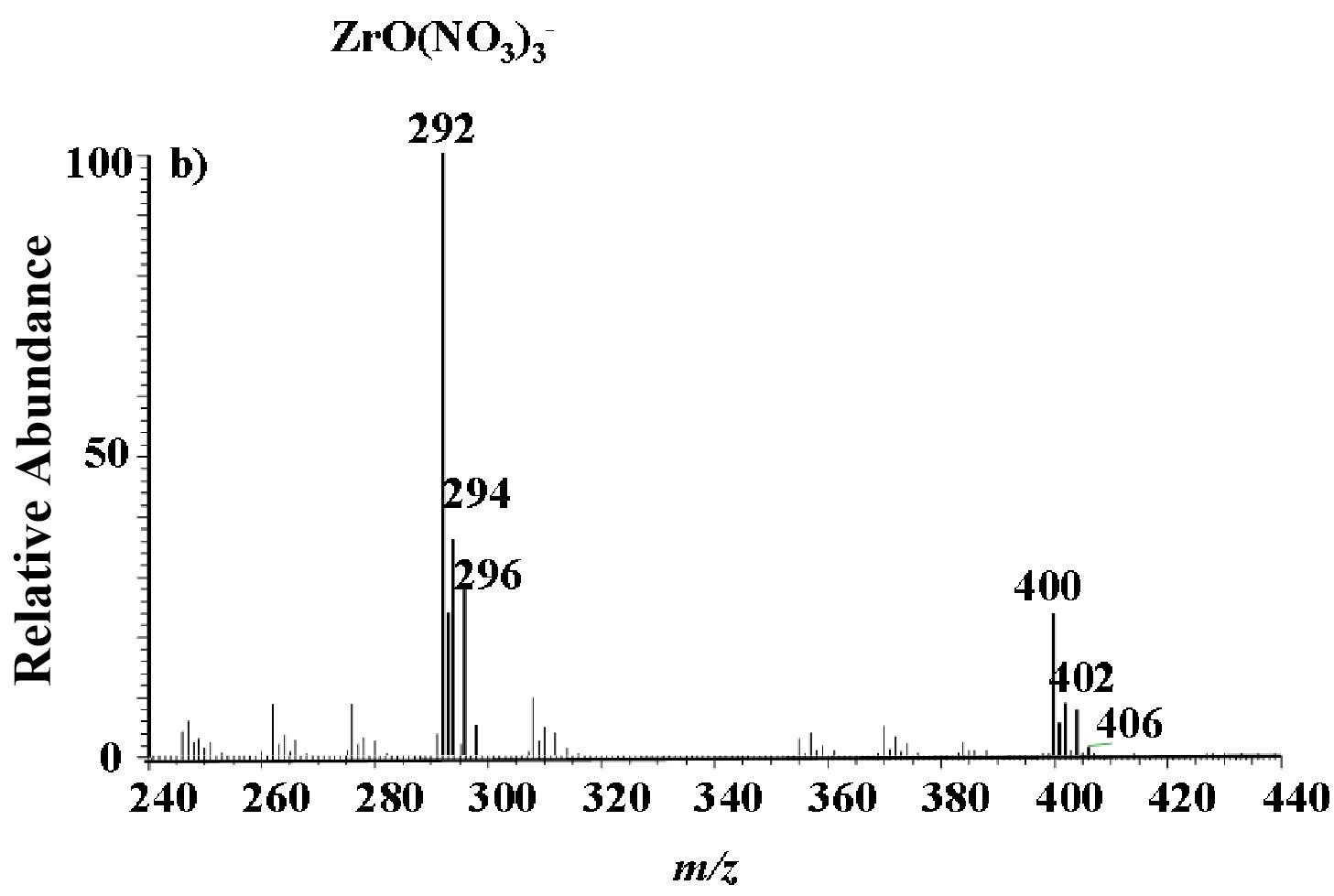
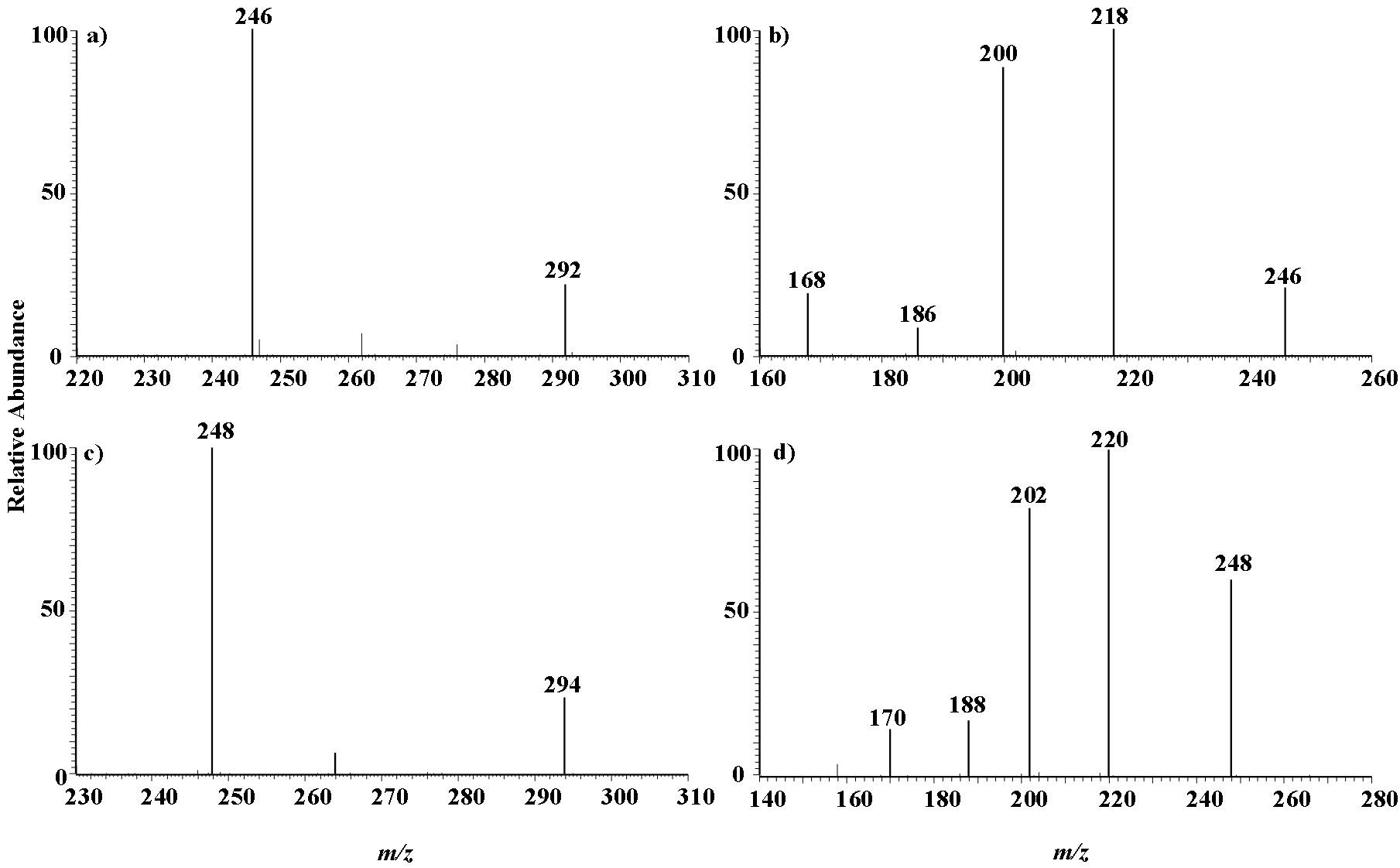
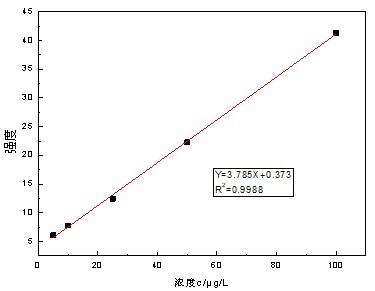
Microwave plasma torch(MPT)is a new type of plasma excitation source developed by domestic research team. It is a soft ionization technology with atmospheric ionization characteristics and is mostly used for the analysis of organic matter. Compared with inductively coupled plasma(ICP)ionization sources,MPT has low ionization energy and is difficult to ionize the tested elements into metal ions,which limits its application in inorganic detection. In order to broaden the application range of MPT source,linear ion trap mass spectrometry(LTQ-MS)was used to establish a quantitative analysis method for zirconium,which was applied to environmental monitoring. The zirconium solution was introduced into the MPT-LTQ-MS experimental device,and the aerosol was produced by pneumatic atomization. After drying by concentrated sulfuric acid,the dried aerosol formed anions in the plasma flame generated by the microwave plasma moment,and was detected by LTQ-MS in the negative ion mode. The experimental results show that part of the excited zirconium ion can basically be confirmed to exist in the form of [ZrO(NO3)3]-. This composite anion can be used as the characteristic signal to detect zirconium in water samples,and can be quantitatively analyzed by the characteristic spectral peak of multi-stage mass spectrometry. The characteristic signal of m/z 292 (90Zr)showed a good linear correlation with the concentration of zirconium in the concentration range of 5~100 μg·L-1(R2=0.998 8). The limit of detection (LOD) of the method was 2.6 μg·L-1,and the precision (RSD) was better than 8.9 %. The content of zirconia in surface water was determined by MPT-LTQ-MS,ranging from 0.34 to 3.22 μg·L-1,and the recovery of standard addition was 94 % to 105 %. The results show that MPT-LTQ-MS can be used as a simple method for the determination of zirconium,and can be used in environmental monitoring and drinking water testing.
ZHANG Tianrui , WANG Jie , JIANG Tao , YAN Yan , LIU Chunhong , ZHU Jianming , CUI Jianyong . Application of microwave plasma linear ion trap mass spectrometry method in the determination of zirconium in water[J]. World Nuclear Geoscience, 2025 , 42(3) : 640 -646 . DOI: 10.3969/j.issn.1672-0636.2025.03.014
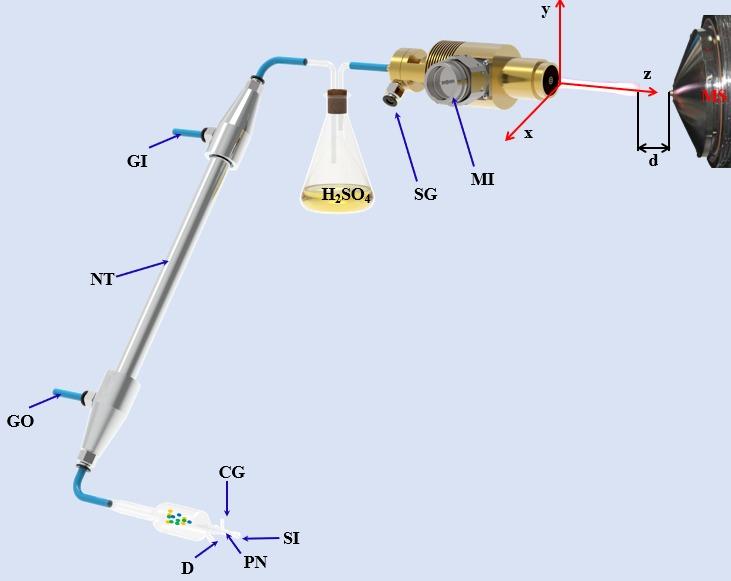
图1 MPT-LTQ-MS的实验装置示意图注:SI-Sample Input(样品引入端);PN-Pneumatic Nebulizer(雾化器);CG-Carrier Gas(载气输入口);D-Drain(废液口);SC-Spray Chamber(雾化室);GO-Gas Out(出气口);GI-Gas In(进气口);NT-Nafion Tube(Nafion管);SG-Support Gas(支持气输入口);MI-Microwave input(微波输入端);d-The distance(12~15 mm) between the tip of MPT plasma and the inlet of LTQ(LTQ质谱口距MPT炬焰尖端的距离d)。 Fig. 1 Schematic diagram of experimental device of MPT-LTQ-MS |
表1 方法精密度Table 1 Precision of the method |
| Zr标准溶液/(μg·L-1) | 测定值/(μg·L-1) | 平均值/(μg·L-1) | 精密度/% | ||
|---|---|---|---|---|---|
| 1.00 | 1.13 | 1.02 | 0.98 | 1.06 | 8.8 |
| 1.05 | 0.97 | 1.21 | |||
| 5.00 | 5.49 | 5.65 | 5.45 | 5.36 | 4.0 |
| 5.11 | 5.12 | 5.32 | |||
| 25.00 | 23.93 | 23.15 | 26.33 | 25.45 | 6.5 |
| 25.45 | 26.18 | 27.65 | |||
| 50.00 | 47.95 | 46.81 | 50.54 | 49.34 | 5.1 |
| 46.76 | 52.63 | 51.37 | |||
表2 MPT-LTQ-MS对实际湖泊水样中的锆含量直接测定和加标测定结果Table 2 Test results of zirconium content in actual lake water samples by MPT-LTQ-MS |
| 实际样品 | 初始测定值/(μg·L-1) | 加标量/(μg·L-1) | 加标测定值/(μg·L-1) | 回收率/% |
|---|---|---|---|---|
| 样品1 | 1.56 | 1.50 | 3.08 | 101.7 |
| 样品2 | 1.18 | 1.50 | 2.67 | 99.2 |
| 样品3 | 0.34 | 0.50 | 0.81 | 94.2 |
| 样品5 | 3.22 | 2.50 | 5.69 | 99.0 |
| 样品6 | 1.16 | 1.50 | 2.74 | 105.3 |
| 样品7 | 1.71 | 2.50 | 4.12 | 96.4 |
| 样品8 | 0.84 | 1.50 | 2.39 | 103.0 |
| 1 |
|
| 2 |
|
| 3 |
张金生, 李丽华, 孙淑英, 等. 微波消解MPT-AES测定催化剂中的铈[J]. 分析科学学报, 2003, 19(5):57-58.
|
| 4 |
赵丽, 张金生, 李丽华. 微波消解-微波等离子体炬原子发射光谱法测定膨化食品中铅和铝[J]. 分析科学学报, 2014, 30(4):563-565.
|
| 5 |
|
| 6 |
|
| 7 |
|
| 8 |
蒋涛, 李云, 赵晓静, 等. 微波等离子体炬质谱法快速测定大米中黄曲霉毒素B1的研究[J]. 分析测试学报, 2016, 35(12):1575-1580 (in Chinese).
|
| 9 |
|
| 10 |
曾昭华, 曾雪萍. 癌症与土壤环境中锆元素的关系[J]. 江苏环境科技, 2003: 16(2):26-27.
ZENG Zhaohua ZENG Xueping. Relationship of cancer and zirconium element in soil environment[J]. Jiangsu Environmental Science and Technology, 2003, 16(2):26-27 (in Chinese).
|
| 11 |
严冬, 曾祥程, 宋娟娥, 等. 电感耦合等离子体质谱测定水体中可溶性65种元素[J]. 环境化学, 2014, 33(8):1418-1421.
|
| 12 |
戴亚明, 陶美娟, 马冲先. 电感耦合等离子体发射光谱法测定镁合金中铝锌锰硅铁铜镍铍锆[J]. 理化检验:化学分册, 2004, 40(3):155-158.
|
| 13 |
赵庆令, 李清彩. 电感耦合等离子体发射光谱法测定锆钛砂矿中铪钛锆[J]. 岩矿测试, 2013, 32(6):883-886.
|
| 14 |
许菱, 许孙曲, 等. 用ICP—AES法测定富铀地质物料中的钇、钪和其他稀土元素[J]. 世界核地质科学, 2000, 17(3):278-284.
|
| 15 |
宋桂兰, 刘玉亭, 王兴恩, 等. 间接原子吸收分光光度法测定锆[J]. 分析化学, 2000, 28(9):1099-1102.
|
/
| 〈 |
|
〉 |