Analysis on the uranium mineralization conditions and prospecting direction of Pingxi pluton in central Jiangxi
|
ZHOU Zhenglong,male,born in 1992,engineer,mainly focusing on uranium geological exploration. E-mail:531789195@qq.com |
Received date: 2024-12-20
Revised date: 2025-01-21
Online published: 2025-11-07
Supported by
China Nuclear Geology(202110)
China Nuclear Geology(202331-2)
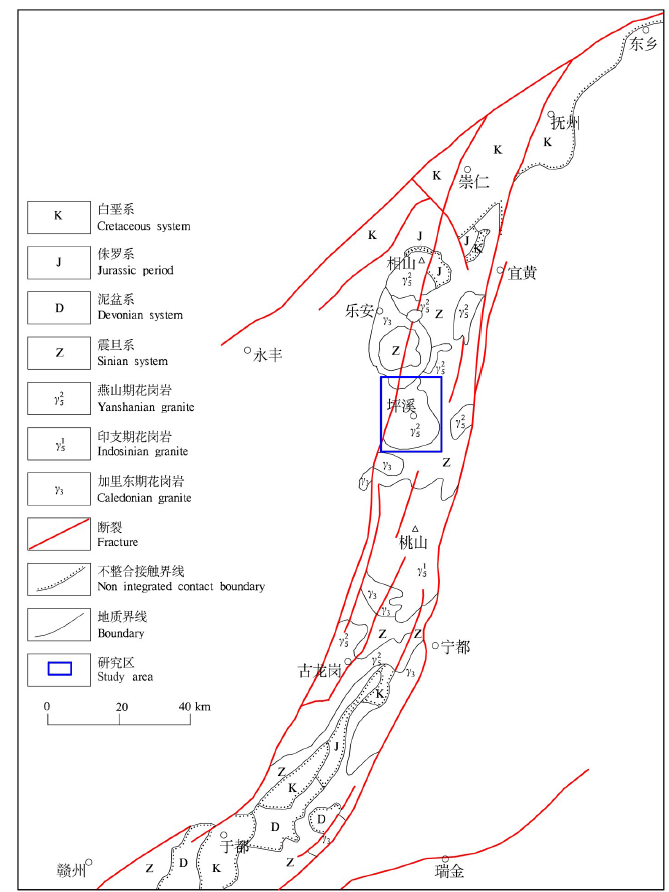
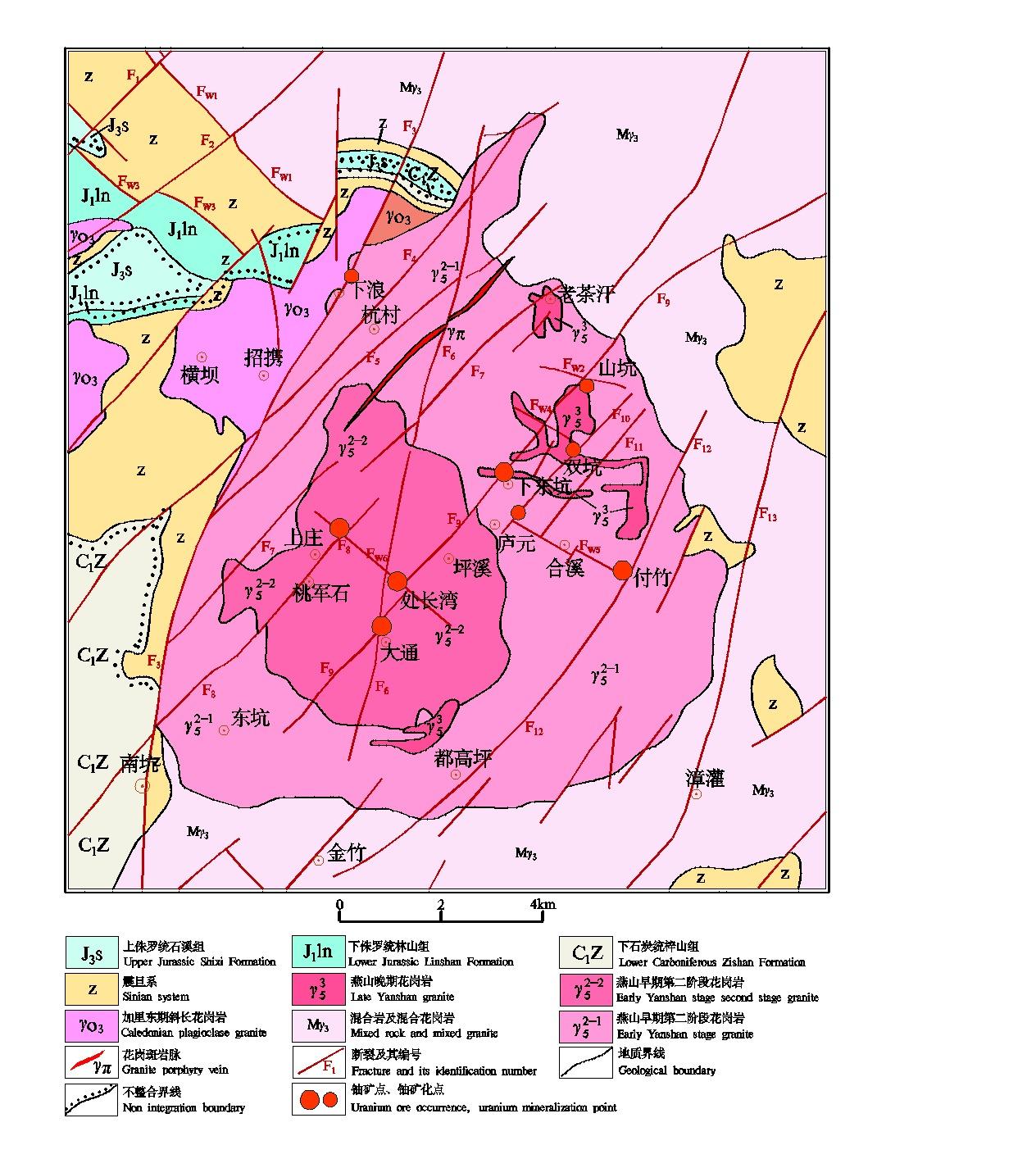
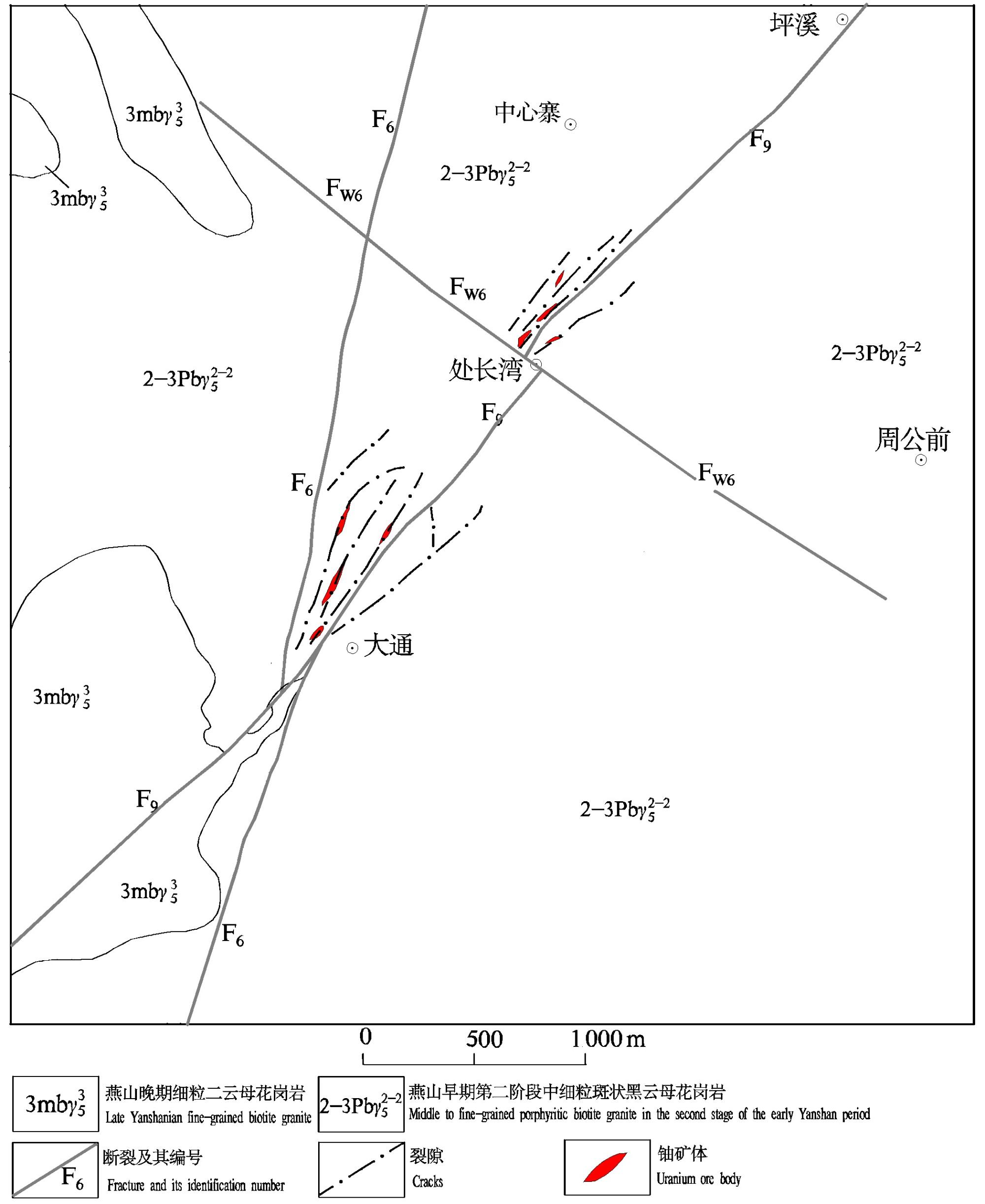
Pingxi pluton is located in the northern section of the Taoshan-Zhuguang uranium mineralization belt,and a number of uranium mineralization occurrences have been found in the pluton by previous researchers,However,the systematical study were conducted on the uranium metallogenic conditions such as lithology,structure and alteration in the area,and the overall evaluation of uranium resource potential was not completed and no specific suggestions or opinions been put forward in the main mineralization control factors for the uranium exploration. In order to find the direction of next exploration,this paper systematically discussed the uranium mineralization characteristics of the pluton by geological investigation,physical survey and chemical analysis,analyzes the conditions of uranium mineralization and ore-controlling factors. The study concluded that the Pingxi pluton is a multi-stage S-type uranium-producing granite,with strong magmatic-tectonic hydrothermal activity,uranium mineralization is mainly controlled by the NNE-NE oriented fracture,and located at the intersection of different striking of fractures,the ore body is set in the fissures of the secondary fracture,which is often accompanied by multi-phase hydrothermal alteration,the hematitization and silicification is the main prospecting sign. The predicted favorite mineralization sectors are Shuangkeng-Fuzhu section where strong magmatic hydrothermal activity occurred in the early to late Yanshan period,with northeast trending Shankeng-Pingxi and northwest trending Luyuan-Hexi-Fuzhu ore controlling faults which extend stably into the deep with strong hydrothermal alteration such as silicification,hematitiztion and pyritization,and geophysical and geochemical anomalies are developed in the shallow and deep. Therefore there is great metallogenic potential in the deep and peripheral areas.
Zhenglong ZHOU . Analysis on the uranium mineralization conditions and prospecting direction of Pingxi pluton in central Jiangxi[J]. World Nuclear Geoscience, 2025 , 42(1) : 86 -95 . DOI: 10.3969/j.issn.1672-0636.2025.01.007
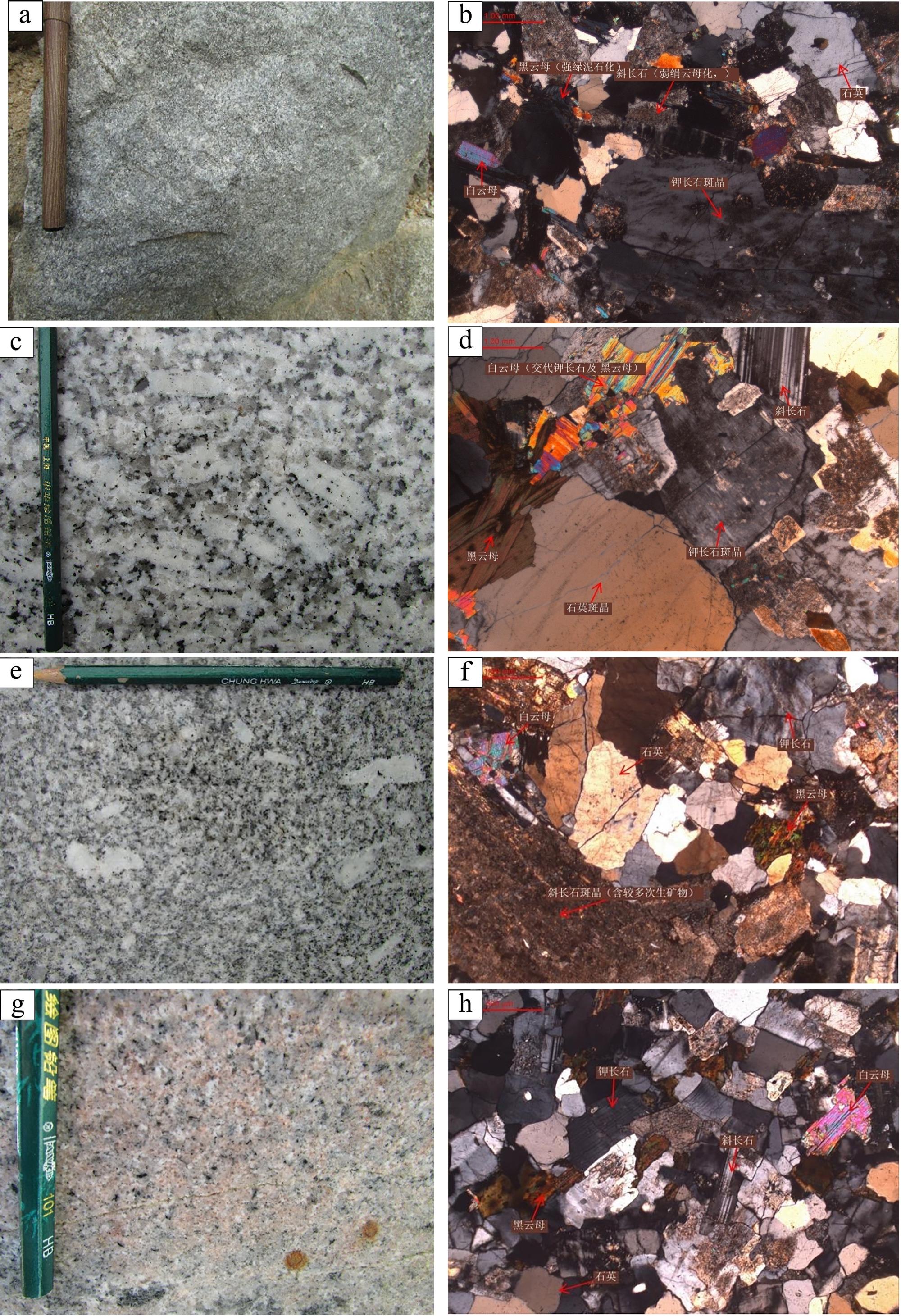
图3 坪溪复式岩体各期次侵入体相关照片a-横坝岩体岩性;b-横坝岩体镜下照片;c-合溪岩体岩性;d-横坝岩体镜下照片;e-大通岩体岩性;f-大通岩体镜下照片;g-老茶汗岩枝岩性;h-老茶汗岩枝镜下照片。 Fig. 3 Photos of intrusions in various stages of the Pingxi granitic complex a-Rock type of Hengba rock mass;b-Microscopic photo of Hengba rock mass;c-lithology of Hexi rock mass;d-Microscopic photo of Hengba rock mass;e-lithology of Datong rock mass;f-photo of Datong rock mass under the microscope;g-Rock type of Laochahan rock branch;h-Photo of the old tea sweat rock branch under a microscope. |
表1 坪溪地区铀矿化特征表Table 1 Characteristics of uranium mineralization in Pingxi area |
| 矿(化)点 | 矿化类型 | 赋矿部位 | 含矿岩性 | 主要控矿因素 | |
|---|---|---|---|---|---|
| 矿点 | 付竹 | 硅化破碎带亚型 | 合溪岩体东部 | 粗粒斑状黑云母花岗岩 | NE向F12和NW向FW5断裂 |
| 上庄 | 硅化破碎带亚型 | 大通岩体西部 | 中细粒斑状黑云母花岗岩 | NE向F8和NW向FW6断裂 | |
| 处长湾 | 硅化破碎带亚型 | 大通岩体中部 | 中细粒斑状黑云母花岗岩 | NE向F9和NW向FW6断裂 | |
| 大通 | 硅化破碎带亚型 | 大通岩体中部 | 中细粒斑状黑云母花岗岩 | NE向F9和NE向F6断裂 | |
| 下东坑 | 硅化破碎带亚型 | 合溪岩体东部 | 粗粒斑状黑云母花岗岩 | NE向F9断裂 | |
| 矿化点 | 双坑 | 硅化破碎带亚型 | 合溪岩体东北部 | 细粒黑云母花岗岩 | NE向F10和NW向FW4断裂 |
| 山坑 | 硅化破碎带亚型 | 合溪岩体北部 | 粗粒斑状黑云母花岗岩 | NE向F9和NW向FW2断裂 | |
| 庐元 | 硅化破碎带亚型 | 合溪岩体东部 | 粗粒斑状黑云母花岗岩 | NE向F10和NW向FW5断裂 | |
| 下浪 | 硅化破碎带亚型 | 合溪岩体西北部 | 粗中粒斑状黑云母花岗岩 | NE向F3断裂 | |
表2 坪溪复式花岗岩体岩浆活动期次表Table 2 Magmatic activity period table of Pingxi complex granite |
| 岩浆活动期次 | 代号 | 岩体/出露面积/km2 | 时代/Ma | 确定方法 | 铀含量 | ||
|---|---|---|---|---|---|---|---|
| 燕山期 | 晚期 | γ53 | 老茶汗岩枝 | 144.7±2.3 | 锆石U-Pb LA-ICP-MS | 18.3 | |
| 早期 | 第2阶段 | γ52-2 | 大通岩体 | 154.7±1.4 | 14.8 | ||
| 第1阶段 | γ52-1 | 合溪岩体 | 156.3±1.3 | 11.5 | |||
| 加里东期 | γ3 | 横坝岩体 | 452.9±3.1 | 8.4 | |||
表3 坪溪复式花岗岩体主量元素分析结果表/%Table 3 Main elements analysis results of Pingxi complex granite /% |
| 岩体 | SiO2 | Al2O3 | Fe2O3 | FeO | CaO | MgO | K2O | Na2O | TiO2 | P2O5 | MnO | LOI |
|---|---|---|---|---|---|---|---|---|---|---|---|---|
| 横坝 | 72.62 | 14.41 | 0.47 | 1.34 | 2.00 | 0.58 | 3.50 | 3.32 | 0.28 | 0.13 | 0.039 | 1.17 |
| 72.15 | 14.59 | 0.53 | 1.26 | 1.90 | 0.55 | 3.82 | 2.96 | 0.28 | 0.13 | 0.048 | 1.62 | |
| 合溪 | 75.93 | 13.09 | 0.23 | 0.82 | 0.47 | 0.099 | 4.66 | 3.23 | 0.086 | 0.089 | 0.067 | 1.14 |
| 73.63 | 14.23 | 0.79 | 0.71 | 0.20 | 0.19 | 5.15 | 3.44 | 0.14 | 0.037 | 0.061 | 1.34 | |
| 75.72 | 12.35 | 0.42 | 1.74 | 0.78 | 0.30 | 4.34 | 2.95 | 0.20 | 0.054 | 0.078 | 0.88 | |
| 75.77 | 13.08 | 0.32 | 0.68 | 0.60 | 0.12 | 4.62 | 3.34 | 0.092 | 0.088 | 0.060 | 1.16 | |
| 大通 | 74.63 | 13.48 | 0.40 | 1.08 | 0.91 | 0.27 | 4.46 | 3.22 | 0.21 | 0.12 | 0.065 | 1.03 |
| 73.86 | 13.85 | 0.34 | 1.24 | 0.74 | 0.22 | 5.36 | 2.95 | 0.19 | 0.14 | 0.044 | 0.93 | |
| 老茶汗岩枝 | 73.69 | 13.78 | 1.05 | 0.78 | 0.46 | 0.22 | 5.33 | 2.92 | 0.22 | 0.11 | 0.064 | 1.27 |
| 75.69 | 13.97 | 0.17 | 0.61 | 0.22 | 0.059 | 4.30 | 3.64 | 0.039 | 0.14 | 0.11 | 0.98 |
| 1 |
张金带, 戴民主, 等. 华东铀矿地质志[R]. 北京: 中国核工业地质局,2005:677-692.
|
| 2 |
赵延娜, 段永红, 邹长桥, 等. 江西九江—福建宁化接收函数剖面研究[J]. 地震学报, 2015, 37(5):722-732+885.
|
| 3 |
陈跃辉, 陈祖伊, 蔡煜琦, 等. 华东南中新生代伸展构造与铀成矿作用[J]. 中国核科技报告,1999:229-241.
|
| 4 |
王正庆, 管太阳, 林子瑜, 等. 华南中新生代构造-岩浆活动驱动机制与铀成矿研究进展[J]. 东华理工大学学报(自然科学版), 2013, 36(4):349-356.
|
| 5 |
邱林飞, 庞雅庆. 华南热液型铀矿成矿流体研究现状及存在问题[J]. 世界核地质科学, 2021, 38(4):424-435.
|
| 6 |
江卫兵, 邵上, 林坤, 等. 华南地区花岗岩特征及其与铀成矿地质作用[J]. 世界核地质科学, 2021, 38(4):446-456.
|
| 7 |
徐金山, 周正龙, 等. 桃山—诸广成矿带北段大王山—于山地区铀矿资源远景调查成果报告[R]. 南昌: 核工业二七○研究所,2018:30-35.
|
| 8 |
夏宗强, 肖敏. 湖南丫江桥岩体锆石U-Pb年代学、地球化学及其地质意义[J]. 世界核地质科学, 2024, 41(4):665-680.
|
| 9 |
张运涛, 裴荣富, 张小平, 等. 赣南花岗岩型铀矿成矿条件及其找矿前景[J]. 铀矿地质, 2012, 28(1):28-34.
|
| 10 |
冯明月, 何德宝. 华南富铀花岗岩和产铀花岗岩特征[J]. 铀矿地质, 2012, 28(4):199-207.
|
| 11 |
商朋强, 胡瑞忠, 毕献武, 等. 华南热液铀矿成矿作用若干问题探讨[J]. 矿物岩石地球化学通报, 2007,(3):290-294.
|
| 12 |
余达淦, 汪明. 桃山-诸广复式花岗岩类岩石铀-钍地球化学特征[J]. 华东地质学院学报, 1988, 11(4):301-312.
|
| 13 |
吴福元, 李献华, 杨进辉, 等. 花岗岩成因研究的若干问题[J]. 岩石学报, 2007, 23(6):1217-1238.
|
| 14 |
林锦荣, 李子颖, 胡志华, 等. 热液型铀矿空间定位的控制因素[J]. 铀矿地质, 2016, 32(6):333-339.
|
| 15 |
胡瑞忠, 毕献武, 彭建堂, 等. 华南地区中生代以来岩石圈伸展及其与铀成矿关系研究的若干问题[J]. 矿床地质, 2007, 26(2):139-152.
|
| 16 |
蔡煜琦, 李子颖, 刘武生, 等. 铀矿大基地资源扩大与评价技术研究[J]. 世界核地质科学, 2022, 39(2):173-185.
|
/
| 〈 |
|
〉 |