RESEARCH ARTICALS

Study on the identification marks of Mesozoic uranium deposit host and non deposit granites in Zhuguangshan area

  • Songxin YE , 1, 2 ,
  • Bin LIU , 1, 2, 3 ,
  • Kun RUAN 1, 2
Expand
  • 1 Research Institute No.290,CNNC,Guangdong Provincial Key Laboratory of Environmental Protection and Nuclear Radiation Tracking Research,Shaoguan 512029,China
  • 2 Guangdong Provincial Engineering Technology Research Center of Radioactive Eco-environmental Protection, Shaoguan, 512029,China
  • 3 State Key Laboratory for Mineral Deposit, School of Earth science and Engineering, Nanjing University,Nanjing 210093,China
LIU Bin,male,born in 1991,PhD,focusing on uranium and polymetallic ore deposit geochemical studies. E-mail:

YE Songxin,male,born in 1980,senior engineer,focusing on regional geological surveys,uranium geological exploration. E-mail:

Received date: 2024-12-31

  Revised date: 2025-01-22

  Online published: 2025-11-07

Supported by

Guangdong province Science and Technology Special Fund Project(201112166271152)

Exploration Project for Uranium Deposits(202439-4)

Exploration Project for Uranium Deposits(202348-9) from the China Nuclear Geological Bureau)

Abstract

In order to explore the uranium mineralization specific characteristics of granite, the geochemical characteristics of Mesozoic-producing and non-producing uranium granites in the Nanling region were analyzed on the base of systematic collection of previous research. The results show that both uranium deposit host and non deposit granites are mainly formed by partial melting of Precambrian metamorphic sedimentary rocks,but the uranium deposit host granites are mainly formed by partially melting U-rich mudstones, while the non-deposit granites are the partially melted products of uranium-depleted sandstone. Compared with uranium deposit host granites,the biotite crystallization temperature in uranium deposit host granites is relatively low,F-rich and Cl-poor,and the magmatic melt has lower oxygen fugacity values,suggesting that uranium deposit host granites formed at relatively low temperatures and low oxygen fugacity. The low temperature, low oxygen fugacity,and F-rich physical and chemical environment are favorable for U to continuously enter the melt during the magma crystallization and differentiation and combine with oxygen to form uranite that are liable to undergo secondary alteration. The formation of uranite provides a good material basis for uranium mineralization.

Cite this article

Songxin YE , Bin LIU , Kun RUAN . Study on the identification marks of Mesozoic uranium deposit host and non deposit granites in Zhuguangshan area[J]. World Nuclear Geoscience, 2025 , 42(1) : 76 -85 . DOI: 10.3969/j.issn.1672-0636.2025.01.006

诸广山地区是我国重要的花岗岩型铀矿集中区[1],其铀矿床与花岗岩体之间存在密切的空间和成因联系。前人研究集中对该区域花岗岩型铀矿床的成矿物理-化学条件、成矿流体特征、矿床地质特征、同位素地球化学特征和成矿时代等方面进行了深入探讨,并积累了丰富的理论成果[1-12]。尽管如此,一些关键科学问题依然存在分歧,尤其是在诸广山地区中生代花岗岩广泛分布的情况下,并非所有花岗岩都与铀矿的形成有直接的成因联系。前人依据铀矿勘探进展,将花岗岩划分为产铀花岗岩与非产铀花岗岩,产铀花岗岩是指存在工业价值铀矿床的花岗岩,而非产铀花岗岩是指至今未发现具有经济价值铀矿资源的花岗岩,并对华南地区的产铀与非产铀花岗岩进行了岩石地球化学和矿物学特征的对比分析 [2,9-13]。但由于不同研究者侧重的方面有所不同,导致得出的结论具有一定局限性。如Zhao[12-13]通过分析对比苗儿山地区产铀与非产铀花岗岩的岩石地球化学、同位素地球化学特征,认为两者的主要区别在于成岩物质的来源不同;而Chen[3]和Zhang [10-11]通过对诸广山—贵东地区产铀和非产铀花岗岩中的黑云母、绿泥石等脉石矿物元素地球化学分析,认为产铀和非产铀花岗岩区别主要在于岩浆分异程度和成岩物理-化学条件不同。鉴于此,本研究在前人研究成果的基础上,从花岗岩的源区特征、成岩物理-化学条件以及卤素元素特征三个维度,对诸广山地区的产铀和非产铀花岗岩进行综合对比分析。旨在建立一套科学的岩石学和地球化学判别标准,用以评估花岗岩的产铀潜力,为确定勘探目标区域提供理论支持。

1 诸广山地区中生代花岗岩分布特征

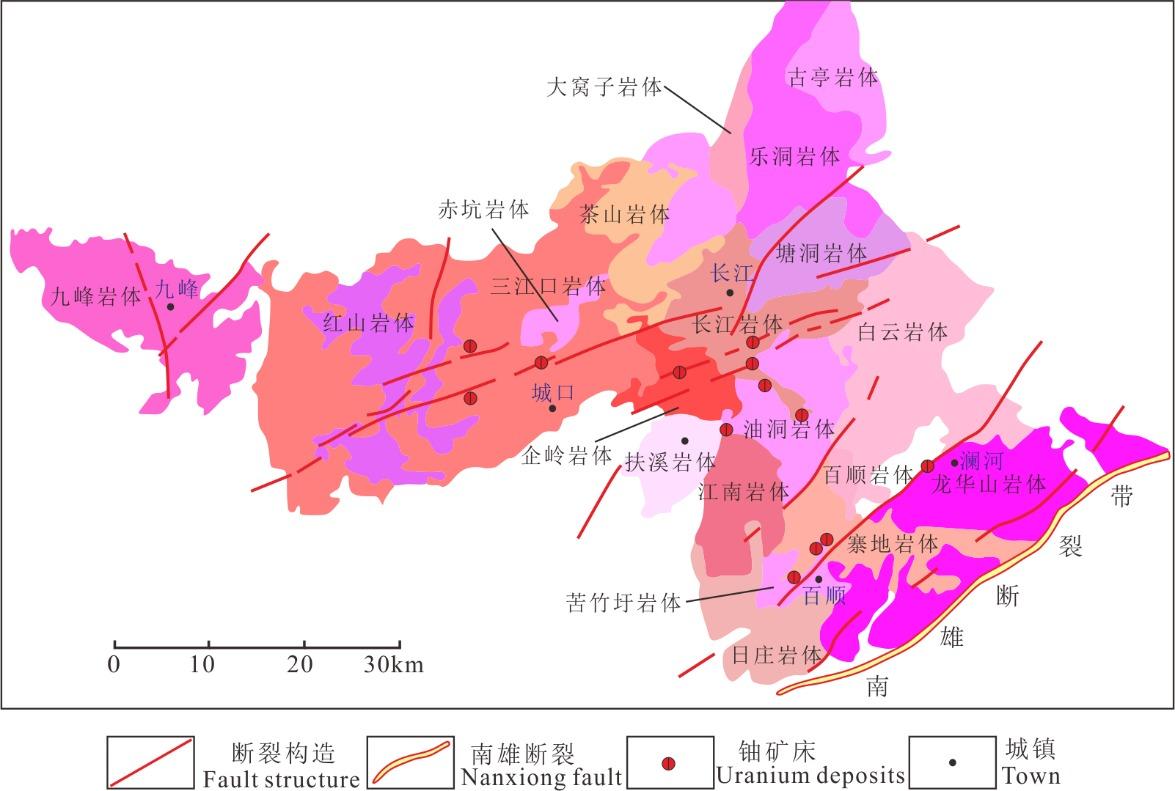
诸广山地区位于华南板块的南部,地理位置涵盖广东北部和湖南南部等。在中生代时期,该地区经历了强烈的岩浆活动,形成诸广山—九峰复式花岗岩基,该岩基呈近EW向展布,主要包括长江、油洞、白云、乐洞、三江口、龙华山和九峰等复式岩体[14]图1),其中产铀花岗岩体主要有长江岩体、油洞岩体、白云岩体和乐洞岩体等,控制了长江铀矿田、城口铀矿田及百顺铀矿田的产出;非产铀花岗岩主要为龙华山岩体和九峰岩体。通过锆石U-Pb同位素年代学分析可知,这些岩体成岩时代主要集中在印支期和燕山早期[15-20],岩性主要以中粗粒黑云母花岗岩及二云母花岗岩为主。
图1 诸广山地区岩浆岩分布示意图

Fig. 1 Schematic distribution of magmatic rocks in Zhuguangshan area

2 产铀与非产铀花岗岩源区特征

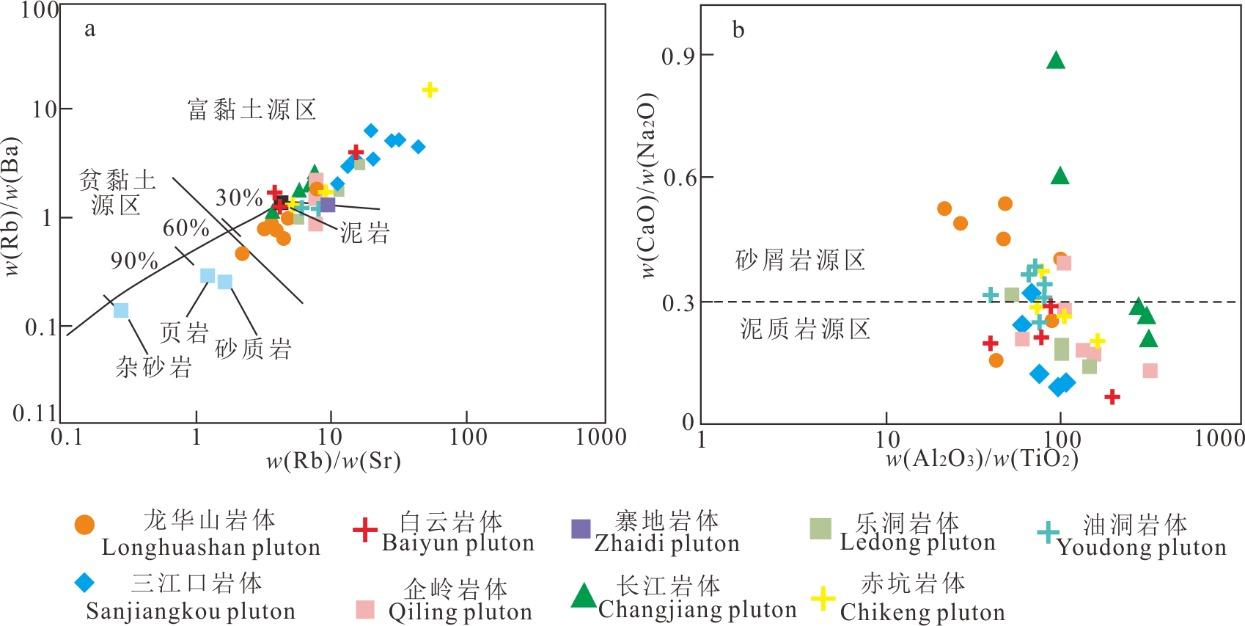
已有研究表明,花岗岩中微量元素及微量元素比值对其源区物质来源的判别具有较好指示意义,如w(CaO)/w(Na2O)比值、w(Rb)/ w(Sr)及w(Rb)/w(Ba)比值等[21]。泥质岩石重熔形成的过铝质花岗岩w(CaO)/w(Na2O)比值小于0.3,而砂质岩石重熔形成的过铝质花岗岩w(CaO)/w(Na2O)比值大于0.3;同样地,Rb、Sr和Ba元素特征主要受钾长石、斜长石和黑云母等矿物的控制[22]。Ba与K离子半径相似,Sr的离子半径与Ca相似,所以Ba主要赋存于黑云母或钾长石中,Sr替换斜长石中的Ca而富集。当源岩为泥质或黏土质岩时,由于其贫斜长石或钾长石,导致部分熔融过程中熔体中Sr、Ba含量相对较低,进而使形成的花岗岩中w(Rb)/w(Sr)(>10)和w(Rb)/w(Ba)比值(>1)较高;而源岩为砂岩或杂砂岩中斜长石含量高,其部分熔融形成的花岗岩中w(Rb)/w(Sr)(<10)和w(Rb)/w(Ba)比值(<1)较低。由w(Rb)/w(Sr)-w(Rb)/w(Ba)图解可知(图2a),诸广山地区中生代产铀花岗岩(如长江岩体、油洞岩体、白云岩体和乐洞岩体)数据分布于泥岩区域,而非产铀花岗岩(九峰岩体、龙华山岩体)数据点主要落于贫黏土源区。此外,在w(Al2O3)/w(TiO2) -w(CaO)/w(Na2O)图解(图2b)中,产铀花岗岩数据点基本落在泥质岩区域,而非产铀花岗岩数据点主要分布于砂屑岩区域。以上表明诸广山中生代非产铀花岗岩的原岩为砂质岩,产铀花岗岩原岩主要为泥质岩。
图2 诸广山地区花岗岩图解

a—w(Rb)/w(Sr)-w(Rb)/w(Ba)[21]; b—w(Al2O3)/w(TiO2)-w(CaO)/w(Na2O)[21]

Fig. 2 Granite diagrams for Zhuguangshan area with granite data cited from reference[20]

a—w(Rb)/w(Sr)-w(Rb)/w(Ba)diagram[21]; b—w(Al2O3)/w(TiO2)-w(CaO)/w(Na2O) plot[21].

3 产铀与非产铀花岗岩成岩物理-化学特征

花岗岩中铀的赋存形式主要包括:1)铀的独立矿物,主要为晶质铀矿;2)呈类质同像赋存于锆石、钍石和独居石等含铀副矿物中;3)均匀分散状态存在于造岩矿物中等[23-26]。已有研究表明,当U与Th、Zr及REE发生类质同象进入副矿物(锆石、独居石及榍石)中时,这些副矿物由于其难熔特性,在流体与围岩的相互作用过程中,铀较难释放进入流体中富集[23-24];而当铀以独立铀矿物形式存在时,铀矿物易发生蚀变作用使铀活化迁移进入流体中富集成矿[27-29]。另外,有研究指出,岩浆的物理-化学条件不同,很大程度上决定了花岗岩中铀的赋存特征[23,30]。因此,对诸广山地区中生代花岗岩形成时物理-化学条件分析显得尤为重要。
一般而言,成岩的物理-化学条件主要包括压力、氧逸度、温度及挥发分组成等。在花岗岩中,包含有磷灰石、锆石及黑云母等副矿物,其中黑云母结晶沉淀时流体的物理-化学条件的不同,导致其包含不同的元素[31-36],因此,通过分析黑云母的化学成分,可以反演出花岗岩形成时的物理-化学条件。

3.1 氧逸度与温度

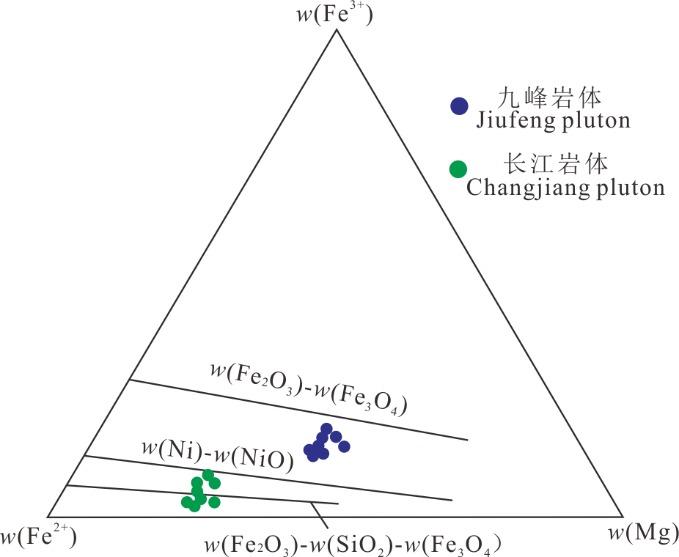
随着岩浆系统中氧逸度的升高,熔体中的w(Fe3+)/w(Fe2+)比值也随之上升,导致较少的Fe2+与Mg2+竞争性地进入镁铁质矿物的晶格中[34-35],因此,黑云母中的w(Fe2+)/w(Fe2++Mg)比例变化可作为评估岩体氧逸度变化的指标。并通过w(Fe3+)-w(Fe2+)-w(Mg)图解和logf(O2)-T图解估计氧逸度缓冲剂和估算氧逸度值[35]
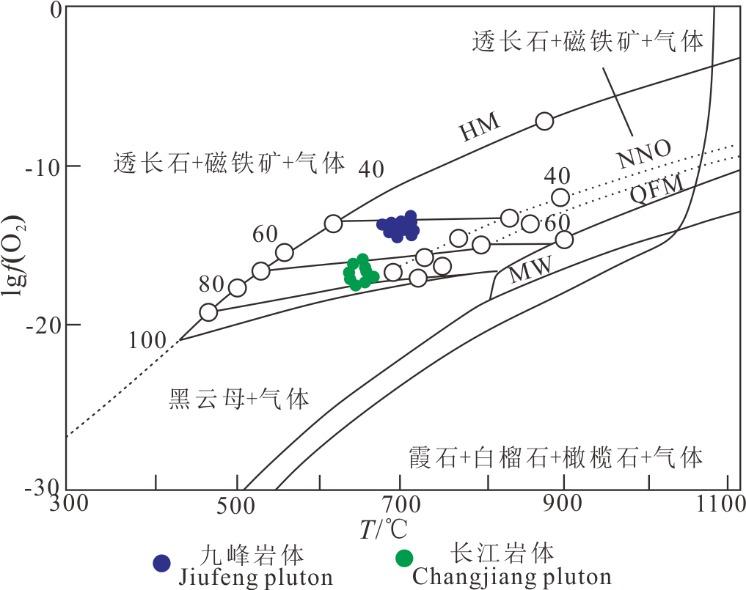
笔者选取诸广山地区典型花岗岩(长江岩体、九峰岩体)为研究对象,计算其花岗岩黑云母中w(Fe2+)/w(Fe2++Mg)比值发现产铀花岗岩(长江岩体)w(Fe2+)/w(Fe2++Mg)明显高于非产铀花岗岩(九峰岩体),这表明非产铀花岗岩的氧逸度高于产铀花岗岩。在w(Fe3 +)-w(Fe2+)-w(Mg)图解中(图3),非产铀花岗岩的黑云母成分介于w(Ni)-w(NiO)与w(Fe2O3)-w(Fe3O4)两条缓冲线之间,产铀花岗岩的黑云母成分主要落于w(Ni)-w(NiO)缓冲线之下,说明诸广山地区产铀花岗岩岩浆氧逸度相对较低。另外,根据黑云母Ti温度计计算获得的温度,在P= 2 070×105Pa条件下的黑云母logf(O2)-T图解[37],诸广山地区产铀花岗岩主要位于氧逸度较低区域(图4),表明产铀花岗质岩浆比非产铀更还原。
图3 诸广山地区典型花岗岩黑云母w(Fe3+)-w(Fe2+)- w(Mg)图解 [37]

Fig. 3 w(Fe3+)-w(Fe2+)- w(Mg)diagram of biotite in typical granites from the Zhuguangshan area[37]

花岗岩中黑云母成分受岩浆结晶冷却时物理-化学条件控制,其中黑云母中的Ti对温度十分敏感,因而可以利用Ti含量来计算黑云母形成时的温度[33-34]。已有学者通过实验研究提出黑云母Ti饱和温度计算公式[34]T={[ln(Ti)-ac(XMg)3]/b}0.333。其中,T的单位为℃,Ti以22个氧原子为基础计算出的黑云母中Ti阳离子数,XMg = Mg /(Mg+Fe),a=-2.359 4、b = 4.648 2×10⁻⁹c = -1.728 3。此外,该公式的应用范围为XMg = 0.275~1.000,Ti = 0.04~0.60 apfu,T = 480~800 ℃。通过数据由此公式计算得出产铀花岗岩结晶温度低于非产铀花岗岩结晶温度(图4)。
图4 诸广山地区典型花岗岩黑云母lgf(O2)-T图解[37]

Fig. 4 Biotite lgf(O2)-T diagram of typical granites in the Zhuguangshan area[37]

3.2 挥发分(F、Cl)组成

在花岗岩浆体系中,卤素元素如氟(F)和氯(Cl)的流体/熔体分配系数通常小于1,意味着这些元素在分离结晶过程中更倾向富集于熔体相中。这一现象表明,在岩浆晚期结晶形成的矿物,如黑云母和磷灰石,会富含氟和氯等挥发性组分。特别是在不含萤石的花岗岩中,黑云母封存70 %至90 %的氟。氟和氯进入黑云母的机制主要是通过替代矿物中的羟基(OH),并且黑云母中氟和氯的含量与镁铁比值w(Mg)/w(Fe)密切相关。当黑云母中w(Mg)/ w(Fe)比值较高时,相应的熔体中更多F替换黑云母中的OH,当黑云母中w(Mg)/w(Fe)比值较低时,则与之相反[38]。据已发表的资料可知[37,39],诸广山地区非产铀花岗岩中黑云母挥发分F含量明显低于产铀花岗岩。暗示产铀花岗岩具有更高的F含量。

4 成矿意义

花岗岩能否成为铀源,主要取决于铀含量的高低、铀的赋存形式及后期花岗岩是否发生热液蚀变作用等综合因素的影响。研究表明,泥质岩中由于含有较多的有机质还原性物质,这些还原性物质易将氧化性铀还原沉淀,而含有较高的铀含量,如寒武纪荷塘组泥页岩U含量高达25.8×10⁻⁶~74.4×10⁻⁶[40],这些泥页岩部分熔融将形成富U 的花岗岩,其铀含量通常超过10×10-6。相比之下,砂质岩中的铀主要存在于副矿物中,这些副矿物在源岩部分熔融形成花岗岩浆时,多数难以熔融进入岩浆,导致岩浆中铀含量较低。由上述分析可知,诸广山地区产铀花岗岩源岩主要是泥质岩,铀含量主要分布于15×10-6~23×10-6之间,而非产铀花岗岩主要为砂质岩,铀含量明显低于10×10-6。这表明,由泥质岩部分熔融形成的花岗岩具有更高的潜力为铀成矿提供铀源。
实验研究表明,在富F的岩浆体系中,U在岩浆与流体之间的分配系数更低,D流体/熔体值介于3×10-2~2×10-2之间[41-42],所以,随着岩浆结晶分异演化,U不断在岩浆熔体中富集。在岩浆演化的中晚阶段,温度、压力及氧逸度的降低导致残余岩浆中w(O)/w(Si)比值降低,游离O2-增多;同时,残余岩浆中的挥发组分、稀有和稀土元素也相对富集,U(IV)优先与这些离子进行类质同象置换,与游离O2-结合形成含铀的富REE副矿物(如独居石、锆石和褐帘石等),这些副矿物中的铀在后期热液流体作用下难以释放进入流体中富集成矿[2-3]。相对地,在岩浆演化晚期,由于岩浆分异演化程度增高,温度和氧逸度降低,岩浆的还原性增强,类质同象程度降低,同时,岩浆演化相对较早阶段难熔副矿物的晶出,导致熔体中REE含量明显降低,而且岩浆演化晚期阶段中大量的F在岩浆熔体中富集,F易使硅酸盐发生解聚作用,释放出大量的游离氧[26]。因此,在岩浆演化晚期,铀主要与熔体中的游离氧结合形成独立铀矿物——晶质铀矿。
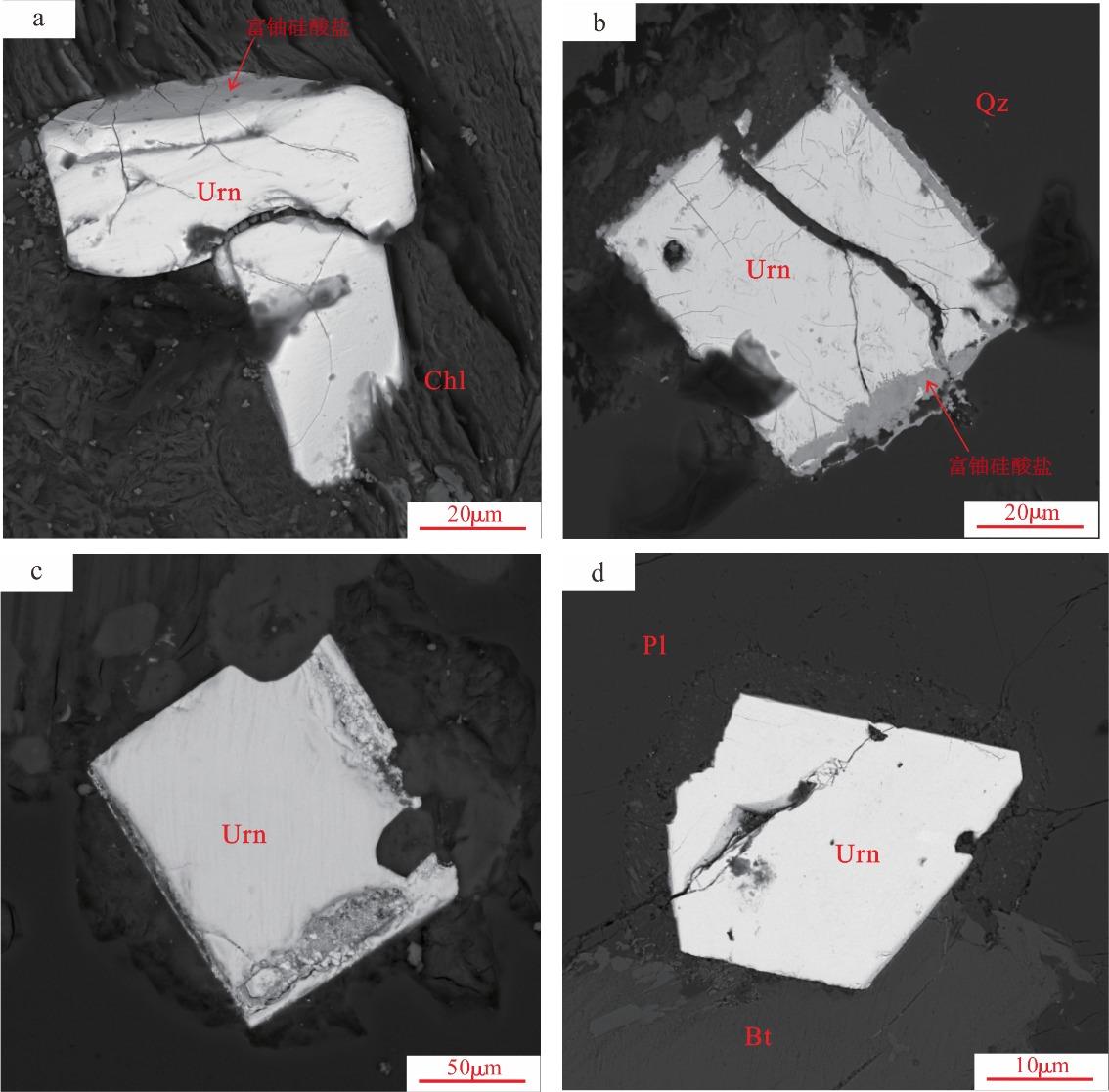
如前所述,诸广山地区中生代产铀与非产铀花岗岩相比,产铀花岗岩具有相对较低的成岩温度、氧逸度及较高的F含量,这些物理-化学条件有利于晶质铀矿形成,而晶质铀矿在后期含F-、CO32-和SO42-的热液流体作用下容易被活化迁移[24-28],从而有利于形成花岗岩型铀矿床。如产铀花岗岩体(长江岩体、油洞岩体等)中晶质铀矿含量明显多于非产铀花岗岩体(九峰岩体等)。其岩体中晶质铀矿含量最高可达15.21×10⁻⁶[43]。此外,早期学者对华南地区多个富铀花岗岩中铀的配分进行了研究,获得花岗岩的铀量主要是晶质铀矿所提供的认识[44]。另外,近些年来,通过分析测试技术手段的提升,从微观角度发现产铀与非产铀花岗岩中晶质铀矿的形态及元素含量也存在差异[45]。如产铀岩体长江岩体中晶质铀矿颗粒边界不规则,出现了溶蚀和交代现象,具有明显亮暗变化特征,其中核部较亮,而边部较暗(图5a、b),较亮的核部U含量较高,而边部较暗区域U含量明显较低,这些均表明产铀花岗岩中晶质铀矿存在明显蚀变作用,为铀成矿提供丰富铀源。而非产铀花岗岩九峰岩体中的晶质铀矿则保持良好的晶形,具有清晰的颗粒边界,几乎没有明显的蚀变迹象(图5c、d[10]。产铀与非产铀花岗岩中晶质铀矿形态特征、U含量高低可作为其是否发生蚀变及其蚀变强度的判别依据,进而可推测其提供铀源的潜力。
图5 诸广山地区长江岩体和九峰岩体中晶质铀矿代表性背散射照片[43]

Fig. 5 Representative BSE images of uraninites from the Changjiang granite and Jiufeng granite in the Zhuguangshan area[43]

Bt-biotite;Chl-chlorite;Qz-quartz;Pl-plagioclase;Urn-uraninite

在铀成矿过程中,热液流体的性质和成分对铀的迁移和富集具有重要影响。研究发现,富含氟的热液流体能够有效地溶解和迁移铀,进而促进铀的富集和矿床的形成[42]。例如,氟的存在不仅可以增强铀的溶解度,还能通过与铀形成络合物来提高其在流体中的迁移能力。因此,诸广山地区的铀源花岗岩体中较高的氟含量可能是其铀矿床形成的重要因素之一。
综上所述,诸广地区产铀与非产铀花岗岩之间不管在矿物学方面,还是在元素地球化学特征方面,均存在较大差异。产铀花岗岩与非产铀花岗岩中均存在黑云母、磷灰石等副矿物,但这两种矿物成分存在明显差异,产铀花岗岩中黑云母、磷灰石明显富F、Cl等卤素元素,而非产铀花岗岩中明显缺少F、Cl等卤素元素。此外,与非产铀花岗岩相比,产铀花岗岩相对富SiO2、NaO、Rb、Ba和Nb,而贫CaO、Al2O3和TiO2等;这些元素含量及岩石副矿物(磷灰石、黑云母)中卤素元素含量的差异可作为一套鉴别产铀与非产铀花岗岩的地球化学标志。

5 结语

通过综合分析诸广山地区中生代产铀与非产铀花岗岩岩石地球化学、矿物学,得到以下初步认识:
1)依据SiO2、Na2O、CaO、Al2O3、Rb、Ba和Sr等元素含量变化及相关二维图解可以很好地区分诸广山地区中生代产铀与非产铀花岗岩。
2)通过对花岗岩体中黑云母矿物化学分析可知,产铀与非产铀花岗岩成岩物理-化学条件存在明显区别,与非产铀花岗岩相比,产铀花岗岩具有较低的成岩温度、氧逸度及较高的F含量。这些物理-化学条件有利于岩浆结晶过程中独立铀矿物形成。因此,可采用花岗岩中富含挥发分的矿物(黑云母、磷灰石等)地球化学特征,来判别产铀与非产铀花岗岩。
3)诸广山地区产铀与非产铀花岗岩之间的差异是由源岩特征及岩浆演化物理-化学条件共同作用的。因此,在后期判别产铀与非产铀花岗岩时,应从花岗岩的源区、成岩演化程度及岩浆物理-化学特征等方面综合分析。
1
陈振宇, 黄国龙, 朱捌, 等. 南岭地区花岗岩型铀矿的特征及其成矿专属性[J]. 大地构造与成矿学, 2014, 38(2):264-275.

CHEN Zhenyu, HUANG Guolong, ZHU Ba, et al. The characteristics and metallogenic specialization of granite-hosted uranium deposits in the Nanling region[J]. Geotectonica et Metallogenia, 2014, 38(2):264-275 (in Chinese).

2
陈佑纬, 毕献武, 胡瑞忠, 等. 贵东复式岩体印支期产铀和非产铀花岗岩地球化学特征对比研究[J]. 矿物岩石, 2009, 29(3):106-114.

CHEN Youwei, BI Xianwu, HU Ruizong, et al. Comparison of geochemical characteristic of uranium and non-uranium-bearing Indosinian granites in Guidong composite plution[J]. Mineralogy and Petrology, 2009, 29(3):106-114 (in Chinese).

3
CHEN Y W, BI X W, HU R Z, et al. Element geochemistry, mineralogy, geochronology and zircon Hf isotope of the Luxi and Xiazhuang granites in Guangdong province,China:Implications for U mineralization[J]. Lithos, 2012, 150 (1):119-134.

4
胡欢, 王汝成, 陈卫锋, 等. 桂东北苗儿山花岗岩黑云母矿物学特征对比及铀成矿意义[J]. 矿物学报, 2014, 34(3):321-327.

HU Huan, WANG Rucheng, CHEN Weifeng, et al. Characteristics of biotite in uranium- and non-uranium-bearing granites from northeastern Guangxi province,China:Implications on uranium mineralization[J]. Acta Mineralogica Sinica, 2014, 34(3):321-327 (in Chinese).

5
庞雅庆, 孟晓庆, 范洪海, 等. 粤北长江地区花岗斑岩脉年代学、地球化学特征及其地质意义[J]. 世界核地质科学, 2023, 40(3):701-714.

PANG Yaqing, MENG Xiaoqing, FAN Honghai, et al. Geochronological and geochemical characteristics and geological significances of granite porphyry dykes from Changjiang area in northern Guangdong province[J]. World Nuclear Geoscience, 2023, 40(3):701-714 (in Chinese).

6
许丽丽. 粤北棉花坑铀矿床萤石矿物标型特征及其地质意义[J]. 世界核地质科学, 2024, 41(2):287-298.

XU Lili. Typomorphic characteristics and geological significance of fluorite in Mianhuakeng uranium deposit,north Guangdong[J]. World Nuclear Geoscience, 2024, 41(2):287-298 (in Chinese)

7
郑可志, 陈东欢, 庞雅庆, 等. 广西苗儿山地区马家铀矿床成矿地质特征研究[J]. 世界核地质科学, 2024, 41(3):450-461.

ZHENG Kezhi, CHEN Donghuan, PANG Yaqing, et al. Study on geological features of Majia uranium deposit in Guangxi province[J]. World Nuclear Geoscience, 2024, 41(3):450-461 (in Chinese).

8
张闯. 诸广南铀矿田脉岩地球化学与地质年代学特征——对“交点型”铀矿床成因的启示[J]. 世界核地质科学, 2024, 41 (2):209-232.

ZHANG Chuang. Hydrothermal alteration, geochemistry and 40Ar-39Ar geochronology of the dikes in South Zhuguang uranium district:Implications for the regional uranium mineralization event[J]. World Nuclear Geoscience, 2024, 41(2):209-232 (in Chinese).

9
张龙, 陈振宇, 田泽瑾, 等. 粤北产铀与不产铀花岗岩中铀矿物特征的电子探针研究及其找矿意义[J]. 岩矿测试, 2016, 35(3):310-319.

ZHANG Long, CHEN Zhenyu, TIAN Zejin, et al. EPMA study on characteristics of uranium minerals in uranium-bearing and uranium-barren granites in northern Guangdong and its prospecting significance[J]. Rock and Mineral Analysis, 2016, 35(3):310-319 (in Chinese).

10
ZHANG L, CHEN Z, LI S, et al. Isotope geochronology, geochemistry,and mineral chemistry of the U-bearing and barren granites from the Zhuguangshan complex,South China:Implications for petrogenesis and uranium mineralization[J]. Ore Geology Review, 2017, 91: 1040-1065.

11
ZHANG L, CHEN Z, LI X, et al. Zircon U-Pb geochronology and geochemistry of granites in the Zhuguangshan complex,South China: Implications for uranium mineralization[J]. Lithos, 2018,308-309:19-33.

12
ZHAO K D, JIANG S Y, DONG C Y, et al. Uranium-bearing and barren granites from the Taoshan complex,Jiangxi province,South China:Geochemical and petrogenetic discrimination and exploration significance[J]. Journal of Geochemical Exploration, 2011, 110 (2): 126-135.

13
ZHAO K D, JIANG S Y, LING H F, et al. Late Triassic U-bearing and barren granites in the Miao’ershan batholith,South China:Petrogenetic discrimination and exploration significance[J]. Ore Geology Review, 2016,77: 260-278.

14
邓平, 舒良树, 谭正中. 诸广山-贵东大型铀矿聚集区富铀矿成矿地质条件[J]. 地质论评, 2003, 49( 5):486 -494.

DENG Ping, SHU Liangshu, TAN Zhengzhong. The geological setting for the formation of rich uranium ores in Zhuguang-Guidong large-scale uranium metalloge-netic area[J]. Geological Review, 2003, 49(5): 486-494 (in Chinese).

15
邓平, 任纪舜, 凌洪飞, 等. 诸广山南体燕山期花岗岩的锆石SHRIMP U-Pb 年龄及其构造意义[J]. 地质论评, 2011, 57( 6) : 881-888.

DENG Ping, REN Jishui, LING Hongfei, et al. Yanshanian granite batholiths of southern Zhuguang mountian: SHRIMP zircon U-Pb dating and tectonic implications[J]. Geological Review, 2011, 57(6): 881-888 (in Chinese).

16
邓平, 任纪舜, 凌洪飞, 等. 诸广山南体印支期花岗岩的SHRIMP锆石U-Pb年龄及其构造意义[J]. 科学通报, 2012, 57(14):1231-1241.

DENG Ping, REN Jishui, LING Hongfei, et al. SHRIMP zircon U-Pb ages and tectonic implications for Indosinian granitoids of southern Zhuguangshan granitic composite, South China[J]. Chinese Science Bulletin, 2012, 57(14):1231-1241 (in Chinese).

17
CHEN W F, CHEN P R, HUANG H Y, et al. Chronological and geochemical studies of granite and enclave in Baimashan pluton, Hunan, South China[J]. Science in China, 2007, 50(11): 1606-1627.

18
尹征平, 凌洪飞, 黄国龙, 等. 粤北九峰岩体的地球化学特征与成因研究[J]. 东华理工大学学报(自然科学版), 2010, 33(1):15-21.

YIN Zhengping, LING Hongfei, HUANG Guolong, et al. Research on geochemical characteristics and genesis of Jiufeng rock mass in northern Guangdong province[J]. Journal of East China University of Technology (Natural Science), 2010, 33(1):15-21 (in Chinese).

19
兰鸿锋, 凌洪飞, 孙立强, 等. 诸广山南体桃金洞花岗岩成因和铀成矿潜力探讨[J]. 高校地质学报, 2016, 38(1):12-29.

LAN Hongfeng, LING Hongfei, SUN Liqiang, et al. Study on petrogenesis and uranium mineralization potential of Taojindong granite in southern Zhuguangshan composite pluton[J]. Geological Journal of China Universities, 2016, 38(1): 12-29 (in Chinese).

20
孙立强. 南岭诸广山地区中生代花岗岩成因及其对铀成矿作用的启示[D]. 南京: 南京大学, 2018.

SUN Liqing. The Mesozoic granites in the Zhuguangshan area of the Nanling mountains and its implications for uranium mineralization[D]. Nanjing: Nanjing University, 2018 (in Chinese).

21
SYLVESTER P J. Post-collisional strongly peraluminous granites[J]. Lithos, 1998, 45 (1/4):29-44.

22
YANG Y, HUANG X L, ROBERTO F W, et al. Melting and melt segregation processes controlling granitic melt composition[J]. American Mineralogist, 2024, 109 (1): 35-50.

23
CUNEY M, FRIEDRICH M. Physicochemical and crystal-chemical controls on accessory mineral paragenesis in granitoids: Implications for uranium metallogenesis[J]. Bulletin Mineralogy, 1987,110:235-247.

24
CUNEY M. Felsic magmatism and uranium deposits[J]. Bulletin de la Societe Geologique de France, 2014,185:75-92

25
祁家明, 黄国龙, 朱捌, 等. 粤北棉花坑铀矿床蚀变花岗岩副矿物特征研究[J]. 地质学报, 2014, 88(9):1691-1704.

QI Jiaming, HUANG Guolong, ZHU Ba, et al. Compositions study on auxiliary minerals in altered granitic rocks of Mianhuakeng uranium deposit in northern Guangdong[J]. Acta Geologica Sinica, 2014, 88(9):1691-1704 (in Chinese).

26
许谱林, 唐湘生, 郭福生, 等. 含铀副矿物的热液蚀变:来自华南鹿井矿田碎裂蚀变岩型铀矿床的矿物学研究[J]. 地质学报, 2022, 96(11):3799-3818.

XU Pulin, TANG Xiangsheng, GUO Fusheng, et al. The hydrothermal alteration of U-bearing accessory minerals: An example from the mineralogical study of cataclastic alteration granite-type uranium deposit in the Lujing ore field,South China[J]. Acta Geologica Sinica, 2022, 96(11):3799-3818 (in Chinese).

27
DEDITIUS A P, UTSUNOMIYA S, EWING R C. Fate of trace elements during alteration of uraninite in a hydrothermal vein-type U-deposit from Marshall Pass,Colorado,USA[J]. Geochimica et Cosmochimica Acta, 2007, 71: 4975-4973.

28
SKIRROW R G, JAIRETH S, HUSTON D L, et al. Uranium mineral systems: Processes, exploration criteria and a new deposit framework[J]. Geoscience Australia Record, 2009,20: 44-49.

29
凌洪飞. 论花岗岩型铀矿床热液来源——来自氧逸度条件的制约[J]. 地质论评, 2011, 57(2):193-206.

LING Hongfei. Origin of hydrothermal fluids of granite-type uranium deposits:Constraints from redox conditions[J]. Geological Review, 2011, 57(2):193-206 (in Chinese).

30
PEIFFERT C, CUNEY M. Uranium in granitic magmas: Part 2. Experimental determination of uranium solubility and fluid-melt partition coefficients in the uranium oxide-haplogranite-H2O-NaX (X=Cl,F) system at 770 °C,2 kbar[J]. Geochimica et Cosmochimica Acta, 1996,60:1515-1529.

31
ABDELGand RAHMAN A F M. Nature of biotites from alkagline, calcalkaline and peraluminous magmas[J]. Journal of Petrology, 1994, 35(2):525-541.

32
BRIGATTI M F, GUGGENHEIM S. Mica crystal chemistry and the influence of pressure, temperature, and solid solution on atomistic models[J]. Reviews in Mineralogy and Geochemistry, 2002, 46(1): 1-97.

33
HENRY D J, GUIDOTTI C V. Ti in biotite from metapelitic rocks:Temperature effects,crystallo chemi-cal controls and petrologic applications[J]. American Mineralogist, 2002, 87(4):375-382.

34
HENRY D J, GUIDOTTI C V, THOMSON J A. The Ti-saturation surface for low-to-medium pressure metape-litic biotites: Implications for geothermometry and Ti-substitution mechanisms[J]. American Mineralogist, 2005, 90(2/3):316-328

35
WONES D R, EUGSTER H P. Stability of biotite- experiment theory and application[J]. American Min-eralogist, 1965, 50(9): 1228-1272.

36
章健, 陈卫锋, 陈培荣. 华南印支期产铀和非产铀花岗岩黑云母矿物化学成分差异[J]. 大地构造与成矿学, 2011, 35(2):270-277.

ZHANG Jian, CHEN Weifeng, CHEN Peirong. Compositional differences of the biotites from the uranium forming and non-uranium forming Indosinian granites in South China[J]. Geotectonica et Metallo-genia, 2011, 35(2): 270-277 (in Chinese).

37
张龙, 陈振宇, 田泽瑾, 等. 粤北产铀与不产铀花岗岩中黑云母和绿泥石矿物化学特征及其与铀成矿的关系[J]. 地学前缘, 2017, 24(5):62-75.

ZHANG Long, CHEN Zhenyu, TIAN Zejin, et al. Chemical composition of biotite and chlorite in the uranium-bearren granites, northern Guangdong Province, South China: Implications for uranium mineralization[J]. Earth Science Frontiers, 2017, 24(5): 62-75 (in Chinese).

38
MUNOZ J L. F-OH and Cl-OH exchange in micas with applications to hydrothermal ore deposits[J]. Review in Mineralogy, 1984, 13: 469-493.

39
高飞, 庞雅庆, 林锦荣, 等. 诸广棉花坑铀矿床花岗岩中黑云母成分特征及其成岩成矿意义[J]. 矿物岩石地球化学通报, 2014, 33(3):384-388.

GAO Fei, PANG Yaqing, LIN Jingrong et al. Mineral composition of biotites in granites of the Zhuguang-Mianhuakeng uranium deposit and its petrogenetic and metallogenic significance[J]. Bulletin of Mineralogy, Petrology and Geochemistry, 2014, 33(3):384-388 (in Chinese).

40
钱建民, 刘崇民, 杜红东, 等. 浙江省下寒武统荷塘组黑色页岩系地球化学特征[J]. 物探与化探, 2009, 33(4):396-399.

QIAN Jianmin, LIU Chongmin, DU Hongdong, et al. Geochemical characteristics of black shales in Lower Cambrian Hetang formation, Zhejiang province[J]. Geophysical Geochemical Exploration, 2009, 33(4): 396-399 (in Chinese).

41
CHABIRON A, CUNEY M, POTY B. Possible uranium sources for the largest uranium district associated with volcanism: The Streltsovka caldera (Transbaikalia, Russia)[J]. Mineralium Deposita, 2003, 38 (2), 127-140.

42
FLETCHER M, FOX K, CHIEN-HUA L. Uranium in granitic magmas: Part 2. Experimental determination of uranium solubility and fluid-melt partition coefficients in the uranium oxide-haplogranite-H2O-NaX (X=Cl, F) system at 770 °C, 2 kbar[J]. Geochimica et Cosmochimica Acta, 1996, 60: 1515-1529.

43
冯明月, 何德宝. 华南富铀花岗岩和产铀花岗岩特征[J]. 铀矿地质, 2012, 28(4): 9.

FENG Mingyue, HE Debao. Uranium rich granite and uranium productive granite in South China[J]. Uranium Geology, 2012, 28(4): 9 (in Chinese).

44
戎嘉树, 孙西田, 王明太. 花岗岩晶质铀矿的产出概况及其富集因素的初步研究[J]. 铀矿地质, 1986, 2(5): 272-279+312.

RONG Jiashu, SUN Xitian, WANG Mingtai. Study on the occurrence of granite-matrixed uranium deposits and their concentrating factors[J]. Uranium Geology, 1986, 2(5): 272-279+312 (in Chinese).

45
ZHANG L, CHEN Z Y, WANG F Y. et al. Release of uranium from uraninite in granites through alteration: Implications for the source of granite-related uranium ores[J]. Economic Geology, 2021, 116: 1115-1139.

Outlines

/