Geochemical characteristics and geological significance of uranium-bearing sandstone in the lower member of Toutunhe formation in Louzhuangzi area, southern margin of Junggar basin
|
GUO Chao,male,born in 1983,engineer,focusing on uranium geological exploration. E-mail:616926119@qq.com |
Received date: 2024-12-30
Revised date: 2025-01-20
Online published: 2025-11-07
Supported by
uranium investigation and evaluation project of China Nuclear Geology “Investigation and Evaluation of Uranium Resources in Jingouhe to Qianshuihe Area in the Southern Margin of the Junggar Basin, Xinjiang(No:202107-2)”
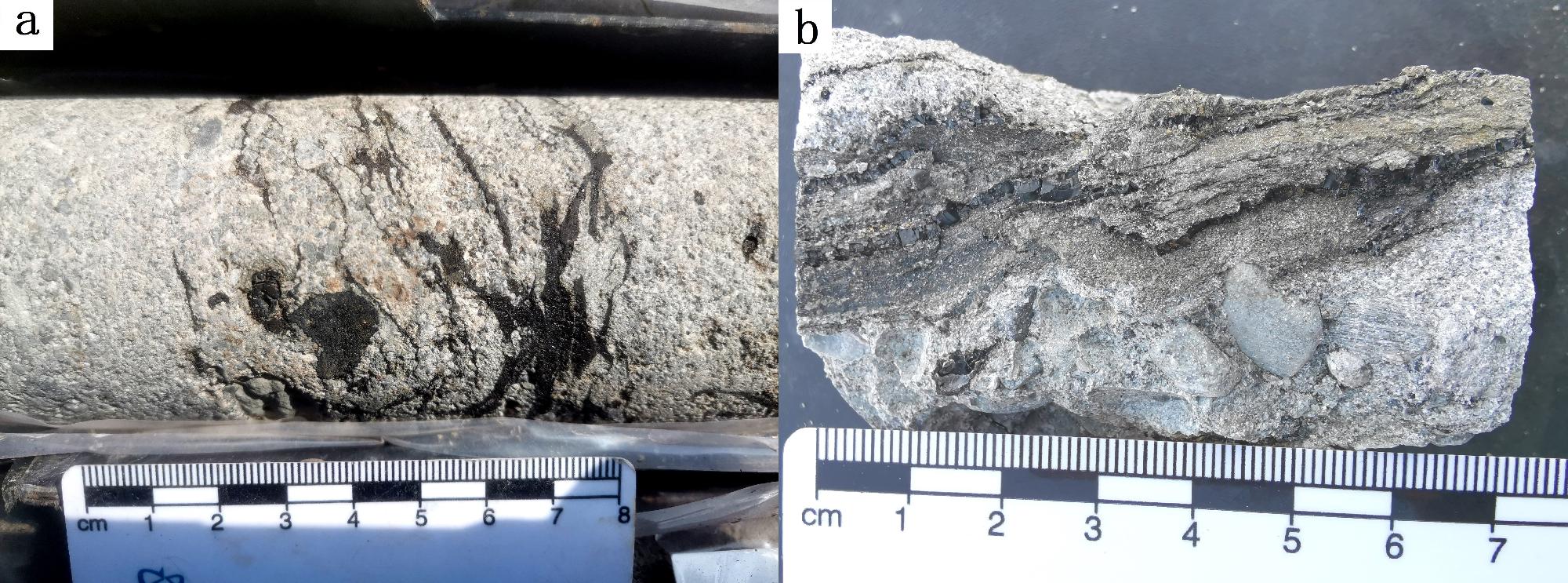
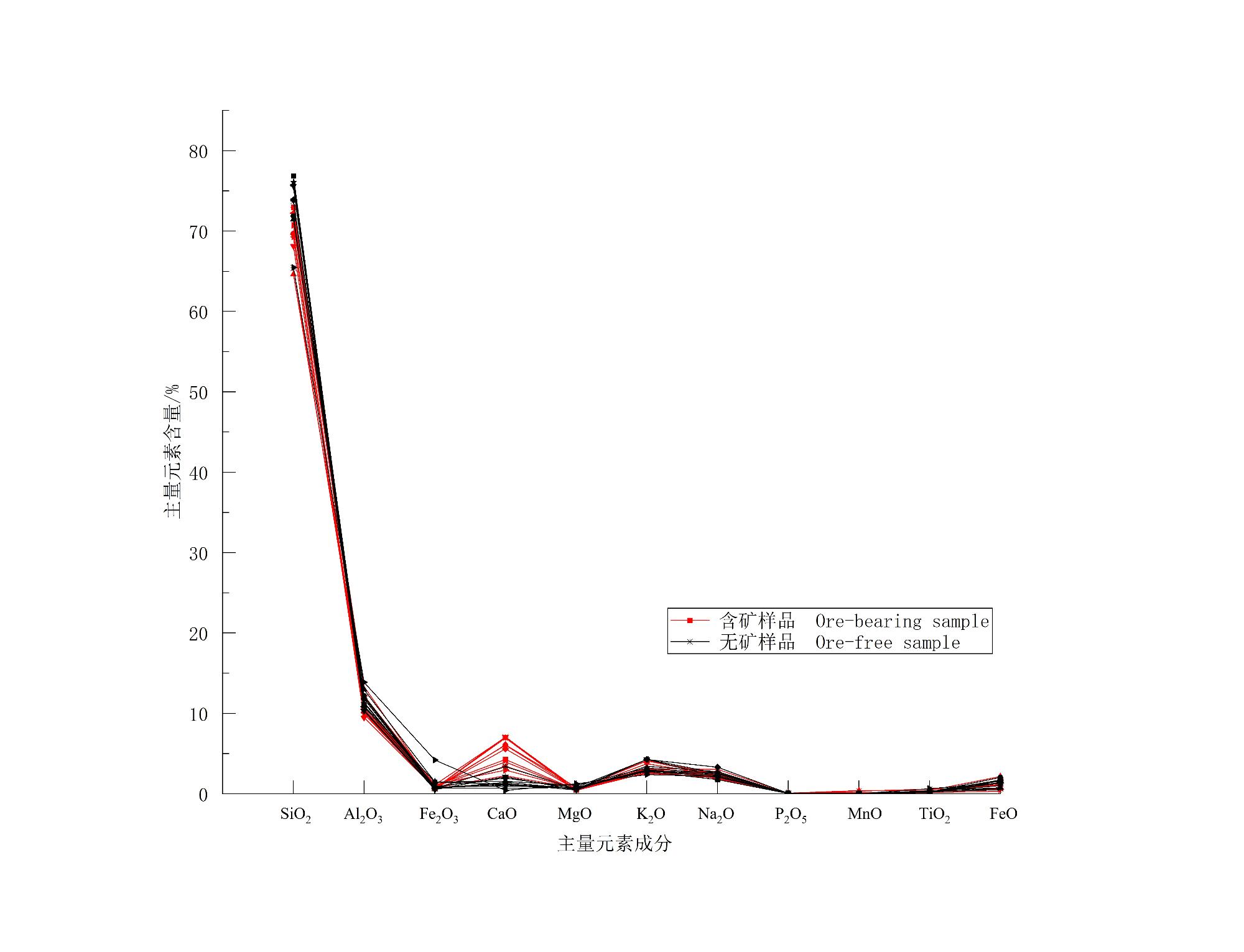
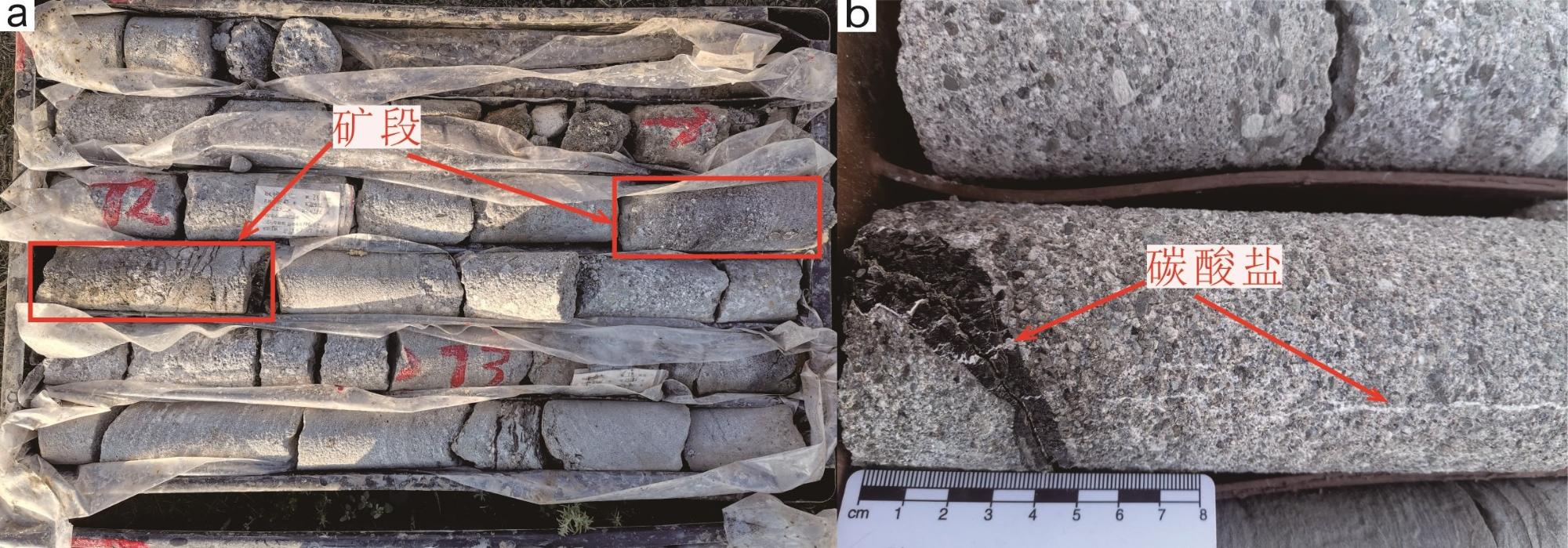
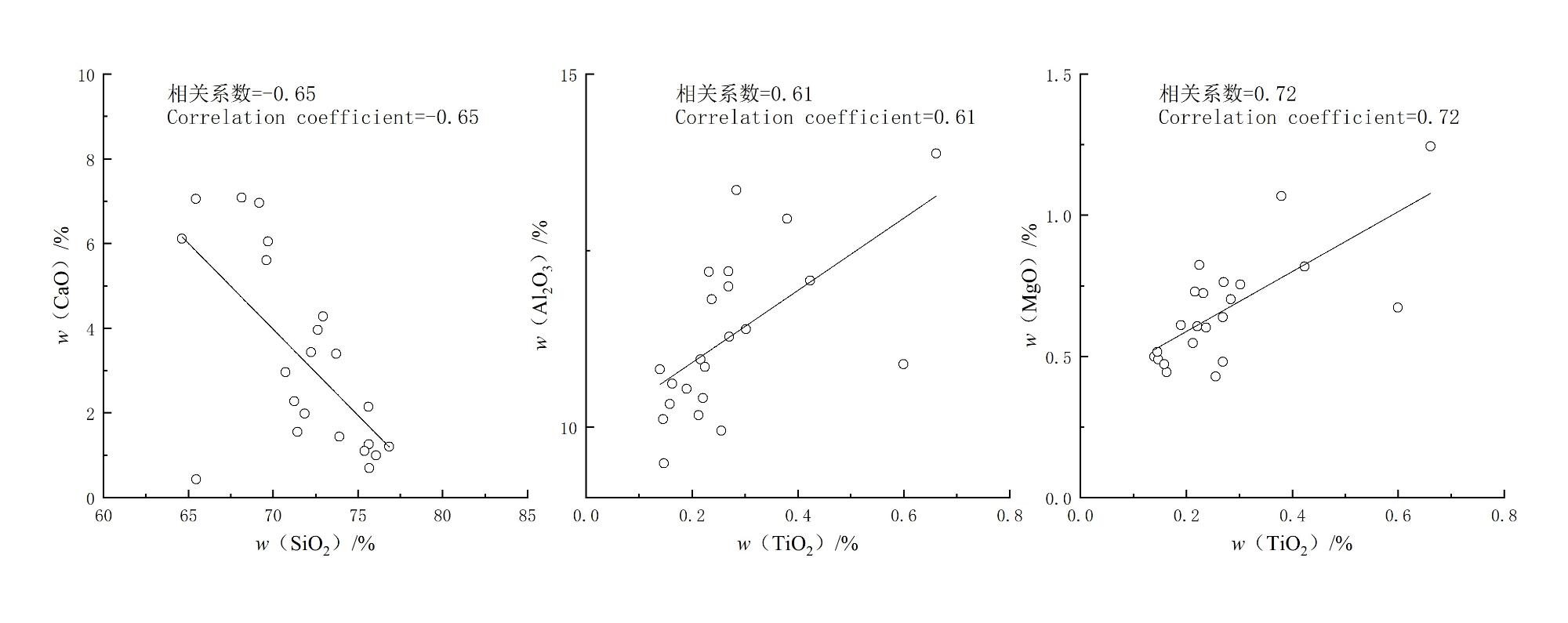
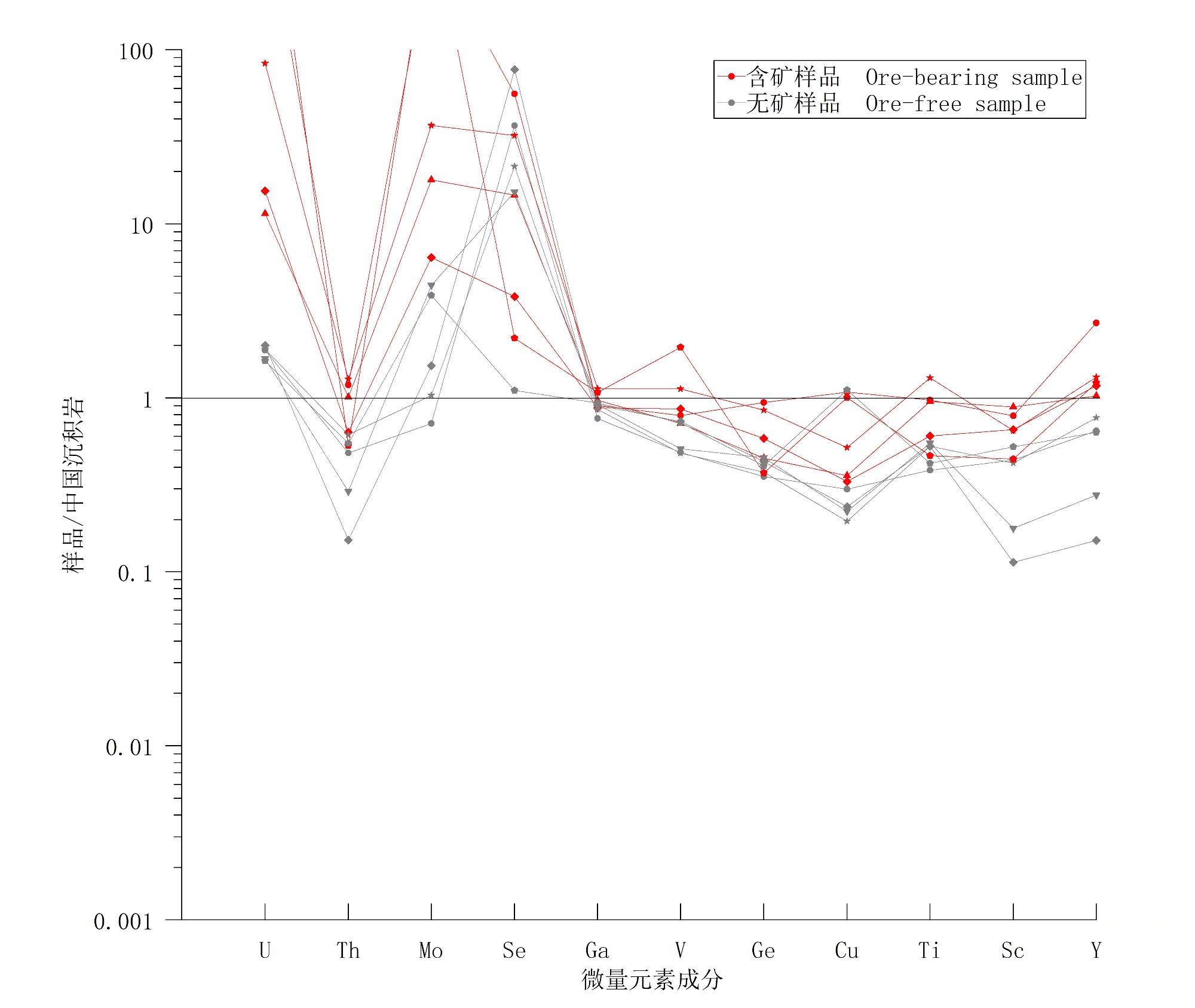
This article analyzes the petrological characteristics,geochemical features,provenance composition,structural background, and sedimentary environment of uranium bearing sandstone in the lower member of the Toutunhe formation in the Louzhuangzi area by the methods of geochemical analysis,microscopic identification and core observation,and preliminarily explores their relationship with uranium mineralization. The results show that the tectonic background of the ore-bearing sandstone source rocks in the lower member of the Toutunhe formation is mainly the active continental margin and the passive continental margin. The special tectonic background provided favorable conditions for the migration of uranium. The source of sandstone debris was dominated by neutral igneous rock,and the parent rock was mainly calc-alkaline granite with a small amount of pyroclastic rock,sedimentary rock and metamorphic rock,which indicated the sandstone from multi-source nature,and has a good uranium source. The sandstone formed in a warm and humid paleoclimate and the source rock was strongly weathered. The sandstone is rich in reducing medium,reflecting that the lower member of Toutunhe formation was in a reducing environment and has good primary reduction ability. The content of major elements of the sandstone debris in the target layer has the characteristics of rich alkali,high silicon and weak aluminum,and the ore-bearing sandstone are of lower w(SiO2) and w(Al2O3) and higher w(CaO) than those of the sterile sandstone. The difference of component content in the sand body of the ore-bearing member is characterized by strong clay alteration and carbonate development. U,Mo and Se are relatively enriched,and other trace elements are relatively depleted except for Ga,which is comparable to the sedimentary rocks in China. The content of trace elements in ore-bearing samples of the same borehole is generally higher than that in sterile samples, U,Mo,Se,V,Ge,Ti,Sc and Y are significantly increased, which indicated that the trace elements in the sand body of the target layer also have migrated and enriched in the uranium mineralization process.
Chao GUO , Weiwei JIA , Song HUANG , Guorong WANG , Gang LIAN . Geochemical characteristics and geological significance of uranium-bearing sandstone in the lower member of Toutunhe formation in Louzhuangzi area, southern margin of Junggar basin[J]. World Nuclear Geoscience, 2025 , 42(1) : 45 -59 . DOI: 10.3969/j.issn.1672-0636.2025.01.004
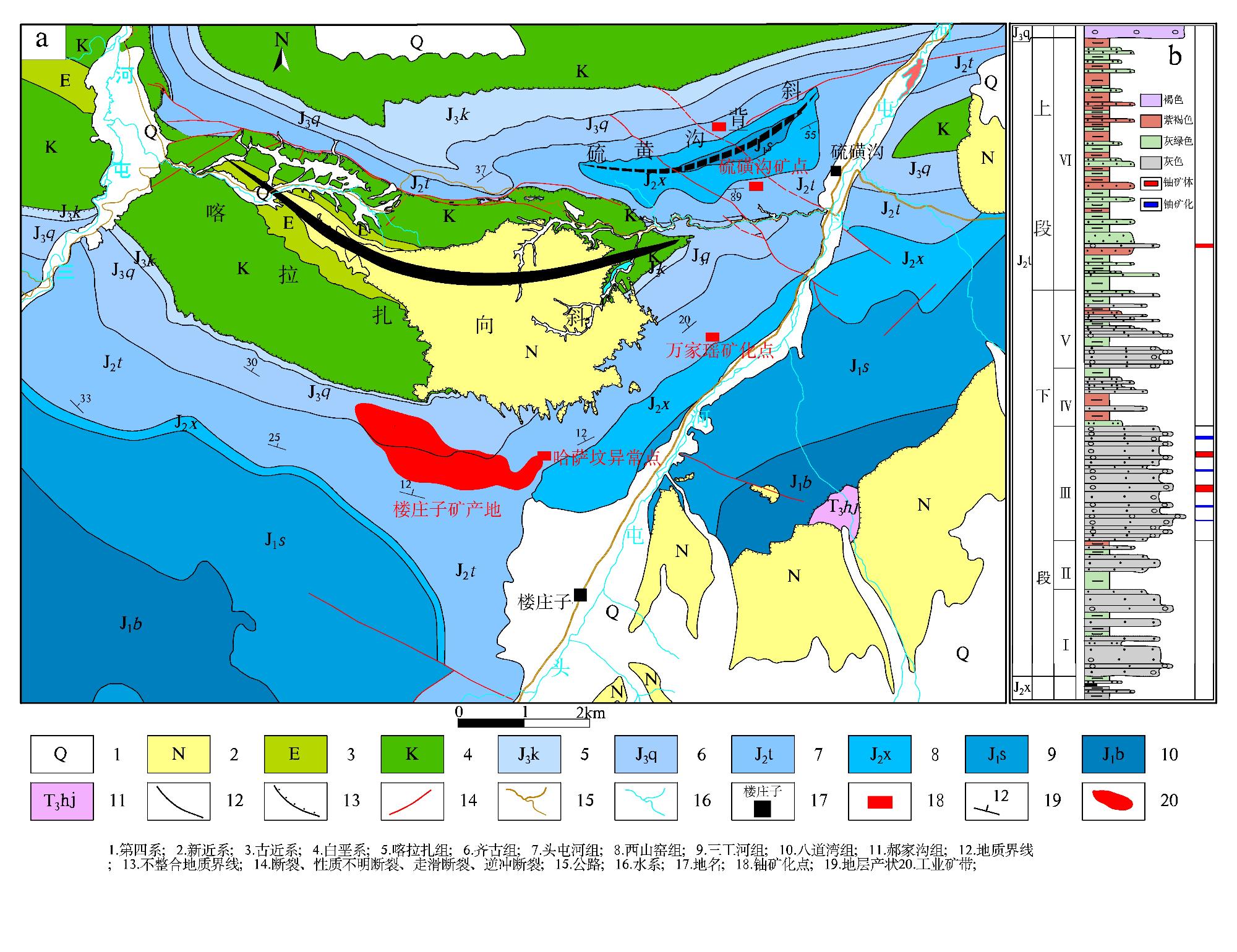
图1 准噶尔盆地南缘楼庄子地区地质略图及头屯河组柱状图1—第四系;2—新近系;3—古近系;4—白垩系;5—喀拉扎组;6—齐古组;7—头屯河组;8—西山窑组;9—三工河组;10—八道湾组;11—郝家沟组;12—地质界线;13—地质界线(不整合);14—断裂;15—公路;16—水系;17—地名;18—铀矿化点;19—地层产状;20—工业矿带。 Fig. 1 The geological sketch map of Louzhuangzi area in the southern margin of Junggar basin and the columnar map of Toutunhe formation 1—Quaternary;2—Neogene;3—Eogene;4—Cretaceous;5—Kalaza formation;6—Qigu formation;7—Toutunhe formation;8—Xishanyao formation;9—Sangonghe formation;10—Badaowan formation;11—Haojiagou formation;12—Geological Boundary;13—Geological unconformity boundary;14—Fracture;15—Highway;16—River syetem;17—Place name;18—Uranium mineralization point;19—Stratigraphic occurrence;20—Industrial ore belt。 |
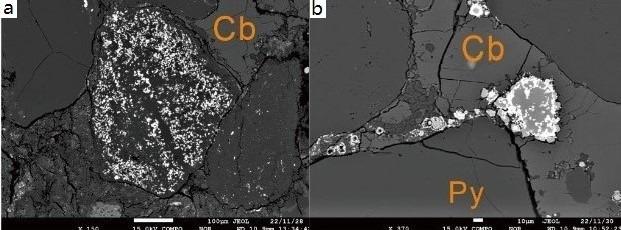
图2 砂岩分类三角图及镜下鉴定照片a—砂岩分类三角图(1-石英砂岩;2-长石石英砂岩;3-岩屑石英砂岩;4-长石砂岩;5-岩屑长石砂岩;6-长石岩屑砂岩;7-岩屑砂岩);b—砂岩中凝灰岩岩屑和黄铁矿(正交偏光);c—砂岩中凝灰岩岩屑和花岗岩岩屑(正交偏光);d—砂岩中凝灰岩岩屑和英安岩岩屑(正交偏光); Q—石英;Kf—钾长石;Pl—斜长石;Cc—方解石;Py—黄铁矿。 Fig. 2 Triangle classification diagrams and thin section of sandstone a—Triangle diagram ofsandstone classification(1-Quartz sandstone;2-Feldspathic quartz sandstone;3-Lithic quartz sandstone;4-Arkose;5-Lithic feldspar sandstone;6-Feldspar lithic sandstone;7-lithic sandstone);b—Orthogonal polarized photo of tuff debris and pyrite in sandstone;c—Orthogonal polarized photo of marl debris and granite debris in sandstone;d—Orthogonal polarized photo of tuff debris and dacite debris in sandstone; Q—Quartz;Kf—Potassium-feldspar;Pl—Plagioclase;Cc—Calcite;Py—Pyrite. |
表1 楼庄子地区头屯河组下段赋铀砂岩主量元素含量/%统计表Table 1 Statistics of main element content /% of uranium-bearing sandstone samples in the lower member of Toutunhe formation in Louzhuangzi area |
| 样号 | SiO2 | Al2O3 | Fe2O3 | CaO | MgO | K2O | Na2O | P2O5 | MnO | TiO2 | FeO | TFe2O3 | 备注 |
|---|---|---|---|---|---|---|---|---|---|---|---|---|---|
| A301-3 | 72.94 | 10.82 | 1.01 | 4.28 | 0.50 | 3.13 | 1.89 | 0.048 | 0.106 | 0.139 | 1.14 | 2.05 | 含矿 |
| A401-2 | 69.69 | 10.17 | 0.74 | 6.05 | 0.55 | 2.67 | 2.01 | 0.051 | 0.180 | 0.212 | 1.41 | 2.08 | |
| A405-3 | 64.62 | 12.08 | 0.63 | 6.11 | 0.82 | 2.58 | 2.63 | 0.086 | 0.398 | 0.423 | 2.16 | 2.73 | |
| A501-2 | 68.14 | 9.49 | 0.69 | 7.09 | 0.49 | 3.76 | 2.31 | 0.063 | 0.190 | 0.147 | 1.34 | 1.95 | |
| A502-1 | 69.59 | 10.11 | 0.65 | 5.61 | 0.52 | 4.10 | 2.30 | 0.047 | 0.056 | 0.145 | 1.41 | 1.99 | |
| A503-2 | 72.24 | 10.54 | 0.71 | 3.43 | 0.61 | 4.13 | 2.49 | 0.063 | 0.088 | 0.189 | 1.66 | 2.30 | |
| A504-1 | 70.72 | 12.21 | 1.15 | 2.96 | 0.64 | 3.05 | 2.68 | 0.063 | 0.022 | 0.269 | 0.57 | 1.60 | |
| A601-1 | 69.18 | 9.95 | 0.67 | 6.96 | 0.43 | 2.62 | 2.38 | 0.050 | 0.066 | 0.255 | 1.20 | 1.80 | |
| A602-3 | 71.25 | 13.36 | 0.74 | 2.27 | 0.70 | 3.15 | 3.06 | 0.086 | 0.112 | 0.283 | 1.41 | 2.08 | |
| A1101-4 | 72.62 | 10.61 | 0.89 | 3.96 | 0.45 | 2.88 | 2.20 | 0.055 | 0.057 | 0.162 | 0.31 | 1.11 | |
| 1102-3 | 65.43 | 10.89 | 1.14 | 7.06 | 0.67 | 2.57 | 1.99 | 0.077 | 0.325 | 0.599 | 0.66 | 1.68 | |
| 平均值 | 69.67 | 10.93 | 0.82 | 5.07 | 0.58 | 3.15 | 2.36 | 0.06 | 0.15 | 0.26 | 1.21 | 1.94 | |
| A301-2 | 76.84 | 10.96 | 1.47 | 1.20 | 0.73 | 2.78 | 1.79 | 0.060 | 0.043 | 0.216 | 1.60 | 2.92 | 无矿 |
| A401-3 | 71.86 | 12.20 | 0.88 | 1.98 | 0.72 | 2.87 | 2.62 | 0.062 | 0.064 | 0.232 | 2.05 | 2.84 | |
| A405-2 | 71.43 | 12.95 | 1.50 | 1.56 | 1.07 | 3.23 | 2.48 | 0.079 | 0.041 | 0.380 | 0.77 | 2.11 | |
| A501-3 | 75.61 | 10.33 | 0.53 | 2.15 | 0.47 | 4.30 | 2.56 | 0.051 | 0.045 | 0.158 | 1.35 | 1.83 | |
| A502-2 | 73.89 | 11.81 | 0.66 | 1.44 | 0.60 | 4.29 | 3.32 | 0.070 | 0.055 | 0.237 | 1.74 | 2.33 | |
| A503-1 | 75.67 | 10.85 | 0.75 | 0.70 | 0.82 | 4.29 | 2.17 | 0.055 | 0.030 | 0.225 | 1.41 | 2.09 | |
| A504-2 | 65.46 | 13.87 | 4.22 | 0.43 | 1.24 | 2.40 | 2.18 | 0.079 | 0.033 | 0.661 | 1.37 | 5.17 | |
| A601-3 | 76.07 | 11.28 | 0.85 | 0.99 | 0.76 | 3.01 | 2.31 | 0.057 | 0.026 | 0.270 | 1.03 | 1.80 | |
| A602-2 | 75.64 | 11.99 | 0.78 | 1.26 | 0.48 | 3.43 | 2.76 | 0.058 | 0.037 | 0.269 | 0.51 | 1.21 | |
| A1101-1 | 75.37 | 11.39 | 0.76 | 1.10 | 0.76 | 2.87 | 2.15 | 0.059 | 0.029 | 0.302 | 0.50 | 1.18 | |
| 1102-6 | 73.72 | 10.41 | 0.66 | 3.40 | 0.61 | 2.99 | 2.06 | 0.056 | 0.081 | 0.220 | 0.70 | 1.29 | |
| 平均值 | 73.78 | 11.64 | 1.19 | 1.47 | 0.75 | 3.31 | 2.40 | 0.062 | 0.044 | 0.288 | 1.18 | 2.25 |
注:TFe2O3代表全铁,TFe2O3=Fe+0.9×Fe2O3 |
表2 楼庄子地区头屯河组下段赋铀砂岩样品微量元素分析结果Table 2 Trace element analysis results of uranium-bearing sandstone samples in the lower member of Toutunhe formation in Louzhuangzi area |
| 样号 | U/10-6 | Th/10-6 | Mo/10-6 | Se/10-6 | Ga/10-6 | V/10-6 | Ge/10-6 | Cu/10-6 | Ti/10-6 | Sc/10-6 | Y/10-6 | 备注 |
|---|---|---|---|---|---|---|---|---|---|---|---|---|
| A501-27 | 1 435.52 | 10.32 | 232.14 | 6.14 | 11.82 | 42.75 | 1.60 | 30.26 | 2 578.91 | 7.89 | 53.94 | 含矿 |
| A602-16 | 3 339.41 | 4.63 | 327.83 | 0.24 | 13.99 | 105.43 | 0.63 | 28.13 | 1 235.31 | 4.46 | 24.45 | |
| A502-14 | 167.30 | 11.17 | 20.6 | 3.54 | 14.71 | 60.78 | 1.45 | 14.52 | 3 461.66 | 6.51 | 26.32 | |
| A1102-9 | 30.92 | 5.52 | 3.60 | 0.42 | 11.39 | 46.67 | 1.00 | 9.26 | 1 602.37 | 6.57 | 23.48 | |
| A503-12 | 22.89 | 8.79 | 10.04 | 1.61 | 12.61 | 38.58 | 0.77 | 10.02 | 2 528.13 | 8.87 | 20.54 | |
| A501-14 | 3.76 | 4.20 | 0.40 | 4.03 | 9.91 | 26.28 | 0.60 | 8.37 | 1 018.90 | 4.40 | 12.95 | 无矿 |
| A602-19 | 3.27 | 4.77 | 2.18 | 0.12 | 12.15 | 38.91 | 0.69 | 31.12 | 1 117.52 | 5.24 | 12.69 | |
| A502-17 | 3.81 | 5.35 | 0.58 | 2.36 | 11.18 | 25.96 | 0.64 | 5.49 | 1 398.78 | 4.22 | 15.41 | |
| A1102-14 | 4.01 | 1.32 | 0.86 | 8.47 | 11.81 | 39.53 | 0.73 | 6.64 | 1 398.45 | 1.13 | 3.03 | |
| A503-13 | 3.37 | 2.53 | 2.48 | 1.68 | 11.94 | 27.54 | 0.77 | 6.25 | 1 459.99 | 1.78 | 5.54 | |
| 中国沉积岩丰度 | 2.00 | 8.70 | 0.56 | 0.11 | 13.00 | 54.00 | 1.70 | 28.00 | 2 650.00 | 10.00 | 20.00 |
表3 楼庄子地区头屯河组下段赋铀砂岩主量元素相关参数计算结果表/%Table 3 Calculation results of main elements and related parameters of uranium-bearing sandstone samples in the lower member of Toutunhe formation in Louzhuangzi area /% |
| 样号 | TFe2O3+MgO | K2O/Na2O | Al2O3/SiO2 | Al2O3/TiO2 | Al2O3/(Na2O+CaO) | CaO/MgO | (Fe2O3+Al2O3)/(MgO+CaO) | F1 | F2 | 备注 |
|---|---|---|---|---|---|---|---|---|---|---|
| A301-3 | 2.55 | 1.66 | 0.15 | 77.84 | 1.75 | 8.56 | 2.47 | 5.99 | 2.00 | 含矿 |
| A401-2 | 2.63 | 1.32 | 0.15 | 47.97 | 1.26 | 11.05 | 1.65 | 7.14 | 2.22 | |
| A405-3 | 3.55 | 0.98 | 0.19 | 28.57 | 1.38 | 7.46 | 1.83 | 8.46 | 2.78 | |
| A501-2 | 2.44 | 1.63 | 0.14 | 64.67 | 1.01 | 14.46 | 1.34 | 6.28 | 4.69 | |
| A502-1 | 2.51 | 1.78 | 0.15 | 69.52 | 1.28 | 10.85 | 1.76 | 5.31 | 4.52 | |
| A503-2 | 2.91 | 1.66 | 0.15 | 55.68 | 1.78 | 5.62 | 2.78 | 4.31 | 3.75 | |
| A504-1 | 2.24 | 1.14 | 0.17 | 45.39 | 2.16 | 4.63 | 3.71 | 5.74 | 2.59 | |
| A601-1 | 2.23 | 1.10 | 0.14 | 38.99 | 1.07 | 16.22 | 1.44 | 7.69 | 3.31 | |
| A602-3 | 2.78 | 1.03 | 0.19 | 47.12 | 2.51 | 3.23 | 4.74 | 6.31 | 2.88 | |
| A1101-4 | 1.56 | 1.31 | 0.15 | 65.32 | 1.72 | 8.89 | 2.61 | 5.45 | 2.26 | |
| 1102-3 | 2.36 | 1.29 | 0.17 | 18.17 | 1.20 | 10.49 | 1.56 | 7.13 | 2.67 | |
| A301-2 | 3.65 | 1.55 | 0.14 | 50.74 | 3.67 | 1.64 | 6.44 | 4.73 | (0.43) | 无矿 |
| A401-3 | 3.56 | 1.09 | 0.17 | 52.57 | 2.65 | 2.74 | 4.83 | 6.20 | 1.40 | |
| A405-2 | 3.18 | 1.30 | 0.18 | 34.13 | 3.21 | 1.46 | 5.50 | 4.55 | 1.42 | |
| A501-3 | 2.31 | 1.68 | 0.14 | 65.22 | 2.20 | 4.54 | 4.15 | 3.12 | 3.78 | |
| A502-2 | 2.93 | 1.29 | 0.16 | 49.86 | 2.48 | 2.39 | 6.11 | 4.03 | 4.44 | |
| A503-1 | 2.91 | 1.98 | 0.14 | 48.33 | 3.79 | 0.84 | 7.64 | 1.91 | 2.15 | |
| A504-2 | 6.41 | 1.10 | 0.21 | 20.99 | 5.32 | 0.35 | 10.78 | 6.85 | (1.49) | |
| A601-3 | 2.57 | 1.30 | 0.15 | 41.74 | 3.41 | 1.30 | 6.90 | 3.79 | 0.86 | |
| A602-2 | 1.69 | 1.24 | 0.16 | 44.58 | 2.98 | 2.62 | 7.32 | 4.07 | 2.76 | |
| A1101-1 | 1.94 | 1.34 | 0.15 | 37.73 | 3.51 | 1.46 | 6.55 | 3.49 | 0.66 | |
| 1102-6 | 1.90 | 1.45 | 0.14 | 47.22 | 1.91 | 5.60 | 2.76 | 4.57 | 1.74 |
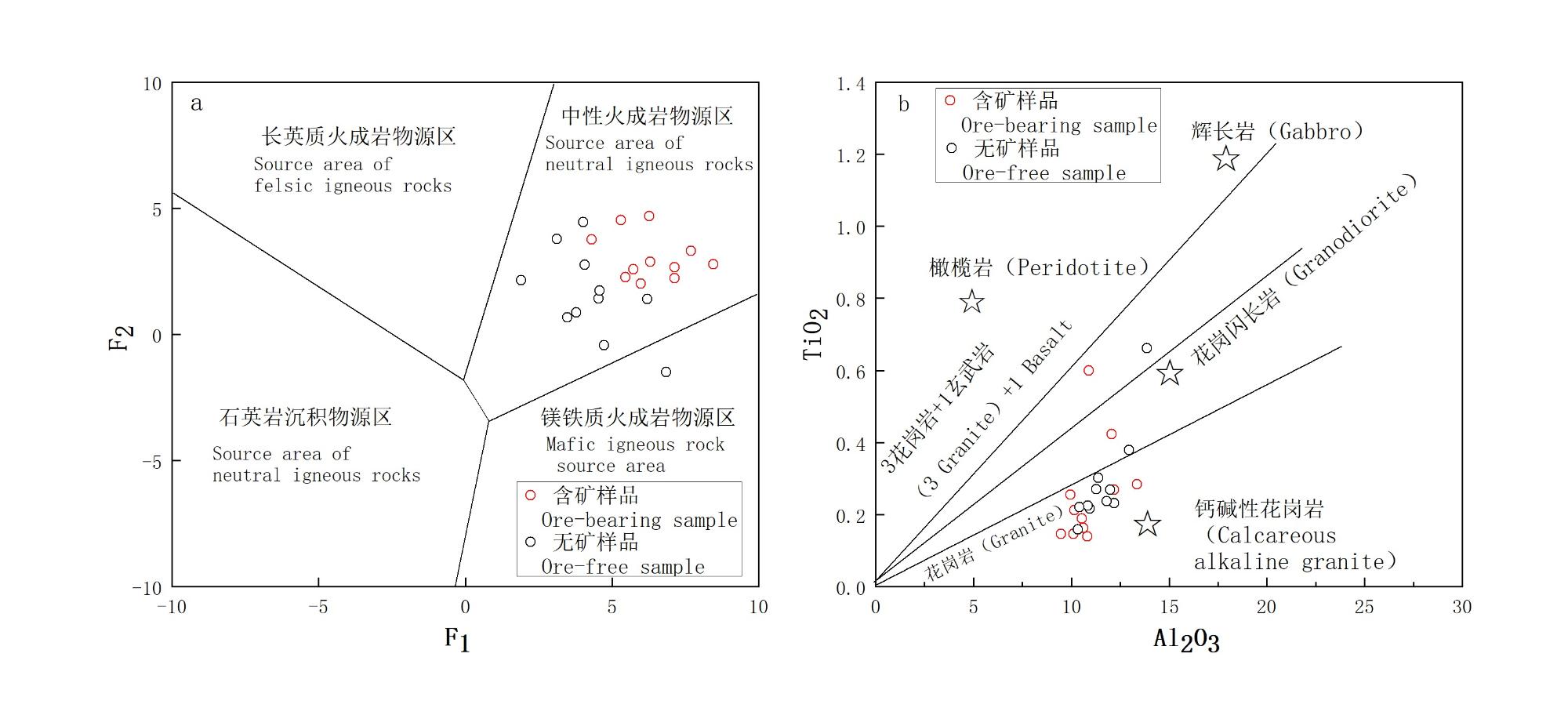
注:TFe2O3为全铁,ICV=(Fe2O3+ K2O+ Na2O + CaO + MgO + MnO + TiO2)/Al2O3( 单位均为摩尔分数);F1=-1.773TiO2+0.607Al2O3+0.76TFe2O3-1.5MgO+0.616CaO+0.509Na2O-1.224K2O-9.09;F2=0.445TiO2+0.07Al2O3-0.25TFe2O3-1.142MgO+0.438CaO+1.475Na2O+1.426K2O-6.861[26]。 |
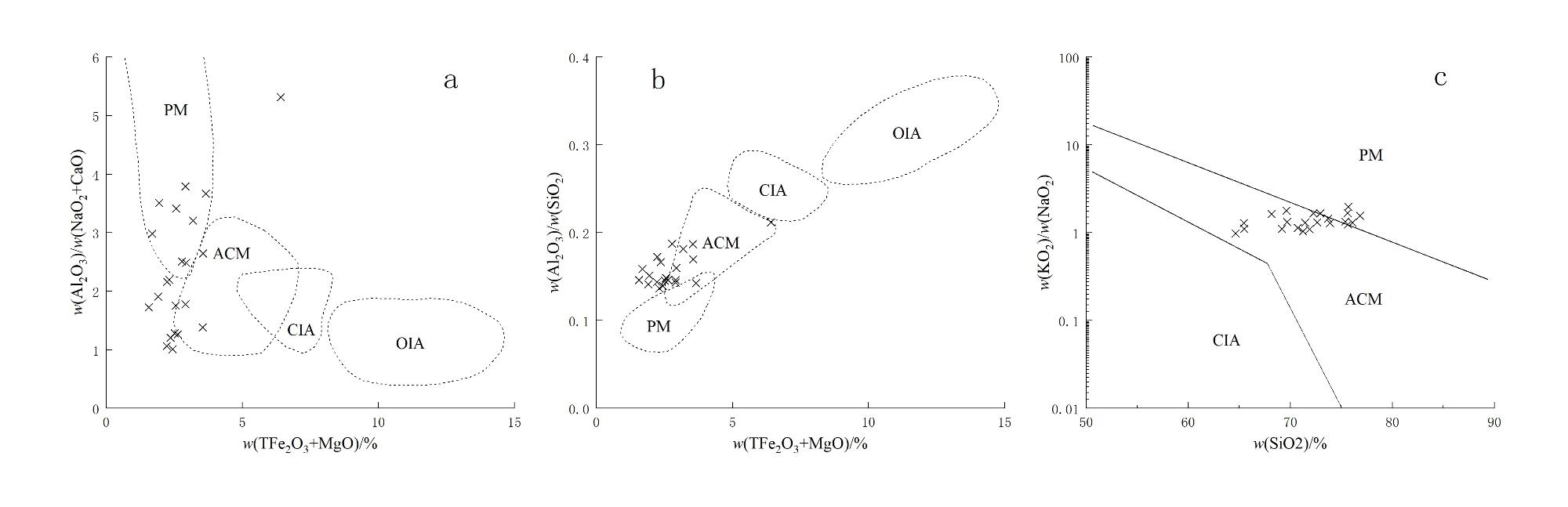
图3 砂岩主量元素构造环境关系图解a-(TFe2O3+MgO)-Al2O3(/ Na2O+CaO)图解, b-(TFe2O3+MgO)-Al2O3/SiO2图解,c-SiO2-K2O/Na2O图解,底图均据文献[27]。ACM-活动大陆边缘;PM-被动大陆边缘;OIA-大洋岛弧);CIA-大陆岛弧;A1-弧(Arc);A2-演化弧。 Fig. 3 Diagrams of the relationship between major elements and tectonic environment of sandstone a-The diagrams of the (TFe2O3+MgO)-Al2O3/( Na2O+CaO), b-The diagrams of the (TFe2O3+MgO)-Al2O3/SiO2,c-The diagrams of the SiO2-K2O/Na2O,Base map according to reference[27]。ACM-Active Continental Margin;PM-Passive Continental Margin;OIA-Ocean Island Arc;CIA-Continental Island Arc;A1-Arc;A2-Evolutionary Arc. |
微量元素富集系数统计结果Table 4 Statistical results of enrichment coefficient of trace elements |
| 样号 | U | Th | Mo | Se | Ga | V | Ge | Cu | Ti | Sc | Y |
|---|---|---|---|---|---|---|---|---|---|---|---|
| DHA501-27 | 717.76 | 1.19 | 414.53 | 55.82 | 0.91 | 0.79 | 0.94 | 1.08 | 0.97 | 0.79 | 2.70 |
| DHA501-14 | 1.88 | 0.48 | 0.71 | 36.66 | 0.76 | 0.49 | 0.35 | 0.30 | 0.38 | 0.44 | 0.65 |
| DHA503-12 | 11.44 | 1.01 | 17.92 | 14.65 | 0.97 | 0.71 | 0.45 | 0.36 | 0.95 | 0.89 | 1.03 |
| DHA503-13 | 1.68 | 0.29 | 4.43 | 15.29 | 0.92 | 0.51 | 0.45 | 0.22 | 0.55 | 0.18 | 0.28 |
| DHA1102-9 | 15.46 | 0.63 | 6.42 | 3.83 | 0.88 | 0.86 | 0.59 | 0.33 | 0.60 | 0.66 | 1.17 |
| DHA1102-14 | 2.00 | 0.15 | 1.53 | 76.96 | 0.91 | 0.73 | 0.43 | 0.24 | 0.53 | 0.11 | 0.15 |
| DHA502-14 | 83.65 | 1.28 | 36.79 | 32.19 | 1.13 | 1.13 | 0.85 | 0.52 | 1.31 | 0.65 | 1.32 |
| DHA502-17 | 1.91 | 0.62 | 1.03 | 21.42 | 0.86 | 0.48 | 0.37 | 0.20 | 0.53 | 0.42 | 0.77 |
| DHA602-16 | 1 669.71 | 0.53 | 585.41 | 2.20 | 1.08 | 1.95 | 0.37 | 1.00 | 0.47 | 0.45 | 1.22 |
| DHA602-19 | 1.63 | 0.55 | 3.89 | 1.11 | 0.93 | 0.72 | 0.41 | 1.11 | 0.42 | 0.52 | 0.63 |
表5 楼庄子地区头屯河组下段赋铀砂岩中C有、全S和CO2含量统计表Table 5 Statistical of C有, total S and CO2 content of uranium-bearing sandstone samples in the lower member of Toutunhe formation in Louzhuangzi area |
| 组分 | 含矿砂岩 | 无矿砂岩 | ||||
|---|---|---|---|---|---|---|
| 最小值 | 最大值 | 平均值 | 最小值 | 最大值 | 平均值 | |
| C有/% | 0.18 | 1.78 | 0.88 | 0.10 | 0.15 | 0.12 |
| 全S/% | 0.96 | 3.29 | 1.97 | 0.35 | 0.83 | 0.57 |
| CO2/% | 5.79 | 10.60 | 7.86 | 0.83 | 8.51 | 3.49 |
感谢唐湘飞、闫晶晶和杜默给予的支持和帮助!
| 1 |
张驰, 于兴河, 姚宗全, 等. 准噶尔盆地南缘西段中、上侏罗统沉积演化及控制因素分析[J]. 中国地质, 2021, 48(1):284-296.
|
| 2 |
陈正乐, 鲁克改, 王果, 等. 准噶尔盆地南缘新生代构造特征及其与砂岩型铀矿成矿作用初析[J]. 岩石学报, 2010, 26(2):457-470.
|
| 3 |
闫晶晶, 贾为卫, 黄松. 准噶尔盆地南缘硫磺沟地区中-新生代构造演化与侏罗系铀成矿的关系[J]. 铀矿地质, 2022, 38(6):1022-1031.
|
| 4 |
贾为卫, 王国荣, 唐湘飞, 等. 准噶尔盆地南缘楼庄子地区头屯河组不同类型蚀变带与铀成矿关系探讨[J]. 世界核地质科学, 2023, 40(2):152-161.
|
| 5 |
黄少华, 秦明宽, 刘章月, 等. 成岩作用与油气侵位对砂岩铀成矿的约束-以准南硫磺沟地区头屯河组砂岩铀成矿为例[J]. 沉积学报, 2016, 34(2):250-259.
|
| 6 |
耿英英, 刘章月, 黄少华, 等. 准噶尔盆地南缘头屯河地区砂岩型铀矿成矿环境与找矿方向[J]. 铀矿地质, 2022, 38(2):194-206.
|
| 7 |
王国荣, 贾为卫, 杜默, 等. 准噶尔盆地南缘侏罗系辫状河沉积体系与铀成矿关系[J]. 铀矿地质, 2021, 37(3):342-354.
|
| 8 |
鲁克改, 杜默, 孙潇, 等. 准噶尔盆地南缘楼庄子地区头屯河组下段砂岩型铀成矿控制因素和成因分析[J]. 铀矿地质, 2023, 39(4):507-521.
|
| 9 |
李琪, 吴柏林, 周玉, 等. 准噶尔盆地南缘硫磺沟地区头屯河组沉积特征及其铀成矿远景分析[J]. 西北大学学报(自然科学版), 2023, 53(4):635-654.
|
| 10 |
黄松, 贾为卫, 闫晶晶. 准噶尔盆地南缘楼庄子地区头屯河组下段砂体特征与铀成矿关系探讨[J]. 铀矿地质, 2023, 39(4):522-530.
|
| 11 |
|
| 12 |
廉刚, 唐湘飞, 黄松. 准噶尔盆地东部卡姆斯特地区头屯河组下段砂岩地球化学特征及地质意义[J]. 铀矿地质, 2023, 39(4):546-557.
|
| 13 |
周月. 准噶尔盆地南缘侏罗系砂岩岩石地球化学特征对物源和古环境的约束[D]. 成都: 成都理工大学, 2022.
|
| 14 |
邓起东, 冯先岳, 张培震, 等. 乌鲁木齐山前坳陷逆断裂-褶皱带及其形成机制[J]. 地学前缘(中国地质大学,北京), 1999, 6(4):19l-201.
|
| 15 |
贾为卫, 黄松, 闫晶晶, 等. 新疆准噶尔盆地南缘金沟河-浅水河地区铀矿资源调查评价[R]. 乌鲁木齐: 核工业二一六大队,2021:1-164.
|
| 16 |
地质矿产实验室测试质量管理规范: DZ/T 0130—2006 [S] : 1-45.
The specification of quality management for geological laboratories[S]:1-45 (in Chinese).
|
| 17 |
铀矿样品加工和管理技术规范: EJ/T 1121—2000[S] :1-13
Standard of manufacturing and managerial technique for the uranium samples[S]:1-13 (in Chinese).
|
| 18 |
硅酸盐岩石化学分析方法,第28部分:16个主次成分量测定:GB/T 14506.28—2010 [S]:1-7.
28:Determination of 16 major and minor elements content [S] :1-7 (in Chinese).
|
| 19 |
硅酸盐岩石化学分析方法,第14部分:氧化亚铁量测定GB/T 14506.14—2010 [S]:1-3.
Methods for chemical analysis of silicate rocks-Part 14: Determination of ferrous oxide content[S]:1-3 (in Chinese).
|
| 20 |
硅酸盐岩石化学分析方法,第30部分:44个元素量测定:GB/T 14506.30—2010[S]:1-14.
Methods for chemical analysis of silicate rocks-Part 30:Determination of slsments[S]:1-14 (in Chinese).
|
| 21 |
岩石矿物分析:DZG 93-12-17[M]. 北京: 地质出版社, 2011. 2:195-197.
|
| 22 |
沉积岩中总有机碳测定:GB/T 19145—2003[S].
Determination for total organic in sedimentary rock[S]:1-3 (in Chinese).
|
| 23 |
硅酸盐岩石化学分析方法,第13部分:硫量测定GB/T 14506.13—2010 [S]:1-4.
Methods for chemical analysis of silicate rocks-Part 13: Determination of sulfur content [S] :1-4 (in Chinese).
|
| 24 |
张博文, 展新忠, 端木常青. 东准噶尔卡姆斯特岩体地球化学特征及构造意义[J]. 新疆大学学报(自然科学版), 2018, 35(4):502-512.
|
| 25 |
黎彤. 中国陆壳及其沉积层和上陆壳的化学元素丰度[J]. 地球化学, 1994, 23(2):140-145.
|
| 26 |
|
| 27 |
李强, 陈擎, 王继斌, 等. 柴达木盆地西缘砂岩型铀矿元素地球化学特征及其地质意义[J]. 矿物岩石地球化学通报, 2022, 41(6):9-10.
|
| 28 |
耿英英, 刘章月, 何中波, 等. 准噶尔盆地南缘头屯河地区砂岩型铀矿铀源区及其成矿构造背景分析[J]. 地质论评, 2020, 66(2):393-409.
|
| 29 |
贾晓亮, 翟明国, 郭瑞清, 等. 新疆南天山泥盆纪钙碱性侵入岩的形成时代、地球化学特征及构造意义[J]. 岩石学报, 2017, 33(10):3057-3075.
|
| 30 |
冯光英, 杨经绥, 刘飞, 等. 新疆中天山干沟一带晚石炭世花岗岩的岩石成因及其地质意义[J]. 中国地质, 2016, 43(5):1545-1557.
|
| 31 |
朱涛, 马中平, 徐学义, 等. 中天山南缘那拉提构造带达格特闪长岩的年龄、地球化学特征及其构造意义[J]. 地质通报, 2012, 31(12):1965-1972.
|
| 32 |
李平, 朱志新, 穆利修, 等. 新疆中天山巴伦台地区花岗质侵入体地球化学、年代学研究及其构造意义[J]. 地质学报, 2017, 91(1):80-93.
|
| 33 |
刘飞, 杨经绥, 李天福, 等. 新疆北天山沙湾地区晚石炭世火山岩地球化学特征及地质意义[J]. 中国地质, 2011, 38(4):868-889.
|
| 34 |
杨猛, 王居里, 王建其, 等. 新疆中天山北缘望峰地区花岗岩的地球化学、锆石U-Pb 年代学及Hf同位素组成研究[J]. 岩石学报, 2012, 28(7):2121-2131.
|
| 35 |
|
| 36 |
|
| 37 |
谢建磊, 赵宝成, 战庆, 等. 元素地球化学在古环境和古生态研究中的应用综述[J]. 上海国土资源, 2015, 36(3):64-74.
|
| 38 |
孙潇, 王国荣, 王果, 等. 东准卡姆斯特地区中侏罗—渐新世古气候环境分析及对砂岩型铀矿的影响[J]. 新疆地质, 2019, 37(2):242-246.
|
/
| 〈 |
|
〉 |