Identification of black odorous water bodies and NH3-N inversion study based on Gaofen-2 remote sensing data
|
First author:LU Huixiong,male,born in 1988,senior engineer,focusing on remote sensing technology and application. E-mail:1551310706@qq.com |
Received date: 2024-12-31
Revised date: 2025-02-21
Online published: 2025-10-24
Supported by
Research on Black and Odorous Waters Based on High-Resolution Remote Sensing(202418)
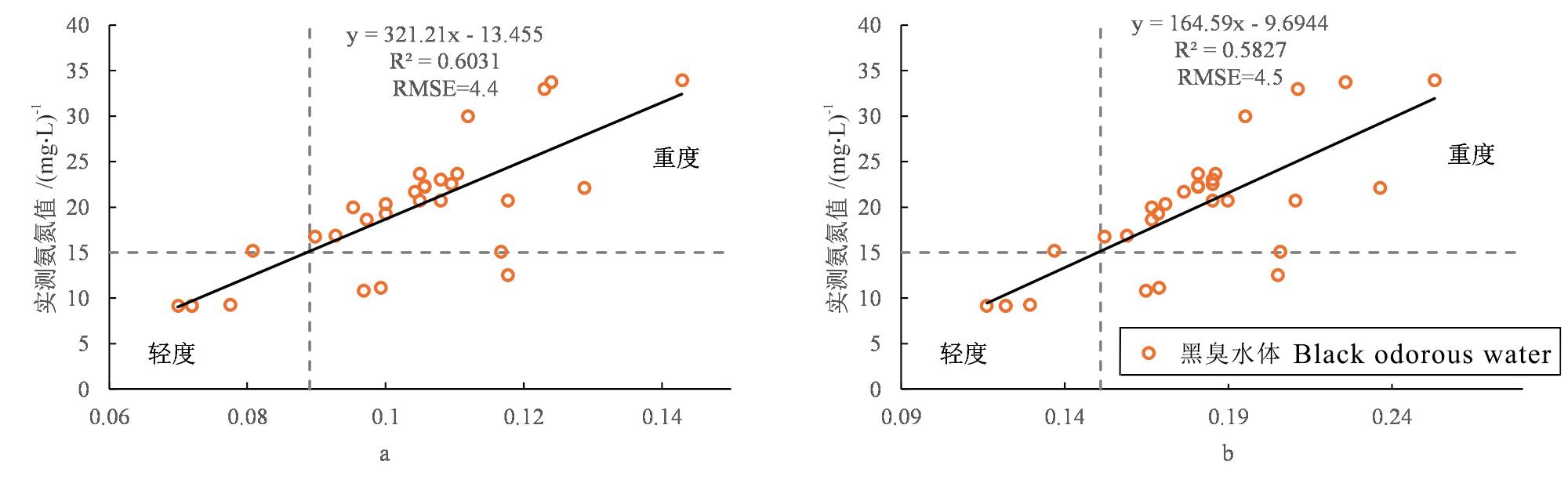
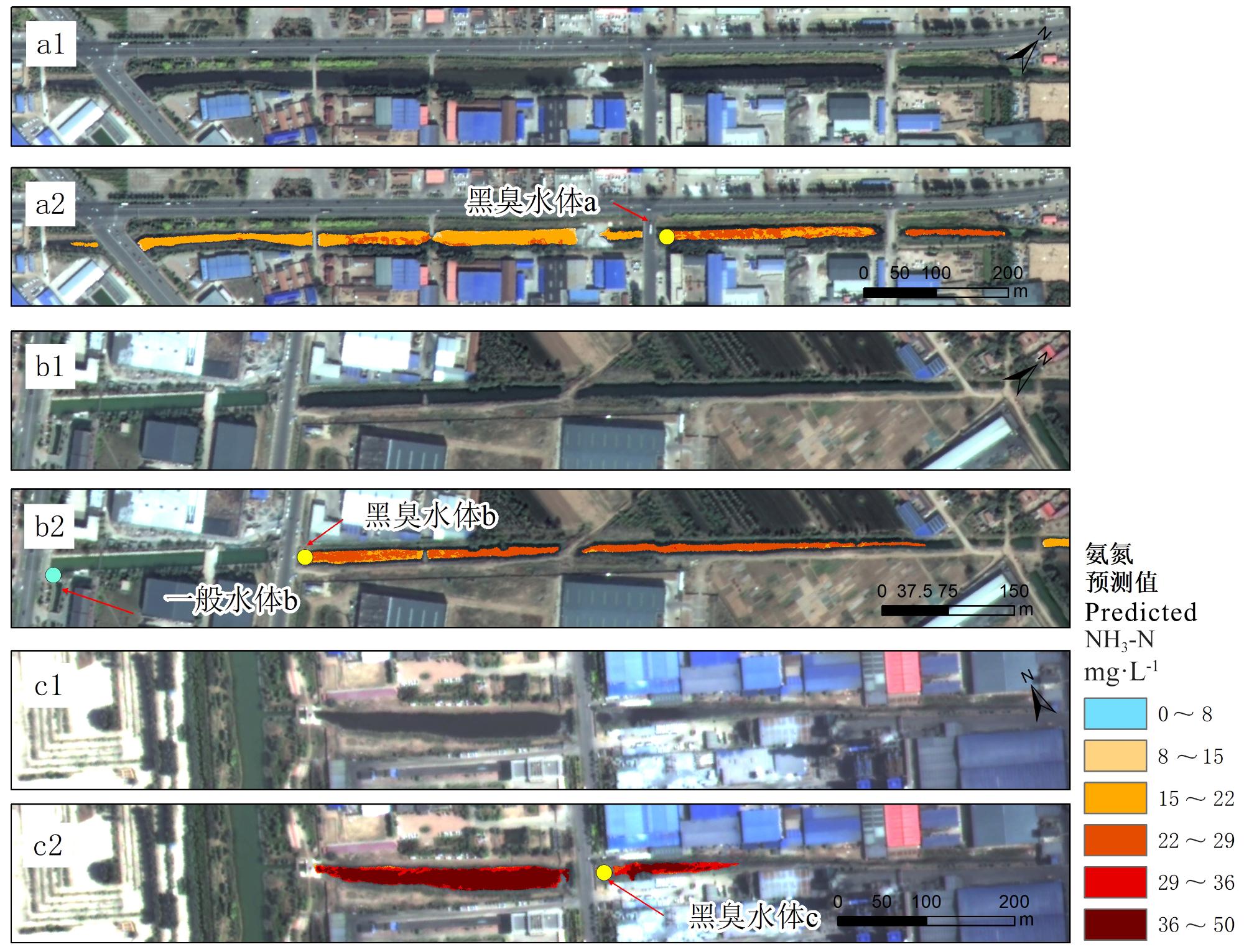
With the continuous promotion of government departments in water pollution prevention and control,the water environment has seen a substantial improvement,but the water bodies near pollution sources such as industrial zones and livestock and poultry farms are still prone to be black and odorous. How to identify these black stinking water bodies with excessive ammonia and nitrogen content is an urgent problem. 30 black stinky water bodies with excessive ammonia nitrogen were collected and assayed to study the identification inversion method for Gaofen-2 remote sensing data. By combining multiple band ratio and threshold segmentation algorithms,a combination algorithms applicable to the study area was obtained to identify the stinky water body and black stinky water by the correlating band ratio and the measured ammonia nitrogen. With the combination algorithms, ammonia nitrogen content of black smelly water bodies was inversed to identify the spatial distribution so as to discover the suspected sewage point position. The results were showed as the following:1) BOCI,WCI,FUI and e4 algorithms had a high separability between black smelly water bodies and general water bodies,the mean value combination of BOCI-OSTU and BOCI had the best segmentation effect on the samples of the prediction set while BOCI played the most stable role among the threshold algorithms;2) BOCI-OSTU,BOCI-mean value and WCI-Minimum are relatively effective in identifying black stinking water bodies;3)the BOI and G-R algorithms have the highest correlation of measured ammonia nitrogen values to the decision coefficients at 0.6 and 0.58 respectively;4) The ammonia nitrogen inversion was performed on three ditches within the study area using the BOI algorithm,and the ammonia nitrogen spatial distribution maps were obtained to present the suspected discharge locations. Therefore,this technique can provide efficient black stinky water body investigation service for government departments and technical support for ecological environment improvement.
LU Huixiong , LI Qiliang , XUE Qing , ZHANG Ce , SUN Yongbin , HAN Shaofei , NIU Haiwei . Identification of black odorous water bodies and NH3-N inversion study based on Gaofen-2 remote sensing data[J]. World Nuclear Geoscience, 2025 , 42(2) : 360 -373 . DOI: 10.3969/j.issn.1672-0636.2025.02.011
表1 黑臭水体波段比值算法表Table 1 Algorithm list of band ratio for black odorous water bodies |
| 算法名称 | 简称 | 公式 | 作者/年份 | 参考文献 |
|---|---|---|---|---|
| 归一化黑臭水体指数水体清洁指数 | WCI | $\frac{(G-B)/({\lambda }_{G}-{\lambda }_{B})}{(R-B)/({\lambda }_{R}-{\lambda }_{G})}$ | 李佳琦,2017 | [2] |
| 归一化黑臭水体指数 | G-R | $\frac{G-R}{G+R}$ | 温爽,2018 | [3] |
| 黑臭水体归一化比值模型 | BOI | $\frac{G-R}{B+G+R}$ | 姚月,2018 | [4] |
| 黑臭水体增强指数 | EHI | $\frac{NIR+R-B}{NIR+R+B}$ | 姚焕玫,2019 | [5] |
| 归一化黑臭水体指数 | NDBWI | $\frac{B+G+R-NIR}{B+G+R+NIR}$ | 姚焕玫,2019 | [5] |
| 城市黑臭水体分级指数 | BOCI | $\left(G-\left(B+\frac{\left(R-B\right)*({\lambda }_{G}-{\lambda }_{B})}{{\lambda }_{R}-{\lambda }_{B}}\right)\right)/R$ | 七珂珂,2019 | [6] |
| 基准高度法 | BH | $\left(G-\left(B+\frac{\left(R-B\right)*({\lambda }_{G}-{\lambda }_{B})}{{\lambda }_{R}-{\lambda }_{B}}\right)\right)$ | Qian Shen,2019 | [7] |
| 黑臭水体识别模型 | BOIM | $\frac{R-(B+\frac{\left(R-B\right)*({\lambda }_{G}-{\lambda }_{B})}{{\lambda }_{R}-{\lambda }_{B}})}{R+(B+\frac{\left(R-B\right)*({\lambda }_{G}-{\lambda }_{B})}{{\lambda }_{R}-{\lambda }_{B}})}$ | 张宁宁,2022 | [8] |
| 黑臭水体多光谱遥感指数 | BOMRI | $(B+\frac{NIR-B}{{\lambda }_{NIR}-{\lambda }_{B}}*\left({\lambda }_{R}-{\lambda }_{B}\right))/R$ | 张宁宁,2022 | [8] |
| 黑臭水体图像反射率指数 | BIR | $\frac{(NIR-R)/({\lambda }_{NIR}-{\lambda }_{R})}{(G-R)/({\lambda }_{R}-{\lambda }_{G})}$ | 刘冰,2024 | [9] |
| CIE色度空间和福莱尔比色表 | Forel-Ule Scale | $ARCTAN2(y-0.333 3,x-0.333 \left.3\right)$ | NOVOA S,2013 | [10] |
| e1 | e1 | NIR/G | 刘冰,2024 | [9] |
| e2 | e2 | (NIR-R)/(NIR+R) | 刘冰,2024 | [9] |
| e3 | e3 | $\frac{NIR-R}{G+R+NIR}$ | 刘冰,2024 | [9] |
| e4 | e4 | $\frac{NIR+B-R}{B+G+R+NIR}$ | 刘冰,2024 | [9] |
注:${\lambda }_{B}、{\lambda }_{G}、{\lambda }_{R}和{\lambda }_{NIR}$分别为蓝、绿、红和近红外波段的中心波长,对于GF-2影像,${\lambda }_{B}$=491 nm,${\lambda }_{G}$=555 nm,${\lambda }_{R}$= 665 nm,${\lambda }_{NIR}$= 821nm,x和y表示CIE色度坐标。 |
表2 黑臭水体阈值分割算法表Table 2 Algorithm list of threshold for odorous water bodies |
| 算法名称 | 公式 | 说明 |
|---|---|---|
| 原始阈值 | 各算法默认的原始阈值 | |
| Otsu | ${\sigma }_{B}^{2}={\omega }_{0}\cdot {\omega }_{1}\cdot {\left({\mu }_{0}-{\mu }_{1}\right)}^{2}$$t=arg\underset{t}{max}\left\{{\sigma }_{B}^{2}\right\}$ | 式中:${\omega }_{0}$和${\omega }_{1}$分别是前景和背景的像素概率;${\mu }_{0}$和${\mu }_{1}$分别是前景和背景的灰度均值;t—选择使类间方差最大的阈值 |
| 平均值 | $t=\frac{1}{L}\sum _{i=0}^{L-1}i\cdot p\left(i\right)$ | 式中:p(i)—灰度级i的概率;L—灰度级总数 |
| 最小交叉熵 | $H\left(t\right)=\sum _{i=0}^{t}i\cdot {h}_{i}\cdot ln\frac{i}{{u}_{0}\left(t\right)}+\sum _{i=t+1}^{L-1}i\cdot {h}_{i}\cdot ln\frac{i}{{u}_{b}\left(t\right)}$$t=arg\underset{0\le t\le L-1}{min}\left\{H\left(t\right)\right\}$ | 式中:hi—灰度级i的直方图值;u0(t)和ub(t)分别是前景和背景的均值。 |
| 最小值 | $t=arg\underset{0\le t\le L-1}{min}\left\{h\right.\left(t\right)\}$ | 式中:h(t)—直方图的值 |
| 三角形 | $t=\frac{L-1}{2}-\frac{\sum _{i=0}^{L-1}\left(i-\frac{L-1}{2}\right)\cdot h\left(i\right)}{\sum _{i=0}^{L-1}h\left(i\right)}$ | 式中:h(i)—直方图的值;L—灰度级总数 |
表3 黑臭水体波段比值算法欧式距离表Table 3 Euclidean distance of band ratio algorithm for black odorous water |
| 波段比值算法 | 欧式距离(ED) | 排名(Rank) | 波段比值算法 | 欧式距离(ED) | 排名(Rank) |
|---|---|---|---|---|---|
| BOCI | 0.62 | 1 | e2 | 0.27 | 9 |
| WCI | 0.53 | 2 | NDBWI | 0.26 | 10 |
| FUI | 0.52 | 3 | BOIM | 0.18 | 11 |
| e4 | 0.45 | 4 | BOI | 0.10 | 12 |
| BOMRI | 0.29 | 5 | G-R | 0.04 | 13 |
| BIR | 0.28 | 6 | EHI | 0.03 | 14 |
| e1 | 0.28 | 7 | BH | 0.02 | 15 |
| e3 | 0.27 | 8 |
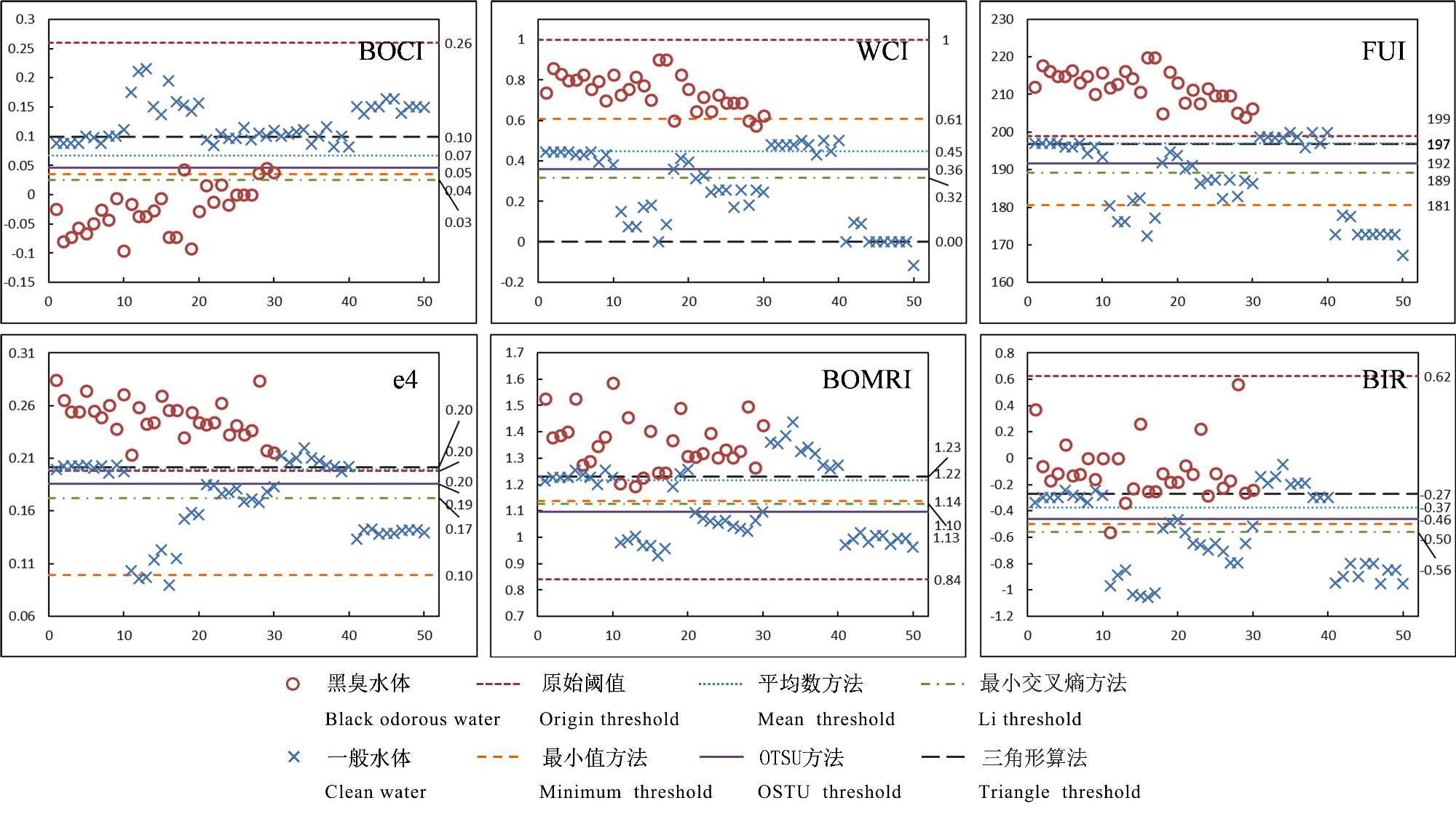
图3 “识别-阈值”组合算法散点图Fig. 3 Scatter plot of the “Identification Threshold”combination algorithm |
表4 黑臭水体“识别-阈值”组合算法准确率评价表Table 4 Accuracy evaluation of the “Identification Threshold”combination algorithm for black odorous water |
| 阈值算法 | 波段比值算法 | F1 Score(F1) | 排名(Rank) |
|---|---|---|---|
| 原始阈值 | WCI | 0 | 34 |
| e4 | 0.78 | 14 | |
| BOCI | 0.55 | 33 | |
| BIR | 0 | 34 | |
| FUI | 0.95 | 3 | |
| BOMRI | 0 | 34 | |
| 最小交叉熵 | WCI | 0.71 | 24 |
| e4 | 0.69 | 29 | |
| BOCI | 0.93 | 5 | |
| BIR | 0.71 | 24 | |
| FUI | 0.71 | 24 | |
| BOMRI | 0.72 | 19 | |
| OSTU | WCI | 0.73 | 17 |
| e4 | 0.75 | 15 | |
| BOCI | 1 | 1 | |
| BIR | 0.72 | 19 | |
| FUI | 0.72 | 19 | |
| BOMRI | 0.71 | 24 | |
| 三角形 | WCI | 0.59 | 31 |
| e4 | 0.8 | 12 | |
| BOCI | 0.81 | 8 | |
| BIR | 0.81 | 8 | |
| FUI | 0.81 | 8 | |
| BOMRI | 0.75 | 15 | |
| 最小值 | WCI | 0.95 | 3 |
| e4 | 0.56 | 32 | |
| BOCI | 0.93 | 5 | |
| BIR | 0.71 | 24 | |
| FUI | 0.63 | 30 | |
| BOMRI | 0.72 | 19 | |
| 平均值 | WCI | 0.87 | 7 |
| e4 | 0.79 | 13 | |
| BOCI | 1 | 1 | |
| BIR | 0.73 | 17 | |
| FUI | 0.81 | 8 | |
| BOMRI | 0.72 | 19 |
| 1 |
住房城乡建设部, 环境保护部. 城市黑臭水体整治工作指南[EB/OL]. [2022-06-17]. http://www.mohurd.gov.cn/wjfb/201509/t20150911_224828.html
Ministry of Housing and Urban-Rural Development,Ministry of Environmental Protection. Guidelines for remediation of urban black smelly water bodies[EB/OL]. [2022-06-17]. http://www.mohurd.gov.cn/wjfb/201509/t20150911_224828.html
|
| 2 |
魏本赞, 张策, 张恩, 等. 基于WorldView-2高分影像信息增强及提取在卡而却卡地区遥感调查中的应用[J]. 世界核地质科学, 2024, 41(5):1013-1022.
|
| 3 |
吴文欢, 于宏, 赵英俊, 等. 基于面向对象的高分辨率遥感影像目标信息提取[J]. 世界核地质科学, 2016, 33(2): 91-95.
|
| 4 |
李佳琦, 李家国, 朱利, 等. 太原市黑臭水体遥感识别与地面验证[J]. 遥感学报, 2019, 23(4):773-784.
|
| 5 |
温爽. 基于GF-2影像的城市黑臭水体遥感识别[D]. 南京: 南京师范大学, 2018.
|
| 6 |
姚月, 申茜, 朱利, 等. 高分二号的沈阳市黑臭水体遥感识别[J]. 遥感学报, 2019, 23(2):230-242.
|
| 7 |
姚焕玫, 卢燕南, 龚祝清. 基于PlanetScope影像的广西钦州市黑臭水体识别方法研究[J]. 环境工程, 2019, 37(10):35-43.
|
| 8 |
七珂珂. 基于多源高分影像的城市黑臭水体遥感分级识别[D]. 重庆: 西南交通大学, 2019.
|
| 9 |
|
| 10 |
张宁宁. 基于GF-2的哈尔滨市黑臭水体动态监测与评价[D]. 哈尔滨: 哈尔滨师范大学, 2022.
|
| 11 |
刘冰, 李天宏. 基于高分影像的城市黑臭水体遥感识别方法研究[J]. 应用基础与工程科学学报, 2024, 32(2): 314-330.
|
| 12 |
|
| 13 |
吴奇, 宫福征, 白伟桦, 等. 太子河干流总氮与氨氮水质参数反演及时空变化研究[J]. 生态与农村环境学报, 2024, 40(8):1017-1028.
|
| 14 |
莫锦英, 田义超, 王家乐, 等. 基于机器学习的养殖池-红树林-海洋复合生态系统氨氮遥感反演[J]. 环境科学学报, 2024, 44(11):415-429.
|
| 15 |
何炜琪, 吴志杰, 王紫安. 基于无人机多光谱影像的城市河道水质反演[J]. 环境监测管理与技术, 2024, 36(5):51-55.
|
| 16 |
徐晓军, 魏小岛, 程佩瑄, 等. 天空地一体立体网络的水质遥感监测及其溯源初探——以淀山湖为例[J]. 环境监控与预警, 2024, 16(6):8-14.
|
| 17 |
吴迪, 于文金, 谢涛. 高分二号卫星数据在粤港澳大湾区水体有机污染监测中的应用[J]. 热带地理, 2020, 40(4):675-683.
|
| 18 |
|
| 19 |
环境保护部. 水质氨氮的测定纳氏试剂分光光度法:HJ 535—2009[S]. 北京: 中国标准出版社, 2009.
Ministry of Environmental Protection. Determination of ammoniacal nitrogen in water by nano reagent spectrophotometric method:HJ 535—2009[S]. Beijing: China Standards Press, 2009 (in Chinese).
|
| 20 |
|
| 21 |
|
| 22 |
|
| 23 |
|
| 24 |
|
/
| 〈 |
|
〉 |