RESEARCH ARTICALS

H-O-S-Pb isotope composition and comparison of uranium and polymetallic mineralization in the Xiangshan orefield

  • GUO Jian , 1, 2, 3 ,
  • LI Ziying , 1, 2, 3 ,
  • NIE Jiangtao 1, 2, 3 ,
  • HE Sheng 1, 2, 3
Expand
  • 1 National Key Laboratory of Uranium Resources Exploration-Mining and Nuclear Remote Sensing, Beijing 100029, China
  • 2 Beijing Research Institute of Uranium Geology, Beijing 100029, China
  • 3 CNNC Key Laboratory of Uranium Resource Exploration and Evaluation Techniques, Beijing 100029, China
LI Ziying,male,born in 1964,senior engineer,PhD supervisor,focusing on uranium metallogenic theory and predictive evaluation techniques. E-mail:

First author:GUO Jian,male,born in 1989,senior engineer,focusing on research on uranium metallogenesis mechanisms and predictive evaluation. E-mail:

Received date: 2025-02-12

  Revised date: 2025-03-22

  Online published: 2025-10-24

Supported by

Youth Innovation Fund Project of CNUC“Research on Uranium Metallogenesis Relationships and Detailed Comparisons in the Western and Northern Parts of the Xiangshan Ore Field”

Abstract

Xiangshan ore field is the largest volcanic-hosted uranium ore field in China. Continuous discoveries of lead,zinc,silver,and copper polymetallic mineralization at depth beneath uranium mineralization reveal a spatial distribution pattern of “upper uranium-lower polymetallic”mineralization. Therefore,the genetic relationship between polymetallic mineralization and large-scale uranium mineralization has become another research focus in the Xiangshan ore field. This study systematically investigated the H-O-S-Pb isotopic compositions and conducted comprehensive comparative analyses of uranium and polymetallic mineralization. Results indicate that uranium mineralization involved more atmospheric precipitation and crustal-derived materials compared to polymetallic mineralization. The sulfur isotopic composition of polymetallic mineralization in the Xiangshan area shows distinct differences from typical regional polymetallic deposits. At least one stage of relatively uranium-enriched mineralization process has been identified during the polymetallic mineralization in Xiangshan region.

Cite this article

GUO Jian , LI Ziying , NIE Jiangtao , HE Sheng . H-O-S-Pb isotope composition and comparison of uranium and polymetallic mineralization in the Xiangshan orefield[J]. World Nuclear Geoscience, 2025 , 42(2) : 263 -276 . DOI: 10.3969/j.issn.1672-0636.2025.02.004

相山矿田处于华南赣杭铀成矿带的西南段,自发现至今已有60余年的勘查和研究历史,共发现了30余个矿床、矿点[1-3]。近年来,找矿勘查工作不断于铀矿化的深部发现铅、锌、银和铜多金属矿化,呈现“上铀下多金属”的空间展布规律,铀与多金属成矿关系成为矿田地质研究又一热点。前人对铀与多金属成矿特征分别开展了较为全面的研究工作,在铀成矿特征[3]、成矿机制[4]、多金属矿物学特征[5]、多金属成矿特征[6]和多金属成矿流体[7-8]等方面取得了一定的成果,积累丰富的数据,但较为系统的铀多金属对比研究工作尚未深入开展,尤其是缺乏对于揭示铀多金属成矿物质来源、成矿机制具有重要指示作用的同位素组成对比。本文通过开展相山矿田铀与多金属矿化H-O-S-Pb多元同位素综合对比,分析铀与多金属矿化之间成矿流体、成矿物质异同,进而探讨铀与多金属之间成矿关系。

1 地质概况

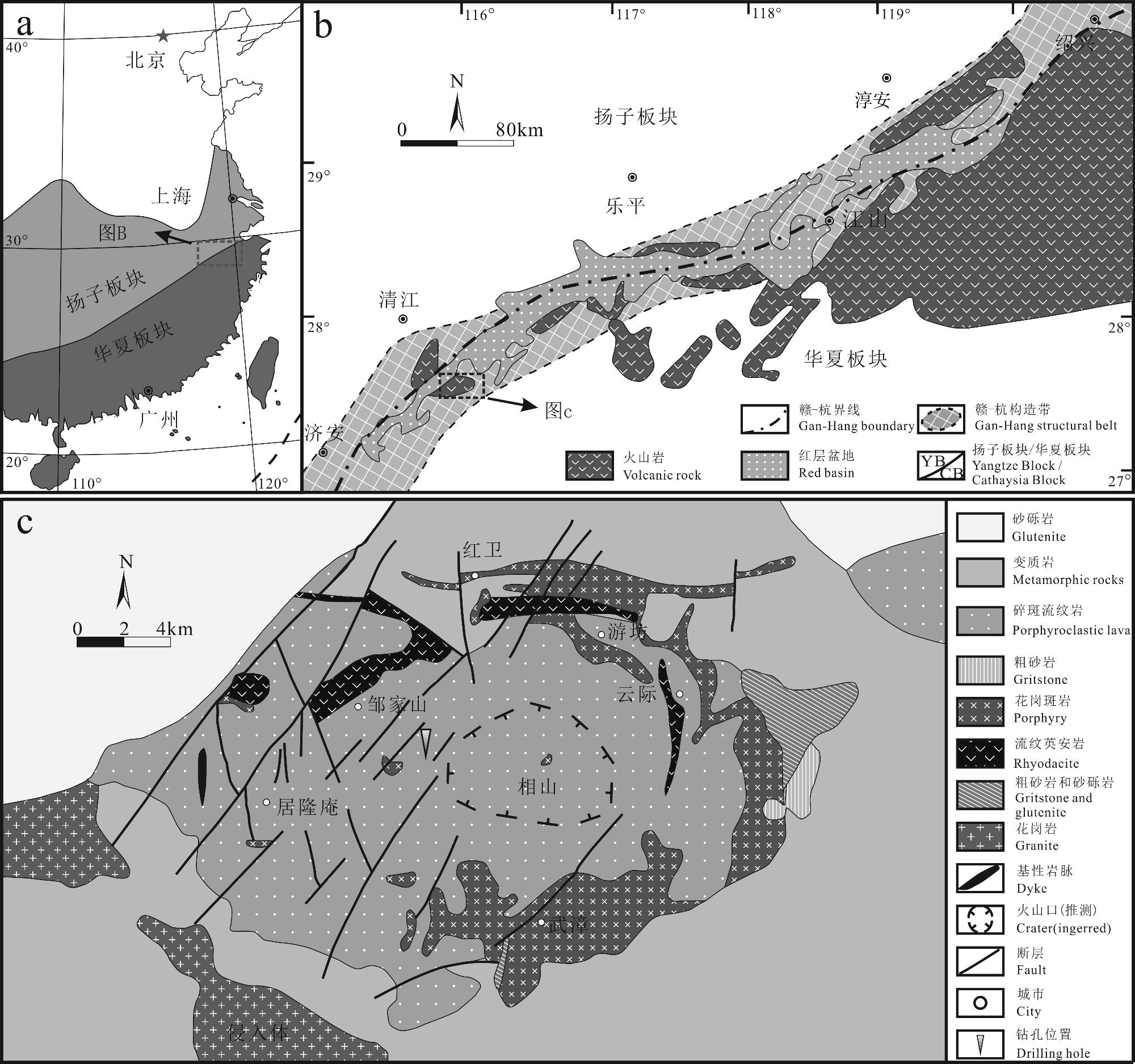
相山火山岩型铀矿田的形成受控于一个大型塌陷式火山盆地(破火山口)(图1c),相山火山盆地面积约300 km2,位于华夏板块和扬子板块的结合部位(图1a),NE向赣杭构造带西南段(图1b),区域EW向构造与NE向赣杭构造叠置转换地带[9]
图1 相山火山-侵入杂岩体地质构造简图

a—赣杭构造带大地构造位置简图; b—赣杭构造带地质略图,据参考文献[10]修改;c—相山火山-侵入杂岩体地质简图,据参考文献[1]和[3]修改 。

Fig. 1 Simplified geological map of the Xiangshan volcanic intrusive complex

a-Tectonic map of Southeastern China,showing the location of the Gan-Hang tectonic belt;b-Geological sketch map, showing the Gan-Hang belt,modified after [10];c-Geological map of Xiangshan volcanic-intrusive complex,modified after [1] and [3].

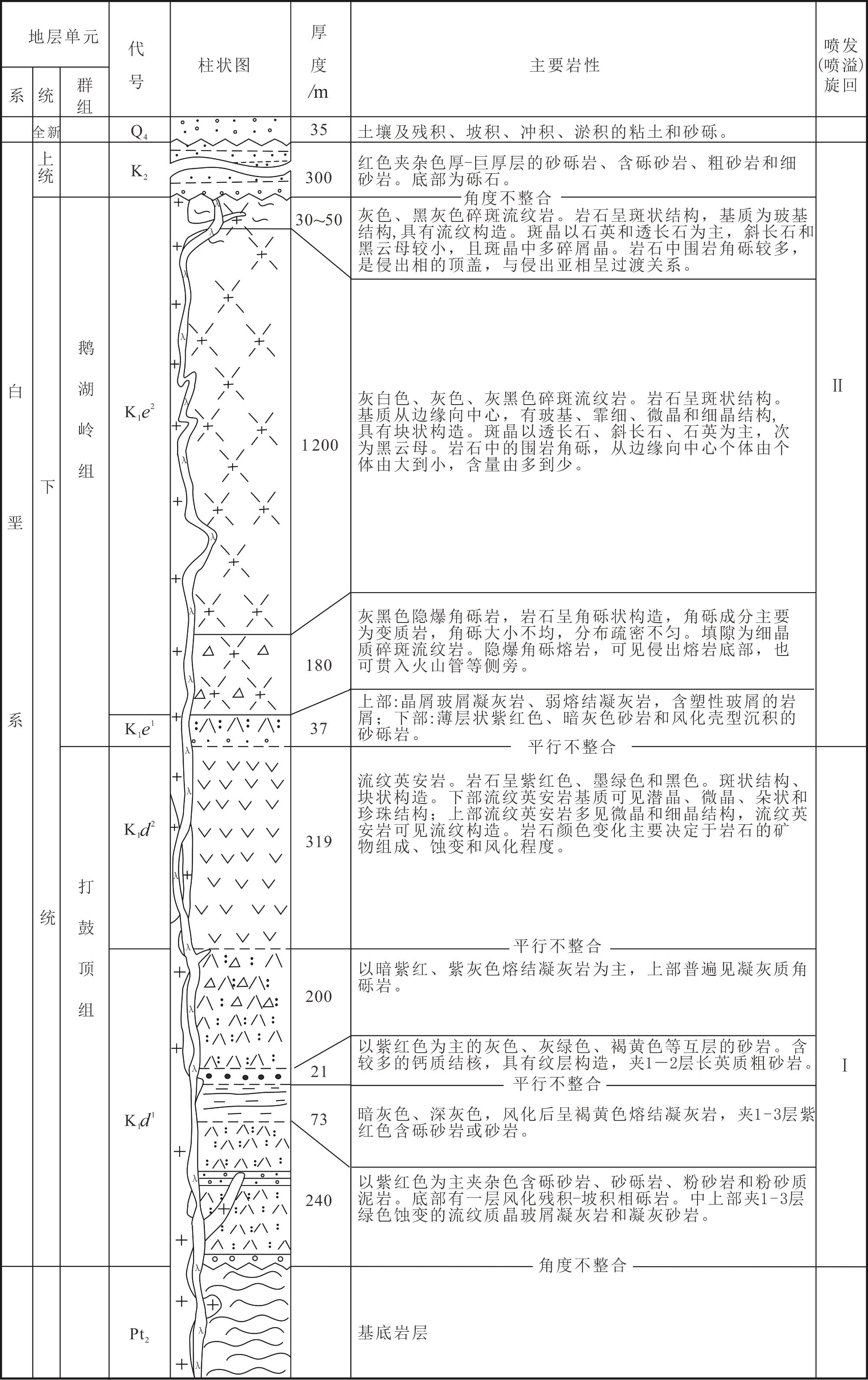
相山火山盆地地层由盖层和基底组成(图2):盖层岩石为早白垩世的中酸性火山岩,下部以打鼓顶组流纹英安岩为主体,上部以鹅湖岭组碎斑流纹岩为主体。鹅湖岭组和打鼓顶组均经历了由沉积到爆发再到喷溢或侵出的岩浆演化过程,整体上构成一个大的火山喷发旋回。盆地基底为震旦系变质岩。
图2 相山地区岩性综合柱状图

Fig. 2 Comprehensive lithological section of Xiangshan area

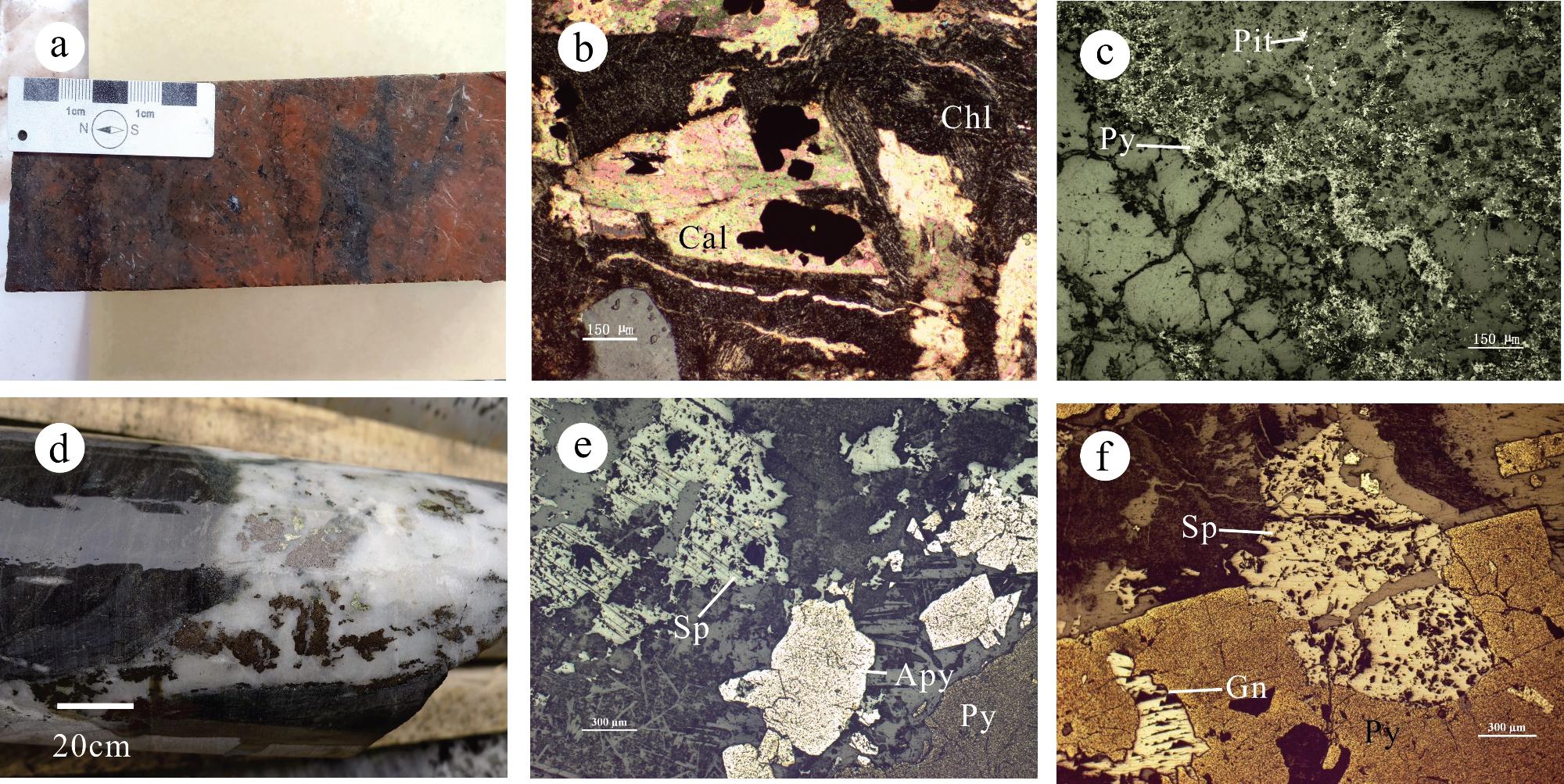
相山矿田众多铀矿床主要分布于矿田西部和北部,形成两大矿化集中区,矿化产出受控于环形火山塌陷构造、NE向线性断裂构造及其次级裂隙、岩性界面及其陡变部位等。矿体多呈密集裂隙带产出,发育较强的酸碱叠加交代蚀变作用(图3a),矿石矿物有沥青铀矿、含钍沥青铀矿、铀钍矿、钛铀氧化物、黄铁矿和方铅矿等(图3c),脉石矿物有石英、萤石、方解石、伊利石和绿泥石等(图3b)。
图3 相山铀矿田铀与多金属矿化显微特征

a—强赤铁矿化铀矿石; b—强碳酸盐化、绿泥石化;c—浸染状黄铁矿、沥青铀矿组合;d—带状多金属矿石;e—闪锌矿、毒砂、黄铁矿共生;f—闪锌矿和方铅矿交代黄铁矿,显示交代残余结构;缩写:Cal—方解石;Chl—绿泥石;Pit—沥青铀矿;Py—黄铁矿;Sp—闪锌矿;Gn—闪锌矿;Apy—毒砂。

Fig. 3 Microscopic characteristics of uranium and polymetallic mineralization in the Xiangshan uranium ore field

a-Strongly hematitized uranium ore;b-Intense carbonatization and chloritization;c-Disseminated pyrite-pitchblende assemblage;d-Banded polymetallic ore;e-Paragenesis of sphalerite, arsenopyrite,and pyrite;f - Sphalerite and galena replacing pyrite,displaying replacement relict texture. Abbreviations: Cal- Calcite;Chl-Chlorite;Pit-Pitchblende;Py-Pyrite, Sp-Sphalerite;Gn-Galena;Apy-Arsenopyrite.

近年来,随着深部铀矿勘查工作的不断推进,在矿田西部铀矿化以深500~1 000 m深度范围内揭露了一批铅、锌、银和铜多金属矿化,例如:牛头山地区(ZK26-9、ZK26-11、ZK26-101孔)和牛脑上地区中国铀矿第一科学深钻(CUSD1)。相山矿田西部地区铀与多金属两种矿化类型在空间上具有“上铀下多金属”垂向分带特征。相山矿田北部铀与多金属矿化具有共伴生的产出特征,未出现空间分离现象,如沙洲矿床、马口雷壁石银金矿点等。多金属矿化呈条带状、团块状、网脉状产出(图3d),主要发育绢云母化、绿泥石化等,矿石矿物有方铅矿(图3f)、闪锌矿(图3e)、毒砂、黄铁矿、磁黄铁矿、黄铜矿和辉银矿等,脉石矿物有石英、方解石、绢云母和少量菱铁矿、绿泥石和锡石。

2 样品和分析测试方法

用于铀成矿作用研究的石英、方解石、硫化物单矿物主要取自相山矿田邹家山、沙洲等铀矿床,用于多金属成矿作用研究的石英、方解石、黄铁矿、方铅矿、闪锌矿单矿物和相山盆地典型岩石样品均采自CUSD1钻孔岩心。挑选单矿物时,首先将矿石样品表面清洁、晾干后,使用破碎设备逐级破碎至0.025 mm左右,然后在双目显微镜下排除矿物包裹体和杂质成分,挑选纯度达99 %以上的石英、方解石、黄铁矿单矿物样品。单矿物H-O-S-Pb同位素分析均在核工业北京地质研究院分析测试中心进行,方解石、石英单矿物H-O同位素分析使用MAT253同位素质谱仪,石英δ18O测定采用BrF5方法获得O2,转变为CO2后在质谱仪上分析获得氧同位素组成,通过标准计算,得到包裹体中水的δ18${\mathrm{O}}_{{\mathrm{H}}_{2}\mathrm{O}}$,分析精度为±2 %。硫化物S同位素分析使用Delta V稳定同位素质谱仪和元素分析仪,用Cu2O对硫化物样品进行氧化,分析过程精度达到0.2 ‰,数据校正通过定期分析内部标准样品进行。硫化物铅同位素组成测试在GV IsoProbe-T热电离质谱上进行。主要分析过程包括使用坩埚中的HF和HCl溶解样品,然后使用碱性阴离子交换树脂纯化铅。标准样品NBS 981的铅同位素组成为208Pb/204Pb=36.611±0.004(2σ),207Pb/204Pb=15.457±0.002(2σ),206Pb/204Pb=16.937±0.002(2σ)[11]

3 测试结果及讨论

3.1 H-O同位素组成及对比

铀成矿作用研究的单矿物氢、氧同位素的分析结果见表1,根据流体包裹体测温众数、SiO2-H2O体系和CaCO3-H2O体系氧同位素平衡分馏公式,求得δ18${\mathrm{O}}_{{\mathrm{H}}_{2}\mathrm{O}}$。其中,铀成矿期4个方解石样品δ18O矿物变化于8.6 ‰~12.6 ‰之间,平均10.63 ‰,计算得δ18${\mathrm{O}}_{{\mathrm{H}}_{2}\mathrm{O}}$变化于0.95 ‰~4.95 ‰之间,平均2.98 ‰,δ18D‰变化于-87.3 ‰~-78.1 ‰之间;多金属成矿期10个石英样品δ18O矿物变化于10.4 ‰~14.7 ‰之间,平均13.7 ‰,计算得δ18${\mathrm{O}}_{{\mathrm{H}}_{2}\mathrm{O}}$变化于3.51 ‰~7.81 ‰之间,平均6.80 ‰,δ18D‰变化于-91.3 ‰~-71.4 ‰之间。
表1 铀及多金属矿化方解石、石英单矿物H-O同位素组成

Table 1 The H-O isotope composition of uranium and polymetallic mineralization

矿化类型 样品号 取样位置/深度/m 样品类型 δ18O矿物/‰ δ18O${}_{{H}_{2}O}$/‰b δD/‰ 温度/℃a 数据来源
铀成矿 V057 邹家山矿床 方解石 12.2 4.55 -78.1 240 本文
V090 邹家山矿床 方解石 12.6 4.95 -79.6 240
V177 邹家山矿床 方解石 8.6 0.95 -87.3 240
V178 邹家山矿床 方解石 9.1 1.45 -85.9 240
多金属成矿 B598-1 1 795.5 石英 10.4 3.51 -81.4 300 据参考文献[2]
B643-1 1 929.3 石英 14.1 7.21 -78.7 300
B660-2 1 980.6 石英 14.0 7.11 -89.9 300
B672-1 2 016.1 石英 14.2 7.31 -91.3 300
B756-3 2 268.8 石英 14.1 7.21 -77.3 300
B760-1 2 280.1 石英 12.4 5.51 -76.7 300
B788-1 2 364.2 石英 14.4 7.51 -73.6 300
B795-2 2 385.8 石英 14.3 7.41 -80.7 300
D070 2 428.6 石英 14.7 7.81 -77.9 300
D080 2 705.3 石英 14.3 7.41 -71.4 300

注:a—铀多金属矿化中流体包裹体显微测温平均值,铀成矿温度据郭建等,2014。 b—计算结果,计算公式如下:

δ18O=δ18O矿物-1 000lnα矿物-水

δ18O石英δ18O=1 000lnα石英-水=3.38×10⁶/T2-3.40[12]

δ18O方解石δ18O=1 000lnα方解石-水=2.78×10⁶/T2-2.89[13]

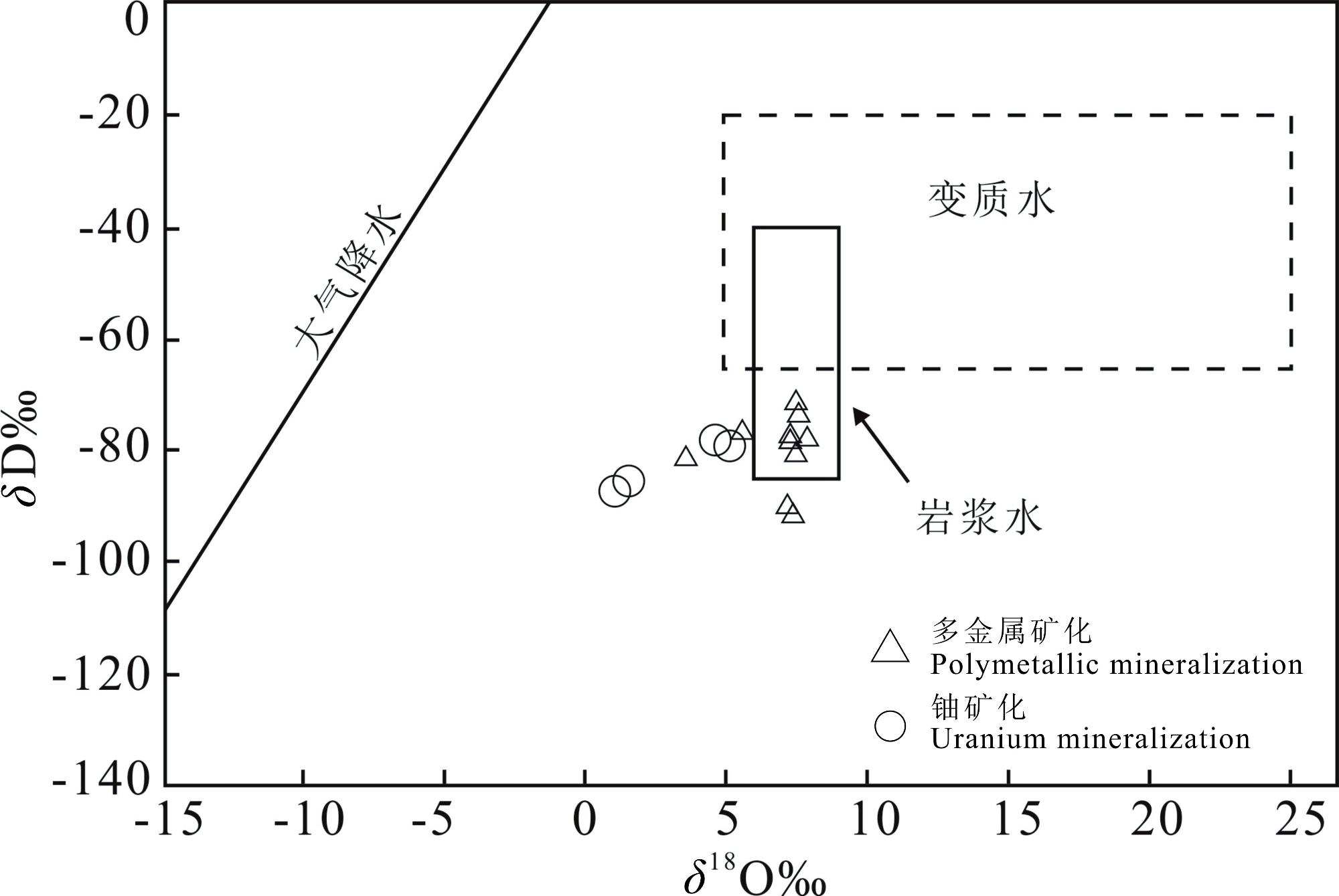
多金属矿化成矿流体H、O同位素组成结果主要落入岩浆水范围内(图4),铀成矿流体氢、氧同位素组成结果较为接近岩浆水,但向大气降水线略有偏移,表明铀成矿流体同位素组成与多金属矿化同位素组成接近,均大部分来自于岩浆水,但铀成矿流体具有更多的大气降水的加入。
图4 铀与多金属矿化成矿流体氢、氧同位素组成(底图据Taylor et al.,1979[14]

Fig. 4 H-O isotopes composition of uranium and polymetallic ore-forming fluid (modified after Taylor et al.,1979[14])

3.2 硫同位素组成及对比

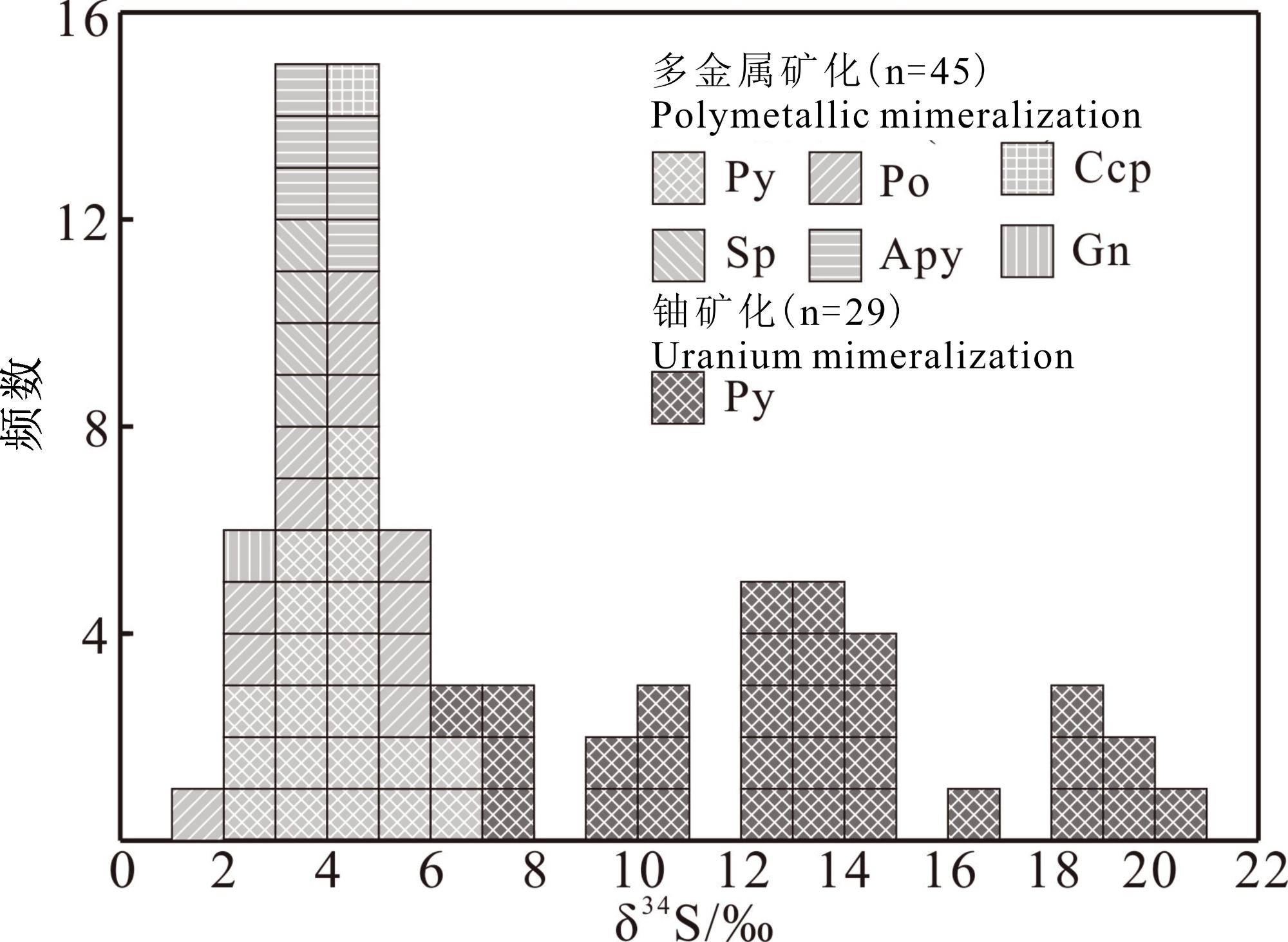
相山铀矿田铀矿化硫化物及科学深钻(CUSD1)中黄铁矿、磁黄铁矿、闪锌矿和毒砂单矿物S同位素组成见图5
图5 铀矿化和多金属矿化硫同位素组成分布直方图

Fig. 5 Sulfur isotope compositions histogram of the uranium and Pb-Zn mineralization

多金属矿化45个硫化物单矿物同位素组成介于2 ‰~6.9 ‰(表2)之间,平均值为4.16 %。黄铁矿、磁黄铁矿、闪锌矿和毒砂的硫同位素组成分别为2.2 ‰~6.9 ‰(n=21),2 ‰~5.8 ‰(n=12),3.3 ‰~3.9 ‰(n=4)和3.1 ‰~4.8 ‰(n=6)。获得单个方铅矿和黄铜矿的硫同位素组成为2.5 ‰和4.6 ‰。铀矿化中黄铁矿的硫同位素组成显示出与多金属矿化金属硫化物硫同位素组成完全不同的分布范围。24个黄铁矿的硫同位素值相对富集重硫,具有一个非常宽泛的分布范围介于6.2 ‰~19.55 ‰之间。铀矿化黄铁矿平均的硫同位素值为13.15 ‰。
表2 相山地区多金属矿化和铀矿化硫化物硫同位素组成

Table 2 S isotope composition of uranium and polymetallic mineralization in Xiangshan ore field

矿化类型 样号 取样深度/m/位置 矿物 δ34S/‰ 数据来源
铀成矿 xsz-8-4-1 沙洲铀矿床 黄铁矿 9.6 参考文献[15]
xsz-58-3-3 沙洲铀矿床 黄铁矿 9.92
xsz-58-3-5 沙洲铀矿床 黄铁矿 10.91
xsz-58-3-7 沙洲铀矿床 黄铁矿 10.55
xsz-5cm-1 沙洲铀矿床 黄铁矿 13.04
xsz-5cm-4 沙洲铀矿床 黄铁矿 13.15
xsz-5cm-2 沙洲铀矿床 黄铁矿 12.79
xsz-5cm-3 沙洲铀矿床 黄铁矿 13.37
xsz-8-21-6-3-6 沙洲铀矿床 黄铁矿 14.2
xsz-8-21-6-4-7 沙洲铀矿床 黄铁矿 18.85
xsz-8-21-6-4-9 沙洲铀矿床 黄铁矿 18.76
xsz-8-21-6-4-10 沙洲铀矿床 黄铁矿 18.97
xsz-8-21-6-3-4 沙洲铀矿床 黄铁矿 17
xsz-8-21-6-3-5 沙洲铀矿床 黄铁矿 19.1
xsz-8-21-6-3-8 沙洲铀矿床 黄铁矿 19.55
SZ13-5 黄铁矿 15 参考文献[16]
SZ13-8 黄铁矿 13.7
SZ13-12 黄铁矿 12.3
SZ13-22-2 黄铁矿 12.9
SZ13-22-3 黄铁矿 12.3
SZ13-28 黄铁矿 7.4
SZ13-37-1 黄铁矿 7.6
SZ13-37-3 黄铁矿 6.2
SZ09-7 沙洲矿床 黄铁矿 14.9 参考文献[6]
ZJS-7 横涧矿床 黄铁矿 7.9
SZ09-3 沙洲矿床 黄铁矿 13.7
SZ09-20 沙洲矿床 黄铁矿 10.4
SZ09-29-2 沙洲矿床 黄铁矿 14.7
SZ-2 沙洲矿床 黄铁矿 12.5
多金属成矿 SZ056S1 1 528 黄铁矿 4 本文
SZ057S1A 1 531 黄铁矿 4
SZ069S1 2 630 黄铁矿 4.7
SZ071S1 2 671 黄铁矿 4.9
SZ073S1 2 682 黄铁矿 2.2
SZ084S1 2 817 黄铁矿 5.6
B572-1S1 1 720 黄铁矿 2.6
B598-1S1 1 797 黄铁矿 6.9
B615-1S1 1 845 黄铁矿 4
B619-1S1 1 857 黄铁矿 4.7
B649-1S1 1 947 黄铁矿 4.2
B775-1S1 2 321 黄铁矿 4.1
SZ065S2 2 552 磁黄铁矿 5.8
SZ067S2 2 612 磁黄铁矿 2
SZ076S2A 2 776 磁黄铁矿 5.8
SZ078S2 2 792 磁黄铁矿 5.5
SZ080S2 2 801 磁黄铁矿 4.3
B747-1S2 2 237 磁黄铁矿 4.3
B647-1-2S4 1 941 磁黄铁矿 3.7
SZ069S4 2 630 磁黄铁矿 3.9
SZ069S6 2 630 毒砂 4.2
B647-1S6 1 941 毒砂 4.8
B666-1S6 1 998 毒砂 4.4
B692-3S6 2 075 毒砂 3.1
SZ055S1 1 461 黄铁矿 4.2 参考文献[7]
SZ057S1 1 531 黄铁矿 3.9
SZ068S1 2 615 黄铁矿 3.5
SZ070S1 2 667 黄铁矿 6.6
SZ072S1 2 677 黄铁矿 3.6
B510-1S1 1 535 黄铁矿 4.3
B593-1S1 1 782 黄铁矿 5
B599-1S1 1 799 黄铁矿 3
B693-1S1 2 078 黄铁矿 5.1
SZ066-1S4 2 606 闪锌矿 3.3
B666-1S4 1 998 闪锌矿 3.8
B615-1S5 1 845 方铅矿 2.5
SZ063S2 2 523 磁黄铁矿 3
SZ066S2 2 606 磁黄铁矿 4
SZ076S2 2 776 磁黄铁矿 5.4
SZ082S2 2 806 磁黄铁矿 4.3
SZ083S2 2 809 磁黄铁矿 4
B666-1S2 1 999 磁黄铁矿 2.6
SZ084S3 2 817 黄铜矿 4.6
SZ081S6 2 803 毒砂 3.3
B804-1S6 2 406 毒砂 3.7
Ohmoto and Rye(1979)[17]对热液系统中硫化物研究发现,在${f}_{{O}_{2}}$较低的还原环境下,热液中硫化物主要以HS-,S2-形式存在,此时沉淀的硫化物δ34S值与流体的δ34S接近;在较高的${f}_{{O}_{2}}$条件下,H2S转化为SO2发生硫酸盐沉淀使流体中亏损δ34S,导致硫化物中δ34S低于流体的δ34S。铀的化学性质及成矿物理化学条件研究表明,已经形成了“还原环境下铀元素沉淀富集”的认识;多金属矿化成矿流体研究表明,在成矿作用中发现有CH4等还原成分[7-8],揭示多金属矿化同样形成于还原环境。因此,相山铀矿田铀与多金属矿化中黄铁矿、方铅矿、闪锌矿等硫化物的δ34S值可以代表铀和多金属成矿流体系统的δ34S
一般情况下,成矿流体中的硫主要有三种来源:1)岩浆或幔源硫(0±3 ‰)[18];2)海相或者海水硫(20 ‰),3)沉积岩中的还原硫(<0)[19]
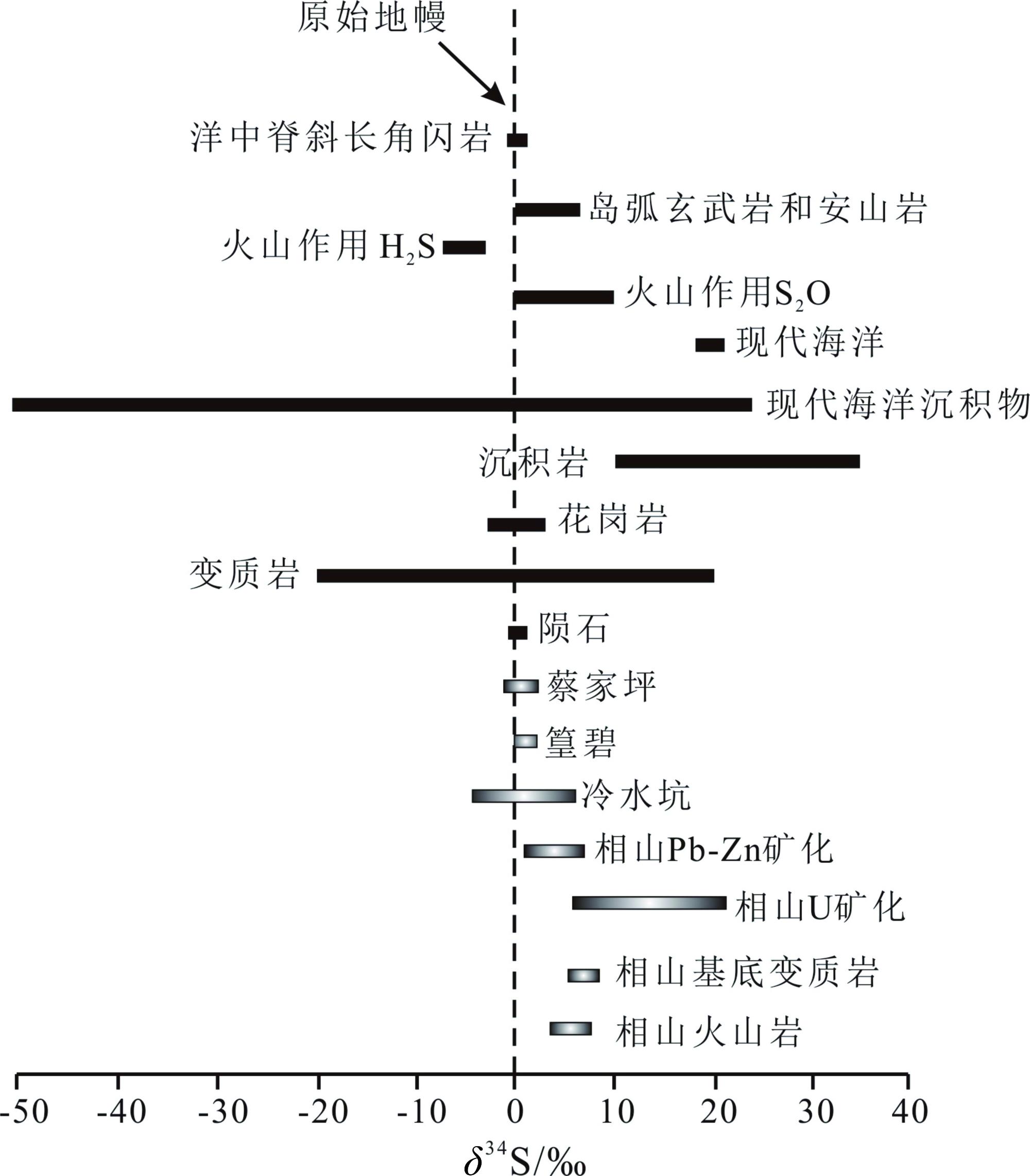
本次研究中,多金属矿化作用硫化物硫同位素值分布于一个相对较窄的区域内,介于2 ‰~6.9 ‰之间(平均值为4.16 ‰),非常接近于幔源岩浆硫(0±3 ‰)[20],说明成矿物质硫主要来自于岩浆,与相山地区岩浆活动密切相关。另外,多金属矿化的硫同位素值同钦杭成矿带东部热液型铅锌矿床硫同位素分布区间存在一定差异,例如:篁碧(0~2.5 ‰)[21],冷水坑(-3.8 ‰~6.9 ‰)[22]和蔡家坪(-1.1 ‰~2.5 ‰)[23]图6)。钦杭构造带东段的热液型铅锌矿床的硫同位素被认为是岩浆来源,与矿区范围内的火山或岩浆活动有关。考虑到多金属矿化与次火山活动的密切关系,本文认为多金属矿化硫主要来自于岩浆源,与该地区的火山岩浆活动密切相关。
图6 铀矿化、多金属矿化、地质单元及区域多金属矿床硫同位素组成(对比自然地质单元的硫同位素组成来自Hoefs (1997)[24]

Fig. 6 S isotope compostion and comparison of uranium mineralization,polymetallic mineralization,geological units and regional polymetallic deposits. S isotope composition of geological units come from Hoefs (1997)[24]

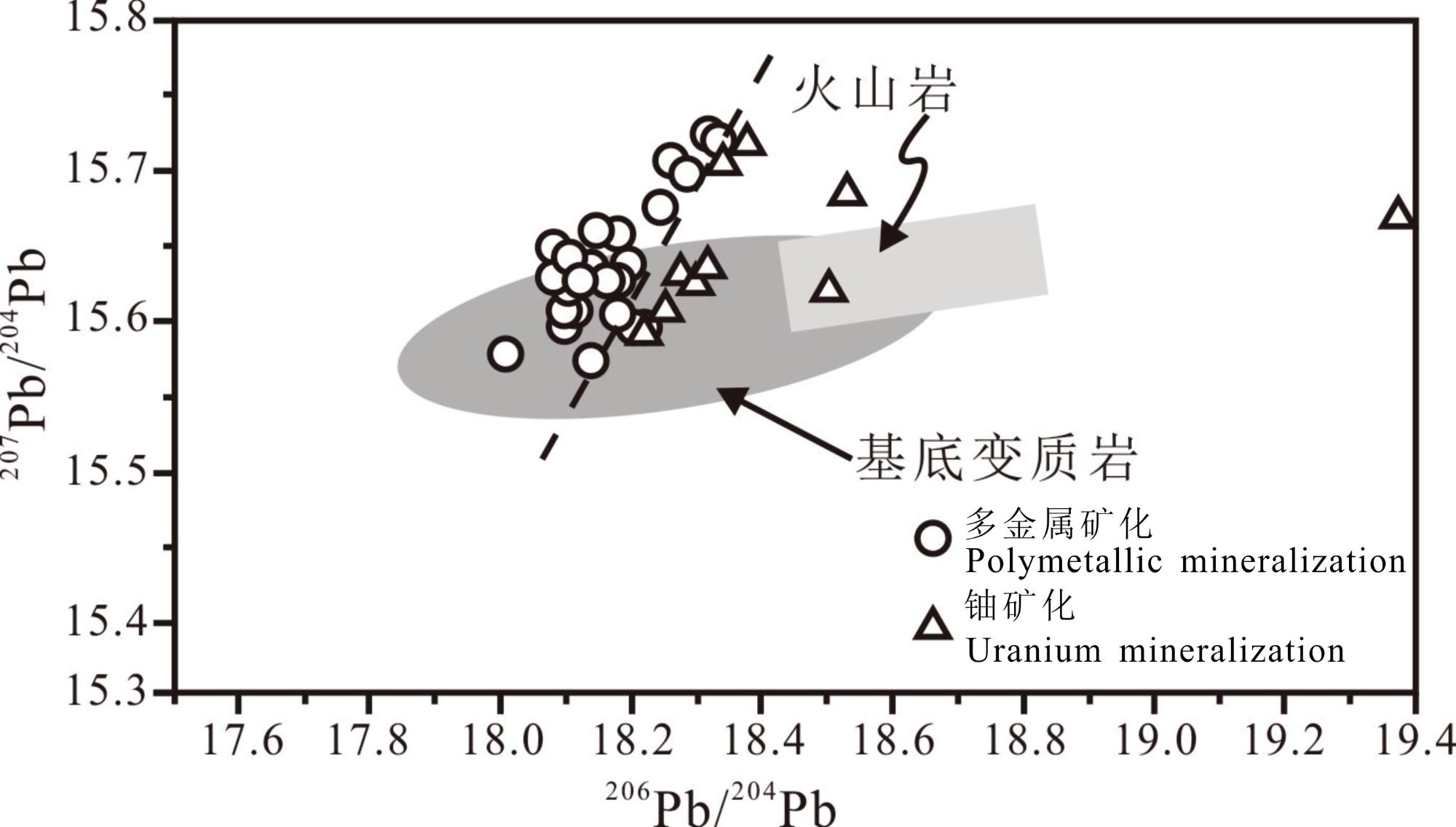
图7 相山地区铀和多金属207Pb/204Pb -206Pb/204Pb上地壳(U),造山带(O),地幔(M)和下地壳(L) 趋势线来自 Zartman and Doe(1981)[25]

Fig. 7 Plots of 207Pb/204Pb vs.206Pb/204Pb for the uranium and Pb-Zn mineralization. Trends for the upper crust, orogen, mantle and lower crust are taken from Zartman and Doe (1981)[25]

铀矿化作用硫同位素分布于6.2 ‰~19.55 ‰之间,与多金属成矿作用相比更加富集重硫,且分布范围更加宽泛,显示相山地区铀成矿作用相对于多金属成矿具有更多的火山岩、基底变质岩等壳源物质的加入,并且两者硫同位素分布范围具有一定的叠至区间,表明铀与多金属成矿作用在S同位素演化特征上具有一定的继承性。

3.3 铅同位素组成及对比

一般情况下,热液环境中沉淀出的黄铁矿、方铅矿和闪锌矿等金属硫化物基本不含U、Th,矿物形成后不再有放射性成因铅的明显加入,可以反映原始热液体系中金属物质来源区的初始铅同位素组成[25-26],而围岩中含有一定量的U、Th元素,初始铅同位素组成需要扣除放射性成因铅的影响[27]。相山地区岩浆岩与多金属矿化均形成于131 Ma左右[2,9,42] ,因此本文使用131 Ma对变质岩基底铅同位素组成进行校正。铀矿化11个黄铁矿样品的(206Pb/204Pb)t分布于18.221~19.372之间,平均值为18.430,(207Pb/204Pb)t分布于15.591~15.717之间,平均值为15.644,(208Pb/204Pb)t分布于38.504~38.910之间,平均值为38.671。多金属矿化15个样品的(206Pb/204Pb)t分布于18.120~18.233之间,平均值为18.176,(207Pb/204Pb)t分布于15.575~15.698之间,平均值为15.634,(208Pb/204Pb)t分布于38.446~39.047之间,平均值为38.600。
在铀和多金属207Pb/204Pb -206Pb/204Pb协和图中,铀和多金属硫化物大部分样品铅同位素组成均聚集分布于一定区域内,代表铀和多金属硫化物的初始铅同位素组成,可以反映铀和多金属成矿物质来源的源区特征,与多金属硫化物相比,铀矿石中黄铁矿铅同位素组成相对靠近变质岩基底和造山带的铅同位素组成分布范围,暗示了铀成矿作用过程中有更多来自基底、火山岩等围岩成分的加入,也可能由于铀矿化放射性成因206Pb引起。
表3 相山地区铀多金属矿化和各地质单元铅同位素组成

Table 3 Statistical results of the Pb isotope compositions of the uranium mineralization, Pb-Zn mineralization, volcanic rocks and metamorphic basement

地质单元 样品数/个 (206Pb/204Pb) 131Ma (207Pb/204Pb)131Ma (208Pb/204Pb)131Ma 来源
分布 平均值 分布 平均值 分布 平均值
铀矿化 11 18.221~19.372 18.430 15.591~15.717 15.644 38.504~38.910 38.671 参考文献[29];参考文献[30]
多金属矿化 15 18.120~18.233 18.176 15.575~15.698 15.634 38.446~39.047 38.600 本文
黄铁矿 8 18.120~18.212 18.164 15.575~15.676 15.631 38.446~38.725 38.583
磁黄铁矿 4 18.139~18.227 18.184 15.598~15.633 15.617 38.488~38.616 38.560
闪锌矿 3 18.151~18.233 18.181 15.628~15.698 15.654 38.571~38.790 38.658
碎斑流纹岩 21 18.476~18.758 18.553 15.618~15.652 15.630 38.634~39.047 38.908
16 18.497~18.758 18.613 15.618~15.652 15.632 38.634~39.047 38.912 本文
5 18.476~18.514 18.492 15.623~15.630 15.627 38.883~38.921 38.903 参考文献[31]
流纹英安岩 14 18.471~18.792 18.625 15.630~15.650 15.638 38.768~39.182 38.945
9 18.471~18.643 18.580 15.630~15.642 15.635 38.768~38.920 38.866 本文
5 18.578~18.792 18.669 15.631~15.650 15.641 38.852~39.182 39.024 参考文献[31]
变质岩基底 10 17.968~18.623 18.212 15.553~15.633 15.592 38.304~38.753 38.435 本文

备注:变质岩铅同位素组成使用火成岩形成年龄131Ma进行估算。(206Pb/204Pb)t=(206Pb/204Pb)p-μ(eλt-1),(207Pb/204Pb)t=(207Pb/204Pb)p-μ/137.88(eλ´t-1),(208Pb/204Pb)t=(208Pb/204Pb)p-w(eλ´´t-1),λ'=9.8485×10-10t-1,λ''=0.494 75×10-10t-1t=131Ma.

4 讨论

4.1 铀多金属成矿与区域构造演化

相山矿田所处的华南大陆位于太平洋和特提斯两大构造域的交接部位[32-34],晚中生代发生了剧烈的构造格局变化,并伴随了巨量岩浆活动和成矿作用[35-38],相山矿田铀与多金属成矿即形成于这一区域构造背景下。尽管对于华南地区中生代构造体制转换发生的机制还未形成统一认识,但大量研究认为135 Ma在中国东部东区是一个重要的地球动力学转折时刻[39-40],这一时期华南地区快速由伸展向拉张体制转变。大量U-Pb同位素定年数据显示相山两旋回火山岩主体形成于145~132 Ma之间[9,41],为区域挤压-拉张构造背景下的产物。尽管Pb-Zn矿化定年难度较大,但黄铁矿Rb-Sr、绢云母Ar-Ar等测年手段显示多金属矿化形成于130~120 Ma之间[2,9,42],为紧随相山火山岩浆活动后的一期成矿事件,相对较低且极差小的硫同位素测量数据、矿岩铅同位素对比结果显示多金属成矿流体及物质主要来源于岩浆,与赣杭成矿带冷水坑、蔡家坪和篁碧等Pb-Zn-Ag多金属矿床具有相似的源区和成矿特征,为同一构造背景下产物。相山矿田铀成矿发生于约100~90 Ma[43-44],华南地区快速持续伸展减薄,壳幔物质强烈交换,表现为铀成矿环境趋于开放,铀成矿过程中大量来自于围岩、大气降水等壳源物质不断混染,造成了较大且宽泛的硫同位素组成,与相山主要地质单元相似的铅同位素分布范围。因此,相山矿田铀与多金属矿化为区域伸展构造背景下不同时代、不同构造开放程度的产物,具体表现在成矿深度、热液蚀变及H-O-S-Pb多元同位素组成的差异。

4.2 铀多金属成矿关系

铀与多金属成矿关系密切,且存在一定的产出规律。大量研究显示铀矿石中普遍存在方铅矿、闪锌矿等多金属硫化物[45-47]。铀多金属在同一地区不同垂向空间出现,且两种矿化均呈一定规模产出的矿化现象在江西相山矿田、盛源矿田、湖南深冲铀矿等地均有报道[48-49]。多金属矿化中存在少量铀矿物富集沉淀的现象则更为普遍,如江苏栖霞山铅锌矿、广东凡口铅锌矿、湖南水口山铅锌矿等[50-51]。同时,多个地区大量宏观、微观和测年数据表明,多金属矿化成矿时代上均早于铀成矿[2,12],且与区内岩浆活动关系密切,如内蒙古核桃坝地区、湖南水口山铅锌矿。
本文研究中发现多金属矿化硫化物中部分样品点出现线性分布规律,与大部分样品相比,硫化物中存在放射性成因铅的加入,这与笔者针对多金属矿化中硫化物微量元素的研究结果[1]一致,表明多金属成矿过程中,可能存在多金属成矿作用导致的早期富铀过程,而这一富铀过程对于晚期大规模铀成矿作用发生所起到的作用或指示意义,值得进一步深入探讨。

5 结论

1)铀与多金属成矿流体H、O同位素组成及对比结果表明,多金属成矿流体主要来自于岩浆水,铀成矿流体相对于多金属成矿流体具有更多大气降水的加入。
2)铀与多金属成矿物质S同位素组成及对比显示,多金属成矿物质S同位素组成与区域典型多金属矿床较为一致,均来自于岩浆源,铀成矿物质S同位素显示成矿过程中有更多来自火山岩、变质岩基底等壳源物质的加入;
3)铀与多金属H-O-S-Pb同位素组成及对比研究表明,相山矿田铀与多金属矿化为区域伸展构造背景下不同时代、不同构造开放程度的产物。
4)铀与多金属成矿物质Pb同位素组成及对比说明,铀成矿物质相对于多金属成矿作用有更多来自火山岩、基底变质岩等壳源物质的加入,多金属矿化Pb同位素组成显示多金属成矿作用过程中可能存在富铀成矿过程。

致谢

感谢审稿人和编辑部老师为本文撰写和修改提出的建设性意见。

1
郭建, 李子颖, 聂江涛, 等. 江西相山铀矿田深部多金属矿化中黄铁矿微量元素地球化学特征[J]. 岩石矿物学杂志, 2020, 39(3):257-266.

GUO Jian, LI Ziying, NIE Jiangtao, et al. Trace-element geochemistry characteristics of pyrite in polymetallic mineralization in the depth of Xiangshan uranium orefield,Jiangxi province[J]. Acta Petrologica et Mineralogica, 2020, 39(3):257-266 (in Chinese).

2
GUO Jian, LI Ziying, NIE Jiangtao, et al. Genesis of Pb-Zn mineralization beneath the Xiangshan uranium orefield,South China: Constraints from H-O-S-Pb isotopes and Rb-Sr dating[J]. Resource Geology, 2018, 68(3):275-286.

3
李子颖, 张万良. 江西相山矿田主要铀矿化类型及其地球化学特征对比研究[J]. 现代地质, 2016, 30(1):1-16.

LI Ziying, ZHANG Wanliang. Main uranium mineralization types and their comparison of geochemical characteristics in Xiangshan orefield,Jiangxi[J]. Geoscience, 2016, 30(1): 1-16 (in Chinese).

4
范洪海, 凌洪飞, 王德滋, 等. 相山铀矿田成矿机理研究[J]. 铀矿地质, 2003, 4(4):208-213.

FAN Honghai, LING Hongfei, WANG Dezi, et al. Study on metallogenic mechanism of Xiangshan uranium ore-field[J]. Uranium Geology, 2003, 4(4):208-213 (in Chinese).

5
王建国, 陈荣清, 谢国发, 等. 相山铀矿田牛头山地区多金属矿地质特征及找矿远景[J]. 世界核地质科学, 2014, 31(1):23-26.

WANG Jianguo, CHEN Rongqing, XIE Guofa, et al. Geological features and prospecting potential of multimetal deposit in Niutoushan area of Xiangshan ore field[J]. World Nuclear Geoscience, 2014, 31(1):23-26 (in Chinese).

6
吴志坚, 胡志华. 相山矿田牛头山铀矿床铀-多金属成矿地质特征及找矿方向[J]. 世界核地质科学, 2014, 31(2):89-94.

WU Zhijian, HU Zhihua. Uranium-polymetallic metallogenic characteristics and prospecting direction of Niutoushan uranium deposit in Xiangshan orefield[J]. World Nuclear Geoscience, 2014, 31(2):89-94 (in Chinese).

7
聂江涛, 李子颖, 王健, 等. 江西相山矿田多金属成矿流体特征与成矿作用[J]. 地质通报, 2015, 34(增刊1):535-547.

NIE Jiangtao, LI Ziying, WANG Jian, et al. Characteristics of polymetallic ore-forming fluid and metallogenesis of the Xiangshan ore-field in Jiangxi[J]. Geological Bulletin of China, 2015, 34(Sup.1): 535-547 (in Chinese).

8
王健, 聂江涛, 郭建. 江西相山矿田铜矿化特征及成矿流体演化[J]. 矿物岩石, 2015, 35(4):74-84.

WANG Jian, NIE Jiangtao, GUO Jian. Characteristic of copper mineralization and fluid evolution in Xiangshan ore field,Jiangxi province[J]. Journal of Mineralogy and Petrology, 2015, 35(4): 74-84 (in Chinese).

9
李子颖, 黄志章, 李秀珍, 等. 相山火成岩与铀成矿作用[M]. 北京: 地质出版社,2014:20-150.

LI Ziying, HUANG Zhizhang, LI Xiuzhen, et al. Xiangshan igneous rocks and uranium mineralization[M]. Beijing: Geological Publishing House, 2014:20-150 (in Chinese).

10
余心起, 吴淦国, 舒良树, 等. 白垩纪时期赣杭构造带的伸展作用[J]. 地学前缘, 2006, 13(3):31-43.

YU Xinqi, WU Ganguo, SHU Liangshu, et al. The Cretaceous tectonism of the Gan-Hang tectonic belt,southeastern China[J]. Earth Science Frontiers, 2006, 13(3): 31-43 (in Chinese).

11
Belshaw N S, Freedman P A, O’Nions R K, et al. A new variable dispersion double-focusing plasma mass spectrometer with performance illustrated for Pb isotopes[J]. International Journal of Mass Spectrometry, 1998, 181: 51-58.

12
Clayton R N, O'Neil J R, Mayeda T K. Oxygen isotope exchange between quartz and water[J]. Journal of Geophysical Research, 1972, 77(17): 3057-3067.

13
O'Neil J R. Stable isotopes in mineralogy[J]. Physics and Chemistry of Minerals, 1977, 2:105-123.

14
Taylor Jr H P. Oxygen and hydrogen isotope relationships in hydrothermal mineral deposits[J]. Geochemistry of hydrothermal ore deposits, 1979:236-277.

15
严冰, 严寒, 周莉, 等. 江西相山火山岩型铀矿C、O、H、S同位素特征及意义[J]. 矿物岩石, 2013, 33(3):47-53.

YAN Bing, YAN Han, ZHOU Li, et al. Isotopic characteristics of C,O,H,and S in Xiangshan uranium orefield,Jiangxi Province[J]. Journal of Mineralogy and Petrology, 2013, 33(3):47-53 (in Chinese).

16
司志发. 江西相山矿田铀与多金属成矿作用对比研究[D]. 北京: 核工业北京地质研究院, 2018.

SI Zhifa. Comparative study on uranium and polymetallic mineralization in Xiangshan ore field,Jiangxi Province[D]. Beijing: Beijing Research Institute of Uranium Geology, 2018 (in Chinese).

17
Ohmoto H. Systematics of sulfur and carbon isotopes in hydrothermal ore deposits[J]. Economic Geology, 1972, 67:551-78.

18
Chaussidon M, Lorand J P. Sulphur isotope composition of orogenic spinel lherzolite massifs from Ariege (North-Eastern Pyrenees,France):An ion microprobe study[J]. Geochimica et Cosmochimica Acta, 1990, 54:2835-46.

19
Rollinson H R. Using geochemical data: Evaluation,presentation,interpretation:Routledge[M]., 2014.

20
Rollinson H. A terrane interpretation of the Archaean Limpopo belt[J]. Geological Magazine, 1993, 130:755-65.

21
Zhang Jiajing, Wang Denghong, Liu Sanbao, et al. Geochronology and isotopic compositions of the Huangbi lead-zinc deposits,Jiangxi,China[J]. Acta Petrologica Sinica, 2012, 28:325-33.

22
Wang Xiao, Li Shengrong, Santosh M, et al. Source characteristics and fluid evolution of the Beiyingxigou Pb-Zn-Ag deposit,central North China Craton:An integrated stable isotope investigation[J]. Ore Geology Reviews, 2014, 56:528-40.

23
Dai Yanpei, Yu Xinqi, Zhang Lianchang, et al. Geology,isotopes and geochronology of the Caijiaping Pb-Zn deposit in the North Wuyi area,South China:Implications for petrogenesis and metallogenesis[J]. Ore Geology Reviews, 2014, 57:116-31.

24
Hoefs J. Stable isotope geochemistry[M]. New York: Springer, 1997.

25
魏菊英, 王关玉. 同位素地球化学[M]. 北京: 地质出版社,1988:59-80.

WEI Juying, WANG Guanyu. Isotope geochemistry[M]. Beijing: Geological Publishing House, 1988:59-80 (in Chinese).

26
张理刚. 长石铅和矿石铅同位素组成及其地质意义[J]. 矿床地质, 1988, 7(2):55-64.

ZHANG Ligang. Isotope composition of feldspar lead and ore lead and their geological significance[J]. Mineral Deposits, 1988, 7(2): 55-64 (in Chinese).

27
张乾, 潘家永, 邵树勋. 中国某些金属矿床矿石铅来源的铅同位素诠释[J]. 地球化学, 2000, 29(3): 231-238.

Zhang Qian, Pan Jiayong, Shao Shuxun. Lead isotope interpretation of the source of ore lead in some metal deposits in China[J]. Geochimica, 2000, 29(3): 231-238 (in Chinese).

28
Zartman R, Doe B. Plumbotectonics-the model[J]. Tectonophysics, 1981, 75:135-162.

29
杨庆坤, 黄强太, 孙清钟. 江西相山矿田硫铅同位素地球化学特征[J]. 矿物岩石地球化学通报, 2015, 34(4):755-762.

YANG Qingkun, HUANG Qiangtai, SUN Qingzhong. Geological characteristics of sulfer and lead isotopes in the Xiangshan ore field[J]. Bulletin of Mineralogy,Petrology and Geochemistry, 2015, 34(4): 755-762 (in Chinese).

30
孙占学. 相山铀矿田铀源的地球化学证据[J]. 矿物学报, 2004, 24(1): 19-24.

SUN Zhanxue. Geochemical evidence for uranium sources in Xiangshan uranium ore field[J]. Acta Mineralogica Sinica, 2004, 24(1): 19-24 (in Chinese).

31
郭福生, 杨庆坤, 孟祥金, 等. 江西相山酸性火山-侵入杂岩体地球化学特征与岩石成因[J]. 地质学报, 2016, 90(4): 769-784.

GUO Fusheng, YANG Qingkun, MENG Xiangjin, et al. Geochemical characteristics and petrogenesis of the acidic volcanic-intrusive complexes,Xiangshan,Jiangxi[J]. Acta Geologica Sinica, 2006, 90(4): 769-784 (in Chinese).

32
Zhao Guochun, Guo Jinghui. Precambrian geology of China:Preface[J]. Precambrian Research, 2012, 222:1-12.

33
张国伟, 郭安林, 王岳军, 等. 中国华南大陆构造与问题[J]. 中国科学:地球科学, 2013, 43(10): 1553-1582.

ZHANG Guowei, GUO Anlin, WANG Yuejun, et al. Tectonics of the continental China South and related issues[J]. Science China Earth Sciences, 2013, 43(10): 1553-1582 (in Chinese).

34
甘成势, 钱鑫, 张玉芝, 等. 华南陆块东部中生代基性岩浆活动及其构造启示[J]. 科学通报, 2024, 69(18): 2618-2631.

GAN Chengshi, QIAN Xin, ZHANG Yuzhi, et al. Mesozoic mafic magmatism in the eastern South China Block and its tectonic implications[J]. Chinese Science Bulletin, 2024, 69(18): 2618-2631 (in Chinese).

35
毛景文, 谢桂青, 李晓峰, 等. 华南地区中生代大规模成矿作用与岩石圈多阶段伸展[J]. 地学前缘(中国地质大学(北京);北京大学), 2004, 11(1): 45-55.

MAO Jingwen, XIE Guiqing, LI Xiaofeng, et al. Mesozoic large-scale mineralization and multi-stage lithospheric extension in South China[J]. Earth Science Frontiers(China University of Geosciences(Beijing);Peking University), 2004, 11(1): 45-55 (in Chinese).

36
毛景文, 谢桂青, 郭春丽, 等. 华南地区中生代主要金属矿床时空分布规律和成矿环境[J]. 高校地质学报, 2008, 14(4): 510.

MAO Jingwen, XIE Guiqing, GUO Chunli, et al. Spatial-temporal distribution of Mesozoic ore deposits in South China and their metallogenic settings[J]. Geological Journal of China Universities, 2008, 14(4): 510 (in Chinese).

37
周新民, 陈培荣, 徐夕生. 南岭地区晚中生代花岗岩成因与岩石圈动力学演化[J]. 北京: 科学出版社, 2007.

ZHOU Xinmin, CHEN Peirong, XU Xisheng. Petrogenesis and lithospheric dynamics of Late Mesozoic granites in Nanling Range[M]. Beijing: Science Press, 2007 (in Chinese).

38
Ji W, Faure M, Lin W, et al. Multiple emplacement and exhumation history of the late Mesozoic Dayunshan-Mufushan batholith in southeast China and its tectonic significance: 1. Structural Analysis and Geochronological Constraints[J]. Journal of Geophysical Research: Solid Earth, 2018, 123(1):689-710.

39
孙卫东, 凌明星, 汪方跃, 等. 太平洋板块俯冲与中国东部中生代地质事件[J]. 矿物岩石地球化学通报, 2008, 27(3): 218-225.

SUN Weidong, LING Mingxing, WANG Fangyue, et al. Pacific plate subduction and Mesozoic geological events in eastern China[J]. Bulletin of Mineralogy,Petrology and Geochemistry, 2008, 27(3): 218-225 (in Chinese).

40
Mao J, Cheng Y, Chen M, et al. Major types and time-space distribution of Mesozoic ore deposits in South China and their geodynamic settings[J]. Mineralium Deposita, 2013, 48(3):267-294.

41
郭建. 相山铀矿田科学深钻岩石铀矿化蚀变作用研究[D]. 北京: 核工业北京地质研究院, 2014.

GUO Jian. Study on uranium mineralization and alteration in Xiangshan uranium field scientific deep drilling[D]. Beijing: Beijing Research Institute of Uranium Geology, 2014 (in Chinese).

42
刘军港, 李子颖, 聂江涛, 等. 相山铀矿田西部地区深部多金属矿化成矿年代与成矿流体演化:Rb-Sr同位素体系的制约[J]. 岩石学报, 2019, 35(9): 2787-2800.

LIU Jungang, LI Ziying, NIE Jiangtao, et al. Metallochronology and fluid evolution of deep polymetallic mineralization in western Xiangshan uranium field:Constraints from Rb-Sr isotope system[J]. Acta Petrologica Sinica, 2019, 35(9): 2787-2800 (in Chinese).

43
刘汉彬, 金贵善, 韩娟, 等. 华东南地区热液型铀矿成矿年代[J]. 地质学报, 2015, 89(增刊1): 157-159.

LIU Hanbin, JIN Guishan, HAN Juan, et al. Metallogenic chronology of hydrothermal uranium deposits in southeastern China[J]. Acta Geologica Sinica, 2015, 89(Sup.1): 157-159 (in Chinese).

44
孟艳宁. 相山矿田西部铀钍矿床的成矿机理研究[D]. 北京: 核工业北京地质研究院, 2012.

MENG Yanning. Study on metallogenic mechanism of uranium-thorium deposits in western Xiangshan ore field[D]. Beijing: Beijing Research Institute of Uranium Geology, 2012 (in Chinese).

45
王冰. 鹿井铀矿田牛尾岭矿床矿物学特征铀的赋存状态及成矿机制探讨[D]. 南昌: 东华理工大学, 2016.

WANG Bing. Mineralogical characteristics,uranium occurrence state and metallogenic mechanism of Niuweiling deposit in Lujing uranium field[D]. Nanchang: East China University of Technology, 2016 (in Chinese).

46
肖为. 诸广南部富大花岗岩型铀矿定位条件及成矿机理[D]. 北京: 核工业北京地质研究院, 2022.

XIAO Wei. Localization conditions and metallogenic mechanism of rich-large granite-type uranium deposits in southern Zhuguang area[D]. Beijing: Beijing Research Institute of Uranium Geology, 2022 (in Chinese).

47
刘斌. 相山铀-铅锌多金属矿床成矿流体特征及成矿机制研究[D]. 南京: 南京大学, 2019.

LIU Bin. Characteristics of ore-forming fluids and metallogenic mechanism of Xiangshan U-Pb-Zn polymetallic deposit[D]. Nanjing: Nanjing University, 2019 (in Chinese).

48
胡茂梅. 盛源盆地基底特征与铀及多金属矿化[J]. 铀矿地质, 2000, 16(3): 150-156+163.

HU Maomei. Basement characteristics and uranium-polymetallic mineralization in Shengyuan basin[J]. Uranium Geology, 2000, 16(3): 150-156+163 (in Chinese).

49
何友宇, 蒋国清, 刘红兵, 等. 苗儿山北段深冲铀矿地质特征及成因探讨[J]. 南华大学学报(自然科学版), 2015, 29(1):46-52.

HE Youyu, JIANG Guoqing, LIU Hongbing, et al. Geological characteristics and genesis of Shenchong uranium deposit in northern Miaoershan area[J]. Journal of University of South China (Science and Technology), 2015, 29(1):46-52 (in Chinese).

50
高鸿来. 江苏省南京市栖霞山铅锌锰矿床1964年放射性元素检查工作结果报告[R]. 南京: 江苏冶金地质勘探总队物探队,1964.

GAO Honglai. Report on radioactive element survey results of Qixiashan Pb-Zn-Mn deposit in Nanjing,Jiangsu province (1964)[R]. Nanjing: Geophysical Team of Jiangsu Metallurgical Geological Exploration Corps, 1964 (in Chinese).

51
刘畅, 田建吉, 何德宝, 等. 湖南水口山铅锌多金属矿田中铀的赋存状态及其共生矿物组合[J]. 地质与勘探, 2022, 58(1):1-11.

LIU Chang, TIAN Jianji, HE Debao, et al. Occurrence state of uranium and associated mineral assemblages in Shuikoushan Pb-Zn polymetallic ore field,Hunan[J]. Geology and Exploration, 2022, 58(1):1-11 (in Chinese).

52
蒋孝君. 内蒙古核桃坝地区铅锌与铀矿的期次关系探讨[J]. 地质论评, 2021, 67(增刊1):97-98.

JIANG Xiaojun. Discussion on the paragenetic sequence of Pb-Zn and uranium mineralization in Hetaoba area,Inner Mongolia[J]. Geological Review, 2021, 67(Sup.1):97-98 (in Chinese).

Outlines

/