Cenozoic structural evolution of the eastern Qaidam basin and its control on the formation of sandstone-type uranium deposits
|
First author:ZHOU Baojun,male,born in 1996,engineer,PhD,focusing on scientific research of uranium geology. E-mail:bjzhoucugb@163.com |
Received date: 2025-03-23
Revised date: 2025-04-01
Online published: 2025-10-24
Supported by
Nuclear Technology R&D program “Study on efficient prediction technology and application of sandstone-type uranium resources in Qaidam basin”(地H2301-1)
uranium investigation and evaluation project of China Nuclear Geology“Investigation and prospective evaluation of uranium metallogenic environment in the central fault-uplift of the Qaidam basin”(202419-5)
Qaidam basin,located at the northeastern margin of the Qinghai-Tibet Plateau,is one of China’s major large-scale oil- and gas-bearing basins. The results of uranium exploration in recent years show that it has good prospects of uranium mineralization. However,compared to the western Qaidam basin,research on the fundamental geology and uranium exploration in the eastern Qaidam basin remains relatively underdeveloped. Based on systematic summary of low-temperature thermochronological data,provenance and growth strata characteristics,the Cenozoic tectonic evolution history of the east Qaidam area was reviewed. We investigated the control of Cenozoic structural evolution on uranium mineralization in the eastern Qaidam,through comprehensive analysis of typical uranium occurrences surface (field observations) and near-surface (seismic profiles) data. The results indicated that fault systems exert primary control over uranium mineralization,with uranium occurrences predominantly distributed within the flank of gentle anticlinal near the thrust faults,and the Olongbulak North Fault and its secondary faults may work as the principal ore-controlling faults. The uranium mineralization in the east Qaidam occurs predominantly by exudative uranium metallogeny,with Carboniferous hydrocarbon source rocks potentially serving as significant provider of abundant uranium for the mineralization processes. The fault systems within the basin provide effective channels and driving force for the upward migration of deep uranium-rich reduction fluid,and the regional intense compression and hydrocarbon generation control the spatial position of uranium mineralization. The findings in this paper are meaningful for the following uranium exploration work in the east Qaidam basin.
ZHOU Baojun , CAI Yuqi , LI Ziying , HE Feng , CHEN Cheng , TIAN Mingming , ZHAO Xingqi , LI Xide , LI Menghua , ZHANG Xiliang , WANG Jie . Cenozoic structural evolution of the eastern Qaidam basin and its control on the formation of sandstone-type uranium deposits[J]. World Nuclear Geoscience, 2025 , 42(2) : 230 -245 . DOI: 10.3969/j.issn.1672-0636.2025.02.002
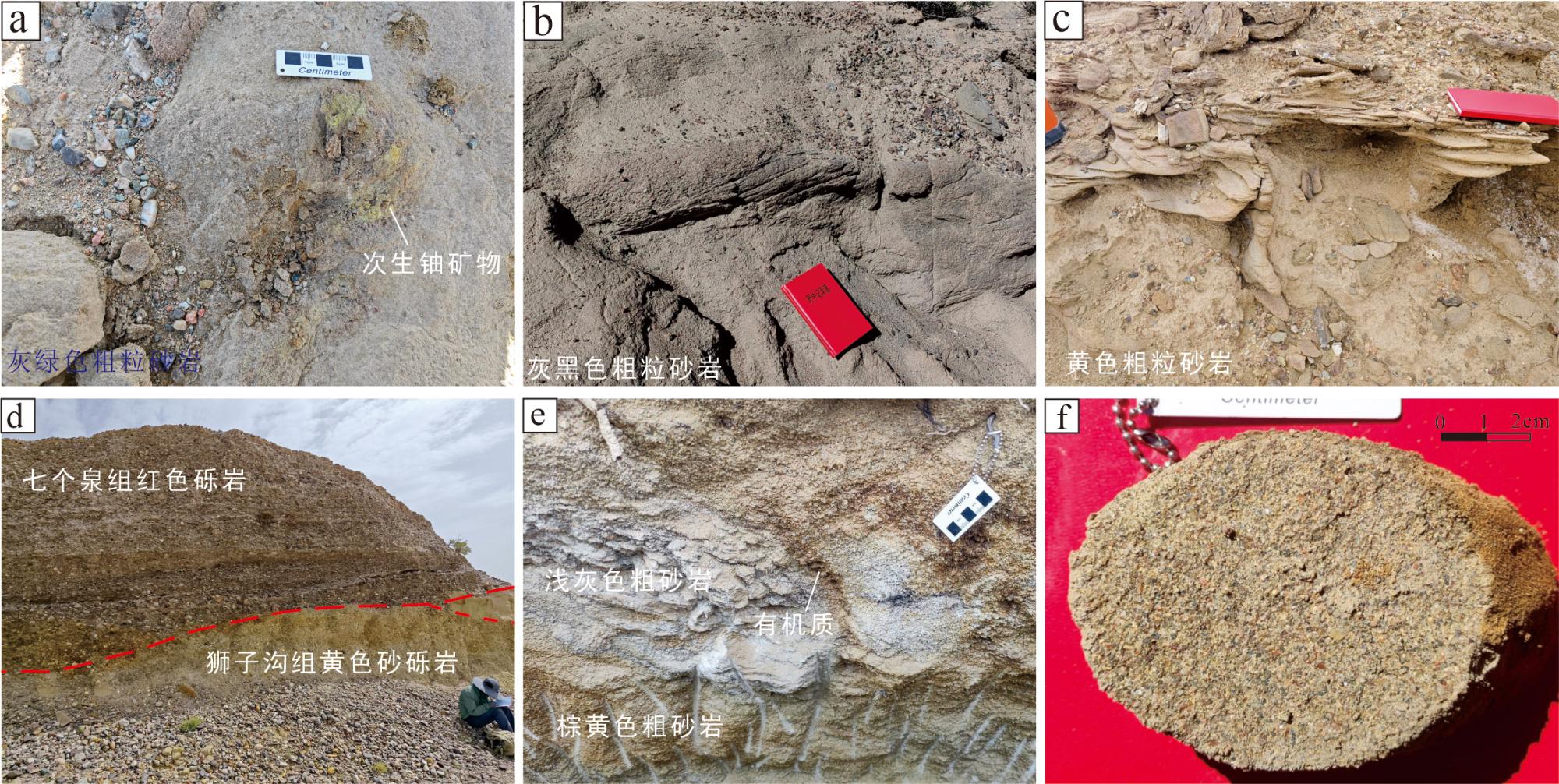
图8 德科、德东和旺尕秀地区含矿层岩性特征a—德科铀矿点上油砂山组灰绿色粗砂岩,见黄色次生铀矿物;b—德科铀矿点上油砂山组灰色粗粒砂岩;c—德东铀矿点狮子沟组黄色钙质粗粒砂岩;d—德东铀矿点狮子沟组与七个泉组角度不整合接触界限;e—旺尕秀铀矿点上油砂山组含矿浅灰色和棕黄色粗砂岩,含有机质团块;f—旺尕秀铀矿点上油砂山组含矿黄色粗砂岩。 Fig. 8 Lithologic characteristics of ore-bearing strata in the Deke,Dedong and Wanggaxiu uranium mineralized sites a-Greyish-green coarse sandstone of Shangyoushashan formation at the Deke uranium mineralized site, with yellow oxidized uranium minerals outcropped;b-Grey coarse sandstone of Shangyoushashan formation at the Deke uranium mineralized site;c-Yellow calcareous coarse sandstone of Shizigou formation at the Dedong uranium mineralized site;d-Unconformable contact between Shizigou formation and Qigequan formation at the Dedong uranium mineralized site;e-Light grey and pale brown uranium-bearing coarse sandstone of Shangyoushashan formation at the Wanggaxiu uranium mineralized site,with blocks of organic matter embedded;f-Yellow uranium-bearing coarse sandstone of Shangyoushashan formation at the Wanggaxiu uranium mineralized site. |
| 1 |
贺锋, 张字龙, 武正乾, 等. 砂岩型铀矿“源-汇”系统[J]. 世界核地质科学, 2024, 41(3):419-433.
|
| 2 |
李子颖, 刘武生, 李伟涛, 等. 内蒙古二连盆地哈达图砂岩铀矿渗出铀矿化作用[J]. 中国地质, 2022, 49(4):1009-1047.
|
| 3 |
李子颖, 秦明宽, 郭庆银, 等. 渗出砂岩型铀矿成矿预测与找矿标志[J]. 铀矿地质, 2024, 40(1):1-15.
|
| 4 |
刘武生, 李子颖, 刘持恒, 等. 二连盆地赛汉高毕铀矿床渗出成矿作用和模式[J]. 铀矿地质, 2024, 40(1):129-142.
|
| 5 |
秦明宽, 李子颖, 蔡煜琦, 等. 对加强我国铀资源勘查“三新”突破的战略性思考[J]. 世界核地质科学, 2022, 39(3):383-398.
|
| 6 |
张希梁, 蔡煜琦, 赵兴齐, 等. 柴达木盆地西缘砂岩型铀矿成矿条件及找矿标志[J]. 铀矿地质, 2025, 41(1):30-44.
|
| 7 |
陈擎, 王继斌, 陈斌, 等. 柴达木盆地古-新近系砂岩型铀矿找矿新发现及其找矿意义[J]. 东华理工大学学报(自然科学版), 2020, 43(4):346-354.
|
| 8 |
|
| 9 |
|
| 10 |
|
| 11 |
|
| 12 |
吴婵, 阎存凤, 李海兵, 等. 柴达木盆地西部新生代构造演化及其对青藏高原北部生长过程的制约[J]. 岩石学报, 2013, 29(6):2211-2222 (in Chinese).
|
| 13 |
|
| 14 |
|
| 15 |
|
| 16 |
王伟涛, 张培震, 段磊, 等. 柴达木盆地新生代地层年代框架与沉积-构造演化[J]. 科学通报, 2022, 67(28/29):3452-3475.
|
| 17 |
|
| 18 |
|
| 19 |
王大华. 柴达木盆地东部构造特征及对成藏的控制作用[D]. 青岛: 中国石油大学(华东), 2016.
|
| 20 |
杜忠明, 樊龙刚, 武国利, 等. 柴达木盆地东部新生代盆地结构与演化[J]. 地球物理学报, 2016, 59(12):4560-4569.
|
| 21 |
杜忠明. 柴达木盆地东部新生代构造-沉积演化[D]. 北京: 中国科学院大学, 2016.
|
| 22 |
易定红, 刘应如, 李积永, 等. 柴达木盆地三湖地区第四系七个泉组物源研究[J]. 古地理学报, 2024, 26(3):644-654.
|
| 23 |
王冰, 刘成林, 李宗星, 等. 柴达木盆地东部中生代以来构造应力场及构造演化[J]. 地球科学与环境学报, 2017, 39(1):83-94.
|
| 24 |
何鹏举. 碎屑磷灰石裂变径迹热年代学记录的青藏高原东北缘祁连山新生代构造变形过程[D]. 兰州: 兰州大学, 2018.
|
| 25 |
田明明, 李子颖, 蔡煜琦, 等. 柴达木盆地东北缘德令哈地区砂岩型铀矿化特征及找矿方向[J]. 世界核地质科学, 2024, 41(6):1076-1088.
|
| 26 |
聂逢君, 严兆彬, 夏菲, 等. 砂岩型铀矿的“ 双阶段双模式” 成矿作用[J]. 地球学报, 2021, 42(6): 823-848.
|
| 27 |
聂逢君, 杨舒琪, 封志兵, 等. 隆起对砂岩型铀矿成矿的控制及找矿启示[J]. 地球学报, 2024, 45(3):265-277.
|
| 28 |
封志兵, 聂逢君, 宁媛丽, 等. 盆地内部砂岩型铀矿找矿技术的设计与探讨[J]. 地质学报, 2022, 96(6): 2217-2229.
|
| 29 |
俞礽安, 金若时, 李彤, 等. 鄂尔多斯盆地砂岩型铀矿成矿地质条件和关键控矿要素分析[J]. 地球学报, 2023, 44(4):689-706.
|
| 30 |
|
| 31 |
李艳青. 鄂尔多斯盆地深部烃源岩生烃过程的油或气铀关系实验及地质意义[D]. 西安: 西北大学, 2018.
|
| 32 |
马寅生, 尹成明, 刘成林, 等. 柴达木盆地石炭系油气资源调查评价进展[J]. 地球学报, 2012, 33(2): 135-144.
|
| 33 |
牛永斌, 钟建华, 段宏亮, 等. 柴达木盆地石炭系烃源岩地球化学特征[J]. 河南理工大学学报(自然科学版), 2012, 31(5):525-532.
|
| 34 |
王利, 李宗星, 刘成林, 等. 柴达木盆地德令哈坳陷石炭系烃源岩成熟度演化史[J]. 地质力学学报, 2019, 25(3):370-381.
|
| 35 |
马立成, 江万, 施辉, 等. 柴达木盆地东部尕海南山地区新生代叠加褶皱与油气运移[J]. 现代地质, 2024, 38(5):1209-1220.
|
| 36 |
|
| 37 |
|
| 38 |
|
| 39 |
|
/
| 〈 |
|
〉 |