Effects of gravel on the water absorption characteristics and hydraulic parameters of stony soil
Received date: 2024-03-14
Revised date: 2024-05-08
Accepted date: 2024-05-10
Online published: 2025-08-14
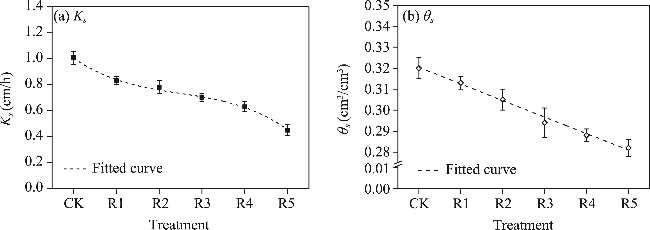
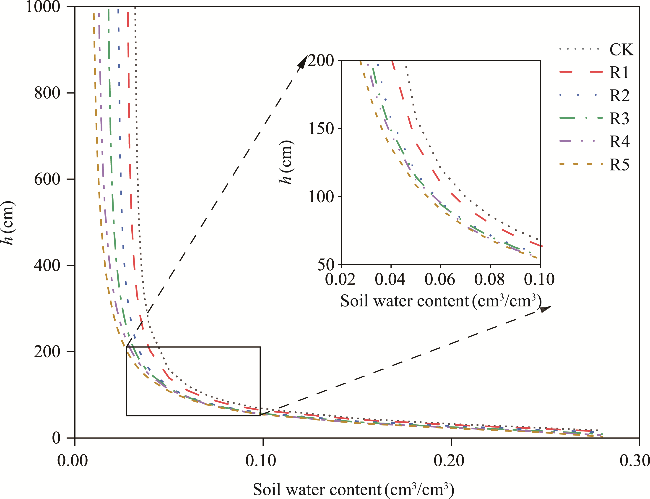
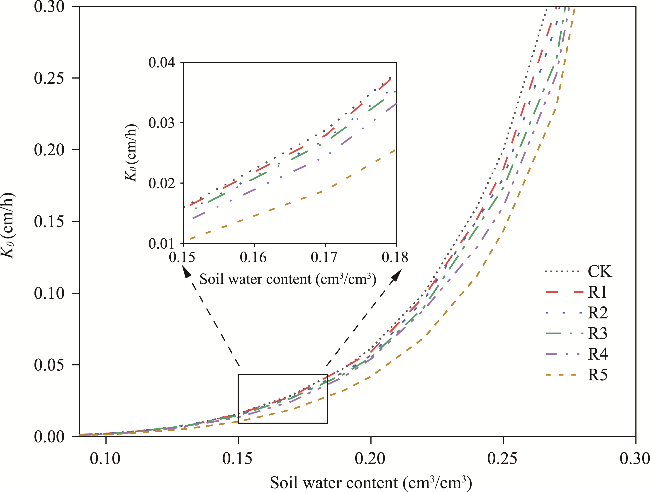
The eastern foothills of the Helan Mountains in China are a typical mountainous region of soil and gravel, where gravel could affect the water movement process in the soil. This study focused on the effects of different gravel contents on the water absorption characteristics and hydraulic parameters of stony soil. The stony soil samples were collected from the eastern foothills of the Helan Mountains in April 2023 and used as the experimental materials to conduct a one-dimensional horizontal soil column absorption experiment. Six experimental groups with gravel contents of 0%, 10%, 20%, 30%, 40%, and 50% were established to determine the saturated hydraulic conductivity (Ks), saturated water content (θs), initial water content (θi), and retention water content (θr), and explore the changes in the wetting front depth and cumulative absorption volume during the absorption experiment. The Philip model was used to fit the soil absorption process and determine the soil water absorption rate. Then the length of the characteristic wetting front depth, shape coefficient, empirical parameter, inverse intake suction and soil water suction were derived from the van Genuchten model. Finally, the hydraulic parameters mentioned above were used to fit the soil water characteristic curves, unsaturated hydraulic conductivity (Kθ) and specific water capacity (C(h)). The results showed that the wetting front depth and cumulative absorption volume of each treatment gradually decreased with increasing gravel content. Compared with control check treatment with gravel content of 0%, soil water absorption rates in the treatments with gravel contents of 10%, 20%, 30%, 40%, and 50% decreased by 11.47%, 17.97%, 25.24%, 29.83%, and 42.45%, respectively. As the gravel content increased, inverse intake suction gradually increased, and shape coefficient, Ks, θs, and θr gradually decreased. For the same soil water content, soil water suction and Kθ gradually decreased with increasing gravel content. At the same soil water suction, C(h) decreased with increasing gravel content, and the water use efficiency worsened. Overall, the water holding capacity, hydraulic conductivity, and water use efficiency of stony soil in the eastern foothills of the Helan Mountains decreased with increasing gravel content. This study could provide data support for improving soil water use efficiency in the eastern foothills of the Helan Mountains and other similar rocky mountainous areas.
MA Yan , WANG Youqi , MA Chengfeng , YUAN Cheng , BAI Yiru . Effects of gravel on the water absorption characteristics and hydraulic parameters of stony soil[J]. Journal of Arid Land, 2024 , 16(7) : 895 -909 . DOI: 10.1007/s40333-024-0079-y
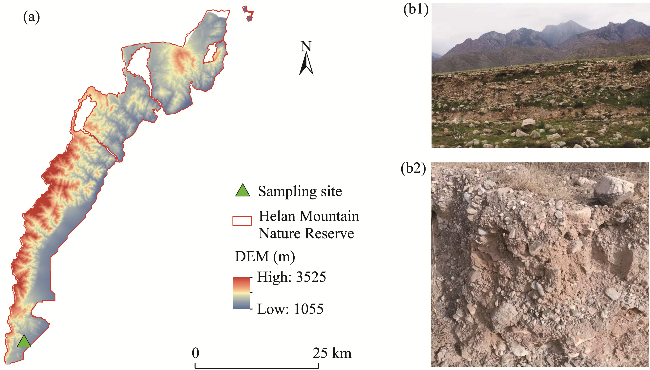
Fig. 1 Overview of the Helan Mountain Nature Reserve based on digital elevation model (DEM) (a) and photos of the sampling sites (b1 and b2) |
Table 1 Soil physical and chemical properties in the sampling site |
| Soil property | Clay (%) | Silt (%) | Sand (%) | pH | SOM (g/kg) |
|---|---|---|---|---|---|
| Value | 4.20±0.45 | 54.00±1.65 | 41.40±1.52 | 8.23±0.04 | 1.62±0.06 |
| Soil property | TN (g/kg) | TP (g/kg) | EC (μs/cm) | SWC (%) | BD (g/cm3) |
| Value | 0.42±0.02 | 0.33±0.02 | 635.00±87.23 | 3.49±0.39 | 1.50±0.02 |
Note: Mean±SD. SOM, soil organic matter; TN, total nitrogen; TP, total phosphorus; EC, electrical conductivity; SWC, soil water content; BD, soil bulk density. |
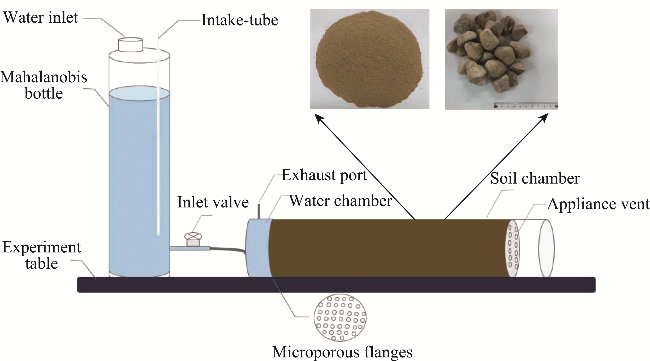
Fig. 2 Diagram of the one-dimensional horizontal soil column absorption experiment equipment |
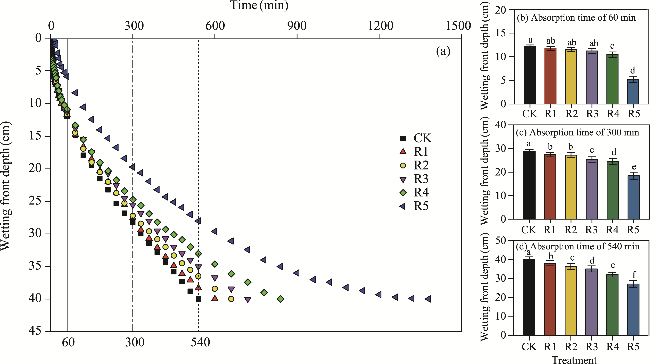
Fig. 3 Variations of the wetting front depth in the whole soil water absorption process (a), at absorption time of 60 min (b), at absorption time of 300 min (c), and at absorption time of 540 min (d) among different treatments. CK, R1, R2, R3, R4, and R5 indicated the treatments with gravel contents of 0%, 10%, 20%, 30%, 40%, and 50%, respectively. Different lowercase letters indicated that a statistically significant difference in the wetting front depth was observed among different treatments at the P<0.05 level. Bars mean standard deviations. |
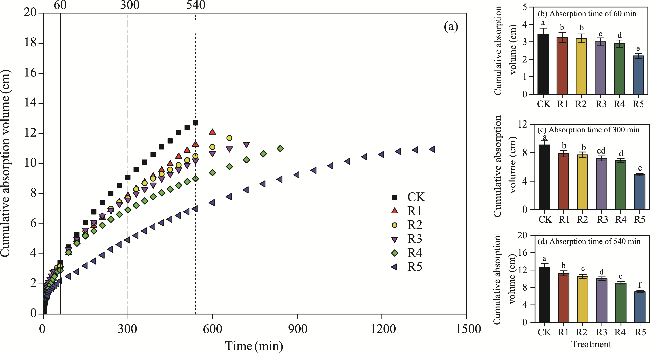
Fig. 4 Variations of cumulative absorption volume in the whole soil water absorption process (a), at absorption time of 60 min (b), at absorption time of 300 min (c), and at absorption time of 540 min (d) among different treatments. Different lowercase letters indicated that a statistically significance in the cumulative absorption volume was observed among the different experimental treatments at the P<0.05 level. Bars mean standard deviations. |
Table 2 Soil water absorption rate (S) based on the Philip model under different treatments |
| Treatment | Philip model | |
|---|---|---|
| S (cm/min0.5) | R2 | |
| CK | 0.523 | 0.993 |
| R1 | 0.463 | 0.996 |
| R2 | 0.429 | 0.997 |
| R3 | 0.391 | 0.998 |
| R4 | 0.367 | 0.998 |
| R5 | 0.301 | 0.997 |
Note: CK, R1, R2, R3, R4, and R5 indicated the treatments with gravel contents of 0%, 10%, 20%, 30%, 40%, and 50%, respectively. |
Fig. 5 Variations in saturated hydraulic conductivity (Ks; a) and saturated water content (θs; b) of stony soil among different treatments. Bars mean standard deviations. |
Table 3 Variations in parameters of the van Genuchten model under different treatments |
| Treatment | S (cm/min0.5) | d (cm/min0.5) | n | m | a (1/cm) | Ks (cm/h) | θs (cm3/cm3) | θi (cm3/cm3) | θr (cm3/cm3) |
|---|---|---|---|---|---|---|---|---|---|
| CK | 0.523 | 2.301 | 2.591 | 0.614 | 0.035 | 1.02 | 0.320 | 0.005 | 0.031 |
| R1 | 0.463 | 2.085 | 2.554 | 0.608 | 0.036 | 0.84 | 0.313 | 0.004 | 0.027 |
| R2 | 0.429 | 1.987 | 2.537 | 0.606 | 0.038 | 0.78 | 0.305 | 0.004 | 0.022 |
| R3 | 0.391 | 1.912 | 2.364 | 0.577 | 0.040 | 0.72 | 0.294 | 0.003 | 0.016 |
| R4 | 0.367 | 1.854 | 2.248 | 0.555 | 0.041 | 0.66 | 0.288 | 0.002 | 0.010 |
| R5 | 0.301 | 1.562 | 2.207 | 0.547 | 0.042 | 0.48 | 0.282 | 0.002 | 0.007 |
Note: d, length of the characteristic wetting front depth; n, shape coefficient; m, empirical parameter; a, inverse intake suction; Ks, saturated hydraulic conductivity; θs, saturated water content; θi, initial water content; θr, retention water content. |
Fig. 6 Variations in soil water characteristic curves under different treatments. h, soil water suction. |
Fig. 7 Variations in unsaturated hydraulic conductivity (Kθ) under different treatments |
Table 4 Specific water capacity (C(h)) in the soil water suction (h) stage of (100-1000 cm) under different treatments |
| h (cm) | C(h) under each treatment (cm3/cm4) | |||||
|---|---|---|---|---|---|---|
| CK | R1 | R2 | R3 | R4 | R5 | |
| 100 | 1.7×10⁻² | 1.6×10⁻² | 1.4×10⁻² | 1.3×10⁻² | 1.3×10⁻² | 1.2×10⁻² |
| 200 | 3.0×10⁻³ | 2.8×10⁻³ | 2.5×10⁻³ | 2.4×10⁻³ | 2.4×10⁻³ | 2.3×10⁻³ |
| 400 | 5.0×10⁻⁴ | 4.9×10⁻⁴ | 4.5×10⁻⁴ | 4.2×10⁻⁴ | 4.1×10⁻⁴ | 4.0×10⁻⁴ |
| 800 | 10.0×10⁻⁵ | 8.0×10⁻⁵ | 7.0×10⁻⁵ | 6.0×10⁻⁵ | 5.0×10⁻⁵ | 3.8×10⁻⁵ |
| 1000 | 4.6×10⁻⁵ | 4.5×10⁻⁵ | 4.2×10⁻⁵ | 4.0×10⁻⁵ | 3.5×10⁻⁵ | 3.3×10⁻⁵ |
| [1] |
|
| [2] |
|
| [3] |
|
| [4] |
|
| [5] |
|
| [6] |
|
| [7] |
|
| [8] |
|
| [9] |
|
| [10] |
|
| [11] |
|
| [12] |
|
| [13] |
|
| [14] |
|
| [15] |
|
| [16] |
|
| [17] |
|
| [18] |
|
| [19] |
|
| [20] |
|
| [21] |
|
| [22] |
|
| [23] |
|
| [24] |
|
| [25] |
|
| [26] |
|
| [27] |
|
| [28] |
|
| [29] |
|
| [30] |
|
| [31] |
|
| [32] |
|
| [33] |
|
| [34] |
|
| [35] |
|
| [36] |
|
| [37] |
|
| [38] |
|
| [39] |
|
| [40] |
|
| [41] |
|
| [42] |
|
| [43] |
|
| [44] |
|
| [45] |
|
| [46] |
|
| [47] |
|
| [48] |
|
| [49] |
|
| [50] |
|
| [51] |
|
| [52] |
|
/
| 〈 |
|
〉 |