Comparison of isotope-based linear and Bayesian mixing models in determining moisture recycling ratio
Received date: 2023-12-30
Revised date: 2024-04-16
Accepted date: 2024-05-11
Online published: 2025-08-13
Stable water isotopes are natural tracers quantifying the contribution of moisture recycling to local precipitation, i.e., the moisture recycling ratio, but various isotope-based models usually lead to different results, which affects the accuracy of local moisture recycling. In this study, a total of 18 stations from four typical areas in China were selected to compare the performance of isotope-based linear and Bayesian mixing models and to determine local moisture recycling ratio. Among the three vapor sources including advection, transpiration, and surface evaporation, the advection vapor usually played a dominant role, and the contribution of surface evaporation was less than that of transpiration. When the abnormal values were ignored, the arithmetic averages of differences between isotope-based linear and the Bayesian mixing models were 0.9% for transpiration, 0.2% for surface evaporation, and -1.1% for advection, respectively, and the medians were 0.5%, 0.2%, and -0.8%, respectively. The importance of transpiration was slightly less for most cases when the Bayesian mixing model was applied, and the contribution of advection was relatively larger. The Bayesian mixing model was found to perform better in determining an efficient solution since linear model sometimes resulted in negative contribution ratios. Sensitivity test with two isotope scenarios indicated that the Bayesian model had a relatively low sensitivity to the changes in isotope input, and it was important to accurately estimate the isotopes in precipitation vapor. Generally, the Bayesian mixing model should be recommended instead of a linear model. The findings are useful for understanding the performance of isotope-based linear and Bayesian mixing models under various climate backgrounds.
XIAO Yanqiong , WANG Liwei , WANG Shengjie , Kei YOSHIMURA , SHI Yudong , LI Xiaofei , Athanassios A ARGIRIOU , ZHANG Mingjun . Comparison of isotope-based linear and Bayesian mixing models in determining moisture recycling ratio[J]. Journal of Arid Land, 2024 , 16(6) : 739 -751 . DOI: 10.1007/s40333-024-0016-0
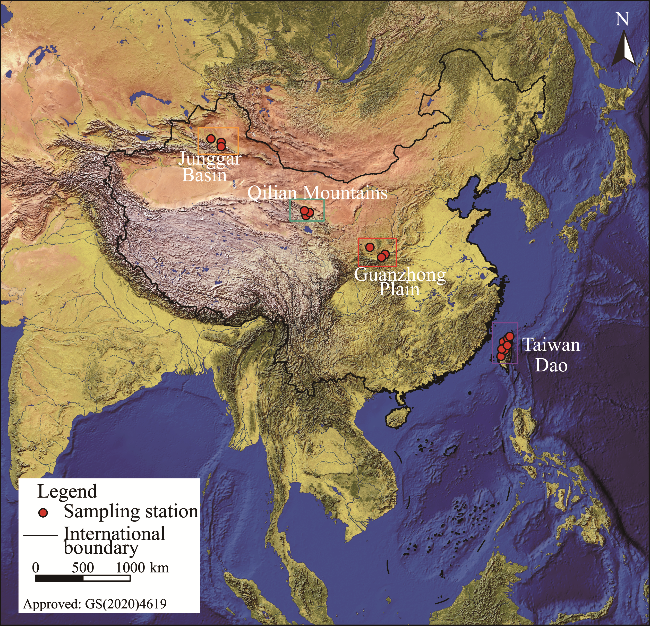
Fig. 1 Sampling stations in China. Four typical sampling areas are marked in squares, i.e., the Taiwan Dao (purple), the Guanzhong Plain (red), the Qilian Mountains (green), and the Junggar Basin (brown) from eastern coastline to western inland in China. Note that the figure is based on the standard map (GS(2020)4619) of the Map Service System (https://bzdt.ch.mnr.gov.cn/), and the standard map has not been modified. |
Table 1 Latitude, longitude, and altitude of the sampling stations used in this study |
| Study area | Station | Latitude | Longitude | Altitude (m) | Reference |
|---|---|---|---|---|---|
| Taiwan Dao | Xinshan | 25°07′N | 121°44′E | 27 | Peng et al. (2011) |
| Wuling | 24°21′N | 121°19′E | 1800 | ||
| Taibei | 24°59′N | 121°31′E | 5 | ||
| Taichung | 24°07′N | 120°41′E | 34 | ||
| Puli | 23°58′N | 120°59′E | 732 | ||
| Lishan | 24°16′N | 121°10′E | 1980 | ||
| Hsinchu | 24°45′N | 121°00′E | 34 | ||
| Feitsui | 24°54′N | 121°34′E | 150 | ||
| Chiayi | 23°29′N | 120°18′E | 27 | ||
| Guanzhong Plain | Xi'an | 34°13′N | 109°00′E | 460 | Li et al. (2020) |
| Weinan | 34°29′N | 109°27′E | 413 | ||
| Changwu | 35°14′N | 107°41′E | 1220 | ||
| Qilian Mountains | Yeniugou | 38°42′N | 99°38′E | 3320 | Zhao et al. (2019) |
| Pailugou | 38°34′N | 100°17′E | 2720 | ||
| Hulugou | 38°15′N | 99°52′E | 3020 | ||
| Junggar Basin | Urumqi | 43°47′N | 87°39′E | 935 | Wang et al. (2016) |
| Shihezi | 44°19′N | 86°03′E | 443 | ||
| Caijiahu | 44°12′N | 87°32′E | 441 |
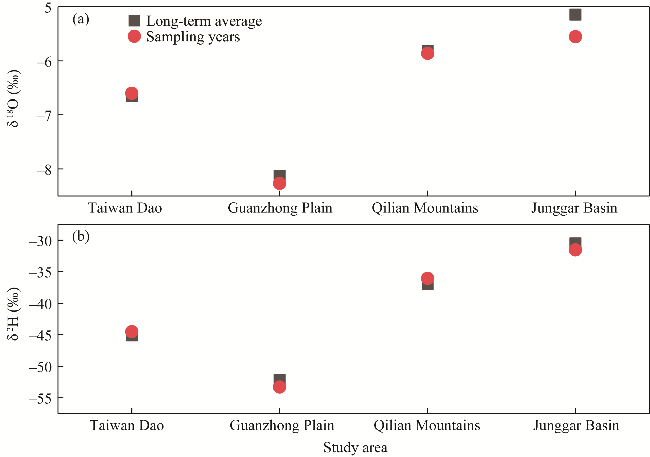
Fig. 2 Precipitation-weighted oxygen (δ18O; a) and hydrogen (δ2H; b) isotopes in summer months from May to September during long-term average (1979-2020) and sampling years in the four areas |
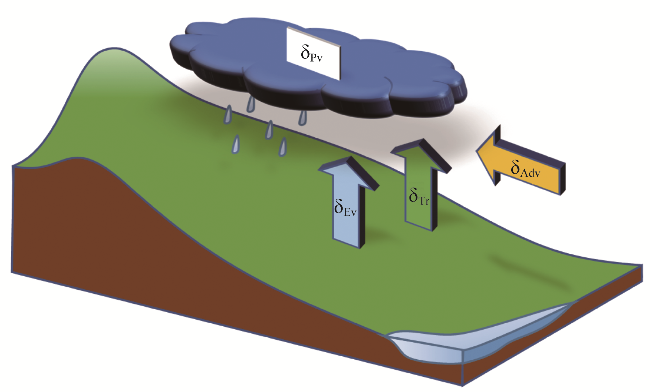
Fig. 3 Schematic of isotope-based three-component mixing model. Three arrows show the isotope compositions of three vapor sources, i.e., advection (δAdv), transpiration (δTr), and surface evaporation (δEv). Isotope composition of precipitating vapor is marked as δPv. |
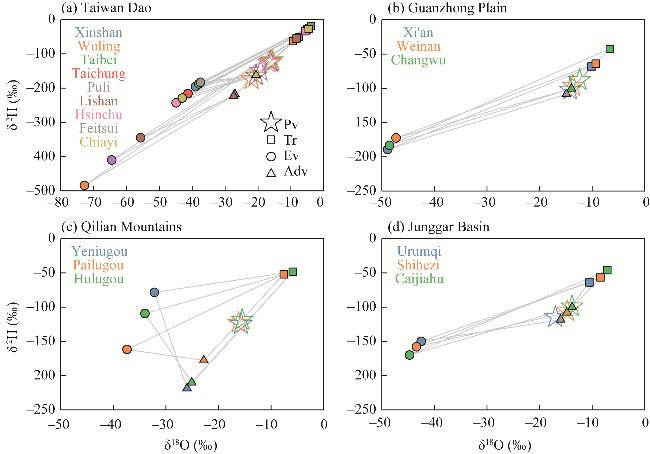
Fig. 4 Relationship between stable hydrogen (δ2H) and oxygen (δ18O) isotope compositions of Pv (precipitating vapor), Tr (transpiration), Ev (surface evaporation), and Adv (advection) vapors for different sampling stations in the four study areas. (a), Taiwan Dao; (b), Guanzhong Plain; (c), Qilian Mountains; (d), Junggar Basin. The symbols of δ2H and δ18O isotope compositions correspond to the sampling stations with the same color. The abbreviations are the same as in the following figures. |
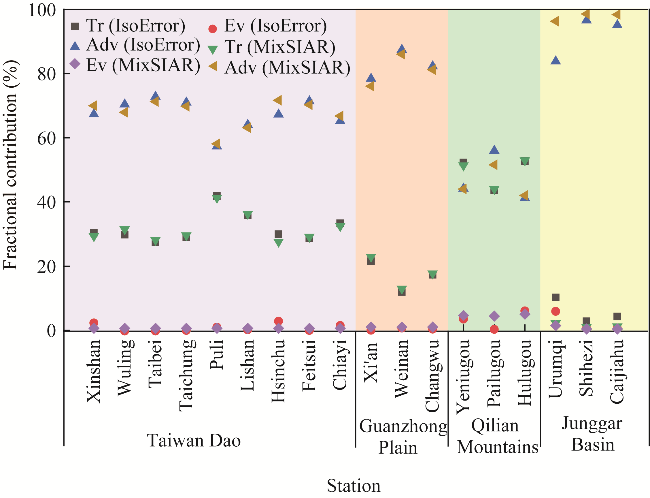
Fig. 5 Fractional contributions of Tr, Ev, and Adv vapors for each sampling station using IsoError and MixSIAR methods |
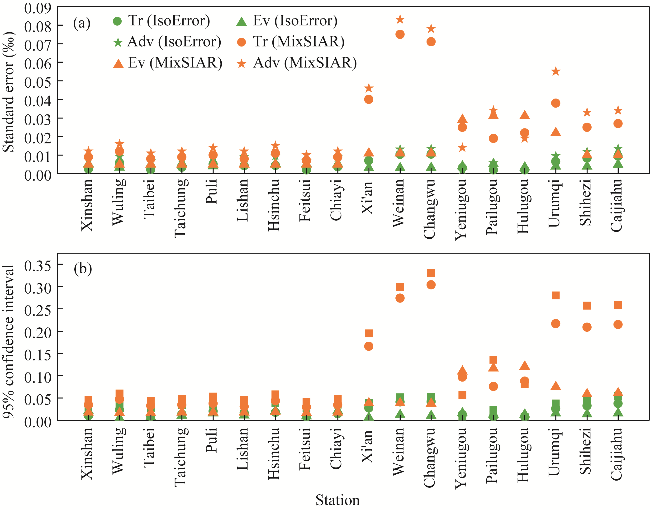
Fig. 6 Standard errors (a) and 95% confidence intervals (b) of Tr, Ev, and Adv vapors for each sampling station using IsoError and MixSIAR methods |
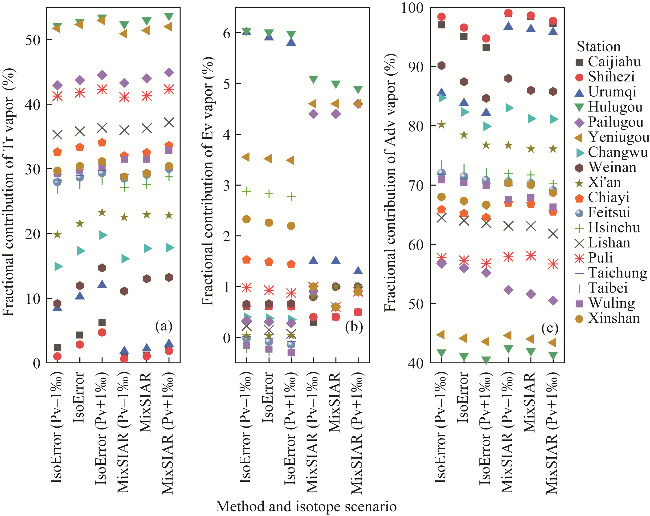
Fig. 7 Sensitivity of fractional contributions for each vapor source when δ2H value in Pv increases by 1‰ (+1‰) or decreases by 1‰ (-1‰) using IsoError and MixSIAR methods. (a), Tr vapor; (b), Ev vapor; (c), Adv vapor. |
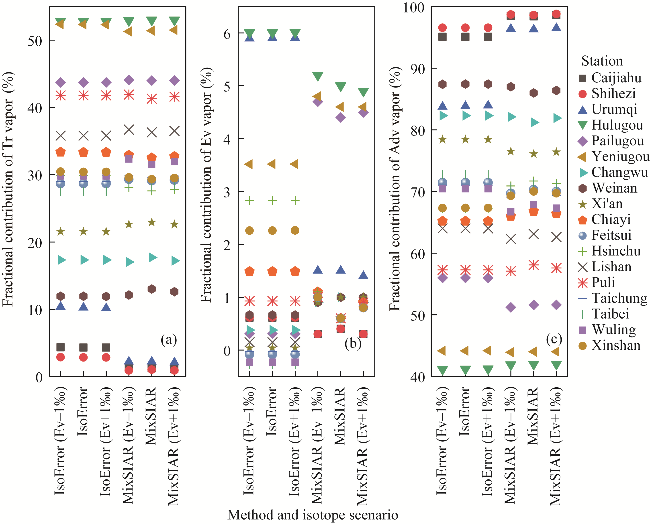
Fig. 8 Sensitivity of fractional contributions for each vapor source when δ2H value in Ev vapor increases by 1‰ (+1‰) or decreases by 1‰ (-1‰) using IsoError and MixSIAR methods. (a), Tr vapor; (b), Ev vapor; (c), Adv vapor. |
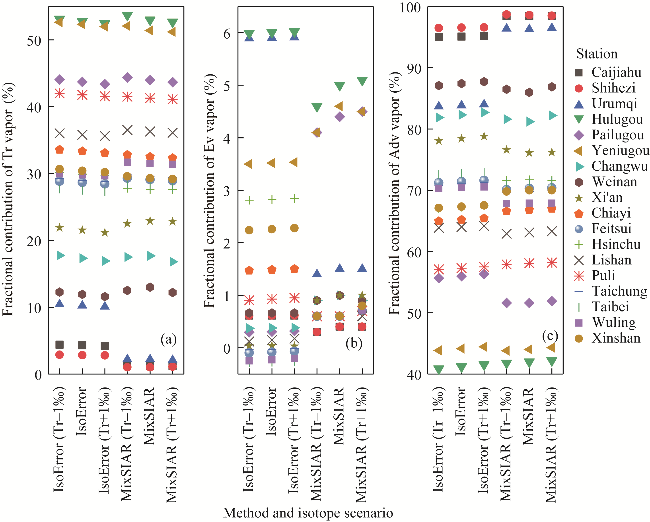
Fig. 9 Sensitivity of fractional contributions for each vapor source when δ2H value in Tr vapor increases by 1‰ (+1‰) or decreases by 1‰ (-1‰) using IsoError and MixSIAR methods. (a), Tr vapor; (b), Ev vapor; (c), Adv vapor. |
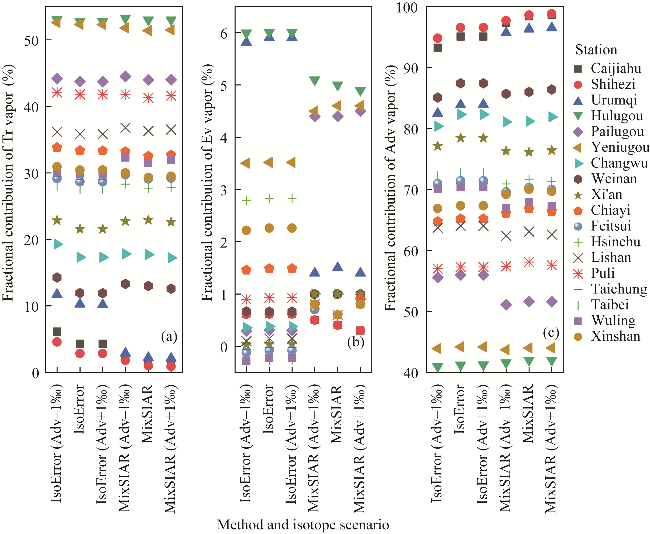
Fig. 10 Sensitivity of fractional contributions for each vapor source when δ2H value in Adv vapor increases by 1‰ (+1‰) or decreases by 1‰ (-1‰) using IsoError and MixSIAR methods. (a), Tr vapor; (b), Ev vapor; (c), Adv vapor. |
| [1] |
|
| [2] |
|
| [3] |
|
| [4] |
|
| [5] |
|
| [6] |
|
| [7] |
|
| [8] |
|
| [9] |
|
| [10] |
|
| [11] |
|
| [12] |
|
| [13] |
|
| [14] |
|
| [15] |
|
| [16] |
|
| [17] |
|
| [18] |
|
| [19] |
|
| [20] |
|
| [21] |
|
| [22] |
|
| [23] |
|
| [24] |
|
| [25] |
|
| [26] |
|
| [27] |
|
| [28] |
|
| [29] |
|
| [30] |
|
| [31] |
|
| [32] |
|
| [33] |
|
| [34] |
|
| [35] |
|
| [36] |
|
| [37] |
|
| [38] |
|
| [39] |
|
| [40] |
|
| [41] |
|
| [42] |
|
| [43] |
|
| [44] |
|
| [45] |
|
/
| 〈 |
|
〉 |