Research article

Erosion on marginal slopes of unpaved roads in semi-arid Brazil, and the role of Caatinga vegetation in sediment retention and disconnectivity

  • Teresa Raquel Lima FARIAS , 1, * ,
  • Maria Thereza Rocha CHAVES 1 ,
  • Cicero Lima de ALMEIDA 2 ,
  • Pedro Henrique Augusto MEDEIROS 1 ,
  • José Carlos de ARAÚJO 3 ,
  • Joaquín NAVARRO-HEVIA 4
Expand
  • 1Federal Institute of Education, Science and Technology of Ceará, Department of Civil Construction, Fortaleza 60040531, Brazil
  • 2Federal Institute of Education, Science and Technology of Ceará, Sobral 62042030, Brazil
  • 3Federal University of Ceará, Department of Agricultural Engineering, Fortaleza 60450760, Brazil
  • 4Agroforestry Department, University of Valladolid, Palencia 34004, Spain
*Teresa Raquel Lima FARIAS (E-mail: )

Received date: 2024-07-27

  Revised date: 2025-01-30

  Accepted date: 2025-02-17

  Online published: 2025-08-13

Abstract

Vegetation plays a major role in soil protection against erosion effects, and studies have also highlighted its importance in retaining sediments from roadside slopes. Yet, hydro-sedimentological studies under natural precipitation conditions are still scarce in semi-arid areas due to difficulties in monitoring the few and very concentrated precipitation events. Quantifying sediment connectivity and yield at watershed scale, often highly impacted by the erosion of unpaved roads, is necessary for management plans. This study aims to evaluate the efficiency of native vegetation on roadside slope segments in Caatinga biome in retaining sediments and conserving the soil in a semi-arid area of Brazil. Surface runoff, sediment concentration, and yield measurements were measured from 34 natural precipitation events in four years on two slopes with and without vegetation. The runoff coefficients of the plot with no vegetation varied from 3.0% to 58.0%, while in the vegetated plot, they showed variation from 1.0% to 21.0%. The annual specific sediment yield ranged from 4.6 to 138.7 kg/(hm2•a) for the vegetated plot and from 34.9 to 608.5 kg/(hm2•a) for the unvegetated one. These results indicate a 4 to 12 times higher soil loss on the unvegetated slope in relation to the vegetated one and demonstrate that natural Caatinga vegetation acts as an effective barrier against surface-transported sediments. Moreover, natural Caatinga vegetation present on the slope plays an important role in breaking connectivity between sediment flows from unpaved roads and the watershed drainage system. These findings indicate that investments in unpaved road and roadside slope restoration, not only enhance road infrastructure but also promote environmental gains by reducing the impact of erosion.

Cite this article

Teresa Raquel Lima FARIAS , Maria Thereza Rocha CHAVES , Cicero Lima de ALMEIDA , Pedro Henrique Augusto MEDEIROS , José Carlos de ARAÚJO , Joaquín NAVARRO-HEVIA . Erosion on marginal slopes of unpaved roads in semi-arid Brazil, and the role of Caatinga vegetation in sediment retention and disconnectivity[J]. Journal of Arid Land, 2025 , 17(4) : 500 -514 . DOI: 10.1007/s40333-025-0012-z

1 Introduction

Water erosion is detrimental, leading to widespread global degradation of soil and water resources (Shi et al., 2022). This form of erosion prevents ecosystem recovery, reduces soil productivity, damages infrastructure, and poses risks to humans. Sediments from erosion can degrade water quality and aquatic habitats, as well as threaten the storage capacity of surface water reservoirs (Ramos-Scharrón et al., 2024). Semi-arid areas are vulnerable due to their climatic, topographic, and soil conditions, which contribute to soil degradation until its final stage of desertification (Medeiros et al., 2014; Ochoa et al., 2016). Storms, coupled with sparse vegetation and poor soil management, are major drivers of erosion in these areas (Feng et al., 2018).
It is well documented that vegetation protects the soil by increasing organic matter content, improving soil physical properties, and reducing water erosion, thereby mitigating soil degradation (Zhang et al., 2015; Almeida et al., 2017; Bai et al., 2023). While the hydro-sedimentological processes—encompassing sediment detachment, transport, and deposition—are natural phenomena, human activities, like road construction, can exacerbate the effects (Farias et al., 2019; Ramos-Scharrón et al., 2024). However, studies of long-term quantitative assessments of erosion control techniques and the effectiveness of different types of vegetation to control erosion under changing precipitation conditions are still scarce (Feng et al., 2020).
Research indicates that increased vegetation cover affects surface runoff and slope erosion, both surface runoff and sediment yield decreasing as vegetation cover increases (Feng et al., 2018; Gu et al., 2020; Han et al., 2021; Shi et al., 2022; Tong et al., 2023). Maintaining or restoring vegetation on slopes helps regulate surface runoff and sediment loss, as it increases surface roughness, soil infiltration capacity, and erosion resistance (Wang and Zhang, 2017; Shi et al., 2022). Especially in disturbed semi-arid areas, vegetation restoration has proven effective in controlling runoff and sediment yield (Ai et al., 2017; Almeida et al., 2017). Additionally, plant roots contribute to soil stability and erosion reduction by enhancing soil cohesion and shear resistance (Wang and Zhang, 2017). In soil bioengineering, the role of roots has been recognized in stabilizing soil surface, forming macropores, and improving soil microaggregate restoration, ultimately leading to reduced runoff velocity and erosive potential (Zhang et al., 2014; Chang et al., 2019).
The sediment balance at the watershed scale is also influenced by specific features such as unpaved roads, whose erosion increases river channel turbidity and contributes to sediment yield (Ramos-Scharrón and MacDonald, 2007; Cunha and Thomaz, 2015; Farias et al., 2021). In Vietnam, roadside slopes contribute to 10.0%-50.0% of the sediment generated by unpaved roads (Linh et al., 2024). Similarly, research in Iran found that infiltration rates are lower on roads than on natural slopes, resulting in a 5-times more frequent road runoff (Parsakhoo and Hosseini, 2023). In Brazil, about 80.0% of the road network consists of unpaved roads (National Transport Confederation, 2024), with potential to affect the sediment balance (Farias et al., 2021).
The importance of sediment sources can vary between watersheds, given that these sediment sources are influenced by their distributions on the landscape (Ramos-Scharrón and MacDonald, 2007). In the same area as this study, Farias et al. (2021) found that, despite occupying only 0.7% of the watershed surface, unpaved roads contribute to 7.0% of soil loss in the area. Consequently, the interaction between unpaved roads and surrounding areas impacts sediment yield processes. Roads alter watershed hydrology by concentrating runoff, modifying flow paths, and reorganizing drainage networks (Rijsdijk et al., 2007; Silva et al., 2021; Ramos-Scharrón et al., 2022). Additionally, the erosion of unpaved roads, being compounded by sediment accumulation from surrounding areas, hinders road maintenance (Griebeler et al., 2009). In dry tropical areas, roads can increase sediment yields in comparison with natural conditions (Ramos-Scharrón et al., 2024). Even so, hydro-sedimentological studies under natural precipitation events, particularly in semi-arid areas, are still scarce due to monitoring difficulties. Such studies could help to understand hydrological processes, improve model parameterization (Ehsan Bhuiyan et al., 2019; Jeung et al., 2020), and contribute to effective soil and water management (Zhu et al., 2022).
The scientific importance of this work lies in providing a better comprehension of the impact of vegetation on erosion control and sediment yield on unpaved roadside slopes in semi-arid areas. Specifically, the study aims to answer the following question, i.e., how does the presence or absence of vegetation on unpaved roadside slopes affect sediment yield under natural precipitation conditions in the semi-arid area of Brazil? This question involves investigating the role of vegetation in mitigating soil erosion and, therefore, contributes to soil and water resource management, as well as environmental conservation in dry areas that are subject to degradation, such as the semi-arid area of Brazil.

2 Materials and methods

2.1 Study area and slope characteristics

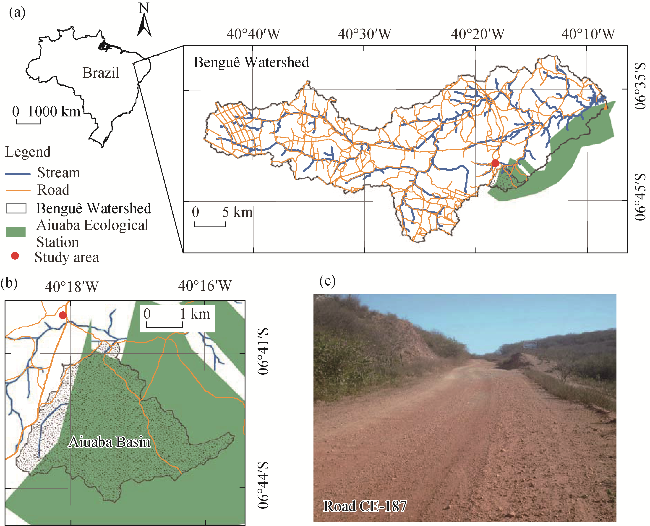
The study was conducted on a roadside slope of the unpaved highway CE-187 (06°41′30″S, 40°18′02″W) near the Aiuaba Ecological Station, which stands for similar rural roads in the semi-arid area of Brazil. According to Costa et al. (2021), the climate of the study area is tropical semi-arid, with a potential evaporation of roughly 2000 mm, average annual precipitation of approximately 600 mm, and an average annual temperature of 25°C.
In the watershed where the experimental plots are located, unpaved roads have an approximate length of 1300 km and occupy 0.7% of the watershed surface. These roads lack drainage systems and, during precipitation events, they transform into irregularly drained channels, facilitating the transport of water and sediments. Additionally, at the end of the rainy season, the roads present a series of problems that hinder vehicle trafficability, so that some segments undergo mechanical regularization processes every year, typically at the end of the rainy season, which results in an increase in sediment availability on these roads (Farias et al., 2021). In Figure 1, the location of the study area is depicted, and the road CE-187 where the experimental plots are located, is highlighted.
Fig. 1 Location of the study area (a and b) in the semi-arid Brazil and the road (c) where the studied plots are located

2.2 Experimental design

Two monitoring plots were installed on the unpaved road slope, one with natural vegetation (WV) and the other one without any vegetation (NV), in September 2012, with no further intervention carried out in subsequent years. Hydro-sedimentological monitoring was conducted from 2013 to 2016, with data for the first two years partially obtained from the study by Farias et al. (2019).
The slopes have the following characteristics: gradient of 0.58 m/m, width of 1.0 m, and length of 6.5 m. The soil of the slopes possesses an average saturated hydraulic conductivity of 17.0 mm/h, with a range from 2.0 to 54.0 mm/h, and a bulk density of 1.76 g/cm3, with a range from 1.61 to 1.90 g/cm3. The soil texture has 47.0% gravel (>2.000 mm), 31.0% sand (2.000-0.050 mm), 19.0% silt (0.050-0.002 mm), and 3.0% clay (<0.002 mm), based on a sampling at 8 points (Farias et al., 2019).
In general, Caatinga biome is characterized by thorny, xerophytic, and deciduous species, presenting trees and shrubs with varying densities, which ranges from very dense dry forests to almost desert-like areas with isolated shrubs. On the studied slope, the presence of herbaceous, shrubby, and sub-shrubby strata stands out. The predominant species include the shrubs Croton sonderianus Müll.Arg. and Combretum leprosum Mart., the sub-shrub Croton heliotropiifolius Kunth, Ipomoea pes-caprae (L.) R. Br. subsp. brasiliensis (L.) Ooststr., Ipomoea sericophylla Meisn., and Hyptis suaveolens L. Point, along with some grasses. These plant species occur naturally in Caatinga biome.
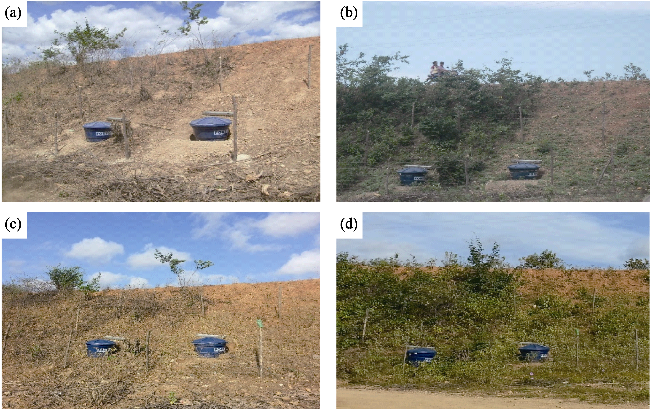
In Figure 2, the plots with and without vegetation monitored on the roadside slope of highway CE-187 are presented. Soil compaction at the top of the slope, closer to the road platform, hinders the natural growth of plant species. It could be observed during the monitoring period, that the plot corresponding to the slope without vegetation experienced a progressive increase in vegetation recolonization during the rainy season.
Fig. 2 Roadside slope and plots with and without vegetation. (a), installation of the sediment monitoring systems in September 2012; (b), vegetation recolonization in February 2013; (c), vegetation recolonization in September 2014; (d) vegetation recolonization in January 2016.

2.3 Monitoring

In the segments of roadside slope with and without vegetation, gutter-shaped systems were installed to capture surface runoff and transported sediments. The gutters were made of steel sheets and followed the model of Gerlach (1967), with a width of 10 cm and depth of 8 cm, but modified to a length of 50-100 cm to capture a longer part of the slope. These systems were positioned near the base of the slope and connected to reservoirs with a capacity of 250 L (Fig. 2), which stored the volume drained from the slopes after each precipitation event.
The soil loss of each slope segment was quantified by multiplying the volumes drained by the suspended sediment concentration, combined with the solid material retained at the bottom of the reservoirs. The integrated values over time allowed for the calculation of sediment yield. After each precipitation event, the water volume in the reservoirs was measured and sediment concentration was determined in the laboratory from samples of 100 mL, with three repetitions, collected from a well-mixed suspension. The filtration method was carried out with 47 mm diameter microfiber filters with a porosity of 1.5 µm. For each event, the sediment deposited at the bottom of the reservoirs and/or gutters was collected and dried in an oven at 105°C for 24 h or until a constant mass was achieved, and then weighed.
The experimental plots were not isolated by physical barriers to avoid edge effects on surface runoff and sediment transport processes. The contributing area of each plot was estimated through topographic surveys of these segments by using the Global Positioning System (GPS). Similar procedures had been employed by Navarro-Hevia (2002), Rijsdijk et al. (2007), Negishi et al. (2008), and Ramos-Scharrón (2010). Precipitation events were recorded using an automatic tipping bucket rain gauge. To assess the long-term precipitation pattern in the study area, we used data provided by the National Water and Sanitation Agency (2025) in its HidroWeb Portal, which were measured daily at the Aiuaba Ecological Station during 1994-2024.

2.4 Statistical analysis

Initially, all data were subjected to the Shapiro-Wilk normality test. Subsequently, the Mann- Whitney U test was used for non-parametric sample pairs, and the Student's t-test for normally distributed data pairs was used to compare the median values of runoff coefficients, sediment concentration, and sediment yield between the two plots with vegetation and without vegetation.
The linear correlation between the data was compared by using Spearman's correlation. All tests were conducted with a significance level of 95.0% (α=0.05). The Mann-Kendall method, along with the Sen's slope estimator, was applied to statistically assess the trend. Various approaches, such as the Mann-Kendall test, Sen's slope estimation, and Spearman's tests, were employed to calculate the changes in time series. The non-parametric tests among these methods are widely used to determine monotonic trends in different parameters (Gumus et al., 2022).

3 Results

3.1 Precipitation

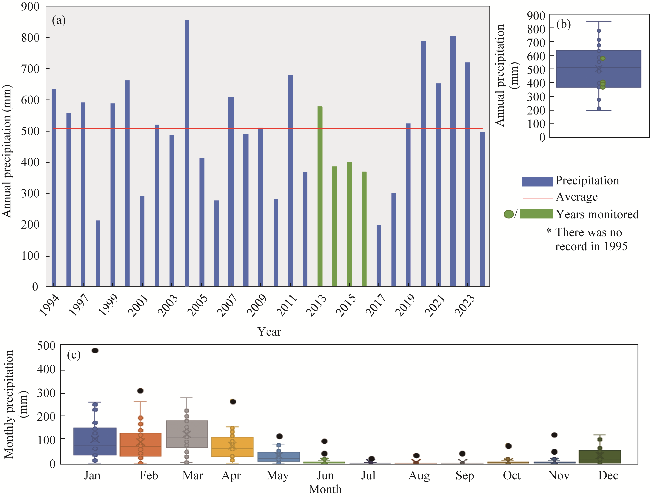
Annual variations in precipitation at the study plots during 1994-2024 are shown in Figure 3a. The maximum precipitation of 855 mm occurred in 2004, and the minimum precipitation of 196 mm in 2017. The annual average precipitation was 506 mm. The years monitored in this research are highlighted in green, the respective precipitation values were 575, 382, 398, and 368 mm in 2013, 2014, 2015, and 2016, respectively.
Fig. 3 Precipitation histogram (a), box plots of annual precipitation (b), and monthly precipitation (c) distribution during 1994-2024. Boxes in Figure 3b and c indicate the IQR (interquartile range, 75th to 25th of the data). The median value is shown as a line within the box. Whisker is shown as the mean. Outliers are shown as circles. Bars extend to the most extreme value within 1.5×IQR. Green circles in Figure 3b represent the annual precipitation during monitoring years.
During 2013-2016, average annual precipitation amounted to 430 mm, which means a 15.0% reduction compared with the historical average during 1994-2024. However, the monitored years did not go below the theoretical lowest limit; therefore, they cannot be considered outliers, as shown in Figure 3b. One should observe that precipitation is very concentrated in the first four months of the year, representing approximately 80.0% of the total precipitation volume recorded throughout each year (Fig. 3c).

3.2 Runoff coefficients and sediment yield

During the study period, a total of 34 events generating runoff on the slope segments were recorded: 9 took place in 2013, 13 in 2014, 7 in 2015, and 5 in 2016. It was found that the lowest precipitation capable of generating surface runoff on the slope was 5 mm (Table S1).
Table S1 Values for precipitation (P), runoff coefficient (CR), sediment concentration (CS), and sediment yield (SY) on the slopes with and without vegetation during 2013-2016
Event Date
(dd/mm/yyyy)
P (mm) Slope with vegetation (WV) Slope with no vegetation (NV)
CR (%) CS (mg/L) SY (kg/hm2) CR (%) CS (mg/L) SY (kg/hm2)
1 04/01/2013 29 5 653 10.1 11 690 21.4
2 16/02/2013 53 6 43 1.3 6 1327 41.1
3 26/03/2013 42 7 172 5.3 7 648 98.7
4 04/04/2013 11 7 428 6.6 14 1506 11.7
5 01/05/2013 19 16 404 12.2 58 395 43.8
6 23/06/2013 13 6 117 1.8 12 3010 23.3
7 09/09/2013 29 16 65 3.0 45 145 19.1
8 20/12/2013 64 1 162 1.3 5 250 8.7
9 23/12/2013 50 3 62 1.0 43 342 78.0
10 13/01/2014 23 15 79 2.7 45 378 37.5
11 31/01/2014 12 6 173 1.3 7 2506 19.4
12 04/02/2014 31 10 49 1.5 17 2083 105.8
13 11/02/2014 44 2 32 0.2 23 42 3.2
14 19/02/2014 10 8 59 0.5 8 82 0.6
15 06/03/2014 10 8 102 0.8 8 224 1.7
16 18/03/2014 15 5 35 0.3 35 87 4.4
17 28/03/2014 17 4 94 0.7 5 205 1.6
18 31/03/2014 5 15 60 0.5 15 258 2.0
19 02/04/2014 37 2 31 0.2 8 110 3.2
20 19/09/2014 7 16 241 2.6 17 315 3.4
21 17/11/2014 18 4 48 0.4 19 80 2.7
22 24/11/2014 32 2 670 5.2 11 852 29.0
23 18/01/2015 6 13 205 1.6 13 245 1.9
24 04/02/2015 142 2 29 1.0 6 130 11.1
25 20/02/2015 31 2 76 0.6 3 80 0.6
26 23/02/2015 35 2 44 0.3 57 75 15.0
27 02/03/2015 49 3 32 0.5 11 47 2.4
28 06/03/2015 27 3 36 0.3 3 53 0.4
29 20/03/2015 26 3 38 0.3 3 445 3.5
30 14/01/2016 79 4 139 4.9 13 390 39.6
31 21/01/2016 88 19 510 85.5 30 1835 489.2
32 25/01/2016 42 4 9 0.2 8 13 0.5
33 18/03/2016 95 21 238 47.7 23 249 54.1
34 12/05/2016 12 13 26 0.4 36 573 25.1
Minimum 5 1 9 0.2 3 13 0.4
Maximum 142 21 670 86.0 58 3010 489.0
Median 29 6 71 1.2 13 254 11.4
Mean 35 7 152 6.0 18 579 35.0
Standard deviation 30 6 177 16.0 16 758 85.0
According to the Shapiro-Wilk test (Table 1), all the analyzed data pairs, except sediment yield in 2013, surface runoff in 2016, and sediment concentration in 2016, exhibited non-parametric distribution (P<0.05), for which the Mann-Whitney test was applied. On the pairs of data within normality, the Student t-test was applied.
Table 1 Normalization test and hypothesis for surface runoff, sediment concentration, and sediment yield for samples from slopes with (WV) and without vegetation (NV)
Year Test Surface runoff Sediment concentration Sediment yield
WV NV WV NV WV NV
2013 Shapiro-Wilk test 0.06 0.02 0.06 0.02 0.08 0.08
Hypothesis test 0.04 0.01 0.01
2014 Shapiro-Wilk test 0.06 0.02 <0.01 <0.01 <0.01 <0.01
Hypothesis test <0.01 <0.01 <0.01
2015 Shapiro-Wilk test <0.01 <0.01 <0.01 0.02 0.04 0.04
Hypothesis test 0.03 0.02 0.03
2016 Shapiro-Wilk test 0.23 0.80 0.33 0.10 0.09 <0.01
Hypothesis test 0.15 0.23 0.42
The results obtained through the statistical significance test revealed significant differences between the slope plots, with and without vegetation, regarding surface runoff coefficient, sediment concentration, and sediment yield in 2013, 2014, and 2015, while maintaining a confidence level of 95.0%. Yet, in 2016, it was not possible to establish the same statistical distinction between the samples of vegetated and unvegetated slopes. This fact can partly be attributed to the progressive vegetation growth over the study period on the slope formerly without vegetation cover (Fig. 2). This finding emphasizes the importance of vegetation in controlling erosion processes and sediment transport on slopes, and it highlights the need to consider vegetation development when interpreting results from geotechnical and soil conservation studies in areas susceptible to erosive processes.
Table 2 presents the precipitation, average runoff coefficient, and sediment yield values during 2013-2016, both for vegetated and non-vegetated slope segments of unpaved road. Additionally, Figure 4 provides a graphical representation of runoff coefficient, sediment concentration, and sediment yield values throughout the study period.
Table 2 Characteristics of the monitored events in the slopes with vegetation (WV) and without vegetation (NV) of the unpaved road
Year Pannual (mm) Pac (mm) Paverage (mm) Number of P events Average runoff coefficient (%) Total sediment yield (kg/(hm2•a))
WV NV NV/WV WV NV NV/WV
2013 575 310 34.4 9 6.1 19.7 3.2 42.6 345.8 8.1
2014 382 261 20.1 13 5.8 17.7 3.0 16.9 214.5 12.7
2015 398 316 45.1 7 2.5 11.8 4.6 4.6 34.9 7.6
2016 367 316 63.2 5 13.6 20.9 1.5 138.7 608.5 21.9

Note: Pac, accumulated precipitation; P, precipitation; NV/WV indicates the ratio between non-vegetated slope and vegetated for average values of runoff coefficient and total sediment yield.

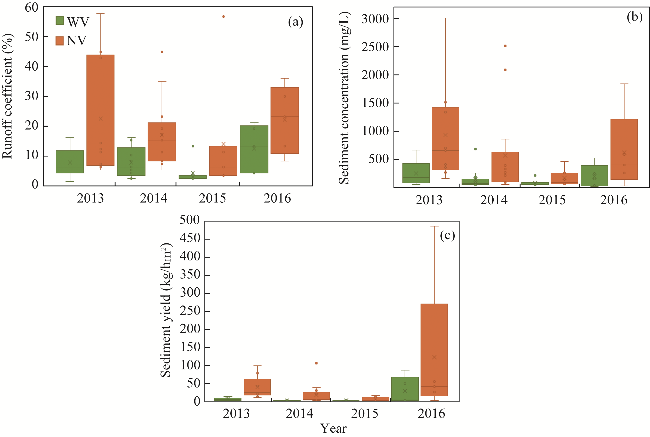
Fig. 4 Variability of runoff coefficient (a), sediment concentration (b), and sediment yield (c) in the slopes with vegetation (WV) and without vegetation (NV) during 2013-2016. Boxes indicate the IQR (interquartile range, 75th to 25th of the data). The median value is shown as a line within the box. Whisker is shown as the mean. Outliers are shown as circles. Bars extend to the most extreme value within 1.5×IQR.
When analyzing the behavior of surface runoff between monitoring years, we noted that the average runoff coefficient in 2013 was three times as high in the unvegetated plot compared with the vegetated plot. However, average runoff coefficient computed for year of 2016 was only one and a half times higher in the unvegetated plot than in the vegetated one. We attributed this fact to the vegetation growth observed in the unvegetated plot during the preceding four years. In addition, in the biennium of 2013-2014, there was a significantly higher incidence of events resulting in surface runoff, but these events were characterized by lower magnitudes. Conversely, in the subsequent years, 2015 and 2016, the frequency of such events decreased, but those fewer precipitation events were of substantially higher magnitudes, and presented different response patterns as well (Fig. 4a).
The comparative analysis of surface runoff coefficients calculated for plots with and without vegetation demonstrated that the presence of vegetation significantly influenced surface runoff, i.e., reductions ranged from 0.0% to 96.5% (average of 44.8%) when compared with the unvegetated plot. Furthermore, it was found that vegetation had a significant impact on sediment concentrations and led to reductions ranging from 0.0% to 97.6%, with an average of 52.9%. Regarding sediment yield, an effective control capacity was observed, since reductions varied between 0.0% and 98.7%, the average reduction being 71.1% in comparison with the unvegetated plot (Fig. 4a).
Sediment values of the events in the study area ranged from 9 to 670 mg/L (average 152 mg/L) on the vegetated slope while, on the unvegetated slope, variation was from 13 to 3010 mg/L (average 579 mg/L; Fig. 4b).
Sediment yield ranged from 0.2 to 85.5 kg/hm2 (average 6.0 kg/hm2) for the vegetated plot and from 0.4 to 489.2 kg/hm2 (average 35.4 kg/hm2) for the unvegetated plot. Annual sediment yields of the unvegetated plot were 350.0, 220.0, 35.0, and 610.0 kg/(hm2•a) in 2013, 2014, 2015, and 2016, respectively. For the vegetated plot, they were 40.0, 20.0, 4.0, and 140.0 kg/(hm2•a), respectively. Thus, the unvegetated slope produced four to twelve times more soil loss than the vegetated one. Moreover, despite a lower number of precipitation events in 2016, the unvegetated slope exhibited more erosive events influencing the annual sediment yield (Fig. 4c).
Results of the Mann-Kendall test and Sen's slope, as presented in Table 3, indicated a considerably decreasing trend (P<0.05) of sediment concentration and yield for the plot with vegetation and of sediment concentration for the plot without vegetation. There was no statistically significant trend for the runoff coefficient in both monitored scenarios.
Table 3 Results of the Mann-Kendall trend and Sen's slope analysis for runoff coefficient (CR), sediment concentration (CS), and sediment yield (SY)
Index Slope with vegetation Slope with no vegetation
CR CS SY CR CS SY
Mann-Kendall statistics 64 -31 -144 -162 -18 -152
Test statistics -0.44 -2.12 -2.39 -0.25 -2.29 -1.63
P-value 0.65 0.03 0.01 0.80 0.02 0.10
Sen's slope 0.00 -2.12 -1.70×10⁻⁵ 0.00 -13.05 -3.80×10⁻⁴
Trend Not significant Decreasing Decreasing Not significant Decreasing Not significant
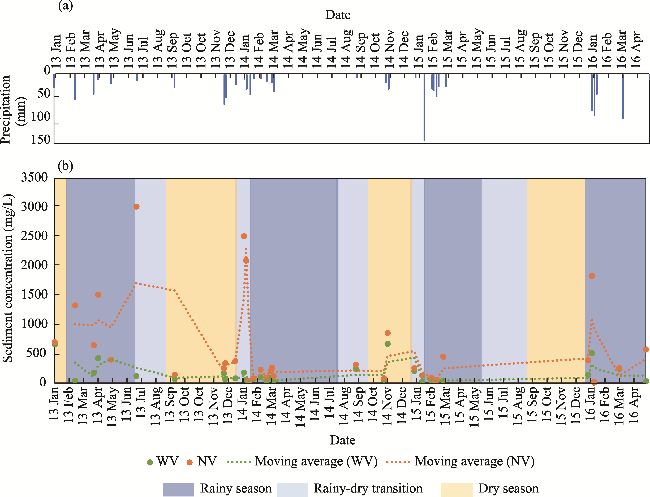
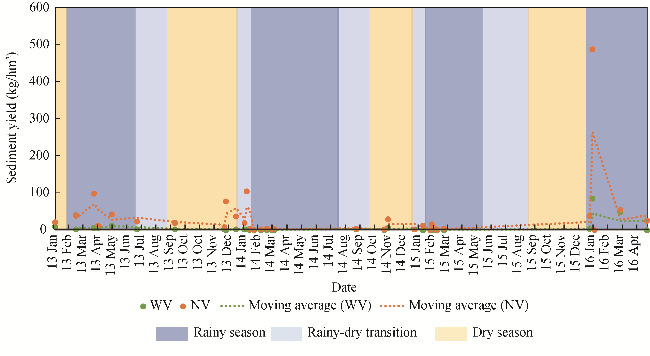
Figures 5 and 6 present the variations of sediment concentration and sediment yield over time. It is important to note the dynamics of sediment concentration and yield impacted by external factors, i.e., 15 d after precipitation event 5 (Figs. 5 and 6). Indeed, a peak in sediment concentration (3010 mg/L for the unvegetated plot) was observed, followed by a decrease in sediment concentration in precipitation events 7 and 8. Similarly, in 2014, precipitation events 11 and 12 showed a peak in sediment concentration followed by a decrease in precipitation event 13.
Fig. 5 Variation in sediment concentration on the slopes with (WV) and without (NV) vegetation after precipitation events during 2013-2016. (a), precipitation; (b), sediment concentration.
Fig. 6 Variation in sediment yield on the slopes with (WV) and without (NV) vegetation after precipitation events during 2013-2016
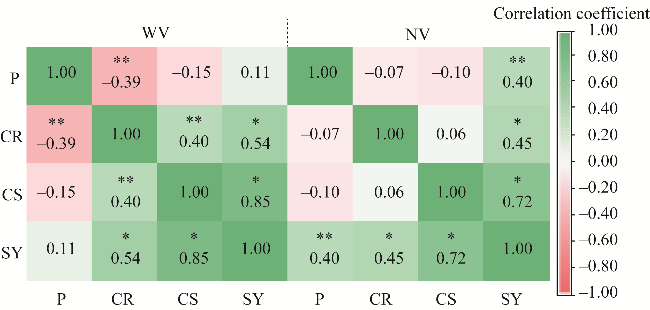
The Spearman correlation was conducted to assess the influence between monitored parameters on the slopes with and without vegetation. Spearman correlation coefficients showed statistically significant associations for the variables of runoff coefficient, sediment concentration, and sediment yield in samples with vegetation (Fig. 7). Similarly, for samples without vegetation, significantly increasing correlations were observed between sediment yield and precipitation, sediment yield and runoff coefficient, and sediment yield and sediment concentration.
Fig. 7 Spearman correlation among precipitation (P), surface runoff coefficient (CR), sediment concentration (CS), and yield (SY) of the slopes with (WV) and without (NV) vegetation.*, P<0.05 level; **, P<0.01 level.
Notably, precipitation did not show a significant positive correlation with any other variables, except sediment yield in samples without vegetation. This result suggests that precipitation magnitude exerts a limited influence on sediment entrainment and runoff coefficient under these specific conditions.

4 Discussion

Monitoring of runoff, sediment concentration, and yield in a four-year period (2013-2016) indicated that the vegetation in Caatinga biome, Brazil, functioned as a barrier to sediment transport from road surfaces and slopes. The vegetation played an important role in disconnecting the sediment fluxes from unpaved roads to the watershed drainage system. According to Gu et al. (2020), vegetation contributes to an increased infiltration capacity and affects parameters such as soil bulk density and aggregate stability. These factors directly influence surface runoff and sediment yield on hillslopes. In addition to vegetation, other factors that influence surface runoff and sediment yield are precipitation intensity and slope gradient (Han et al., 2021; Zhang et al., 2022).
The studies conducted in the semi-arid area of Brazil, where the Caatinga prevails, indicated the vegetation role in intercepting precipitation (Brasil et al., 2020), reducing the impact of raindrops (Brasil et al., 2022), controlling surface runoff, increasing soil resistance to detachment, and reducing sediment transport capacity (Santos et al., 2017). These findings are confirmed by this study on surface runoff coefficients and sediment yield on roadside slope. Specifically, regarding erosion, vegetation reduces the kinetic energy of raindrops and delays the onset of runoff, contributes to soil surface protection, increases surface roughness, and enhances the infiltration rate of the slope surface. Furthermore, root fixation can improve physical soil properties including cohesion, aggregation, and organic matter content (Zhang et al., 2015; Han et al., 2021).
Wischmeier and Smith (1978) emphasize that erosion caused by water in semi-arid areas is exacerbated by low humidity and periodic droughts, as these factors limit the time during which plant growth provides adequate soil cover. Soares et al. (2024) state that, although precipitation is the predominant and immediate factor driving the rainy season in Brazil's semi-arid area, it is essential to consider other variables that broaden the understanding of the seasonality of hydrological processes in semi-arid environments. Precipitation events increase soil moisture and trigger phenological responses in vegetation. The onset of the dry season is marked by most of the deciduous Caatinga vegetation shedding nearly all of its leaves. The above-mentioned study observed that short dry-to-wet transition periods indicate rapid vegetation response to early precipitation events.
In the roadside slope monitored in this study, the vegetated slope exhibited an average reduction of 44.8% (±33.5%) in runoff coefficient, 52.9% (±30.5%) in sediment concentration, and 71.1% (± 29.6%) in sediment yield compared with the unvegetated plot. The vegetation on marginal slopes of unpaved roads serves as a barrier to retaining sediments that originate from these roads. Ramos-Scharrón et al. (2022) observed approximately three times higher erosion rates on cut slopes compared with unpaved road surfaces. They monitored erosion rates on cut slopes with and without treatment and found that erosion on slopes was inversely related to vegetation cover. The implementation of erosion control practices proved highly effective and reduced erosion to approximately 3.0% in comparison with untreated slopes. Parsakhoo and Hosseini (2023) evaluated the effectiveness of soil conservation practices with different vegetation treatments on cut and fill slopes of unpaved roads, and obtained soil loss reduction rates ranging from 53.0% to 86.0% compared with slopes with exposed soil.
According to Shi et al. (2022), pasture vegetation coverage should exceed 86.0% to ensure that the reduction rate of runoff and sediment is higher than 60.0%. Yue et al. (2020) conducted a study monitoring vegetation, precipitation, surface runoff, and soil erosion in runoff plots under field conditions during 2015-2019 in a semi-arid area of China. The results revealed that vegetation restoration could reduce surface runoff from 68.0% to 97.4% and soil erosion from 98.0% to 99.9% compared with bare soil. However, no significant differences in surface runoff and soil loss were identified regarding different vegetation types.
Other features, such as sediment availability, also impact the dynamics of sediment concentration and yield from unpaved roads and the marginal slopes. According to Farias et al. (2019), who assessed erosion of the same road as this study, sediment concentration exceeding 2000 mg/L was influenced by road maintenance activities, which increased the availability of loose and easily transportable sediments on the surface. A decreasing trend was also observed in studies such as that of Cao et al. (2015), as the availability of sediments on roads decreased with the occurrence of surface runoff.
Road infrastructure impacts sediment balance at the watershed scale not only by local runoff and sediment generation, but also delivering water and sediment directly to the natural drainage system, altering the overall connectivity. In this study, runoff coefficients of the unvegetated plot varied from 3.0% to 58.0% (average 18.4%), while the vegetated plot showed variation from 1.0% to 21.0% (average 7.4%). According to Medeiros et al. (2014), the annual runoff coefficients in the Brazil's semi-arid areas are generally low, ranging from 5.0% to 12.0%, and some areas present coefficients even below 3.0%. This hydrological characteristic explains the system’s low sediment transport capacity, i.e., 60.0% of the eroded sediment is deposited in the landscape before reaching the river channels. Moreover, the presence of a dense surface reservoir network prevents sediment propagation, and the sediment delivery ratio decreases with scale. For example, in the same area of this study, at the Aiuaba Experimental Basin (Ceará, Brazil) an almost entirely preserved area of 12 km² with an average slope of 19.4%, the average annual runoff coefficient was around 0.8%, with a median of 0.5% and a maximum value of 2.6% (Figueiredo et al., 2016).
The data obtained in this study confirms the beneficial effect of vegetation for sediment retention on unpaved road slopes. However, there is an important aspect to be considered regarding road safety conditions impacted by growing vegetation, which may invade roadsides or even lanes, impair visibility and traffic ability, and thereby represent a risk to road users. It is, therefore, recommended to prune vegetation whose branches invade the roadway, hindering safe traffic, and causing critical situations. Since Caatinga vegetation is predominantly herbaceous and shrubby, i.e., low height, it can be used to control sediment yield from unpaved roads and the marginal slopes without compromising road safety, as long as adequate species are selected.
In areas with exposed and vulnerable soils, such as the margins of unpaved roads, erosion can accelerate soil degradation and the ability to support vegetation, as well as increase sediment loss. These processes have significant impacts not only on transportation infrastructure, but also on water quality and local ecosystem. Evaluating erosion and sediment retention on slopes is essential to understand the natural mechanisms of soil conservation and the factors that contribute to environmental degradation. This knowledge contributes to the identification of solutions that minimize the impacts of anthropogenic activities that are frequent in semi-arid areas. It is possible to enhance predictive models through quantitative data and support decision-making in territorial planning and land use management.

5 Conclusions

In this study, we monitored marginal slopes, with and without vegetation, of an unpaved road in semi-arid Brazil during 2013-2016, and recorded 34 precipitation events that generated runoff and sediment yield. Our results indicate that sediment concentration and yield in the plot without vegetation were significantly higher than those in the plot with vegetation, which confirmed that vegetation can play an important role in retaining sediments from unpaved roads and in breaking the sedimentological connectivity of roads with the drainage network. The findings of this work highlight the potential of Caatinga vegetation in retaining sediments from both the slope itself and the surface of unpaved roads. Yet, road safety must always be carefully addressed, especially regarding visibility and traffic ability because uncontrolled vegetation growth along the roadside and within the roadway can pose a risk and requires regular pruning so as to mitigate potential critical spots that may compromise safe traffic. However, given the predominance of herbaceous and shrubby vegetation in the Caatinga, a wise choice of low-height species together with periodic maintenance can help control erosion without compromising road safety.
The research underscores the importance of investing in the adaptation of roads and marginal slopes, aiming not only for improvements to infrastructure itself but also for environmental gains through the reduction of impacts of land use changes on sediment yield in rural watersheds located in semi-arid environments. Our study provides important support for the creation of soil conservation strategies and sustainable management in semi-arid areas susceptible to erosion. The result can guide public policies, such as the use of native vegetation to stabilize slopes and mitigate surface runoff, as well as promote ecological engineering practices in arid areas with poor infrastructure.

Conflict of interest

The authors declare that they have no known competing financial interests or personal relationships that could have appeared to influence the work reported in this paper.

Acknowledgements

The authors would like to express their gratitude to the National Council for Scientific and Technological Development (CNPq) for funding the field studies and for the research productivity fellowship (CNPq/PQ) awarded to Pedro Henrique Augusto MEDEIROS and José Carlos de ARAÚJO; to the Coordination for the Improvement of Higher Education Personnel (CAPES) for the doctoral scholarship awarded to Teresa Raquel Lima FARIAS (2117/13-4); and to the Foundation for the Support of Scientific and Technological Development in the State of Ceará (FUNCAP) for the master scholarship awarded to Maria Thereza Rocha CHAVES.

Author contributions

Conceptualization, methodology, investigation, data curation, and writing - original draft preparation: Teresa Raquel Lima FARIAS; Data curation, formal analysis, methodology, and writing - review and editing: Maria Thereza Rocha CHAVES; Data curation, formal analysis, and writing - review and editing: Cicero Lima de ALMEIDA; Formal analysis, methodology, supervision, and writing - review and editing: Pedro Henrique Augusto MEDEIROS; Conceptualization, methodology, supervision, writing - review and editing, funding acquisition, and project administration: José Carlos de ARAÚJO; Methodology, supervision, writing - review and editing: Joaquín NAVARRO-HEVIA. All authors approved the manuscript.
[1]
Ai N, Wei T X, Zhu Q, et al. 2017. Impacts of land disturbance and restoration on runoff production and sediment yield in the Chinese Loess Plateau. Journal of Arid Land, 9(1): 76-86.

[2]
Almeida C L D, Araújo J C D, Costa M C G, et al. 2017. Fallow reduces soil losses and increases carbon stock in Caatinga. Floresta E Ambiente, 24: 017516, doi: 10.1590/2179-8087.017516.

[3]
Bai L L, Shi P, Li Z B, et al. 2023. Synergistic effects of vegetation restoration and check dams on water erosion in a slope-gully system. Land Degradation & Development, 34(12): 3581-3592.

[4]
Brasil J B, Andrade E M D, Queiroz Palácio H A D, et al. 2020. Temporal variability of throughfall as a function of the canopy development stage: From seasonal to intra-event scale. Hydrological Sciences Journal, 65(10): 1640-1651.

[5]
Brasil J B, Andrade E M D, Queiroz Palácio H A D, et al. 2022. Canopy effects on rainfall partition and throughfall drop size distribution in a tropical dry forest. Atmosphere, 13(7): 1126, doi: 10.3390/atmos13071126.

[6]
Cao L X, Zhang K L, Dai H L, et al. 2015. Modeling interrill erosion on unpaved roads in the Loess Plateau of China. Land Degradation & Development, 26(8): 825-832.

[7]
Chang E H, Li P, Li Z B, et al. 2019. The impact of vegetation successional status on slope runoff erosion in the Loess Plateau of China. Water, 11(12): 2614, doi: 10.3390/w11122614.

[8]
Costa J A, Navarro-Hevia J, Costa C A G, et al. 2021. Temporal dynamics of evapotranspiration in semiarid native forests in Brazil and Spain using remote sensing. Hydrological Processes, 35(3): e14070, doi: 10.1002/hyp.14070.

[9]
Cunha M C, Thomaz E L. 2015. Is it possible to reduce water turbidity in a rural basin through the implementation of infiltration boxes? Brazilian Journal of Geomorphology, 16(4): 725, doi: 10.20502/rbg.v16i4.725. (in Portuguese)

[10]
Ehsan Bhuiyan M A, Nikolopoulos E I, Anagnostou E N, et al. 2019. Assessment of precipitation error propagation in multi-model global water resource reanalysis. Hydrology and Earth System Sciences, 23(4): 1973-1994.

[11]
Farias T R L, Medeiros P H A, Navarro-Hevia J, et al. 2019. Unpaved rural roads as source areas of sediment in a watershed of the Brazilian semi-arid region. International Journal of Sediment Research, 34(5): 475-485.

[12]
Farias T R L, Medeiros P H A, de Araújo J C, et al. 2021. The role of unpaved roads in the sediment budget of a semiarid mesoscale catchment. Land Degradation & Development, 32(18): 5443-5454.

[13]
Feng J, Wei W, Pan D L. 2020. Effects of rainfall and terracing-vegetation combinations on water erosion in a loess hilly area, China. Journal of Environmental Management, 261: 110247, doi: 10.1016/j.jenvman.2020.110247.

[14]
Feng T J, Wei W, Chen L D, et al. 2018. Assessment of the impact of different vegetation patterns on soil erosion processes on semiarid loess slopes. Earth Surface Processes and Landforms, 43(9): 1860-1870.

[15]
Figueiredo J V, de Araújo J C, Medeiros P H A, et al. 2016. Runoff initiation in a preserved semiarid Caatinga small watershed, Northeastern Brazil. Hydrological Processes, 30(13): 2390-2400.

[16]
Gerlach T. 1967. Hillslope troughs for measuring sediment movement. In: TricartJ, Se Macar P. 1967. Field Methods for the Study of Slope and Fluvial Processes. Belguim: The Comission on Applied Geomprphology International Geographical Union, 173.

[17]
Griebeler N P, Pruski F F, Silva J M A. 2009. Erosion control on unpaved roads. In: PruskiF F. Federal University de Viçosa, Soil and Water Conservation: Mechanical Practices for Water Erosion Control (2nd ed.). Viçosa: 166-215. (in Portuguese)

[18]
Gu C J, Mu X M, Gao P, et al. 2020. Distinguishing the effects of vegetation restoration on runoff and sediment generation on simulated rainfall on the hillslopes of the Loess Plateau of China. Plant and Soil, 447: 393-412.

[19]
Gumus V, Avsaroglu Y, Simsek O. 2022. Streamflow trends in the Tigris River basin using Mann-Kendall and innovative trend analysis methods. Journal of Earth System Science, 131(1): 34, doi: 10.1007/s12040-021-01770-4.

[20]
Han D D, Deng J C, Gu C J, et al. 2021. Effect of shrub-grass vegetation coverage and slope gradient on runoff and sediment yield under simulated rainfall. International Journal of Sediment Research, 36(1): 29-37.

[21]
Jeung S J, Lim G K, Kim B S. 2020. Analysis of statistical characteristics of annual precipitation in Korea using data screeening technique. Journal of Korean Society of Disaster and Security, 13(3): 15-28.

[22]
Linh N T M, MacDonald L H, Gomi T, et al. 2024. Runoff and erosion from three unpaved road segments in northern Vietnam. Journal of Hydrology: Regional Studies, 51: 101625, doi: 10.1016/j.ejrh.2023.101625.

[23]
Medeiros P H A, de Araújo J C, Mamede G L, et al. 2014. Connectivity of sediment transport in a semiarid environment: A synthesis for the Upper Jaguaribe Basin, Brazil. Journal of Soils and Sediments, 14: 1938-1948.

[24]
National Transport Confederation. 2024. Roadway Research CNT 2024. Brasília. [2024-06-28]. https://pesquisarodovias.cnt.org.br/. (in Portuguese)

[25]
National Water and Sanitation Agency. 2025. Portal Hidro Web. [2024-05-07]. https://www.snirh.gov.br/hidroweb/serieshistoricas.

[26]
Navarro-Hevia J. 2002. Erosion control in clearings caused by road infrastructure projects:Application to the area around Palencia City. PhD Dissertation. Madrid: Technical University of Madrid. (in Spanish)

[27]
Negishi J N, Sidle R C, Ziegler A D, et al. 2008. Contribution of intercepted subsurface flow to road runoff and sediment transport in a logging-disturbed tropical catchment. Earth Surface Processes and Landforms, 33(8): 1174-1191.

[28]
Ochoa P A A, Fries A, Mejía D, et al. 2016. Effects of climate, land cover and topography on soil erosion risk in a semiarid basin of the Andes. Catena, 140: 31-42.

[29]
Parsakhoo A, Hosseini S A. 2023. Effect of bioengineering treatments on reduction of soil erosion from road cut slope and fill slope. Journal of Forest Science, 69(9): 367-376.

[30]
Ramos-Scharrón C E, MacDonald L H. 2007. Measurement and prediction of natural and anthropogenic sediment sources, St. John, U.S. Virgin Islands. CATENA, 71(2): 250-266.

[31]
Ramos-Scharrón C E. 2010. Sediment production from unpaved roads in a sub-tropical dry setting-Southwestern Puerto Rico. Catena, 82(3): 146-158.

[32]
Ramos-Scharrón C E, Alicea-Díaz E E, Figueroa-Sánchez Y A, et al. 2022. Road cutslope erosion and control treatments in an actively-cultivated tropical montane setting. Catena, 209(2): 105814, doi: 10.1016/j.catena.2021.105814.

[33]
Ramos-Scharrón C E, McLaughlin P, Figueroa-Sánchez Y. 2024. Impacts of unpaved roads on runoff and erosion in a dry tropical setting: Isla De Culebra, Puerto Rico. Journal of Soils and Sediments, 24: 1420-1430.

[34]
Rijsdijk A, Bruijnzeel L S, Sutoto C K. 2007. Runoff and sediment yield from rural roads, trails and settlements in the upper Konto catchment, East Java, Indonesia. Geomorphology, 87(1-2): 28-37.

[35]
Santos J C N D, de Andrade E M, Medeiros P H A, et al. 2017. Effect of rainfall characteristics on runoff and water erosion for different land uses in a tropical semiarid region. Water Resources Management, 31(1): 173-185.

[36]
Shi P, Li P, Li Z B, et al. 2022. Effects of grass vegetation coverage and position on runoff and sediment yields on the slope of Loess Plateau, China. Agricultural Water Management, 259: 107231, doi: 10.1016/j.agwat.2021.107231.

[37]
Silva C C, Minella P G, Schlesner A, et al. 2021. Unpaved road conservation planning at the catchment scale. Environmental Monitoring and Assessment, 193: 595, doi: 10.1007/s10661-021-09398-z.

[38]
Soares N S, Costa C A G, de Lima J B C, et al. 2024. Method for identification of hydrological seasons in the semi-arid Caatinga biome, Brazil. Hydrological Sciences Journal, 69(3): 309-320.

[39]
Tong S C, Li G R, Li X L, et al. 2023. Soil water erosion and its hydrodynamic characteristics in degraded bald patches of alpine meadows in the Yellow River Source Area, western China. Sustainability, 15(10): 8165, doi: 10.3390/su15108165.

[40]
Wang B, Zhang G H. 2017. Quantifying the binding and bonding effects of plant roots on soil detachment by overland flow in 10 typical grasslands on the Loess Plateau. Soil Science Society of America Journal, 81(6): 1567-1576.

[41]
Wischmeier W H, Smith D D. 1978. Predicting Rainfall Erosion Losses:A Guide to Conservation Planning (Agriculture Handbook, No. 537). Washington DC: United States Department of Agriculture, Science and Education Administration.

[42]
Yue L, Jiao J Y, Tang B Z, et al. 2020. Response of runoff and soil erosion to erosive rainstorm events and vegetation restoration on abandoned slope farmland in the Loess Plateau region, China. Journal of Hydrology, 584: 124694, doi: 10.1016/j.jhydrol.2020.124694.

[43]
Zhang H Y, Meng Q, You Q J, et al. 2022. Influence of vegetation filter strip on slope runoff, sediment yield and nutrient loss. Applied Sciences, 12(9): 4129, doi: 10.3390/app12094129.

[44]
Zhang L, Wang J M, Bai Z K, et al. 2015. Effects of vegetation on runoff and soil erosion on reclaimed land in an opencast coal-mine dump in a loess area. Catena, 128: 44-53.

[45]
Zhang X, Yu G Q, Li Z B, et al. 2014. Experimental study on slope runoff, erosion and sediment under different vegetation types. Water Resources Management, 28(9): 2415-2433.

[46]
Zhu W, Wang S T, Luo P P, et al. 2022. A quantitative analysis of the influence of temperature change on the extreme precipitation. Atmosphere, 13(4): 612, doi: 10.3390/atmos13040612.

Outlines

/