Effects of temperature and precipitation on drought trends in Xinjiang, China
Received date: 2024-04-30
Revised date: 2024-07-26
Accepted date: 2024-07-30
Online published: 2025-08-13
The characteristics of drought in Xinjiang Uygur Autonomous Region (Xinjiang), China have changed due to changes in the spatiotemporal patterns of temperature and precipitation, however, the effects of temperature and precipitation—the two most important factors influencing drought—have not yet been thoroughly explored in this region. In this study, we first calculated the standard precipitation evapotranspiration index (SPEI) in Xinjiang from 1980 to 2020 based on the monthly precipitation and monthly average temperature. Then the spatiotemporal characteristics of temperature, precipitation, and drought in Xinjiang from 1980 to 2020 were analyzed using the Theil-Sen median trend analysis method and Mann-Kendall test. A series of SPEI-based scenario-setting experiments by combining the observed and detrended climatic factors were utilized to quantify the effects of individual climatic factor (i.e., temperature and precipitation). The results revealed that both temperature and precipitation had experienced increasing trends at most meteorological stations in Xinjiang from 1980 to 2020, especially the spring temperature and winter precipitation. Due to the influence of temperature, trends of intensifying drought have been observed at spring, summer, autumn, and annual scales. In addition, the drought trends in southern Xinjiang were more notable than those in northern Xinjiang. From 1980 to 2020, temperature trends exacerbated drought trends, but precipitation trends alleviated drought trends in Xinjiang. Most meteorological stations in Xinjiang exhibited temperature-dominated drought trend except in winter; in winter, most stations exhibited precipitation-dominated wetting trend. The findings of this study highlight the importance of the impact of temperature on drought in Xinjiang and deepen the understanding of the factors influencing drought.
YANG Jianhua , LI Yaqian , ZHOU Lei , ZHANG Zhenqing , ZHOU Hongkui , WU Jianjun . Effects of temperature and precipitation on drought trends in Xinjiang, China[J]. Journal of Arid Land, 2024 , 16(8) : 1098 -1117 . DOI: 10.1007/s40333-024-0105-0
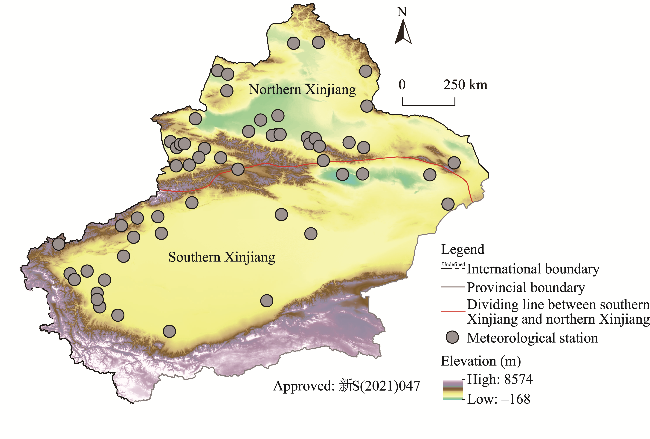
Fig. 1 Location of 56 meteorological stations adopted by this study in Xinjiang. Noted that the figure is based on the standard map (No. 新S(2021)047) of the Xinjiang Uygur Autonomous Region Platform for Common Geospatial Information Services (https://xinjiang.tianditu.gov.cn/main/bzdt.html) marked by the Department of Natural Resources of Xinjiang Uygur Autonomous Region, and the base map has not been modified. |
Table 1 Drought classification based on the value of standardized precipitation evapotranspiration index (SPEI) |
| Value | Classification |
|---|---|
| SPEI< -2.00 | Extreme drought |
| -2.00≤SPEI< -1.50 | Severe drought |
| -1.50≤SPEI< -1.00 | Moderate drought |
| -1.00≤SPEI< -0.50 | Slight drought |
| -0.50≤SPEI≤0.50 | Normal |
| SPEI>0.50 | Wet |
Table 2 Scenario setting |
| Scenario | SPEI | Description |
|---|---|---|
| Obs | SPEIObs | SPEI is calculated on the basis of the observed temperature and observed precipitation |
| DtOp | SPEIDtOp | SPEI is calculated on the basis of the detrended temperature and observed precipitation |
| OtDp | SPEIOtDp | SPEI is calculated on the basis of the observed temperature and detrended precipitation |
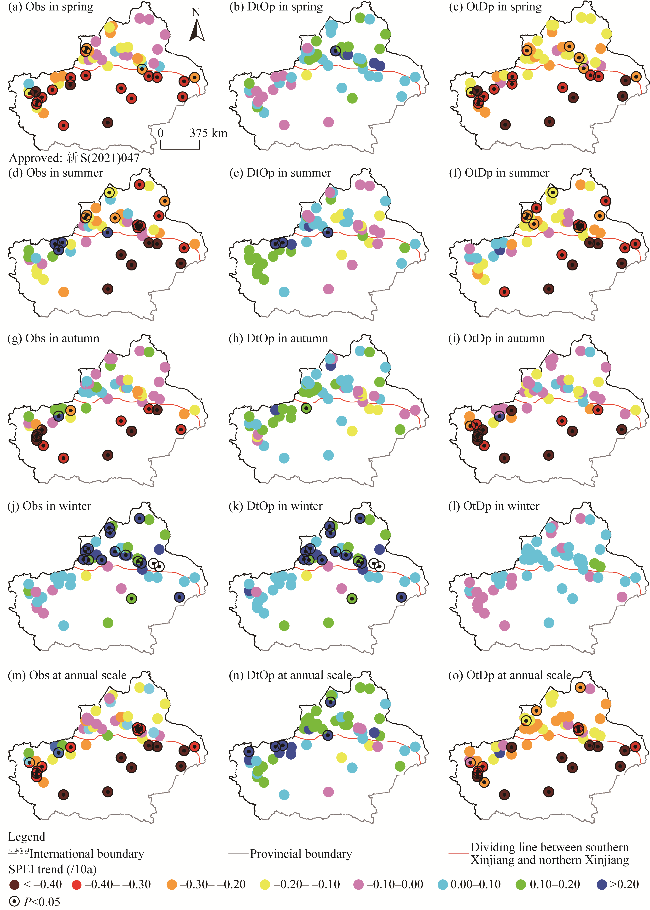
Note: Obs, observed temperature and precipitation; DtOp, detrended temperature and observed precipitation; OtDp, observed temperature and detrended precipitation. SPEIObs, the SPEI value of scenario Obs; SPEIDtOp, the SPEI value of scenario DtOp; and SPEIOtDp, the SPEI value of scenario OtDp. |
Table 3 Division rule for the dominant factors of drought and wetting trends |
| Dominant type | Abbreviation | Cr_tas | Cr_pre | Absolute value comparison |
|---|---|---|---|---|
| Ⅰ | T_drought | <0 | <0 | |Cr_tas|>|Cr_pre| |
| <0 | >0 | |Cr_tas|>|Cr_pre| | ||
| Ⅱ | T_wet | >0 | >0 | |Cr_tas|>|Cr_pre| |
| >0 | <0 | |Cr_tas|>|Cr_pre| | ||
| Ⅲ | P_drought | >0 | <0 | |Cr_tas|<|Cr_pre| |
| <0 | <0 | |Cr_tas|<|Cr_pre| | ||
| Ⅳ | P_wet | >0 | >0 | |Cr_tas|<|Cr_pre| |
| <0 | >0 | |Cr_tas|<|Cr_pre| |
Note: Cr_tas, contribution of temperature trend to drought trend; Cr_pre, contribution of precipitation trend to drought trend; T_drought, temperature-dominated drought trend; T_wet, temperature-dominated wetting trend; P_drought, precipitation-dominated drought trend; P_wet, precipitation-dominated wetting trend. |
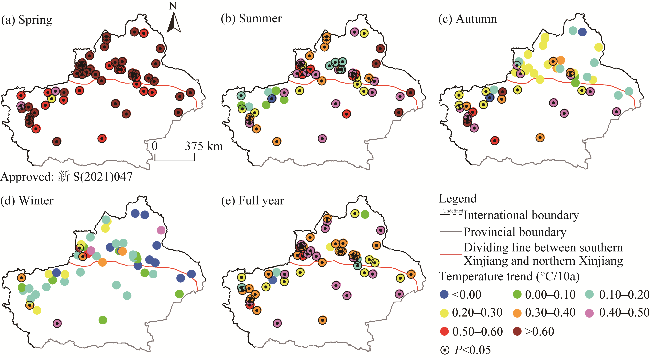
Fig. 2 Spatial distribution of temperature trends in Xinjiang at seasonal (a-d) and annual (e) scales from 1980 to 2020 |
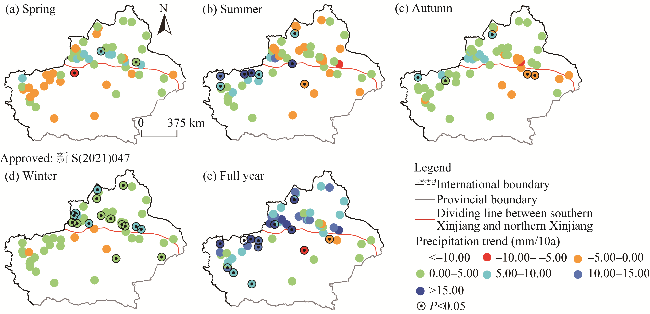
Fig. 3 Spatial distribution of precipitation trends in Xinjiang at seasonal (a-d) and annual (e) scales from 1980 to 2020 |
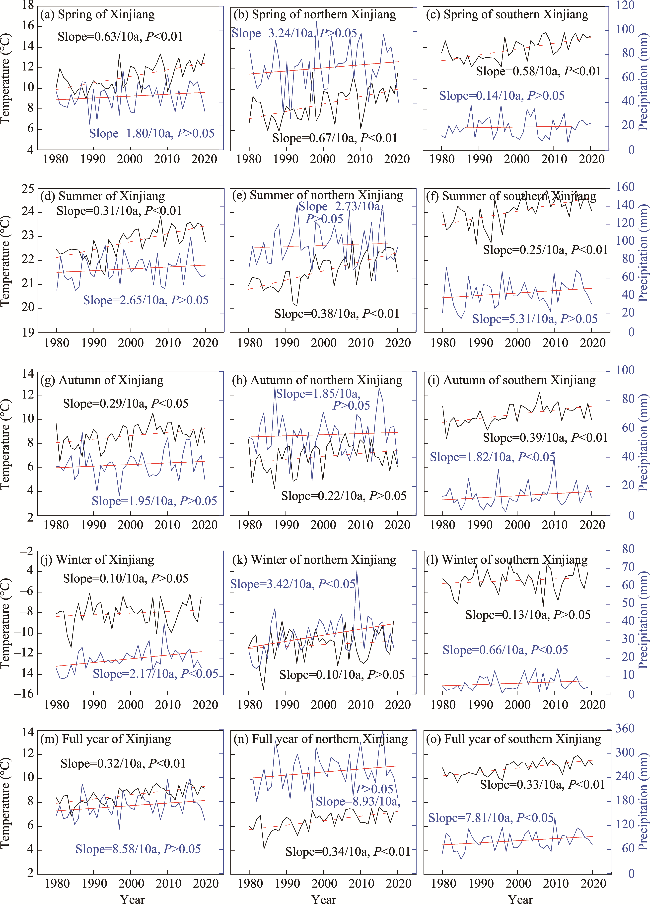
Fig. 4 Change trends of temperature and precipitation in Xinjiang (a, d, g, j, and m), northern Xinjiang (b, e, h, k, and n), and southern Xinjiang (c, f, i, l, and o) at seasonal and annual scales from 1980 to 2020 |
Table 4 Drought trends in Xinjiang at seasonal and annual scales from 1980 to 2020 |
| Region | SPEI trend (/10a) | ||||
|---|---|---|---|---|---|
| Spring | Summer | Autumn | Winter | Full year | |
| Xinjiang | -0.26* | -0.20 | -0.07 | 0.32* | -0.21 |
| Northern Xinjiang | -0.13 | -0.20 | -0.03 | 0.30* | -0.14 |
| Southern Xinjiang | -0.38* | -0.04 | -0.20 | 0.15 | -0.30* |
Note: Positive value indicates an increasing trend, while negative value indicates a decreasing trend. *, significance at P<0.05 level. |
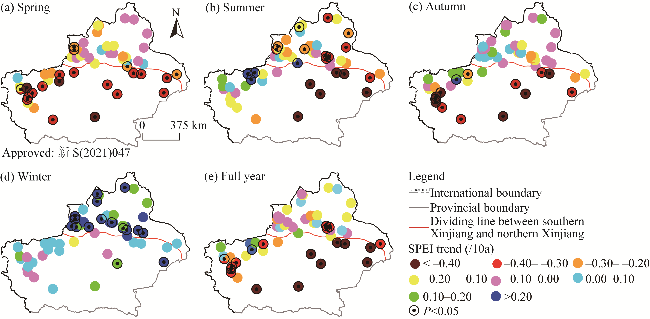
Fig. 5 Spatial distribution of drought trends in Xinjiang at seasonal (a-d) and annual (d) scales at from 1980 to 2020 |
Table 5 Drought trends in Xinjiang at seasonal and annual scales from 1980 to 2020 under different scenarios |
| Scenario | Region | SPEI trend (/10a) | ||||
|---|---|---|---|---|---|---|
| Spring | Summer | Autumn | Winter | Full year | ||
| Obs | Xinjiang | −0.26* | −0.20 | −0.07 | 0.32* | −0.21 |
| Northern Xinjiang | −0.13 | −0.20 | −0.03 | 0.30* | −0.14 | |
| Southern Xinjiang | −0.38* | −0.04 | −0.20 | 0.15 | −0.30* | |
| DtOp | Xinjiang | 0.12 | 0.16 | 0.14 | 0.32* | 0.25 |
| Northern Xinjiang | 0.16 | 0.09 | 0.08 | 0.30* | 0.15 | |
| Southern Xinjiang | 0.02 | 0.24 | 0.19 | 0.16 | 0.17 | |
| OtDp | Xinjiang | −0.30* | −0.32* | −0.17 | 0.02 | −0.28* |
| Northern Xinjiang | −0.19 | −0.26 | −0.06 | 0.03 | −0.25 | |
| Southern Xinjiang | −0.39* | −0.20 | −0.39* | 0.01 | −0.43* | |
Note: Positive value indicates an increasing trend, while negative value indicates a decreasing trend. *, significance at P<0.05 level. |
Fig. 6 Spatial distribution of drought trends in Xinjiang from 1980 to 2020 under the Obs (a, d, g, j, and m), DtOp (b, e, h, k, and n), and OtDp (c, f, i, l, and o) scenarios. Obs, observed temperature and precipitation; DtOp, detrended temperature and observed precipitation; OtDp, observed temperature and detrended precipitation. |
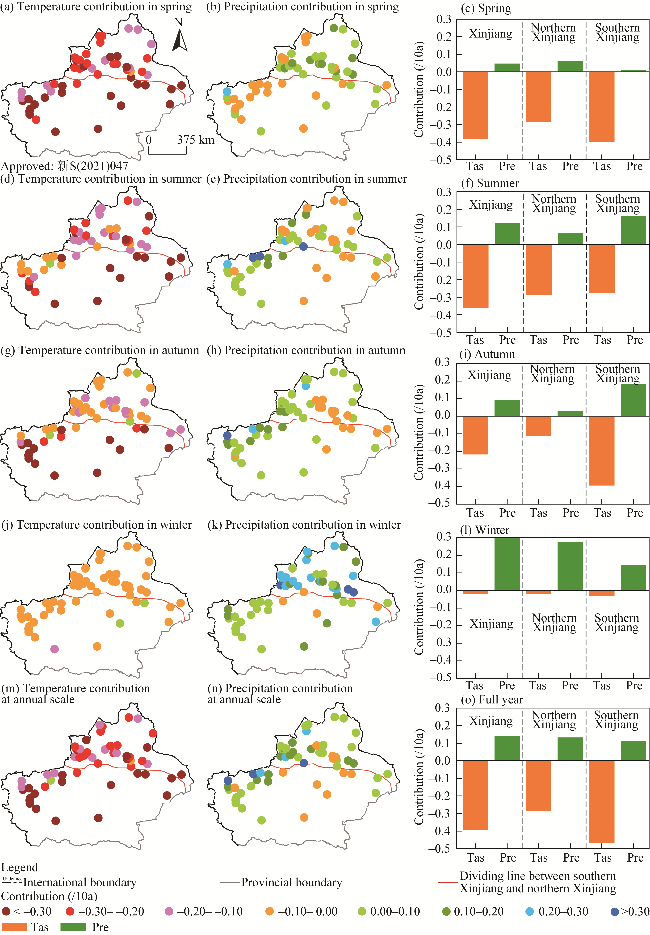
Fig. 7 Contribution of temperature and precipitation trends to drought trends at seasonal (a, b, c, d, e, f, h, i, j, k, and l) and annual (m, n, and o) scales in Xinjiang from 1980 to 2020. Tas, temperature; Pre, precipitation. |
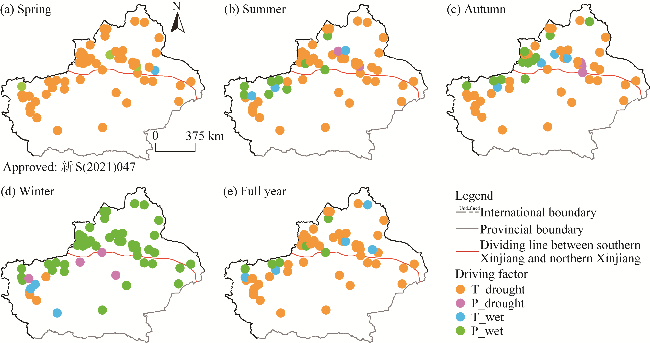
Fig. 8 Spatial distribution of dominant factors influencing the drought and wetting trends in Xinjiang at seasonal (a-d) and annual (e) scales from 1980 to 2020. T_drought, temperature-dominated drought trend; P_drought, precipitation-dominated drought trend; P_wet, precipitation-dominated wetting trend; T_wet, temperature-dominated wetting trend. |
Table 6 Temperature and precipitation trends in Xinjiang from 1980 to 2020 |
| Region | Temperature trend (°C/10a) | Precipitation trend (mm/10a) | ||||||||
|---|---|---|---|---|---|---|---|---|---|---|
| Spring | Summer | Autumn | Winter | Full year | Spring | Summer | Autumn | Winter | Full year | |
| Xinjiang | 0.63** | 0.31** | 0.29* | 0.10 | 0.32** | 1.80 | 2.65 | 1.95 | 2.17* | 8.58 |
| Northern Xinjiang | 0.67** | 0.38** | 0.22 | 0.10 | 0.34** | 3.24 | 2.73 | 1.85 | 3.42* | 8.93 |
| Southern Xinjiang | 0.58** | 0.25** | 0.39** | 0.13 | 0.33** | 0.14 | 5.31 | 1.82* | 0.66 | 7.81* |
Note: Positive value indicates an increasing trend, while negative value indicates a decreasing trend. *, significance at P<0.05 level; **, significance at P<0.01 level. |
| [1] |
|
| [2] |
|
| [3] |
|
| [4] |
|
| [5] |
|
| [6] |
|
| [7] |
|
| [8] |
|
| [9] |
|
| [10] |
|
| [11] |
|
| [12] |
|
| [13] |
|
| [14] |
|
| [15] |
|
| [16] |
|
| [17] |
|
| [18] |
|
| [19] |
|
| [20] |
|
| [21] |
|
| [22] |
|
| [23] |
|
| [24] |
|
| [25] |
|
| [26] |
|
| [27] |
|
| [28] |
|
| [29] |
|
| [30] |
|
| [31] |
|
| [32] |
|
| [33] |
|
| [34] |
|
| [35] |
|
| [36] |
|
| [37] |
|
| [38] |
|
| [39] |
|
| [40] |
|
| [41] |
|
| [42] |
|
| [43] |
|
| [44] |
|
| [45] |
|
| [46] |
|
| [47] |
|
| [48] |
|
| [49] |
|
| [50] |
|
| [51] |
|
| [52] |
|
| [53] |
|
| [54] |
|
| [55] |
|
| [56] |
|
| [57] |
|
| [58] |
|
| [59] |
|
| [60] |
|
| [61] |
|
| [62] |
|
/
| 〈 |
|
〉 |