Research article

Impact of climate and human activity on NDVI of various vegetation types in the Three-River Source Region, China

  • LU Qing 1, 2, 3, 4 ,
  • KANG Haili 3 ,
  • ZHANG Fuqing 3 ,
  • XIA Yuanping 3 ,
  • YAN Bing , 5, *
Expand
  • 1Research Center of Resource and Environment Economics, East China University of Technology, Nanchang 330013, China
  • 2Jiangxi Key Laboratory of Watershed Ecological Process and Information, East China University of Technology, Nanchang 330013, China
  • 3School of Surveying and Geoinformation Engineering, East China University of Technology, Nanchang 330013, China
  • 4Nanchang Key Laboratory of Landscape Process and Territorial Spatial Ecological Restoration, East China University of Technology, Nanchang 330013, China
  • 5Institute of Energy Research, Jiangxi Academy of Sciences, Nanchang 330096, China
*YAN Bing (E-mail: )

Received date: 2024-04-10

  Revised date: 2024-07-14

  Accepted date: 2024-07-18

  Online published: 2025-08-13

Abstract

The Three-River Source Region (TRSR) in China holds a vital position and exhibits an irreplaceable strategic importance in ecological preservation at the national level. On the basis of an in-depth study of the vegetation evolution in the TRSR from 2000 to 2022, we conducted a detailed analysis of the feedback mechanism of vegetation growth to climate change and human activity for different vegetation types. During the growing season, the spatiotemporal variations of normalized difference vegetation index (NDVI) for different vegetation types in the TRSR were analyzed using the Moderate Resolution Imaging Spectroradiometer (MODIS)-NDVI data and meteorological data from 2000 to 2022. In addition, the response characteristics of vegetation to temperature, precipitation, and human activity were assessed using trend analysis, partial correlation analysis, and residual analysis. Results indicated that, after in-depth research, from 2000 to 2022, the TRSR's average NDVI during the growing season was 0.3482. The preliminary ranking of the average NDVI for different vegetation types was as follows: shrubland (0.5762)>forest (0.5443)>meadow (0.4219)>highland vegetation (0.2223)>steppe (0.2159). The NDVI during the growing season exhibited a fluctuating growth trend, with an average growth rate of 0.0018/10a (P<0.01). Notably, forests displayed a significant development trend throughout the growing season, possessing the fastest rate of change in NDVI (0.0028/10a). Moreover, the upward trends in NDVI for forests and steppes exhibited extensive spatial distributions, with significant increases accounting for 95.23% and 93.80%, respectively. The sensitivity to precipitation was significantly enhanced in other vegetation types other than highland vegetation. By contrast, steppes, meadows, and highland vegetation demonstrated relatively high vulnerability to temperature fluctuations. A further detailed analysis revealed that climate change had a significant positive impact on the TRSR from 2000 to 2022, particularly in its northwestern areas, accounting for 85.05% of the total area. Meanwhile, human activity played a notable positive role in the southwestern and southeastern areas of the TRSR, covering 62.65% of the total area. Therefore, climate change had a significantly higher impact on NDVI during the growing season in the TRSR than human activity.

Cite this article

LU Qing , KANG Haili , ZHANG Fuqing , XIA Yuanping , YAN Bing . Impact of climate and human activity on NDVI of various vegetation types in the Three-River Source Region, China[J]. Journal of Arid Land, 2024 , 16(8) : 1080 -1097 . DOI: 10.1007/s40333-024-0104-1

1 Introduction

The Three-River Source Region (TRSR), the source of Yangtze, Yellow, and Lancang rivers, a significant Chinese water source conservation area, is essential to biodiversity preservation, water resource purification, and climate management (Feng et al., 2018). Although the TRSR has abundant natural resources, the biological system is delicate and vulnerable to human activity and climate change (Li et al., 2022a). Vegetation, a fundamental component of terrestrial ecosystems, exhibits exceptional sensitivity to climate change and human interventions (Gong et al., 2022), particularly in environmentally fragile regions such as the TRSR (Zheng et al., 2018). Amidst global climate change, the TRSR has witnessed numerous ecological disasters, including water scarcity, sediment dispersal, and sandstorms in the downstream reaches of major Asian rivers (Dong et al., 2022). Consequently, the Three-River Source National Nature Reserve was established in 2000, followed by the Three-River Source Ecological Engineering Project in 2005 (Liu et al., 2017), to implement a complete set of ecological and environmental protection measures. Monitoring the vegetation dynamics in this region is crucial for understanding ecological shifts and evaluating the effectiveness of conservation efforts.
Throughout the vegetation development phase, the normalized difference vegetation index (NDVI) is a crucial indicator for assessing the resistance and resilience of terrestrial ecosystems (Hossain and Li, 2021). It has been extensively used for crop growth monitoring and assessment (Li et al., 2019). Research conducted by scholars has revealed differences in vegetation changes and their reactions to climate change in various seasons (Mao et al., 2012; Chu et al., 2019; Peng et al., 2019). An apparent spatial heterogeneity pattern was found in the relationship between vegetation NDVI dynamics and climate factors across various time intervals (Liu et al., 2018). In recent years, the NDVI of most vegetation types on the Qinghai-Xizang Plateau (QXP) has exhibited an upward trend, with steppe, meadow, and highland vegetation exhibiting the most significant increase (Pang et al., 2017). The Three-River Source National Park, located in the central zone of the QTP, displayed a gradual yet consistent upward trajectory in its NDVI during the growth season spanning from 2000 to 2016. Among various vegetation types, shrubland growth was particularly pronounced, followed closely by meadows (Sun et al., 2020). Scholars improved the precision of NDVI spatial variations by leveraging the Moderate Resolution Imaging Spectroradiometer (MODIS)-NDVI data and contrasting measured values with simulated data, ultimately advancing researchers' comprehension of how vegetation will respond to future climatic shifts (Liu et al., 2020; Chen et al., 2021; Liu et al., 2023). An in-depth analysis of the interplay between NDVI and climatic factors highlighted the significant correlations of precipitation and temperature on NDVI in the TRSR (Ma et al., 2022). The connections among air temperature, precipitation, and NDVI are crucial to monitoring vegetation development under varying climatic circumstances and maintaining ecological balance, because these climatic factors supply the heat and water required for plant growth.
The heterogeneity of NDVI throughout the growing season is also influenced by human activity besides temperature, precipitation, and other factors (Jin et al., 2021). Clarifying this point is conducive to improving the understanding of vegetation changes and their causes. Many academics currently use long-term vegetation index (e.g., NDVI) data to examine the effects of prominent climatic factors (e.g., temperature and precipitation) and human activity on vegetation improvement. And some studies have been applied to distinguish the relative impacts of climate change and human activity on vegetation dynamics. For example, Ren et al. (2023) found that climate change greatly influenced Jilin Province's vegetation improvement compared with human activity. By contrast, Lin et al. (2022) found that human activity contributed to vegetation improvement in the Mu Us Sandy Land more than climate factors. Shi et al. (2021) distinguished among all vegetation changes that occurred on the Loess Plateau, indicating that human activity was the dominant driver of vegetation changes. Chen et al. (2024) discovered that human activity has had a larger impact on NDVI than climate change in northern China. Additionally, on a time scale, Liu et al. (2022) found that climate change dominated the growth of NDVI in southern China before 2000, and human activity dominated the changes in NDVI in most regions in China after 2000. Quantifying the contributions of climate change and human activity to vegetation changes is a pivotal step in developing sustainable restoration strategies (Ma et al., 2023). Most current studies on the spatiotemporal evolution of vegetation NDVI and its influencing factors in the TRSR focus on the combined effects of human activity and climate change (Jiang and Zhang, 2016; Li et al., 2018b). Therefore, this study examined the respective response characteristics of climate change and human activity to changes in vegetation NDVI in the TRSR without neglecting their respective impact.
Drawing upon MODIS-NDVI data, this study employed trend analysis, partial correlation analysis, and residual analysis techniques to examine the spatiotemporal evolution patterns of NDVI for various vegetation types in the TRSR from 2000 to 2022. We delved into the feedback mechanisms of vegetation growth in response to climate change, focusing on different vegetation types. In addition, we disentangled the contributions of climatic factors and human activity to NDVI variations to quantitatively assess the practical outcomes of ecological protection and development initiatives. This study focused on the TRSR with three primary goals given the mounting gravity of global warming: to explore the spatiotemporal patterns of NDVI throughout the growing season from 2000 to 2022; to separately assess the effects of climatic factors and human activity on vegetation improvement; and to analyze thoroughly the major climatic drivers underlying the variations in NDVI during the growing season. This study provides deep comprehension of the impacts of global warming on vegetation ecosystem in the TRSR and offers theoretical insights for promoting sustainable economic growth, raising ecological awareness, and devising conservation measures.

2 Study area

The TRSR (31°39′-36°12′N, 89°45′-102°23′E), located in the southern part of Qinghai Province in China, covers an area of 30.25×10⁴ km2, spanning 16 counties of 4 Tibetan autonomous prefectures (Yushu Tibetan Autonomous Prefecture, Golog Tibetan Autonomous Prefecture, Hainan Tibetan Autonomous Prefecture, and Huangnan Tibetan Autonomous Prefecture) as well as Tanggula Town in Golmud City of Haixi Mongolian and Tibetan Autonomous Prefecture. Nestled in the heart of the QTP, the TRSR is renowned as the core region of the "Roof of the World", boasting high altitudes and intricate terrain with an average elevation ranging from 3500 to 4800 m. This region is renowned for its robust water system, which serves as the origin of numerous rivers (Yangtze, Yellow, and Lancang rivers), imparting significant ecological significance (Xue et al., 2023). The TRSR, dubbed as the "Asian Water Tower" due to its abundant water resources, not only supplies ample water to downstream areas, but also serves as a crucial water source and runoff for rivers, lakes, and wetlands (Ning et al., 2022). In terms of climate, the region falls under the plateau sub-frigid monsoon semi-arid climate, featuring distinct cold and warm seasons, with an annual average temperature of 2.9°C (Cai et al., 2022). The vegetation in this area is predominantly composed of meadows and steppes, with highland vegetation and shrublands comprising a relatively minor share, ranging from 5.00% to 15.00%, and other vegetation types occupying an even smaller proportion. The growing season runs from May to September in the TRSR (Wang et al., 2020b; Zhai et al., 2022).

3 Data and methods

3.1 Data sources

3.1.1 NDVI data

We utilized NDVI data provided by the United States National Aeronautics and Space Administration (NASA; https://search.earthdata.nasa.gov/search). We acquired MOD13Q1 vegetation index products spanning the whole China from 2000 to 2022, with a spatial resolution of 1 km and a temporal resolution of 16 d. We applied the maximum value compositing method, which ensures that the monthly composite data accurately depict the vegetation distribution, to generate precise NDVI data. By cropping with ArcGIS 10.6 (Esri, Redlands, California, USA), NDVI data for the growing season in the TRSR were obtained.

3.1.2 Vegetation type data

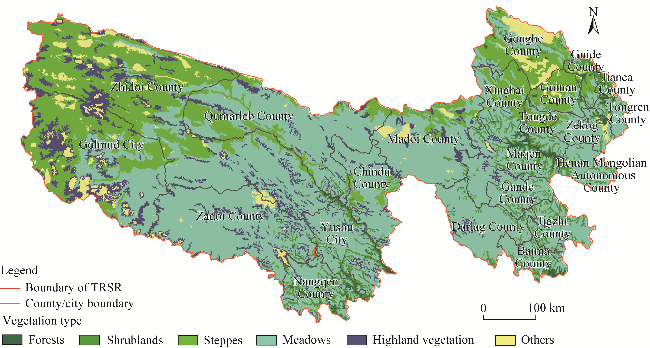
We gathered the TRSR's vegetation type data from the 1:1,000,000 vegetation type spatial distribution data that were provided by the Chinese Academy of Sciences Environmental and Resource Science Data (https://www.resdc.cn/). On the basis of the "1:1,000,000 Vegetation Map of China", which boasts a spatial resolution of 1 km, the distribution patterns, horizontal zonation, and vertical zonation attributes of 11 different vegetation types were comprehensively detailed. The TRSR includes nine types of vegetation: coniferous forests, broad-leaved forests, shrublands, meadows, steppes, highland vegetation, cultivated plants, deserts, and others. Given the relatively small number of coniferous and broad-leaved forests, we categorized them as "forests" for simplicity. The proportions of area of the different vegetation types in the TRSR are as follows: steppes (23.38%), meadows (55.41%), highland vegetation (9.12%), shrublands (6.06%), forests (1.97%), and other types (4.06%). Our study primarily delved into the crucial vegetation types, including steppes, meadows, highland vegetation, shrublands, and forests (Fig. 1).
Fig. 1 Spatial distribution of different vegetation types in the Three-River Source Region (TRSR)

3.1.3 Climate data

We obtained the meteorological information of the TRSR, which includes 1 km resolution datasets of monthly average temperature and monthly average precipitation from 2000 to 2022, from the China National Earth System Science Data Center (http://www.geodata.cn/).

3.2 Methods

3.2.1 Trend analysis

Trend analysis is used to analyze variables over time through linear regression. The statistical methodology of least squares is applied to model the NDVI trends over time for each distinct vegetation type. This method is suitable for analyzing the interannual variation trend of NDVI for various vegetation types in the TRSR from 2000 to 2022, image by image. The mathematical formula is as follows:
$\text { slope }=\frac{n \sum_{i=1}^{n}\left(i \times \mathrm{NDVI}_{i}\right)-\sum_{i=1}^{n} i \times \sum_{i=1}^{n} \mathrm{NDVI}_{i}}{n \sum_{i=1}^{n} i^{2}-\left(\sum_{i=1}^{n} i\right)^{2}},$
where slope is to the slope of the tendency to change; NDVIi is the mean NDVI value for a given year i; and n is the span of years. A positive slope value signifies a growing trend in NDVI for the respective pixel, a slope value of zero indicates stability, and a negative slope value suggests a declining trend. To further elaborate on these trends, we classified them into five categories based on F-test significance: extremely significant increase (slope>0, P<0.01), significant increase (slope>0, 0.01≤P≤0.05), non-significant change (P>0.05), significant decrease (slope<0, 0.01≤P≤0.05), and extremely significant decrease (slope<0, P<0.01).

3.2.2 Residual analysis

Residual analysis emerges as an effective quantitative tool for assessing the specific impact of human activity on vegetation NDVI. This approach considers the predicted NDVI as a baseline influenced solely by climate change. We further explored the relationship between temperature and precipitation as independent variables and NDVI as the dependent variable by constructing a multiple regression analysis model. We developed a residual analysis model that focuses on calculating the difference between actual and predicted NDVI values, known as residual, to accurately measure the impact of human activity. We can effectively exclude other non-primary influencing factors and focus on elucidating the specific impact of human activity on vegetation NDVI through this methodology. The mathematical representations of this analytical approach are detailed as follows:
$\mathrm{NDVI}_{\mathrm{CC}}=a \times T+b \times P+c,$
$\mathrm{NDVI}_{\mathrm{HA}}=\mathrm{NDVI}_{\text {obs }}-\mathrm{NDVI}_{\mathrm{CC}},$
where T and P are the mean temperature (°C) and precipitation (mm) during the growing season, respectively, with a, b, and c introduced as model parameters; NDVICC is the predicted NDVI value based on regression models; NDVIobs is the actual NDVI value obtained from remote sensing images; and NDVIHA is the impact of human activity on vegetation growth. A positive NDVIHA indicates that human activity facilitates plant growth; conversely, a negative value signifies inhibition of plant development; and a zero value suggests no significant impact of human activity on vegetation growth. To dissect the contributions of climate change and human activity to NDVI, we stratified the residual results into distinct categories, focusing on two overarching scenarios: areas of vegetation increase and areas of vegetation decrease (Table 1). For areas of vegetation increase, three scenarios were identified: (1) where both NDVICC>0 and NDVIHA>0, both climate change and human activity contribute to vegetation enhancement; (2) where NDVICC>0 but NDVIHA<0, climate change alone leads to increased vegetation coverage; and (3) conversely, where NDVICC<0 yet NDVIHA>0, human activity is the sole driver of expanded vegetation coverage. In contrast, for areas of vegetation decrease, three analogous scenarios were delineated: (1) where both NDVICC<0 and NDVIHA<0, both climate change and human activity contribute to vegetation loss; (2) where NDVICC<0 but NDVIHA>0, climate change solely results in decreased vegetation coverage; (3) and finally, where NDVICC>0 but NDVIHA<0, human activity drives the reduction in vegetation area (Sun et al., 2015).
Table 1 Relative contribution of climate change and human activity to normalized difference vegetation index (NDVI) variations under various scenarios
Category Scenario Slope Relative contribution rate (%)
NDVICC NDVIHA NDVICC NDVIHA
Area of vegetation increase Scenario 1 >0 >0 $\frac{\left|\Delta \mathrm{NDVI}_{\mathrm{CC}}\right|}{\left|\Delta \mathrm{NDVI}_{\mathrm{CC}}\right|+\left|\Delta \mathrm{NDVI}_{\mathrm{HA}}\right|} \times 100 \%$ $\frac{\left|\Delta \mathrm{NDVI}_{\mathrm{HA}}\right|}{\left|\Delta \mathrm{NDVI}_{\mathrm{CC}}\right|+\left|\Delta \mathrm{NDVI}_{\mathrm{HA}}\right|} \times 100 \%$
Scenario 2 >0 <0 100.00 0.00
Scenario 3 <0 >0 0.00 100.00
Area of vegetation decrease Scenario 1 <0 <0 $\frac{\left|\Delta \mathrm{NDVI}_{\mathrm{CC}}\right|}{\left|\Delta \mathrm{NDVI}_{\mathrm{CC}}\right|+\left|\Delta \mathrm{NDVI}_{\mathrm{HA}}\right|} \times 100 \%$ $\frac{\left|\Delta \mathrm{NDVI}_{\mathrm{CC}}\right|}{\left|\Delta \mathrm{NDVI}_{\mathrm{CC}}\right|+\left|\Delta \mathrm{NDVI}_{\mathrm{HA}}\right|} \times 100 \%$
Scenario 2 <0 >0 100.00 0.00
Scenario 3 >0 <0 0.00 100.00

Note: NDVICC is the potential impact trend of climate changes on NDVI variations during the growing season; NDVIHA is the impact trend of human activities on NDVI variations; ΔNDVICC is the variations in NDVI predicted by climate changes alone at time t+j compared with NDVI at time t, of which j is the incremental time; ΔNDVIHA is the difference in the variation of NDVI residual under human activities compared with that without human activity disturbance.

3.2.3 Pearson correlation analysis

We adopted Pearson correlation analysis in pursuit of a deeper understanding of how NDVI responds to climate change (Tong et al., 2017; Kumar et al., 2023). This method enables us to isolate and evaluate the impact of temperature on the variations in NDVI, disregarding precipitation factor as well as the influence of precipitation on the dynamics of NDVI while overlooking temperature variations. The formula of this approach is as follows:
$R_{x y, z}=\frac{R_{x y}-R_{x z} \times R_{y z}}{\sqrt{\left(1-R_{x z}^{2}\right)\left(1-R_{y z}^{2}\right)}},$
where Rxy,z is the partial correlation coefficient with the controlling variable z (temperature or precipitation); and Rxy, Rxz, and Ryz are the correlation coefficients between precipitation and vegetation, temperature and vegetation, and temperature and precipitation, respectively. The t-test results categorized the trend changes into five distinct classes: no significant correlation (θ=0), significant positive correlation (θ>0, P≤0.05), significant negative correlation (θ<0, P≤0.05), non-significant positive correlation (θ>0, P>0.05), and non-significant negative correlation (θ<0, P>0.05). This classification facilitates a more precise understanding of the correlations and their significance among different factors.

4 Results

4.1 Spatial and temporal changes in NDVI

4.1.1 Temporal changes in NDVI

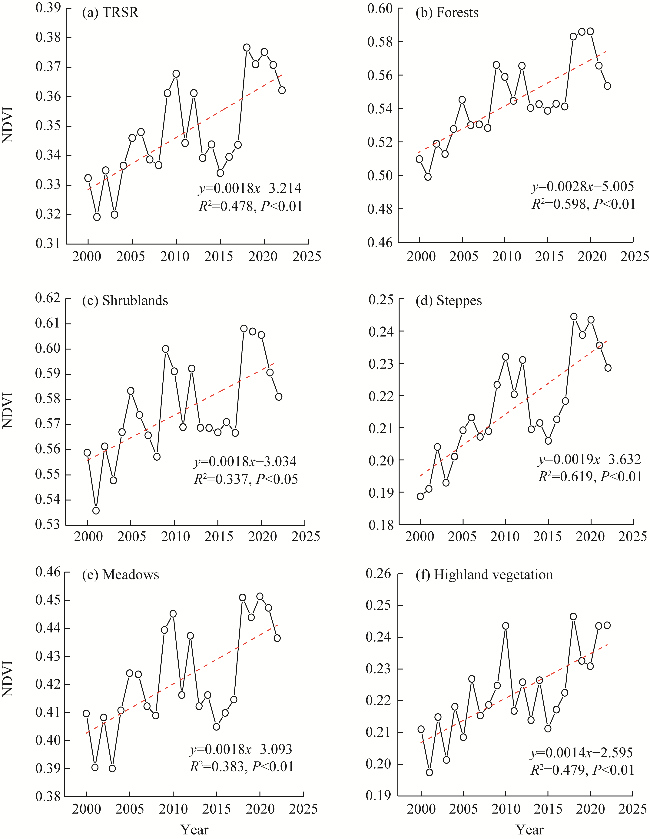
We conducted a detailed analysis on NDVI time series data to explore the temporal dynamics of vegetation coverage in the TRSR from 2000 to 2022 (Fig. 2). The primary objective was to elucidate the long-term trend in vegetation coverage variation. The analysis revealed that the annual average NDVI ranged from 0.3192 to 0.3767 from 2000 to 2022, of which 2018 was the year with the highest average NDVI of 0.3767, whereas 2001 recorded the lowest value of 0.3192. Overall, from 2000 to 2022, the average NDVI of the growing season in the TRSR generally displayed an increasing tendency, with a mean growth rate of 0.0018/10a (P<0.01).
Fig. 2 Interannual change in normalized difference vegetation index (NDVI) of the TRSR (a) and different vegetation types (b-f) during the growing season from 2000 to 2022
Figure 2 illustrates that the average NDVI of diverse vegetation types exhibited marked variations according to growth magnitude and velocity. Among all the five vegetation types, forests had a remarkable growth rate of 0.0028/10a, displaying a fluctuating pattern of NDVI increase. Among all the vegetation types examined, shrublands ranked high in terms of vegetation index, peaking at 0.6082 in 2018 and the lowest at 0.5363 in 2001, similar to the trend of steppes. Further analysis of historical data revealed that while the NDVI value of forests during the growing season was slightly lower than that of shrublands, they still reached a high value of 0.5863 in 2020, contrary to the lowest value of 0.4991 in 2001. Overall, the NDVI of various vegetation types exhibited a general upward trend with fluctuations. Notably, since the spring of 2018, precipitation in the TRSR has increased abnormally, ranging from 20.00% to 90.00% higher than usual. This condition directly contributed to the peak NDVI in 2018. Conversely, in years with abnormally low precipitation, such as in 2001 and 2003, the NDVI plummeted to troughs. This variation underscored the significant impact of precipitation on vegetation growth.

4.1.2 Spatial changes in NDVI

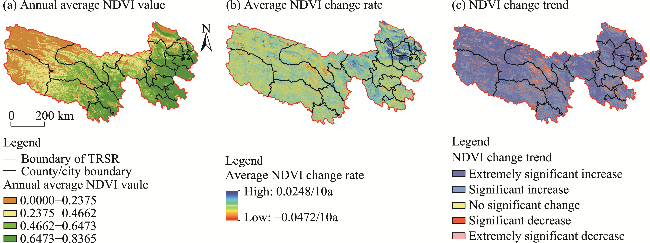
A thorough analysis of the spatial distribution of NDVI change trends for vegetation coverage in the TRSR was conducted. The northeastern part of the region had higher NDVI, whereas the central and western areas had lower values, revealing significant regional disparities (Fig. 3a). During the growing season, the TRSR experienced a marked upward trend, spreading from southwest to northeast (Fig. 3b). Notably, 90.53% of the region exhibited an increasing NDVI trend, significantly exceeding the areas with a decreasing trend, indicating a healthy vegetation coverage in the TRSR.
Fig. 3 Spatial distribution of NDVI variations in the TRSR during the growing season from 2000 to 2022. (a), annual average NDVI; (b), change rate of average NDVI; (c), change trend of average NDVI.
In addition, the area with a notable increase in NDVI encompassed 56.98% of the total region, primarily located in the northeastern and northwestern parts of the TRSR (Fig. 3c). Conversely, in the southeastern, middle, and small areas in the northwest of the TRSR, the NDVI presented a downward trend, and the central area exhibited a notable decrease, which is attributable to the preponderance of shrublands and steppes. These areas had endured prolonged drought conditions, resulting in a measurable degradation of the local vegetation.
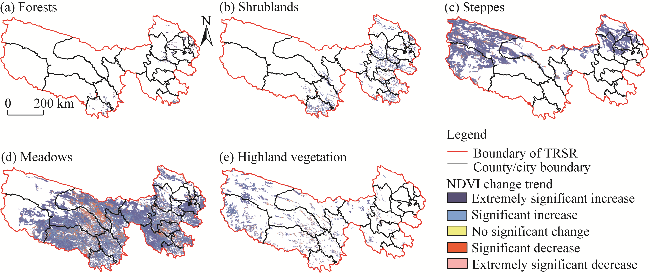
Regarding spatial distribution, the NDVI increased over most of the TRSR, accounting for 90.53% of the total area (P<0.01). The southeastern, central, and small areas in the northwestern TRSR showed a declining trend in NDVI, making up 9.44% of the entire area (0.01≤P≤0.05). The vegetation distribution indicated that, forests (95.23%) and steppes (93.80%) exhibited a broad range of NDVI increase (Fig. 4). Meanwhile, the proportion of area of shrublands, meadows, and highland vegetation showed a decreasing trend in NDVI exceeded 10.00%. In summary, more vegetation types showed a growing trend than a decreasing trend concerning proportion.
Fig. 4 Spatial change trend of NDVI of different vegetation types in the TRSR during the growing season from 2000 to 2022. (a), forests; (b), shrublands; (c), steppes; (d), meadows; (e), highland vegetation.

4.2 Anthropogenic impacts on NDVI

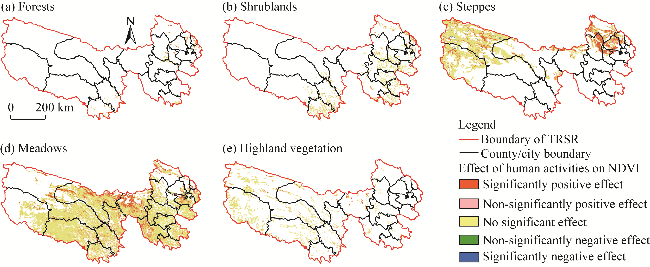
The criteria for determining driving factors suggested that 90.53% of the TRSR had improved plants, arising from the interaction of human activity and climate change. In addition, improvement covered most of the region, except for the central part and small patches in the northeastern and southeastern TRSR. The residual analysis indicated that steppes and forests were significantly influenced by human activity, with the proportion of area exhibiting a significantly positive effect at 20.15% and 26.48%, respectively (Fig. 5). Moreover, the main distribution of areas with significantly positive impacts was in the northeast for steppes and in central part for forests. More areas with human activity showed no apparent impact on other vegetation types. Therefore, NDVI variations across various vegetation types in the TRSR primarily resulted from climate change.
Fig. 5 Spatial distribution of human activity contribution to NDVI variations of different vegetation types in the TRSR during the growing season from 2000 to 2022. (a), forests; (b), shrublands; (c), steppes; (d), meadows; (e), highland vegetation.

4.3 Relative contributions of climate change and human activity to NDVI

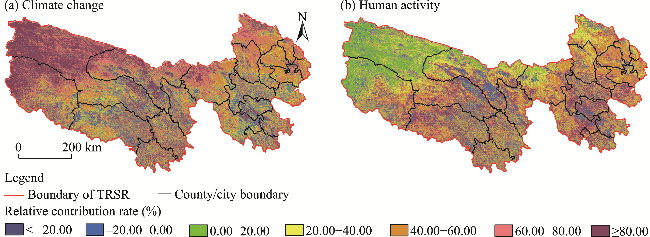
The relative contributions of climate change and human activity to the volatility in NDVI during the growing season in the TRSR were obtained using the actual values, residual values, and the slopes of residuals of NDVI (Table 2). Under the driving force of climate change, the area with positive contribution to forests was about 93.34% of the total forest area, which was the vegetation type with the maximum positive contribution area; in addition, the area with negative contribution to highland vegetation was only 13.89% of the total highland vegetation area, while the negative contribution area of other vegetation types was less than 10.00% (Table 3), mainly distributed in the southwest and southeast of the TRSR, indicating that climate change mainly promoted vegetation growth (Fig. 6).
Table 2 Proportion of area contributed by climate change and human activity to NDVI variations in the TRSR from 2000 to 2022
Relative contribution rate (%) Proportion of area (%)
Climate change Human activity
< -20.00 1.17 8.74
-20.00-0.00 13.78 28.61
0.00-20.00 9.64 14.56
20.00-40.00 19.16 10.23
40.00-60.00 19.11 12.59
60.00-80.00 17.02 9.69
≥80.00 20.12 15.58
Table 3 Proportion of area contributed by climate change and human activity to NDVI variations in different vegetation types in the TRSR from 2000 to 2022
Relative contribution
rate (%)
Proportion of area (%)
Climate change Human activity
Forest Shrubland Steppe Meadow Highland vegetation Forest Shrubland Steppe Meadow Highland vegetation
< -20.00 1.02 0.92 0.36 0.38 1.12 1.92 1.84 1.24 1.26 2.11
-20.00-0.00 5.64 8.83 6.58 9.58 12.77 8.65 17.64 4.45 16.09 10.46
0.00-20.00 9.84 7.75 36.95 8.84 28.16 8.17 11.35 2.12 9.33 5.18
20.00-40.00 23.90 15.61 25.97 17.61 19.78 16.34 17.89 6.30 16.51 9.24
40.00-60.00 27.24 20.79 18.07 22.46 14.09 27.24 20.79 18.07 22.46 14.09
60.00-80.00 16.34 17.89 6.30 16.51 9.24 23.02 14.73 25.09 16.73 18.82
≥80.00 16.02 28.19 5.77 24.62 14.84 14.68 15.79 42.73 17.62 40.10
Fig. 6 Spatial distribution of relative contribution of climate change (a) and human activity (b) to NDVI variations in the TRSR from 2000 to 2022
Previous studies indicated a close relationship between human activity and steppes and forests; thus, this section focuses on these two vegetation types. Under the influence of human activity, the relative contribution rate of forests was 40.00%-60.00%, accounting for approximately 27.24% of the total forest area, mainly concentrated in Guinan County. Negative NDVI contribution rates of steppes and forests were 5.69% and 10.57%, respectively, suggesting that plant growth was not merely the outcome of natural forces (Table 3). Notably, human interventions had considerable influence in fostering plant growth. Specifically, the relative contribution rate of human activity to steppes exceeded 80.00%, accounting for 42.73% of the total steppe area. Herders possessed a profound understanding of ecological conservation given their reliance on steppes for their livelihoods. This understanding has fostered the widespread adoption of artificial grass, thereby significantly enhancing the sustainability of steppes and further improving the vegetative growth in these areas.

4.4 Major climatic influences on NDVI

4.4.1 Effects of precipitation on NDVI

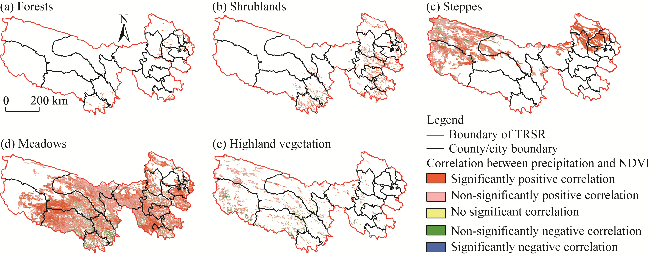
According to the partial correlation analysis' outcomes and significant test between NDVI and precipitation during the growing season in different vegetation types in the TRSR from 2000 to 2022, except for highland vegetation (P>0.05), precipitation had a superior effect on vegetation types. The partial correlation coefficient between average precipitation of the growing season and forest NDVI was 0.65 (P<0.01), which was the highest of all vegetation types (Table 4). A significant positive correlation accounted for 46.23% of the total forest area, distributed in Maqen County and Guinan County, while a non-significant positive correlation accounted for 43.51% of the total forest area, mainly distributed in the northeast of Zekog County (Fig. 7). In addition, the partial correlation coefficient between average precipitation of the growing season and steppe NDVI was 0.56 (P<0.01), showing a significant positive correlation for 43.48% of the entire steppe area, which were mainly distributed in the northern counties bounded by Xinghai County as well as in Zhidoi County (Table 5). While 49.62% area of steppes were non-significantly positively correlated, mainly distributed in the northwestern part of Golmud City.
Table 4 Correlation between average precipitation of the growing season and NDVI of different vegetation types in the TRSR from 2000 to 2022
Vegetation type Partial correlation coefficient P
Forests 0.65 0.001
Shrublands 0.54 0.010
Steppes 0.56 0.007
Meadows 0.52 0.014
Highland vegetation 0.37 0.091
Fig. 7 Spatial distribution of correlation between average precipitation and NDVI of different vegetation types in the TRSR from 2000 to 2022. (a), forests; (b), shrublands; (c), steppes; (d), meadows; (e), highland vegetation.
Table 5 Proportion of area occupied by different correlation levels between precipitation and NDVI of different vegetation types in the TRSR from 2000 to 2022
Correlation level Proportion of area (%)
Forests Shrublands Steppes Meadows Highland vegetation
Significantly positive correlation 46.23 40.31 43.48 37.63 15.83
Non-significantly positive correlation 43.51 49.46 49.62 53.10 61.25
No significant correlation 0.36 0.29 0.18 0.12 0.55
Significantly negative correlation 0.73 0.37 0.25 0.32 0.88
Non-significantly negative correlation 9.19 9.58 6.47 8.85 21.47

4.4.2 Effects of temperature on NDVI

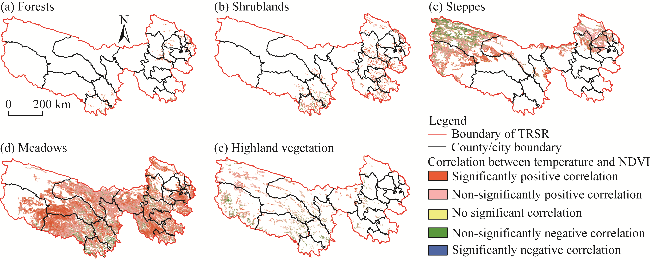
Partial correlation analysis and significance testing between NDVI of different vegetation types and average temperature of the growing season illustrated that the impacts of average temperature of the growing season on steppes, meadows, and highland vegetation, except for forests and shrublands (P>0.05), were significant (Table 6). Delving into the relationship between NDVI of highland vegetation and temperature, we observed an unequivocally significant positive correlation (θ=0.61, P<0.01). Further analysis revealed that this significant positive correlation covered 28.08% of the total highland vegetation area, primarily concentrated in areas where temperature changes had a marked promotional effect on vegetation growth such as northwest part of Zhiduo County. However, nearly half (49.14%) of the highland vegetation area did not exhibit a significant positive correlation with temperature, primarily distributed in the northwestern part of Zhidoi County and Golmud City (Fig. 8). Furthermore, the meadows' net vegetation index demonstrated a non-significantly positive correlation (47.34% of the total meadow area) and a significantly positive correlation (44.07% of the total meadow area) with temperature (Table 7), with a partial correlation coefficient of 0.52 (P<0.05). The significantly positive correlation mainly focused on the most areas of Zadoi and Darlag counties. However, the non-significantly positive correlation mainly occurred in Yushu City and Nangqen County, indicating that the positive correlation still dominated.
Table 6 Correlation between average temperature of the growing season and the NDVI of different vegetation types in the TRSR from 2000 to 2022
Vegetation type Partial correlation coefficient P
Forests 0.12 0.594
Shrublands 0.27 0.225
Steppes 0.42 0.049
Meadows 0.52 0.014
Highland vegetation 0.61 0.002
Fig. 8 Spatial distribution of correlation between temperature and NDVI of different vegetation types in the TRSR from 2000 to 2022. (a), forests; (b), shrublands; (c), steppes; (d), meadows; (e), highland vegetation.
Table 7 Proportion of area occupied by different correlation levels between temperature and the NDVI of different vegetation types in the TRSR from 2000 to 2022
Correlation level Proportion of area (%)
Forests Shrublands Steppes Meadows Highland vegetation
Significantly positive correlation 27.41 30.98 21.27 44.07 28.08
Non-significantly positive correlation 57.01 55.45 57.55 47.34 49.14
No significant correlation 0.36 0.29 0.18 0.12 0.54
Significantly negative correlation 0.89 0.53 0.55 0.26 0.82
Non-significantly negative correlation 14.34 12.76 20.46 8.21 21.42

5 Discussion

From 2000 to 2022, an extremely significant increase was observed in the NDVI of TRSR, except for a few areas with a decreasing trend. The notable recent improvement in vegetation conditions in the TRSR has also been validated by earlier investigations, with NDVI increasing from west to east, consistent with existing research results (Hu et al., 2011; Liu et al., 2014a). This study found that the area of decreased NDVI in meadows and highland vegetation were greater than 10.00% due to reduced precipitation. By contrast, other vegetation types showed varying degrees of increasing trend. The notable accomplishments in ecological restoration in the TRSR in recent years might be largely attributed to numerous national key ecological projects (Shen et al., 2018). The present study highlighted the remarkable heterogeneity observed in the dynamic shifts of NDVI. Extensive inquiries have dissected the influential factors behind these changes, including human and natural factors (Yang et al., 2021; Li et al., 2022b). In the realm of anthropogenic factors, researchers have included economic indicators such as population density and gross domestic product (GDP) (Xu et al., 2020; Yang et al., 2024). In the natural factor domain, scholars have conducted a thorough analysis of climatic variables, including precipitation, temperature, and evapotranspiration, and geographical factors like soil type and vegetation type, as well as topographical characteristics such as elevation and slope, and confirmed the importance of topographic factors on vegetation growth processes (Wang et al., 2021a; Xu et al., 2024). Natural factors occupy a central position in dictating the dynamics of NDVI (Meng et al., 2020), and research has consistently indicated that climate change is the primary determinant of the dynamic variations in NDVI across a wide range of regions (Jiao et al., 2021; Yi et al., 2022; Yu et al., 2023).
To investigate how the NDVI of different vegetation types has changed over time in the TRSR, we used the residual analysis method to differentiate the factors related to climate and human activity that affect fluctuations in NDVI. In this study, the NDVI and dominating factors' correlations and significance levels were determined. When juxtaposed with earlier research on the spatiotemporal evolution of NDVI and the factors controlling it in the TRSR (Liu et al., 2014b; Zhang et al., 2016), the primary influencing elements for NDVI were discovered, and the impact of climatic factors and human activity in this study was quantified. The NDVI in the TRSR exhibited a pronounced correlation with the temporal evolution of meteorological variables, particularly during the peak vegetation growth season (July-August). During this period, temperature and precipitation fluctuations played a pivotal role in enhancing the NDVI of diverse vegetation types, displaying a dominant positive correlation. A comprehensive comparative analysis revealed that, although the NDVI of steppe and forest ecosystems was significantly influenced by human activity, this impact was relatively subdued in the TRSR when juxtaposed against the overarching influence of climate change dynamics (Liu et al., 2014a; Li et al., 2018a).
Notably, human interventions have not manifested marked stimulatory or inhibitory effects on meadows, highland vegetation, and shrublands, suggesting a limited or non-significant influence on their NDVI (Wang et al., 2021b; Sun et al., 2022). In most areas of the TRSR, human activity slightly affected various vegetation types. According to an analysis of the driving mechanisms underlying NDVI fluctuations over the growing season, these results were in line with earlier studies (Gao et al., 2021; Zhang and Jin, 2021). The primary cause of this finding is that the TRSR is constrained by harsh natural conditions, characterized by high altitude, low temperatures, thin atmosphere, and relatively low population density. In addition, the economic activities in the TRSR are primarily focused on animal husbandry (Fang et al., 2011), leading to significant human impacts on steppes and forests, with negative contributions of 5.69% and 10.97%, respectively. Overall, in the TRSR, NDVI varies during the growing season mainly due to climatic factors (Zhang and Jin, 2021), with human activity having a negligible impact on vegetation changes.
In accordance with the existing study results in the TRSR, correlational research was carried out on the climate factors causing NDVI changes in various vegetation types. The results demonstrated a general positive correlation between vegetation NDVI and air temperature, as well as between precipitation and NDVI in the TRSR, and the correlations between forests, shrublands, steppes, and meadows and precipitation were more significant. Nevertheless, highland vegetation and precipitation did not significantly correlate (P>0.05). The TRSR has witnessed a gradual decline in glacier and snow cover (Wang et al., 2022; Wang et al., 2023), as well as reduced annual precipitation, owing to the consequences of global warming. Consequently, the high adaptability of highland vegetation to the mountainous environment has rendered the non-significant correlation between precipitation and highland vegetation. The findings of the NDVI change analysis conducted in the TRSR indicated that precipitation affected the northeastern half of the region the most (Wang et al., 2020a). Conversely, the western portion of the territory is severely affected by temperature, whereas the southern portion is largely unaffected by either temperature or precipitation (Zhai et al., 2020). Simultaneously, in the analysis of link between temperature and NDVI of various vegetation types, for example steppes, meadows, and highland vegetation exhibited a more pronounced correlation with temperature, whereas forests and shrublands showed non-significant correlation with temperature. Only from May to September, when the growing season is in full swing, can the monthly average temperature in the TRSR normally get achieve 0°C. During periods of lower temperatures, vegetation growth is hampered (Miehe et al., 2019), and forests may fail to thrive, potentially transitioning into shrubland. Consequently, the correlations between forests and shrublands and temperature are not significant.
In-depth research has been conducted on the feedback mechanism of vegetation growth on climate change, clarifying the contributions of climate factors and human activity to NDVI and determining the optimal range or type of factors suitable for vegetation growth in the TRSR. These findings revealed the patterns of vegetation change in the TRSR in recent years and the impacts of environmental factors on NDVI changes. The research results provide a scientific basis for regional ecological protection. While our study has made significant strides in deepening the comprehension of the mechanisms driving vegetation changes and uncovering the intricate relationships among vegetation, climate, and human activity, we must acknowledge its limitations. Initially, we failed to adequately incorporate the synergistic effects of climatic, socioeconomic, and environmental variables (Miehe et al., 2019), which are crucial for grasping the complexities of vegetation dynamics. Furthermore, our analysis disregarded the significance of soil metabolism in influencing the trends in NDVI change (Zhang et al., 2023). In addition, our current investigation was limited to exploring the impacts of just two climatic factors, temperature and precipitation, on NDVI, whereas the effects of other climatic variables such as humidity, solar radiation, and wind speed remain unexplored. Therefore, in the future research, we should gradually improve and expand the range of driving factors, considering the improvement of the accuracy and applicability of research.

6 Conclusions

Along with the effects of climatic conditions and human activity on NDVI, the temporal and spatial fluctuations of NDVI during the vegetation growing season in the TRSR from 2000 to 2022 were examined. From 2000 to 2022, the average NDVI of the TRSR during the growing season displayed an overall fluctuating upward trend. Specifically, a significant NDVI increase accounted for 90.53% of the whole area, indicating the widespread nature of this growth. Despite geographic differences in vegetation types, an overall increase was renowned, reflecting a healthy vegetation coverage and stability. Climate change and human activity were pivotal driving forces shaping vegetation dynamics. In the case of the TRSR, the proportion of the area (in the northwest), where climate change contributed positively to vegetation changes, accounted for approximately 85.05% of the total area. Meanwhile, the area (in the southwest and southeast), where human activity had a positive impact, comprised roughly 62.65% of the total area, indicating that climate change was the dominant driver of vegetation improvement in this region. Amidst the diverse vegetation types in the TRSR, the interplay between NDVI and climatic factors such as temperature and precipitation, revealed a nuanced pattern. Despite instances in which these factors correlated negatively, the preponderance of positive correlations emerged as a defining trend. A meticulous examination of the influence of crucial climatic variables on NDVI across various vegetation types underscored that precipitation was the pivotal climatic driver of NDVI fluctuations during the growth season.

Conflict of interest

The authors declare that they have no known competing financial interests or personal relationships that could have appeared to influence the work reported in this paper.

Acknowledgements

This study was supported by the National Natural Science Foundation of China (42377472, 42174055), the Jiangxi Provincial Social Science "Fourteenth Five-Year Plan" (2024) Fund Project (24GL45), the Research Center of Resource and Environment Economics (20RGL01), and the Provincial Finance Project of Jiangxi Academy of Sciences - Young Talent Cultivation Program (2023YSBG50010).

Author contributions

Data curation: KANG Haili, LU Qing; Methodology: LU Qing, KANG Haili; Formal analysis: LU Qing; Conceptualization: LU Qing, YAN Bing; Writing - original draft preparation: LU Qing, KANG Haili; Writing - review and editing: YAN Bing, ZHANG Fuqing, XIA Yuanping; Funding acquisition: YAN Bing; Visualization: LU Qing. All authors approved the manuscript.
[1]
Cai Z Y, Song P F, Wang J B, et al. 2022. Grazing pressure index considering both wildlife and livestock in Three-River Headwaters, Qinghai-Tibetan Plateau. Ecological Indicators, 143: 109338, doi: 10.1016/j.ecolind.2022.109338.

[2]
Chen J H, Wang S Q, Chen B, et al. 2021. Comparative analysis on the estimation of diurnal solar-induced chlorophyll fluorescence dynamics for a subtropical evergreen coniferous forest. Remote Sensing, 13(16): 3143, doi: 10.3390/rs13163143.

[3]
Chen M Z, Xue Y Y, Xue Y B, et al. 2024. Assessing the effects of climate and human activity on vegetation change in Northern China. Environmental Research, 247: 118233, doi: 10.1016/j.envres.2024.118233.

[4]
Chu H S, Venevsky S, Wu C, et al. 2019. NDVI-based vegetation dynamics and its response to climate changes at Amur-Heilongjiang River Basin from 1982 to 2015. Science of the Total Environment, 650: 2051-2062.

[5]
Dong S K, Shang Z H, Gao J X, et al. 2022. Enhancing the ecological services of the Qinghai-Tibetan Plateau's grasslands through sustainable restoration and management in era of global change. Agriculture, Ecosystems & Environment, 326: 107756, doi: 10.1016/j.agee.2021.107756.

[6]
Fang Y P, Qin D H, Ding Y J. 2011. Frozen soil change and adaptation of animal husbandry: a case of the source regions of Yangtze and Yellow Rivers. Environmental Science & Policy, 14(5): 555-568.

[7]
Feng S R, Guo L, Li D D, et al. 2018. Spatial patterns of landscape change in the Three Rivers Headwaters Region of China, 1987-2015. Acta Ecologica Sinica, 38(2): 76-80.

[8]
Gao S Q, Dong G T, Jiang X H, et al. 2021. Quantification of natural and anthropogenic driving forces of vegetation changes in the Three-River Headwater Region during 1982-2015 based on geographical detector model. Remote Sensing, 13(20): 4175, doi: 10.3390/rs13204175.

[9]
Gong X W, Li Y Q, Wang X Y, et al. 2022. Quantitative assessment of the contributions of climate change and human activities on vegetation degradation and restoration in typical ecologically fragile areas of China. Ecological Indicators, 144: 109536, doi: 10.1016/j.ecolind.2022.109536.

[10]
Hossain M, Li J F. 2021. NDVI-based vegetation dynamics and its resistance and resilience to different intensities of climatic events. Global Ecology and Conservation, 30: e01768, doi: 10.1016/j.gecco.2021.e01768.

[11]
Hu M Q, Mao F, Sun H, et al. 2011. Study of normalized difference vegetation index variation and its correlation with climate factors in the Three-River-Source Region. International Journal of Applied Earth Observation and Geoinformation, 13(1): 24-33.

[12]
Jiang C, Zhang L B. 2016. Ecosystem change assessment in the Three-river Headwater Region, China: Patterns, causes, and implications. Ecological Engineering, 93: 24-36.

[13]
Jiao K W, Gao J B, Liu Z H, et al. 2021. Revealing climatic impacts on the temporal and spatial variation in vegetation activity across China: Sensitivity and contribution. Advances in Climate Change Research, 12(3): 409-420.

[14]
Jin H Y, Chen X H, Wang Y M, et al. 2021. Spatio-temporal distribution of NDVI and its influencing factors in China. Journal of Hydrology, 603: 127129, doi: 10.1016/j.jhydrol.2021.127129.

[15]
Kumar V, Bharti B, Singh H, et al. 2023. Assessing the interrelation between NDVI and climate dependent variables by using granger causality test and vector auto-regressive neural network model. Physics and Chemistry of the Earth, Parts A/B/C, 131: 103428, doi: 10.1016/j.pce.2023.103428.

[16]
Li C C, Li H J, Li J Z, et al. 2019. Using NDVI percentiles to monitor real-time crop growth. Computers and Electronics in Agriculture, 162: 357-363.

[17]
Li L H, Zhang Y L, Liu L S, et al. 2018a. Spatiotemporal patterns of vegetation greenness change and associated climatic and anthropogenic drivers on the Tibetan Plateau during 2000-2015. Remote Sensing, 10(10): 1525, doi: 10.3390/rs10101525.

[18]
Li P, Peng C H, Wang M, et al. 2018b. Dynamics of vegetation autumn phenology and its response to multiple environmental factors from 1982 to 2012 on Qinghai-Tibetan Plateau in China. Science of the Total Environment, 637-638: 855-864.

[19]
Li S H, Yu D Y, Huang T, et al. 2022a. Identifying priority conservation areas based on comprehensive consideration of biodiversity and ecosystem services in the Three-River Headwaters Region, China. Journal of Cleaner Production, 359: 132082, doi: 10.1016/j.jclepro.2022.132082.

[20]
Li S K, Li X B, Gong J R, et al. 2022b. Quantitative analysis of natural and anthropogenic factors influencing vegetation NDVI changes in temperate drylands from a spatial stratified heterogeneity perspective: a case study of Inner Mongolia grasslands, China. Remote Sensing, 14(14): 3320, doi: 10.3390/rs14143320.

[21]
Lin M, Hou L Z, Qi Z M, et al. 2022. Impacts of climate change and human activities on vegetation NDVI in China's Mu Us Sandy Land during 2000-2019. Ecological Indicators, 142: 109164, doi: 10.1016/j.ecolind.2022.109164.

[22]
Liu D, Cao C X, Dubovyk O, et al. 2017. Using fuzzy analytic hierarchy process for spatio-temporal analysis of eco-environmental vulnerability change during 1990-2010 in Sanjiangyuan region, China. Ecological Indicators, 73: 612-625.

[23]
Liu H J, Zhao X Q, Han X P, et al. 2020. Comparative study of gut microbiota in Tibetan wild asses (Equus kiang) and domestic donkeys (Equus asinus) on the Qinghai-Tibet plateau. PeerJ, 8: e9032, doi: 10.7717/peerj.9032.

[24]
Liu H Y, Zhang M Y, Lin Z S, et al. 2018. Spatial heterogeneity of the relationship between vegetation dynamics and climate change and their driving forces at multiple time scales in Southwest China. Agricultural and Forest Meteorology, 256-257: 10-21.

[25]
Liu X F, Zhang J S, Zhu X F, et al. 2014a. Spatiotemporal changes in vegetation coverage and its driving factors in the Three-River Headwaters Region during 2000-2011. Journal of Geographical Sciences, 24: 288-302.

[26]
Liu X F, Zhu X F, Zhu W Q, et al. 2014b. Changes in spring phenology in the Three-Rivers Headwater Region from 1999 to 2013. Remote Sensing, 6(9): 9130-9144.

[27]
Liu Y, Liu H H, Chen Y, et al. 2022. Quantifying the contributions of climate change and human activities to vegetation dynamic in China based on multiple indices. Science of the Total Environment, 838: 156553, doi: 10.1016/j.scitotenv.2022.156553.

[28]
Liu Y F, Xu M, Guo B, et al. 2023. Changes in the vegetation NPP of mainland China under the combined actions of climatic-socioeconomic factors. Forests, 14(12): 2341, doi: 10.3390/f14122341.

[29]
Ma B R, Zeng W H, Hu G Z, et al. 2022. Normalized difference vegetation index prediction based on the delta downscaling method and back-propagation artificial neural network under climate change in the Sanjiangyuan region, China. Ecological Informatics, 72: 101883, doi: 10.1016/j.ecoinf.2022.101883.

[30]
Ma M Y, Wang Q M, Liu R, et al. 2023. Effects of climate change and human activities on vegetation coverage change in northern China considering extreme climate and time-lag and -accumulation effects. Science of the Total Environment, 860: 160527, doi: 10.1016/j.scitotenv.2022.160527.

[31]
Mao D H, Wang Z M, Luo L, et al. 2012. Integrating AVHRR and MODIS data to monitor NDVI changes and their relationships with climatic parameters in Northeast China. International Journal of Applied Earth Observation and Geoinformation, 18: 528-536.

[32]
Meng X Y, Gao X, Li S Y, et al. 2020. Spatial and temporal characteristics of vegetation NDVI changes and the driving forces in Mongolia during 1982-2015. Remote Sensing, 12(4): 603, doi: 10.3390/rs12040603.

[33]
Miehe G, Schleuss P, Seeber E, et al. 2019. The Kobresia pygmaea ecosystem of the Tibetan highlands—Origin, functioning and degradation of the world's largest pastoral alpine ecosystem. Science of the Total Environment, 648: 754-771.

[34]
Ning X G, Zhu N, Liu Y F, et al. 2022. Quantifying impacts of climate and human activities on the grassland in the Three-River Headwater Region after two phases of ecological project. Geography and Sustainability, 3(2): 164-176.

[35]
Pang G J, Wang X J, Yang M X. 2017. Using the NDVI to identify variations in, and responses of, vegetation to climate change on the Tibetan Plateau from 1982 to 2012. Quaternary International, 444(Part A): 87-96.

[36]
Peng W F, Kuang T T, Tao S. 2019. Quantifying influences of natural factors on vegetation NDVI changes based on geographical detector in Sichuan, western China. Journal of Cleaner Production, 233: 353-367.

[37]
Ren Y T, Zhang F, Zhao C L, et al. 2023. Attribution of climate change and human activities to vegetation NDVI in Jilin Province, China during 1998-2020. Ecological Indicators, 153: 110415, doi: 10.1016/j.ecolind.2023.110415.

[38]
Shen X J, An R, Feng L, et al. 2018. Vegetation changes in the Three-River Headwaters Region of the Tibetan Plateau of China. Ecological Indicators, 93: 804-812.

[39]
Shi S Y, Yu J J, Wang F, et al. 2021. Quantitative contributions of climate change and human activities to vegetation changes over multiple time scales on the Loess Plateau. Science of the Total Environment, 755: 142419, doi: 10.1016/j.scitotenv.2020.142419.

[40]
Sun L J, Zhao D, Zhang G Z, et al. 2022. Using SPOT VEGETATION for analyzing dynamic changes and influencing factors on vegetation restoration in the Three-River Headwaters Region in the last 20 years (2000-2019), China. Ecological Engineering, 183: 106742, doi: 10.1016/j.ecoleng.2022.106742.

[41]
Sun Q Y, Liu W W, Gao Y N, et al. 2020. Spatiotemporal variation and climate influence factors of vegetation ecological quality in the Sanjiangyuan National Park. Sustainability, 12(16): 6634, doi: 10.3390/su12166634.

[42]
Sun Y L, Yang Y L, Zhang L, et al. 2015. The relative roles of climate variations and human activities in vegetation change in North China. Physics and Chemistry of the Earth, Parts A/B/C, 87-88: 67-78.

[43]
Tong S Q, Zhang J Q, Bao Y H, et al. 2017. Spatial and temporal variations of vegetation cover and the relationships with climate factors in Inner Mongolia based on GIMMS NDVI3g data. Journal of Arid Land, 9(3): 394-407.

[44]
Wang C Y, Wang J N, Naudiyal N, et al. 2021a. Multiple effects of topographic factors on spatio-temporal variations of vegetation patterns in the Three Parallel Rivers Region, Southeast Qinghai-Tibet Plateau. Remote Sensing, 14(1): 151, doi: 10.3390/rs14010151.

[45]
Wang G Q, Li J Y, Sivakumar B, et al. 2020a. Attribution of growing season vegetation activity to climate change and human activities in the Three-River Headwaters Region, China. Journal of Hydroinformatics, 22(1): 186-204.

[46]
Wang J Y, Sun H Z, Xiong J N, et al. 2021b. Dynamics and drivers of vegetation phenology in Three-River Headwaters Region based on the Google Earth Engine. Remote Sensing, 13(13): 2528, doi: 10.3390/rs13132528.

[47]
Wang L, Bi Y Q, Wang F T, et al. 2022. Scrutinise the variations of glaciers and their climatic attributions in the Sanjiangyuan National Park during 1969-2018. Advances in Climate Change Research, 13(4): 531-539.

[48]
Wang M Y, Fu J, Wu Z T, et al. 2020b. Spatiotemporal variation of NDVI in the vegetation growing season in the source region of the Yellow River, China. ISPRS International Journal of Geo-Information, 9(4): 282, doi: 10.3390/ijgi9040282.

[49]
Wang R J, Ding Y J, Shangguan D H, et al. 2023. Projections of glacier peak water and its timing in the Sanjiangyuan on the Tibet Plateau. Journal of Hydrology: Regional Studies, 45: 101313, doi: 10.1016/j.ejrh.2022.101313.

[50]
Xu B N, Li J J, Liu Y G, et al. 2024. Disentangling the response of vegetation dynamics to natural and anthropogenic drivers over the Qinghai-Tibet Plateau using dimensionality reduction and structural equation model. Forest Ecology and Management, 554: 121677, doi: 10.1016/j.foreco.2023.121677.

[51]
Xu J Y, Chen J X, Liu Y X, et al. 2020. Identification of the geographical factors influencing the relationships between ecosystem services in the Belt and Road region from 2010 to 2030. Journal of Cleaner Production, 275: 124153, doi: 10.1016/j.jclepro.2020.124153.

[52]
Xue J, Li Z X, Feng Q, et al. 2023. Construction of ecological conservation pattern based on ecosystem services of Three River Headwaters, western China. Global Ecology and Conservation, 44: e02491, doi: 10.1016/j.gecco.2023.e02491.

[53]
Yang J, Yan D M, Yu Z L, et al. 2024. NDVI variations of different terrestrial ecosystems and their response to major driving factors on two side regions of the Hu-Line. Ecological Indicators, 159: 111667, doi: 10.1016/j.ecolind.2024.111667.

[54]
Yang L, Shen F X, Zhang L, et al. 2021. Quantifying influences of natural and anthropogenic factors on vegetation changes using structural equation modeling: A case study in Jiangsu Province, China. Journal of Cleaner Production, 280: 124330, doi: 10.1016/j.jclepro.2020.124330.

[55]
Yi L, Sun Y, Ouyang X, et al. 2022. Identifying the impacts of climate change and human activities on vegetation cover changes: a case study of the Yangtze River Basin, China. International Journal of Environmental Research and Public Health, 19(10): 6239, doi: 10.3390/ijerph19106239.

[56]
Yu S, Du W L, Zhang X, et al. 2023. Spatiotemporal changes in NDVI and its driving factors in the Kherlen River Basin. Chinese Geographical Science, 33: 377-392.

[57]
Zhai D C, Gao X Z, Li B L, et al. 2022. Diverse chronic responses of vegetation aboveground net primary productivity to climatic changes on Three-River Headwaters region. Ecological Indicators, 139: 108925, doi: 10.1016/j.ecolind.2022.108925.

[58]
Zhai X H, Liang X L, Yan C Z, et al. 2020. Vegetation dynamic changes and their response to ecological engineering in the Sanjiangyuan Region of China. Remote Sensing, 12(24): 4035, doi: 10.3390/rs12244035.

[59]
Zhang L H, Jia L Z, He L Y, et al. 2023. Homeostatic evidence of management-induced phosphorus decoupling from soil microbial carbon and nitrogen metabolism. Journal of Plant Ecology, 16(6): rtad035, doi: 10.1093/jpe/rtad035.

[60]
Zhang X C, Jin X M. 2021. Vegetation dynamics and responses to climate change and anthropogenic activities in the Three-River Headwaters Region, China. Ecological Indicators, 131: 108223, doi: 10.1016/j.ecolind.2021.108223.

[61]
Zhang Y, Zhang C B, Wang Z Q, et al. 2016. Vegetation dynamics and its driving forces from climate change and human activities in the Three-River Source Region, China from 1982 to 2012. Science of the Total Environment, 563-564: 210-220.

[62]
Zheng Y T, Han J C, Huang Y F, et al. 2018. Vegetation response to climate conditions based on NDVI simulations using stepwise cluster analysis for the Three-River Headwaters region of China. Ecological Indicators, 92: 18-29.

Outlines

/