Research article

Land use/cover change and ecological network in Gansu Province, China during 2000-2020 and their simulations in 2050

  • MA Xinshu 1 ,
  • XIN Cunlin , 1, * ,
  • CHEN Ning 1 ,
  • XIN Shunjie 2 ,
  • CHEN Hongxiang 1 ,
  • ZHANG Bo 1 ,
  • KANG Ligang 1 ,
  • WANG Yu 1 ,
  • JIAO Jirong 3
Expand
  • 1College of Geography and Environmental Science, Northwest Normal University, Lanzhou 730070, China
  • 2College of Earth and Environment Science, Lanzhou University, Lanzhou 730030, China
  • 3School of Architecture and Urban Planning, Lanzhou Jiaotong University, Lanzhou 730070, China
*XIN Cunlin (E-mail: )

Received date: 2024-07-03

  Revised date: 2024-11-18

  Accepted date: 2024-11-25

  Online published: 2025-08-13

Abstract

Land use/cover change (LUCC) constitutes the spatial and temporal patterns of ecological security, and the construction of ecological networks is an effective way to ensure ecological security. Exploring the spatial and temporal change characteristics of ecological network and analyzing the integrated relationship between LUCC and ecological security are crucial for ensuring regional ecological security. Gansu is one of the provinces with fragile ecological environment in China, and rapid changes in land use patterns in recent decades have threatened ecological security. Therefore, taking Gansu Province as the study area, this study simulated its land use pattern in 2050 using patch-generating land use simulation (PLUS) model based on the LUCC trend from 2000 to 2020 and integrated the LUCC into morphological spatial pattern analysis (MSPA) to identify ecological sources and extract the ecological corridors to construct ecological network using circuit theory. The results revealed that, according to the prediction results in 2050, the areas of cultivated land, forest land, grassland, water body, construction land, and unused land would be 63,447.52, 39,510.80, 148,115.18, 4605.21, 8368.89, and 161,752.40 km2, respectively. The number of ecological sources in Gansu Province would increase to 80, with a total area of 99,927.18 km2. The number of ecological corridors would increase to 191, with an estimated total length of 6120.66 km. Both ecological sources and ecological corridors showed a sparse distribution in the northwest and dense distribution in the southeast of the province at the spatial scale. The number of ecological pinch points would reach 312 and the total area would expect to increase to 842.84 km2, with the most pronounced increase in the Longdong region. Compared with 2020, the number and area of ecological barriers in 2050 would decrease significantly by 63 and 370.71 km2, respectively. In general, based on the prediction results, the connectivity of ecological network of Gansu Province would increase in 2050. To achieve the predicted ecological network in 2050, emphasis should be placed on the protection of cultivated land and ecological land, the establishment of ecological sources in desert areas, the reinforcement of the protection for existing ecological sources, and the construction of ecological corridors to enhance the stability of ecological network. This study provides valuable theoretical support and references for the future construction of ecological networks and regional land resource management decision-making.

Cite this article

MA Xinshu , XIN Cunlin , CHEN Ning , XIN Shunjie , CHEN Hongxiang , ZHANG Bo , KANG Ligang , WANG Yu , JIAO Jirong . Land use/cover change and ecological network in Gansu Province, China during 2000-2020 and their simulations in 2050[J]. Journal of Arid Land, 2025 , 17(1) : 43 -57 . DOI: 10.1007/s40333-025-0092-9

1 Introduction

As a hub between human activities and natural environment, land use/cover change (LUCC) links ecological processes such as the water, atmospheric, and soil cycle (Wang et al. 2023b). Increased human activities have led to unprecedented changes in land cover over past few decades, which directly reflects the impact of human activities on ecosystems and threatens regional ecological security (Li et al., 2021a). Due to close linkage to public well-being and social stability, ecological security becomes a crucial component of national security. Therefore, maintaining ecological security is highly important. The construction of ecological networks is a key strategy for solving regional ecological security problems and guaranteeing sustainable land use (An et al., 2021).
The ecological networks initially originated in landscape ecology, and previous research fields of ecological networks mainly focused on biodiversity conservation, ecosystem services, and spatiotemporal evolution (Opdam et al., 2006; Théau et al., 2015; Peng et al., 2018; Modica et al., 2021; Popescu et al., 2022). The study of ecological networks mostly concentrated on urban lands, industrial developed areas, watersheds, drylands, plateau areas, etc. (Yu et al., 2017; Shi et al., 2020; Yu et al., 2021; Jia et al., 2023; Jiang et al., 2023; Li et al., 2023a; Li et al., 2023b). Through continuous researches, researchers has established the following process for ecological networks: (1) identifying ecological sources; (2) establishing ecological resistance surface; and (3) extracting ecological corridors (Fan et al., 2021; Nie et al., 2021; Wang et al., 2021b). Ecological sources are habitat patches that are crucial for regional ecological security and possess radiative function, serving as the foundation for the establishment of ecological networks (Wu et al., 2013). The combination of morphological spatial pattern analysis (MSPA) and landscape connectivity assessment has been introduced for ecological source identification in recent years to improve the scientificity and objectivity of ecological source selection (Aminzadeh and Khansefid, 2010). Ecological resistance surface describes the difficulty of species in moving through different habitat patches and reflects the horizontal resistance to ecological processes. Ecological resistance surface is typically determined by land use types and supplemented by factors such as elevation and slope (Cui et al., 2020). Ecological corridors provide channels for species migration and energy flow. Currently, the application of circuit theory in the identification of ecological corridors has received more attention (Li et al., 2023b). Circuit theory uses the random wandering properties of electrons in circuit to simulate the moving species and energy in landscape to achieve a state closer to actual biological migration, in addition to identifying ecological pinch points and ecological barriers in the corridor (Dickson et al., 2019; Liu et al., 2023). Ecological pinch points are necessary place for organism migration and should be prioritized for protection in ecological network construction (Wang and Zhao, 2024). Ecological barriers refer to areas in which the movement of organisms between habitats is hindered. Identifying ecological barriers and removing or improving them can greatly weaken the resistance of ecological processes and improve landscape connectivity (Chen et al., 2023).
Notably, prolonged high-intensity land use has severely disrupted many ecological sources and corridors, further influencing the process of ecological networks identification and posing significant threats to the long-term stability and sustainability of ecological networks (Hou et al., 2022; Li et al., 2022). Considering ecological networks solely from historical and current perspectives is insufficient to address the demands of future ecological protection and governance. Modeling LUCC is conductive to our understanding of ecosystems and their dynamic processes. Additionally, LUCC plays an essential role in shaping the spatiotemporal patterns of ecological security, and the interplay between LUCC and ecological security has become a central focus of ecological environmental research (Zheng et al., 2015; Kucsicsa et al., 2019). Current LUCC simulation models include future land-use simulation (FLUS) (Fu et al., 2018), cellular automata-markov (CA-Markov) (Zhao et al., 2019), conversion of land use and its effects (CLUES) (Islam et al., 2021), and patch-generating land use simulation (PLUS) (Liang et al., 2021). The PLUS model combines a rule mining framework using land expansion analysis strategy (LEAS) module and a cellular automata model based on multi-type random seeds (CARS). Due to high precision, PLUS model has been widely applied in modelling future land use patterns. For instance, Zhang et al. (2022) used PLUS model to predict landscape patterns under different local shared socio-economic pathway (SSP) scenarios in Fujian Delta region; and Xu et al. (2022) simulated the urban expansion of Hangzhou metropolitan area.
Gansu Province serves as a critical ecological security barrier in northwestern China and an important water conservation area in the upper reaches of Yellow River and Yangtze River. It holds a strategic position in China's overall ecological security network (Guo et al., 2023). To date, ecological security issues in Gansu Province have become increasingly prominent due to significant shifts in land use patterns. Therefore, exploring the spatial and temporal evolution characteristics of ecological networks and analyzing the impact of LUCC on ecological security are crucial to ensuring the ecological security of Gansu Province. This study analyzed the spatial and temporal changes in land use in Gansu Province from 2000 to 2020 and simulated the land use pattern in 2050 using PLUS model. The MSPA model was coupled with circuit theory to identify ecological sources, resistance surfaces, pinch points, corridors, and barriers based on LUCC, thereby establishing the ecological network of Gansu Province in 2000, 2020, and 2050. The result of the study might provide reasonable instructions for land use policies and ecological protection for Gansu Province.

2 Materials

2.1 Study area

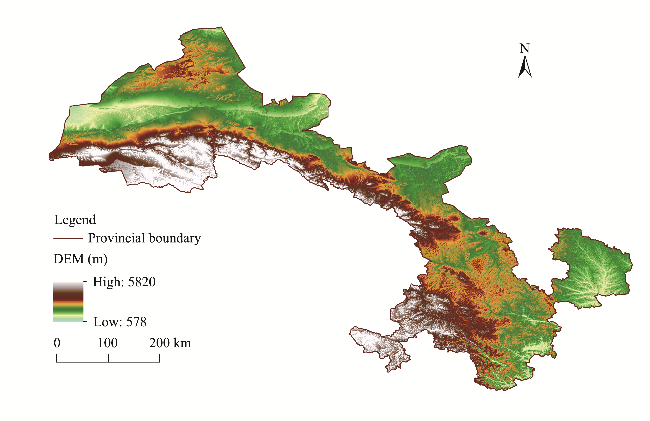
Gansu Province (32°11′-42°57′N, 92°13′-108°46′E; Fig. 1) is located in northwestern China, at the intersection zone of the Loess Plateau, Qinghai-Xizang Plateau, and Inner Mongolian Plateau. Covering an area of approximately 425,800.00 km2, the province features a narrow and elongated topography, with complex and diverse geological landforms, climatic conditions, and fragile ecological systems. The unique geographical location results in different land use patterns from east to west of the province. The central and western part of Gansu Province is the Hexi Corridor, which has less precipitation and strong evapotranspiration, presenting the landscape transition characteristics of mountain-oasis-desert. The southeastern part is the junction of the Qinghai-Xizang Plateau and Loess Plateau and has a monsoon climate, with diverse terrain such as mountains and hills, forest lands, and grasslands (Yin et al., 2023).
Fig. 1 Topography of Gansu Province. DEM, digital elevation model.

2.2 Data sources

The data used in this study included three dimensions: land use, socio-economy, and climatic environment (Table 1). For the purpose of subsequent modeling and analysis, we reclassified land use into six types: cultivated land, forest land, grassland, water body, construction land, and unused land. The socio-economic factors involved in this study included gross domestic product (GDP), population, and distance to road (the road in this study included national highway, provincial highway, and railway), of which the data for the factor of distance to road were processed by ArcGIS v.10.8 software (Esri, Redlands, California, USA) through the Euclidean distance model. The climatic environmental factors utilized in this study included digital elevation model (DEM), slope, annual precipitation, annual average temperature, soil type, and soil erosion. We conducted all spatial analyses using ArcGIS v.10.8 software and resampled the raster resolution to 100 m×100 m to ensure data consistency and model accuracy.
Table 1 Indicators used in this study and their data sources
Data type Indicator Year Resolution Data source
Land use Land use/cover change (LUCC) 2000, 2010, and 2020 30 m Resources and Environmental Science Data Platform, Chinese Academy of Sciences (https://www.resdc.cn)
Socio-economy Gross domestic product (GDP; ×104 CNY/km2) 2020 1 km Resources and Environmental Science Data Platform, Chinese Academy of Sciences (https://www.resdc.cn)
Population (people/km2) 2020 1 km Resources and Environmental Science Data Platform, Chinese Academy of Sciences (https://www.resdc.cn)
Distance to road (m) 2020 100 m Open Street Map (https://www.openhistoricalmap.org)
Climatic environment Digital elevation
model (DEM; m)
2020 90 m Resources and Environmental Science Data Platform, Chinese Academy of Sciences (https://www.resdc.cn)
Slope (°) 2020 90 m
Annual precipitation (mm) 2020 1 km
Annual average temperature (°C) 2020 1 km
Soil type 1995 1 km
Soil erosion (t/(km2•a)) 1995 1 km

3 Methods

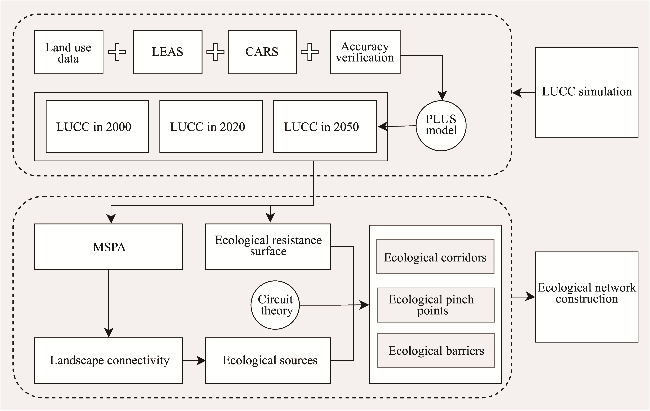
In this study, we adopted PLUS model to predict the land use pattern of Gansu Province in 2050. And then, the land use data were integrated with MSPA and through landscape connectivity to identify ecological sources. Ecological sources and ecological resistance surfaces were integrated into circuit theory to determine ecological corridors, ecological pinch points, and ecological barriers. Finally, the ecological network of Gansu Province was constructed. The research framework of this study is shown in Figure 2.
Fig. 2 Research framework of this study. LEAS, land expansion analysis strategy; CARS, cellular automata model based on multi-type random Seeds; PLUS, patch-generating land use simulation; LUCC, land use/cover change; MSPA, morphological spatial pattern analysis.

3.1 LUCC simulation modeling

The PLUS model simulates LUCC in two stages. In the first stage, LEAS module analyzes historical land use data to explore spatial relationships among various driving factors and uncover conversion rules for different land use types, forming an adaptive graph set for land use conversion. In the second stage, based on the land expansion conversion rules from the first stage, CARS module utilizes cellular automata with a threshold-decreasing rule in iterative time for space allocation (Chen and Ning, 2024).

3.1.1 Determination of neighborhood weight

Neighborhood weight represents the expansion capacity of one land use type driven by external factors (Liang et al., 2018). The change in the area of one land use type reflects the expansion intensity of the land use type. The dimensionless value of the area change meets the parameter requirements of the neighborhood weight in PLUS model in terms of data meaning and data structure (Wang et al., 2023a). Therefore, the calculation formula of the neighborhood weight is as follows:
$W=\frac{\Delta \text{T}{{\text{A}}_{i}}\Delta \text{T}{{\text{A}}_{\min }}}{\Delta \text{T}{{\text{A}}_{\max }}\Delta \text{T}{{\text{A}}_{\min }}}$,
where W is the neighborhood weight of each land use type; ∆TAi is the change in area of land use type i (km2); ∆TAmin is the smallest area change among six land use types (km2); and ∆TAmax is the largest area change among six land use types (km2). According to the change in area of each land use type in Gansu Province from 2010 to 2020, we calculated the neighborhood weight of each land use type, as shown in Table 2.
Table 2 Neighborhood weight of each land use type
Land use type Cultivated land Forest land Grassland Water body Construction land Unused land
Neighborhood weight 0.00 0.48 0.78 0.61 1.00 0.07

3.1.2 Transfer matrix

To simulate the land use pattern of Gansu Province in 2050, we used the land use conversion constraint matrix module in the PLUS model with the land use data of Gansu Province in 2020 (Table 3).
Table 3 Land use transition matrix
Land use type Cultivated land Forest land Grassland Water body Construction land Unused land
Cultivated land 1 1 1 1 1 1
Forest land 1 1 1 1 1 1
Grassland 1 1 1 1 1 1
Water body 0 0 0 1 0 0
Construction land 1 1 1 1 1 1
Unused land 1 1 1 1 1 1

Note: The number 1 represents that two land use types can be converted into each other, while the number 0 indicates can't (Mondal et al., 2016).

3.1.3 Accuracy verification

We simulated the land use pattern of Gansu Province in 2020 using PLUS model with the land use data of 2000 and 2010. Then, the simulation results were validated against the actual land use situation of Gansu Province in 2020. The validation results showed that the kappa coefficient was 0.91 and the overall accuracy value was 0.93, indicating that the simulation effect was satisfactory and the land use pattern of Gansu Province in 2050 could be predicted by this model.

3.2 Ecological network construction

3.2.1 Identification of ecological source

In this study, a comprehensive landscape analysis was performed using MSPA in combination with landscape connectivity assessment to identify ecological sources. First, land use data of Gansu Province in 2000, 2020, and 2050 were imported into MSPA to identify the ecological patches. The forest land, grassland, and water body were assigned a foreground value of 1, while cultivated land, construction land, and unused land were assigned background value of 2. Although MSPA is able to identify the ecological patches, it could not differentiate their importance (Zhou and Song, 2021). In this study, we calculated the importance of each ecological patches in ecological network using Conefor v.2.6 software (Jenness Enterprises, Flagstaff, Arizona, USA).
$\text{PC}=\frac{\sum\nolimits_{i=1}^{n}{\sum\nolimits_{j=1}^{n}{{{P}_{ij}}{{a}_{i}}{{a}_{j}}}}}{\text{A}{{\text{L}}^{2}}}$,
$d\text{PC}i=\frac{\operatorname{PC}\text{P}{{\text{C}}_{\text{remove}}}}{\text{PC}}\times 100%$,
where PC is the overall connectivity index of all ecological patches; n is the total number of ecological patches in the study area; pij is the maximum likelihood index of migration between patch i and patch j; ai and aj are the areas of ecological patches i and j, respectively (km2); AL is the total area of ecological patches (km2); dPCi is the importance level of ecological patch i; and PCremove is connectivity index after removing the ecological patch i. According to Men and Pan (2023), the ecological patches with dPC<0.10 have small areas and poor landscape connectivity, which makes them unsuitable as ecological sources; therefore, we selected ecological patches with dPC>0.10 as ecological sources in this study.

3.2.2 Establishment of ecological resistance surface

Integrating land use into the establishment of ecological resistance surface can better reflect the resistance differences among different land use types. A total of five resistance factors were selected: land use type, DEM, slope, population, and distance to road (Ying et al., 2023). Among these, land use type, DEM, and slope are natural resistance factors; contrastingly, population and distance to road are social resistance factors (Cui et al., 2022; Xiang et al., 2023). To standardize each resistance factor, we assigned uniform resistance value ranging from 1 to 5 and used Spatial Principal Component Analysis (SPCA) to calculate the weight value of each resistance factor (Table 4). Finally, the ecological resistance surface was established by overlaying weights of resistance factors in ArcGIS v.10.8 software.
Table 4 Resistance factor assignment and weight
Resistance factor Grading criteria Resistance value Weight
Land use type Forest land 1 0.34
Water body 2
Grassland 3
Cultivated land 4
Construction land and unused land 5
Slope (°) 0.00-5.11 1 0.10
5.11-12.24 2
12.24-20.10 3
20.10-29.77 4
29.77-77.05 5
DEM (m) 578-1626 1 0.12
1626-2239 2
2239-2988 3
2988-3770 4
3770-5820 5
Population (people/km2) 0-97 1 0.24
97-756 2
756-2903 3
2903-7638 4
7638-12,840 5
Distance to road (m) 107,726.28-180,016.29 1 0.20
67,328.93-107,726.28 2
36,145.00-67,328.93 3
13,465.78-36,145.00 4
36,145.00-13,465.78 5

3.2.3 Extraction of ecological corridor, pinch point, and barrier

In this study, we utilized Circuitscape v.4.0.5 software (https://circuitscape.org/publications/), which is based on circuit theory and includes Linkage Mapper (used to identify ecological corridor), Barrier Mapper (used to recognize ecological barrier), and Pinchpoint Mapper (used to extract ecological pinch point) components, in conjunction with ArcGIS v.10.8 to extract ecological corridors, pinch points, and barriers (Fan et al., 2021).

4 Results

4.1 Spatial and temporal changes in land use from 2000 to 2020 and simulation result in 2050

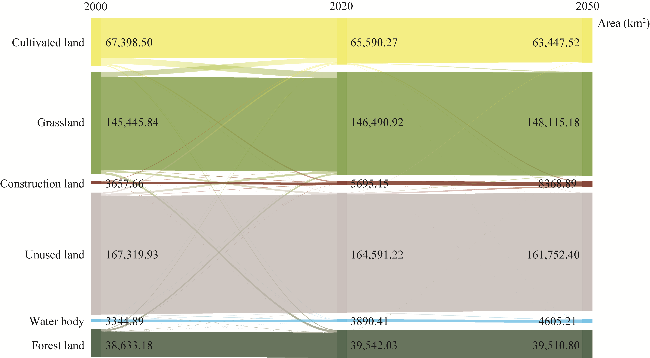
Grassland and unused land were the primary land use types in Gansu Province, accounting for over 80.00% of the total area, followed by cultivated land, forest land, construction land, and water body successively (Fig. 3). From 2000 to 2020, the most obvious transfer was observed between cultivated land and grassland, and the area of construction land experienced the most significant increase (2037.49 km2). Besides, the areas of forest land, grassland, water body increased 908.85, 1045.08, and 545.52 km2, respectively. However, the areas of cultivated land and unused land decreased 1808.23 and 2728.71 km2, respectively. Totally, the area of land use transfer in Gansu Province reached 9073.88 km2 from 2000 to 2020.
Fig. 3 Sankey diagram of land use transfer in Gansu Province from 2000 to 2050. The width of the curve represents the area of transfer between different land use types.
According to the simulation results in 2050, the areas of cultivated land, forest land, grassland, water body, construction land, and unused land would be 63,447.52, 39,510.80, 148,115.18, 4605.21, 8368.89, and 161,752.40 km2, respectively. Compared with 2020, there would be a considerable increase in areas of grassland (1624.26 km2), water body (714.80 km2), and construction land (2673.74 km2); while the areas of cultivated land, forest land, and unused land would decrease by 2142.75, 31.23, and 2838.82 km2, respectively. In summary, based on the simulation results, the land conversion in Gansu Province would reach 10,025.60 km2 from 2020 to 2050, larger than that from 2000 to 2020.
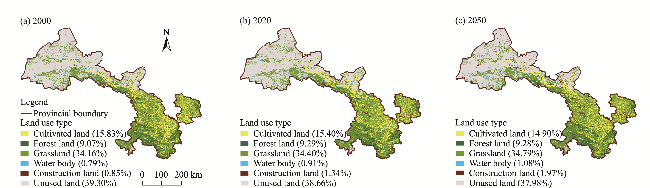
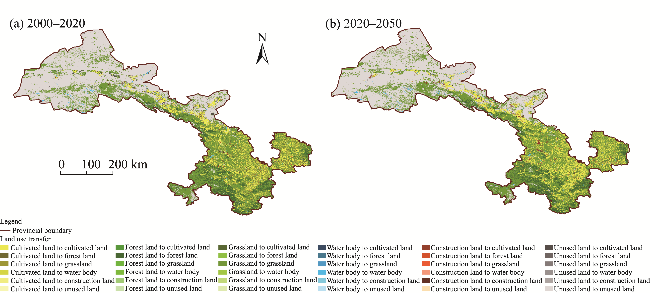
Cultivated lands were primarily located in the oasis area of the Hexi Corridor and the eastern part of Gansu Province (Fig. 4). Forest lands were mainly distributed in the southeastern part of the province, Hexi Corridor, and Qilian Mountains. Grasslands were widely distributed across the whole province. Water bodies were most prominent in the western part of the study area, and unused lands were predominantly found in the northwestern and eastern-central parts of Gansu Province. The variations of LUCC in Gansu Province exhibited obviously differences in different periods (Fig. 5). Changes in water bodies were concentrated in the northwestern part of the study area; and significant expansion of construction land occurred in the northwestern part of the province, central Hexi Corridor, and Longzhong region (Fig. 5).
Fig. 4 Spatial distribution of land use type in Gansu Province in 2000 (a) and 2020 (b), and simulation result in 2050 (c)
Fig. 5 Spatial distribution of land use transfer in Gansu Province during 2000-2020 (a) and 2020-2050 (b)

4.2 Spatial and temporal changes in ecological network from 2000 to 2020 and simulation result in 2050

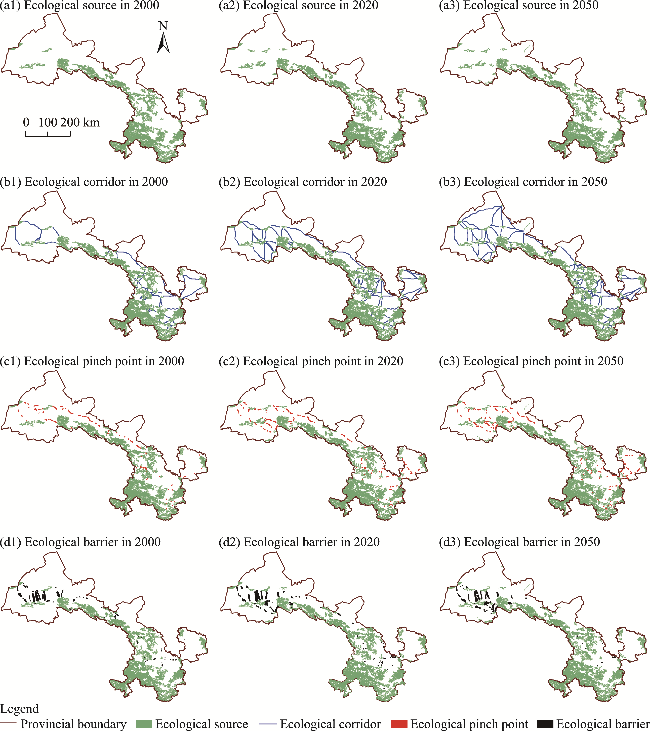
In 2000, there were a total of 50 ecological sources in Gansu Province, and these sources had a combined area of 92,317.96 km2 (Table 5). By 2020, the number of ecological sources increasedto 60, and the total area increased to 97,512.30 km2. Overall, the distribution range of ecological sources in Gansu Province showed an expanding trend from 2000 to 2020 and exhibited a spatial pattern of more ecological sources in the southeastern and fewer in the northwestern part of the province (Fig. 6). In 2000, there were 113 ecological corridors in Gansu Province, and these corridors had a combined length of 2922.52 km. By 2020, the number of ecological corridors increased to 139, and the total length increased to 4858.95 km. In terms of spatial distribution, ecological corridors increased significantly in the northwestern part of the province and Longzhong region from 2000 to 2020. The areas and numbers of ecological pinch points and ecological barriers in the study area increased continuously, mainly in the northwestern part of the province.
Table 5 Statistics of ecological source, corridor, pinch point, and barrier in Gansu Province
Component of ecological network Year
2000 2020 2050
Ecological source Amount 50 60 80
Area (km2) 92,317.96 97,512.30 99,927.18
Ecological corridor Amount 113 139 191
Length (km) 2922.52 4858.95 6120.66
Ecological pinch point Amount 207 307 312
Area (km2) 508.12 814.34 842.84
Ecological barrier Amount 111 163 100
Area (km2) 2827.15 3252.70 2881.99
Fig. 6 Spatial distribution of ecological source (a1 and a2), corridor (b1 and b2), pinch point (c1 and c2), and barrier (d1 and d2) in Gansu Province in 2000 and 2020, and simulation result in 2050 (a3, b3, c3, and d3)
In 2050, the number of ecological sources in Gansu Province would increase to 80, with a total area of 99,927.18 km2, and the increased ecological sources would be concentrated in the northwestern part of the province. There would be a total increase of 7069.22 km2 in area compared with 2020, and the type of increased ecological sources would mainly be small and fragmented patches. The number of ecological corridors would increase to 191, with an estimated total length of 6120.66 km. Ecological corridors would be a sparse spatial pattern in the northwestern part and a dense pattern in the southern part of the province. By 2050, as projection, ecological corridor would effectively connect all ecological sources, enhancing the connectivity among the ecological sources and ensuring the flow of ecological elements among ecological sources. The southeastern part of the province would exhibit a relatively high concentration of ecological sources in 2050, connected by shorter ecological corridors. In contrast, due to the sparse distribution of ecological sources, the corridor connectivity length in the northwestern and central regions would be relatively longer. Compared with 2020, both the number (312) and area (842.84 km2) of ecological pinch points would increase in 2050, with the increase being most pronounced in the Longdong region. In 2050, according to the simulation result, both the number and area of ecological barriers would decrease significantly, being 63 and 370.71 km2, respectively. From the perspective of spatial variation, the distribution of ecological barriers in 2050 also would decrease.

5 Discussion

5.1 Impacts of LUCC on ecological security

LUCC shapes the spatial and temporal patterns of ecological security (Li et al., 2021b). This study revealed significant changes in land use pattern of Gansu Province from 2000 to 2020 and simulated it in 2050. The area of cultivated land decreased, consistent with the study by Wang et al. (2021c), who thought that China may lose 130,000 km2 of cultivated land from 2015 to 2050. Notably, the productive function of cultivated land has long been emphasized, but its ecological function has been weakened, resulting in lack of adequate understanding to the crucial role that cultivated land plays in the construction of ecological network. Given China's large population and significant demand for food, it is crucial to maintain the ecological security of cultivated land. From 2000 to 2020, the area of construction land increased, and it will continue to increase from 2020 to 2050. Significant expansion of construction land occurred with encroachment on other land use types and substantial anthropogenic impacts on ecosystem, thereby obstructing ecological processes and the formation of ecological networks (Zeng et al., 2023). To ensure regional ecological security, the uncontrolled expansion of construction land must be strictly regulated. From 2000 to 2020, the areas of forest land, grassland, and water body in Gansu Province increased. These changes were closely linked to the implementation of various ecological protection policies, including the implementation of national key ecological protection projects, the establishment of national forest parks, and the banning of grazing (Liu et al., 2010; Bryan et al., 2018; Wang et al., 2021a). In 2050, the areas of forest land, grassland, and water body will continue to increase. This result is consistent with the findings of Liu et al. (2024), who concluded that the Gansu Province's ecological environment would improve significantly over the next 30 years, with gradual expansions in forest land and grassland. Forest land, grassland, and water body can promote the development of ecological processes and facilitate species dispersal, therefore they can be regarded as ecological sources. With the expansion of forest land, grassland, and water body, the number and area of ecological sources will increase, facilitating the generation of ecological network.
In summary, identifying land use patterns and rationalizing land use planning have a direct impact on ecological security. The protection of ecological resources such as forests and grasslands should be reinforced, and deforestation and overgrazing should be prevented. The efficiency and structure of construction land should be improved. Additionally, the development of unused land should be optimized to ease the conflict between land supply and demand.

5.2 Implication for ecological conservation and management

Due to the vast expanses of deserts and gravel plains in the northwestern part of Gansu Province, where the natural conditions are harsh and the distribution of ecological sources is generally sparse in this area. Therefore, the construction of ecological network of Gansu Province in the future should focus on increasing the number of ecological sources in this area. Ecological sources can be increased through measures such as the construction of desertification control projects and afforestation efforts (Gao et al., 2022).
The length of ecological corridors is closely related to the spatial distribution of ecological sources. Compared with the southern part of Gansu Province, ecological corridors in the northwestern and central regions are relatively long. However, excessively long corridors may hinder ecological activities, such as species migration between ecological sources. Corridor length can be reduced by creating ecological nodes, which enhance survival rates of organisms during long-distance migration (Kang et al., 2023; Qiu et al., 2023).
The loss of ecological pinch points will damage the connectivity of ecological network. Combining natural conservation methods with artificial conservation measures, such as establishing nature reserves, can expand the area of ecological pinch points and prevent their disappearance (Lian et al., 2024). This study revealed that the number of ecological barriers in 2050 might be lower than that in 2000, and their area was significantly smaller than that in 2020. Removing ecological barriers can effectively improve connectivity between patches and safeguard the integrity of ecological processes (Ran et al., 2022). Species access can be ensured by altering land use types at barrier points or constructing artificial ecological pathways, such as ecological bridges and culverts (Pan et al., 2023).

5.3 Limitations

In this study, by integrating land use into the process of ecological network construction, the identified ecological sources and corridors can better reflect the combined effects of natural and anthropogenic factors on the ecological security of Gansu Province and can be used to adjust land use policies and ecological protection measures. There are still some limitations in this study. First, only a single PLUS model was used to simulate LUCC, which is insufficient for capturing the structural allocation of land resources under different development situations. Second, modeling land use only under natural development scenarios lacks comparability. Therefore, many land use modeling scenarios as possible should be included in future studies to enhance comparisons.

6 Conclusions

This study analyzed the land use changes of Gansu Province from 2000 to 2020 and utilized PLUS model to simulate the land use pattern in 2050. By combining MSPA and circuit theory, the study constructed and analyzed the differences among the ecological networks of Gansu Province in 2000, 2020, and 2050. The results indicated there would be significant land use changes in Gansu Province from 2000 to 2050, with a reduction in the areas of cultivated land and unused land and an increase in the areas of forest land, grassland, water body, and construction land. The conversions among all six land use types were pronounced from 2000 to 2020, while the changes in construction land and water body were particularly notable from 2020 to 2050. For ecological network, the changes would be evident from 2000 to 2050, with an increasing trend in the areas and numbers of ecological sources, ecological corridors, and ecological pinch points, and a decreasing trend in the area and number of ecological barriers. The spatial distribution of ecological sources was characterized by a higher agglomeration in the southeastern and a lower agglomeration in the northwestern part of the province. Ecological corridors were dense and shorter in the southeastern than those in the northwestern part of the province. Ecological pinch points would significantly increase in Longdong region. The area and number of ecological barriers initially increased and then decreased, with a denser distribution in the northwestern part of the study area. The analysis of land use and ecological network changes in Gansu Province from 2000 to 2050 provides scientific support for the formulation of future local land use policies and ecological protection strategies.

Conflict of interest

The authors declare that they have no known competing financial interests or personal relationships that could have appeared to influence the work reported in this paper.

Acknowledgements

This work was supported by the Science Fund for the Gansu Provincial Natural Science Foundation Project (22JR5RA339). The authors are very thankful to the anonymous reviewers for improving the paper.

Author contributions

Conceptualization: MA Xinshu, CHEN Ning, ZHANG Bo; Methodology: MA Xinshu, CHEN Hongxiang; Formal analysis and investigation: MA Xinshu; Writing - original draft preparation: MA Xinshu; Writing - review and editing: MA Xinshu; Resources: MA Xinshu, XIN Shunjie, KANG Ligang, WANG Yu; Supervision: XIN Cunlin; Funding: JIAO Jirong. All authors approved the manuscript.
[1]
Aminzadeh B, Khansefid M. 2010. A case study of urban ecological networks and a sustainable city: Tehran's metropolitan area. Urban Ecosystems, 13: 23-36.

[2]
An Y, Liu S L, Sun Y X, et al. 2021. Construction and optimization of an ecological network based on morphological spatial pattern analysis and circuit theory. Landscape Ecology, 36: 2059-2076.

[3]
Bryan B A, Gao L, Ye Y Q, et al. 2018. China's response to a national land-system sustainability emergency. Nature, 559: 193-204.

[4]
Chen Q B, Ning Y. 2024. Projecting LUCC dynamics and ecosystem services in an emerging urban agglomeration under SSP-RCP scenarios and their management implications. Science of the Total Environment, 949: 175100, doi: 10.1016/j.scitotenv.2024.175100.

[5]
Chen X Q, Kang B Y, Lei M Y, et al. 2023. Identification of priority areas for territorial ecological conservation and restoration based on ecological networks: A case study of Tianjin City, China. Ecological Indicators, 146: 109809, doi: 10.1016/j.ecolind.2022.109809.

[6]
Cui L, Wang J, Sun L, et al. 2020. Construction and optimization of green space ecological networks in urban fringe areas: A case study with the urban fringe area of Tongzhou District in Beijing. Journal of Cleaner Production, 276: 124266, doi: 10.1016/j.jclepro.2020.124266.

[7]
Cui X F, Deng W, Yang J X, et al. 2022. Construction and optimization of ecological security patterns based on social equity perspective: A case study in Wuhan, China. Ecological Indicators, 136: 108714, doi: 10.1016/j.ecolind.2022.108714.

[8]
Dickson B G, Albano C M, Anantharaman R, et al. 2019. Circuit‐theory applications to connectivity science and conservation. Conservation Biology, 33(2): 239-249.

[9]
Fan F F, Liu Y X, Chen J X, et al. 2021. Scenario-based ecological security patterns to indicate landscape sustainability: a case study on the Qinghai-Tibet Plateau. Landscape Ecology, 36: 2175-2188.

[10]
Fu Q, Hou Y, Wang B, et al. 2018. Scenario analysis of ecosystem service changes and interactions in a mountain-oasis-desert system: a case study in Altay Prefecture, China. Scientific Reports, 8: 12939, doi: 10.1038/s41598-018-31043-y.

[11]
Gao L N, Tao F, Liu R R, et al. 2022. Multi-scenario simulation and ecological risk analysis of land use based on the PLUS model: A case study of Nanjing. Sustainable Cities and Society, 85: 104055, doi: 10.1016/j.scs.2022.104055.

[12]
Guo Z C, Xie Y W, Guo H, et al. 2023. Do the ecosystems of Gansu Province in Western China's crucial ecological security barrier remain vulnerable? Evidence from remote sensing based on geospatial analysis. Journal of Cleaner Production, 402: 136740, doi: 10.1016/j.jclepro.2023.136740.

[13]
Hou W, Zhou W, Li J Y, et al. 2022. Simulation of the potential impact of urban expansion on regional ecological corridors: A case study of Taiyuan, China. Sustainable Cities and Society, 83: 103933, doi: 10.1016/j.scs.2022.103933.

[14]
Islam S, Li Y C, Ma M G, et al. 2021. Simulation and prediction of the spatial dynamics of land use changes modelling through CLUE-S in the southeastern region of Bangladesh. Journal of the Indian Society of Remote Sensing, 49: 2755-2777.

[15]
Jia Q Q, Jiao L M, Lian X H, et al. 2023. Linking supply-demand balance of ecosystem services to identify ecological security patterns in urban agglomerations. Sustainable Cities and Society, 92: 104497, doi: 10.1016/j.scs.2023.104497.

[16]
Jiang H P, Guo H D, Sun Z C, et al. 2023. Urban-rural disparities of carbon storage dynamics in China's human settlements driven by population and economic growth. Science of the Total Environment, 871: 162092, doi: 10.1016/j.scitotenv.2023.162092.

[17]
Kang J M, Qing Y X, Lu W. 2023. Construction and optimization of the Saihanba ecological network. Ecological Indicators, 153: 110401, doi: 10.1016/j.ecolind.2023.110401.

[18]
Kucsicsa G, Popovici E-A, Bălteanu D, et al. 2019. Future land use/cover changes in Romania: regional simulations based on CLUE-S model and CORINE land cover database. Landscape and Ecological Engineering, 15: 75-90.

[19]
Li C, Wu Y M, Gao B P, et al. 2021a. Multi-scenario simulation of ecosystem service value for optimization of land use in the Sichuan-Yunnan ecological barrier, China. Ecological Indicators, 132: 108328, doi: 10.1016/j.ecolind.2021.108328.

[20]
Li L, Huang X J, Wu D F, et al. 2022. Optimization of ecological security patterns considering both natural and social disturbances in China's largest urban agglomeration. Ecological Engineering, 180: 106647, doi: 10.1016/j.ecoleng.2022.106647.

[21]
Li L, Huang X J, Wu D F, et al. 2023a. Construction of ecological security pattern adapting to future land use change in Pearl River Delta, China. Applied Geography, 154: 102946, doi: 10.1016/j.apgeog.2023.102946.

[22]
Li Y G, Liu W, Feng Q, et al. 2023b. The role of land use change in affecting ecosystem services and the ecological security pattern of the Hexi Regions, Northwest China. Science of the Total Environment, 855: 158940, doi: 10.1016/j.scitotenv.2022.158940.

[23]
Li Z X, Feng Q, Li Z J, et al. 2021b. Reversing conflict between humans and the environment—The experience in the Qilian Mountains. Renewable and Sustainable Energy Reviews, 148: 111333, doi: 10.1016/j.rser.2021.111333.

[24]
Lian H G, Liu C F, Ni B W, et al. 2024. Construction and optimization of the ecological network of natural reserves system in the northwestern arid region: A case study of the Hexi Corridor. Chinese Journal of Applied Ecology, doi: 10.13287/j.1001-9332.202501.02. (in Chinese)

[25]
Liang X, Liu X P, Li D, et al. 2018. Urban growth simulation by incorporating planning policies into a CA-based future land-use simulation model. International Journal of Geographical Information Science, 32(11): 2294-2316.

[26]
Liang X, Guan Q F, Clarke K C, et al. 2021. Understanding the drivers of sustainable land expansion using a patch-generating land use simulation (PLUS) model: A case study in Wuhan, China. Computers, Environment and Urban Systems, 85: 101569, doi: 10.1016/j.compenvurbsys.2020.101569.

[27]
Liu H L, Wang Z L, Zhang L P, et al. 2023. Construction of an ecological security network in the Fenhe River Basin and its temporal and spatial evolution characteristics. Journal of Cleaner Production, 417: 137961, doi: 10.1016/j.jclepro.2023.137961.

[28]
Liu J M, Pei X T, Yu W J, et al. 2024. How much carbon storage will loss in a desertification area? Multiple policy scenario analysis from Gansu Province. Science of the Total Environment, 913: 169668, doi: 10.1016/j.scitotenv.2023.169668.

[29]
Liu J Y, Zhang Z X, Xu X L, et al. 2010. Spatial patterns and driving forces of land use change in China during the early 21st century. Journal of Geographical Sciences, 20: 483-494.

[30]
Men D, Pan J H. 2023. Incorporating network topology and ecosystem services into the optimization of ecological network: A case study of the Yellow River Basin. Science of the Total Environment, 912: 169004, doi: 10.1016/j.scitotenv.2023.169004.

[31]
Modica G, Praticò S, Laudari L, et al. 2021. Implementation of multispecies ecological networks at the regional scale: analysis and multi-temporal assessment. Journal of Environmental Management, 289: 112494, doi: 10.1016/j.jenvman.2021.112494.

[32]
Mondal M S, Sharma N, Garg P K, et al. 2016. Statistical independence test and validation of CA Markov land use land cover (LULC) prediction results. The Egyptian Journal of Remote Sensing and Space Science, 19(2): 259-272.

[33]
Nie W B, Shi Y, Siaw M J, et al. 2021. Constructing and optimizing ecological network at county and town scale: The case of Anji County, China. Ecological Indicators, 132: 108294, doi: 10.1016/j.ecolind.2021.108294.

[34]
Opdam P, Steingröver E, van Rooij S. 2006. Ecological networks: A spatial concept for multi-actor planning of sustainable landscapes. Landscape and Urban Planning, 75(3-4): 322-332.

[35]
Pan J H, Wang Y M, Zhang Z. 2023. Identification and optimization of ecological network in arid inland river basin using MSPA and spatial syntax: a case study of Shule River Basin, NW China. Land, 12(2): 292, doi: 10.3390/land12020292.

[36]
Peng J, Yang Y, Liu Y, et al. 2018. Linking ecosystem services and circuit theory to identify ecological security patterns. Science of the Total Environment, 644: 781-790.

[37]
Popescu O-C, Tache A-V, Petrișor A-I. 2022. Methodology for identifying ecological corridors: a spatial planning perspective. Land, 11(7): 1013, doi: 10.3390/land11071013.

[38]
Qiu S, Fang M Z, Yu Q, et al. 2023. Study of spatialtemporal changes in Chinese forest eco-space and optimization strategies for enhancing carbon sequestration capacity through ecological spatial network theory. Science of the Total Environment, 859(Part 1): 160035, doi: 10.1016/j.scitotenv.2022.160035.

[39]
Ran Y J, Lei D M, Li J, et al. 2022. Identification of crucial areas of territorial ecological restoration based on ecological security pattern: A case study of the central Yunnan urban agglomeration, China. Ecological Indicators, 143: 109318, doi: 10.1016/j.ecolind.2022.109318.

[40]
Shi F N, Liu S L, An Y, et al. 2020. Spatio-temporal dynamics of landscape connectivity and ecological network construction in Long Yangxia Basin at the upper Yellow River. Land, 9(8): 265, doi: 10.3390/land9080265.

[41]
Théau J, Bernier A, Fournier R A. 2015. An evaluation framework based on sustainability-related indicators for the comparison of conceptual approaches for ecological networks. Ecological Indicators, 52: 444-457.

[42]
Wang J J, Liu Z P, Gao J L, et al. 2021a. The Grain for Green project eliminated the effect of soil erosion on organic carbon on China's Loess Plateau between 1980 and 2008. Agriculture, Ecosystems & Environment, 322: 107636, doi: 10.1016/j.agee.2021.107636.

[43]
Wang M M, Jiang Z Z, Li T B, et al. 2023a. Analysis on absolute conflict and relative conflict of land use in Xining Metropolitan Area under different scenarios in 2030 by PLUS and PFCI. Cities, 137: 104314, doi: 10.1016/j.cities.2023.104314.

[44]
Wang N N, Zhao Y. 2024. Construction of an ecological security pattern in Jiangnan water network area based on an integrated Approach: A case study of Gaochun, Nanjing. sEcological Indicators, 158: 111314, doi: 10.1016/j.ecolind.2023.111314.

[45]
Wang Q Z, Guan Q Y, Sun Y F, et al. 2023b. Simulation of future land use/cover change (LUCC) in typical watersheds of arid regions under multiple scenarios. Journal of Environmental Management, 335: 117543, doi: 10.1016/j.jenvman.2023.117543.

[46]
Wang S, Wu M Q, Hu M M, et al. 2021b. Promoting landscape connectivity of highly urbanized area: An ecological network approach. Ecological Indicators, 125: 107487, doi: 10.1016/j.ecolind.2021.107487.

[47]
Wang S T, Bai X M, Zhang X L, et al. 2021c. Urbanization can benefit agricultural production with large-scale farming in China. Nature Food, 2: 183-191.

[48]
Wu J S, Zhang L Q, Peng J, et al. 2013. The integrated recognition of the source area of the urban ecological security pattern in Shenzhen. Acta Ecological Sinica, 33(13): 4125-4133. (in Chinese)

[49]
Xiang H X, Zhang J, Mao D H, et al. 2023. Optimizing ecological security patterns considering zonal vegetation distribution for regional sustainability. Ecological Engineering, 194: 107055, doi: 10.1016/j.ecoleng.2023.107055.

[50]
Xu L F, Liu X, Tong D, et al. 2022. Forecasting urban land use change based on cellular automata and the PLUS Model. Land, 11(5): 652, doi: 10.3390/land11050652.

[51]
Ying B, Liu T, Ke l, et al. 2023. Identifying the landscape security pattern in karst rocky desertification area based on ecosystem services and ecological ensitivity: a case tudy of Guanling County, Guizhou Province. Forests, 14(3): 613, doi: 10.3390/f14030613

[52]
Yin Z L, Feng Q, Zhu R, et al. 2023. Analysis and prediction of the impact of land use/cover change on ecosystem services value in Gansu Province, China. Ecological Indicators, 154: 110868, doi: 10.1016/j.ecolind.2023.110868.

[53]
Yu H C, Huang J, Ji C N, et al. 2021. Construction of a landscape ecological network for a large-scale energy and chemical industrial base: a case study of Ningdong, China. Land, 10(4): 344, doi: 10.3390/land10040344.

[54]
Yu Q, Yue D P, Wang J P, et al. 2017. The optimization of urban ecological infrastructure network based on the changes of county landscape patterns: a typical case study of ecological fragile zone located at Deng Kou (Inner Mongolia). Journal of Cleaner Production, 163: S54-S67.

[55]
Zeng W, Tang H, Liang X, et al. 2023. Using ecological security pattern to identify priority protected areas: A case study in the Wuhan Metropolitan Area, China. Ecological Indicators, 148: 110121, doi: 10.1016/j.ecolind.2023.110121.

[56]
Zhang S H, Zhong Q L, Cheng D L, et al. 2022. Landscape ecological risk projection based on the PLUS model under the localized shared socioeconomic pathways in the Fujian Delta region. Ecological Indicators, 136: 108642, doi: 10.1016/j.ecolind.2022.108642.

[57]
Zhang Z, Wang Q, Feng Y G, et al. 2024. The spatio-temporal evolution of spatial structure and supply-demand relationships of the ecological network in the Yellow River Delta region of China. Journal of Cleaner Production, 471: 143388, doi: 10.1016/j.jclepro.2024.143388.

[58]
Zhao M M, He Z B, Du J, et al. 2019. Assessing the effects of ecological engineering on carbon storage by linking the CA-Markov and InVEST models. Ecological Indicators, 98: 29-38.

[59]
Zheng H W, Shen G Q, Wang H, et al. 2015. Simulating land use change in urban renewal areas: A case study in Hong Kong. Habitat International, 46: 23-34.

[60]
Zhou D, Song W. 2021. Identifying ecological corridors and networks in mountainous areas. International Journal of Environmental Research and Public Health, 18(9): 4797, doi: 10.3390/ijerph18094797.

Outlines

/