Research article

Effects of biological soil crusts on plant growth and nutrient dynamics in the Minqin oasis-desert ecotone, Northwest China

  • KANG Jianjun 1 ,
  • YANG Fan , 2, * ,
  • ZHANG Dongmei 1 ,
  • DING Liang 3
Expand
  • 1Key Laboratory of Ecological Safety and Sustainable Development in Arid Lands, Linze Inland River Basin Research Station, Chinese Ecosystem Research Network, Northwest Institute of Eco-Environment and Resources, Chinese Academy of Sciences, Lanzhou 730000, China
  • 2Minqin National Studies Station for Desert Steppe Ecosystem, Gansu Desert Control Research Institute, Lanzhou 730070, China
  • 3Zhangye Agricultural and Rural Bureau, Zhangye 734000, China
*YANG Fan (E-mail: )

Received date: 2024-07-13

  Revised date: 2024-11-03

  Accepted date: 2024-11-23

  Online published: 2025-08-13

Abstract

Biological soil crusts (BSCs) play crucial roles in improving soil fertility and promoting plants settlement and reproduction in arid areas. However, the specific effects of BSCs on growth status and nutrient accumulation of plants are still unclear in different arid areas. This study analyzed the effects of three different BSCs treatments (without crust (WC), intact crust (IC), and broken crust (BC)) on the growth, inorganic nutrient absorption, and organic solute synthesis of three typical desert plants (Grubovia dasyphylla (Fisch. & C. A. Mey.) Freitag & G. Kadereit, Nitraria tangutorum Bobrov, and Caragana koraiensis Kom.) in the Minqin desert-oasis ecotone of Northwest China. Results showed that the effects of three BSCs treatments on seed emergence and survival of three plants varied with seed types. The IC treatment significantly hindered the emergence and survival of seeds, while the BC treatment was more conducive to seed emergence and survival of plants. BSCs significantly promoted the growth of three plants, but their effects on plant growth varied at different stages of the growth. Briefly, the growth of G. dasyphylla was affected by BSCs in early stage, but the effects on the growth of G. dasyphylla significantly weakened in the middle and late stages. However, the growth of N. tangutorum and C. koraiensis only showed differences at the middle and late stages, with a significant enhancement in growth. Analysis of variance showed that BSCs, plant species, growth period, and their interactions had significant effects on the biomass and root: shoot ratio of three plants. BSC significantly affected the nutrients absorption and organic solute synthesis in plants. Specifically, BSCs significantly promoted nitrogen (N) absorption in plants and increased plant adaptability in N poor desert ecosystems, but had no significant effects on phosphorus (P) absorption. The effects of BSCs on inorganic nutrient absorption and organic solute synthesis in plants varied significantly among different plant species. The results suggest that BSCs have significant effects on the growth and nutrient accumulation of desert plants, which will provide theoretical basis for exploring the effects of BSCs on desert plant diversity, biodiversity conservation, and ecosystem management measures in arid and semi-arid areas.

Cite this article

KANG Jianjun , YANG Fan , ZHANG Dongmei , DING Liang . Effects of biological soil crusts on plant growth and nutrient dynamics in the Minqin oasis-desert ecotone, Northwest China[J]. Journal of Arid Land, 2025 , 17(1) : 130 -143 . DOI: 10.1007/s40333-025-0003-0

1 Introduction

Drought is considered to be one of the major abiotic factors, which inevitably causes desertification coupled with decreased vegetation coverage and rapid soil degradation in many arid and semi-arid areas (Kang et al., 2020a). Therefore, desertification control is of great significance to many countries with severe desertification hazards. Biological soil crusts (BSCs), known as "desert ecosystem engineer" and "desert biological carpet", play important roles in the restoration and stability maintenance of desert vegetation in arid and semi-arid areas worldwide, including the Polar Regions (Gao et al., 2017; Lu et al., 2022). BSCs are complex systems of various microorganisms, including microalgae, cyanobacteria, bacteria, fungi, etc., and soil particles, which are widely distributed in arid and semi-arid areas with a coverage rate over 40%, and even accounting for 70% of the surface area in some areas (Su et al., 2007). According to the succession stage, researchers divided BSCs into algal crust, lichen crust, and moss crust (Belnap et al., 2016; Tang et al., 2018; Liu et al., 2020), and the presence of BSCs results in important contributions to the increase of nitrogen (N) nutrition in plants, and the improvement of N nutrition in soil and long-term response to N deposition in arid and semi-arid areas (Zhuang et al., 2015; Li et al., 2016; Tang et al., 2018; Rong et al., 2022). Additionally, BSCs are important carbon (C) sink in terrestrial ecosystems because global soil algae absorb approximately 3.6 Pg C/a, which is equivalent to 6% of the net primary production of terrestrial vegetation, and they can also release CO2 into the atmosphere through their own organic components and respiration, thereby affecting C cycling of drylands (Bi et al., 2022; Jassey et al., 2022; Li and Zhang, 2023). The microbial communities, as important components of BSCs, play important roles in the BSCs formation, soil physical-chemical properties improvement, soil aggregates stability, and vegetation development (Li et al., 2017, 2018; Liu et al., 2020; Zhou et al., 2023), and especially N fixing microorganisms play significant roles in seed germination and growth of plants, which can directly affect the process of seed germination and growth of plants by accumulating C and N, and indirectly promote plant growth and development by regulating soil environmental factors (Zhang et al., 2022). Due to the unique physio-ecological processes and strong adaptability to adversity, the formation and succession of BSCs profoundly change the structural characteristics and physical-chemical properties of the soil surface, i.e., nutrient status, micro-terrain, water and heat conditions, and rapid infiltration of precipitation and runoff, thereby affecting seed germination, seedling survival, and growth stage of plants in arid and semi-arid areas (Li, 2012; Chen et al., 2017; Li et al., 2017, 2018; Luo et al., 2020; Nevins et al., 2021). Therefore, it is necessary to clarify and reveal the specific impact processes and mechanisms of BSCs on seed reproduction, germination, seedling survival, and growth of plants in arid and semi-arid areas.
There are controversies on the effects of BSCs on seed plants germination, survival, nutritional condition, and plant growth, which can be roughly summarized as follows: inhibitory effect, promoting effect, and no significant effect (Li et al., 2002, 2005; Aguilar et al., 2005; Chen et al., 2008; Zhang and Nie, 2011; Wang et al., 2021). At present, researches on the effects of BSCs on plant growth and nutrients absorption are mainly concentrated in the Gurbantunggut Desert, Tengger Desert, Mu Us Sandy Land, and Loess Plateau, China. The effect of BSCs on the growth of herbs was highly time-dependent in the Gurbantunggut Desert, and BSCs significantly increased N and potassium (K) absorption of plants, but had no significant effect on the phosphorus (P) absorption, and the effect of BSCs on other elements' absorption varied among plant species (Zhuang et al., 2017; Zhuang and Zhang, 2017). BSCs and sand burial mutual complementary effects (BSCs inhibit the seed germination, while sand burial can improve the availability of soil water and nutrients to reduce the inhibitory effects of BSCs on seed germination) promoted the establishment and overall recruited success of annual herbs in the Tengger Desert (Gao et al., 2023). BSCs had significantly different effects on seed germination and survival of different plant life forms in the Tengger Desert, which played ecological filtering roles in the invasion and settlement process of plant species (Song et al., 2022). BSCs played important roles in the nutrient turnover of Artemisia ordosica Krasch communities in the Mu Us Sandy Land, which improved soil C and N availability, and thus promoted nutrients absorption of A. ordosica communities (Sun et al., 2020). Moreover, the appearance of BSCs didn't negatively affect the water absorption of A. ordosica in the Mu Us Sandy Land. BSCs improved soil moisture under drought conditions and alleviated drought stress on A. ordosica, and the effect degree on water absorption of A. ordosica depended on the developmental stage of BSCs and rainfall variation (Guan, 2023). BSCs positively affected the seed emergence and growth of plants through indirect effects in the Loess Plateau, and the survival and growth of plant seedlings were mainly affected by penetration resistance and soil chemical properties of BSCs (Zhang et al., 2024). It should be noted that there are different results on the effects of BSCs on plant growth and nutrients absorption in different arid areas. Although extensive studies have been conducted on the effects of BSCs on growth and nutrient accumulation of plants in different arid areas, systematic study on the effect of BSCs on beneficial element accumulation and organic solute synthesis of plants, especially under different kinds of vegetation and climate, remains insufficient. BSCs play important roles in protecting the ecological environment of the Minqin Desert (He et al., 2017). In recent years, studies on BSCs in the Minqin Desert have mainly focused on the developmental stages, soil physical-chemical properties, hydrological characteristics, soil seed bank, microorganisms, and precipitation infiltration (Li et al., 2002; Jia et al., 2003; Qiao et al., 2015; He et al., 2017; Tao et al., 2023). However, the systematic study on the effect of BSCs on plant growth and nutrients accumulation is less well studied in the Minqin Desert, which is important for the conservation of the desert.
Grubovia dasyphylla (Fisch. & C. A. Mey.) Freitag & G. Kadereit (Amaranthaceae), Nitraria tangutorum Bobrov (Zygophyllaceae), and Caragana koraiensis Kom (legume) are three drought tolerant plants widely distributed in the Minqin oasis-desert ecotone. However, the effects of BSCs on the seedling growth and nutrient absorption of the three plant species are less concerned. In this study, we hypothesize that: (1) BSCs significantly hinder the emergence and survival of plant seeds, but broken BSCs is more conducive to seed emergence and seedling survival; (2) BSCs can promote the growth and increase biomass accumulation of plants, and the effects of BSCs on plant growth have temporal effects; and (3) BSCs not only affect the inorganic nutrient absorption of plants in the soil, but also affect the organic solute synthesis in plants, and the effects vary significantly among species. This result of the study will provide theoretical support for exploring the effects of BSCs on plant diversity, and scientific basis for the biodiversity conservation in the Minqin desert-oasis ecotone.

2 Materials and methods

2.1 Study area

The study area is located in the Minqin County, Gansu Province, China (38°03′-39°28′N, 101°49′-104°12′E; 1400 m a.s.l.). This area is surrounded by the Badain Jaran Desert in the west and north, and by the Tengger Desert in the east. The total area is 1.6×10⁴ km2, with desertification and oases areas accounting for 91% and 9% of the total area, respectively. The area is mainly characterized by an arid climate, and average mean precipitation, evaporation, and temperature are 115.4 mm, 2644.0 mm, and 8°C, respectively. Average mean accumulated temperature of ≥10°C is 3036°C, with a frost free period of 189 d, and an average mean wind speed of 2.5 m/s (Zhao et al., 2023). The soil is composed of loose and barren sand, with a stable soil moisture content ranging from 2% to 3%. This area is dominated by algal crust, followed by lichen crust. Due to the unreasonable human activities and global climate change, the ecological environment in the area has severely degraded, and has become a typical desert-oasis ecotone in Northwest China (Li et al., 2021a).

2.2 Methods

In early May 2022, well-developed algal crusts at 4-6 mm depth were collected from the Minqin desert-oasis ecotone, and samplers (40 cm in height and 30 cm in diameter) were made using polyvinyl chloride (PVC) pipes. When collecting crust soil samples, we vertically pressed the sampler into the soil to collect intact soils covered with algae crusts. Then, soils at the bottom of the sampler are flattened, and transported back to the laboratory as culture substrates. To ensure the integrity of the crust, we moistened before collection and kept it intact for test use.
Mature seeds of N. tangutorum, C. koraiensis, and G. dasyphylla were collected in mid-August, early July, and mid-October 2021, respectively, and stored in a stable environment (4°C) for test use. N. tangutorum, a typical succulent xerophyte with a high level of seeds dormancy, is recognized as one of the most drought resistant plants for afforesting deserts. Before the experiment, N. tangutorum seeds were treated as follows: firstly, seeds were soaked in 98% H2SO4 for 55 min, then were treated with 150 mg/L gibberellin (GA3) for 48 h, and finally seeds were germinated at 25°C/5°C in darkness for 8 d. The seeds germination rate reached up to 69% (Kang et al., 2016). C. koraiensis, a typical less succulent xerophyte, is an important plant for constructing windbreak and sand fixation forests. G. dasyphylla, a typical annual herb, is used for the herb layer construction of windbreak and sand fixation forests in the Minqin desert-oasis ecotone.

2.3 Experimental design

The experiment was conducted in a greenhouse in mid-May 2022. Before conducting the experiment, we watered the collected BSCs daily to remove all sprouted seedlings from the BSCs until no seedlings appeared in the BSCs for 7 d. To prevent damage to the integrity of the crust, we cut off all sprouted plants from the roots with scissors. Preprocessed seeds of N. tangutorum, C. koraiensis, and G. dasyphylla were selected for germination experiments in late May. Then the soil samples in the samplers were divided into three parts. The first part was completely removed the crust on the surface of soil samples using a flat shovel until the bare sand was exposed in the lower layer (without crust; WC). The second part kept the intact of crust surface (intact crust; IC), and the remaining part was broken as control (broken crust; BC), which was evenly rolled by cylindrical tools on the crust to form similar sized particles. Totally 15 mature seeds of each plant were sown (1.0-1.5 cm burial depth) in the samplers with 20 replicates for each treatment, and then covered with IC, BC, and bare sand, respectively. Every noon, water was sprayed on the surface of the crusts for 8 d to keep them moist, and then recorded the seedling emergence numbers and the initial emergence time of each plant seeds every morning. After 10 d, the seedling survival numbers were counted in each treatment, and all seedlings were thinned out and kept 8 uniform seedlings in each sampler. Soil water content (SWC) in all treatments was maintained at 70% of field water holding capacity by irrigating with water, then water was withheld for 5 d to gradually induce drought stress. SWC was maintained at 30% of field water holding capacity by irrigating water. Due to the fact that the study was a control experiment conducted in a greenhouse, we divided the growth processes of the tested plants into three stages based on the number of cultivation days. Early growth stage was from late May to 1 July. Middle growth stage was from 1 July to 1 August. Late growth stage was from 1 August to the end of the growing period. After the growth period was ended, 10 healthy uniform plants in each treatment were dug out and separated into roots, stems, and leaves for physiological and morphological analysis. Soil sampling of each treatment (IC, BC, and WC) was performed after the experiment. Soils were sampled as 5 sub-samples at different soil layers (0-5, 5-10, and 10-15 cm), then were mixed, and all soil samples were placed in sealed plastic bags and taken to the laboratory for soil nutrients analysis.

2.4 Measurement of samples

2.4.1 Seed germination and plant growth

Plant height was measured by a ruler, fresh weight of plants was estimated using an electronic scale, and root:shoot ratio was calculated. The seed emergence rate (SER) was calculated using the following formula: SER=SEN/TSM, where SEN is the seed emergence numbers; and TSM is the total sowing numbers. The seed emergence speed (SES) was calculated as follows: SES=(∑QDCC)/n×FER×10, where QDCC is the quotient obtained by dividing the cumulative numbers of seedlings per day by the corresponding number of seedling emergence days; n is the number of days from emergence to end; and FER is the final emergence rate (%) (Wang et al., 2011).

2.4.2 Plant nutrients

We measured Na+, K+, Ca2+, Mg2+, N, and P contents in plants according to the method described by Kang et al. (2020b). Na+, K+, Ca2+, and Mg2+ contents were measured by an atomic absorption spectrophotometry. Si concentration (SiO32-) in plants was determined by the molybdate-blue method, and total N and total P were determined by acid standard solution titration and vanadium-molybdenum-yellow spectrophotometry, respectively. Free proline and soluble sugars contents were analyzed by the method of acidic indene three ketone and hydrochloric acid (HCl) transformation-copper reduction-iodimetry, respectively (Kang et al., 2020b).

2.4.3 SWC and soil nutrients

SWC was determined by weighing. We measured the soil nutrient indices according the methods of Bao (2000). Briefly, soil organic carbon (SOC) was measured by the K2Cr2O7-H2SO4 oxidation method, total N was measured by the Kjeldahl procedure, and total P was measured by molybdenum-antimony anti-colorimetric method. Available N was measured by the method of alkali-hydrolyzable diffusion and available P was measured by the Bray method. Available K included the sum of soluble, exchangeable, and available nonchangeable K, and concentration of available K was measured by the method of ammonium acetate extract.

2.5 Data analysis

All data obtained from the experiment was analyzed using SPSS v.13.0 (SPSS Inc., Chicago, USA) and Excel v.2010 softwares. One-way analysis of variance (ANOVA) was used to examine the effects of three BSCs treatments on soil nutrients, growth indices, inorganic nutrient absorption, and organic solute synthesis of three desert plants. Multivariate variance analysis was used to examine the interactive effects of three BSCs treatments, plant types, and growth periods on seed emergence rate, biomass, and root:shoot ratio of three desert plants. Duncan's multiple range tests were used to detect significant differences between means at a significance level of P<0.05.

3 Results

3.1 Effects of BSCs on SWC and nutrients

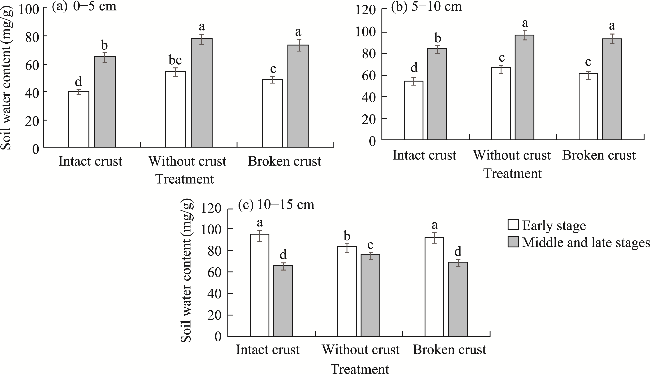
Different BSCs treatments had significant effects on SWC (Fig. 1). Under three BSCs treatments, SWC in the 0-5 and 5-10 cm soil layers in early growth stage was significantly lower than those in middle and late growth stages of the three desert plants, but the trend of SWC in the 10-15 cm soil layer was opposite to those in the 0-5 and 5-10 cm soil layers. Moreover, SWC in the 0-5 and 5-10 cm soil layers under WC and BC treatments were consistently higher than that under IC treatment throughout the whole growth period of the three desert plants. However, SWC in the 10-15 cm soil layer under IC and BC treatments were higher than that under WC treatment in early growth stage, but the trend was exactly opposite to those in middle and late growth stage.
Fig. 1 Effects of different biological soil crusts (BSCs) treatments on soil water content. (a), 0-5 cm soil layer; (b), 5-10 cm soil layer; (c), 10-15 cm soil layer. Different lowercase letters indicate significant differences among different BSCs treatments at P<0.05 level. Bars are standard errors.
There was no significant change in soil nutrients during different growth stages of the three desert plants, but significant differences in soil nutrients were observed among different BSCs treatments (Table 1). In the 0-5 cm soil layer, SOC, total N, total K, available N, and available K under IC and BC treatments were significantly higher than that under WC treatment, and in the 5-10 cm soil layer, SOC, total N, and available N under IC and BC treatments were significantly higher than that under WC treatment. However, the three BSCs treatments didn't significantly affect the nutrients content in the 10-15 cm soil layer (Table 1).
Table 1 Changes of soil nutrients status under different BSCs treatments and soil layers
Index 0-5 cm soil layer 5-10 cm soil layer 10-15 cm soil layer
IC WC BC IC WC BC IC WC BC
SOC
(g/kg)
4.22±0.31a 2.53±0.22b 4.34±0.30a 2.04±0.20c 1.55±0.19d 2.13±0.28bc 1.64±0.27d 1.53±0.16d 1.58±0.21d
Total N (g/kg) 0.43±0.01a 0.39±0.02b 0.46±0.05a 0.30±0.03b 0.22±0.04c 0.32±0.04b 0.25±0.03c 0.25±0.03c 0.27±0.04bc
Total P (g/kg) 0.24±0.04a 0.20±0.02ab 0.25±0.04a 0.24±0.02a 0.20±0.01ab 0.19±0.03ab 0.22±0.02a 0.19±0.01ab 0.19±0.03ab
Total K (g/kg) 13.36±0.82a 11.41±0.71b 14.86±1.02a 11.69±0.90b 10.26±0.91bc 12.11±0.90ab 9.25±0.40c 9.30±0.56c 9.33±0.38c
Available N
(mg/kg)
10.38±0.92a 8.20±0.55b 10.51±0.62a 8.95±1.01b 7.26±0.47c 8.23±0.81b 6.32±0.44d 6.19±0.68d 6.40±0.41d
Available P
(mg/kg)
7.20±0.75a 6.58±0.62ab 7.30±0.57a 7.06±0.63a 6.37±0.58ab 7.09±0.47a 6.63±0.55ab 6.26±0.49ab 6.51±0.42ab
Available K
(mg/kg)
123.65±9.80a 103.56±7.60b 131.65±7.80a 98.28±6.00b 94.26±7.30b 96.31±5.20b 72.38±5.30c 73.75±4.40c 73.95±4.90c

Note: BSCs, biological soil crusts; SOC, soil organic carbon; N, nitrogen; P, phosphorous; K, potassium; IC, intact crust; WC, without crust; BC, broken crust. The abbreviations are the same as in the following figures and tables. Different lowercase letters within the same index indicates significant differences among different BSCs treatments and soil layers at P<0.05 level. Mean±SD.

3.2 Effects of BSCs on seed emergence and seedling survival

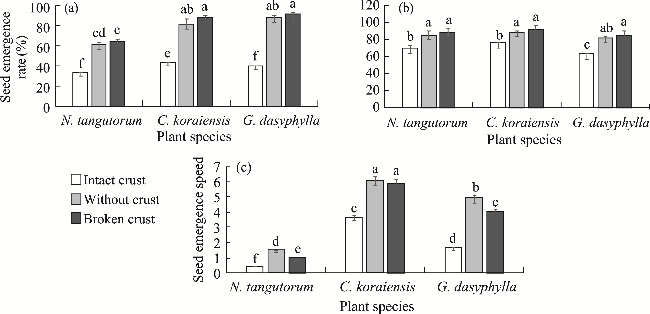
Both plant seed types and crust treatments (IC, WC, and BC) had significant effects on seed emergence rate, while the interaction between seed types and crust treatments was not significant, indicating that the effects of different types of crusts on the seed emergence rate varied with seed types (Table 2). Seed emergence rate and seedling survival rate of the three desert plants under WC and BC treatments were significantly higher than that under IC treatment, indicating that IC treatment hindered the seed emergence and seedling survival. Seed emergence rate and seedling survival rate of C. koraiensis and G. dasyphylla were significantly higher than that of N. tangutorum, while the difference in seed emergence rate and seedling survival rate of the two plants was not significant between WC and BC treatments, indicating that BC treatment has no significant effects on seed germination, and was more conducive to seed emergence and seedling survival (Fig. 2a and b). Moreover, different BSC treatments had different effects on the seed emergence speed of plants, and under different BSCs treatments, seed emergence speed of C. koraiensis was the fastest, followed by G. dasyphylla, and N. tangutorum was the slowest. Seed emergence speed of the three desert plants under three BSCs treatments was ranked as follows: WC>BC>IC, indicating that the presence of BSCs decreased the seed emergence speed of plants (Fig. 2c).
Table 2 Multivariate variance analysis of plant seed types and BSCs treatments on seed emergence rate
Variation source Sum of square df Mean square F P
Correction mode 33,546.51 9.00 3452.48 26.72 0.00
Intercept 125,448.86 1.00 125,448.86 1020.41 0.00
Seed type (ST) 30,665.31 2.00 10,508.20 86.46 0.00
BSCs treatments (BSCs) 2566.72 3.00 1240.40 10.86 0.00
ST×BSCs 1157.85 6.00 198.68 1.56 0.12
Error 4013.25 32.00 104.45
Total variation (TA) 159,320.58 49.00
Correction of TA 410,802.17 46.00
Fig. 2 Effects of different BSCs treatments on seed emergence rate (a), seedling survival rate (b), and seed emergence speed (c) of the three desert plants. N. tangutorum, Nitraria tangutorum Bobrov; C. koraiensis, Caragana koraiensis Kom.; G. dasyphylla, Grubovia dasyphylla (Fisch. & C. A. Mey.) Freitag & G. Kadereit. Different lowercase letters indicate significant differences among different BSCs treatments and plant species at P<0.05 level. Bars are standard errors.

3.3 Effects of BSCs on growth status of desert plants

Different BSCs treatments had significant effects on the growth height of the three desert plants (Table 3). The growth heights of plants under IC and BC treatments were higher than that under WC treatment, and the promoting effects of BSCs on the growth height of N. tangutorum and C. koraiensis were weaker than that of G. dasyphylla (Table 3). Moreover, the growth height of G. dasyphylla was affected by BSCs in early growth stage, but the effects on the growth of G. dasyphylla significantly weakened in middle and late growth stages. However, the growth height of N. tangutorum and C. koraiensis only showed differences in the middle and late growth stages, and the growth height of two plants significantly increased during this period (Table 3).
Table 3 Changes of plant height under different BSCs treatments and growth stages
Species Treatment Early growth stage (cm) Middle growth stage (cm) Late growth stage (cm) End of growth period (cm)
15 June 1 July 15 July 1 August 15 August 1 September
Nitraria tangutorum Bobrov IC 3.42±0.21a 6.06±0.31a 10.02±0.60 a 15.42±1.22a 19.42±1.22a 24.68±1.65a 30.80±2.25a
WC 3.02±0.28b 5.01±0.42b 9.14±0.66b 13.45±0.98b 17.15±0.98b 21.15±1.20b 27.45±1.78b
BC 3.70±0.26a 6.20±0.50a 10.28±0.58a 15.09±1.30a 20.19±1.30a 25.15±1.40a 31.58±2.50a
Caragana koraiensis
Kom.
IC 2.89±0.22a 5.10±0.35a 8.17±0.61a 12.38±0.65a 16.13±0.65a 20.23±2.60a 25.06±2.77a
WC 2.62±0.19b 4.42±0.24b 7.09±0.50b 11.12±0.68b 14.20±0.68b 18.25±1.64b 22.20±1.49b
BC 3.45±0.15a 5.23±0.25a 8.75±0.71a 12.80±0.87a 16.78±0.87a 20.70±2.17a 25.77±2.86a
Grubovia dasyphylla (Fisch. & C. A. Mey.) Freitag & G. Kadereit IC 6.11±0.33a 15.01±0.51a 19.11±0.69a 24.21±1.02a 29.23±1.77a 34.73±2.01a 39.66±2.38a
WC 5.34±0.20b 13.80±0.71b 17.38±0.80b 22.17±1.21b 27.36±1.57b 31.38±1.85b 35.40±2.80b
BC 6.61±0.25a 15.72±0.66a 19.71±0.91a 24.02±1.15a 29.66±1.8a 34.16±1.69a 39.10±2.25a

Note: Different lowercase letters within the same plant species indicates significant differences among different BSCs treatments at P<0.05 level. Mean±SD.

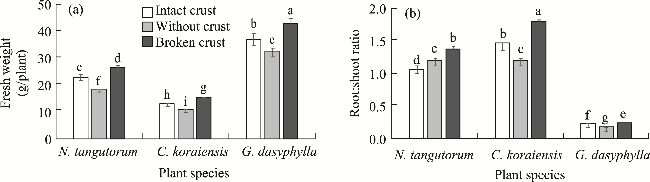
BSCs had different effects on the fresh weight and root:shoot ratio of the three desert plants (Fig. 3a and b). The effects of BSCs on fresh weight varied from species to species. Fresh weight of the three desert plants under BC treatment was significantly higher than those under IC and WC treatments, and fresh weight of the three desert plants was the lowest under WC treatment (Fig. 3a). Under different BSCs treatments, the changes in root:shoot ratio of the three desert plants were consistent with the trends in fresh weight (Fig. 3b). ANOVA result showed that BSCs, plant species, growth stages, and their interactions all significantly affected the accumulation of single plant fresh weight of the three desert plants, and BSCs, plant species, growth periods, and their interactions had significant effects on the above-underground biomass and root:shoot ratio of the three desert plants (Table 4).
Fig. 3 Effects of different BSCs treatments on fresh weight (a) and root:shoot ratio (b) of the three desert plants. Different lowercase letters indicate significant differences among different BSCs treatments and plant species at P<0.05 level. Bars are standard errors.
Table 4 One-way analysis of variance (ANOVA) on the effects of biological crusts, plant species, growth stages, and their interactions on plant growth
Factor Fresh weight per plant Aboveground biomass Belowground biomass Root:shoot ratio
Biological crusts (B) 33.47** 30.29** 0.93 11.57**
Plant species (S) 1026.83** 1865.50** 1565.39** 90.91**
Growth stages (P) 1895.66** 1070.23** 305.40** 4.36*
B×S 10.80** 14.36** 0.11 2.26
B×P 36.14** 34.40** 2.96* 4.02*
S×P 504.28** 412.75** 178.23** 4.47*
B×S×P 18.45** 15.56** 1.45* 0.69**

Note: *, P<0.05 level; **, P<0.01 level.

3.4 Effects of BSCs on inorganic nutrient absorption and organic solute synthesis of desert plants

BSCs treatments had different effects on inorganic nutrient absorption and organic solute synthesis of the three desert plants, and the effects varied among species (Tables 5 and 6). Inorganic nutrient absorption of the three desert plants was the highest under BC treatment and the lowest under WC treatment (Table 5). BSCs significantly promoted N absorption of the three desert plants, but had no significant effect on P absorption. BC treatment significantly promoted the absorption of Na+, Ca2+, Mg2+, and SiO32- of N. tangutorum, but had no significant effect on K+ absorption, while BC treatment significantly promoted the absorption of K+, Ca2+, Mg2+, and SiO32- by C. koraiensis, but had little effect on Na+ absorption. Inorganic nutrient absorption by G. dasyphylla was similar to that of C. koraiensis, and BSCs had stronger effect on promoting the absorption and accumulation of inorganic nutrient in C. koraiensis than in G. dasyphylla (Table 5).
Table 5 Effects of different BSCs treatments on inorganic nutrient uptake of the three desert plants
Index
(mg/g)
N. tangutorum C. koraiensis G. dasyphylla
IC WC BC IC WC BC IC WC BC
N 25.35±1.33b 22.10±1.06c 30.30±1.39a 19.14±0.94d 16.65±0.73e 24.86±0.88b 16.81±0.23e 14.15±0.27f 20.41±0.31cd
P 0.09±0.01ab 0.10±0.01a 0.9±0.01ab 0.09±0.03ab 0.08±0.01ab 0.09±0.03ab 0.11±0.02a 0.11±0.03a 0.10±0.03a
K+ 16.10±1.28e 15.43±1.33e 14.82±1.33e 29.65±1.77b 25.16±1.15c 36.65±1.77a 20.45±1.26d 16.39±0.79e 25.38±1.22c
Na+ 47.41±2.32b 36.47±2.18c 60.45±2.25a 2.79±0.35e 2.90±0.24e 2.74±0.33e 6.77±0.32d 6.33±0.48d 6.53±0.41d
Ca2+ 28.24±2.09b 23.16±0.89c 34.11±2.11a 17.35±1.23e 14.22±0.65f 20.85±1.25d 9.36±0.34h 7.13±0.23i 11.30±0.55g
Mg2+ 16.15±1.33b 14.13±0.74c 18.95±1.06a 8.65±0.51f 7.26±0.43g 11.66±0.30d 8.25±0.19f 7.16±0.27g 9.55±0.24e
SiO32- 43.63±2.90b 37.69±1.92c 50.74±3.11a 32.11±1.53d 26.37±1.77e 37.54±2.24c 22.94±1.31f 20.29±1.15g 24.57±1.68ef

Note: Different lowercase letters within the same index indicates significant differences among different BSCs treatments and plant species at P<0.05 level. Mean±SD.

Organic solute synthesis of plants (except for N. tangutorum) was the highest under BC treatment and the lowest under WC treatment. BC treatment significantly promoted organic solute synthesis (especially soluble sugar) of C. koraiensis and G. dasyphylla, and no significant difference in organic solute synthesis was observed in N. tangutorum (Table 6).
Table 6 Effect of different BSCs treatments on organic solutes synthesis of the three desert plants
Index (mg/g) N. tangutorum C. koraiensis G. dasyphylla
IC WC BC IC WC BC IC WC BC
Free proline 1.18±0.16g 1.12±0.12g 1.09±0.18g 5.03±0.29b 4.16±0.18c 5.73±0.31a 3.61±0.25e 3.13±0.21f 4.11±0.22d
Soluble sugar 2.24±0.32g 2.17±0.41g 2.11±0.30g 8.45±0.34b 7.12±0.29c 9.36±0.24a 6.22±0.31e 5.45±0.40f 6.79±0.36d
Soluble protein 1.44±0.29g 1.38±0.21g 1.32±0.36g 6.12±0.30b 5.33±0.32c 6.82±0.40a 4.50±0.40e 4.05±0.25f 4.98±0.33d

Note: Different lowercase letters within the same index indicates significant differences among different BSCs treatments and plant species at P<0.05 level. Mean±SD.

4 Discussion

4.1 Effects of BSCs on seed germination and plant growth of desert plants

In arid and semi-arid ecosystems, BSCs exhibit a mosaic distribution pattern with herbs and woody vegetation, which forms a small ecosystem together with the surrounding plants (Zhou et al., 2019; Bi et al., 2022). BSCs affect the seed germination and growth of plants that coexist with it through different effects on soil nutrients, structure, hydrological processes, and surface roughness (Li et al., 2021b). Our results showed that both plant seed types and crust treatments (IC, WC, and BC) had significant effects on seed emergence and seedling survival, and seed emergence rate and growth height of the three desert plants under BC treatment were higher than those under IC and WC treatments, indicating that BSCs inhibited seed germination and seedling growth and the effects of BSCs treatments on seed emergence and seedling survival of the three desert plants varied with seed types (Fig. 2; Table 2).
BSCs had different effects on seed germination of desert plants with different types, resulting in spatial heterogeneity of seed germination and affecting the distribution and diversity of desert plants. Our result was consistent with Song et al. (2022), Gao et al. (2023), and Zhang et al. (2024), who found that BSCs as a key biological factor in vegetation succession, had significantly effects on seed germination and survival of different plant life forms. Thus, BSCs played important roles in the species composition and establishment of plant communities in arid areas. The binding effects of crust microorganisms and their secretions on surface soil particles significantly enhanced soil adhesion, making it difficult for plant seeds to penetrate the crust for emergence, as well as lacking habitat space for colonization and survival (Zhao et al., 2006; Wang et al., 2011). Results also showed that BSCs provided a suitable hydrothermal microenvironment for seed germination and growth, which was conducive to the germination of plant seeds with small particles and simple morphological structures. But the presence of BSCs is unfavorable for the germination of plant seeds with large particles and complex morphological structures (Song et al., 2017). We found that BSCs promoted the seeds germination and emergence of C. koraiensis and G. dasyphylla, but was not conducive to the seeds germination and emergence of N. tangutorum (Fig. 2a), which was similar to Song et al (2017). The main reason for this result could be attributed to the large particle size, thick, and impermeable seed coat, and complex seed structure of N. tangutorum. In addition, N. tangutorum seeds exhibited severe morphological and physiological dormancy. Even after dormancy was broken, the seeds of N. tangutorum germination and emergence rates were very slow (Kang et al., 2016). This situation makes it difficult for the seeds of N. tangutorum to quickly absorb water and nutrients from the soil under BSCs isolation layer, ultimately leading to a low seed emergence rate. However, C. koraiensis and G. dasyphylla seeds were relatively small and had simple morphological structure, making them less susceptible to the barrier effect of BSCs, and instead, they are protected in the relatively stable microenvironment provided by BSCs, thereby promoting seed germination, emergence, and plant growth (Zhang and Belnap, 2015; Havrilla et al., 2019; Wang et al., 2021).
Our results indicated that the growth height, FW, and root:shoot ratio of the three desert plants under BC treatment were higher than that under IC treatment, and the growth status of plants was the worst under WC treatment (Fig. 2; Tables 2 and 3), indicating that BSCs affected the growth status of seeds in the lower soil layer by affecting the transportation and transfer of water and nutrients. The reason for this result was that IC treatment hindered soil water infiltration and light, but BC treatment promoted the transfer of water and nutrients through cracks that was beneficial for seed germination and plant growth. WC treatment had a significant inhibitory effect on plants due to poor soil water retention and nutrient deficiency. Similarly, studies in tropical deserts have found that all perennial plants had a high density under BC treatment, indicating that BC didn't inhibit plant growth. On the contrary, the rough surface of BSCs can capture organic matter, water, and soil fine particles, resulting in an increase in soil micro-environment fertility (Happer and Marble, 1988; Prasse and Bornkamm, 2000; Wang et al., 2011). It is worth mentioning that BSCs showed a positive effect on G. dasyphylla in early growth stage, but showed a negative effect in middle and late growth stages. However, the effects of BSCs on early, middle, and late growth stages of N. tangutorum and C. koraiensis were opposite to that of G. dasyphylla (Table 3). Effect of BSCs on G. dasyphylla was positive because soil moisture and nutrients in the lower layers of BSCs were relatively sufficient, which can be beneficial for the growth and development of G. dasyphylla. The lack of promoting effect of BSCs on N. tangutorum and C. koraiensis may be attributed to the fact that they were deep rooted plants, and the growth was not affected. The negative effect of BSCs on G. dasyphylla and the positive effects on N. tangutorum and C. koraiensis in later growth stage may be related to the lack of soil moisture. During this period, deep soil moisture was severely lacking, and G. dasyphylla was unable to utilize deep soil moisture. However, N. tangutorum and C. koraiensis belong to extreme xerophytes. Under drought stress, the presence of BSCs significantly reduced soil moisture content. Therefore, they can exert normal physiological drought resistance functions by improving various metabolic activities (Kang et al., 2020b; Wang et al., 2023; Feng et al., 2024).

4.2 Effects of BSCs on inorganic nutrient absorption and organic solute synthesis of desert plants

BSCs could change soil surface chemical properties, resulting in the corresponding changes of essential elements contained in plants (Zhou et al., 2023). The effects of BSCs on plant nutrient absorption may be due to the increase of organic matter on the soil surface, which is transferred to plants, allowing them to absorb more nutrients (Zhang and Nie, 2011; Zhuang et al., 2017). Results showed that the presence of BSCs increased the content of soil organic nutrients, and blue-green algae in BSCs has N fixation effect, which can be utilized by plants (Wu et al., 2009; Wang et al., 2021). In addition, the decomposition products of various components in BSCs will increase the content of organic nutrients in the soil, and can also promote the absorption of essential nutrients by plants (Zhuang et al., 2017; Wang et al., 2021). Our results indicated that N content in plants growing under IC and BC treatments was significantly higher than that under WC treatment, but there was no significant difference in P content between the two treatments (Table 5). Our result was consistent with Zhuang et al. (2017), who found that regardless of the type of BSCs, BC treatment promoted N uptake and inhibited P uptake of plants, which was contrary to the conclusion of DeFalco (1995) on the promotion of P of plants by BSCs. The reason for the different P content in desert plants with the presence of SBCs can be attributed the differences in plants, research areas, and crust types. Moreover, in many arid desert areas, calcareous and sandy soils often lack P. BSCs organisms may compete with plants for P, which may be the main reason for the negative effects of BSC on P content in plants (Harper and Belnap, 2001).
More and more studies have shown that the increase of plant nutrients when BSCs exist may be due to the role of fungi in nutrient transfer between soil and plant (Green et al., 2008; Maestre et al., 2011; Zhuang et al., 2015). BSCs may also promote nutrient absorption of plants in other ways. For example, soil covered by BSCs often contains more clay, and more clay components are more conducive to soil particles binding more nutrients, especially in humid conditions. These soil particles are more likely to adsorb sticky sheath substances and negatively charged sheath substances chelate with positively charged plant nutrients, thereby increasing nutrient content of plants (Verrecchia et al., 1995; Zhuang et al., 2017). Interestingly, our results indicated that the presence or absence of BSCs had a consistent effect on inorganic nutrient absorption and organic solute synthesis, which exhibited significant selectivity in the three desert plants, but didn't significantly alter their nutrient characteristics (Tables 5 and 6). The difference lies in different amounts of inorganic nutrient absorption and organic solute synthesis in the three desert plants under different BSCs treatments. The reason for this result was that the presence of BSCs increased the water content in the soil, leading to an increase in plant water use efficiency and an enhancement of physiological metabolic activities of plants, thereby promoting growth and enhancing drought resistance of plants (He et al., 2017; Zhuang and Zhang, 2017; Guan, 2023). This further confirms our previous research findings that accumulation of high concentration of inorganic nutrients was one of the most effective physiological adaptation strategies for N. tangutorum to cope with drought stress, as it didn't rely on the accumulation of K+ and organic solutes to enhance its drought resistance. However, accumulation of a large amount of inorganic nutrients and moderate organic solutes was an important mechanism for C. koraiensis to adapt to arid habitats. The accumulation of inorganic nutrients and organic solutes in G. dasyphylla was similar to that of C. koraiensis, with the difference being that the nutrient accumulation in G. dasyphylla was significantly lower than that of C. koraiensis. Thus, due to the unique nutrient accumulation characteristics of plants for drought-resistance, the succulent xerophytes (N. tangutorum) had a strong drought-resistance than the less succulent xerophyte (C. koraiensis), and the mesophyte (G. dasyphylla) has the worst drought resistance in arid areas (Wang et al., 2004; Kang et al., 2020b).

5 Conclusions

In this study, the presence of BSCs significantly affected the seed emergence, seedling survival, and growth of the three desert plants in the Minqin desert-oasis ecotone, Northwest China. Overall, the positive effects of BSCs on seed emergence, seedling survival and growth, and nutrient accumulation of the three desert plants were significantly greater than the negative effects. Effects BSCs on seed emergence and seedling survival varied with seed types and growth stages. Effects of BSCs on inorganic nutrient accumulation and organic solute synthesis had interspecific difference, indicating the complex interactions between desert plants and BSCs. The internal mechanism can be attributed to the fact that different desert plants have evolved unique strategies and mechanisms to adapt to external environment changes and to ensure their survival and growth in adverse environment. Therefore, it is necessary to further study and clarify the specific mechanisms of long-term effects of BSCs on seed emergence, seedling survival, and growth of desert plants in different arid areas.

Conflict of interest

The authors declare that they have no known competing financial interests or personal relationships that could have appeared to influence the work reported in this paper.

Acknowledgements

This work was supported by the Natural Science Foundation of Gansu Province, China (24JRRA733, 23JRRA589), the National Natural Science Foundation of China (42377470, 42207539), and the Light of Western Light Program of Talent Cultivation of Chinese Academy of Sciences (22JR9KA028). The authors are very grateful to the anonymous reviewers and editors for their critical review and comments.

Author contributions

Conceptualization: KANG JianJun, ZHANG Dongmei; Methodology: KANG JianJun, DING Liang; Formal analysis: KANG JianJun, YANG Fan; Writing - original draft preparation: KANG JianJun, YANG Fan; Writing - review and editing: KANG JianJun, ZHANG Dongmei; Funding acquisition: KANG JianJun, YANG Fan, ZHANG Dongmei. All authors approved the manuscript.
[1]
Aguilar V R, Alvarez H G, Cacheux I M, et al. 2005. Physical effect of biological soil crusts on seed germination of two desert plants under laboratory conditions. Journal of Arid Environments, 63(1): 344-352.

[2]
Bao S D. 2000. Soil Chemical Analysis of Agriculture (4th ed.). Beijing: Agriculture Press, 12-21. (in Chinese)

[3]
Belnap J, Weber B, Büdel B. 2016. Biological Soil Crusts as an Organizing Principle in Drylands. Switzerland: Springer International Publishing.

[4]
Bi Y L, Guo Y, Liu F, et al. 2022. Ecological restoration effect and carbon neutrality contribution of biological soil crusts in western mining area. Journal of China Coal Society, 47(8): 2883-2895. (in Chinese)

[5]
Chen M C, Zhang J G, Liu L C, et al. 2017. Advances and prospects for the effects of biological soil crusts on annual plants. Journal of Desert Research, 37(3): 483-490. (in Chinese)

[6]
Chen R Y, Wei W S, Zhang Y M, et al. 2008. Effect of biological soil crust on plant diversity in arid area. Journal of Desert Research, 28(5): 868-873. (in Chinese)

[7]
DeFalco L A. 1995. Influence of Cryptobiotic Crusts on Winter Annuals and Foraging Movements of the Desert Tortoise. Fort Collins: Colorado State University.

[8]
Feng L, Teng F, Li N, et al. 2024. A reference-grade genome of the xerophyte Ammopiptanthus mongolicus sheds light on its evolution history in legumes and drought-tolerance mechanisms. Plant Communication, 5(7): 100891, doi: 10.1016/j.xplc.2024.100891.

[9]
Gao L Q, Bowker M A, Xu M X, et al. 2017. Biological soil crusts decrease erodibility by modifying inherent soil properties on the Loess Plateau, China. Soil Biology and Biochemistry, 105: 49-58.

[10]
Gao Y H, Jia R L, Liu Y P, et al. 2023. Biocrust and sand burial together promote annual herb community assembly in an arid sandy desert area. Plant and Soil, 491(1-2): 645-663.

[11]
Green L E, Porras-alfaro A, Sinsabaugh R L. 2008. Translocation of nitrogen and carbon integrates biotic crust and grass production in desert grassland. Journal of Ecology, 96(5): 1076-1085.

[12]
Guan H J. 2023. Biocrust effects on root water uptake of shrubs in the Mu Us Desert. Acta Ecologica Sinica, 43(14): 5875-5889. (in Chinese)

[13]
Happer K T, Marble J R. 1988. A role for nonvascular plants in management of arid and semi-arid rangelands. In: Tueller P T. Application of Plant Sciences to Rangeland Management. Amsterdam: Martinus Nijhoff, 135-169.

[14]
Harper K T, Belnap J. 2001. The influence of biological soil crusts on mineral uptake by associated vascular plants. Journal of Arid Environments, 47(3): 347-357.

[15]
Havrilla C A, Chaudhary V B, Ferrenbe S, et al. 2019. Towards a predictive framework for biocrust mediation of plant performance: A meta-analysis. Journal of Ecology, 107(6): 2789-2807.

[16]
He F L, Guo C X, Wu H, et al. 2017. Effect of biological soil crust succession on soil texture, nutrient contents, and microbial populations of dune surfaces at the edge of the Minqin Oasis. Acta Ecologica Sinica, 37(18): 6064-6073. (in Chinese)

[17]
Jassey V E J, Walcker R, Kardol P, et al. 2022. Contribution of soil algae to the global carbon cycle. New Phytologist, 234(1): 64-76.

[18]
Jia B Q, Zhang H Q, Zhang Z Q, et al. 2003. The study on the physical and chemical characteristics of sand soil crust in the Minqin County, Gansu Province. Acta Ecologica Sinica, 23(7): 1442-1448.

[19]
Kang J J, Yue L J, Wang S M, et al. 2016. Na compound fertilizer stimulates growth and alleviates water deficit in the succulent xerophyte Nitraria tangutorum (Bobr) after breaking seed dormancy. Soil Science and Plant Nutrition, 62(5-6): 489-499.

[20]
Kang J J, Zhang X W, Zhang J Q, et al. 2020a. Special organic fertilizer for improving soil fertilization and xerophyte Haloxylon ammodendron growth in the nursery and afforestation in desert regions of China. Journal of Soil Science and Plant Nutrition, 20(9): 2241-2252.

[21]
Kang J J, Zhao W Z, Wang Z W, et al. 2020b. The features of main osmolytes, silicon and their coupling effects in improving drought resistance of the typical xerophytes in the desert areas of Northwest China. Land Degradation and Development, 31(17): 2720-2733.

[22]
Li C L, Jiang S X, Wu H, et al. 2020. The influence of soil crust development on the dynamics of precipitation infiltration under the Haloxylon ammodendron forest. Journal of Northwest Forestry University, 35(5): 35-40, 103. (in Chinese)

[23]
Li X R, Wang X P, Li T, et al. 2002. Microbiotic soil crust and its effect on vegetation and habitat on artificially stabilized desert dunes in Tengger Desert, Northern China. Biology and Fertility of Soils, 35(3): 147-154.

[24]
Li X R, Jia X H, Long L Q, et al. 2005. Effects of biological soil crusts on seed bank, germination and establishment of two annual plant species in the Tengger Desert. Plant and Soil, 277(1-2): 375-385.

[25]
Li X R. 2012. Eco-hydrology of Biological Soil Crusts in Desert Regions of China. Beijing: Higher Education Press. (in Chinese)

[26]
Li X R, Zhou H Y, Wang X P, et al. 2016. Ecological restoration and recovery in arid desert regions of China: A review for 60-year research progresses of Shapotou desert research and experiment station, Chinese Academy of Sciences. Journal of Desert Research, 36(2): 247-264. (in Chinese)

[27]
Li X R, Hui R, Zhao Y. 2017. Eco-physiology of Biological Soil Crusts in Desert Regions of China. Beijing: Higher Education Press. (in Chinese)

[28]
Li X R, Tan H J, Hui R, et al. 2018. Biological soil crusts in deserts and sandy lands of China. Science Bulletin, 63(23): 2320-2334.

[29]
Li X R, Hui R, Tan H J, et al. 2021b. Biocrust research in China: Recent progress and application in land degradation control. Frontiers in Plant Science, 25(12): 751521, doi: 10.3389/fpls.2021.751521.

[30]
Li Y G, Zhang Y M. 2023. Response of carbon flux of different moss biocrust patches to rainfall in arid desert. Acta Ecologica Sinica, 43(4): 1584-1595. (in Chinese)

[31]
Liu Y B, Wang Z R, Gao T P. 2020. Succession of microbial community structure and their functions of biological soil crusts in temperate desert: A review. Microbiology China, 47(9): 2974-2983.

[32]
Lu Q, Xiao Y, Lu Y J. 2022. Employment of algae-based biological soil crust to control desertification for the sustainable development: A mini-review. Algal Research, 65(4): 102747, doi: 10.1016/j.algal.2022.102747.

[33]
Luo Z P, Kang N X, Liu X X. 2020. Study on the role of biological soil crust in ecological restoration and its enlightenment to the control of rocky desertification. Research of Soil and Water Conservation, 27(1): 394-404. (in Chinese)

[34]
Maestre F T, Bowker M A, Cantón Y, et al. 2011. Ecology and functional roles of biological soil crusts in semi-arid ecosystems of Spain. Journal of Arid Environments, 75(12): 1282-1291.

[35]
Nevins C J, Inglett P W, Strauss S L. 2021. Biological soil crusts structure the subsurface microbiome in a sandy agroecosystem. Plant and Soil, 462(2): 311-329.

[36]
Prasse R, Bornkamm R. 2000. Effect of microbiotic soil surface crusts on emergence of vascular plants. Plant Ecology, 150(1-2): 65-75.

[37]
Qiao Y, Xu X Y, Fu G Q, et al. 2015. Characteristics of soil crusts of different development years and their impact on soil hydrological processes in Minqin Oasis fringe. Journal of Soil and Water Conservation, 29(4): 1-6. (in Chinese)

[38]
Rong X Y, Zhou X B, Li X Z, et al. 2022. Biocrust diazotrophs and bacteria rather than fungi are sensitive to chronic low N deposition. Environmental Microbiology, 24(11): 5450-5466.

[39]
Song G, Li X R, Hui R. 2017. Biological soil crusts determine the germination and growth of two exotic plants. Ecology and Evolution, 7(22): 9441-9450.

[40]
Song G, Hui R, Yang H T, et al. 2022. Biocrusts mediate the plant community composition of dryland restoration ecosystems. Science of the Total Environment, 844: 157135, doi: 10.1016/j.scitotenv.2022.157135.

[41]
Su Y T, Li X R, Huang G, et al. 2007. Effects of two types of biological soil crusts on the germination of desert vascular plants under laboratory conditions. Acta Ecologica Sinica, 27(5): 1845-1851. (in Chinese)

[42]
Sun Y Q, Feng W, Zhang Y Q, et al. 2020. Effects of biological soil crusts on soil enzyme activities of Artemisia ordosica community in the Mu Us Desert of northwestern China. Journal of Beijing Forestry University, 42(11): 82-90. (in Chinese)

[43]
Tang K, Gao X D, Jia L J, et al. 2018. Community structure and diversity of diazotrophs in biological soil crusts and soil underneath crust of Hunshandake Deserts. Microbiology China, 45(2): 293-301. (in Chinese)

[44]
Tao H X, Guo C X, Ma J M, et al. 2023. Influences of soil crust development on soil seed bank of herbaceous plants in arid desert area. Journal of Desert Research, 43(4): 89-97. (in Chinese)

[45]
Verrecchia E, Yair A, Kidron G J, et al. 1995. Physical properties of the psammophile cryptogamic crust and their consequences to the water regime of sandy soils, north-western Negev Desert, Israel. Journal of Arid Environments, 29(4): 427-437.

[46]
Wang N, Liu J E, Zhou Z C. 2021. Research progress on the effect of biological soil crust on seed germination and seedling establishment. Acta Ecologica Sinica, 41(18): 7464-7474. (in Chinese)

[47]
Wang R, Zhu Q K, Zhao L L, et al. 2011. Effects of biological soil crusts on seed emergence and seedling growth in Loess Plateau, North Shaanxi Province. Arid Zone Research, 28(5): 800-807. (in Chinese)

[48]
Wang S M, Wan C G, Wang Y R, et al. 2004. The characteristics of Na+, K+ and free proline distribution in several drought-resistant plants of the Alxa Desert, China. Journal of Arid Environments, 56(3): 525-539.

[49]
Wang S Y, Liu Y H, Hao X, et al. 2023. AnWRKY29 from the desert xerophytic evergreen Ammopiptanthus nanus improves drought tolerance through osmoregulation in transgenic plants. Plant Science, 336(15): 111851, doi: 10.1016/j.PLANTSCI.2023.111851.

[50]
Wu N, Zhang Y M, Downing A. 2009. Comparative study of nitrogenase activity in different types of biological soil crusts in the Gurbantunggut Desert, Northwestern China. Journal of Arid Environments, 73(9): 828-833.

[51]
Zhang L Y, Zhang M L, Huang S Y, et al. 2022. A highly conserved core bacterial microbiota with nitrogen-fixation capacity inhabits the xylem sap in maize plants. Nature Communications, 13(1): 3361-3373.

[52]
Zhang X, Xiao B, Han F M. 2024. The effect of biological crust on seed emergence, seedling survival and growth in the Loess Plateau. Acta Ecologica Sinica, 44(20): 9354-9363. (in Chinese)

[53]
Zhang Y M, Nie H L. 2011. Effects of biological soil crusts on seedling growth and element uptake in five desert plants in Junggar Basin, western China. Chinese Journal of Plant Ecology, 35(4): 380-388.

[54]
Zhang Y M, Belnap J. 2015. Growth responses of five desert plants as influenced by biological soil crusts from a temperate desert, China. Ecological Research, 30(6): 1037-1045.

[55]
Zhao P, Xu X Y, Zhang Y N, et al. 2023. Age structure and its dynamics of artificial Haloxylon ammodendron population in Minqin oasis-desert ecotone. Acta Ecologica Sinica, 43(13): 6069-6079. (in Chinese)

[56]
Zhao Y G, Xu M X, Wang Q J, et al. 2006. Physical and chemical properties of soil bio-crust on rehabilitated grassland in hilly Loess Plateau of China. Chinese Journal of Applied Ecology, 17(8): 1429-1434.

[57]
Zhou S J, Han B H, Jiang J C, et al. 2023. Influence of biological soil crust development on soil nutrients in typical grasslands of Loess Plateau in central Gansu province. Acta Botanica Boreali-Occidentalia Sinica, 43(1): 147-154. (in Chinese)

[58]
Zhou X J, An X L, De Philippis R, et al. 2019. The facilitative effects of shrub on induced biological soil crust development and soil properties. Applied Soil Ecology, 137(12): 129-138.

[59]
Zhuang W W, Downing A, Zhang Y M. 2015. The influence of biological soil crusts on 15N translocation in soil and vascular plant in a temperate desert of Northwestern China. Journal of Plant Ecology, 8(4): 420-428.

[60]
Zhuang W W, Zhang Y M. 2017. Effects of biological soil crusts on the photosynthetic characteristics of three desert herbs in Gurbantunggut Desert. Plant Science Journal, 35(3): 387-397. (in Chinese)

[61]
Zhuang W W, Zhou X B, Zhang Y M. 2017. Effects of biological soil crusts on growth and nutrient uptake in three desert herbs in the Gurbantunggut Desert, Northwestern China. Bulletin of Botanical Research, 37(1): 37-44. (in Chinese)

Outlines

/