Spatiotemporal evolution of ecological environment quality and its drivers in the Helan Mountain, China
Received date: 2024-08-08
Revised date: 2024-11-24
Accepted date: 2024-11-28
Online published: 2025-08-12
Understanding the ecological evolution is of great significance in addressing the impacts of climate change and human activities. However, the ecological evolution and its drivers remain inadequately explored in arid and semi-arid areas. This study took the Helan Mountain, a typical arid and semi-arid area in China, as the study area. By adopting an Enhanced Remote Sensing Ecological Index (ERSEI) that integrates the habitat quality (HQ) index with the Remote Sensing Ecological Index (RSEI), we quantified the ecological environment quality of the Helan Mountain during 2010-2022 and analyzed the driving factors behind the changes. Principal Component Analysis (PCA) was used to validate the composite ERSEI, enabling the extraction of key features and the reduction of redundant information. The results showed that the contributions of first principal component (PC1) for ERSEI and RSEI were 80.23% and 78.72%, respectively, indicating that the ERSEI can provide higher precision and more details than the RSEI in assessing ecological environment quality. Temporally, the ERSEI in the Helan Mountain exhibited an initial decline followed by an increase from 2010 to 2022, with the average value of ERSEI ranging between 0.298 and 0.346. Spatially, the ERSEI showed a trend of being higher in the southwest and lower in the northeast, with high-quality ecological environments mainly concentrated in the western foothills at higher altitudes. The centroid of ERSEI shifted northeastward toward Helan County from 2010 to 2022. Temperature and digital elevation model (DEM) emerged as the primary drivers of ERSEI changes. This study highlights the necessity of using comprehensive monitoring tools to guide policy-making and conservation strategies, ensuring the resilience of fragile ecosystems in the face of ongoing climatic and anthropogenic pressures. The findings offer valuable insights for the sustainable management and conservation in arid and semi-arid ecosystems.
HE Yuanrong , CHEN Yuhang , ZHONG Liang , LAI Yangfeng , KANG Yuting , LUO Ming , ZHU Yunfei , ZHANG Ming . Spatiotemporal evolution of ecological environment quality and its drivers in the Helan Mountain, China[J]. Journal of Arid Land, 2025 , 17(2) : 224 -244 . DOI: 10.1007/s40333-025-0073-z
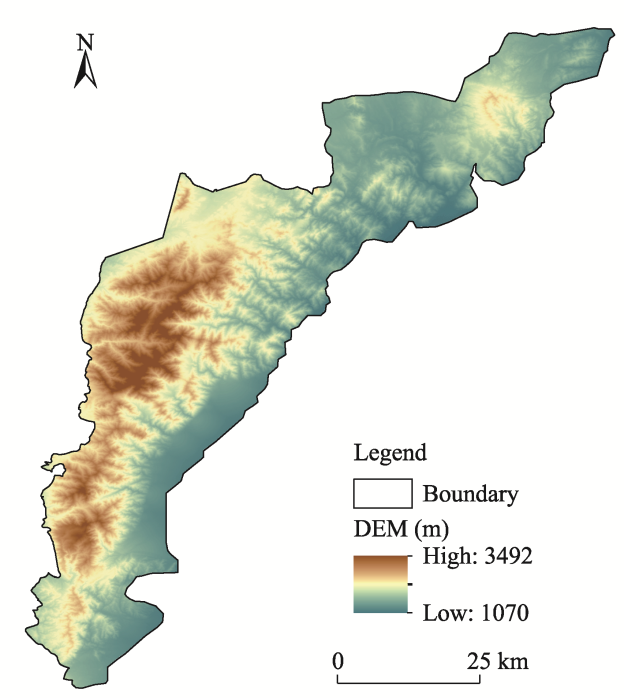
Fig. 1 Overview of the Helan Mountain based on the digital elevation model (DEM) |
Table 1 Detailed description of data used in the study |
| Data | Resolution (m) | Time period | Unit | Data source |
|---|---|---|---|---|
| Landsat 5 TM images | 30 | 2010 | - | EarthExplorer (https://earthexplorer.usgs.gov/) |
| Landsat 8 OLI images | 30 | 2014-2022 | - | GSCloud (https://www.gscloud.cn/) |
| Precipitation | 1000 | 2010-2022 | mm | Resources and Environmental Science Data Center (http://www.resdc.cn) |
| Temperature | 1000 | 2010-2022 | ℃ | Resources and Environmental Science Data Center (http://www.resdc.cn) |
| DEM | 15 | 2022 | m | GSCloud (https://www.gscloud.cn/) |
| Slope | 15 | 2022 | ° | GSCloud (https://www.gscloud.cn/) |
| NPP | 30 | 2022 | g C/(m2•a) | GSCloud (https://www.gscloud.cn/) |
| Population density | 1000 | 2010-2022 | persons/km2 | GSCloud (https://www.gscloud.cn/) |
| LULC | 1000 | 2010-2022 | - | Resources and Environmental Science Data Center (http://www.resdc.cn) |
Note: DEM, digital elevation model; NPP, net primary productivity; LULC, land use and land cover. "-" indicates the data do not have a unit. |
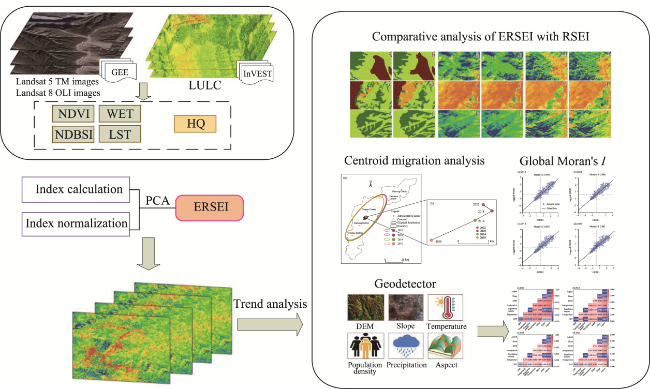
Fig. 2 Technical workflow of this study. GEE, Google Earth Engine; LULC, land use and land cover; NDVI, Normalized Difference Vegetation Index; WET, Wetness Component; NDBSI, Normalized Difference Built-up and Soil Index; LST, Land Surface Temperature; HQ, habitat quality; PCA, Principal Component Analysis; ERSEI, Enhanced Remote Sensing Ecological Index; RSEI, Remote Sensing Ecological Index; Geodetector, geographic detector. |
Table 2 Threat factors and their weights in the study area |
| Threat factor | Maximum impact distance (km) | Weight | Decay type |
|---|---|---|---|
| Farmland | 0.5 | 0.2 | Linear |
| Construction land | 5.0 | 0.5 | Index |
Table 3 Habitat suitability of each LULC type and its sensitivity to different coercion factor |
| LULC type | Habitat suitability | Sensitivity | |
|---|---|---|---|
| Farmland | Construction land | ||
| Farmland | 0.3 | 0.0 | 0.5 |
| Woodland | 1.0 | 0.4 | 0.6 |
| Grassland | 0.7 | 0.3 | 0.4 |
| Shrubland | 0.8 | 0.3 | 0.4 |
| Wetland | 1.0 | 0.4 | 0.5 |
| Water body | 0.9 | 0.6 | 0.7 |
| Construction land | 0.0 | 0.0 | 0.0 |
| Unused land | 0.0 | 0.0 | 0.0 |
Table 4 Description of interaction effects caused by the interaction between driving factors |
| Description | Interaction effect |
|---|---|
| q(F1∩F2)<min(q(F1), q(F2)) | Nonlinear attenuation |
| min(q(F1), q(F2))<q(F1∩F2)<max(q(F1), q(F2)) | Single-factor nonlinear attenuation |
| q(F1∩F2)>max(q(F1), q(F2)) | Two-factor enhancement |
| q(F1∩F2)=q(F1)+q(F2) | Independent |
| q(F1∩F2)>q(F1)+q(F2) | Nonlinear enhancement |
Note: F1 is a driving factor of ERSEI; F2 is another driving factor of ERSEI; q(F1) and q(F2) are the influences of F1 and F2 on the spatial heterogeneity of ERSEI, respectively; q(F1∩F2) is the influence of the interaction of F1 and F2 on the spatial heterogeneity of ERSEI. min, minimum; max, maximum. |
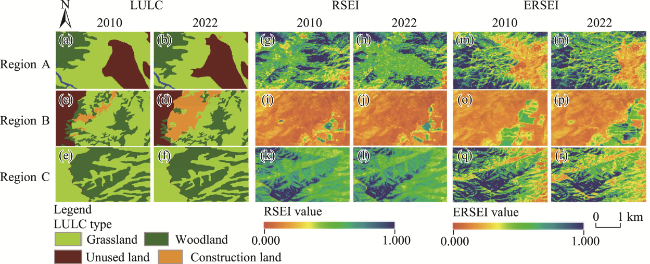
Fig. 3 Spatial distributions of LULC type (a-f), RSEI (g-l), and ERSEI (m-r) in region A, region B, and region C in the Helan Mountain in 2010 and 2022 |
Table 5 Principal Component Analysis results of ERSEI and RSEI |
| Index | Target | PC1 | PC2 | PC3 | PC4 | PC5 |
|---|---|---|---|---|---|---|
| RSEI | NDVI | 0.5472 | -0.2350 | 0.5989 | -0.5355 | - |
| WET | 0.4684 | 0.7028 | -0.4334 | -0.3144 | - | |
| LST | -0.5086 | 0.6241 | 0.5731 | -0.1527 | - | |
| NDBSI | -0.4716 | -0.2477 | -0.3537 | -0.7689 | - | |
| Eigenvalue | 0.1848 | 0.0204 | 0.0107 | 0.0023 | - | |
| Contribution (%) | 78.72 | 12.34 | 7.90 | 1.05 | - | |
| ERSEI | NDVI | 0.5277 | -0.1432 | -0.2462 | -0.6146 | -0.5124 |
| WET | 0.4471 | -0.2667 | 0.6561 | 0.4461 | -0.3153 | |
| LST | -0.5077 | -0.0488 | 0.6372 | -0.5595 | -0.1443 | |
| NDBSI | -0.4335 | 0.1993 | -0.2223 | 0.3253 | -0.7856 | |
| HQ | 0.2756 | 0.9307 | 0.2311 | -0.0657 | -0.0086 | |
| Eigenvalue | 0.1740 | 0.0404 | 0.0177 | 0.0101 | 0.0020 | |
| Contribution (%) | 80.23 | 8.88 | 5.24 | 5.02 | 1.03 |
Note: ERSEI, Enhanced Remote Sensing Ecological Index; RSEI, Remote Sensing Ecological Index; NDVI, Normalized Difference Vegetation Index; WET, Wetness Component; NDBSI, Normalized Difference Built-up and Soil Index; LST, Land Surface Temperature; HQ, habitat quality. PC1, PC2, PC3, PC4, and PC5 are the first, second, third, fourth, and fifth principal components, respectively. "-" indicates no data. |
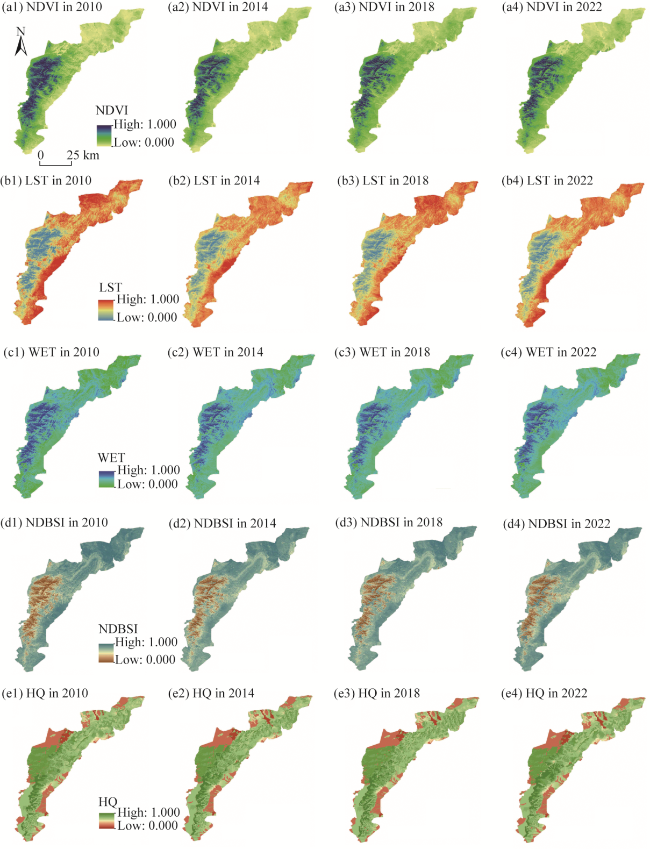
Fig. 4 Spatial variations in NDVI (a1-a4), LST (b1-b4), WET (c1-c4), NDBSI (d1-d4), and HQ (e1-e4) in the the Helan Mountain during 2010-2022 |
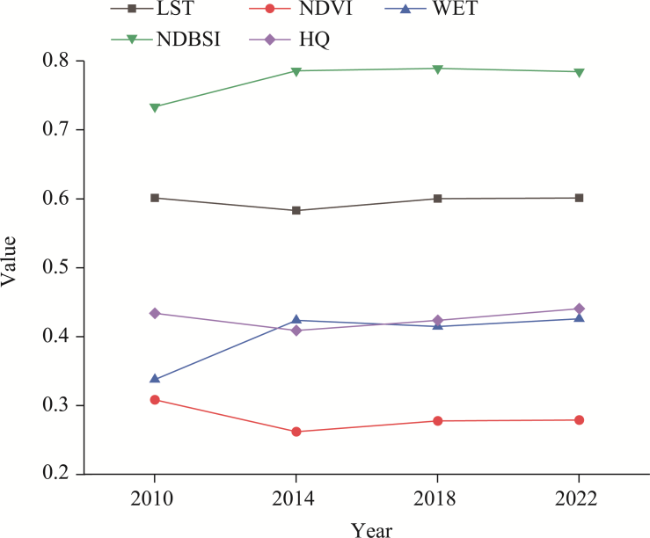
Fig. 5 Temporal variations in the mean NDVI, WET, NDBSI, LST and HQ in the Helan Mountain during 2010-2022 |
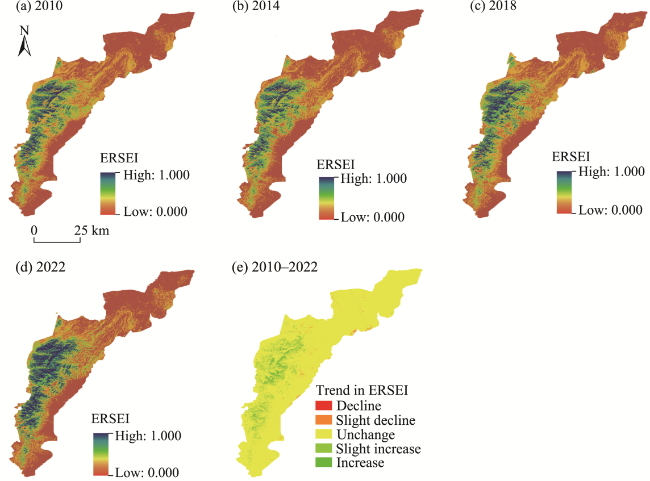
Fig. 6 Spatial distributions of ERSEI in the Helan Mountain in 2010 (a), 2014 (b), 2018 (c), and 2022 (d), as well as trend in ERSEI during 2010-2022 |
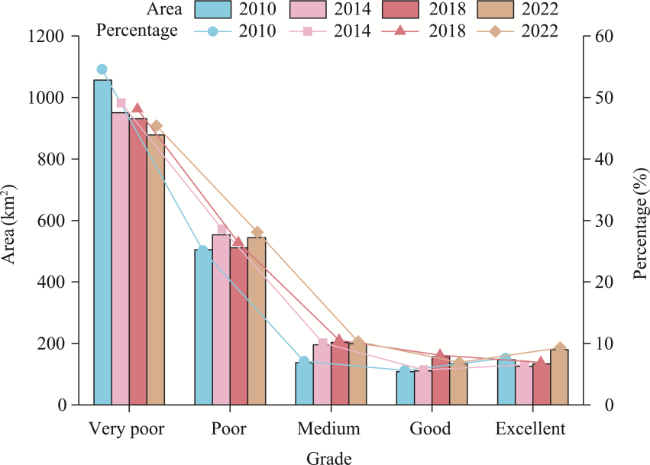
Fig. 7 Area and proportion of different grades of ecological environment quality during 2010-2022 |
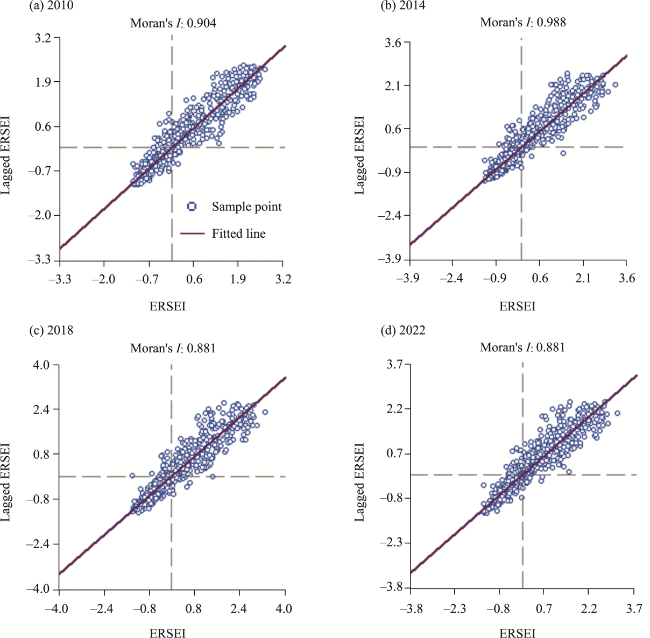
Fig. 8 Global Moran's I scatter plots for ERSEI in the Helan Mountain in 2010 (a), 2014 (b), 2018 (c), and 2022 (d) |
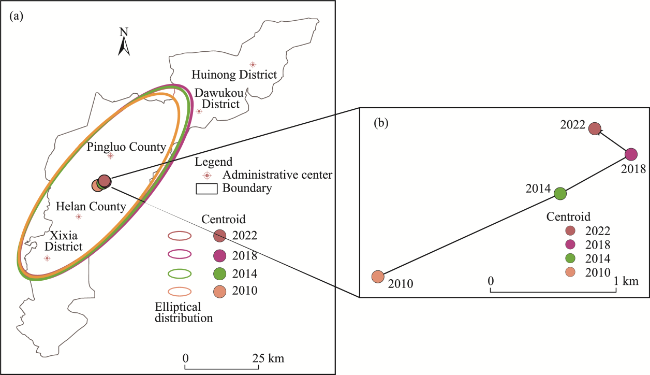
Fig. 9 Elliptical distributions and their corresponding centroids for ERSEI in the Helan Mountain in different years from 2010 to 2020 (a) and a closer view of the centroid migration trajectory of ERSEI (b) |
Table 6 Centroid migration analysis of the ERSEI in the study area during 2010-2022 |
| Year | Latitude | Longitude | Angle | Oblateness |
|---|---|---|---|---|
| 2010 | 38°50′53″N | 106°00′32″E | 40°00′00″ | 0.65 |
| 2014 | 38°51′14″N | 106°01′19″E | 40°34′48″ | 0.66 |
| 2018 | 38°51′25″N | 106°01′41″E | 40°58′48″ | 0.66 |
| 2022 | 38°51′32″N | 106°01′30″E | 41°03′00″ | 0.66 |
Table 7 Impacts of various driving factors on ERSEI from 2010 to 2022 |
| Driving factor | 2010 | 2014 | 2018 | 2022 | 2010-2022 | |||||
|---|---|---|---|---|---|---|---|---|---|---|
| q-value | P-value | q-value | P-value | q-value | P-value | q-value | P-value | Average q-value | rank | |
| NPP | 0.300 | >0.05 | 0.580 | >0.05 | 0.422 | >0.05 | 0.420 | >0.05 | 0.431 | 4 |
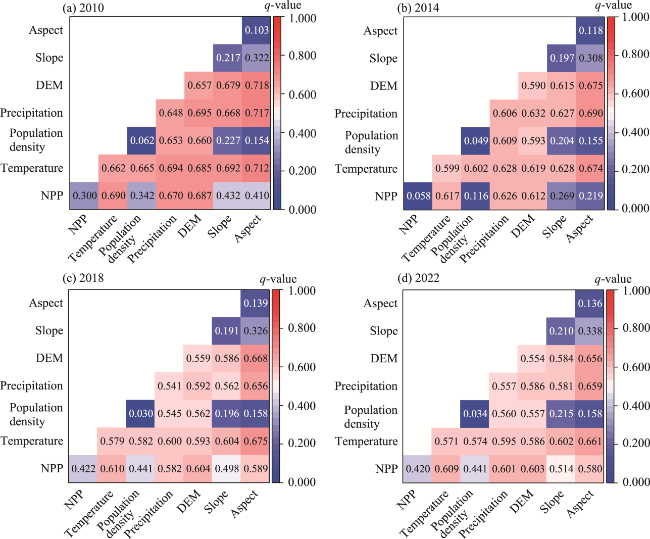
| Temperature | 0.662 | <0.01 | 0.599 | <0.01 | 0.579 | <0.01 | 0.571 | <0.01 | 0.603 | 1 |
| Population density | 0.063 | >0.05 | 0.049 | >0.05 | 0.030 | >0.05 | 0.034 | >0.05 | 0.043 | 7 |
| Precipitation | 0.649 | <0.01 | 0.606 | <0.01 | 0.541 | <0.01 | 0.557 | <0.01 | 0.588 | 3 |
| DEM | 0.657 | <0.01 | 0.590 | <0.01 | 0.559 | <0.01 | 0.554 | <0.01 | 0.590 | 2 |
| Slope | 0.217 | >0.05 | 0.197 | >0.05 | 0.191 | >0.05 | 0.210 | >0.05 | 0.204 | 5 |
| Aspect | 0.103 | >0.05 | 0.118 | >0.05 | 0.139 | >0.05 | 0.136 | >0.05 | 0.124 | 6 |
Note: q-value represents the explanatory power of each driving factor on ERSEI changes. |
Fig. 10 Results of interaction detection showing the combined effects of any two driving factors on ERSEI changes in the Helan Mountain for 2010 (a), 2014 (b), 2018 (c), and 2022 (d) |
Table 8 Ecological environment quality of 169 ecological restoration sites scaled by ERSEI and IRSEI |
| Index | Ecological restoration sites | ||||
|---|---|---|---|---|---|
| Very poor | Poor | Fair | Good | Excellent | |
| ERSEI | 101 | 49 | 10 | 6 | 3 |
| IRSEI | 87 | 50 | 20 | 8 | 4 |
Note: IRSEI, Improved Remote Sensing Ecological Index. |
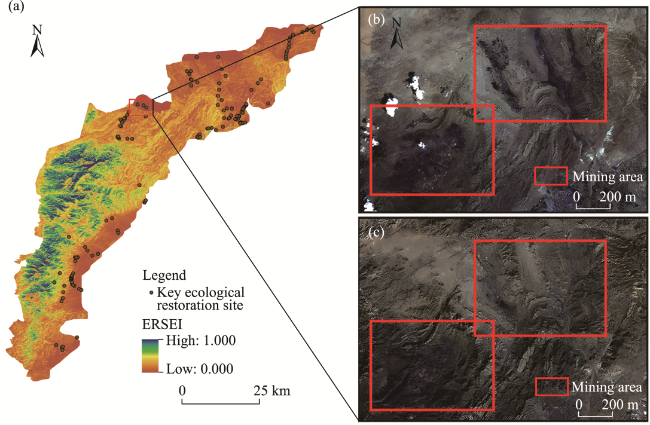
Fig. 11 Distribution of 169 key ecological restoration sites (a), Rujigou mine area based on GF-1 remote sensing image in 2013 (b), and Rujigou mine area based on GF-2 remote sensing image in 2021 (c). The distribution data of 169 key ecological restoration sites and high-resolution remote sensing imagery were provided by the Department of Natural Resources of Ningxia Hui Autonomous Region. |
| [1] |
|
| [2] |
|
| [3] |
|
| [4] |
|
| [5] |
|
| [6] |
|
| [7] |
|
| [8] |
|
| [9] |
|
| [10] |
|
| [11] |
|
| [12] |
|
| [13] |
|
| [14] |
|
| [15] |
|
| [16] |
|
| [17] |
|
| [18] |
|
| [19] |
|
| [20] |
|
| [21] |
|
| [22] |
|
| [23] |
|
| [24] |
|
| [25] |
|
| [26] |
|
| [27] |
|
| [28] |
|
| [29] |
|
| [30] |
|
| [31] |
|
| [32] |
|
| [33] |
|
| [34] |
|
| [35] |
|
| [36] |
|
| [37] |
|
| [38] |
|
| [39] |
|
/
| 〈 |
|
〉 |