Research article

Non-stationary characteristics and causes of extreme precipitation in a desert steppe in Inner Mongolia, China

  • LI Wei 1 ,
  • WANG Yixuan , 2, 3, * ,
  • DUAN Limin 2, 3 ,
  • TONG Xin 2, 3 ,
  • WU Yingjie 1 ,
  • ZHAO Shuixia 1
Expand
  • 1Yinshanbeilu Grassland Eco-hydrology National Observation and Research Station, China Institute of Water Resources and Hydropower Research, Beijing 100038, China
  • 2College of Water Conservancy and Civil Engineering, Inner Mongolia Agricultural University, Hohhot 010018, China
  • 3Autonomous Region Collaborative Innovation Center for Integrated Management of Water Resources and Water Environment in the Inner Mongolia Reaches of the Yellow River, Hohhot 010018, China
*WANG Yixuan (E-mail: )

Received date: 2024-09-01

  Revised date: 2025-01-12

  Accepted date: 2025-01-16

  Online published: 2025-08-12

Abstract

Recent years have witnessed increasingly frequent extreme precipitation events, especially in desert steppes in the semi-arid and arid transition zone. Focusing on a desert steppe in western-central Inner Mongolia Autonomous Region, China, this study aimed to determine the principle time-varying pattern of extreme precipitation and its dominant climate forcings during the period 1988-2017. Based on the generalized additive models for location, scale, and shape (GAMLSS) modeling framework, we developed the best time-dependent models for the extreme precipitation series at nine stations, as well as the optimized non-stationary models with large-scale climate indices (including the North Atlantic Oscillation (NAO), Atlantic Multidecadal Oscillation (AMO), Southern Oscillation (SO), Pacific Decadal Oscillation (PDO), Arctic Oscillation (AO), and North Pacific Oscillation (NPO)) as covariates. The results indicated that extreme precipitation remained stationary at more than half of the stations (Hailisu, Wuyuan, Dengkou, Hanggin Rear Banner, Urad Front Banner, and Yikewusu), while linear and non-linear time-varying patterns were quantitatively identified at the other stations (Urad Middle Banner, Linhe, and Wuhai). These non-stationary behaviors of extreme precipitation were mainly reflected in the mean value of extreme precipitation. The optimized non-stationary models performed best, indicating the significant influences of large-scale climate indices on extreme precipitation. In particular, the NAO, NPO, SO, and AMO remained as covariates and significantly influenced the variations in the extreme precipitation regime. Our findings have important reference significance for gaining an in-depth understanding of the driving mechanism of the non-stationary behavior of extreme precipitation and enable advanced predictions of rainstorm risks.

Cite this article

LI Wei , WANG Yixuan , DUAN Limin , TONG Xin , WU Yingjie , ZHAO Shuixia . Non-stationary characteristics and causes of extreme precipitation in a desert steppe in Inner Mongolia, China[J]. Journal of Arid Land, 2025 , 17(5) : 590 -604 . DOI: 10.1007/s40333-025-0078-7

1 Introduction

Under global climate change, extreme weather events are occurring more frequently worldwide (Robinson et al., 2021; Wang et al., 2022a). In particular, over the past few decades, extreme events related to precipitation have occurred more frequently and have caused an increasing amount of damage (Myhre et al., 2019; Tabari, 2020; Tang et al., 2021). Correspondingly, the variation characteristics of extreme precipitation have attracted widespread attention (Mou et al., 2022; Zhang et al., 2023b). A great deal of related research has been conducted on different spatial and temporal scales, revealing the non-stationary variations in extreme precipitation in many regions (Gao et al., 2016; Hao et al., 2019; Zhang et al., 2023a).
Many statistical analysis methods, such as the Mann-Kendall rank test (Kliengchuay et al., 2024), regression model (Marques et al., 2020), and wavelet analysis (Tan et al., 2016), have usually been used to detect the non-stationary characteristics of hydro-meteorological variables. However, the results obtained using these traditional methods can only explain the magnitude and significance of the temporal variability and cannot explain the specific change modes and mechanisms.
Rigby and Stasinopoulos (2005) introduced the generalized additive models for location, scale, and shape (GAMLSS), consisting of parametric and semi-parametric regression type models. The GAMLSS can provide a flexible framework for describing the non-stationarity of time series using a wide selection of probability distribution functions, including extreme value distributions and high deviation distributions. The addition of various explanatory variables to the GAMLSS makes it possible to describe the distribution parameters as linear (or non-linear) and parametric or (non-parametric) functions of the explanatory variables. The GAMLSS models have been widely used in temporal statistical analysis of hydro-meteorological processes. For example, they have often been established for non-stationary flood frequency analysis using climate and anthropogenic factors as covariates (Durocher et al., 2019; Wang et al., 2022b; Barbhuiya et al., 2023). The non-stationary characteristics of the precipitation frequency were also detected using the GAMLSS models, in which time and climate factors have commonly been selected as the explanatory variables for parameter fitting (Hao et al., 2019; Noh et al., 2021; Zhang et al., 2023a). In addition, large-scale climate indices, such as the Pacific Decadal Oscillation (PDO), North Atlantic Oscillation (NAO), and Atlantic Multidecadal Oscillation (AMO), were considered in the GAMLSS models to explain the response of regional climate dynamics to global climate change (Li and Tan, 2015; Zhang et al., 2015; Wang et al., 2023).
Temperate grasslands constitute an important component of terrestrial ecosystems, and the temperate grassland area in northern China is regarded as an important natural green barrier. Along the climate gradient, its vegetation changes from meadow steppe in the east to typical steppe in the middle to desert steppe in the west. The desert steppe area located in the semi-arid and arid transition zone plays an active role in wind prevention, sand fixation, and soil and water conservation. In recent years, global warming has accelerated the water cycle of inland areas, resulting in the more frequent occurrence of extreme climate events (Zhang et al., 2018; Zhao et al., 2024). Correspondingly, the ecological security and sustainable development of desert steppe area has been seriously threatened (Wu et al., 2021; Lv et al., 2023). The desert steppe area, located in western-central Inner Mongolia Autonomous Region, China, is a type of very fragile grassland ecosystem in the transition zone from grassland to desert, and it has a special geographic location. It is regarded as the northern sand prevention belt in northern China and is closely related to the steady development of the important economic zone in Inner Mongolia. Hence, there is an urgent need to better understand the variations in the extreme precipitation regime in this region caused by global climate change.
In this study, based on the GAMLSS modeling framework, we aimed to detect the non-stationary behavior of extreme precipitation in a desert steppe area in Inner Mongolia and determine its driving factors from the perspective of global circulation anomalies. Our research can provide a scientific reference for developing effective strategies for coping with climate change and natural disasters in other similar desert steppes in the semi-arid and arid transition zone.

2 Study area

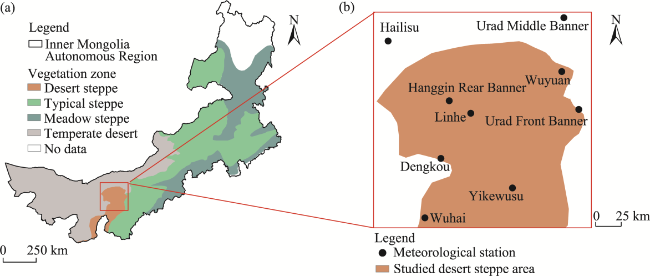
The desert steppe area in western-central Inner Mongolia was selected as the study area (39°41′32″-41°22′37″N, 106°15′03″-108°42′18″E; Fig. 1a). It covers an area of approximately 2.84×10⁴ km2 and has a semi-arid continental monsoon climate in the middle and temperate zone, with long and cold winters, short and cool summers, and a large difference in temperature between day and night. The average annual precipitation is 282.90 mm, and precipitation mainly occurs in July, August, and September. The average annual evaporation is 2305.00 mm; the annual average temperature is 2.5°C; the average annual sunshine duration is 3100 h; and the annual average wind speed is 4.5 m/s. Windy days and sandstorms occur more frequent in spring. The main soil type is chestnut soil, and the vegetation coverage is low. The constructive species of the vegetation community is Stipa krylovii, and the dominant species are Leymus chinensis and Aritimisia frigida. Other plants include more than 140 species, such as Cleistogenes squarrosa and Agropyron cristatum.
Fig. 1 Overview of the vegetation zones in Inner Mongolia Autonomous Region, northern China and location of the studied desert steppe area (a) and distribution of the selected meteorological stations in and around the studied desert steppe area (b). Note that the boundary of Inner Mongolia Autonomous Region is based on the standard map (GS(2020)4619) of the Map Service System (https://bzdt.ch.mnr.gov.cn/), and the boundary has not been modified. The data for the vegetation zones were obtained from the Resource and Environmental Science Data Platform (https://www.resdc.cn/).
The study area has a simple ecosystem structure and corresponding weak self-regulation and recovery abilities. The area has limited water resources, and the ecological background is very fragile. Located in an interlacing pastoral-agricultural region, it is extremely vulnerable to human interference and natural disasters. In addition, the drying tendency caused by climate warming has led to an increased risk of grassland degradation and agricultural losses in this region.

3 Materials and methods

3.1 Data sources

3.1.1 Precipitation data

This study selected nine national basic meteorological stations distributed in and around the study area (Fig. 1b) and obtained their corresponding daily precipitation data for the period 1988-2017 from the Inner Mongolia Meteorological Service.
The maximum precipitation during five consecutive days (Rx5d) is an extreme precipitation index of a core set of indices (27 in total) that have become a common standard for monitoring climate change and are recommended by the Expert Team on Climate Change Detection and Indices (ETCCDI). In the past two decades, there has been a steady increase in the application of the ETCCDI recommendations for monitoring climate extremes (Alexander, 2016; Yosef et al., 2019; IPCC, 2021; Yosef et al., 2021; Adeyeri et al., 2022). Numerous studies have used the Rx5d index to investigate the characteristics of extreme precipitation, demonstrating its good representation ability (Rao et al., 2019; Freychet et al., 2022; Ge et al., 2023; Li and Wu, 2024). In addition, only daily precipitation data were available for use in our study, limiting the definition of precipitation events. Therefore, the Rx5d index was used as the extreme precipitation index in this study. The Rx5d index was calculated for each station after data quality checks.

3.1.2 Large-scale climate indices

Anomalies in general atmospheric circulations are good indicators of global climate change. Many previous studies have proven that large-scale climate phenomena can influence extreme precipitation patterns across the globe. For example, in China, Li et al. (2024) noted that extreme precipitation events are more common in El Niño phases in winter and summer. Gao et al. (2017) reported that the El Niño-Southern Oscillation (ENSO) and AMO have strong effects on extreme precipitation in the monsoon regions in China. Deng et al. (2018) explored the possible teleconnection of the Southern Oscillation (SO), NAO, and PDO to the intensity and frequency of extreme precipitation. He et al. (2017) pointed out the generally accepted knowledge that a positive spring Arctic Oscillation (AO) is followed by significant positive summer precipitation anomalies. Sun and Li (2022) clarified the synergistic effect of El Niño and the North Pacific Oscillation (NPO) on winter precipitation extremes. According to the related findings in previous studies, six large-scale climate indices were considered in our study, namely the SO, AO, PDO, AMO, NAO, and NPO. Monthly data for the six climate indices from 1988 to 2017 were obtained from the Climate Prediction Center of National Oceanic and Atmospheric Administration's Earth System Research Laboratory (https://www.ncei.noaa.gov/access/monitoring/).

3.2 Methods

3.2.1 GAMLSS models

The GAMLSS models are distributional regression models, in which all of the parameters of the assumed distribution for the response variable can be modeled as linear (or non-linear) and parametric (or non-parametric) functions of the explanatory variables. The use of the GAMLSS models is appropriate when the focus is not only on the mean (or location) of the distribution but possibly other parts of the distribution such as the variance, quantiles, skewness, kurtosis, and tails. The maximum likelihood estimation (maximum penalty estimation), including the calculation methods of the Cole and Green (CG) algorithm and Rigby and Stasinopoulos (RS) algorithm, is usually used to conduct the model fitting. The GAMLSS models provide over 100 continuous, discrete, and mixed distributions for modeling the response variable (Rigby and Stasinopoulos, 2005; Stasinopoulos et al., 2018).
In the GAMLSS models, it is assumed that the variable Y corresponding to time t is the independent observation data yt (t=1, 2, …, n), and its probability density function f is expressed as f(yt|θt) conditional on θt=(θt1, θt2, …, θtm), where θt is the vector including m distribution parameters for explanatory variables. The parameter variables can be constants or can be correlated with the explanatory variables. The first two parameters of the model are usually referred to as the location and scale parameters, which, respectively, correspond to the expected value (mean value) and the coefficient of variation (mean square error) of the variables. The other parameters in the distribution are referred to as the shape parameters. The kth parameter of a given distribution is connected to explanatory variables through the monotonic link function gk(θk) as follows:
g k ( θ k ) = X k β k + j = 1 J k Z j k γ j k ,
where θk is a vector of length n, which represents the value of the probability distribution function corresponding to yt (t=1, 2, …, n) for the kth parameter; Xk is a n×Jk matrix of explanation variable X; βk is the regression parameter vector of length Jk; Zjkγjk is the jth random effect (i.e., a non-parametric term); Zjk is a fixed design matrix; and γjk is a normally distributed vector of random variables. According to the research purpose of our study, it is not necessary to consider the random effects on the distribution parameters in the GAMLSS models. Thus, a full-parameter model was developed in this study:
g k ( θ k ) = X k β k .
To make the non-stationary modeling sufficiently flexible, a three-parameter distribution is usually used, and Equation 2 can be specifically expressed as follows:
g 1 ( u ) = X 1 β 1 g 2 ( σ ) = X 2 β 2 g 3 ( λ ) = X 3 β 3 ,
where u represents the location parameter, which is directly related with the mean of the variable of interest; σ represents the scale parameter related with the variance; and λ represents the shape parameter related with the skewness.
In this study, the GAMLSS modeling framework was used to develop a time-dependent model with time as the covariate and a non-stationary model with climate indices as the covariate to fit the extreme precipitation.
To provide sufficient flexibility in fitting the Rx5d series, we considered five three-parameter distributions (generalized gamma (GG), ex-Gaussian, normal distribution family (NOF), power exponential (PE), and Box-Cox Cole and Green (BCCG)) and five two-parameter distributions (Gamma (GA), Gumbel (GU), Logistic (LO), Weibull (WEI), and Inverse Gaussian (IG)). We selected the best fitting distribution according to the minimum Akaike information criterion (AIC) value.

3.2.2 Traditional methods

Among the methods most commonly used in previous studies, the non-parametric Mann-Kendall statistical test (Mann, 1945; Kendall, 1975) was selected as a traditional method to detect if a trend in the Rx5d time series was statistically significant at the significance level α=0.1. At the 0.1 significance level, the null hypothesis of no trend is rejected if the test statistic |Z| is greater than 1.64. The Theil-Sen approach was also selected as a traditional method and used to compute Sen's slope estimates to quantify the slope of the trend (magnitude) (Theil, 1950; Sen, 1968). Because both the Mann-Kendall statistical test and Theil-Sen approach require time series to be serially independent, the pre-whitening technique was first used to solve this problem. The sequential Mann-Kendall test was adopted to detect the time when the trend experienced a shift (change in regime) (Partal and Kahya, 2006; Modarres and Silva, 2007).
To determine the correlation relationship between the Rx5d and large-scale climate indices, this study selected the traditional method in terms of Spearman's correlation analysis. Spearman's correlation analysis in statistics is a nonparametric alternative to Pearson's correlation analysis. This method was used to identify the large-scale climate indices that are significantly correlated with the regional Rx5d series according to Spearman's rank order correlation coefficient (Glasser and Winter, 1961).

4 Results

4.1 Spatial and temporal distributions of extreme precipitation

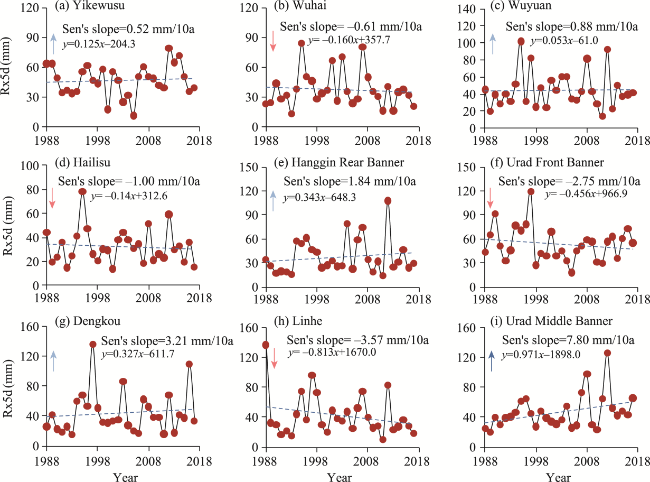
Based on the Rx5d series for the period 1988-2017 at the nine selected stations, we first used the linear regression analysis to detect the temporal trend (Fig. 2). The Rx5d index exhibited linear increasing trends at five stations, namely Yikewusu, Wuyuan, Hanggin Rear Banner, Dengkou, and Urad Middle Banner, with rates of change ranging from 0.52 to 7.80 mm/10a. At the other four stations (Wuhai, Hailisu, Urad Front Banner, and Linhe), the Rx5d index tended to decrease with rates of change ranging from -3.57 to -0.61 mm/10a. The Urad Middle Banner and Linhe stations had the maximum increasing and decreasing magnitudes, respectively. The results of Mann-Kendall statistical test and Theil-Sen approach yielded a conclusion similar to that obtained through the linear regression analysis. However, only the increasing trend at the Urad Middle Banner station was significant. The corresponding Sen's slope was estimated to be 7.80 mm/10a, indicating that extreme precipitation at the Urad Middle Banner station increased by 0.78 mm/a on average. Based on the results obtained using the sequential Mann-Kendall test, there was no clear trend break point in the Rx5d series at the selected stations. Overall, the temporal non-stationarity in the variability of extreme precipitation regime over the study area seemed to be undefined using the common methods.
Fig. 2 Results of linear regression, Mann-Kendall statistical test, and Theil-Sen approach for the Rx5d series at the nine stations from 1988 to 2017. (a), Yikewusu; (b), Wuhai; (c), Wuyuan; (d), Hailisu; (e), Hanggin Rear Banner; (f), Urad Front Banner; (g), Dengkou; (h), Linhe; (i), Urad Middle Banner. Rx5d indicates the maximum precipitation during five consecutive days. The pink downward pointing arrow indicates a decreasing trend. The light blue upward pointing arrow indicates an increasing trend, and the dark blue upward pointing arrow indicates a significant increasing trend (α=0.01).
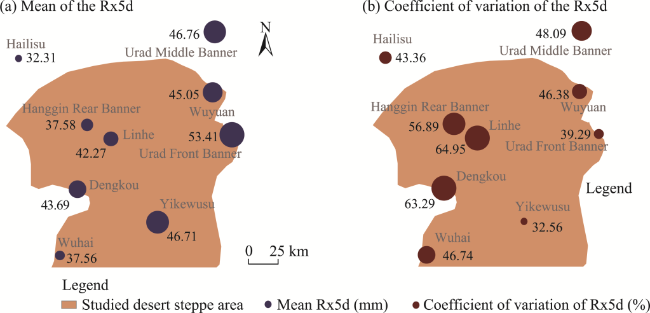
Figure 3 gives the mean value and coefficient of variation of the Rx5d series during the period 1988-2017. Despite the relatively small spatial range, the mean value of the Rx5d series increased from 32.31 mm in the northwest to 53.41 mm in the east, and the coefficient of variation was approximately 35.0% at the stations in the periphery of the study area, while it was more than 60.0% at the stations in the central region of the study area. There were large differences in the spatial distributions of the Rx5d statistics, indicating the inconsistent spatial variations in extreme precipitation.
Fig. 3 Spatial variations in mean (a) and coefficient of variation (b) of the Rx5d series at the nine stations during 1988-2017. Circle size represents the magnitude of the value at each station.

4.2 Time-dependent variations in extreme precipitation

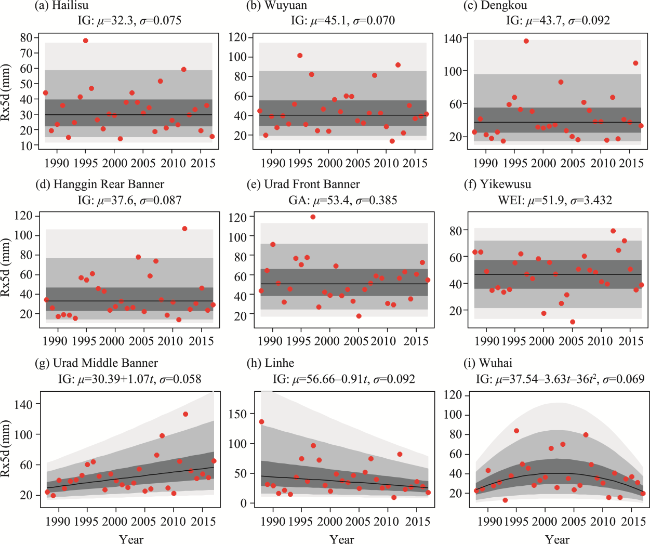
Using the GAMLSS models with time as the covariate, the time-dependent models were optimized for fitting the Rx5d series at each station. According to the selections of the best distributions shown in Figure 4, the IG distribution performed the best at most of the stations, and the GA and WEI distributions only performed the best at one station (Urad Front Banner and Yikewusu, respectively). This demonstrates that the two-parameter IG distribution is capable of describing extreme precipitation changes in this desert steppe area.
Fig. 4 Distribution selection, parameter estimation, and modeling results of the best time-dependent model for extreme precipitation at each station from 1988 to 2017. (a), Hailisu; (b), Wuyuan; (c), Dengkou; (d), Hanggin Rear Banner; (e), Urad Front Banner; (f), Yikewusu; (g), Urad Middle Banner; (h), Linhe; (i), Wuhai. The red circles represent the measured annual Rx5d values. The light gray region represents the area between the 0.01 and 0.99 quantiles, the dark gray region represents the area between the 0.05 and 0.95 quantiles, the black region represents the area between the 0.25 and 0.75 quantiles, and the black line represents the median (0.50 quantile). IG, GA, and WEI denote the Inverse Gaussian, Gamma, and Weibull distributions, respectively. μ and σ are the location and scale parameters, respectively.
Based on the estimated parameters shown in Figure 4, the time-dependent models at six stations (namely Hailisu, Wuyuan, Dengkou, Hanggin Rear Banner, Urad Front Banner, and Yikewusu) were optimized as stationary models, in which the parameters were independent of time. It is suggested that the variations in the extreme precipitation regime at these stations remained stationary. For the remaining three stations, a time-dependent model was finally identified, with the mean as a linear or non-linear function of time and the variance as a constant. This demonstrates the non-stationary behaviors of extreme precipitation, which are mainly reflected in the first moment.
The modeling results obtained using the best time-dependent models visually showed the non-stationary characteristics of extreme precipitation during the last three decades (Fig. 4). At the Urad Middle Banner station, a linear increasing trend in the extreme precipitation regime was observed, with a rate of change of 10.70 mm/10a. The extreme precipitation at the Linhe station decreased linearly at a rate of 9.13 mm/10a. At the Wuhai station, a non-linear trend was identified; namely, the extreme precipitation initially increased during the period 1988-2002 and then decreased during the period 2002-2017. For the other six stations, all of the quantile fitting curves remained at a certain level with time. This is consistent with the results of traditional methods, indicating the insignificant temporal variations in the extreme precipitation regime during the last three decades.

4.3 Underlying causes of the non-stationarity of extreme precipitation

4.3.1 Selection of climate indices

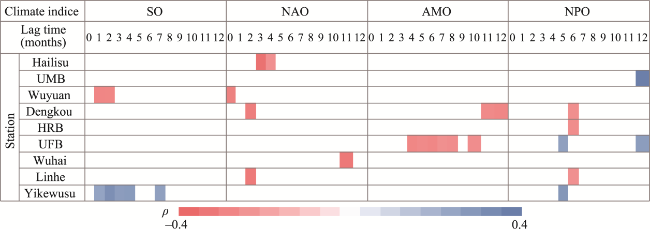
Concurrent and lagging correlation analyses were conducted between the Rx5d and large-scale climate indices (Fig. 5). Because there may be a lag in the effect of the large-scale climate patterns on regional extreme precipitation, lag times of 1-12 months were considered in this study. For a certain climate pattern, 13 related time series were prepared for the correlation analyses with the Rx5d series at each station, including the series for the corresponding month and the series averaged over the previous 1-12 months. The significantly correlated climate indices were summarized at the 0.05 significance level.
Fig. 5 Concurrent and lagging correlation between the Rx5d and large-scale climate indices at the nine stations during 1988-2017. SO, Southern Oscillation; NAO, North Atlantic Oscillation; AMO, Atlantic Multidecadal Oscillation; NPO, North Pacific Oscillation. UMB, HRB, and UFB denote the Urad Middle Banner, Hanggin Rear Banner, and Urad Front Banner, respectively. ρ is the Spearman's rank order correlation coefficient.
The anomalies of the AO and PDO did not exhibit significant correlations with extreme precipitation during the last three decades. The NPO was significantly correlated with extreme precipitation at most of the stations, with lag times of 5-6 and 12 months. There were both negative and positive correlations. Specifically, the NAO exhibited a positive correlation with extreme precipitation, and this correlation was significant at more than half of the stations, with a main lag time of 1-4 months. There was also a positive correlation between the AMO and extreme precipitation, but it was only significant at two stations (Dengkou and Urad Front Banner) with longer lag times (4-12 months). The SO exhibited both positive and negative correlations with extreme precipitation, but the correlation was only significant at two stations (Wuyuan and Yikewusu) with lag times of 1-4 months.

4.3.2 Non-stationary modeling results with covariates

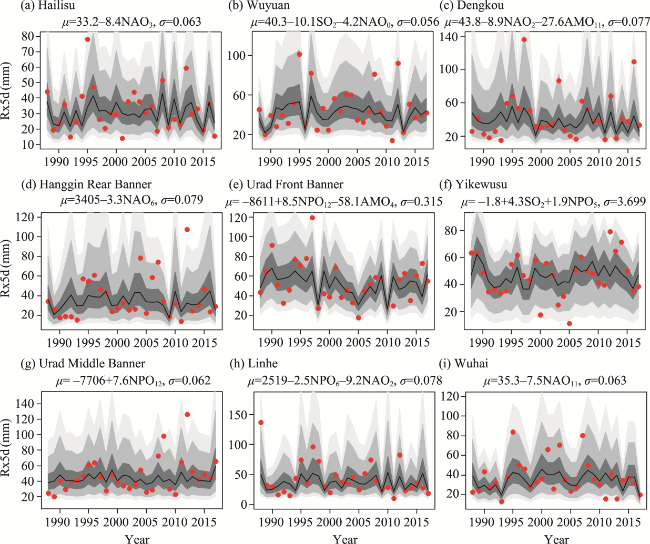
Based on the selected best distribution (Fig. 4), we developed a non-stationary model with the significantly related climate indices as covariates, in which the parameters were modeled as a multivariate linear function of the covariates. The model was optimized by removing the explanatory variables one by one according to their AIC values. Among all the compared models, the optimal non-stationary model with the smallest AIC yielded the best performance in fitting the Rx5d series, and its remaining covariates may have been the most powerful climate forcings in terms of explaining the variations in regional extreme precipitation.
Based on the parameter estimations (Fig. 6), the NAO, with lag times of 0-3 months, was taken as a covariate of the mean at five stations. All of the correlation coefficients of the NAO with Rx5d were positive, implying that the positive phase of the NAO may have caused an increase in regional extreme precipitation. The NPO was also retained as a covariate at five stations, but its lag time extended to 5-6 months and even to 12 months, with negative and positive coefficients, respectively. It can be inferred that both the negative and positive NPO phases within a cycle could cause abnormal variations in the extreme precipitation regime. In addition, the previous 1-2 months of SO anomalies exhibited a strong correlation with extreme precipitation at two stations, with a mixture of positive and negative effects. The AMO exhibited a strong negative correlation with extreme precipitation at only two stations, but it had a longer lag time of approximately 12 months. This demonstrates that the previous large-scale climate indices may have been the key factor leading to the non-stationary behavior of extreme precipitation.
Fig. 6 Parameter estimation and modeling results of the best non-stationary model for extreme precipitation at each station from 1988 to 2017. (a), Hailisu; (b), Wuyuan; (c), Dengkou; (d), Hanggin Rear Banner; (e), Urad Front Banner; (f), Yikewusu; (g), Urad Middle Banner; (h), Linhe; (i), Wuhai. The red circles are the measured annual RX5d values. The light gray shading represents the area between the 0.01 and 0.99 quantiles, the dark gray shading represents the area between the 0.05 and 0.95 quantiles, the black shading represents the area between the 0.25 and 0.75 quantiles, and the black line represents the median (0.50 quantile). The subscript number of the climate index represents the corresponding lag time.
The fitting results of the best non-stationary model exhibited a better fitting performance than the other two models (Fig. 6), and thus, this model can capture the extreme outliers and reflect the random fluctuations in the extreme precipitation regime. This reveals that considering the large-scale climate forcings and their influencing mechanism on the non-stationarity of extreme precipitation has improved the model. Based on the results of the stationary, time-dependent, and non-stationary models, it can be inferred that the NAO exerted a 3-month lagged influence on extreme precipitation at the Hailisu station, but it did not cause non-stationary variations in the extreme precipitation regime. Similar results were obtained for the Wuyuan, Dengkou, Hangjin Rear Banner, Urad Front Banner, and Yikewusu stations.
It was found that the significant influences of various climate indices with different lag times on the extreme precipitation regime mainly promoted the random variations in extreme precipitation. Conversely, the significant linear increasing trend of the Rx5d series for the Urad Front Banner station was most likely caused by the 12-month lagged influence of the NPO. The non-linear changes observed at the Wuhai station may have been caused by the influence of the 11-month lagged effect of the NAO, and the non-linear tendency at the Linhe station may have been the result of the combined effect of the 2-month lagged effect of the NPO and the 6-month lagged effect of the NAO. This demonstrates that the anomalies in large-scale climate patterns can explain the non-stationary behaviors of regional extreme precipitation.

5 Discussion

5.1 Non-stationarity of extreme precipitation

Extreme precipitation drives adverse phenomena, with implications for both human and natural systems. Some of the repercussions of extreme precipitation include heavy flooding, soil erosion, fatal landslides, reduced agricultural production, and infrastructure damage. As a random variable, precipitation usually follows a probability distribution, and its extremes occupy the upper part of the distribution (the tail of the distribution). Studies performed on a global scale have provided evidence that daily precipitation extremes are more adequately described by heavy- rather than light-tailed distributions (De Michele and Avanzi, 2018; Hu and Franzke, 2020). Our findings also support this conclusion, namely, the time series of extreme precipitation in the studied desert steppe area were characterized by heavy-tailed distributions. More intense and frequent extreme events occurred in the study area.
Traditional statistical analysis of extreme precipitation is generally based on the stationarity assumption, which assumes that the distribution parameters of the variable are constant. However, under the influence of climate change and human activities, the hypothesis of stationarity has been questioned (Milly et al., 2008). Non-stationary characteristics, such as trends, abrupt changes, or a combination of the two, have been observed in data for extreme meteorological events in some areas of China (Sun and Zhang, 2017; Guan et al., 2022). For example, previous studies have pointed out that the magnitude and frequency of extreme precipitation events are increasing in most parts of China while decreasing in the north (Wang and Qian, 2009; Diao et al., 2023). Accordingly, research on non-stationary precipitation extremes has attracted much attention in recent years (Huang et al., 2021; Zhang et al., 2023a). In this study, we developed a time-dependent model to identify the non-stationary behaviors of extreme precipitation. As a result, we quantitatively captured the linear and non-linear variations in the extreme precipitation regime. Non-stationarity was not prominently observed for the majority of the stations. The spatial differences between the stationary and non-stationary patterns could not represent the complete spatial differences in extreme precipitation. These patterns essentially indicate the time-dependency level of extreme precipitation changes. The Rx5d series for more than 65.0% of the selected stations exhibited stationary behaviors, while those for less than 35.0% of the stations exhibited non-stationary variations. This implies that the extreme precipitation in the study area generally exhibited stationary variations without significant time dependency, but the special cases in which non-stationary patterns existed indicated the occurrence of spatial heterogeneity of the temporal variations in the precipitation extreme regime over the study area. Even in the areas where extreme precipitation exhibited stationary variations, spatial differences still existed in the characteristics of extreme precipitation events, such as the amount, intensity, and frequency. However, it is possible that because of the limitation of the time-varying forms we considered, the non-stationarity of extreme precipitation may not conform to linear, parabolic, and cubic changes. The GAMLSS and generalized extreme value distribution have been commonly used to construct non-stationary models, i.e., by modeling the first and/or second moment of the extreme series as a function of time (Shao et al., 2022; Liu et al., 2024). In many previous studies, almost all of the evaluation indices indicated that the time-dependent models can better describe the extreme precipitation events in China than the stationary models (e.g., Gu et al., 2017; Sun et al., 2018). The temporal trends of the mean and variance of the extreme precipitation series can be well captured under the condition that the functional form of the time is sufficiently flexible (Chen et al., 2017). In general, the incorporation of time as a covariate could effectively improve the accuracy of non-stationary modeling because the time series has a significant time-varying pattern. This modeling method can derive the mathematical expression of the temporal trend to infer the mode, rate, turning points, and extreme points of the change trends.
In this study, we found that the differences between the GAMLSS models and the traditional methods were noteworthy. From a methodological point of view, in terms of the Mann-Kendall test and Sen's slope estimation, the traditional methods mainly determined the direction and magnitude of the temporal trends, while the GAMLSS models directly provided the change patterns over time, thus capturing the specific change processes. From a result point of view, similar results were obtained for seven of the stations using the two approaches, indicating that the extreme precipitation regime exhibited stationary behavior at the Yikewusu, Wuyuan, Hanggin Rear Banner, Dengkou, Hailisu, and Urad Front Banner stations and a significant increase at the Urad Middle Banner station. However, for the Linhe and Wuhai stations, different results were obtained using the two approaches. The traditional methods did not detect the linear decreasing trend at the Linhe station and the non-linear change trend at the Wuhai station. This demonstrates that the GAMLSS models can be used as an effective supplement to temporal characteristic analysis.
In addition, due to data available, the precipitation data used in this study spanned from 1988 to 2017, thus, the time series with a 30-a length only reflected part of the characteristics of precipitation changes. Although there is a large amount of remote sensing data available, the data at the site point scale extracted from remote sensing data exhibited a relatively low fitting accuracy with the site observations, especially for the observed and remote sensing-based Rx5d series. Thus, effective data updating is difficult, and this data deficiency inevitably leads to limitations of the results. It is recommended to explore effective ways to update data in the future and identify the long-term temporal variation patterns of extreme precipitation in response to global warming.

5.2 Climate indices used as covariates for fitting extreme precipitation

In addition to time, climate indices are also commonly introduced into the probability distribution as covariates for fitting extreme precipitation. This is because of the significant correlation between extreme precipitation events and climate factors. Numerous studies have revealed that the East Asian monsoon, which dominates the climate in most areas of China, is significantly affected by the ENSO, as well as by the NAO, PDO, AMO, and Indian Ocean Dipole (Xiao et al. 2015; Zhang et al., 2022a; Zhang et al., 2022b; Dong et al., 2024; Wang et al., 2024). Among these numerous climate covariate factors, the ENSO is the most widely studied and has been shown to exert the most significant effect on extreme precipitation in some regions (Li et al., 2011). This is consistent with our findings that the ENSO is closely related to the extreme precipitation at the Yikewusu station. In addition, the NAO, AMO, and NPD were significantly correlated with the extreme precipitation regime in the study area but with less obvious regularity. This may be due to the complex water vapor sources of extreme precipitation in inland areas. Consequently, the non-stationary model with climate indices as covariates yielded a better goodness of fit than that with time as the covariate, which could better describe the fluctuation in extreme precipitation. This is consistent with the results of previous studies (Singh et al., 2021; Schlef et al., 2023; Li et al., 2024). The use of climate indices as covariates can more adequately capture the dispersion of precipitation values. In this study, we found that the anomalies of the AO and PDO did not exhibit significant correlations with extreme precipitation in the study area during the last three decades. This does not mean that the AO and PDO do not influence regional precipitation patterns. The previous warming of the AMO had a significant influence on the extreme precipitation regime in the studied desert steppe area.
Instead of considering a single factor, combinations of different climate indices are usually used as covariates to construct non-stationary models, such as the optimized linear combination or principal component factors of climate variables (Gu et al., 2022; Barbhuiya et al., 2023). Climate covariate factors are expected to provide a root cause explanation for the trend and non-stationarity of extreme precipitation. Although the non-stationary model had a better performance in terms of fitting the variations in extreme precipitation, it can also introduce much uncertainty due to the complexity of the model structure and the natural variability of the covariates. Thus, quantitative assessment of the uncertainty should be a focus of future research.

6 Conclusions

We investigated the non-stationary characteristics of extreme precipitation in a desert steppe area located in western-central Inner Mongolia. Using the GAMLSS modeling approach, a stationary model, a time-dependent model, and a non-stationary model with climate indices as covariates were constructed to fit the Rx5d series at nine meteorological stations. The IG distribution with the best performance in fitting the Rx5d time series indicated that extreme precipitation changes in this desert steppe area exhibited heavy-tailed characteristics. Compared with the stationary model, the time-dependent model was only optimal at three stations, and the mean of the distribution was described as a linear or non-linear function of time.
It is suggested that the variations in the extreme precipitation regime remained stationary in most cases. However, the non-stationary behavior reflected by the first moment was also significant in some specific cases. The non-stationary model that incorporated climate indices yielded the lowest AIC values, supporting the conclusion that the large-scale climate forcings (NAO, NPO, AMO, and SO) have significant influences on the extreme precipitation regime in this inland area. It is inferred that the positive phase of the NAO may have caused an increase in regional extreme precipitation, while both the negative and positive NPO phases may have caused abnormal variations in the extreme precipitation regime. These findings enhance the understanding of extreme precipitation mechanisms in inland arid ecosystems under climate change, providing critical insights for regional water resource management and disaster prevention.

Conflict of interest

The authors declare that they have no known competing financial interests or personal relationships that could have appeared to influence the work reported in this paper.

Acknowledgements

This research was funded by the Yinshanbeilu Grassland Eco-hydrology National Observation and Research Station, China Institute of Water Resources and Hydropower Research (YSS202105), the National Natural Science Foundation of China (52269005), the Inner Mongolia Science and Technology Plan Project (2022YFSH0105), the Central Guidance for Local Science and Technology Development Fund Projects (2024ZY0002), the Inner Mongolia Autonomous Region University Youth Science and Technology Talent Project (NJYT 22037), and the Inner Mongolia Agricultural University Young Teachers' Scientific Research Ability Improvement Project (BR220104).

Author contributions

Conceptualization: WANG Yixuan, DUAN Limin; Data curation: LI Wei, TONG Xin; Formal analysis: LI Wei, TONG Xin, ZHAO Shuixia; Funding acquisition: WANG Yixuan, LI Wei; Investigation: WANG Yixuan, WU Yingjie; Methodology: WANG Yixuan, DUAN Limin; Project administration: LI Wei, ZHAO Shuixia; Resources: LI Wei, WU Yingjie; Software: WANG Yixuan, DUAN Limin; Supervision: LI Wei, WU Yingjie; Validation: LI Wei, TONG Xin, ZHAO Shuixia; Visualization: WANG Yixuan, DUAN Limin; Writing - original draft: WANG Yixuan; Writing - review and editing: LI Wei. All authors approved the manuscript.
[1]
Adeyeri O E, Zhou W, Wang X, et al. 2022. The trend and spatial spread of multisectoral climate extremes in CMIP6 models. Scientific Reports, 12(1): 21000, doi: 10.1038/s41598-022-25265-4.

[2]
Alexander L V. 2016. Global observed long-term changes in temperature and precipitation extremes: A review of progress and limitations in IPCC assessments and beyond. Weather and Climate Extremes, 11: 4-16.

[3]
Barbhuiya S, Ramadas M, Biswal S S. 2023. Nonstationary flood frequency analysis:Review of methods and models. In: Pandey M, Gupta A K, Oliveto G. River, Sediment and Hydrological Extremes: Causes, Impacts and Management. Disaster Resilience and Green Growth. Singapore: Springer.

[4]
Chen P C, Wang Y H, You G J Y, et al. 2017. Comparison of methods for non-stationary hydrologic frequency analysis: Case study using annual maximum daily precipitation in Taiwan. Journal of Hydrology, 545: 197-211.

[5]
De Michele C, Avanzi F. 2018. Superstatistical distribution of daily precipitation extremes: A worldwide assessment. Scientific Reports, 8(1): 14204, doi: 10.1038/s41598-018-31838-z.

[6]
Deng Y, Jiang W G, He B, et al. 2018. Change in intensity and frequency of extreme precipitation and its possible teleconnection with large-scale climate index over the China from 1960 to 2015. Journal of Geophysical Research: Atmospheres, 123(4): 2068-2081.

[7]
Diao Y N, Guo J H, Zhang Y Z, et al. 2023. Trend turning of North China summer extreme precipitations around early 2000s and its possible reason. Climate Dynamics, 61(11): 5367-5386.

[8]
Dong H X, Huang S Z, Wang H, et al. 2024. Effects of interaction of multiple large-scale atmospheric circulations on precipitation dynamics in China. Science of the Total Environment, 923: 171528, doi: 10.1016/j.scitotenv.2024.171528.

[9]
Durocher M, Burn D H, Ashkar F. 2019. Comparison of estimation methods for a nonstationary index-flood model in flood frequency analysis using peaks over threshold. Water Resources Research, 55(11): 9398-9416.

[10]
Freychet N, Tett S F B, Tian F X, et al. 2022. Physical processes of summer extreme rainfall interannual variability in Eastern China—Part II: evaluation of CMIP6 models. Climate Dynamics, 59(1): 455-469.

[11]
Gao M, Mo D Y, Wu X Q. 2016. Nonstationary modeling of extreme precipitation in China. Atmospheric Research, 182: 1-9.

[12]
Gao T, Wang H J, Zhou T J. 2017. Changes of extreme precipitation and nonlinear influence of climate variables over monsoon region in China. Atmospheric Research, 197: 379-389.

[13]
Ge S L, Jiang C, Wang J, et al. 2023. Analyzing temperature and precipitation extremes in China using multiple gridded datasets: A comparative evaluation. Weather and Climate Extremes, 42: 100614, doi: 10.1016/j.wace.2023.100614.

[14]
Glasser G J, Winter R F. 1961. Critical values of the coefficient of rank correlation for testing the hypothesis of independence. Biometrika, 48(3/4): 444-448.

[15]
Gu X H, Zhang Q, Singh V P, et al. 2017. Non-stationarities in the occurrence rate of heavy precipitation across China and its relationship to climate teleconnection patterns. International Journal of Climatology, 37(11): 4186-4198.

[16]
Gu X Z, Ye L, Xin Q, et al. 2022. Extreme precipitation in China: A review on statistical methods and applications. Advances in Water Resources, 163: 104144, doi: 10.1016/j.advwatres.2022.104144.

[17]
Guan J Y, Yao J Q, Li M Y, et al. 2022. Historical changes and projected trends of extreme climate events in Xinjiang, China. Climate Dynamics, 59: 1753-1774.

[18]
Hao W L, Shao Q X, Hao Z C, et al. 2019. Non-stationary modelling of extreme precipitation by climate indices during rainy season in Hanjiang River Basin, China. International Journal of Climatology, 39(10): 4154-4169.

[19]
He S P, Gao Y Q, Li F, et al. 2017. Impact of Arctic Oscillation on the East Asian climate: A review. Earth-Science Reviews, 164: 48-62.

[20]
Hu G N, Franzke C L E. 2020. Evaluation of daily precipitation extremes in reanalysis and gridded observation-based data sets over Germany. Geophysical Research Letters, 47(18): e2020GL089624, doi: 10.1029/2020GL089624.

[21]
Huang H F, Cui H J, Ge Q S. 2021. Will a nonstationary change in extreme precipitation affect dam security in China? Journal of Hydrology, 603: 126859, doi: 10.1016/j.jhydrol.2021.126859.

[22]
IPCC (Intergovernmental Panel on Climate Change). 2021. Annex VI:Climatic Impact-driver and Extreme Indices. In Climate Change 2021: The Physical Science Basis. Contribution of Working Group I to the Sixth Assessment Report of the Intergovernmental Panel on Climate Change. Cambridge, United Kingdom and New York, NY, USA: Cambridge University Press, 2205-2214.

[23]
Kendall M G. 1975. Rank Correlation Methods. London: Griffin.

[24]
Kliengchuay W, Mingkhwan R, Kiangkoo N, et al. 2024. Analyzing temperature, humidity, and precipitation trends in six regions of Thailand using innovative trend analysis. Scientific Reports, 14(1): 7800, doi: 10.1038/s41598-024-57980-5.

[25]
Li J Z, Tan S M. 2015. Nonstationary flood frequency analysis for annual flood peak series, adopting climate indices and check dam index as covariates. Water Resources Management, 29: 5533-5550.

[26]
Li M, Feng Z L, Zhang M F, et al. 2024. Influence of large-scale climate indices and regional meteorological elements on drought characteristics in the Luanhe River Basin. Atmospheric Research, 300: 107219, doi: 10.1016/j.atmosres.2024.107219.

[27]
Li W, Zhai P M, Cai J H. 2011. Research on the relationship of ENSO and the frequency of extreme precipitation events in China. Advances in Climate Change Research, 2(2): 101-107.

[28]
Li Y, Wu Z Y. 2024. Improving sub-seasonal extreme precipitation forecasts over China through a hybrid statistical-dynamical framework. Journal of Hydrology, 643: 131972, doi: 10.1016/j.jhydrol.2024.131972.

[29]
Liu W W, Yu L, Deng Q Q, et al. 2024. Toward digitally screening and profiling AD: A GAMLSS approach of MemTrax in China. Alzheimers & Dementia, 20(1): 399-409.

[30]
Lv G Y, He M T, Li Q, et al. 2023. Experimental climate change in desert steppe reveals the importance of C4 plants for ecosystem carbon exchange. Ecological Indicators, 154: 110705, doi: 10.1016/j.ecolind.2023.110705.

[31]
Mann H B. 1945. Nonparametric tests against trend. Econometrica, 13(3): 245-259.

[32]
Marques I, Klein N, Kneib T. 2020. Non-stationary spatial regression for modelling monthly precipitation in Germany. Spatial Statistics, 40: 100386, doi: 10.1016/j.spasta.2019.100386.

[33]
Milly P C D, Betancourt J, Falkenmark M, et al. 2008. Stationarity is dead: Whither water management? Science, 319(5863): 573-574.

[34]
Modarres R, Silva V. 2007. Rainfall trends in arid and semi-arid regions of Iran. Journal of Arid Environments, 70(2): 344-355.

[35]
Mou Y L, Gao X C, Yang Z Y, et al. 2022. Variation characteristics and the impact of urbanization of extreme precipitation in Shanghai. Scientific Reports, 12(1): 17618, doi: 10.1038/s41598-022-22352-4.

[36]
Myhre G, Alterskjær K, Stjern C W, et al. 2019. Frequency of extreme precipitation increases extensively with event rareness under global warming. Scientific Reports, 9(1): 16063, doi: 10.1038/s41598-019-52277-4.

[37]
Noh T G, Yeh S W, Hyun Y K, et al. 2021. Non-stationary characteristics of intraseasonal precipitation variability in Northeast Asia during the boreal summer. International Journal of Climatology, 41(1): 714-725.

[38]
Partal T, Kahya E. 2006. Trend analysis in Turkish precipitation data. Hydrological Processes, 20(9): 2011-2026.

[39]
Rao X Q, Lu X, Dong W J. 2019. Evaluation and projection of extreme precipitation over northern China in CMIP5 models. Atmosphere, 10(11): 691, doi: 10.3390/atmos10110691.

[40]
Rigby R A, Stasinopoulos D M. 2005. Generalized Additive Models for Location, Scale and Shape. Journal of the Royal Statistical Society Series C: Applied Statistics, 54(3): 507-554.

[41]
Robinson A, Lehmann J, Barriopedro D, et al. 2021. Increasing heat and rainfall extremes now far outside the historical climate. npj Climate and Atmospheric Science, 4(1): 45, doi: 10.1038/s41612-021-00202-w.

[42]
Schlef K E, Kunkel K E, Brown C, et al. 2023. Incorporating non-stationarity from climate change into rainfall frequency and intensity-duration-frequency (IDF) curves. Journal of Hydrology, 616: 128757, doi: 10.1016/j.jhydrol.2022.128757.

[43]
Sen P K. 1968. Estimates of the regression coefficient based on Kendall's tau. Journal of the American Statistical Association, 63(324): 1379-1389.

[44]
Shao S T, Zhang H B, Singh V P, et al. 2022. Nonstationary analysis of hydrological drought index in a coupled human-water system: Application of the GAMLSS with meteorological and anthropogenic covariates in the Wuding River basin, China. Journal of Hydrology, 608: 127692, doi: 10.1016/j.jhydrol.2022.127692.

[45]
Singh H, Najafi M R, Cannon A J. 2021. Characterizing non-stationary compound extreme events in a changing climate based on large-ensemble climate simulations. Climate Dynamics, 56(5): 1389-1405.

[46]
Stasinopoulos M D, Rigby R A, Bastiani F D. 2018. GAMLSS: A distributional regression approach. Statistical Modelling, 18(3-4): 248-273.

[47]
Sun J, Zhang F Q. 2017. Daily extreme precipitation and trends over China. Science China Earth Sciences, 60: 2190-2203.

[48]
Sun P, Zhang Q, Gu X H, et al. 2018. Nonstationarities and at-site probabilistic forecasts of seasonal precipitation in the East River Basin, China. International Journal of Disaster Risk Science, 9: 100-115.

[49]
Sun Y, Li J P. 2022. Synergistic effect of El Niño and the North Pacific Oscillation on wintertime precipitation over Southeastern China and the East China Sea Kuroshio area. Climate Dynamics, 58(5): 1635-1649.

[50]
Tabari H. 2020. Climate change impact on flood and extreme precipitation increases with water availability. Scientific Reports, 10(1): 13768, doi: 10.1038/s41598-020-70816-2.

[51]
Tan X Z, Gan T Y, Shao D G. 2016. Wavelet analysis of precipitation extremes over Canadian ecoregions and teleconnections to large-scale climate anomalies. Journal of Geophysical Research: Atmospheres, 121(24): 14469-14486.

[52]
Tang Y, Huang A N, Wu P L, et al. 2021. Drivers of summer extreme precipitation events over East China. Geophysical Research Letters, 48(11): e2021GL093670, doi: 10.1029/2021GL093670.

[53]
Theil H. 1950. A rank-invariant method of linear and polynomial regression analysis, i, ii, iii. Proceedings of the Koninklijke Nederlandse Akademie Wetenschappen, A53: 386-392, 521-525, 1397-1412.

[54]
Wang D W, Chen Y Y, Jarin M, et al. 2022a. Increasingly frequent extreme weather events urge the development of point-of-use water treatment systems. npj Clean Water, 5(1): 36, doi: 10.1038/s41545-022-00182-1.

[55]
Wang M H, Jiang S H, Ren L L, et al. 2022b. Nonstationary flood and low flow frequency analysis in the upper reaches of Huaihe River Basin, China, using climatic variables and reservoir index as covariates. Journal of Hydrology, 612: 128266, doi: 10.1016/j.jhydrol.2022.128266.

[56]
Wang N, Dee S, Hu J, et al. 2024. PDO and AMO modulation of the ENSO-Asian summer monsoon teleconnection during the Last Millennium. Journal of Geophysical Research: Atmospheres, 129(1): e2023JD039638, doi: 10.1029/2023JD039638.

[57]
Wang Y X, Peng T, He Y H, et al. 2023. Attribution analysis of non-stationary hydrological drought using the GAMLSS framework and an improved SWAT model. Journal of Hydrology, 627: 130420, doi: 10.1016/j.jhydrol.2023.130420.

[58]
Wang Z F, Qian Y F. 2009. Frequency and intensity of extreme precipitation events in China. Advances in Water Science, 20(1): 1-9. (in Chinese)

[59]
Wu Q, Ren H Y, Bisseling T, et al. 2021. Long-term warming and nitrogen addition have contrasting effects on ecosystem carbon exchange in a desert steppe. Environmental Science & Technology, 55(11): 7256-7265.

[60]
Xiao M Z, Zhang Q, Singh V P. 2015. Influences of ENSO, NAO, IOD and PDO on seasonal precipitation regimes in the Yangtze River basin, China. International Journal of Climatology, 35(12): 3556-3567.

[61]
Yosef Y, Aguilar E, Alpert P. 2019. Changes in extreme temperature and precipitation indices: Using an innovative daily homogenized database in Israel. International Journal of Climatology, 39(13): 5022-5045.

[62]
Yosef Y, Aguilar E, Alpert P. 2021. Is it possible to fit extreme climate change indices together seamlessly in the era of accelerated warming? International Journal of Climatology, 41 (Suppl. 1): E952-E963, doi: 10.1002/joc.6740.

[63]
Zhang C, Gu X Z, Ye L, et al. 2023a. Climate informed non-stationary modeling of extreme precipitation in China. Water Resources Management, 37(9): 3319-3341.

[64]
Zhang D D, Yan D H, Wang Y C, et al. 2015. GAMLSS-based nonstationary modeling of extreme precipitation in Beijing-Tianjin-Hebei region of China. Natural Hazards, 77: 1037-1053.

[65]
Zhang Q, Gu X H, Li J F, et al. 2018. The impact of tropical cyclones on extreme precipitation over coastal and inland areas of China and its association to ENSO. Journal of Climate, 31(5): 1865-1880.

[66]
Zhang Y, Zhou W, Wang X, et al. 2022a. IOD, ENSO, and seasonal precipitation variation over eastern China. Atmospheric Research, 270: 106042, doi: 10.1016/j.atmosres.2022.106042.

[67]
Zhang Y M, Zhao Z H, Liao E H, et al. 2022b. ENSO and PDO-related interannual and interdecadal variations in the wintertime sea surface temperature in a typical subtropical strait. Climate Dynamics, 59(11): 3359-3372.

[68]
Zhang Y X, Li P, Xu G C, et al. 2023b. Temporal and spatial variation characteristics of extreme precipitation on the Loess Plateau of China facing the precipitation process. Journal of Arid Land, 15(4): 439-459.

[69]
Zhao Q K, Cao L, Meng Q Y, et al. 2024. Nonlinear causal relationships between urbanization and extreme climate events in China. Journal of Cleaner Production, 434: 139889, doi: 10.1016/j.jclepro.2023.139889.

Outlines

/