Mechanical properties of surface soil in alpine meadow and its relationship with soil cracking in Qinghai Province, China
Received date: 2025-01-26
Revised date: 2025-03-15
Accepted date: 2025-05-05
Online published: 2025-08-12
ZHANG Hailong , ZHU Haili , WU Yuechen , XU Pengkai , HONG Chenze , LIU Yabin , LI Guorong , HU Xiasong . [J]. Journal of Arid Land, 2025 , 17(5) : 644 -663 . DOI: 10.1007/s40333-025-0100-0
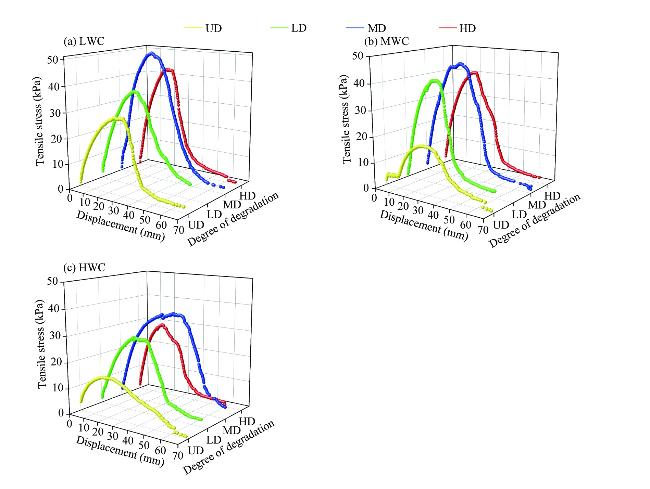
Surface soil cracking in alpine meadows signifies the transition of degradation from quantitative accumulation to qualitative deterioration. Quantitative research remains insufficient regarding changes in the mechanical properties of degraded meadow soils and the mechanical thresholds for cracking initiation. This study explored the relationships between surface cracking and the physical properties, tensile strength, and matrix suction of root-soil composites in alpine meadow sites with different stages of degradation (undegraded (UD), lightly degraded (LD), moderately degraded (MD), and heavily degraded (HD)) under different water gradients (high water content (HWC), medium water content (MWC), and low water content (LWC)) corresponding to different drying durations at a constant temperature of 40.0°C. The Huangcheng Mongolian Township in Menyuan Hui Autonomous County, Qinghai Province, China was chosen as the study area. The results indicated that as the degradation degree of alpine meadow intensified, both water content of root-soil composite and the fine grain content of soil decreased. In contrast, the root-soil mass ratio and root area ratio initially increased and then decreased with progressive degradation. Under a consistent water content, the tensile strength of root-soil composite followed a pattern of MD>HD>LD>UD. The peak displacement of tensile strength also decreased as the degradation degree of alpine meadow increased. Both the tensile strength and matrix suction of root-soil composite increased as root-soil water content decreased. A root-soil water content of 30.00%-40.00% was found to be the critical threshold for soil cracking in alpine meadows. Within this range, the matrix suction of root-soil composite ranged from 50.00 to 100.00 kPa, resulting in the formation of linear cracks in the surface soil. As the root-soil water content continued to decrease, liner cracks evolved into branch-like and polygonal patterns. The findings of this study provide essential data for improving the mechanical understanding of grassland cracking and its development process.
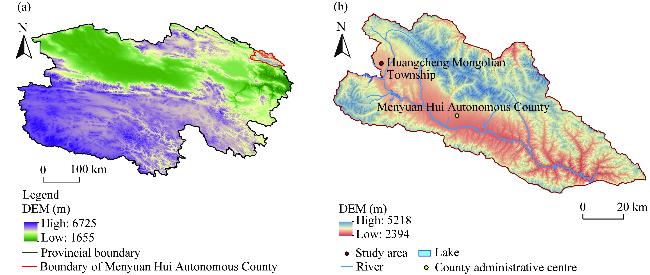
Fig. 1 Location of Menyuan Hui Autonomous County in Qinghai Province (a) and location of the study area in Huangcheng Mongolian Township, Menyuan Hui Autonomous County (b). DEM, digital elevation model. |
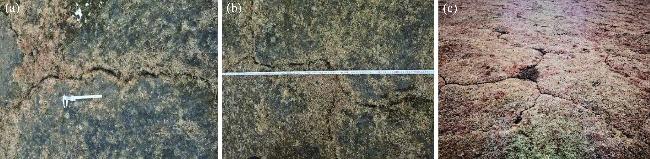
Fig. 2 Developmental morphological of surface cracks in alpine meadows. (a), linear fracture; (b), dendritic fracture; (c), polygonal fracture. |
Table 1 Basic characteristics of alpine meadow sites with different degrees of degradation in the study area |
| Degradation degree | Dominant species | Coverage of Gramineae and Cyperaceae (%) | Vegetation coverage (%) | Status of surface crack |
|---|---|---|---|---|
| Undegraded (UD) | Kobresia humilis (C. A. Mey. ex Trautv.) Serg., Elymus nutans Griseb., and Poa crymophila Keng | 73.00-85.00 | 95.00-100.00 | The meadow surface layer doesn't exhibit apparent crack. |
| Lightly degraded (LD) | Kobresia pygmaea C. B. Clarke, Poa crymophila Keng, and Saussurea pulchra Lipsch | 62.00-72.00 | 80.00-95.00 | Simple linear cracks can be observed. |
| Moderately degraded (MD) | Kobresia pygmaea C. B. Clarke, Gentiana dahurica Fischer, and Saussurea pulchra Lipsch | 45.00-58.00 | 60.00-85.00 | Branch-like cracks can be observed and the crack area doesn't exceed 5.00% of the total plot area. |
| Heavily degraded (HD) | Potentilla bifurca L., Anaphalis lactea Maxim. and Carex capillifolia (Decne.) S. R. Zhang | 30.00-43.00 | 40.00-60.00 | Irregular polygonal cracks can be observed, accompanied by bare ground and collapse areas around the cracks. |
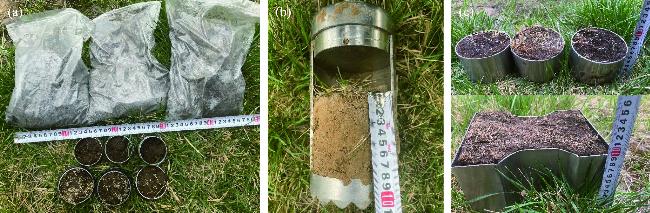
Fig. 3 Field sampling. (a), soil physical properties samples; (b), plant root parameters; (c), tensile and matrix suction samples. |
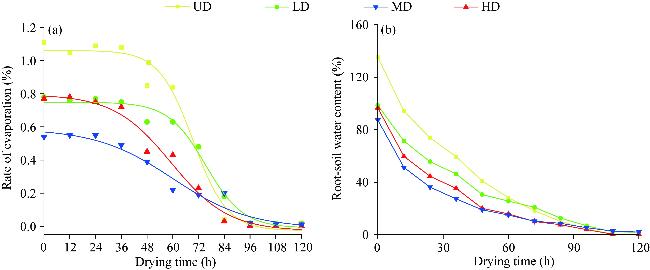
Fig. 4 Evaporation rate curve (a) and water content curve (b) of root-soil composite sample determined by this study. UD, undegraded; LD, lightly degraded; MD, moderately degraded; HD, highly degraded. |
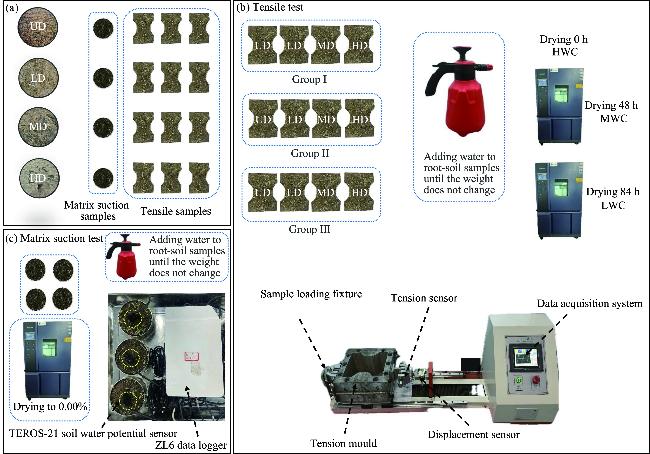
Fig. 5 Schematic diagram of test process. (a), field sampling; (b), drying experiment and tensile test; (c), matrix suction test. HWC, high water content; MWC, medium water content; LWC, low water content. |
Table 2 Basic characteristics of root-soil composite in alpine meadows with different degrees of degradation |
| Degradation degree | ρd (g/cm3) | wsr (%) | wr (%) | ws (%) | Rs (%) | RAR (%) |
|---|---|---|---|---|---|---|
| UD | 0.39±0.03 | 93.40±7.21 | 140.42±13.55 | 56.39±5.70 | 13.58±2.12 | 14.75±2.05 |
| LD | 0.57±0.02 | 76.25±5.37 | 113.30±14.14 | 47.82±6.52 | 16.45±1.48 | 18.11±1.42 |
| MD | 0.60±0.01 | 48.86±10.47 | 82.63±11.27 | 35.50±3.90 | 22.29±5.52 | 32.31±18.48 |
| HD | 0.66±0.02 | 38.56±12.73 | 31.34±1.44 | 33.34±3.93 | 12.80±1.56 | 17.37±12.49 |
Note: ρd, dry density; wsr, root-soil water content; wr, root water content; ws, soil water content; Rs, root-soil mass ratio; RAR, root area ratio. Mean±standard deviation. |
Table 3 Basic characteristics of sand particle at the upper soil layer in alpine meadows with different degrees of degradation |
| Degradation degree | Granule composition (%) | Cu | Cc | Gradation type | Soil type | ||
|---|---|---|---|---|---|---|---|
| >0.250 mm | 0.075-0.250 mm | <0.075mm | |||||
| UD | 34.05±12.56 | 41.25±10.36 | 23.70±6.56 | 8.78 | 1.93 | Well-graded | SS |
| LD | 36.60±14.11 | 53.21±12.29 | 13.93±8.42 | 3.69 | 1.17 | Poorly-graded | CS |
| MD | 53.04±20.53 | 39.03±18.46 | 7.93±6.53 | 4.44 | 0.96 | Poorly-graded | CS |
| HD | 61.35±22.95 | 29.95±17.34 | 10.25±4.34 | 7.45 | 0.78 | Poorly-graded | CS |
Note: Cu, uniformity coefficient; Cc, curvature coefficient; SS, silt sand; CS, clay sand. Well-graded means the particles with various diameters are well-distributed in the soil; Poorly-graded means the particles with various diameters are uneven distributed in the soil. Mean±standard deviation. |
Fig. 6 Tensile stress-displacement curve of root-soil composite under different water content gradients. (a), LWC; (b), MWC; (c), HWC. |
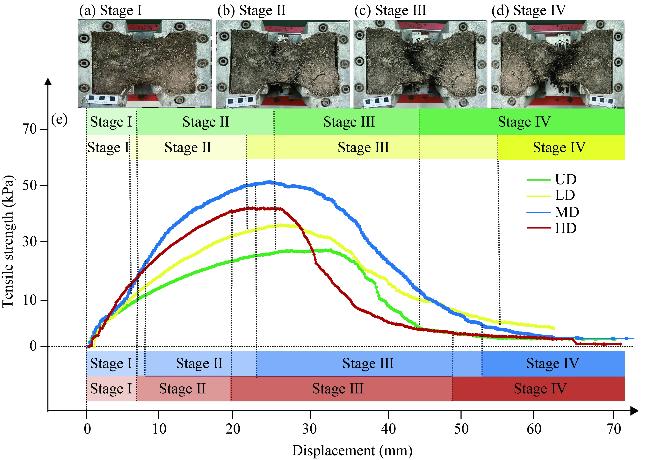
Fig. 7 Stage classification diagram of tensile stress-displacement curve under LWC condition. (a), elastic deformation stage (Stage I); (b), elastic-plastic deformation stage (Stage II); (c), root fracturing and local soil failure stage (Stage III); (d), overall failure stage (Stage IV); (e), tensile stress-displacement curve. |
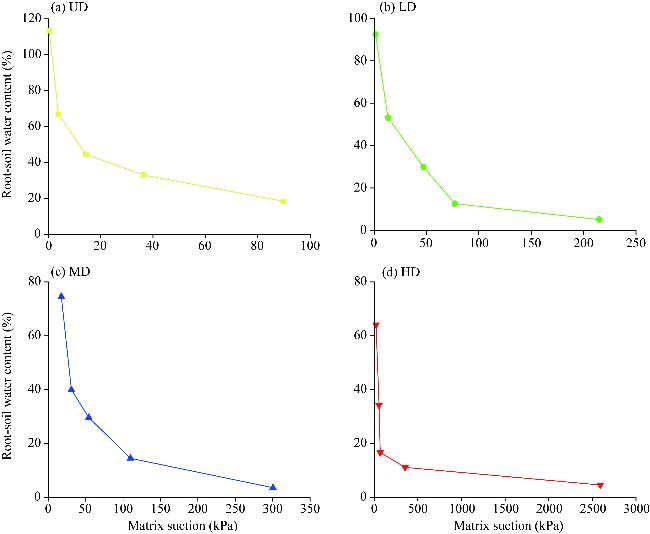
Fig. 8 Matrix suction characteristic curve of root-soil composite with different degrees of degradation. (a), UD; (b), LD; (c), MD; (d), HD. |
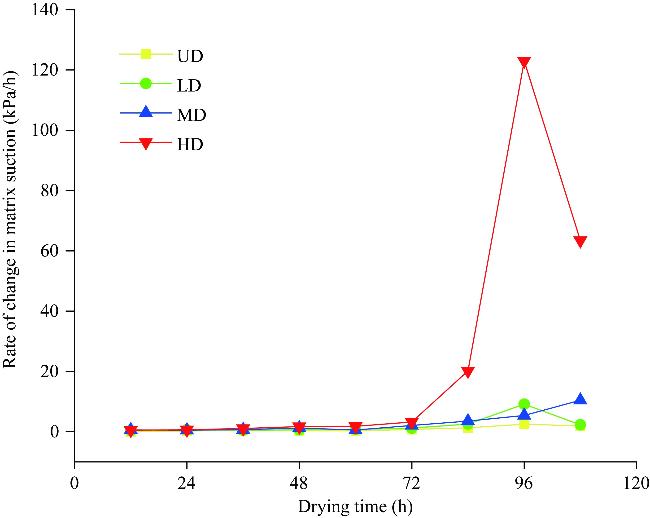
Fig. 9 Rate of change in matrix suction of root-soil composites with different degrees of degradation |
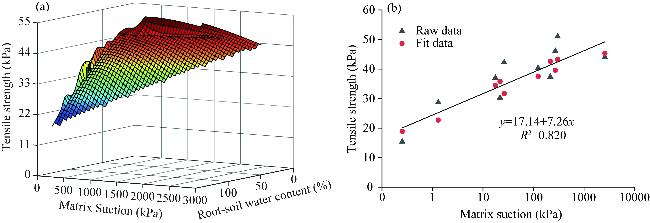
Fig. 10 Relationship among root-soil water content, matrix suction and tensile strength. (a), fitting surface diagram; (b), simulation formula between tensile strength and matrix suction. |
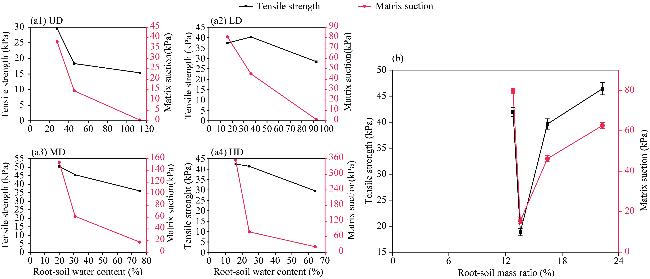
Fig. 11 Variation trend in matrix suction and tensile strength of root-soil composites from different degrees of degradation with water content (a) and root content (b) changes. |
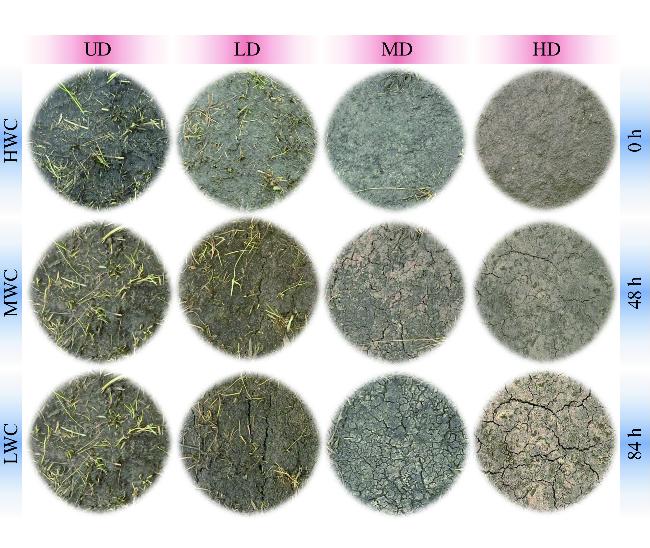
Fig. 12 Images of crack development in root-soil composites during drying process |
| [1] |
|
| [2] |
|
| [3] |
|
| [4] |
|
| [5] |
|
| [6] |
General Administration of Quality Supervision, Inspection and Quarantine of the People's Republic of China. 2004. Parameters for Degradation, Sandification, and Salification of Rangelands (GB19377-2003). [2024-12-01]. https://std.samr.gov.cn. (in Chinese)
|
| [7] |
|
| [8] |
|
| [9] |
|
| [10] |
|
| [11] |
|
| [12] |
|
| [13] |
|
| [14] |
|
| [15] |
|
| [16] |
|
| [17] |
|
| [18] |
|
| [19] |
|
| [20] |
Ministry of Housing and Urban-Rural Development of the People's Republic of China. Standard for Geotechnical Testing Method (GB/T50123-2019). [2024-12-10]. https://www.mohurd.gov.cn. (in Chinese)
|
| [21] |
|
| [22] |
|
| [23] |
|
| [24] |
|
| [25] |
|
| [26] |
|
| [27] |
|
| [28] |
|
| [29] |
|
| [30] |
|
| [31] |
|
| [32] |
|
| [33] |
|
| [34] |
|
| [35] |
|
| [36] |
|
| [37] |
|
| [38] |
|
| [39] |
|
| [40] |
|
| [41] |
|
| [42] |
|
| [43] |
|
| [44] |
|
| [45] |
|
| [46] |
|
| [47] |
|
/
| 〈 |
|
〉 |