Forecasting land use changes in crop classification and drought using remote sensing
Received date: 2024-09-04
Revised date: 2025-02-16
Accepted date: 2025-03-10
Online published: 2025-08-12
Mashael MAASHI , Nada ALZABEN , Noha NEGM , Venkatesan VEERAMANI , Sabarunisha Sheik BEGUM , Geetha PALANIAPPAN . [J]. Journal of Arid Land, 2025 , 17(5) : 575 -589 . DOI: 10.1007/s40333-025-0013-y
Challenges in land use and land cover (LULC) include rapid urbanization encroaching on agricultural land, leading to fragmentation and loss of natural habitats. However, the effects of urbanization on LULC of different crop types are less concerned. The study assessed the impacts of LULC changes on agriculture and drought vulnerability in the Aguascalientes region, Mexico, from 1994 to 2024, and predicted the LULC in 2034 using remote sensing data, with the goals of sustainable land management and climate resilience strategies. Despite increasing urbanization and drought, the integration of satellite imagery and machine learning models in LULC analysis has been underutilized in this region. Using Landsat imagery, we assessed crop attributes through indices such as normalized difference vegetation index (NDVI), normalized difference water index (NDWI), normalized difference moisture index (NDMI), and vegetation condition index (VCI), alongside watershed delineation and spectral features. The random forest model was applied to classify LULC, providing insights into both historical and future trends. Results indicated a significant decline in vegetation cover (109.13 km2) from 1994 to 2024, accompanied by an increase in built-up land (75.11 km2) and bare land (67.13 km2). Projections suggested a further decline in vegetation cover (41.51 km2) and continued urban land expansion by 2034. The study found that paddy crops exhibited the highest values, while common bean and maize performed poorly. Drought analysis revealed that mildly dry areas in 2004 became severely dry in 2024, highlighting the increasing vulnerability of agriculture to climate change. The study concludes that sustainable land management, improved water resource practices, and advanced monitoring techniques are essential to mitigate the adverse effects of LULC changes on agricultural productivity and drought resilience in the area. These findings contribute to the understanding of how remote sensing can be effectively used for long-term agricultural planning and environmental sustainability.
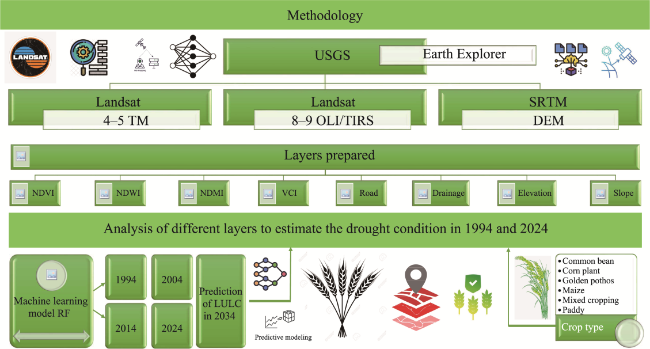
Fig. 1 Flowchart of method in this study. USGS, U.S. Geological Survey; TM, thematic mapper; OLI/TIRS, operational land imager/thermal infrared sensor; SRTM, shuttle radar topography mission; DEM, digital elevation model; NDVI, normalized difference vegetation index; NDWI, normalized difference water index; NDMI, normalized difference moisture index; VCI, vegetation condition index; RF, random forest; LULC, land use and land change. The abbreviations are the same in the following figures. |
Table 1 Data used in this study |
| Data | Source | Date (yyyy-mm-dd) | Resolution (m) | Projection |
|---|---|---|---|---|
| Landsat 4 TM | USGS Earth Explorer | 1994-06-02 | 30.0 | UTM 13N |
| Landsat 4 TM | USGS Earth Explorer | 2004-05-12 | 30.0 | UTM 13N |
| Landsat 8 OLI/TIRS | USGS Earth Explorer | 2024-02-23 | 30.0 | UTM 13N |
| Landsat 8 OLI/TIRS | USGS Earth Explorer | 2014-01-16 | 30.0 | UTM 13N |
| SRTM DEM Data | USGS Earth Explorer | 2000-02-11 | 30.0 | UTM 13N |
| Road data | Google Earth Pro | 2024-02-25 | 2.5 | UTM 13N |
Note: TM, thematic mapper; OLI/TIRS, operational land imager/thermal infrared sensor; SRTM, shuttle radar topography mission; DEM, digital elevation model; USGS, U.S. Geological Survey; UTM, Universal Transverse Mercator. The abbreviations are the same in the following tables. |
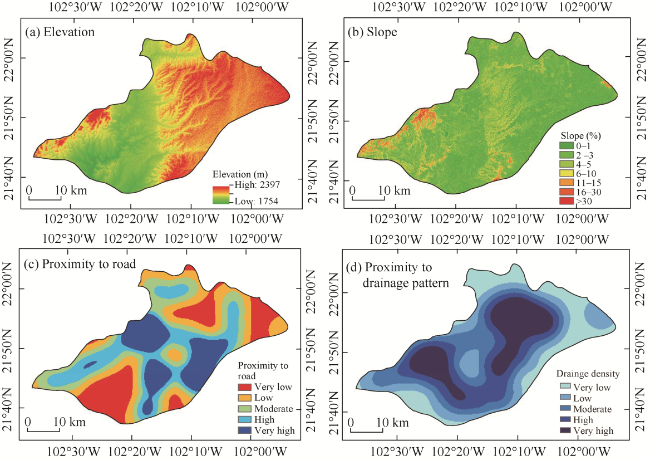
Fig. 2 Elevation (a), slope (b), proximity to road (c), and proximity to drainage (d) in the Aguascalientes region, central Mexico |
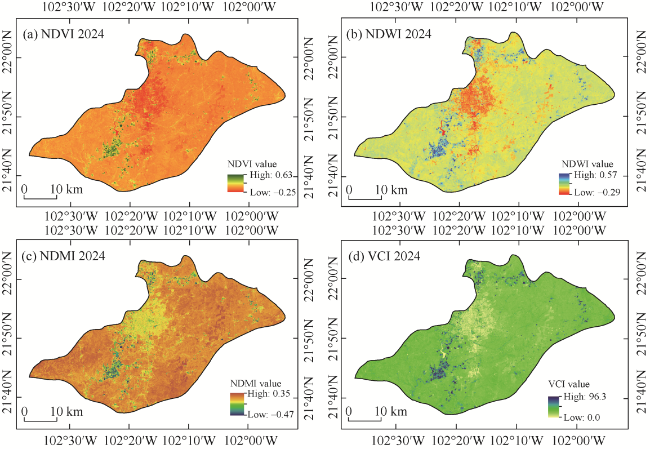
Fig. 3 Spatiotemporal changes of NDVI (a), NDWI (b), NDMI (c), and VCI (d) in 2024 in the Aguascalientes region, central Mexico |
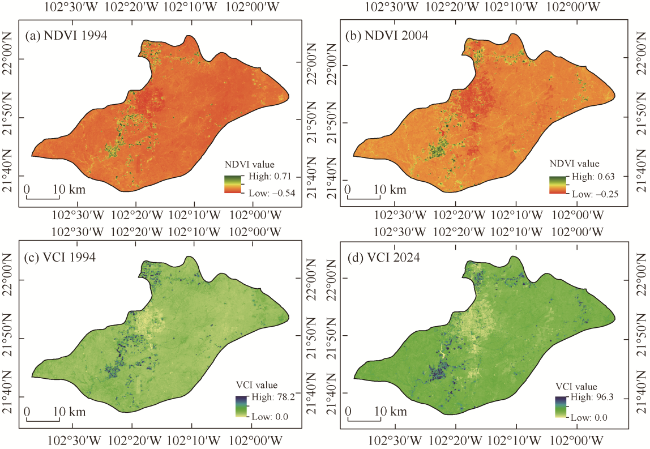
Fig. 4 Spatiotemporal changes of NDVI (a and b) and VCI (c and d) in 1994 and 2024 in the Aguascalientes region, central Mexico |
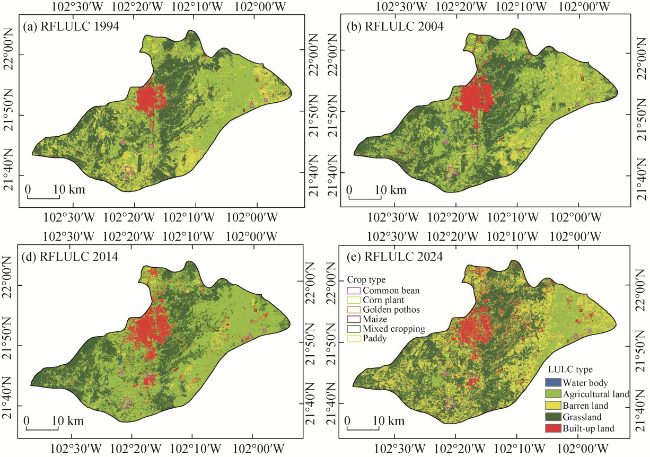
Fig. 5 Random forest (RF) model result based on LULC classification in 1994 (a), 2004 (b), 2014 (c) and 2024 (d) in the Aguascalientes region, central Mexico |
Table 2 Land use and land cover (LULC) changes from 1994 to 2024 in the Aguascalientes region, central Mexico |
| LULC | 1994 | 2004 | 2014 | 2024 | Trend from 2024 to 1994 |
|---|---|---|---|---|---|
| (km2) | |||||
| Water body | 3.12 | 2.96 | 2.45 | 2.23 | -0.89 |
| Agricultural land | 808.78 | 796.25 | 758.45 | 699.65 | -109.13 |
| Barren land | 306.99 | 325.14 | 365.45 | 374.15 | 67.16 |
| Grassland | 415.10 | 370.76 | 349.47 | 380.818 | -34.28 |
| Built-up land | 145.74 | 182.58 | 201.87 | 220.85 | 75.11 |
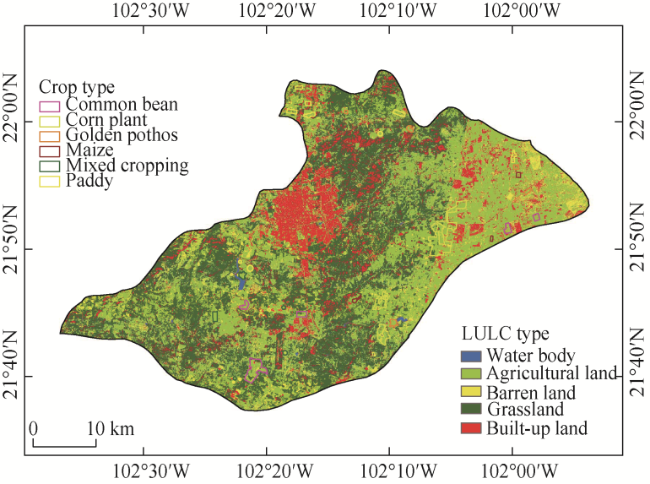
Fig. 6 Spatial distribution of predicted LULC in 2034 in the Aguascalientes region, central Mexico |
Table 3 Area changes of predicted LULC from 2024 to 2034 in the Aguascalientes region, central Mexico |
| LULC | 2024 | 2034 | Trend from 2034 to 2024 |
|---|---|---|---|
| (km2) | |||
| Water body | 2.23 | 1.63 | -0.60 |
| Agricultural land | 699.65 | 658.14 | -41.51 |
| Barren land | 374.15 | 390.19 | 16.04 |
| Grassland | 380.82 | 390.80 | 9.98 |
| Built-up land | 220.85 | 236.94 | 16.09 |
Table 4 Crop types, areas, and normalized difference indices in the Aguascalientes region, central Mexico |
| Crop type | Area (km2) | Mean NDVI | Mean NDWI | Mean NDMI |
|---|---|---|---|---|
| Common bean | 120.35 | 0.35 | 0.26 | 0.37 |
| Corn plant | 150.72 | 0.42 | 0.27 | 0.29 |
| Golden pothos | 85.43 | 0.36 | 0.32 | 0.34 |
| Maize | 145.67 | 0.39 | 0.35 | 0.33 |
| Mixed cropping | 88.98 | 0.49 | 0.37 | 0.36 |
| Paddy | 67.99 | 0.52 | 0.45 | 0.48 |
Table 5 Vegetation condition index (VCI) of different crop types in 1994 and 2024 in the Aguascalientes region, central Mexico |
| Crop type | VCI in 1994 | VCI in 2024 | Drought in 1994 | Drought in 2024 |
|---|---|---|---|---|
| Common bean | 21.00 | 28.00 | No drought | Light drought |
| Corn plant | 29.00 | 32.00 | Light drought | Moderate drought |
| Golden pothos | 30.00 | 39.00 | Moderate drought | Moderate drought |
| Maize | 25.00 | 35.00 | Light drought | Moderate drought |
| Mixed cropping | 30.00 | 41.00 | Moderate drought | Severe drought |
| Paddy | 32.00 | 43.00 | Moderate drought | Severe drought |
Table 6 Percentage change of LULC from 1994 to 2024 and predicted LULC in 2034 in the Aguascalientes region, central Mexico |
| LULC | 1994 | 2004 | 2014 | 2024 | 2034 |
|---|---|---|---|---|---|
| (%) | |||||
| Water body | 0.19 | 0.18 | 0.15 | 0.13 | 0.10 |
| Agricultural land | 48.21 | 47.46 | 45.21 | 41.70 | 39.23 |
| Barren land | 18.30 | 19.38 | 21.78 | 22.30 | 23.26 |
| Grassland | 24.74 | 22.10 | 20.83 | 22.70 | 23.29 |
| Built-up land | 8.69 | 10.88 | 12.03 | 13.16 | 14.12 |
| [1] |
|
| [2] |
|
| [3] |
|
| [4] |
|
| [5] |
|
| [6] |
|
| [7] |
|
| [8] |
|
| [9] |
|
| [10] |
|
| [11] |
|
| [12] |
|
| [13] |
|
| [14] |
|
| [15] |
|
| [16] |
|
| [17] |
|
| [18] |
|
| [19] |
|
| [20] |
|
| [21] |
|
| [22] |
|
| [23] |
|
| [24] |
|
| [25] |
|
| [26] |
|
| [27] |
|
| [28] |
|
| [29] |
|
| [30] |
|
| [31] |
|
| [32] |
|
| [33] |
|
| [34] |
|
| [35] |
|
| [36] |
|
| [37] |
|
| [38] |
|
| [39] |
|
| [40] |
|
| [41] |
|
| [42] |
|
/
| 〈 |
|
〉 |