
水土资源

干旱区微塑料污染来源、迁移规律与生态风险

  • 汪彩琴 , 1 ,
  • 邵佳时 2 ,
  • 扶黛叶 2 ,
  • 张道勇 , 1 ,
  • 潘响亮 2
展开
  • 1.浙江工业大学地理信息学院,浙江 杭州 310014
  • 2.浙江工业大学环境学院,浙江 杭州 310014
张道勇. E-mail:

汪彩琴(1992-),女,博士,讲师,主要从事土壤改良与土壤修复等研究. E-mail:

收稿日期: 2025-06-05

  修回日期: 2025-06-11

  网络出版日期: 2026-03-12

基金资助

浙江省领雁项目(2025C02216)

国家自然科学基金青年项目(42107238)

浙江省自然科学基金探索项目(LQ22D030004)

Sources, migration and ecological risks of microplastic pollution in arid regions

  • WANG Caiqin , 1 ,
  • SHAO Jiashi 2 ,
  • FU Daiye 2 ,
  • ZHANG Daoyong , 1 ,
  • PAN Xiangliang 2
Expand
  • 1. College of Geoinformatics, Zhejiang University of Technology, Hangzhou 310014, Zhejiang, China
  • 2. College of Environment, Zhejiang University of Technology, Hangzhou 310014, Zhejiang, China

Received date: 2025-06-05

  Revised date: 2025-06-11

  Online published: 2026-03-12

摘要

干旱区作为全球微塑料(Microplastics,MPs)的重要源汇区域,其独特的气候条件和人类活动模式塑造了微塑料污染的特殊性。本文系统梳理了近年来干旱区微塑料的来源与污染特征、迁移规律及生态风险。污染特征方面,干旱区土壤微塑料丰度呈现显著空间异质性,纤维状微塑料占比达64%~92%,聚乙烯(Polyethylene,PE)、聚丙烯(Polypropylene,PP)和尼龙为主要成分,其中农膜残留是主要来源。迁移机制上,风蚀和沙尘暴事件主导局地至区域尺度传输,纤维状微塑料因高长径比和低密度更易通过大气环流实现跨境迁移;电场与风场耦合作用延长了微塑料的大气驻留时间。生态风险方面,微塑料通过改变土壤理化性质(如孔隙结构、持水性)、干扰微生物代谢及诱导植物氧化应激,对生态系统产生多维度影响。未来需重点关注多尺度模型耦合、微塑料-污染物复合效应及标准化监测体系的建立。

本文引用格式

汪彩琴 , 邵佳时 , 扶黛叶 , 张道勇 , 潘响亮 . 干旱区微塑料污染来源、迁移规律与生态风险[J]. 干旱区研究, 2025 , 42(9) : 1599 -1611 . DOI: 10.13866/j.azr.2025.09.05

Abstract

Arid regions function as important global sources and sinks for microplastics (MPs), with their unique climatic conditions and human activity patterns giving rise to specific MP pollution characteristics. This article systematically reviews recent advances in understanding MP sources, pollution patterns, migration, and ecological risks within arid environments. Regarding pollution characteristics, soil MP abundance exhibits significant spatial heterogeneity, with fibrous microplastics accounting for 64%-92% of the total. Polyethylene, polypropylene, and nylon are identified as the main polymer components, primarily originating from agricultural film residues. In terms of migration mechanisms, wind erosion and sandstorm events dominate local-to-regional-scale transport. Due to their high aspect ratio and low density, fibrous microplastics are particularly prone to cross-border atmospheric migration, further prolonged by the coupling effect of electric and wind fields on their atmospheric residence time. Ecologically, MPs exert multi-dimensional impacts on ecosystems by altering soil physicochemical properties (e.g., pore structure and water retention capacity), interfering with microbial metabolism, and inducing oxidative stress in plants. Future research efforts should focus on integrating multiscale models, investigating the combined effects of microplastics and other pollutants, and establishing a standardized monitoring system.

微塑料(Microplastics,MPs)是粒径小于5.0 mm的塑料颗粒,微塑料污染已成为全球性环境问题[1-3]。干旱半干旱区约占全球陆地面积的40%,其脆弱的生态系统对微塑料污染的敏感性日益凸显。干旱区因其特殊的气候条件(降水稀少、强风、高紫外线辐射)和人类活动模式(农业覆膜、污水灌溉),形成了独特的微塑料污染格局[4]。近年来,中国西北农用地[4]、伊朗卢特沙漠[5]和青藏高原[6]等地的研究揭示了干旱区微塑料赋存的普遍性,但其来源、迁移机制及生态风险仍存在明显的知识空白。
干旱区微塑料的输入途径具有显著的地域特征。农业地膜残留是主要人为源[4],其破碎产生的次级微塑料通过风蚀作用扩散至百公里外的区域[7]。大气传输是另一关键途径,伊朗沙漠中90%以上的纤维状微塑料来自城市与农业区的风力传输[5]。此外,干旱区特殊的地貌特征(如雅丹地貌、沙丘)导致微塑料分布呈现显著空间异质性[5]。干旱区强烈的紫外线辐射、沙粒摩擦及高温等作用加速微塑料老化[4-5]。土壤-大气界面交换呈现“快速通过”与“内部循环”双重路径,表层土壤微塑料丰度比深层高3~5倍[4]。风蚀驱动下的微塑料迁移通量大,而纤维状微塑料因高比表面积更易悬浮,移动距离更远[8]
生态风险方面,微塑料通过改变土壤孔隙度、抑制酶活性和干扰微生物群落等影响干旱区生态功能[1,3]。在沙漠地区,沙尘暴携带的微塑料尘埃很容易吸附残留农药和细菌[5],从而引发公众健康问题[9]。因此,对干旱区微塑料污染的来源、分布及潜在生态风险进行研究,对于科学研究和实际应用都具有极高的价值。现有研究在监测方法标准化、长期效应评估和区域协同治理等方面仍存在显著不足,亟需建立跨学科研究框架以应对这一新兴环境挑战。本文系统梳理了近年来干旱区微塑料的污染特征、迁移规律及生态风险,并对该领域存在的不足和未来研究方向进行了展望。

1 干旱区微塑料的来源与输入途径

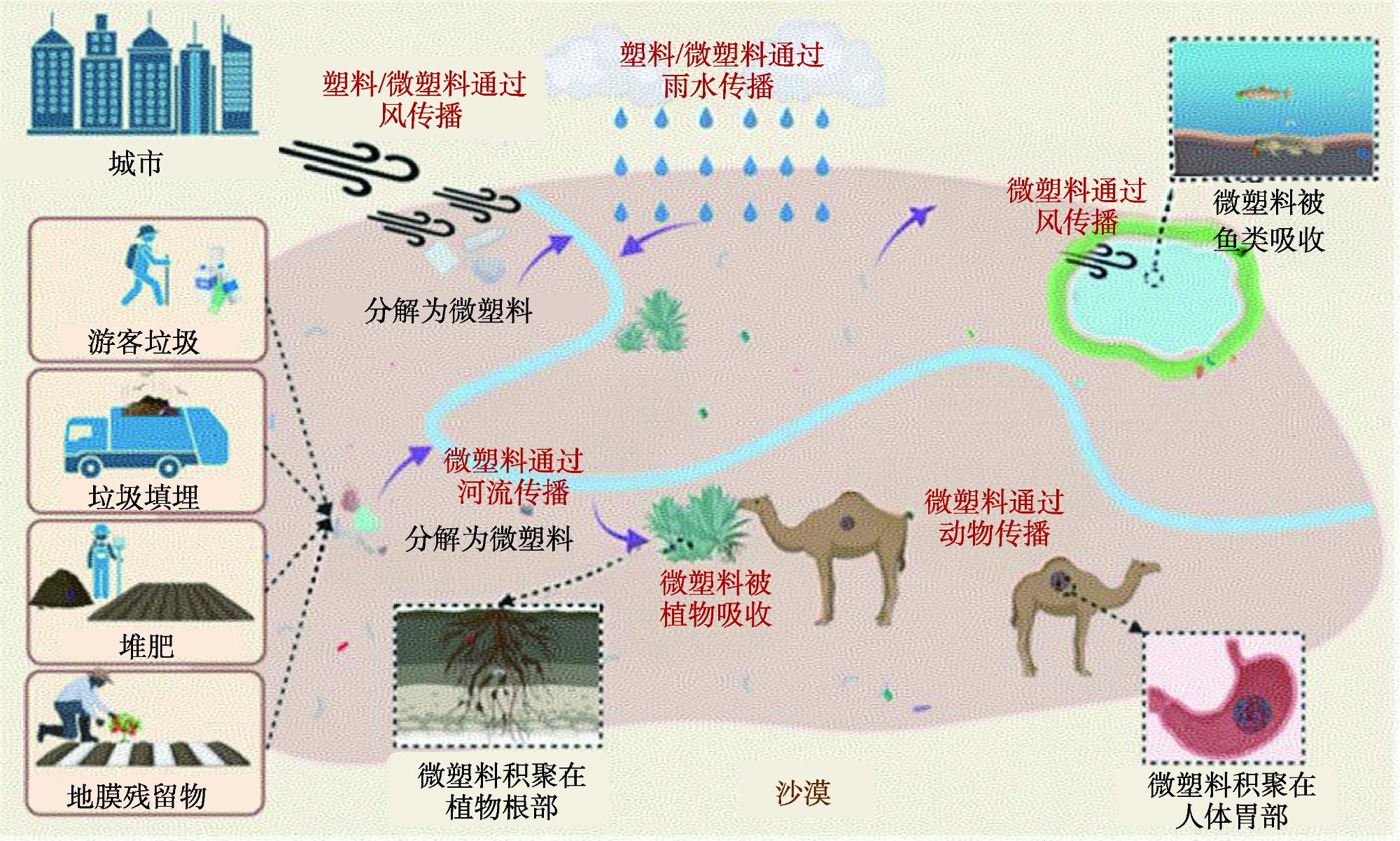
干旱区微塑料来源主要有农业地膜的破碎分解、旅游业的微塑料输入、工业生产产生的微塑料及大气沉降(沙尘暴)引入的微塑料,主要类别有聚乙烯(Polyethylene,PE)、聚丙烯(Polypropylene,PP)、聚苯乙烯(Polystyrene,PS)、聚对苯二甲酸乙二醇酯(Polyethylene terephthalate,PET)和尼龙(Polyamide,PA)等[10]。干旱区微塑料的来源与迁移途径复杂多样,且受区域环境特征和人类活动模式的影响(图1[10]。如图1所示,极端天气事件(如降水、沙尘暴)和动物活动(如误食塑料)是驱动微塑料自然迁移与分布的重要因子;同时,人类活动(旅游、堆肥、垃圾填埋)不仅直接贡献微塑料,还通过加速塑料老化降解及有毒添加剂释放,加剧了干旱区微塑料污染程度和复杂性[10]。干旱区土壤中微塑料来源包括生活垃圾、塑料地膜、污泥、洪水、道路径流以及大气沉降等[11-12]
图1 干旱区微塑料来源及迁移途径

Fig. 1 Sources and migration routes of microplastics in arid regions

1.1 农业活动主导的微塑料输入

农业覆膜技术是干旱区微塑料污染的核心来源[13]。塑料薄膜覆盖已成为空气中邻苯二甲酸酯(PAEs)的主要来源[14]。农田微塑料丰度随覆膜时间的增加而增加,不覆膜、4 a覆膜和10 a连续覆膜的水稻田微塑料丰度分别为76.2±18.4 个·kg-1、118.6±44.8 个·kg-1和159.6±23.5 个·kg-1[15]。随着连续覆盖年限的增加(5~30 a),微塑料的含量会大幅增加,而颗粒大小则会随着覆盖时间的延长而减小。中国西北地区地膜覆盖率高,连续使用农膜30 a的棉田土壤中微塑料丰度达1426.7 个·kg-1,其中PE占比74%~99%,与农膜材质具有高度一致性[16-17]。地膜残留量随使用年限增长,新疆农田塑料残留量远超全国均值[13]。机械耕作和紫外线辐射共同导致地膜破碎,土壤中微塑料丰度可高达4198~47420 个·kg-1,表层土(0~20 cm)中微塑料含量达192.6 kg·hm-2[18]。此外,温室覆盖地块因抑制风蚀,微塑料降解慢,更容易发生积累。此外,灌溉也是土壤微塑料输入的重要来源,地表水灌溉农田的微塑料丰度(326~2406 个·kg-1)显著高于地下灌溉水源农田(274~2053 个·kg-1)和处理过的废水农田(114~800 个·kg-1[19]。有研究发现有机肥中微塑料含量较高,平均丰度为39629±10114 个·kg-1,有机肥的使用使延安黄土丘陵沟壑区农田环境中平均微塑料丰度达到4505±435 个·kg-1[20]
一项关于中国农田土壤中微(中)塑料分布的全国性研究显示,在干旱或半干旱的北部地区(如新疆),微塑料丰度较高,而在温带的西南地区则相对较低[21]。中国沙漠面积最大的省份新疆以及使用覆盖膜最多的省份甘肃,冬冷夏热、紫外线辐射强烈且秋季和冬季多风[21-22],这些条件导致覆盖膜更快降解,从而在土壤中积累更多。由于这些来源的持续排放以及塑料薄膜的快速降解,预计随着时间的推移,土壤中的塑料含量将会显著增加[23]。地膜残留产生的微塑料具有特殊的空间分布模式。在垂直分布上,表层土壤(0~10 cm)微塑料丰度显著高于深层(20~30 cm)(P<0.05),这与耕作扰动和生物活动受限密切相关[4]

1.2 城市与旅游带来的微塑料输入

城市化进程加剧了微塑料的多源输入特征。城市功能区(如公园、道路)的微塑料丰度与土地利用强度呈正相关。土耳其城市土壤中微塑料以蓝色纤维为主(55%),主要来源于纺织品磨损和塑料制品风化[24]。工业活动(如船舶拆解、港口建设)亦加剧了沿海河口微塑料污染,阿拉伯海沿岸河口中PS占比达38%,与港口疏浚导致的沉积物扰动密切相关[24]。伊朗西南部设拉子城市土壤微塑料丰度(92.9±119.2 个·kg-1)显著高于工业区(41.2 个·kg-1)和农业区(36.7 个·kg-1),其中纤维占主导[25]。城市污水处理系统也是微塑料输入的重要来源。污水处理厂尾水检测显示,卡塔尔三级处理工艺对微塑料去除效率为87%~95%,但出水中微塑料作为重金属载体,使重金属元素仍有一定量检出,提示构成复合污染风险[26]
旅游活动对偏远生态系统的微塑料输入不容忽视。有旅游活动的沙漠边缘区微塑料含量(8.2±17.9 个·kg-1)高于无旅游活动区(0.9±1.6 个·kg-1),表明旅游对微塑料潜在贡献较大[27]。沙漠地区的塑料垃圾主要源自人类活动产生的飘浮垃圾,其成分包括常见的塑料,如PE、PP和PS[28]。巴丹吉林沙漠无人区微塑料丰度(检出限约40 μm)为1.5±0.7~15.5±11.7 个·kg-1,平均15.4±6.0 个·kg-1,通过反轨迹模拟发现,这些微塑料主要来自沙漠东南部的居民区,表明大气在沙漠中的长距离输送和沉积[27]。湖泊旅游区近岸沉积物微塑料丰度(1130 个·kg-1)是湖心区的15倍,主要来源于防护装备遗弃、服装纤维和宗教用品降解[29]。祁连山生态旅游区检出异常富集的微塑料,以PA和PET为主,可能是一次性餐具等塑料制品引入的[30-31]。此外,交通排放贡献显著,尤其轮胎磨损产生的微塑料颗粒使道路周边占比显著提升[16]

1.3 微塑料迁移的大气传输路径

干旱区强风蚀作用使大气成为微塑料跨介质迁移的关键通道。青藏高原微塑料绝大部分源自中亚干旱区,冬季西北风主导下的传输距离超过1000 km[6]。值得注意的是,与尘埃气溶胶一样,带电的微塑料会影响大气气溶胶的成分,从而影响云的形成和降水,这种相互作用可能会改变气溶胶的尺寸分布、化学成分和辐射特性[32]
降雨过程在将大气中的微粒物质输送至地面发挥着重要作用[33]。研究表明,在相同的空气质量条件下,降雨事件能够增加微粒物质的沉积通量,尤其是通过促进纤维状微粒物质和较小颗粒的沉积来实现[33]。由于其轻质特性,小尺寸的微粒物质能够在大气中停留更长时间,从而导致丰度升高以及在降雨期间更容易发生迁移[34]。在环境恶劣、植被稀疏的干旱地区,100~300 μm的微粒物质很容易在地表积累。降雨后,这些微粒物质可以通过地表径流转移到河口和高速公路旁的沟渠中,这可能会对当地居民的日常生活用水和生态环境产生影响[35-37]。为了减轻这种影响,未来的策略可能包括在排放前对雨水径流进行过滤,或者增加植被覆盖率,以帮助减少这些地区微粒物质的迁移和积累。
一些沙漠地区容易出现极端气团,并且经常经历持续降雪。在降雪期间,大气中的气溶胶颗粒会与水蒸气结合而凝结,从而形成表面粗糙且具有大孔隙的雪。地表降雪可以通过干沉降作用使气溶胶颗粒聚集起来[38]。不仅城市雪中有高丰度的微塑料,北极雪中也发现了微塑料[39]。在伊朗塔布里兹东南部和德黑兰东北部的6个站点进行的一项研究显示,降雨和降雪期间沉积的气溶胶颗粒数量相似。然而,由于雪粒比雨滴更大且密度更低,它们能够捕获更广泛的气溶胶类型和尺寸[40]。随着雪的融化,气溶胶颗粒可以通过径流被土壤、植被或地表水吸收[38]。雪融水中的塑料颗粒丰度明显高于附近径流中的丰度,这表明雪会随着时间的推移积累塑料颗粒[41]。气溶胶颗粒数量随着其尺寸减小而增加,这可能会比径流中的情况造成更大的环境风险,因为气溶胶颗粒急性释放更为严重[42]。因此,在雪融化进入水生环境之前,必须考虑采用诸如沙滤法或池塘沉淀法等处理方法,以减少对环境的影响。

2 干旱区微塑料污染时空特征

干旱区微塑料污染分布具有时空差异,同一地点不同介质微塑料丰度相差可达上千倍,即便同一介质中,不同深度/高度差异也很大。表1展示了干旱区部分位点微塑料丰度差异。
表1 干旱区不同地点不同介质中的微塑料丰度

Tab. 1 Microplastic abundance in different locations and media

地点 沉积物 土壤 空气 参考文献
内蒙古高原湖泊 0.5~12.6 个·L-1 50~325 个·L-1 - - [43]
黄土高原,黄河 51.1~686.7 个·kg-1 - - - [44]
青藏高原,青海湖 0.05× 105~7.6× 105 个·km-2 50~1292 个·km-2 - - [28,45]
伊朗,马哈鲁湖 10.4 个·kg-1 57.1 个·kg-1 - - [44]
川藏 - - 76.2~159.6 个·kg-1 - [15,46]
黄土高原 - - 1667~4333 个·kg-1 - [47]
新疆,阿勒泰 - - 1.1×10⁴~7.8×10⁴ 个·kg-1 - [48]
新疆,石河子 - - 80.3~1075.6 个·kg-1 - [13]
伊朗,德黑兰 - - - 0.74~1 个·m-3 [48]
伊朗,阿瓦兹 - - - 0~0.02 个·m-3 [7]
埃及,大开罗地区 - - - 30~87 个·m-3 [49]

2.1 土壤系统的空间异质性

干旱区微塑料分布受土地利用类型显著影响。祁连山区不同植被类型土壤表现为:灌木区(26369 个·kg-1)>林地(22215 个·kg-1)>荒漠(17769 个·kg-1[31]。城市周边区域丰度较高(1.06 个·g-1),而偏远沙漠地区可低至0.02 个·g-1[5]。城市功能区因高强度人类活动,道路尘埃及垃圾填埋场周边土壤微塑料丰度可达660 个·kg-1[25]。微塑料的垂直分布受耕作制度调控。连续覆膜30 a的棉田土壤中,随着土壤深度的增加,微塑料丰度从78.7±14.7 个·kg-1下降到28.0±5.3 个·kg-1,但是长期耕作会改变微塑料在土壤剖面中的分布,导致0~10 cm和20~30 cm土层的微塑料丰度没有显著差异[50]。微塑料在干旱地貌中呈现显著空间分异:干旱区山坡面因风力沉积作用微塑料丰度(25 个·kg-1)显著高于顶部(未检出);沙丘与流动沙地,动态沙区微塑料易发生再悬浮,而固定沙丘因植被截留呈现表层富集;季节性湖泊,融雪径流携带山地微塑料进入干旱区,但贡献率低于风蚀[5]。伊朗卢特沙漠表层土壤微塑料丰度在119~7292 个·kg-1之间波动,城市周边区域丰度较偏远沙漠高50倍[5]
微塑料形态,城市功能区以碎片和纤维为主,而农业区以薄膜状占优,主要来自地膜破碎,其粒径多集中在100~250 μm[25]。沙尘暴传输的微塑料中纤维占主导[51],降雪捕获的纤维比例达90%[40]。干旱区强烈风化作用导致微塑料显著小型化趋势,小于0.5 mm的微塑料颗粒占93%,0.02~0.1 mm、0.1~0.5 mm、0.5~1.0 mm和1.0~5.0 mm颗粒占总MPs的比例分别为28%、65%、5%和2%[18]。值得注意的是,盐分与粒径分布存在相关性,土壤盐含量与0.1~0.5 mm 微塑料比例呈正相关,与0.02~0.1 mm 微塑料比例呈负相关,表明土壤盐渍化可能控制了塑料残留物的降解过程,导致0.1~0.5 mm颗粒占比升高[18]。微塑料聚合物组成也具有区域特异性:西亚干旱区以PE(30%)、PA(25%)和PP(20%)为主[51];青藏高原大气中PA和聚氨酯(Polyurethane,PU)占比突出[6];农业区以PE和PP为主,与地膜材质高度一致[52];城市区域PET、PS占优,反映包装和建材来源,工业区周边检出高密度聚合物,可能与润滑剂泄漏有关[53]

2.2 干旱区大气中微塑料时空规律

干旱区大气微塑料类型和丰度呈现显著季节差异。以德黑兰为例,夏季PP(19%)占主导,秋季PS(20%)占主导[48]。中国乌梁素湖微塑料大气沉降通量具有明显的季节变化特征,表现为春季>夏季>秋季,沉积的微塑料以纤维为主(>50%),PET和PE是最常见的聚合物类型[54-55]。西北半干旱城市环境大气微塑性沉积的时空分布研究发现,总沉积通量最高和最低的季节分别为夏季[535.5 个·(m2·d)-1]和冬季[197.5 个·(m2·d)-1][56]
粒径分布显示,<100 μm纤维状微塑料占主导,这与大气传输过程中的分选效应密切相关[6]。微塑料的大气传输距离可达上千公里,例如青藏高原微塑料绝大部分源自中亚干旱区,传输距离超过1000 km[6]。干旱区强电场(>150 kV·m-1)可扬起直径80~250 μm的微塑料,将风驱动微塑料颗粒运动所需的阈值摩擦速度降低10%[32]。城市地区大气微塑料的沉降通量往往高于非城市地区,PE和PET是主要的聚合物类型,纤维和碎片是主要形状,而微塑料来源、人类活动和天气条件都可能对大气中微塑料类型、形态、丰度和沉降产生影响[57]

2.3 干旱区水环境微塑料分布情况

干旱区的高温、降雨、强烈紫外线辐射和沙尘暴等恶劣条件加剧了微塑料的迁移、分布、降解和老化。这些条件还导致微塑料污染在宝贵的水资源和湖泊中不断累积。干旱区水体微塑料丰度受水文条件强烈调控。内蒙古乌梁素湖入水口微塑料丰度高达11.3 个·L-1,显著高于其他开阔水域[54-55]。布鲁卢斯湖开阔水域微塑料的平均丰度(165.0 个·m-3)显著低于排水沟附近(835.6 个·m-3[53]。拉姆萨尔湿地Bujaraloz-Sástago和Gallocanta内陆盐湖的微塑料丰度达到850~1556 个·L-1[40]。同时干旱区水体微塑料丰度季节性变化显著,印度西北部曼萨加尔湖水样中的微塑料丰度在季风前季(42.9±29.7 个·L-1)明显低于季风后季节(70.5±36.5 个·L-1[58]。博斯腾湖平均微塑料丰度由5月的108.2 个·L-1下降到10月的21.7 个·L-1[59]
尽管大气沉降是干旱区水体微塑料的重要来源,但也应考虑其他不同的原因,如这些湖泊的内生性,导致污染物在填充和蒸发周期中积累,从而出现高丰度微塑料[39]。间歇性洪水是干旱区微塑料再分配的重要驱动力。圣克鲁兹河监测显示,洪水后水体微塑料碎片丰度增加,而沉积物纤维减少,反映强径流对底泥的冲刷效应[59]。这种脉冲式输入导致微塑料在洪泛区形成带状分布,粒径>1.0 mm的颗粒主要滞留在距河道50~100 m范围内[60-61]

3 干旱区微塑料迁移机制

3.1 风蚀驱动的微塑料水平迁移

干旱区强风是微塑料跨区域传输的主要驱动力。先前的研究表明,风蚀作用是陆地环境中微塑料远距离迁移的重要途径[4,62]。这一点在干旱和半干旱地区尤为明显,在这些地区,原土壤中微塑料的丰度与风蚀沉积物中微塑料的丰度之间存在正相关关系[61-62]。风洞实验和实地研究表明,风蚀沉积物中的微塑料丰度高于原土壤中的丰度。这是因为比土壤颗粒轻的微塑料更容易被风蚀作用携带[51]。在人口聚集区和某些工业区附近或精耕细作的土地,土壤中受微塑料污染最严重[63-64]。然而,在远离发展的地区,包括智利草原和草地以及青藏高原土壤中也检测到微塑料[65-67]。在这里,微塑料主要的迁移途径被认为是气团源自或经过较发达地区的颗粒的远程风尘输送[67-68]
中国北方半干旱地区的土壤样本显示,尽管土壤有机质的含量随海拔升高而增加,微塑料的丰度与土壤有机质正相关,但是微塑料富集程度与海拔无关[69]。在伊朗法尔斯省,风蚀沉积物中的微塑料含量约为原土壤中的200倍[8]。此外,沙漠及其周边地区的微塑料含量随着颗粒大小的减小而增加。较小的颗粒更易被风带入大气并在长距离内扩散[67,69-70]。此外,微塑料表面的电荷性质也影响其大气输送距离和滞留时间。带电微塑料作为云凝结核吸附大量水分子,延长大气滞留时间[32]。这种电-风耦合机制导致干旱区微塑料传输距离高于传统模型预测值[32]

3.2 微塑料水文迁移

地表径流是微塑料颗粒的主要收集点之一,也是微塑料颗粒通过城市生活污水、雨水径流和大气传输进入海洋或内陆环境的关键途径[71]。在沙漠地区,季节性降雨也会导致微塑料颗粒从地表进入河流。例如,中国西北部的渭河(黄河中游的一条支流)的微塑料颗粒含量明显低于黄河入海口[72-73]。一项关于黄河流域干旱地区地表水和沉积物中微塑料颗粒的分布模式、影响因素和潜在生态风险的研究表明,颗粒大小和河流流速是影响微塑料颗粒分布和含量的主要因素[74]。在水流速度相对较慢的区域,如中下游地区,聚磺酸盐污染更为普遍,且较小颗粒的微塑料颗粒更有可能沉淀[74]
灌溉和降水驱动微塑料向深层土壤和地下水迁移。滴灌或者融雪驱使小尺寸微塑料向下迁移,随着土层深度的增加,纤维的比例由12%下降到7%[50]。雨季时,纤维类物质是微塑料颗粒中含量最丰富的类型[74]。干旱区特有的大孔隙结构促进微塑料快速迁移,但是微塑料迁移过程会降低土壤孔隙率。微塑料(≤3%,w/w)可使非盐渍土总孔隙率降低2%~8%,使盐渍土总孔隙率降低2%~7%[75-76]

3.3 生物介导的迁移与转化

在广泛使用塑料地膜的向日葵和玉米地块中,微塑料的丰度和破碎度显著较高,因为这些高大的作物将地膜固定在其茎-根系统附近,然后由于农业实践(如机械耕作和残留物保留)和风蚀等作用而破碎老化[50]。随着时间的推移,微塑料在环境中不断累积,会破坏土壤结构、持水能力和微生物群落,最终进入食物链[76-77]。微塑料能够穿透植物细胞膜和细胞壁,或在根毛中积聚,阻碍养分和水分的吸收,降低光合作用效率,影响小麦等常见作物的生长发育[77]。微塑料也可被摄入或以其他方式转移到土壤生物,导致有害的生理影响。同时土壤动物,如蚯蚓和蠕虫可以加速土壤中微塑料的迁移[78]。这种生物迁移导致食物链传递,进而对野生动物构成威胁,导致健康状况恶化甚至死亡[79-80]

4 干旱区微塑料污染环境效应与生态风险

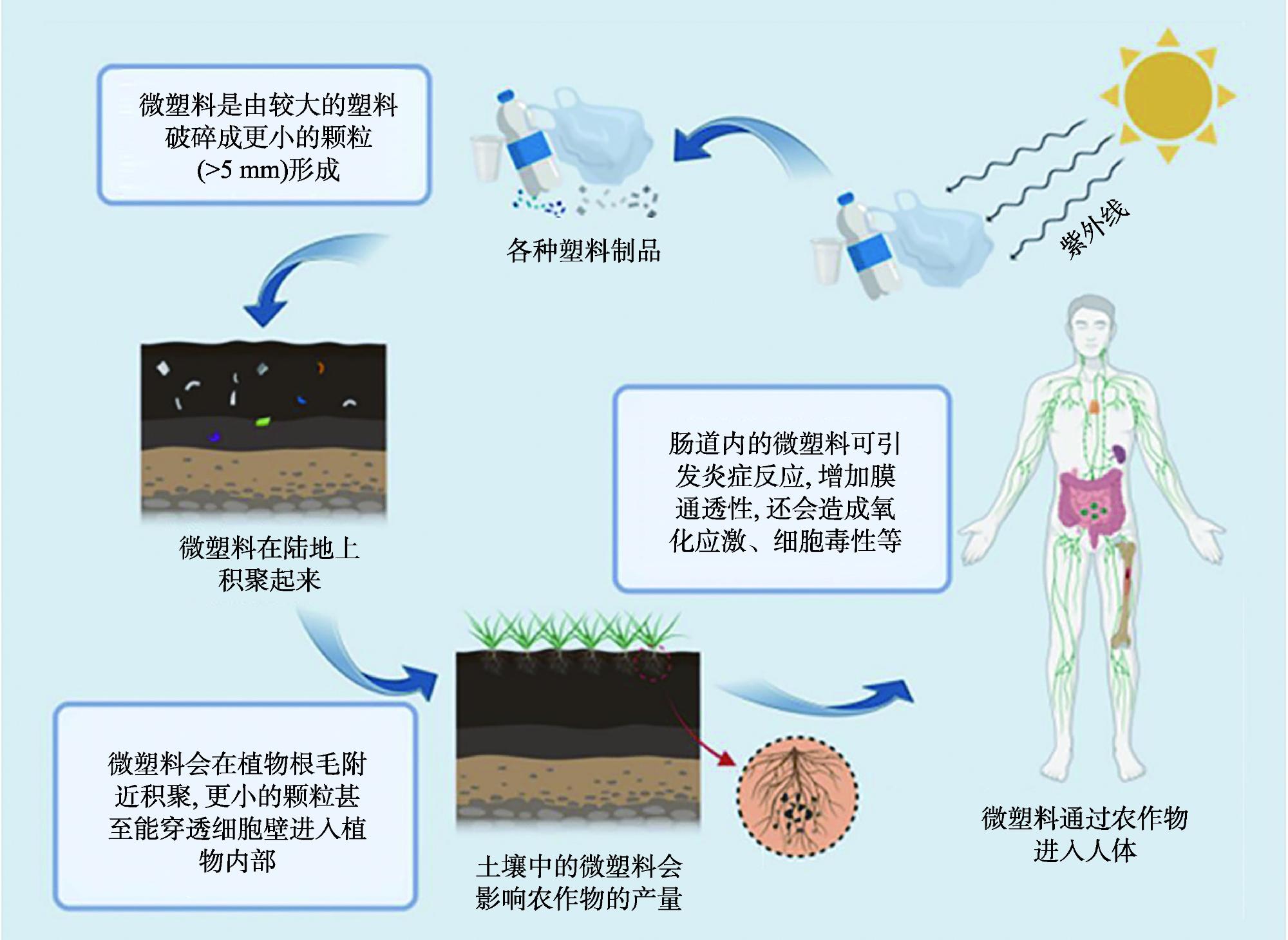
干旱区独特的昼夜温差、强紫外辐射、风蚀等作用可以加速微塑料的形成和富集,微塑料污染会显著改变土壤结构,影响土壤的肥力和持水能力,进而改变土壤微生物群落及其碳代谢,增加温室气体排放。干旱区微塑料污染对生态系统的影响是多维度的,其潜在生态风险最终可能通过食物链传递威胁人类健康(图2[10]。如图2所示,微塑料在土壤中累积,可以积聚在植物根部甚至进入植物内部,进而影响农作物生长和产量,最终可能通过食物链进入人体,构成潜在的健康风险[10]
图2 干旱区微塑料在土壤中累积、影响农作物产量并通过食物链进入人体的示意图

Fig. 2 Schematic diagram of microplastics accumulation in the soil of arid areas, their impact on crop yields, and their entry into human body through food chain

4.1 微塑料对干旱区土壤生态系统的影响

由于微塑料对陆地生态系统的威胁,近年来在土壤中的研究越来越多[81]。从中国新疆、辽宁、四川和山东省的4个长期塑料薄膜覆盖的农田收集了表层土壤(0~20 cm)发现,长期塑料薄膜覆盖不仅显著增加了表层(尤其是在0~10 cm层)微塑料的积累,还显著改变了表层土壤pH值(P<0.05)。其中,四川、辽宁和山东的表层土壤pH分别提高了0.43、0.36和0.77个单位[82]
尽管传统的覆盖薄膜可以提高水资源利用效率并减少灌溉需求[82-83],但从长远来看,在人工供水或缺水的干旱和沙质表土中长期使用传统覆盖薄膜可能会导致土壤成分甚至生态的变化,并最终变得更加干燥,甚至具有防水性[84]。以PE微塑料为例,不同丰度的PE短期暴露(4个月)即可降低粉质黏土的持水能力[85]。此外,长期覆膜导致土壤团聚体稳定性降低,加速土壤氮素流失[82]。微塑料的存在也会加速土壤有机碳(SOC)的矿化,其中PE污染土壤中累积SOC衍生的CO2外排量最高,其次是PA、PLA、PS和未添加微塑料的对照[86]
干旱区土壤微塑料通过降低土壤的保水能力和养分含量,严重影响土壤微生物种群的分布和数量[86-87]。长期使用塑料地膜会对土壤中的细菌群落产生影响,地膜作为微生物碳源,导致能够降解塑料的细菌数量增多。此外,许多地膜未能得到及时和适当的回收处理,加速了土壤层中微塑料污染的积累,而降解过程中释放的添加剂则加剧了污染情况[88-89]。与森林和农田土壤相比,在沙质土壤中,微塑料颗粒物质对细菌群落造成了更大的干扰,进而影响了碳和氮的循环[89]。重要的是,微塑料颗粒在老化或降解过程中产生的有害物质可能会导致某些微生物种群的减少或灭绝。中国陕西省北部的干旱农田调查发现,塑料薄膜残留物释放出邻苯二甲酸酯,导致土壤中的邻苯二甲酸酯含量逐年增加,这显著改变了细菌群落结构,并干扰了细菌的代谢功能[90-91]
由于荒漠化过程所伴随的极端气候条件,能够存活下来的植物数量和种类都相对较少。环境因素的微小变化都会对植物产生深远的影响。因此,荒漠生态系统中的微塑料污染往往会对当地植被产生更大的负面影响[91]。微塑料可以通过改变土壤的物理特性来降低土壤的吸水能力和渗透性,导致该区域的植物面临更严重的干旱胁迫,从而威胁到它们的生长、发育甚至生存[92-93]。50.0 mg·L-1 PS微塑料使玉米生物量降低35%,叶绿素b含量减少24%,Rubisco酶活性下降超50%[94]

4.2 微塑料对水生生物的影响与生态风险

干旱区湖泊是重要的微塑料“汇”,如乌梁素湖中微塑料大气沉降高达2266±271 个·(m2·d)-1,其水体中微塑料丰度可达11.3 个·L-1,且以小尺寸微塑料为主,小于2.0 mm的微塑料占总微塑料的98%[54,94-95]。水生生物摄入的微塑料很可能会导致一系列不良影响,比如机械损伤、生长速度减慢以及生理压力(例如免疫反应、代谢异常、行为改变以及能量预算的改变)[96-98]。例如,高剂量的PS微塑料暴露会导致部分水生生物的生殖功能紊乱[99]。PE微塑料能够显著降低一些昆虫移动的距离和速度[100]。除了塑料本身之外,微塑料所吸附的环境毒素(例如塑料添加剂,邻苯二甲酸酯和双酚A等)、未反应的塑料单体以及其他有机污染物在水生生物摄入后可能会通过食物链进行生物累积,进而对处于更高营养级的生物(包括人类)构成重大威胁[101-102]。一项关于人类来源细胞的最新研究证实,PS微塑料能够增加活性氧物质的产生导致免疫细胞的急性炎症以及部分细胞的死亡[103]

4.3 微塑料表面污染物吸附加剧其生态风险

微塑料表面吸附污染物,形成复合污染,加剧生态风险。干旱区特有的盐度条件促进微塑料与污染物共沉淀,使复合生态风险提升[43-44]。微塑料-盐分联合胁迫使玉米叶片H2O2含量升高57%,钠吸收量减少24%[94]。含有微塑料颗粒的尘埃对环境构成更大的风险,因为微塑料具有较大的比表面积以及吸附有毒物质的能力[104-105]。一项模拟研究显示,中亚地区的公共卫生问题可能归因于阿拉库姆沙漠中扬起的大量携带塑料颗粒的沙子,因为尘埃能够轻易地携带病原体或其他污染物,在整个地区扩散开来[9]

4.3.1 微塑料-塑化剂复合污染特征

随着大块塑料的分解以及微塑料的形成,塑料添加剂,例如邻苯二甲酸酯(PAEs),会释放到周围环境中[87,106]。干旱区农用地膜残留的微塑料对塑化剂表现出强亲和力,其表面疏水性及裂纹结构显著提升吸附容量。例如,塑料地膜(PE)含有极高水平的邻苯二甲酸酯(高达65.3 mg·kg-1[106],因而容易形成微塑料和邻苯二甲酸酯的复合污染[92]。作为疏水性半挥发性有机化合物,邻苯二甲酸酯通常不会与塑料制品发生化学结合,而是通过氢键或范德华力等弱相互作用结合,从而保持相对独立的化学性质[107-108]。因此,当地膜老化或分解时,邻苯二甲酸酯的释放速率会大幅增加[109]。同时,邻苯二甲酸酯作为典型的环境激素类物质,具有潜在的致癌、致畸和致突变作用。它们可以通过食物链、食物网等方式在生物体内积累,干扰生物的正常内分泌功能,对生命和健康构成潜在威胁[110-111]

4.3.2 微塑料-持久性有机污染物复合污染特征

农业覆盖塑料容易受到农药的污染,这使得它们难以处理和回收。覆盖薄膜的主要成分PE可以通过薄膜的无定型区域吸收农药以及其他有机和无机物质,并将它们带入土壤基质中,从而促进农药、抗生素和其他污染物向土壤和植物的转移[11,111]。在5 μg·L-1 和200 μg·L-1多环芳烃(PAHs)浓度水平下,地膜微塑料(PE)的吸附量分别为:萘(22%和48%)、芴(39%和39%)、蒽(65%和68%)和芘(76%和86%),吸附受辛醇-水分配系数(logKow)和离子强度的影响。且与纯PE微球相比,从地膜中提取的PE微塑料的吸附率高出90%[112]
微塑料老化及其对PAHs的吸附是部分水生生物氧化应激的重要影响因素,有研究发现在暴露于所有不同微塑料处理的贻贝中均检测到神经毒性[113]

4.3.3 微塑料-重金属复合污染特征

微塑料作为污染物载体,也可富集重金属。研究发现从中国典型的干旱绿洲埃比努尔湖流域土壤微塑料中提取的7种重金属与土壤pH、电导率(EC)、总盐、N、P、K含量呈显著正相关(P<0.01),表明土壤微塑料表面重金属主要来自土壤施肥,并受到pH、EC以及土壤N、P、K和总盐含量的影响[114]。伊朗城市土壤中微塑料携带的Cd、Pb浓度分别达到土壤本底值的1.5倍和2.3倍[25]。此外,聚苯乙烯微塑料对铜(Cu)具有很高的亲和力,其吸收量[1192 μg Cu·(g C)-1]高于锌(Zn)[173 μg Zn·(g C)-1][115]。城市土壤中,交通密集区微塑料表面富集的合成橡胶颗粒(含Zn、Sb)占比达12%,其Zn含量是农业区的8倍[25]。对原始PE和老化PE上Cd(Ⅱ)的吸附行为进行研究,发现老化PE对Cd(Ⅱ)的吸附量大于PE,其中老化PE表面的含氧基团可提供结合位点,增加对重金属的吸附[116]

5 未来优先研究领域

随着全球气候变化加剧与人类活动强度攀升,干旱区微塑料污染已突破传统环境问题的边界,呈现出跨介质、跨尺度、跨区域的复合性特征,其环境行为与生态效应亟待系统性解析。未来研究需突破当前方法论局限,构建多学科交叉的创新研究范式,重点围绕以下核心领域展开攻关:建立干旱区特异的微塑料全生命周期监测体系,揭示多界面耦合迁移机制,量化长期生态风险阈值,发展基于自然-社会协同的治理技术体系。这些优先方向的突破将为实现干旱区生态安全维护与可持续发展提供科学支撑。
(1) 多尺度监测方法与标准化体系构建
当前干旱区微塑料研究面临的首要挑战是监测方法的区域适应性与数据可比性问题。传统采样与分析方法在应对干旱区复杂基质(如高盐土壤、多粉尘大气)时存在显著局限性,尤其对纳米级塑料、降解中间体及异质复合体的识别精度不足。未来需重点发展多模态联用检测技术,集成光谱指纹识别、同位素示踪和人工智能算法,建立覆盖宏-微-纳多尺度的原位表征体系。针对干旱区特有的风沙迁移特性,应研发气溶胶连续采集与实时分析装置,结合卫星遥感与地面传感网络,构建“天-空-地”立体监测系统。此外,应重视历史沉积物和冰芯等自然档案的微塑料溯源研究,重建百年尺度污染演变规律,为预测未来情景提供基线数据。
(2) 多介质界面过程与系统耦合机制
干旱区微塑料的独特环境行为源于其多界面耦合迁移特性,这种特性在气候变化背景下呈现非线性放大效应。未来研究需突破单介质研究的传统范式,重点揭示四大耦合机制:大气-土壤界面的风蚀/沉降动态平衡机制,土壤-植物系统的根际微域传输机制,地表水-地下水系统的优先流驱动机制,以及生物-非生物界面的表面修饰效应。应建立多过程耦合的数学模型,整合微塑料的物理破碎、光化学老化、生物膜形成等过程参数,量化不同气候情景下的跨介质通量。特别需要关注干湿交替、冻融循环等干旱区特有过程对微塑料表面特性及迁移能力的调控作用,阐明盐分梯度、电场强度等环境因子与微塑料胶体行为的交互机制。
(3) 生态风险阈值与适应性管理路径
干旱区微塑料的生态风险研究需实现从危害识别向定量管理的范式转变。当前研究对长期低剂量暴露效应、复合污染协同作用及生态阈值等关键问题认知严重不足。未来应建立多营养级暴露实验体系,重点关注微塑料与干旱区典型胁迫因子(如高温、盐碱、沙尘)的复合效应,解析其对土壤微生物功能基因表达、植物水分利用策略及动物免疫应答的分子机制。需要突破传统毒理学评估框架,发展基于生态系统服务功能的风险评估模型,量化微塑料对碳氮循环、水分调节等关键生态过程的干扰强度。在治理技术层面,应重点研发仿生降解材料、智能回收装备和生态拦截系统,发展“源头减量-过程阻断-末端修复”的全链条技术体系,并建立基于区块链的农膜回收激励机制和跨境生态补偿机制,形成具有干旱区特色的微塑料治理方案。
[1]
de Souza Machado A A, Kloas W, Zarfl C, et al. Microplastics as an emerging threat to terrestrial ecosystems[J]. Global Change Biology, 2018, 24(4): 1405-1416.

DOI PMID

[2]
Sahai H, Aguilera Del Real A M, Alcayde A, et al. Key insights into microplastic pollution in agricultural soils: A comprehensive review of worldwide trends, sources, distribution, characteristics and analytical approaches[J]. Trends in Analytical Chemistry, 2025, 185(45): 118176.

[3]
Sun H, Ai L, Wu X, et al. Effects of microplastic pollution on agricultural soil and crops based on a global meta-analysis[J]. Land Degradation & Development, 2024, 35(2): 551-567.

[4]
Yang Z, F, Zhang H, et al. A neglected transport of plastic debris to cities from farmland in remote arid regions[J]. Science of the Total Environment, 2022, 807(51): 150982.

[5]
Abbasi S, Turner A, Hoseini M, et al. Microplastics in the Lut and Kavir Deserts, Iran[J]. Environmental Science & Technology, 2021, 55(9): 5993-6000.

[6]
Luo X, Zhang Y, Kang S, et al. Atmospheric emissions of microplastics entrained with dust from potential source regions[J]. Journal of Hazardous Materials, 2025, 488(51): 137509.

[7]
Abbasi S, Jaafarzadeh N, Zahedi A, et al. Microplastics in the atmosphere of Ahvaz City, Iran[J]. Journal of Environmental Sciences, 2023, 126(35): 95-102.

[8]
Rezaei M, Abbasi S, Pourmahmood H, et al. Microplastics in agricultural soils from a semi-arid region and their transport by wind erosion[J]. Environmental Research, 2022, 212(56): 113213.

[9]
Banks J R, Heinold B, Schepanski K. Impacts of the desiccation of the Aral Sea on the central Asian dust life-cycle[J]. Journal of Geophysical Research: Atmospheres, 2022, 127(21): e2022JD036618.

[10]
Li H, Liu H, Lin Q, et al. The hidden threat of microplastics in desert environments: Environmental impact, challenges, and response measures[J]. Sustainability, 2025, 17(5): 1897.

[11]
严昌荣, 刘恩科, 舒帆, 等. 我国地膜覆盖和残留污染特点与防控技术[J]. 农业资源与环境学报, 2014, 31(2): 95-102.

[Yan Changrong, Liu Enke, Shu Fan, et al. Review of agricultural plastic mulching and its residual pollution and prevention measures in China[J]. Journal of Agricultural Resources and Environment, 2014, 31(2): 95-102.]

[12]
Bläsing M, Amelung W. Plastics in soil: Analytical methods and possible sources[J]. Science of the Total Environment, 2018, 612(47): 422-435.

[13]
Huang Y, Liu Q, Jia W, et al. Agricultural plastic mulching as a source of microplastics in the terrestrial environment[J]. Environmental Pollution, 2020, 260(34): 114096.

[14]
程万莉, 樊廷录, 王淑英, 等. 我国西北覆膜农田土壤微塑料数量及分布特征[J]. 农业环境科学学报, 2020, 39(11): 2561-2568.

[Cheng Wanli, Fan Tinglu, Wang Shuying, et al. Quantity and distribution of microplastics in film mulching farmland soil of Northwest China[J]. Journal of Agro-Environment Science, 2020, 39(11): 2561-2568.]

[15]
Yang J, Song K, Tu C, et al. Distribution and weathering characteristics of microplastics in paddy soils following long-term mulching: A field study in Southwest China[J]. Science of the Total Environment, 2023, 858(52): 159774.

[16]
Jiries A, Al-Omari A, Fraihat S, et al. Abundance and distribution of microplastics in irrigation canal water in Jordan[J]. Desalination and Water Treatment, 2024, 318(16): 100409.

[17]
陈荣龙, 陈延华, 黄珊, 等. 陕西关中农田土壤中塑料碎片和微塑料残留及其累积特征研究[J]. 中国生态农业学报(中英文), 2022, 30(10): 1649-1658.

[Chen Ronglong, Chen Yanhua, Huang Shan, et al. Residues and accumulation characteristics of plastic fragments and micro-plastics in farmland soil of Guanzhong Plain, Shaanxi[J]. Chinese Journal of Eco-Agriculture, 2022, 30(10): 1649-1658.]

[18]
Yu Y, Zhang Z, Zhang Y, et al. Abundances of agricultural microplastics and their contribution to the soil organic carbon pool in plastic film mulching fields of Xinjiang, China[J]. Chemosphere, 2023, 316(52): 137837.

[19]
Salehi Z, Hashemi S H, Flury M. Micro-and mesoplastics in farmlands with different irrigation water sources[J]. Water, Air, & Soil Pollution, 2023, 234(4): 267.

[20]
Jia Z, Wei W, Wang Y, et al. Occurrence characteristics and risk assessment of microplastics in agricultural soils in the loess hilly gully area of Yan' an, China[J]. Science of the Total Environment, 2024, 912(53): 169627.

[21]
郝爱红, 赵保卫, 张建, 等. 土壤中微塑料污染现状及其生态风险研究进展[J]. 环境化学, 2021, 40(4): 1100-1111.

[Hao Aihong, Zhao Baowei, Zhang Jian, et al. Research progress on pollution status and ecological risk of microplastics in soil[J]. Environmental Chemistry, 2021, 40(4): 1100-1111.]

[22]
Harms I K, Diekötter T, Troegel S, et al. Amount, distribution and composition of large microplastics in typical agricultural soils in Northern Germany[J]. Science of the Total Environment, 2021, 758(50): 143615.

[23]
Piehl S, Leibner A, Löder M G J, et al. Identification and quantification of macro-and microplastics on an agricultural farmland[J]. Scientific Reports, 2018, 8(1): 17950.

[24]
Akca M O, Gündoğdu S, Akca H, et al. An evaluation on microplastic accumulations in Turkish soils under different land uses[J]. Science of the Total Environment, 2024, 911(53): 168609.

[25]
Sunil M, Mithun N, Kalthur G, et al. Analysis of microplastics in the estuary lying along the coastal belt of the Arabian Sea[J]. Case Studies in Chemical and Environmental Engineering, 2024, 10(5): 100804.

[26]
Hoshyari E, Hassanzadeh N, Keshavarzi B, et al. Characterization of microplastic, metals associated and ecological risk assessment in the topsoil of shiraz metropolis, south west of Iran[J]. Chemosphere, 2023, 335(52): 139060.

[27]
Shomar B, Rovira J. Human health risk assessment associated with the reuse of treated wastewater in arid areas[J]. Environmental Pollution, 2024, 345(38): 123478.

[28]
杨扬. 农田土壤地膜源微塑料污染分布特征与释放机制研究[D]. 中国农业科学院, 2022.

[Yang Yang. Study on the Distribution Pattern and Kinetics of Microplastics Generation from Plastic Mulch Films in Agricultural Soil[D]. Beijing: Chinese Academy of Agricultural Sciences, 2022.]

[29]
Xiong X, Zhang K, Chen X, et al. Sources and distribution of microplastics in China's largest inland lake-Qinghai Lake[J]. Environmental Pollution, 2018, 235(32): 899-906.

[30]
Kang Q, Zhang Y, Kang S, et al. Characteristics of soil microplastics and ecological risks in the Qilian Mountains region, Northeast Tibetan Plateau[J]. Environmental Pollution, 2024, 363(1):125016.

[31]
Kang Q, Zhang Y, Kang S, et al. Characteristics of soil microplastics and ecological risks in the Qilian Mountains region, Northeast Tibetan Plateau[J]. Environmental Pollution, 2024, 363(38): 125016.

[32]
Zhang Z, Li P, Hu W, et al. Electric forces can enhance the emission of microplastics into air[J]. Environmental Pollution, 2025, 376(39): 126405.

[33]
Huang Y, He T, Yan M, et al. Atmospheric transport and deposition of microplastics in a subtropical urban environment[J]. Journal of Hazardous Materials, 2021, 416(47): 126168.

[34]
Sun J, Peng Z, Zhu Z R, et al. The atmospheric microplastics deposition contributes to microplastic pollution in urban waters[J]. Water Research, 2022, 225(56): 119116.

[35]
Villafañe A B, Ronda A C, Rodríguez Pirani L S, et al. Microplastics and anthropogenic debris in rainwater from Bahia Blanca, Argentina[J]. Heliyon, 2023, 9(6): e17028.

[36]
雷鹏, 李梦蛟, 刘亮亮, 等. 西北典型干旱区域棉田微塑料赋存特征及风险评估[J]. 环境污染与防治, 2025, 47(6): 10-19.

[Lei Peng, Li Mengjiao, Liu Liangliang, et al. Occurrence characteristic and risk assessment of microplastic from cotton fields in typical arid regions of Northwest China[J]. Environmental Pollution & Control, 2025, 47(6): 10-19.]

[37]
Imbulana S, Tanaka S, Moriya A, et al. Inter-event and intra-event dynamics of microplastic emissions in an urban river during rainfall episodes[J]. Environmental Research, 2024, 243(58): 117882.

[38]
Han N, Zhao Q, Ao H, et al. Horizontal transport of macro-and microplastics on soil surface by rainfall induced surface runoff as affected by vegetations[J]. Science of the Total Environment, 2022, 831(51): 154989.

[39]
Ohno H, Iizuka Y. Microplastics in snow from protected areas in Hokkaido, the northern island of Japan[J]. Scientific Reports, 2023, 13(1): 9942.

DOI PMID

[40]
Hueso-Kortekaas K, Delgado-Mellado N, Calzada-Funes J, et al. Microplastics in Inland Saline Lakes of the Central Ebro Basin, NE Spain[J]. Water, 2025, 17(7): 989.

[41]
王金花, 李冰, 侯宇晴, 等. 农田土壤中微塑料的赋存、迁移及生态效应研究进展[J]. 农业环境科学学报, 2023, 42(5): 951-965, 946.

[Wang Jinhua, Li Bing, Hou Yuqing, et al. Research process on the occurrence, migration, and ecological effects of microplastics in farmland soil[J]. Journal of Agro-Environment Science, 2023, 42(5): 951-965, 946.]

[42]
Rødland E S, Lind O C, Reid M J, et al. Occurrence of tire and road wear particles in urban and peri-urban snowbanks, and their potential environmental implications[J]. Science of the Total Environment, 2022, 824(51): 153785.

[43]
Vijayan A, Österlund H, Magnusson K, et al. Microplastics (MPs) in urban roadside snowbanks: Quantities, size fractions and dynamics of release[J]. Science of the Total Environment, 2022, 851(51): 158306.

[44]
Zhao X, Qiang M, Yuan Y, et al. Distribution of microplastic contamination in the major tributaries of the Yellow River on the Loess Plateau[J]. Science of the Total Environment, 2023, 905(52): 167431.

[45]
Luo S, Wu H, Xu J, et al. Effects of lakeshore landcover types and environmental factors on microplastic distribution in lakes on the Inner Mongolia Plateau, China[J]. Journal of Hazardous Materials, 2024, 465(50): 133115.

[46]
Alirezazadeh M, Nematollahi M J, Keshavarzi B, et al. Microplastics in Abiotic Compartments of a Hypersaline Lacustrine Ecosystem[J]. Environmental Toxicology and Chemistry, 2023, 42(1): 19-32.

[47]
Wang Y, Liu L, Cao S, et al. Spatio-temporal variation of soil microplastics as emerging pollutant after long-term application of plastic mulching and organic compost in apple orchards[J]. Environmental Pollution, 2023, 328(37): 121571.

[48]
Liu H, Wang X, Shi Q, et al. Microplastics in arid soils: Impact of different cropping systems (Altay, Xinjiang)[J]. Environmental Pollution, 2022, 303(36): 119162.

[49]
Dehhaghi S, Pardakhti A. Characterization of microplastics in the atmosphere of megacity Tehran (Iran)[J]. Environmental Science and Pollution Research, 2023, 30(48): 106026-106037.

[50]
Mohamed E F, El-Mekawy A, Abdel-Latif N M. Airborne microplastic contamination and health risks in Greater Cairo, Egypt[J]. Environmental Science and Pollution Research, 2025, 32(12): 7705-7721.

[51]
龚喜龙, 张道勇, 潘响亮. 黄河沉积物微塑料污染和表征[J]. 干旱区研究, 2020, 37(3): 790-798.

[Gong Xilong, Zhang Daoyong, Pan Xiangliang. Pollution and characterization of microplastics in the sediments of the Yellow River[J]. 2020, 37(3): 790-798.]

[52]
Abbasi S, Rezaei M, Mina M, et al. Entrainment and horizontal atmospheric transport of microplastics from soil[J]. Chemosphere, 2023, 322(52): 138150.

[53]
En-Nejmy K, El Fels L, El Hayany B, et al. Microplastics behavior and distribution in mulched agricultural soil under semi-arid climate: A case study from Morocco[J]. Pedosphere, 2025, 5: S100020 16025000372.

[54]
El-Alfy M A, El-Hamid H T A, Keshta A E, et al. Assessing microplastic pollution vulnerability in a protected coastal lagoon in the Mediterranean Coast of Egypt using GIS modeling[J]. Scientific Reports, 2025, 15(1): 11557.

[55]
Liu Y, Wang K, Shi X, et al. Analysis of microplastic sources in Wuliangsuhai Lake, China: Implications to microplastic deposition in cold, arid region lakes[J]. Journal of Hazardous Materials, 2025, 492(51): 138135.

[56]
Liu Z, Liu X, Bai Y, et al. Spatiotemporal distribution and potential sources of atmospheric microplastic deposition in a semiarid urban environment of Northwest China[J]. Environmental Science and Pollution Research, 2023, 30(29): 74372-74385.

[57]
Wang J, Zhang X, Li X, et al. Exposure pathways, environmental processes and risks of micro (nano) plastics to crops and feasible control strategies in agricultural regions[J]. Journal of Hazardous Materials, 2023, 459(49): 132269.

[58]
Jaiswal P K, Vijayan V, Kumar S, et al. Seasonal distribution of microplastics and associated ecological risks in a semi-arid freshwater ecosystem in India[J]. Environmental Pollution, 2025, 376(39): 126430.

[59]
Liang X, Ye J, Cao R, et al. Microplastics and their interaction with microorganisms in Bosten Lake water[J]. Journal of Cleaner Production, 2024, 481(32): 144157.

[60]
Eppehimer D E, Hamdhani H, Hollien K D, et al. Impacts of baseflow and flooding on microplastic pollution in an effluent-dependent arid land river in the USA[J]. Environmental Science and Pollution Research, 2021, 28(33): 45375-45389.

[61]
Hurley R R, Lusher A L, Olsen M, et al. Validation of a method for extracting microplastics from complex, organic-rich, environmental matrices[J]. Environmental Science & Technology, 2018, 52(13): 7409-7417.

[62]
Yang M, Tian X, Guo Z, et al. Effect of dry soil aggregate size on microplastic distribution and its implications for microplastic emissions induced by wind erosion[J]. Environmental Science & Technology Letters, 2022, 9(7): 618-624.

[63]
Rezaei M, Riksen M J P M, Sirjani E, et al. Wind erosion as a driver for transport of light density microplastics[J]. Science of the Total Environment, 2019, 669(48): 273-281.

[64]
Chen Y, Leng Y, Liu X, et al. Microplastic pollution in vegetable farmlands of suburb Wuhan, central China[J]. Environmental Pollution, 2020, 257(34): 113449.

[65]
Büks F, Kaupenjohann M. Global concentrations of microplastics in soils-a review[J]. Soil, 2020, 6(2): 649-662.

[66]
Li S, Li Z, Xue J, et al. Pollution and distribution of microplastics in grassland soils of Qinghai-Tibet Plateau, China[J]. Toxics, 2023, 11(1): 86.

[67]
Feng S, Lu H, Tian P, et al. Analysis of microplastics in a remote region of the Tibetan Plateau: Implications for natural environmental response to human activities[J]. Science of the Total Environment, 2020, 739(49): 140087.

[68]
Brahney J, Hallerud M, Heim E, et al. Plastic rain in protected areas of the United States[J]. Science, 2020, 368(6496): 1257-1260.

DOI PMID

[69]
Tian X, Yang M, Guo Z, et al. Amount and characteristics of microplastic and organic matter in wind-blown sediment at different heights within the aeolian sand saltation layer[J]. Environmental Pollution, 2023, 327(37): 121615.

[70]
Zhang P, Wang J, Huang L, et al. Microplastic transport during desertification in drylands: Abundance and characterization of soil microplastics in the Amu Darya-Aral Sea basin, Central Asia[J]. Journal of Environmental Management, 2023, 348(51): 119353.

[71]
Wang J, Li J, Liu S, et al. Distinct microplastic distributions in soils of different land-use types: A case study of Chinese farmlands[J]. Environmental Pollution, 2021, 269(35): 116199.

[72]
Feng S, Lu H, Xue Y, et al. Driving factors and sources of microplastics in soils in the Yellow River source area[J]. Environmental Pollution, 2025, 369(15):125848.

[73]
Gan M, Zhang Y, Shi P, et al. Occurrence, potential sources, and ecological risk assessment of microplastics in the inland river basins in northern China[J]. Marine Pollution Bulletin, 2024, 205(55): 116656.

[74]
Wan S, Xu G, Xiong P, et al. Microplastic pollution characteristics and ecological risk assessment in the Wuding River Basin, China[J]. Environmental Pollution, 2024, 356(38): 124228.

[75]
Gan M, Zhang Y, Shi P, et al. Microplastic pollution in typical seasonal rivers in northern China: Temporal variation and risk assessment[J]. Environmental Science: Processes & Impacts, 2023, 25(9): 1479-1490.

[76]
Feng H, Xing X, Zhao F, et al. Insights into simultaneous changes of water evaporation and desiccation crack formation for microplastics-contained saline soils[J]. Geoderma, 2024, 448(58): 116977.

[77]
Shi J, Wang J, Lv J, et al. Microplastic additions alter soil organic matter stability and bacterial community under varying temperature in two contrasting soils[J]. Science of the Total Environment, 2022, 838(51): 156471.

[78]
Li L, Zhou Q, Yin N, et al. Uptake and accumulation of microplastics in an edible plant[J]. Chinese Science Bulletin, 2019, 64(9): 928-934.

[79]
Li W, Wufuer R, Duo J, et al. Microplastics in agricultural soils: Extraction and characterization after different periods of polythene film mulching in an arid region[J]. Science of the Total Environment, 2020, 749(49): 141420.

[80]
Eriksen M, Lusher A, Nixon M, et al. The plight of camels eating plastic waste[J]. Journal of Arid Environments, 2021, 185(44): 104374.

[81]
Choi Y R, Kim Y N, Yoon J H, et al. Plastic contamination of forest, urban, and agricultural soils: A case study of Yeoju City in the Republic of Korea[J]. Journal of Soils and Sediments, 2021, 21(5): 1962-1973.

DOI

[82]
Zhang J, Wang K, Hao T, et al. Long-term plastic film mulching promotes microplastic accumulation and alters gross nitrogen transformation in soil[J]. Applied Soil Ecology, 2025, 208(32): 106007.

[83]
Dong H, Li W, Tang W, et al. Furrow seeding with plastic mulching increases stand establishment and lint yield of cotton in a saline field[J]. Agronomy Journal, 2008, 100(6): 1640-1646.

[84]
Zhao Z Y, Wang P Y, Xiong X B, et al. Environmental risk of multi-year polythene film mulching and its green solution in arid irrigation region[J]. Journal of Hazardous Materials, 2022, 435(48): 128981.

[85]
Ebrahimi S, Doulgeris C, Karimpoor R. Variability in characteristics of water retention curve in polluted loessial soils by polyethylene microplastics[J]. Water, Air, & Soil Pollution, 2025, 236(4): 206.

[86]
Lin J, Chen B, Dong H, et al. Effects of soil moisture fluctuation and microplastics types on soil organic matter decomposition and carbon dynamics[J]. Soil Biology and Biochemistry, 2025, 205(57): 109781.

[87]
Bandopadhyay S, Martin-Closas L, Pelacho A M, et al. Biodegradable plastic mulch films: Impacts on soil microbial communities and ecosystem functions[J]. Frontiers in Microbiology, 2018, 9(9): 819.

[88]
Reay M K, Graf M, Murphy M, et al. Higher potential leaching of inorganic and organic additives from biodegradable compared to conventional agricultural plastic mulch film[J]. Journal of Hazardous Materials, 2025, 5(488): 137147.

[89]
Wang P, Liu T, Liu J, et al. Effects of different colored polyethylene mulching films on bacterial communities from soil during enrichment incubation[J]. Ecotoxicology and Environmental Safety, 2022, 246(46): 114160.

[90]
曹林杰. 不同类型农膜降解性能和污染特征及其对土壤理化影响[D]. 咸阳: 西北农林科技大学, 2023.

[Cao Linjie. Degradation and Pollution Characteristics of Different Types of Agricultural Film and their Effects on Soil Physicochemical Properties[D]. Xianyang: Northwest Agriculture and Forestry University, 2023.]

[91]
Sun Q, Zhang X, Liu C, et al. The content of PAEs in field soils caused by the residual film has a periodical peak[J]. Science of the Total Environment, 2023, 864(52): 161078.

[92]
Zang H, Zhou J, Marshall M R, et al. Microplastics in the agroecosystem: Are they an emerging threat to the plant-soil system?[J]. Soil Biology and Biochemistry, 2020, 148(52): 107926.

[93]
Qi R, Jones D L, Li Z, et al. Behavior of microplastics and plastic film residues in the soil environment: A critical review[J]. Science of the Total Environment, 2020, 703(49): 134722.

[94]
Liu X, Wang Z, Shi G, et al. Effects of microplastics and salt single or combined stresses on growth and physiological responses of maize seedlings[J]. Physiologia Plantarum, 2025, 177(1): e70106.

[95]
Mao R, Hu Y, Zhang S, et al. Microplastics in the surface water of Wuliangsuhai Lake, northern China[J]. Science of the Total Environment, 2020, 723(49): 137820.

[96]
薛颖昊. 我国农田残膜污染特征及聚乙烯微塑料对水生动物的毒性效应研究[D]. 沈阳: 沈阳农业大学, 2023.

[Xue Yinghao. Characteristics of Residual Film Pollution in Farmland and Toxicity Effects of Polyethylene Microplastics to Aquatic Animal in China[D]. Shenyang: Shenyang Agricultural University, 2023.]

[97]
蔡亚云, 赵佳玥, 李文锋, 等. 不同粒径塑料微颗粒在斑马鱼腮组织中的积累及其对蒽毒性的影响[J]. 应用与环境生物学报, 2017, 23(6): 1154-1158.

[Cai Yayun, Zhao Jiayue, Li Wenfeng, et al. Retention of polystyrene particles of different sizes in zebrafish gills and their effect on toxicity of anthracene to gill cells[J]. Chinese Journal of Applied and Environmental Biology, 2017, 23(6): 1154-1158.]

[98]
Yan M, Nie H, Xu K, et al. Microplastic abundance, distribution and composition in the Pearl River along Guangzhou City and Pearl River estuary, China[J]. Chemosphere, 2019, 217(48): 879-886.

[99]
Ma H, Pu S, Liu S, et al. Microplastics in aquatic environments: Toxicity to trigger ecological consequences[J]. Environmental Pollution, 2020, 261(34): 114089.

[100]
Sussarellu R, Suquet M, Thomas Y, et al. Oyster reproduction is affected by exposure to polystyrene microplastics[J]. Proceedings of the National Academy of Sciences, 2016, 113(9): 2430-2435.

[101]
Kim S W, An Y J. Edible size of polyethylene microplastics and their effects on springtail behavior[J]. Environmental Pollution, 2020, 266(34): 115255.

[102]
Carbery M, O'Connor W, Palanisami T. Trophic transfer of microplastics and mixed contaminants in the marine food web and implications for human health[J]. Environment International, 2018, 115(41): 400-409.

[103]
熊雄, 吴辰熙. 湖泊——内陆水体微塑料污染的热点区域[J]. 自然杂志, 2021, 43(4): 243-250.

[Xiong Xiong, Wu Chenxi. Lakes—hotspots of microplastic pollution in inland water bodies[J]. Chinese Journal of Nature, 2021, 43(4): 243-250.]

DOI

[104]
Choi D, Bang J, Kim T, et al. In vitro chemical and physical toxicities of polystyrene microfragments in human-derived cells[J]. Journal of Hazardous Materials, 2020, 400(46): 123308.

[105]
Long X, Fu T M, Yang X, et al. Efficient atmospheric transport of microplastics over Asia and adjacent oceans[J]. Environmental Science & Technology, 2022, 56(10): 6243-6252.

[106]
Cao Y, Lin H, Zhang K, et al. Microplastics: A major source of phthalate esters in aquatic environments[J]. Journal of Hazardous Materials, 2022, 15(432):128731.

[107]
Zhang Q Q, Ma Z R, Cai Y Y, et al. Agricultural plastic pollution in China: Generation of plastic debris and emission of phthalic acid esters from agricultural films[J]. Environmental Science & Technology, 2021, 55(18): 12459-12470.

[108]
Wittassek M, Koch H M, Angerer J, et al. Assessing exposure to phthalates-The human biomonitoring approach[J]. Molecular Nutrition & Food Research, 2011, 55(1): 7-31.

[109]
Yen T H, Lin-Tan D T, Lin J L. Food safety involving ingestion of foods and beverages prepared with phthalate-plasticizer-containing clouding agents[J]. Journal of the Formosan Medical Association, 2011, 110(11): 671-684.

[110]
Karamianpour J, Arfaeinia H, Vakilabadi D R, et al. Accumulation, sources, and health risks of phthalic acid esters (PAEs) in road dust from heavily industrialized, urban and rural areas in southern Iran[J]. Heliyon, 2023, 9(12): e23129.

[111]
Selvaraj K K, Mubarakali Habibunisha, Rathinam Maniraj, et al. Cumulative exposure and dietary risk assessment of phthalates in bottled water and bovine milk samples: A preliminary case study in Tamil Nadu, India[J]. Human and Ecological Risk Assessment: An International Journal, 2016, 22(5): 1166-1182.

[112]
Dong Y, Gao M, Song Z, et al. Microplastic particles increase arsenic toxicity to rice seedlings[J]. Environmental Pollution, 2020, 259(34): 113892.

[113]
Sahai H, García Valverde M, Murcia Morales M, et al. Exploring sorption of pesticides and PAHs in microplastics derived from plastic mulch films used in modern agriculture[J]. Chemosphere, 2023, 333(52): 138959.

[114]
Moncrieffe R, Masry M, Cai B, et al. Study of the ageing and the sorption of polyaromatic hydrocarbons as influencing factors on the effects of microplastics on blue mussel[J]. Aquatic Toxicology, 2023, 262(43): 106669.

[115]
Zhang Z, Guo J, Wang P. Occurrence, sources, and relationships of soil microplastics with adsorbed heavy metals in the Ebinur Lake Basin, Northwest China[J]. Journal of Arid Land, 2022, 14(8): 910-924.

DOI

[116]
Brennecke D, Duarte B, Paiva F, et al. Microplastics as vector for heavy metal contamination from the marine environment[J]. Estuarine, Coastal and Shelf Science, 2016, 178(36): 189-195.

文章导航

/