



河西走廊水资源-生态环境-社会经济系统耦合关系及时空分异
|
张文睿(2001-),女,硕士研究生,主要从事水文与水资源研究. E-mail: zhangwr@st.gsau.edu.cn |
收稿日期: 2023-10-28
修回日期: 2023-12-19
网络出版日期: 2025-08-13
基金资助
甘肃省高等学校青年博士基金项目(2022QB-070)
甘肃农业大学科技创新基金—青年导师扶持基金项目(GAU-QDFC-2021-16)
甘肃省重点研发计划项目(21YF5NA015)
甘肃省水利科学试验研究与技术推广项目(23GSLK092)
甘肃省水利科学试验研究与技术推广项目(23GSLK087)
Coupling relationship and spatiao-temporal differentiation of the water resources-ecological environment-social economic system in the Hexi Corridor
Received date: 2023-10-28
Revised date: 2023-12-19
Online published: 2025-08-13
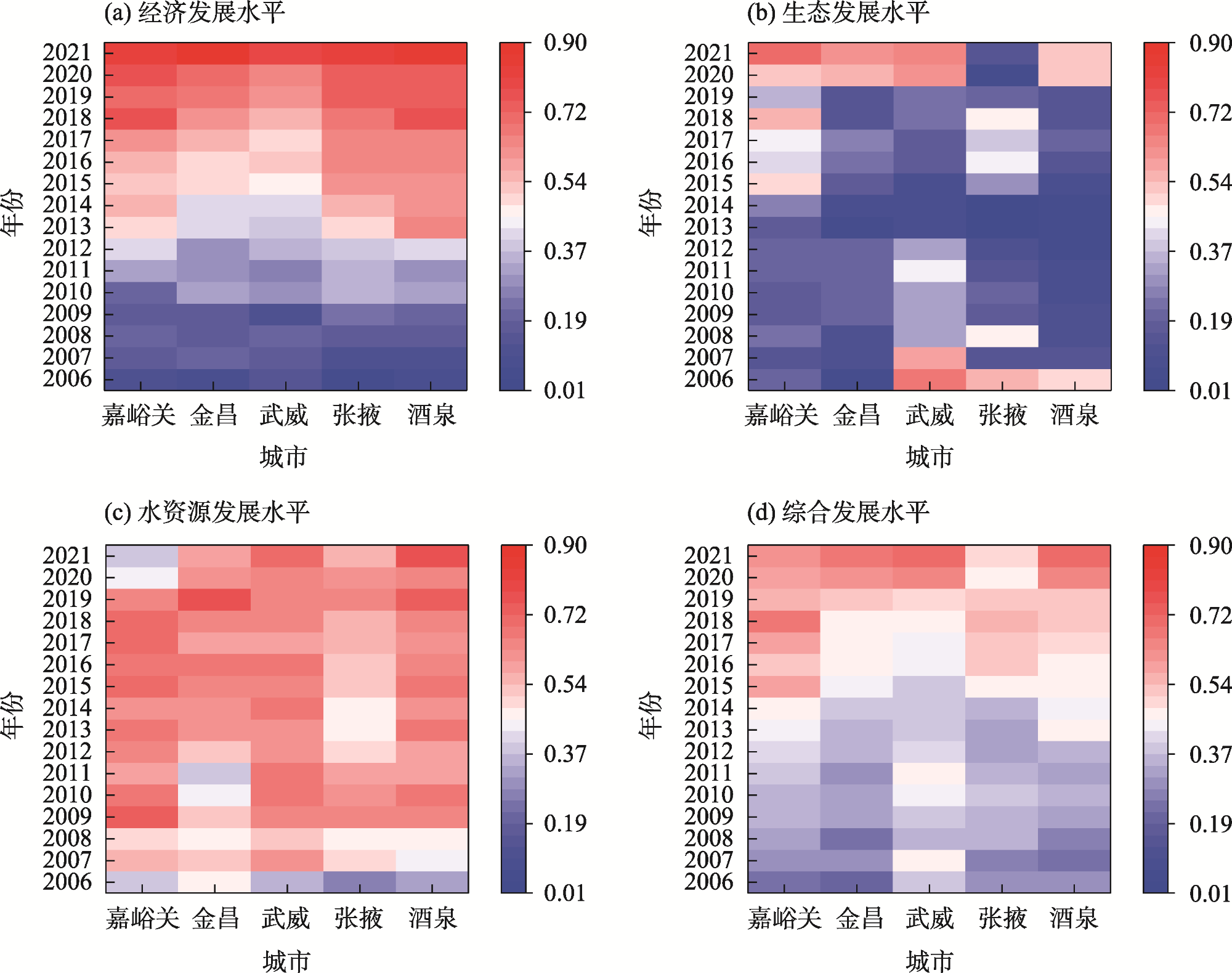
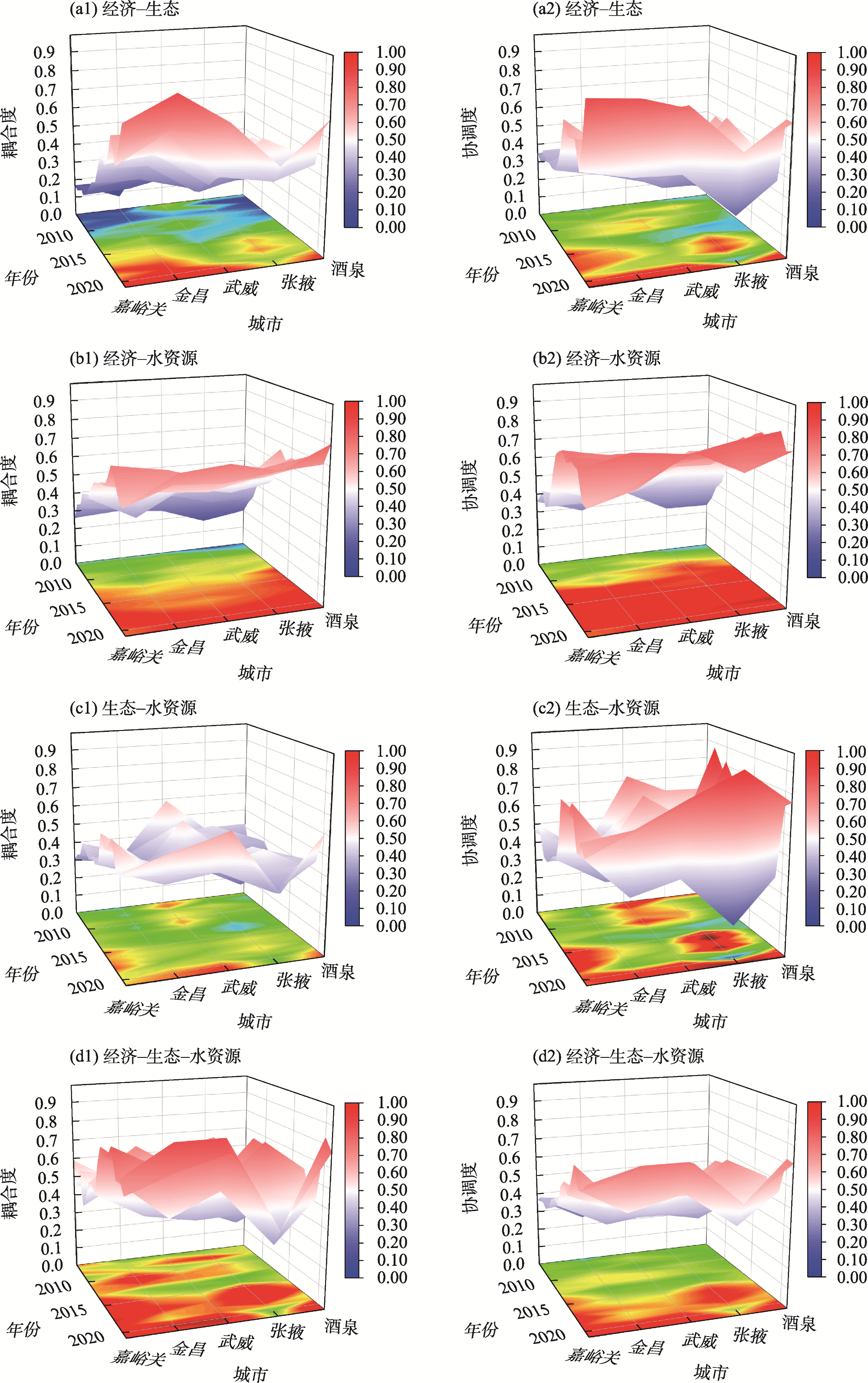
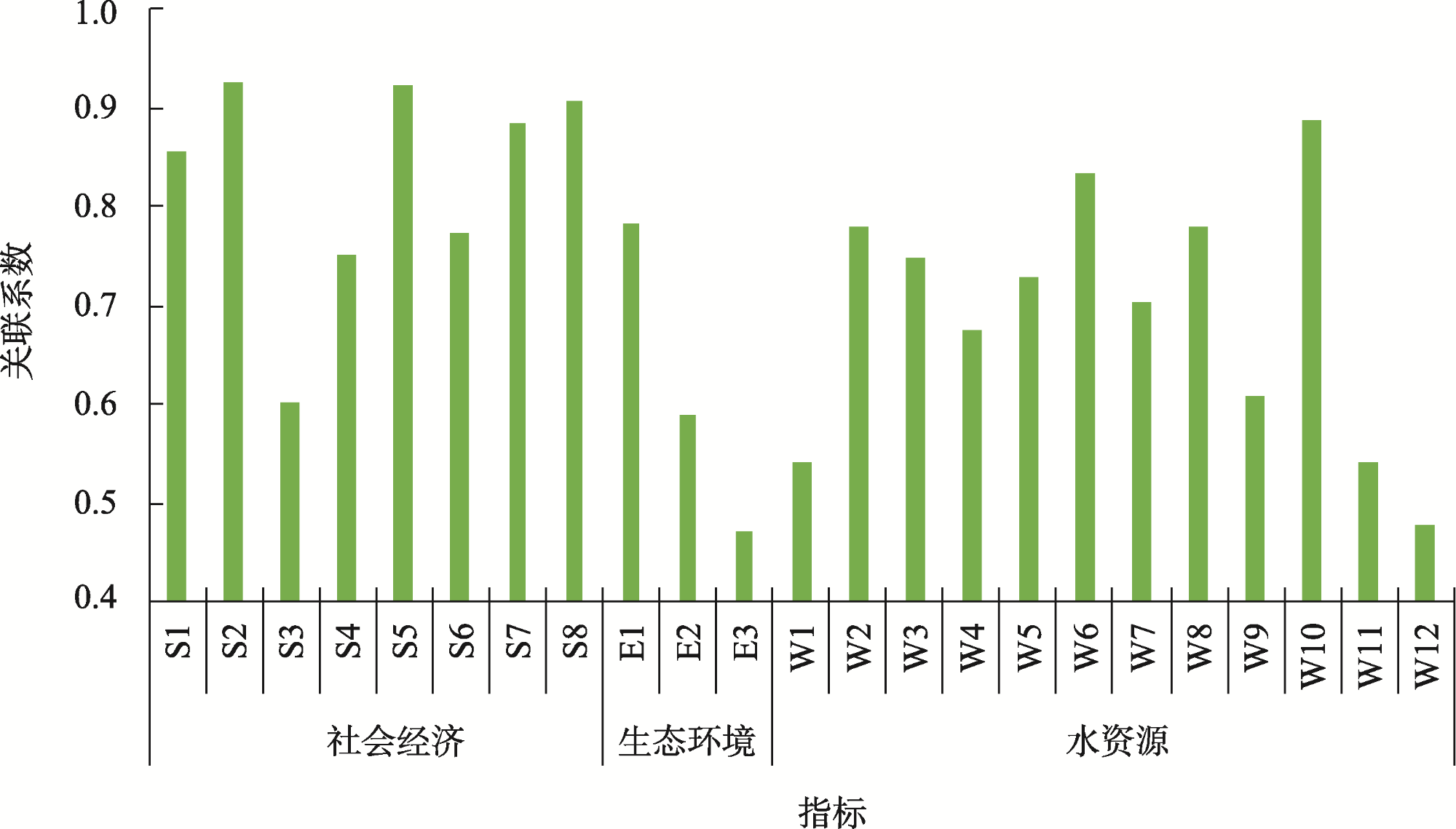
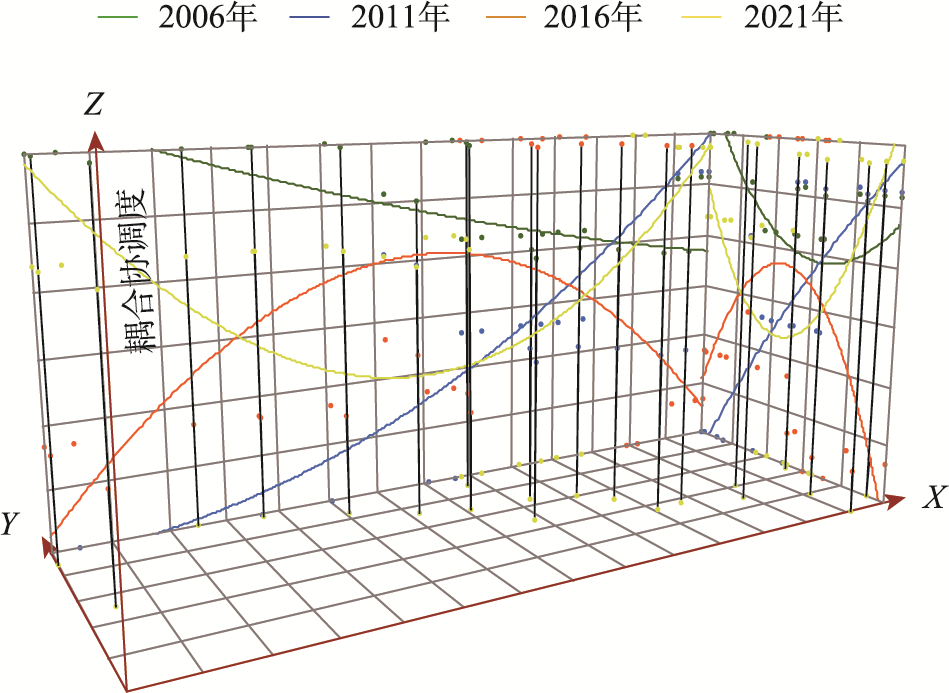
推进水资源、生态环境与社会经济系统协调发展为促进区域经济增长、社会进步和生态和谐与高质量发展提供技术支撑。文章基于修正耦合协调度模型评价河西走廊水资源-生态环境-社会经济系统耦合协调水平,运用灰色关联度模型和泰尔指数揭示驱动因素和空间异质性,并利用趋势面映射耦合协调度全域分布。结果表明:(1) 由经济发展带动水资源-经济-生态系统综合发展水平逐年上升,综合发展指数由2006年0.29增长至2021年0.65。(2) 河西走廊水资源子系统、经济子系统、生态子系统两两之间的耦合协调度呈不同趋势上升,水资源-生态-经济系统耦合度发展处于颉颃阶段向磨合阶段升级;协调度经历“轻度失调衰退-濒临失调衰退-勉强协调发展-初级协调发展-中级协调发展”五个阶段。(3) 区域空间异质性逐渐发展为减小趋势,2021年空间分布表现出东南部发展优于西北部格局,金昌和张掖逐步成为河西发展优势区域。(4) 城市化率、排污总量、节水灌溉面积对河西走廊水资源-生态环境-社会经济耦合发展起到较大的驱动作用。研究结果对河西走廊经济-生态-水资源系统协同发展具有一定的借鉴意义。
关键词: 修正耦合协调模型; 水资源-生态环境-社会经济系统; 时空演变规律; 驱动因素; 河西走廊
张文睿 , 孙栋元 , 王亦可 , 杨俊 , 兰立军 , 靳虎甲 , 徐裕 . 河西走廊水资源-生态环境-社会经济系统耦合关系及时空分异[J]. 干旱区研究, 2024 , 41(9) : 1527 -1537 . DOI: 10.13866/j.azr.2024.09.09
Promoting the coordinated development of water resources, the ecological environment, and the socio-economic system provides technical support for enhancing regional economic growth, social progress, ecological harmony, and high-quality development. Based on the modified coupling coordination degree model, this paper evaluated the coupling coordination level of water resources-ecological environment-social economic system in the Hexi Corridor. The gray correlation degree model and Theil index were used to identify the driving factors and spatial heterogeneity. The trend surface was utilized to map the global distribution of the coupling coordination degree. The results showed that: (1) The comprehensive development level of water resources-economy-ecosystem driven by economic development increased every year, and the comprehensive development index enhanced from 0.29 in 2006 to 0.65 in 2021. (2) The coupling coordination degree between the water resources, economic, and ecological subsystems in the Hexi Corridor showed different trends, and the development of the coupling degree of the water resources-ecology-economy system was upgraded from the antagonistic to the running-in stage. The coordination degree experienced five stages of “mild imbalance recession-on the verge of imbalance recession-reluctant coordinated development-primary coordinated development-intermediate coordinated development”. (3) The spatial heterogeneity in the region first increased and then decreased. The spatial distribution revealed that the development of the southeast was better than that of the northwest. Jinchang and Zhangye have gradually become the dominant areas of development in Hexi. (4) Urbanization rate, total pollutant discharge, and water-saving irrigation areas played a remarkable role in driving the coupling development of water resources-ecological environment-social economy in the Hexi Corridor. These results have a certain reference-related significance for the coordinated development of the economy-ecology-water resources system in the five cities of the Hexi Corridor.
表1 指标体系构建Tab. 1 Indicator system construction |
| 目标层 | 指标层 | 指标属性 | 指标编号 | 变异系数法权重 | 层次分析法权重 | 综合权重 |
|---|---|---|---|---|---|---|
| 社会经济 | 人口/104人 | + | S1 | 0.02 | 0.07 | 0.04 |
| 城市化率/% | + | S2 | 0.06 | 0.11 | 0.09 | |
| 三产占比/% | + | S3 | 0.29 | 0.10 | 0.19 | |
| 人均GDP/104元 | + | S4 | 0.17 | 0.12 | 0.15 | |
| 第三产业占GDP比例/% | + | S5 | 0.14 | 0.17 | 0.15 | |
| 工业增加值/108元 | + | S6 | 0.17 | 0.15 | 0.16 | |
| 农田实际灌溉面积/hm2 | + | S7 | 0.06 | 0.13 | 0.10 | |
| 粮食总产量/104 t | + | S8 | 0.09 | 0.15 | 0.12 | |
| 生态环境 | 排污总量/108 t | - | E1 | 0.07 | 0.16 | 0.12 |
| 生态环境用水量/108 m3 | + | E2 | 0.46 | 0.54 | 0.50 | |
| 城市环境用水量/108 m3 | + | E3 | 0.47 | 0.30 | 0.38 | |
| 水资源 | 万元工业增加值用水量/108 m3 | - | W1 | 0.10 | 0.08 | 0.09 |
| 年降水量/mm | + | W2 | 0.04 | 0.09 | 0.06 | |
| 地表水供水量/108 m3 | + | W3 | 0.03 | 0.08 | 0.06 | |
| 地下水供水量/108 m3 | + | W4 | 0.09 | 0.08 | 0.08 | |
| 农田灌溉用水量/108 m3 | - | W5 | 0.03 | 0.09 | 0.06 | |
| 林牧渔畜用水量/108 m3 | - | W6 | 0.03 | 0.08 | 0.06 | |
| 工业用水量/108 m3 | - | W7 | 0.07 | 0.08 | 0.08 | |
| 城镇公共用水量/108 m3 | - | W8 | 0.07 | 0.08 | 0.08 | |
| 居民生活用水量/108 m3 | - | W9 | 0.07 | 0.09 | 0.08 | |
| 节水灌溉面积/hm2 | + | W10 | 0.05 | 0.08 | 0.06 | |
| 人均用水量/L | - | W11 | 0.17 | 0.09 | 0.13 | |
| 万元GDP用水量/m3 | - | W12 | 0.25 | 0.08 | 0.16 |
注:+表示正向指标,指标越高越好;-表示逆向指标,指标越低越好。 |
表2 系统耦合度与协调发展的区间划分评价标准Tab. 2 Evaluation criteria for the interval division of system coupling degree and coordinated development |
| 不可接受区间 | 可接受区间 | |||||
|---|---|---|---|---|---|---|
| 区间 | 协调发展度 评价 | 耦合度 评价 | 区间 | 协调发展度 评价 | 耦合度 评价 | |
| 0~0.09 | 极度失调衰退 | 低水平耦合状态 | 0.50~0.59 | 勉强协调发展 | 磨合阶段 | |
| 0.10~0.19 | 严重失调衰退 | 0.60~0.69 | 初级协调发展 | |||
| 0.20~0.29 | 中度失调衰退 | 0.70~0.79 | 中级协调发展 | |||
| 0.30~0.39 | 轻度失调衰退 | 颉颃阶段 | 0.80~0.89 | 良好协调发展 | 高水平耦合阶段 | |
| 0.40~0.49 | 濒临失调衰退 | 0.90~1.00 | 优质协调发展 | |||
表3 河西走廊水资源-生态-社会经济系统耦合协调度空间分异Tab. 3 Spatial differentiation of the coupling coordination degree of water resources-ecology- social economic system in five cities of the Hexi Corridor |
| 年份 | 耦合协调度 | 泰尔指数 | 年份 | 耦合协调度 | 泰尔指数 |
|---|---|---|---|---|---|
| 2006年 | 0.34 | 0.0119 | 2014年 | 0.43 | 0.0151 |
| 2007年 | 0.38 | 0.0058 | 2015年 | 0.50 | 0.0122 |
| 2008年 | 0.37 | 0.0050 | 2016年 | 0.56 | 0.0067 |
| 2009年 | 0.36 | 0.0037 | 2017年 | 0.60 | 0.0038 |
| 2010年 | 0.42 | 0.0050 | 2018年 | 0.61 | 0.0138 |
| 2011年 | 0.45 | 0.0080 | 2019年 | 0.58 | 0.0024 |
| 2012年 | 0.45 | 0.0046 | 2020年 | 0.65 | 0.0188 |
| 2013年 | 0.38 | 0.0093 | 2021年 | 0.70 | 0.0067 |
| [1] |
张恬姿, 王小军, 齐广平, 等. 甘肃省水资源-经济社会-生态环境耦合协调驱动因素研究[J]. 水利水运工程学报, 2023(3): 38-46.
[
|
| [2] |
吴青松, 马军霞, 左其亭, 等. 塔里木河流域水资源-经济社会-生态环境耦合系统和谐程度量化分析[J]. 水资源保护, 2021, 37(2): 55-62.
[
|
| [3] |
刘科, 韩路, 范聪喆. 关中地区水资源-社会经济-生态系统耦合协调发展评价[J]. 水利建设与管理, 2023, 43(11): 6-12, 16.
[
|
| [4] |
袁汝华, 臧艳秋. 长江经济带经济发展与水资源环境耦合协调性实证分析[J]. 水利经济, 2021, 39(2): 1-8.
[
|
| [5] |
王西琴, 何芬, 张兵. 丽江市经济发展与环境污染水平的关系[J]. 地理研究, 2010, 29(5): 927-934.
[
|
| [6] |
黄松, 李燕林, 李如友. 桂西地区地质遗迹与民族文化资源的空间关系及成因机理[J]. 地理学报, 2015, 70(9): 1434-1448.
[
|
| [7] |
牟宇峰, 孙伟, 袁丰, 等. 长江三角洲地区产业演变的就业响应研究[J]. 地理与地理信息科学, 2013, 29(2): 60-65.
[
|
| [8] |
谢保鹏, 陈英, 白志远, 等. 甘肃省县区单元城镇工矿用地与二三产业耦合状态的时空变化研究[J]. 干旱区资源与环境, 2013, 27(9): 18-25.
[
|
| [9] |
冯俊华, 张路路, 唐萌. 农业经济—生态—社会复合系统耦合协调发展研究——以陕西省为例[J]. 系统科学学报, 2021, 29(3): 92-96.
[
|
| [10] |
|
| [11] |
彭红松, 郭丽佳, 章锦河, 等. 区域经济增长与资源环境压力的关系研究进展[J]. 资源科学, 2020, 42(4): 593-606.
[
|
| [12] |
丛晓男. 耦合度模型的形式、性质及在地理学中的若干误用[J]. 经济地理, 2019, 39(4): 18-25.
[
|
| [13] |
赵文智, 任珩, 杜军, 等. 河西走廊绿洲生态建设和农业发展的若干思考与建议[J]. 中国科学院院刊, 2023, 38(3): 424-434.
[
|
| [14] |
王新源, 刘世增, 陈翔舜, 等. 河西走廊绿洲面积动态及其驱动因素[J]. 中国沙漠, 2019, 39(4): 212-219.
[
|
| [15] |
赵雪雁. 甘肃省经济发展与环境质量的交互耦合关系[J]. 干旱区资源与环境, 2008, 22(6): 1-7.
[
|
| [16] |
秦东丽, 陈屹德. 基于“PSR-EES”模型的江苏省旅游生态安全研究[J]. 南阳师范学院学报, 2019, 18(6): 10-16.
[
|
| [17] |
王重玲, 韩莉, 朱志玲. 宁夏新型城镇化与人居环境发展时空耦合关系分析[J]. 中国农学通报, 2018, 34(26): 83-89.
[
|
| [18] |
白爱桃, 叶得明. 西北干旱区人口农业经济—生态耦合协调态势分析——以甘肃省民勤县为例[J]. 资源开发与市场, 2017, 33(1): 54-58.
[
|
| [19] |
吴玥葶, 郭利丹, 井沛然, 等. 中亚五国水-能源-粮食-生态耦合关系及时空分异[J]. 干旱区研究, 2023, 40(4): 573-582.
[
|
| [20] |
王淑佳, 孔伟, 任亮, 等. 国内耦合协调度模型的误区及修正[J]. 自然资源学报, 2021, 36(3): 793-810.
[
|
| [21] |
张妍, 吴玉洁. 基于耦合模型的产业结构与生态环境的协调发展研究——以陕西省商洛市为例[J]. 湖北农业科学, 2021, 60(23): 196-200.
[
|
| [22] |
张玉春, 于鹏生, 任剑翔. 甘肃省产业结构与经济增长的灰色关联分析[J]. 中国管理信息化, 2011, 14(16): 55-57.
[
|
| [23] |
李岚, 樊瑞博, 谈存峰. 农业高质量发展时空演化与区域差异——基于甘肃省14市州的实证分析[J]. 云南农业大学学报(社会科学), 2024, 18(4): 52-58.
[
|
| [24] |
陈述, 纪勤, 颜克胜, 等. 长江流域水资源—经济—生态系统的耦合协调及影响因素研究[J]. 水资源与水工程学报, 2023, 34(3): 28-36.
[
|
| [25] |
陈亚宁, 李忠勤, 徐建华, 等. 中国西北干旱区水资源与生态环境变化及保护建议[J]. 中国科学院院刊, 2023, 38(3): 385-393.
[
|
| [26] |
黄晓楠, 张目. 中国省域生态文明建设与金融集聚耦合协调发展研究[J]. 林业经济, 2020, 42(4): 34-45.
[
|
| [27] |
董燕红, 钟定胜, 卢小丽. 主成分与层次分析法在区域可持续发展能力评价中的应用对比[J]. 安全与环境学报, 2016, 16(1): 359-365.
[
|
| [28] |
高泽阳, 常跟应. 中国干旱区城市经济社会与资源环境协调发展研究——以河西走廊5市为例[J]. 复旦学报(自然科学版), 2021, 60(4): 515-523.
[
|
/
| 〈 |
|
〉 |