



青海湖入湖口水温演变初步研究
|
谢刚(1977-),男,副教授,主要从事气候变化与生态环境研究. E-mail: xiegang@lut.edu.cn |
收稿日期: 2024-04-08
修回日期: 2024-06-19
网络出版日期: 2025-08-13
基金资助
甘肃省自然科学基金(22JR5RA073)
国家自然科学基金项目(42275044)
中国科学院“西部之光”项目(E129030101)
中国科学院“西部之光”项目(Y929641001)
A preliminary study on the evolution of water temperature in the estuary of the Qinghai Lake
Received date: 2024-04-08
Revised date: 2024-06-19
Online published: 2025-08-13
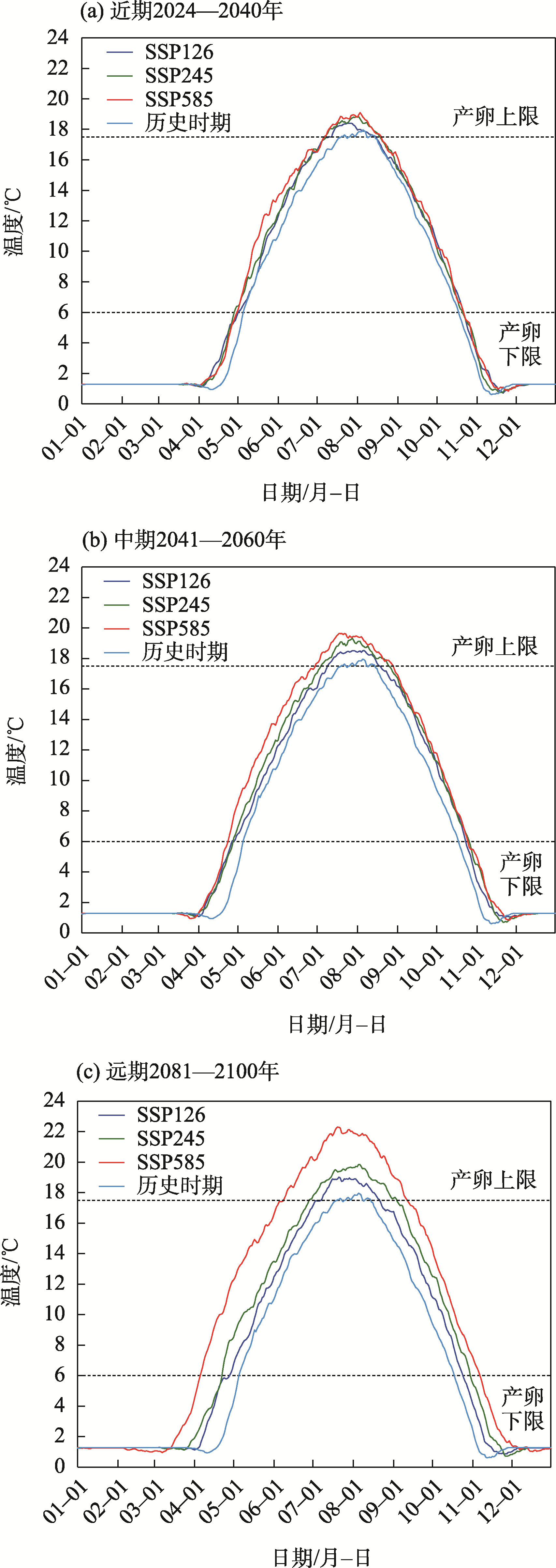
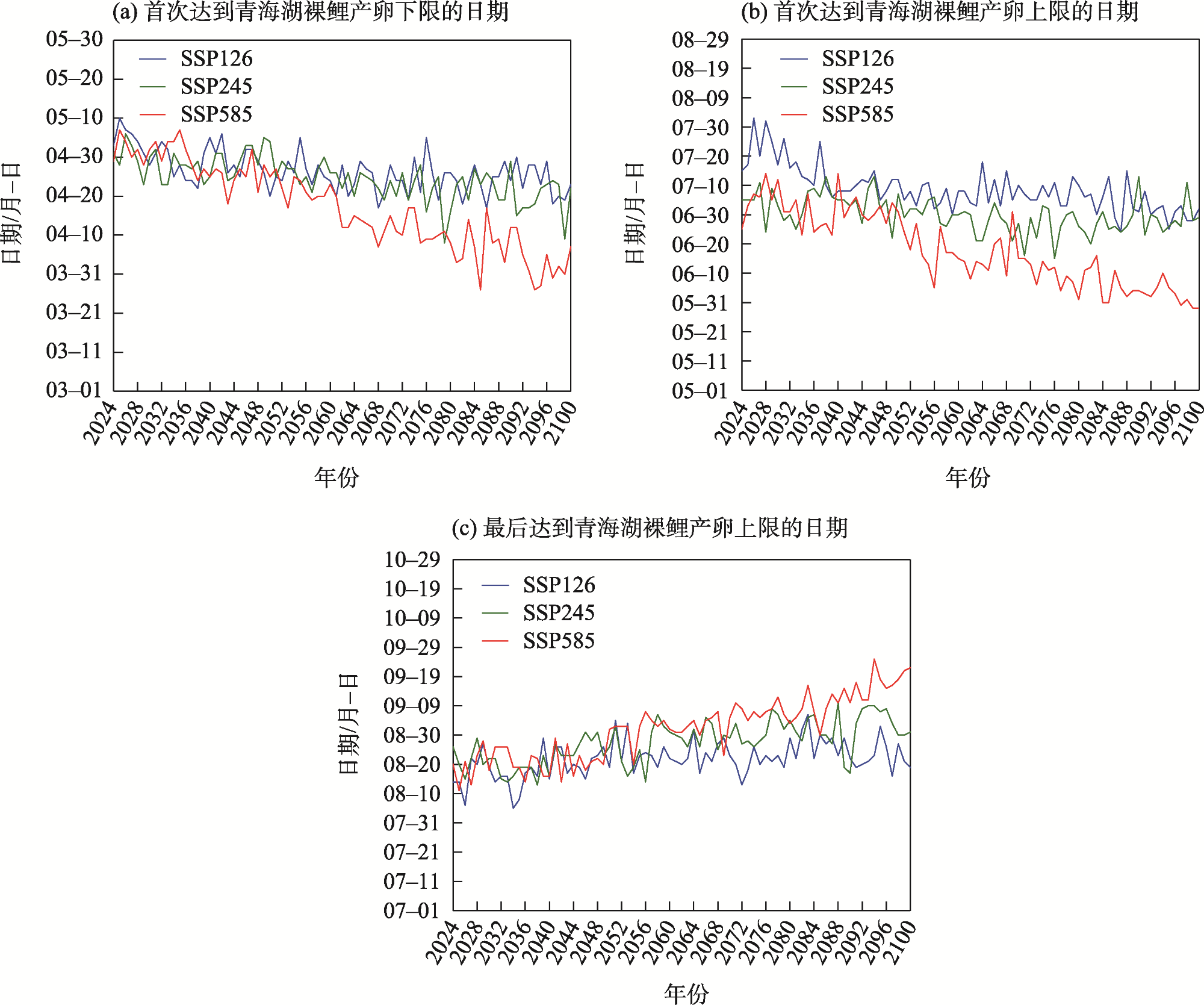
受全球气候变暖的影响,青藏高原湖泊、河流的温度显著升高,水温变化与水生生物的繁育息息相关,但目前对于青海湖裸鲤洄游产卵的重要场所——河流入湖口的水温研究较少,水温变化对于裸鲤产卵的影响也尚不明确。因此本研究基于刚察气象站观测数据、中国区域地面气象要素驱动数据集(CMFD)、欧洲中期天气预报中心第五代陆面再分析数据集(ERA5-Land)、第六次国际耦合模式比较计划(CMIP6)的多模式数据,尝试利用Fresh water Lake Model(简称FLake模式)模拟青海湖最大支流布哈河入湖口处水温并评估其适用性,探讨了再分析数据和CMIP6多模式数据驱动模拟历史(1981—2014年)水温的集合的优越性,预估了未来时期(2024—2100年)三种情景下的水温演变及成因,结果表明:(1) CMFD和ERA5-Land模拟水温的集合优于单个模式的模拟水温且在短期和长期模拟结果精度都较好,CMIP6多模式长期的模拟水温集合优于单个模式的模拟水温,可以较好的再现再分析数据模拟水温的集合。(2) 未来布哈河入湖口的水温随着排放强度的增加显著升高,与水温呈正相关的气象因子从大到小依次为气温、比湿、向下长波辐射和向下短波辐射,呈负相关的气象因子是风速;除远期高排放情景(SSP585)的向下短波辐射,其他情景的气象因子与水温的关系均通过了95%的显著性检验。(3) 近期(2024—2040年),三种情景的水温较历史时期均有少许升高,水温间的差异不大,青海湖裸鲤产卵的窗口期略微缩短,水温升高会对裸鲤的产卵造成轻微影响;中期(2041—2060年),三种情景的水温进一步升高,水温间的差异逐渐显现,裸鲤的产卵窗口期明显缩短,水温升高对裸鲤的产卵有一定的危害;远期(2081—2100年),三种情景的水温差异更显著,SSP126和SSP245情景的升高速率减慢;SSP585情景的水温升高速率依旧加快,水温持续升高导致裸鲤的产卵窗口期显著缩短,一定程度限制了青海湖裸鲤的产卵活动。
谢刚 , 王甜甜 , 于涛 , 董靖玮 , 陈世强 , 王梦晓 , 张圣杰 , 张浩铭 . 青海湖入湖口水温演变初步研究[J]. 干旱区研究, 2024 , 41(9) : 1503 -1513 . DOI: 10.13866/j.azr.2024.09.07
Under the influence of global warming, the temperature of lakes and rivers in the Qinghai-Xizang Plateau has increased significantly, and the change is closely related to the breeding of aquatic organisms. However, there are few studies on the water temperature at the estuary of rivers, which is an important place for the migration and spawning of Gymnocypris przewalskii in Qinghai Lake, and the influence of water temperature change on the spawning of G. przewalskii is still unclear. Therefore, this study is based on the observation data of Gangcha Meteorological Station, China Meteorological Forcing Dataset (CMFD), European Centre for Medium-Range Weather Forecasts Reanalysis v5-Land (ERA5-Land) and Coupled Model Intercomparison Projects 6 (CMIP6). The Fresh water Lake Model (FLake Model) is used to simulate the water temperature at the estuary of Buha River, the largest tributary of Qinghai Lake, and evaluate its applicability. It also discusses the superiority of reanalysis and CMIP6 multi-model data to drive the collection of simulated historical water temperatures (1981-2014). The evolution and causes of water temperature under three scenarios in the future period (2024-2100) are estimated. The results show that: (1) Average water temperature simulated by CMFD and ERA5-Land was better than that of the single model, and the accuracy of the simulation results was better in both short and long terms, of the average simulated water temperature of CMIP6 multi-model was better than that of a single model, which reproduced the simulated water temperature of reanalysis data set effectively. (2) In the future, the water temperature at the estuary of the Buha River may increase significantly with the increase of emission intensity. The meteorological factors that were positively correlated with the water temperature are air temperature, specific humidity, downward long wave radiation and downward short wave radiation from the largest to the smallest, while the wind speed was negatively correlated is; except for the downward short-wave radiation of the long-term high emission scenario (SSP585), the meteorological factors of the others all passed the 95% significance test. (3) In the recent period (2024-2040), the water temperature under the three scenarios may elevate slightly, increased compared with the historical period, and there is little difference between the water temperatures. The spawning window period of G. przewalskii is slightly shortened, and the rising water temperature will have a slight impact on the spawning of G. przewalskii. In the middle period (2041-2060), the water temperature of the three scenarios increased further, and the difference between the water temperatures gradually appeared. The spawning window period of G. przewalskii was obviously shortened, and the rising water temperature had certain harm to the spawning of G. przewalskii. In the long term (2081-2100), the water temperature difference between the three scenarios is more significant, and the rise rate of SSP126 and SSP245 scenarios slows down. In the SSP585 scenario, the rate of water temperature rise was still accelerated, and the continuous rise of water temperature resulted in a significant shortening of the spawning window period of G. przewalskii, which limited the spawning activities of G. przewalskii to a certain extent.
表1 第六次国际耦合模式比较计划(CMIP6)中三个模式基本信息Tab. 1 Basic information about three models in Coupled Model Intercomparison Projects 6(CMIP6) |
| 序号 | 模式名称 | 所属国家 | 研发机构 |
|---|---|---|---|
| 1 | CMCC-CM2-SR5 | 意大利 | 地中海气候变化研究中心 |
| 2 | MIROC6 | 日本 | 日本海洋地球科学与技术局、大气海洋研究所、国家环境变化研究所 |
| 3 | MPI-ESM1-2-LR | 德国 | 马克斯·普朗克气象研究所 |
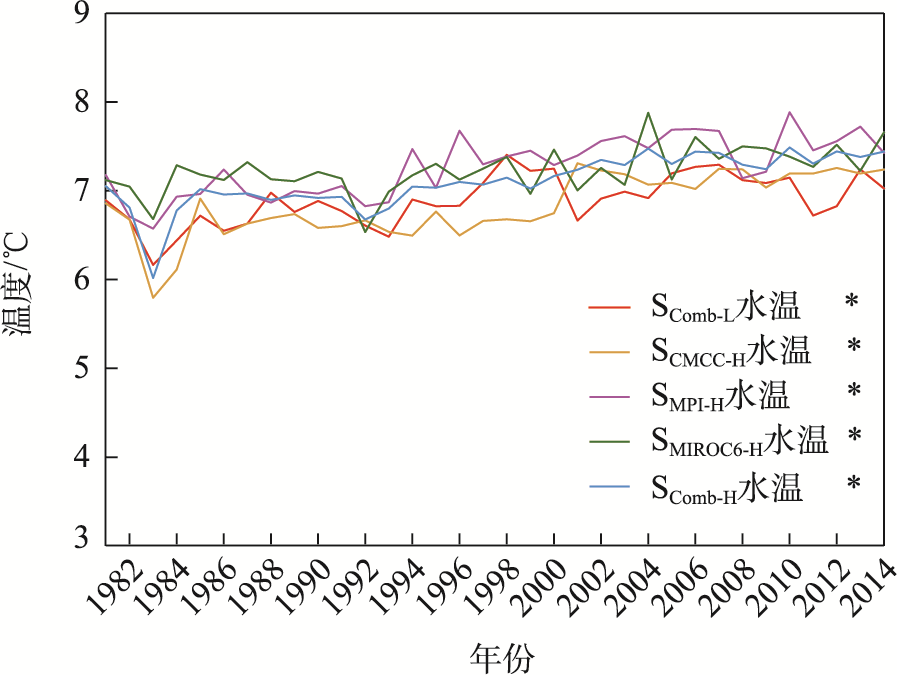
图3 1981—2014年CMFD和ERA5-Land模拟水温的集合与CMIP6三个模式的模拟水温及模拟水温的集合注:SComb-L、SCMCC-H、SMIROC6-H、SMPI-H、SComb-H分别为长时间序列CMFD和ERA5-Land模拟水温的集合、历史时期CMIP6三个模式的模拟水温及模拟水温的集合。 Fig. 3 The average simulated water temperature of CMFD and ERA5-Land, the single simulated water temperature of three models of CMIP6 and the average simulated water temperature of three models from 1981 to 2014 |
| [1] |
|
| [2] |
|
| [3] |
叶博文, 孙标, 史小红, 等. 1989—2021年蒙新高原湖泊时空特征及驱动力分析[J]. 湖泊科学, 2024, 36(4): 1252-1269.
[
|
| [4] |
IPCC. Climate change: Work group Icon tribution to the IPCC fifth assessment report (AR5)[R]. Switzerland: IPCC, 2013.
|
| [5] |
|
| [6] |
王欣, 连文皓, 魏俊锋, 等. 青藏高原水资源现状与问题[J]. 水科学进展, 2023, 34(5): 812-826.
[
|
| [7] |
|
| [8] |
|
| [9] |
|
| [10] |
|
| [11] |
董靖玮. 气候变化下青海湖水温演变及其对裸鲤影响的预估研究[D]. 兰州: 兰州理工大学, 2023.
[
|
| [12] |
袁博, 周孝德, 宋策, 等. 黄河上游高寒区河流水温变化特征及影响因素研究[J]. 干旱区资源与环境, 2013, 27(12): 59-65.
[
|
| [13] |
熊明, 邹珊, 姜彤, 等. 长江源区河流水温对气候变化的响应[J]. 人民长江, 2018, 49(14): 48-54.
[
|
| [14] |
|
| [15] |
|
| [16] |
|
| [17] |
黄屾, 李长忠, 李梓瑄, 等. 盐度对青海湖裸鲤生长及渗透调节基因的影响[J]. 水产科学, 2022, 41(4): 527-536.
[
|
| [18] |
董靖玮, 文莉娟, 于涛, 等. 青海湖湖温预估研究[J]. 干旱气象, 2024, 42(1): 64-74.
[
|
| [19] |
祝存兄, 史飞飞, 乔斌, 等. 基于高分1号卫星数据的青海湖扩张及湖滨沙地变化特征分析[J]. 干旱区研究, 2022, 39(4): 1076-1089.
[
|
| [20] |
李沁园, 张思九, 林育青, 等. 近十年青海湖水生态系统生产总值变化及其影响因素[J]. 湖泊科学, 2024, 36(3): 963-974.
[
|
| [21] |
莫皓焜, 胡光印, 孟惠聪. 青海湖地区风沙活动研究进展[J]. 中国沙漠, 2023, 43(6): 197-209.
[
|
| [22] |
谢廷锋, 和雅静, 赵永晶, 等. 青海湖入湖河流大型底栖动物时空分布及渔产潜力估算[J]. 水生态学杂志, 2023, 44(3): 70-78.
[
|
| [23] |
陈含墨. 基于底栖动物的布哈河生态水文模型[D]. 北京: 中国水利水电科学研究院, 2019.
[
|
| [24] |
宗荷花. 布哈河流域河水碳组分特征及其来源探究[D]. 烟台: 鲁东大学, 2023.
[
|
| [25] |
张宏, 谭细畅, 史建全, 等. 布哈河青海湖裸鲤鱼苗鱼卵的时空分布研究[J]. 生态科学, 2009, 28(5): 443-447.
[
|
| [26] |
|
| [27] |
温婷婷, 郭英香, 董少睿, 等. 1979—2017年CRU、ERA5、CMFD格点降水数据在青藏高原适用性评估[J]. 干旱区研究, 2022, 39(3): 684-697.
[
|
| [28] |
|
| [29] |
王坤鑫, 张寅生, 张腾, 等. 1979—2017年青藏高原色林错流域气候变化分析[J]. 干旱区研究, 2020, 37(3): 652-662.
[
|
| [30] |
|
| [31] |
卢冬燕, 朱秀芳, 刘婷婷, 等. 2 ℃温升情景下中国气象干旱特征变化[J]. 干旱区地理, 2023, 46(8): 1227-1237.
[
|
| [32] |
戴君, 胡海珠, 毛晓敏, 等. 基于CMIP6多模式预估数据的石羊河流域未来气候变化趋势分析[J]. 干旱区研究, 2023, 40(10): 1547-1562.
[
|
| [33] |
|
| [34] |
|
| [35] |
|
| [36] |
苏东生, 胡秀清, 文莉娟, 等. 青海湖热力状况对气候变化响应的数值研究[J]. 高原气象, 2018, 37(2): 394-405.
[
|
| [37] |
|
| [38] |
王仁军, 刘宝康, 黄炳婷. 1986—2019年哈拉湖面积动态变化及其成因分析[J]. 人民珠江, 2021, 42(1): 20-25, 33.
[
|
| [39] |
|
| [40] |
袁康, 谭德宝, 赵静, 等. 近十年可可西里盐湖水量变化及其影响因素分析[J]. 人民长江, 2022, 53(5): 111-117.
[
|
| [41] |
谈龙飞, 徐东坡, 祁洪芳, 等. 沙柳河青海湖裸鲤早期资源发生量及时空分布[J]. 水生生物学报, 2022, 46(2): 265-272.
[
|
| [42] |
周杨浩, 荣义峰, 周卫国, 等. 人工模拟条件下青海湖裸鲤自然繁殖环境条件需求研究[J]. 水生生物学报, 2022, 46(6): 779-787.
[
|
/
| 〈 |
|
〉 |