
水土资源

古尔班通古特沙漠不同坡位地衣结皮土壤磷组分分布特征

  • 杨孜悦 , 1, 2 ,
  • 尹本丰 2, 3 ,
  • 张署军 2, 3, 4 ,
  • 黄韵杰 2, 3, 4 ,
  • 杨傲 2, 5 ,
  • 张元明 2, 3 ,
  • 高英志 1 ,
  • 井长青 , 1
展开
  • 1.新疆农业大学草业学院,新疆草地资源与生态重点实验室,西部干旱荒漠区草地资源与生态教育部重点实验室,新疆 乌鲁木齐 830052
  • 2.中国科学院新疆生态与地理研究所,干旱区生态安全与可持续发展全国重点实验室,新疆 乌鲁木齐 830011
  • 3.中国科学院新疆生态与地理研究所,新疆干旱区生物多样性保育与应用重点实验室,新疆 乌鲁木齐 830011
  • 4.中国科学院大学,北京 100049
  • 5.新疆师范大学生命科学学院,新疆 乌鲁木齐 830054
井长青. E-mail:

杨孜悦(2000-),女,硕士研究生,主要从事干旱区生态适应与功能过程研究. E-mail:

收稿日期: 2024-12-09

  修回日期: 2025-04-02

  网络出版日期: 2025-08-13

基金资助

新疆维吾尔自治区天山英才领军(2022TSYCLJ0058)

新疆维吾尔自治区自然科学基金项目(2022D01D83)

新疆维吾尔自治区自然科学基金面上项目(2022D01A349)

新疆维吾尔自治区天池英才

Distribution of soil phosphorus fractions in lichen crusts at different slope positions in Gurbantunggut Desert

  • YANG Ziyue , 1, 2 ,
  • YIN Benfeng 2, 3 ,
  • ZHANG Shujun 2, 3, 4 ,
  • HUANG Yunjie 2, 3, 4 ,
  • YANG Ao 2, 5 ,
  • ZHANG Yuanming 2, 3 ,
  • GAO Yingzhi 1 ,
  • JING Changqing , 1
Expand
  • 1. Key Laboratory of Grassland Resources and Ecology, Key Laboratory of Grassland Resources and Ecology of Western Arid Region, Ministry of Education, College of Grassland Science, Xinjiang Agricultural University, Urumqi 830052, Xinjiang, China
  • 2. State Key Laboratory of Ecological Safety and Sustainable Development in Arid Lands, Xinjiang Institute of Ecology and Geography, Chinese Academy of Sciences, Urumqi 830011, Xinjiang, China
  • 3. Xinjiang Key Laboratory of Biodiversity Conservation and Application in Arid Lands, Xinjiang Institute of Ecology and Geography, Chinese Academy of Sciences, Urumqi 830011, Xinjiang, China
  • 4. University of Chinese Academy of Sciences, Beijing 100049, China
  • 5. College of Life Sciences, Xinjiang Normal University, Urumqi 830054, Xinjiang, China

Received date: 2024-12-09

  Revised date: 2025-04-02

  Online published: 2025-08-13

摘要

沙垄作为沙漠的基本地形单元,不同坡位的地表水热环境深刻影响了生物土壤结皮的发育和空间分布格局。地衣结皮广泛分布于沙漠表面,然而不同坡位地衣结皮将如何影响土壤磷循环,其关键影响因素是什么等科学问题仍不清楚。基于此,本文以古尔班通古特沙漠为研究区,系统分析了不同坡位地衣结皮层和下层0~5 cm土壤磷组分及相关酶活性变化特征。结果显示:土壤中的稳定性磷(HCl-Pi、HHCl-Po、HHCl-Pi和Residual-P)占到全磷(TP)含量的75%以上,其次为中度不稳定性磷(NaOH-Pi和NaOH-Po)和不稳定性磷(Resin-P、NaHCO3-Pi和NaHCO3-Po)。坡位对稳定性磷具有显著影响,土层对中度不稳定性磷具有显著影响(P<0.05)。稳定性磷、TP、有机磷(Po)和无机磷(Pi)的含量均表现出在结皮层中坡底显著高于东坡和西坡,在下层0~5 cm土壤中西坡显著低于坡底和东坡(P<0.05)。而NaOH-Pi的含量均呈现出在结皮层中东坡和西坡显著高于坡底,在下层0~5 cm土壤中西坡显著高于东坡与坡底。在土壤酶方面,东坡具有结皮层最低和下层0~5 cm土壤最高的碱性磷酸酶活性(ALP)和β-葡萄糖苷酶活性(GC)。随机森林模型分析表明,坡位带来的水分和温度变化分别是影响地衣结皮土壤不稳定性磷和稳定性磷含量的最关键因子。这为丰富荒漠生态系统土壤磷循环相关理论提供了科学支撑。

本文引用格式

杨孜悦 , 尹本丰 , 张署军 , 黄韵杰 , 杨傲 , 张元明 , 高英志 , 井长青 . 古尔班通古特沙漠不同坡位地衣结皮土壤磷组分分布特征[J]. 干旱区研究, 2025 , 42(7) : 1236 -1245 . DOI: 10.13866/j.azr.2025.07.07

Abstract

As the fundamental terrain of deserts, sand ridges play a crucial role in shaping the surface water and thermal environment at different slope positions, which profoundly influences how biological soil crusts develop and their spatial distribution patterns. Lichen crusts are widely distributed on the desert surface. However, issues such as how lichen crusts at different slope positions affect the soil phosphorous cycle and what factors play key roles in influencing this remain unclear. Against this background, this study was conducted in Gurbantunggut Desert, involving a systematic analysis of the changes in phosphorus fractions and related enzyme activities in the lichen crust and 0-5 cm soil layer beneath the crust at different slope positions. The results showed that stable phosphorus in the soil (HCl-Pi, HHCl-Po, HHCl-Pi, and Residual-P) accounted for over 75% of the total phosphorus (TP) content, followed by medium labile phosphorus (NaOH-Pi and NaOH-Po) and labile phosphorus (Resin-P, NaHCO3-Pi, and NaHCO3-Po). The slope position had a significant impact on stable phosphorus, and the soil layer had a significant impact on medium labile phosphorus (P<0.05). The data on the contents of stable phosphorus, TP, organic phosphorus (Po), and inorganic phosphorus (Pi) all revealed that, in the crust layer, the values at the bottom of the slope were significantly higher than those on the east and west slopes, while in the 0-5 cm soil layer, the values on the west slope were significantly lower than those at the bottom of the slope and on the east slope (P<0.05). However, the content of NaOH-Pi was significantly higher on the east and west slopes than at the bottom of the slope in the crust layer, and it was significantly higher on the west slope than on the east slope and at the bottom of the slope in the 0-5 cm soil layer. In terms of soil enzymes, the east slope exhibited the lowest activity of alkaline phosphatase activity (ALP) and β-glucosidase activity (GC) in the crust layer, but the highest in the 0-5 cm soil layer. Random forest model analysis showed that the changes in moisture and temperature brought about by the slope position were the most important factors affecting the levels of labile phosphorus and stable phosphorus in the crust soil, respectively. This provides scientific support that enriches the theoretical framework of soil phosphorous cycling in desert ecosystems.

磷作为植物细胞膜、核酸、能量等关键组成物质,是影响陆地生态系统生产力的关键限制性营养元素之一[1]。土壤中的磷主要来源于土壤母质的风化及小部分的大气沉降,但大部分磷以闭蓄态形式存在,难以被植物吸收利用[2]。按照磷在土壤中的形态,可将其分为有机磷(Po)与无机磷(Pi),根据磷的生物有效性进一步分为不稳定性磷、中度不稳定性磷和稳定性磷[3]。不同形态的磷在被植物/微生物的可利用性上存在显著差异[4]。通常,不稳定性磷被认为能够在短期内直接被植物吸收利用[5];中度不稳定性磷易被铁、铝氧化物等矿物质吸附固定,需要借助土壤胞外酶、有机酸等生物作用或pH、金属离子等非生物作用将其转化为不稳定性磷,才能被植物吸收利用[6];而稳定性磷很难被植物直接吸收利用,需要数百年甚至千年才能被转化利用[7]。在荒漠生态系统中,根据传统的土壤养分化学计量比分析认为该区域属于氮限制,土壤磷十分丰富[8],这在一定程度上限制了荒漠生态系统土壤磷循环相关研究的发展。其实,化学计量学用的是全氮和全磷的比值,尽管土壤全磷含量高,但能被植物所能直接利用的生物有效磷含量却较低,依然严重限制了荒漠生态系统的初级生产力[9]。因此,深入探究荒漠生态系统中土壤各形态磷的组成及影响因素,对荒漠生态系统稳定性维持机制和可持续发展具有重要意义。
土壤磷组分的转化受到非生物与生物因素的共同影响[10]。在非生物因素中,地球化学过程以及气候(如温度、降水等)等均能够深刻影响土壤磷转化[11]。地球化学过程能够通过风化作用、吸附/解吸附作用、沉淀/溶解作用等控制不同磷形态间的转化。温度的升高能够促进土壤不稳定性磷和中度不稳定性磷转化为稳定性磷,而降水带来的水分增加促进了土壤金属离子扩散和pH等的变化,影响磷的吸附/解析、沉淀/溶解等物理化学过程最终影响土壤磷的生物有效性[12-13]。温度和降水除自身对土壤磷组分的直接影响外,还能够通过影响地表植物和土壤微生物间接影响土壤磷循环。在生物因素方面,植物和微生物会通过产生凋落物/微生物残体、分泌胞外酶、有机酸等调节土壤磷素[14]。当受到磷限制时,植物和微生物会释放磷酸酶以矿化Po转化为可被生物利用的Pi,或释放有机酸将难利用性磷转化为易利用性磷,提高磷的生物有效性[15-16]。然而,现有相关研究多集中在传统认为的磷限制生态系统,如森林、草地、农田等,降水量少、生物活动弱等荒漠生态系统是否与其他生态系统具有一致的磷循环规律还需深入研究。
在荒漠生态系统中,由于降水稀少,土壤磷难以淋溶到地下,其活性主要受到地表生物的影响[2]。生物土壤结皮作为干旱区地表生命活动的重要载体,是由蓝藻、地衣、苔藓等隐花植物与土壤表层颗粒相互胶结而成的有机复合体,在部分干旱区盖度可达70%以上[17],其发育能够改善水文过程、微生物活动,促进碳、氮、磷等养分循环过程[18-19]。随结皮演替,地衣结皮在沙漠中广泛分布,占全球陆地总面积的8%以上[20]。地衣结皮凭借自身假根与菌丝优势穿透沙漠表面,固定沙漠表层颗粒,定植后凹凸不平的粗糙表面可以促进岩石风化,进而截留风化累积的磷素[21]。沙垄作为沙漠的基本地形单元,不同坡位的地表水热环境改变土壤理化性质,从而影响生物土壤结皮的发育和空间分布格局[22]。研究表明,相比于东坡,西坡的生物土壤结皮能更好地利用清晨形成的凝结水进行生长[23]。坡位如何通过改变地表水热环境影响地衣结皮中磷素的周转仍不明确。
因此,笔者提出以下两个科学假设:(1) 不同坡位带来的环境差异会影响地衣结皮土壤磷组分,相比于东坡,西坡磷有效性更高;(2) 生物因素是影响结皮层土壤磷循环的关键因素,非生物因素是影响结皮下层土壤磷循环的关键因素。为了验证以上科学假设,笔者以我国最大的固定半固定沙漠古尔班通古特沙漠为研究区,以地衣结皮为研究对象,通过采集不同坡位的地衣结皮层与下层0~5 cm土壤,探究不同坡位对地衣结皮土壤磷组分的变化特征,为荒漠生态系统土壤磷循环提供理论支撑。

1 数据与方法

1.1 研究区概况

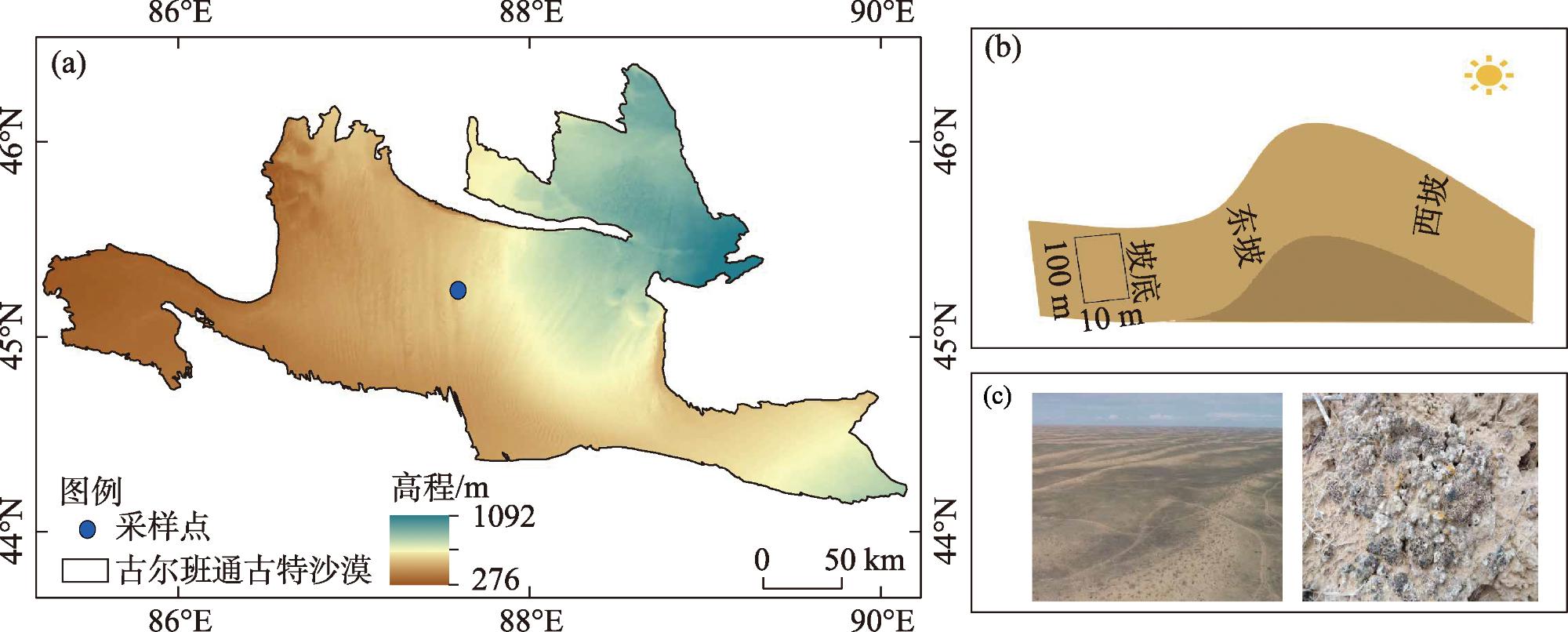
研究区选在准噶尔盆地腹地的古尔班通古特沙漠(44°15′~46°50′N,84°50′~91°20′E),面积4.88×10⁴ km2,是中国第二大沙漠和最大的固定半固定沙漠。受西风环流影响,该沙漠的沙丘类型主要有线性沙垄、蜂窝状沙丘和新月形沙丘等,其中以南北走向的线性沙垄为主。该沙漠夏季炎热高温,冬季寒冷多雪,存在100~150 d稳定的积雪期,年均温6~10 ℃,年均降水量70~150 mm,年均蒸发量大于2000 mm,属于典型的温带大陆性气候[24]。早春积雪的融化为植物的萌发和生长提供了充足的水热条件,其中植被以梭梭(Haloxylon ammodendron)、蛇麻黄(Haloxylon persicum)、沙拐枣(Calligonum mongolicum)以及油蒿(Artemisia ordosica)等优势灌木为主,草本植物主要有尖喙牻牛儿苗(Erodium oxyrhinchum)、角果藜(Ceratocarpus arenarius)、琉苞菊(Centaurea pulchella)等。此外,沙漠也发育着良好的生物土壤结皮,主要有藻结皮、地衣结皮和藓类结皮,其中地衣结皮在该沙漠占主导地位,并在不同沙丘坡位上差异性分布[25]图1)。
图1 古尔班通古特沙漠采样点分布(a)、沙丘景观(b)以及样品采集示意图(c)

Fig. 1 Distribution of sampling sites (a), landscape of sand dunes (b), and schematic diagram of sample collection (c) in the Gurbantunggut Desert

1.2 样地设置及采样

于2022年7月在古尔班通古特沙漠腹地荒漠生态系统长期监测样地,选择典型南北走向沙垄,在西坡、坡底、东坡分别设置10 m(垂直于沙垄方向)×100 m(平行于沙垄方向)样带,在每条样带内设置5个2 m×2 m的小样方,每个小样方之间大于20 m,在每个小样方内选择发育较好的地衣结皮进行采集结皮层与下层0~5 cm土壤,共采集了30份样品。将所采集样品装进自封袋后在4 ℃下保存带回实验室进行处理。首先,将土壤样品充分混合,过2 mm筛去除大的凋落物后,选取一小部分用于土壤含水量(SWC)的测定。随后将剩余样品分成两部分,一部分自然风干,用于测定土壤碳氮磷含量、pH、电导率(EC)及土壤磷组分等土壤理化性质;另一部分-20 ℃冰箱保存,用于测定土壤铵态氮(NH4+-N)、硝态氮(NO3--N)与土壤酶活性。同时,借助长期监测样地EM50数据采集器同步收集了7月不同坡位的土壤温度数据。

1.3 叶绿素含量测定

采用乙醇法测定叶绿素含量来表征地衣结皮生物量[26]。通过称取1.00 g的地衣结皮鲜样,加入10 mL 95%的乙醇充分研磨。将研磨好的混合液避光反应24 h,于4 ℃离心30 min。随后,分别在649 nm、665 nm下测定吸光度值。根据公示计算叶绿素a(Chl a)、叶绿素b(Chl b)、总叶绿素含量(Chl)。
C h l     a   ( m g L - 1 ) = 13.95 × A 665 - 6.88 × A 649
C h l     b   ( m g L - 1 ) = 24.96 × A 649 - 7.32 × A 665
C h l   ( m g L - 1 ) = C h l     a + C h l     b
X   =   C × V × N / M
式中:X为色素含量(mg·g-1);C为色素浓度(mg·L-1);V为提取液体积(L);N为稀释倍数;M为样品质量(g)。

1.4 土壤理化性质测定

SWC采用质量烘干法测定。pH和EC分别采用土水比为1:2.5、1:5的电位法测定。土壤全碳(TC)、有机碳(SOC)在碳氮分析仪中(Multi N/C3100, Germany)通过燃烧法测定,其中SOC在测定前需先加入1 mol·L-1 HCl去除无机碳。土壤全氮(TN)采用凯氏定氮法测定;土壤全磷(TP)采用钼锑抗比色法测定。NH4+-N、NO3--N和速效磷(AP)含量通过氯化钙和碳酸氢钠溶液浸提,采用比色法测定(AA3连续流动分析仪,Seal,Jena,Germany)。

1.5 土壤酶活性测定

主要测定了与土壤磷循环相关的土壤碱性磷酸酶(ALP)活性与β-葡萄糖苷酶(GC)活性。两种酶活性均采用检测试剂盒(Suzhou Grace Biotechnology Co. Ltd., Jiangsu, China)通过比色法测定。ALP活性测定中,通过特定的试剂与反应条件,处理土壤中的磷酸对硝基苯酯,生成黄色对硝基苯酚与其他物质发生显色反应,在最大吸收峰值405 nm波长处进行比色测定。GC活性测定中,通过试剂催化对-硝基苯-β-D吡喃葡萄糖苷进行水解反应,生成对-硝基苯酚,在400 nm波长处进行比色确定吸光度。将酶活性以每小时每克干土释放的纳摩尔底物(nmol·g-1·h-1)表示。

1.6 土壤磷组分测定

采用改进后的Hedley连续浸提法进行土壤磷组分的测定[3,27]。首先,将采集的土壤样品风干并充分混合,使其均一化。随后过60目筛,称取0.5 g土壤,按照提取顺序依次使用强碱性阴离子树脂膜提取得到树脂磷(Resin-P);使用0.5 mol·L-1 NaHCO3提取得到碳酸氢钠无机磷(NaHCO3-Pi)、碳酸氢钠有机磷(NaHCO3-Po);使用0.1 mol·L-1 NaOH提取得到氢氧化钠无机磷(NaOH-Pi)、氢氧化钠有机磷(NaOH-Po);以及使用1 mol·L-1稀盐酸提取得到稀盐酸无机磷(HCl-Pi)。在完成以上提取后,接着采用6 mol·L-1 浓盐酸提取测定浓盐酸无机磷(HHCl-Pi)、浓盐酸有机磷(HHCl-Po)。最后,使用浓硫酸和高氯酸混合对土壤残渣进行消解,从而获得残余磷(Residual-P)。在每一个分级提取步骤完成后,针对所得上清液均采用钼蓝比色法进行测定。其中,TP与Pi含量的差值为Po含量[27]。根据先前研究,按照磷组分活性差异将其分为三大类别[28],分别为不稳定性磷(Labile P),包括Resin-P、NaHCO3-Po和NaHCO3-Pi;中度不稳定性磷(Med-labile P),包括NaOH-Po和NaOH-Pi;稳定性磷(Stable P),包括HCl-Pi和HHCl-Pi、HHCl-Po以及Residual-P。

1.7 数据分析

本研究使用R 4.1.2软件(https://www.r-project.org)进行数据处理、统计检验和结果展示。首先,验证了数据的正态性和方差齐性,确保满足统计分析的基本假设。然后,采用双因素方差分析(ANOVA)对不同坡位和土层条件下的土壤磷组分及土壤酶活性进行检验,判断其是否存在显著差异,并通过最小显著性差异(LSD)法进行多重比较。接着,采用皮尔逊相关性分析(Pearson correlation analysis)方法探讨环境因素、养分与土壤磷组分之间的关系。最后,采用随机森林方法(Random Forest)确定影响不同磷组分的关键因素,分析通过randomForest程序包完成。

2 结果与分析

2.1 不同坡位地衣结皮土壤磷组分特征

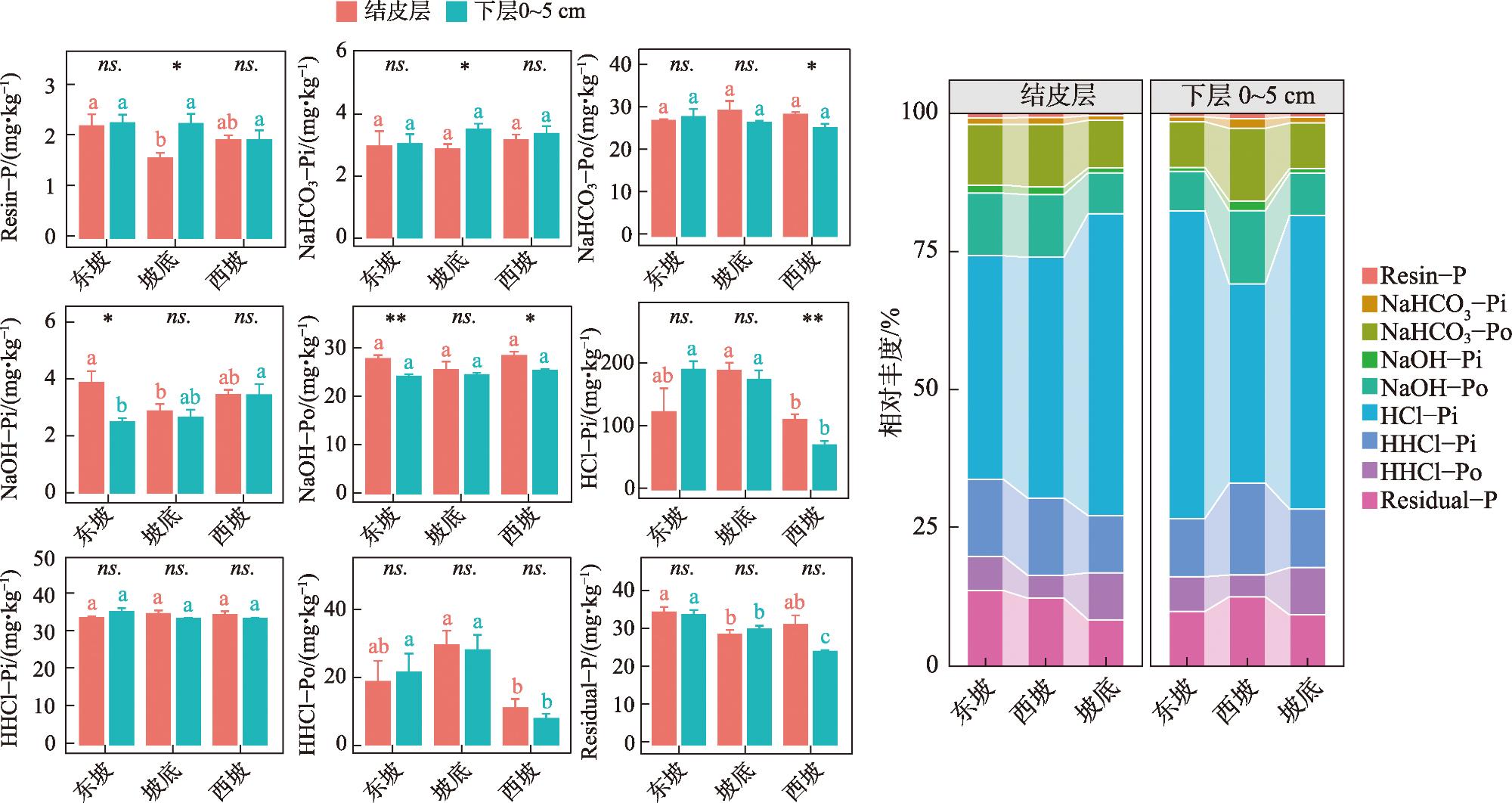
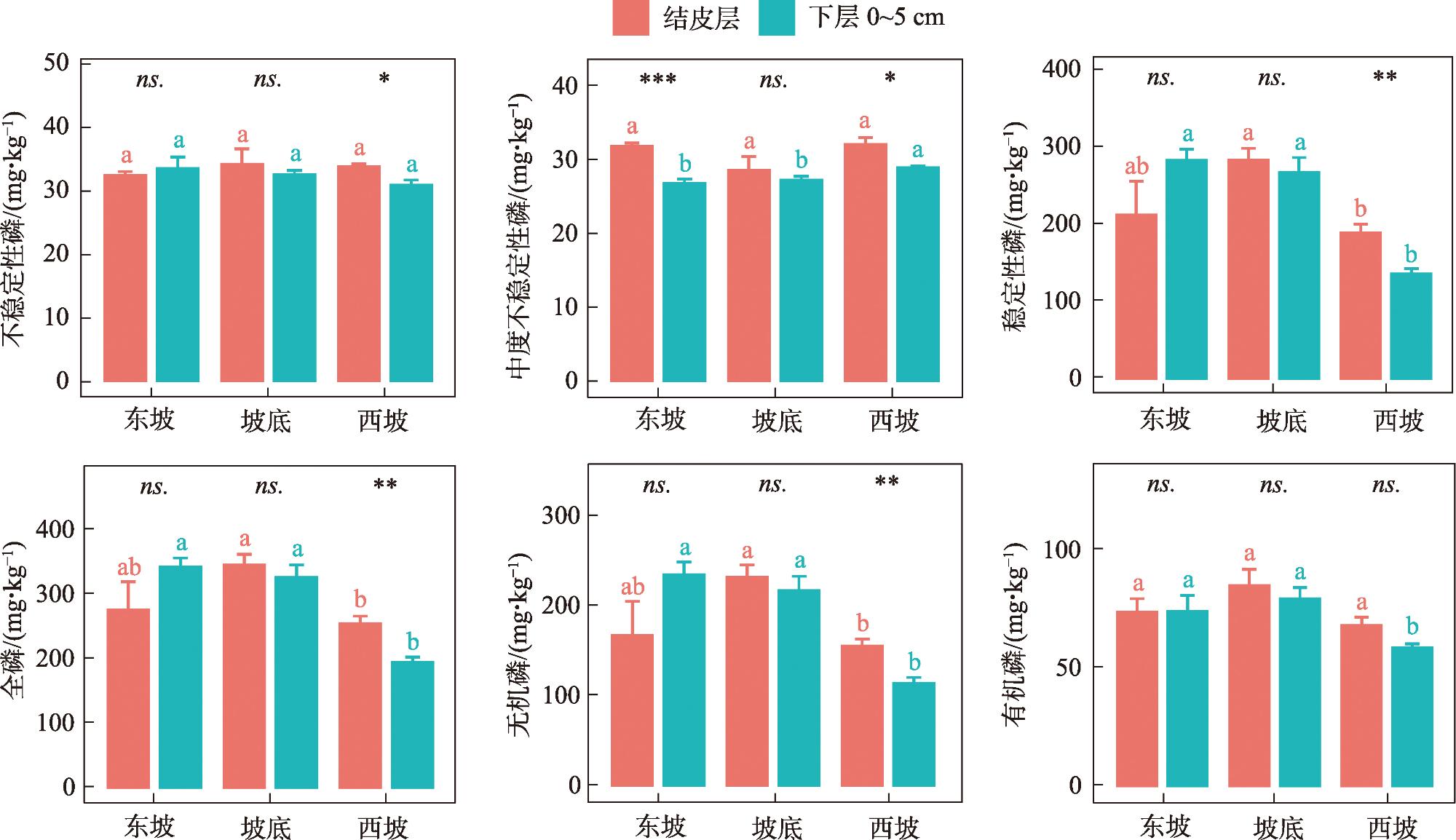
图2可知,土壤中的稳定性磷(HCl-Pi、HHCl-Po、HHCl-Pi和Residual-P)占到TP含量的75%以上,其次为中度不稳定性磷(NaOH-Pi和NaOH-Po)和不稳定性磷(Resin-P、NaHCO3-Pi和NaHCO3-Po)。双因素方差分析结果表明,坡位、土层和二者的交互作用显著影响了土壤磷组分含量(表1)。坡位对HCl-Pi、HHCl-Po、Residual-P等稳定性磷具有显著影响,土层对NaOH-Pi和NaOH-Po等中度不稳定性磷具有显著影响,二者的交互作用显著影响HCl-Pi和Residual-P等稳定性磷的含量(P<0.05)。在结皮层中,Resin-P、NaOH-Pi、Residual-P的含量均呈现出东坡和西坡显著高于坡底;而稳定性磷、TP和Pi的含量呈现出坡底显著高于东坡和西坡(图2图3)。对于下层0~5 cm土壤,NaOH-Pi与中度不稳定性磷的含量均为西坡显著高于东坡与坡底,HCl-Pi、HHCl-Po、稳定性磷、TP、Pi、Po的含量均为东坡、坡底显著高于西坡,Residual-P的含量则表现出东坡>坡底>西坡(图2图3)。
图2 不同坡位对地衣结皮层、下层0~5 cm土壤磷组分含量的影响

注:小写字母表示同一土层不同坡位土壤磷组分变化的差异(P<0.05);不同符号表示同一坡位不同土层间的差异。*表示P<0.05;**表示P<0.01;***表示P<0.001;ns.表示不显著。下同。

Fig. 2 Effects of different slope positions on the contents of soil phosphorus fractions in the lichen crust layer and the lower 0-5 cm soil layer

表1 不同坡位与土层对土壤磷组分影响的双因素方差分析(F值)

Tab. 1 Two-way analysis of variance for the effects of different slope positions and soil layers on soil phosphorus fractions (F value)

磷组分与胞外酶 土层 坡位 土层×坡位
树脂磷(Resin-P) 3.151 2.309 2.413
碳酸氢钠无机磷(NaHCO3-Pi) 1.619 0.479 0.515
碳酸氢钠有机磷(NaHCO3-Po) 2.536 0.362 1.544
氢氧化钠无机磷(NaOH-Pi) 5.493* 2.927 3.321
氢氧化钠有机磷(NaOH-Po) 12.773** 2.254 1.113
稀盐酸无机磷(HCl-Pi) 0.071 12.371** 4.463*
浓盐酸无机磷(HHCl-Pi) 0.993 0.967 2.082
浓盐酸有机磷(HHCl-Po) 0.029 9.852** 0.242
残余磷(Residual-P) 3.226 10.856** 4.614*
β-葡萄糖苷酶GC 264.818** 0.729 4.820*
碱性磷酸酶ALP 10.133** 0.134 0.675

注:*表示P<0.05;**表示P<0.01。

图3 不同坡位对地衣结皮层、下层0~5 cm土壤生物有效性不同的土壤磷组分含量的影响

Fig. 3 Effects of different slope positions on the contents of soil phosphorus fractions with different soil bioavailability in the lichen crust layer and the lower 0-5 cm soil layer

2.2 不同坡位对土壤酶的影响

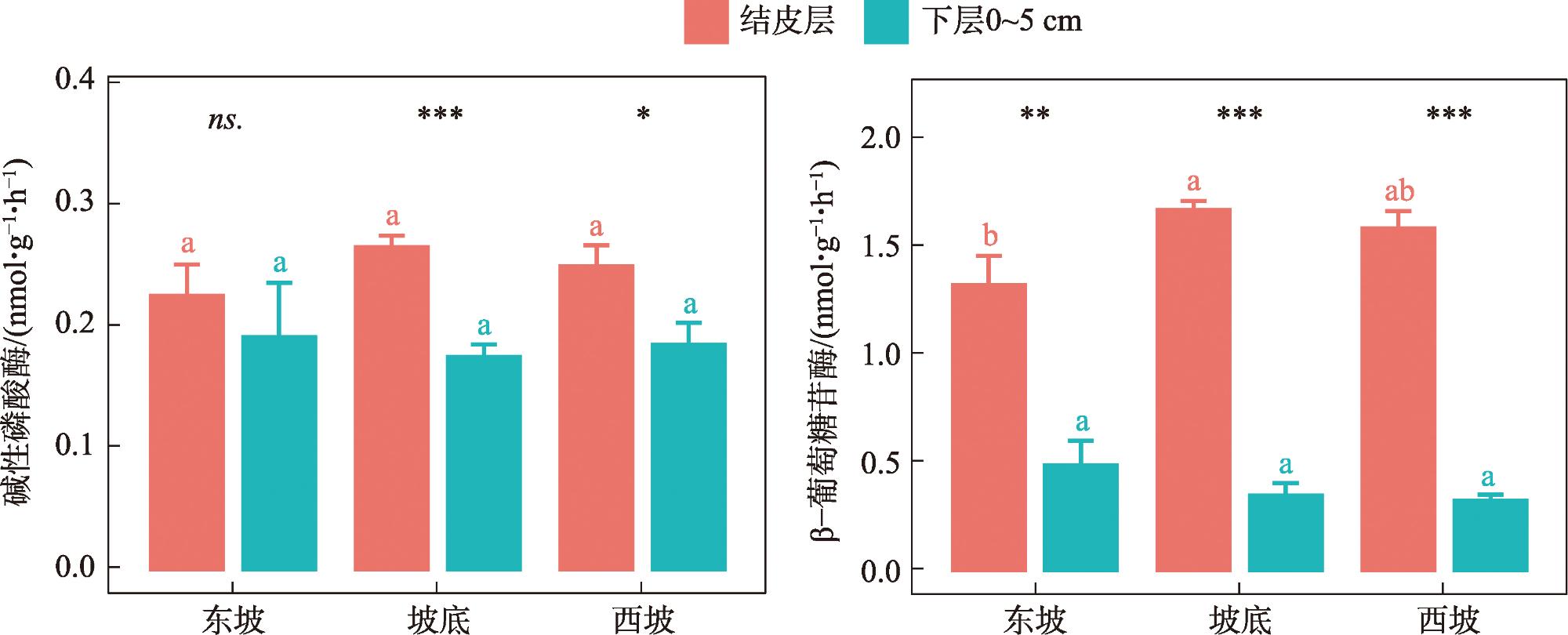
相比于坡位,土层显著影响了GC和ALP活性,坡位和土层的交互作用显著影响了GC活性(表1)。相比于结皮下层,结皮层的GC和ALP活性在不同坡位上均显著高于下层0~5 cm土壤(P<0.05)。在结皮层中,东坡的GC和ALP活性低于西坡和坡底,但不同坡位的ALP活性差异不显著(图4)。在0~5 cm土壤中,表现出与结皮层相反的趋势,但差异均不显著(P>0.05)。
图4 不同坡位对地衣结皮层、下层0~5 cm土壤酶活性的影响

Fig. 4 Effects of different slope positions on the soil enzyme activities in the lichen crust layer and the lower 0-5 cm soil layer

2.3 影响土壤磷组分的关键因子

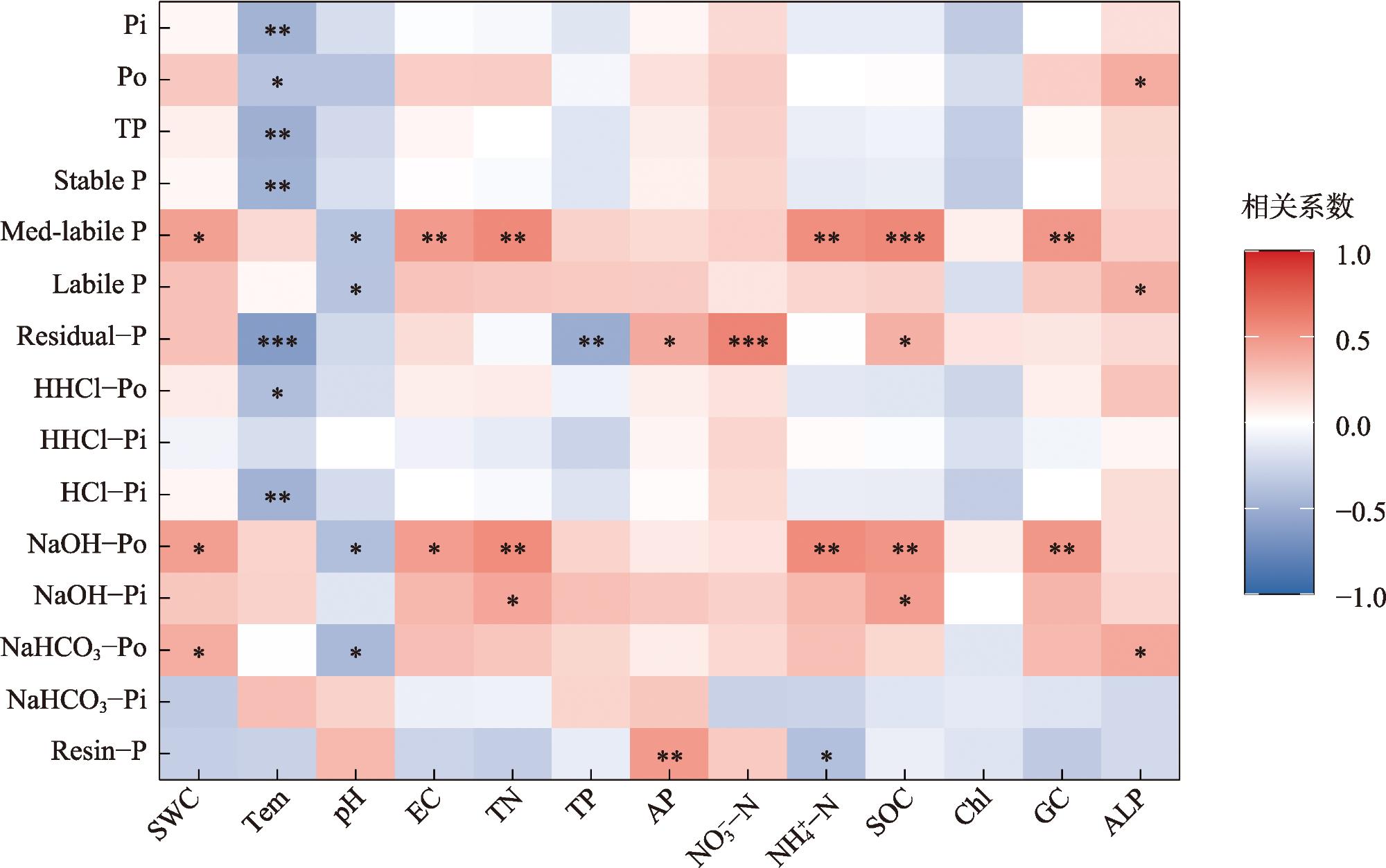
相关性分析表明,土壤NaHCO3-Po和不稳定性磷与SWC、ALP活性呈显著正相关,与土壤pH呈显著负相关;Resin-P与AP呈正相关,与NH4+-N含量呈负相关(图5)。土壤NaOH-Po和中度不稳定性磷含量与SWC、EC、GC活性、NH4+-N、SOC和TN含量呈显著正相关,与pH呈显著负相关。土壤Residual-P与TP含量和温度呈显著负相关,与SOC、NO3--N、AP呈显著正相关(图5)。
图5 土壤磷生物有效性组分与环境因子的相关性分析

注:SWC表示土壤含水量;Tem表示土壤温度;EC表示电导率;TN表示全氮;NH4+-N表示铵态氮;NO3--N表示硝态氮;TP表示全磷;AP表示有效磷;SOC表示有机碳;Chl表示生物量;GC表示β-葡萄糖苷酶;ALP表示碱性磷酸酶。下同。

Fig. 5 Correlation analysis of soil phosphorus bioavailability fractions with environmental factors

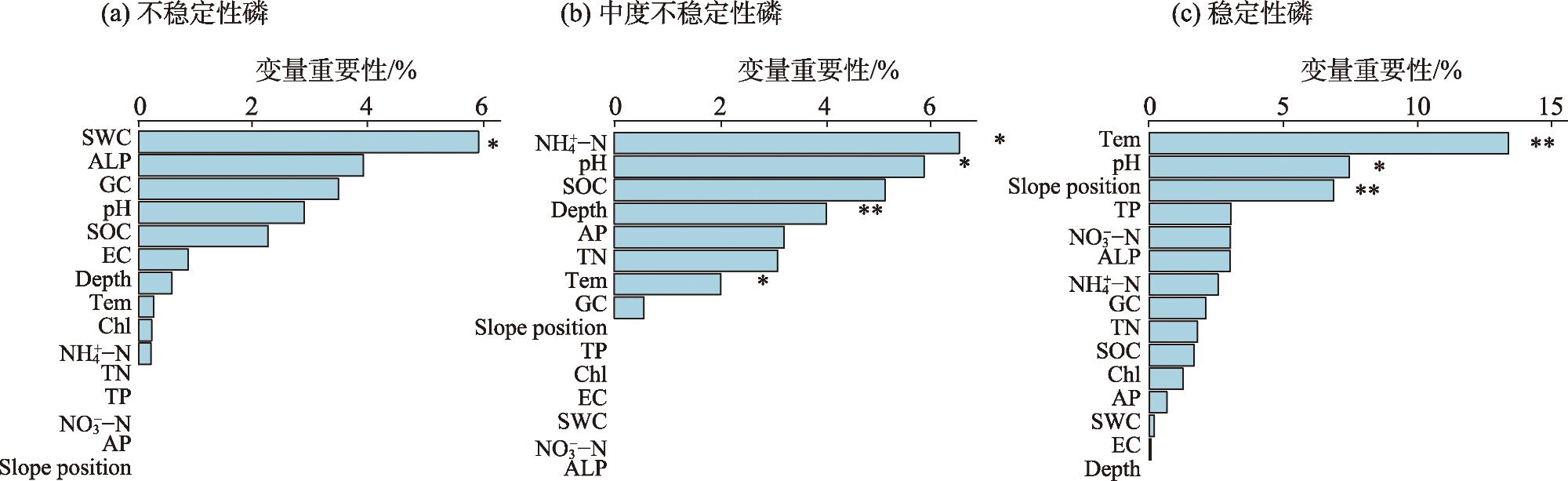
通过随机森林模型筛选,确定了影响地衣结皮土壤磷组分转化的主要预测因子(图6)。其中,SWC是影响不稳定性磷转化的关键变量,其次为GC活性和ALP活性;NH4+-N、pH、SOC、土层(Depth)、土壤温度(Tem)是影响中度不稳定性磷转化的关键变量;Tem、坡位(Slope position)和pH是稳定性磷转化的关键变量(图6)。
图6 基于随机森林模型预测影响土壤磷组分转化的关键因子

Fig. 6 Prediction of key factors affecting soil phosphorus fraction transformation based on random forest model

3 讨论

3.1 坡位对地衣结皮磷组分的影响

与笔者的科学假设一致,不同坡位带来的水热变化和土壤理化性质变化影响了地衣结皮的土壤磷组分。相比于东坡,西坡地衣结皮层不稳定性磷含量更高。这主要归结于西坡的水热条件更利于地衣结皮的发育,促进了结皮层磷周转[23]。尽管在古尔班通古特沙漠,东坡作为阴坡其土壤日平均含水量较多、温度较低[29-30]。然而,东坡作为迎风坡,其坡度通常比西坡陡峭,且西坡较高的土壤黏粒含量提高了表层土壤的持水能力,增强了凝结水的积累[31-32]。此外,西坡清晨太阳直射的时间较晚,利于生物土壤结皮能更好地利用清晨形成的凝结水进行生长,前期的研究结果也证实了这一点,西坡单位面积地衣结皮的生物量明显高于东坡[23]。生物结皮的发育除自身能够分泌胞外酶和有机酸促进土壤磷周转外,结皮的发育也能够促进土壤微生物的多样性、丰度等,利于磷循环[33]
除坡位带来的水分因素外,不同坡位的温度也存在较大差异。相比于东坡,西坡每天会接受更多的太阳辐射。地衣结皮作为嗜日光植物,受不同坡位的影响[34]。当温度升高时微生物活性增强,代谢速率加快,为土壤提供了充足的碳源,进而促进土壤中的铁铝氧化物氧化还原反应[35]。当Fe3+还原为Fe2+,促进稳定性磷向生物可用磷的转化。同样,在本研究的结果中,温度与稳定性磷显著负相关的关系也进一步表明,升温会促进有效磷含量的积累。
土壤理化性质是影响土壤磷循环的重要因素。研究表明,较高的NH4+和NO3-会导致土壤酸化,降低pH值,从而促进磷与铝、铁等金属离子结合,形成不溶性化合物[36-37],减少了土壤中速效磷的含量。本文的研究结果也证实了这一点,即坡底的地衣结皮具有较高的NH4+,且NH4+的积累与土壤中Resin-P含量呈显著负相关,而与NaOH-Po显著正相关。同时,土壤pH的降低可能抑制一些溶解磷的微生物活性,降低可溶性磷的释放[38]。此外,较高的NH4+浓度还可能通过促进植物和微生物的生长,增加对土壤有效磷的吸收[39],进一步降低土壤中磷的速效磷。因此,NH4+-N的积累不仅通过改变土壤理化性质减少了速效磷的可用性,还通过影响微生物和植物的生长,进一步加剧了磷的利用限制。

3.2 影响地衣结皮磷组分的关键因素

在干旱半干旱区,水分是限制植物生长的最主要限制因子[40]。在地势较低的区域,土壤含水量较高,有利于植物的生长发育和微生物群落的活性,提升了植物/微生物对土壤磷的吸收和利用,这与本研究结果相似[41]。本研究还发现,土壤中不稳定性磷和NaHCO3-Pi与SWC呈负相关,而与NaHCO3-Po和NaOH-Po显著正相关。这表明,坡底较高的土壤含水量促进了地衣结皮的生长,吸收了更多的土壤易利用性的Pi,将土壤中的Pi转化为了Po。此外,高含水量的土壤溶液流动性较强,增加了磷酸根离子与金属离子之间的接触机会,促进了稳定性磷和中度不稳定性磷的形成[42]
土壤pH值既能通过影响生物活性也能通过影响物理化学过程进而影响土壤磷素的可利用性[38]。首先,在碱性土壤中,生物结皮的发育将降低土壤pH,土壤pH的降低(近中性)将增加植物和土壤微生物的生物活性,促进土壤磷周转[43]。这在本研究中也得到证实,土壤的NaHCO3-Po和NaOH-Po以及不稳定性磷和中度不稳定性磷与pH呈现显著负相关。即pH的降低促进了不稳定性磷和中度不稳定性磷的积累,尤其是Po。此外,pH的降低也会影响土壤磷的吸附能力[44]。在土壤中存在大量可交换的钙,这些二价阳离子在碱性土壤中常会与土壤溶液中的游离态无机磷发生结合,形成稳定态磷[45]。pH的降低将促进钙结合态的磷酸盐转换为不稳定性和中度不稳定性磷,但也增加了铁铝对磷酸根的吸附作用,从而对土壤磷的生物有效性产生复杂的影响。值得注意的是,pH的降低也会减弱ALP的活性(最适pH在8.5附近),抑制Po的矿化进程[46]。这也是不稳定性磷和中度不稳定性磷中仅Po显著增加,而Pi没有增加的重要原因。

4 结论

古尔班通古特沙漠地衣结皮下土壤磷组分主要为HCl-Pi、HHCl-Pi、HHCl-Po和Residual-P等稳定性磷,占到TP含量的75%以上。坡位能够通过影响地表水热环境影响土壤磷组分含量,结皮层中的TP、Po和Pi含量均表现出坡底显著高于东坡和西坡,0~5 cm土壤中西坡显著低于坡底和东坡。随机森林结果表明,不稳定性磷含量主要受到土壤含水量的显著影响;中度不稳定性磷主要受到铵态氮、pH、土层、温度的显著影响;稳定性磷主要受到温度、坡位以及pH的显著影响。
[1]
Amadou I, Faucon M P, Houben D. Role of soil minerals on organic phosphorus availability and phosphorus uptake by plants[J]. Geoderma, 2022, 428: 116125.

[2]
李承义, 何明珠, 唐亮. 荒漠生态系统磷循环及其驱动机制研究进展[J]. 生态学报, 2022, 42(12): 5115-5124.

[Li Chengyi, He Mingzhu, Tang Liang. Advances on phosphorus cycle and their driving mechanisms in desert ecosystems: A review[J]. Acta Ecologica Sinica, 2022, 42(12): 5115-5124.]

[3]
Hedley M J, Stewart J W B, Chauhan B S. Changes in inorganic and organic soil phosphorus fractions induced by cultivation practices and by laboratory incubations[J]. Soil Science Society of America Journal, 1982, 46(5): 970-976.

[4]
Helfenstein J, Pistocchi C, Oberson A, et al. Estimates of mean residence times of phosphorus in commonly considered inorganic soil phosphorus pools[J]. Biogeosciences, 2020, 17(2): 441-454.

DOI

[5]
Johnson A H, Frizano J, Vann D R. Biogeochemical implications of labile phosphorus in forest soils determined by the Hedley fractionation procedure[J]. Oecologia, 2003, 135(4): 487-499.

DOI PMID

[6]
Fan Y, Lin F, Yang L, et al. Decreased soil organic P fraction associated with ectomycorrhizal fungal activity to meet increased P demand under N application in a subtropical forest ecosystem[J]. Biology and Fertility of Soils, 2018, 54(1): 149-161.

[7]
Zhang H, Shi L, Fu S. Effects of nitrogen deposition and increased precipitation on soil phosphorus dynamics in a temperate forest[J]. Geoderma, 2020, 380: 114650.

[8]
陶冶, 刘耀斌, 吴甘霖, 等. 准噶尔荒漠区域尺度浅层土壤化学计量特征及其空间分布格局[J]. 草业学报, 2016, 25(7): 13-23.

DOI

[Tao Ye, Liu Yaobin, Wu Ganlin, et al. Regional-scale ecological stoichiometric characteristics and spatial distribution patterns of key elements in surface soils in the Junggar Desert, China[J]. Acta Prataculturae Sinica, 2016, 25(7): 13-23.]

DOI

[9]
Gao Y, Tariq A, Zeng F, et al. Allocation of foliar-P fractions of Alhagi sparsifolia and its relationship with soil-P fractions and soil properties in a hyperarid desert ecosystem[J]. Geoderma, 2022, 407: 115546.

[10]
O’Connell C S, Ruan L, Silver W L. Drought drives rapid shifts in tropical rainforest soil biogeochemistry and greenhouse gas emissions[J]. Nature Communications, 2018, 9: 1348.

DOI PMID

[11]
Hou E, Chen C, Luo Y, et al. Effects of climate on soil phosphorus cycle and availability in natural terrestrial ecosystems[J]. Global Change Biology, 2018, 24(8): 3344-3356.

DOI PMID

[12]
Dixon J L, Chadwick O A, Vitousek P M. Climate-driven thresholds for chemical weathering in postglacial soils of New Zealand[J]. Journal of Geophysical Research-Earth Surface, 2016, 121(9): 1619-1634.

[13]
Brucker E, Spohn M. Formation of soil phosphorus fractions along a climate and vegetation gradient in the Coastal Cordillera of Chile[J]. Catena, 2019, 180: 203-211.

[14]
Zavisic A, Polle A. Dynamics of phosphorus nutrition, allocation and growth of young beech (Fagus sylvatica L.) trees in P-rich and P-poor forest soil[J]. Tree Physiology, 2018, 38(1): 37-51.

[15]
Li J, Xie T, Zhu H, et al. Alkaline phosphatase activity mediates soil organic phosphorus mineralization in a subalpine forest ecosystem[J]. Geoderma, 2021, 404: 115376.

[16]
董鹏, 任悦, 高广磊, 等. 呼伦贝尔沙地樟子松枯落物和土壤碳、氮、磷化学计量特征[J]. 干旱区研究, 2024, 41(8): 1354-1363.

DOI

[Dong Peng, Ren Yue, Gao Guanglei, et al. Stoichiometry of carbon, nitrogen, and phosphorus in the litter and soil of Pinus sylvestris var. mongolica in the Hulunbuir Sandy Land[J]. Arid Zone Research, 2024, 41(8): 1354-1363.]

[17]
Rodriguez-Caballero E, Belnap J, Buedel B, et al. Dryland photoautotrophic soil surface communities endangered by global change[J]. Nature Geoscience, 2018, 11(3): 185-189.

[18]
Weber B, Belnap J, Budel B, et al. What is a biocrust? A refined, contemporary definition for a broadening research community[J]. Biological Reviews, 2022, 97(5): 1768-1785.

[19]
雷菲亚, 李小双, 陶冶, 等. 西北干旱区藓类结皮覆盖下土壤多功能性特征及影响因子[J]. 干旱区研究, 2024, 41(5): 812-820.

DOI

[Lei Feiya, Li Xiaoshuang, Tao Ye, et al. Characterization of soil multifunctionality and its determining factors under moss crust cover in the arid regions of Northwest China[J]. Arid Zone Research, 2024, 41(5): 812-820.]

DOI

[20]
张婷婷, 程向敏, 魏鑫丽, 等. 荒漠地衣结皮研究进展[J]. 菌物学报, 2021, 40(1): 1-13.

DOI

[Zhang Tingting, Cheng Xiangmin, Wei Xinli, et al. Research progress on desert lichen crust[J]. Mycosystema, 2021, 40(1): 1-13.]

DOI

[21]
张元明, 杨维康, 王雪芹, 等. 生物结皮影响下的土壤有机质分异特征[J]. 生态学报, 2005, 25(12): 3420-3425.

[Zhang Yuanming, Yang Weikang, Wang Xueqin, et al. Influence of cryptogamic soil crusts on accumulation of soil organic matter in Gurbantunggut Desert, northern Xinjiang, China[J]. Acta Ecologica Sinica, 2005, 25(12): 3420-3425.]

[22]
Tao Y, Zhou X B, Zhang S H, et al. Soil nutrient stoichiometry on linear sand dunes from a temperate desert in Central Asia[J]. Catena, 2020, 195: 104847.

[23]
Zhang S, Yang A, Zang Y, et al. Slope position affects nonstructural carbohydrate allocation strategies in different types of biological soil crusts in the Gurbantunggut Desert[J]. Plant and Soil, 2024. http://doi.org/10.1007/s11104-024-06951-w.

[24]
Zhang J, Zhang Y. Ecophysiological responses of the biocrust moss Syntrichia caninervis to experimental snow cover manipulations in a temperate desert of Central Asia[J]. Ecological Research, 2020, 35(1): 198-207.

DOI

[25]
Yin B, Zhang Q, Li Y, et al. Moss mortality significantly altered topsoil multifunctionality and microbial networks in a temperate desert[J]. Land Degradation & Development, 2024, 35(6): 2034-2045.

[26]
Castle S C, Morrison C D, Barger N N. Extraction of chlorophyll a from biological soil crusts: A comparison of solvents for spectrophotometric determination[J]. Soil Biology and Biochemistry, 2011, 43(4): 853-856.

[27]
Tiessen H, Moir J. Characterization of available P by sequential extraction[J]. Soil Sampling and Methods of Analysis, 1993, 7: 75-86.

[28]
Song X, Fang C, Yuan Z Q, et al. Long-term alfalfa (Medicago sativa L.) establishment could alleviate phosphorus limitation induced by nitrogen deposition in the carbonate soil[J]. Journal of Environmental Management, 2022, 324: 116346.

[29]
Zang Y X, Min X J, de Dios V R, et al. Extreme drought affects the productivity, but not the composition, of a desert plant community in Central Asia differentially across microtopographies[J]. Science of The Total Environment, 2020, 717: 137251.

[30]
Mata-González R, Pieper R D, Cárdenas M M. Vegetation patterns as affected by aspect and elevation in small desert mountains[J]. Southwestern Naturalist, 2002, 47(3): 440-448.

[31]
Lange O L, Meyer A, Zellner H, et al. Vegetation patterns as affected by aspect and elevation in small desert mountains[J]. Functional Ecology, 1994, 8(2): 253-264.

[32]
Jacobs A F G, Heusinkveld B G, Berkowicz S M. Dew measurements along a longitudinal sand dune transect, Negev Desert, Israel[J]. International Journal of Biometeorology, 2000, 43(4): 184-190.

PMID

[33]
Baumann K, Siebers M, Kruse J, et al. Biological soil crusts as key player in biogeochemical P cycling during pedogenesis of sandy substrate[J]. Geoderma, 2019, 338: 145-158.

DOI

[34]
Zhang J, Liu Y, Hou F. Changes in vegetation and soil coupling induced by biocrusts: New thinking on the segmented control of soil and water loss in the Loess Plateau, China[J]. Ecological Indicators, 2024, 161: 111953.

[35]
罗朝逸, 吴艳宏. 高山生态系统生物土壤结皮对磷循环影响研究进展[J]. 土壤通报, 2024, 55(3): 867-875.

[Luo Chaoyi, Wu Yanhong. Progress of research on the effect of biological soil crust on phosphorus cycling in alpine ecosystems[J]. Chinese Journal of Soil Science, 2024, 55(3): 867-875.]

[36]
刘春增, 张成兰, 张琳, 等. 长期紫云英配施减量化肥对土壤铵态氮吸附解吸特征的影响[J]. 中国土壤与肥料, 2024(6): 11-17.

[Liu Chunzeng, Zhang Chenglan, Zhang Lin, et al. Effects of long-term Chinese milk vetch application coupled with reduced chemical fertilizer usage on soil ammonium nitrogen adsorption and desorption characteristics[J]. Soil and Fertilizer Sciences in China, 2024(6): 11-17.]

[37]
Tian D, Niu S. A global analysis of soil acidification caused by nitrogen addition[J]. Environmental Research Letters, 2015, 10(2): 024019.

[38]
Ragot S A, Huguenin-Elie O, Kertesz M A, et al. Total and active microbial communities and phoD as affected by phosphate depletion and pH in soil[J]. Plant and Soil, 2016, 408(1): 15-30.

[39]
冯欢欢, 高思齐, 高晋丽, 等. 氮添加对大兴安岭泥炭地典型植物叶片叶绿素和养分含量的影响[J/OL]. 生态学杂志, 1-10[2025-04-22]. http://kns.cnki.net/kcms/detail/21.1148.Q.20240612.1213.004.html.

[Feng Huanhuan, Gao Siqi, Gao Jinli, et al. Effect of nitrogen addition on typical plant leaf chlorophyll and nutrient content in peatland of the Great Hing’ an Mountains[J/OL]. Chinese Journal of Ecology, 1-10[2025-04-22]. http://kns.cnki.net/kcms/detail/21.1148.Q.20240612.1213.004.html.]

[40]
Gebrelibanos T, Assen M. Effects of slope aspect and vegetation types on selected soil properties in a dryland Hirmi watershed and adjacent agro-ecosystem, northern highlands of Ethiopia[J]. African Journal of Ecology, 2014, 52(3): 292-299.

[41]
Xue R, Yang Q, Miao F, et al. Slope aspect influences plant biomass, soil properties and microbial composition in alpine meadow on the Qinghai-Tibetan Plateau[J]. Journal of Soil Science and Plant Nutrition, 2018, 18(1): 1-12.

[42]
韩志立, 尹本丰, 杨孜悦, 等. 积雪变化对温带荒漠齿肋赤藓结皮土壤磷组分的影响[J]. 生态学报, 2024, 44(16): 7119-7129.

[Han Zhili, Yin Benfeng, Yang Ziyue, et al. Effects of snow cover change on soil phosphorus fractions of Syntrichia caninervis crust in temperate desert[J]. Acta Ecologica Sinica, 2024, 44(16): 7119-7129.]

[43]
韩炳宏, 牛得草, 贺磊, 等. 生物土壤结皮发育及其影响因素研究进展[J]. 草业科学, 2017, 34(9): 1793-1801.

[Han Binghong, Niu Decao, He Lei, et al. A review on the development and effect of biological soil crusts[J]. Pratacultural Science, 2017, 34(9): 1793-1801.]

[44]
Wang C, Kuzyakov Y. Soil organic matter priming: The pH effects[J]. Global Change Biology, 2024, 30(6): e17349.

[45]
Zhang H, Shi L, Lu H, et al. Drought promotes soil phosphorus transformation and reduces phosphorus bioavailability in a temperate forest[J]. Science of the Total Environment, 2020, 732: 139295.

[46]
Jing X, Yang X, Ren F, et al. Neutral effect of nitrogen addition and negative effect of phosphorus addition on topsoil extracellular enzymatic activities in an alpine grassland ecosystem[J]. Applied Soil Ecology, 2016, 107: 205-213.

文章导航

/