



甘肃省内陆河流域水资源承载能力
|
李常亮(1984-),男,硕士,主要从事水利规划、水资源配置研究. E-mail: 158908312@qq.com |
收稿日期: 2024-02-27
修回日期: 2024-04-22
网络出版日期: 2025-08-13
基金资助
甘肃省重点研发计划项目(23YFFA0020)
Carrying capacity of the water resources of the inland river basin in the Gansu Province
Received date: 2024-02-27
Revised date: 2024-04-22
Online published: 2025-08-13
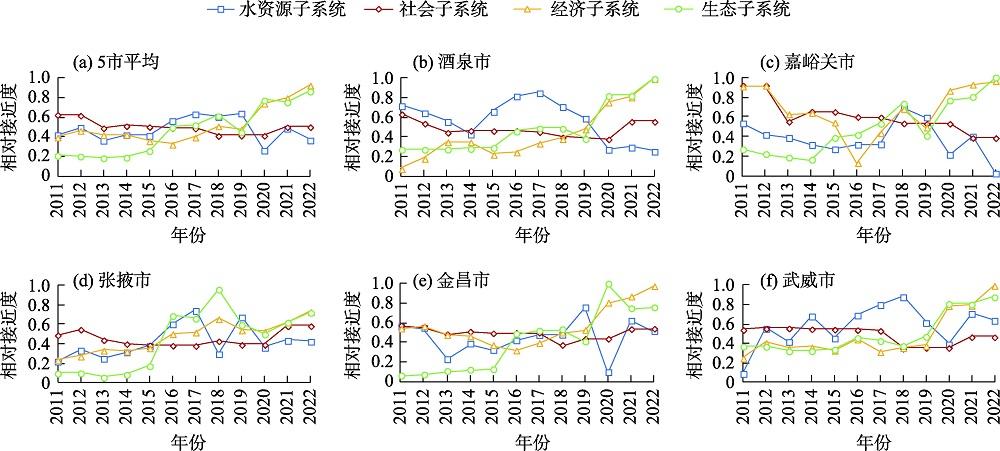
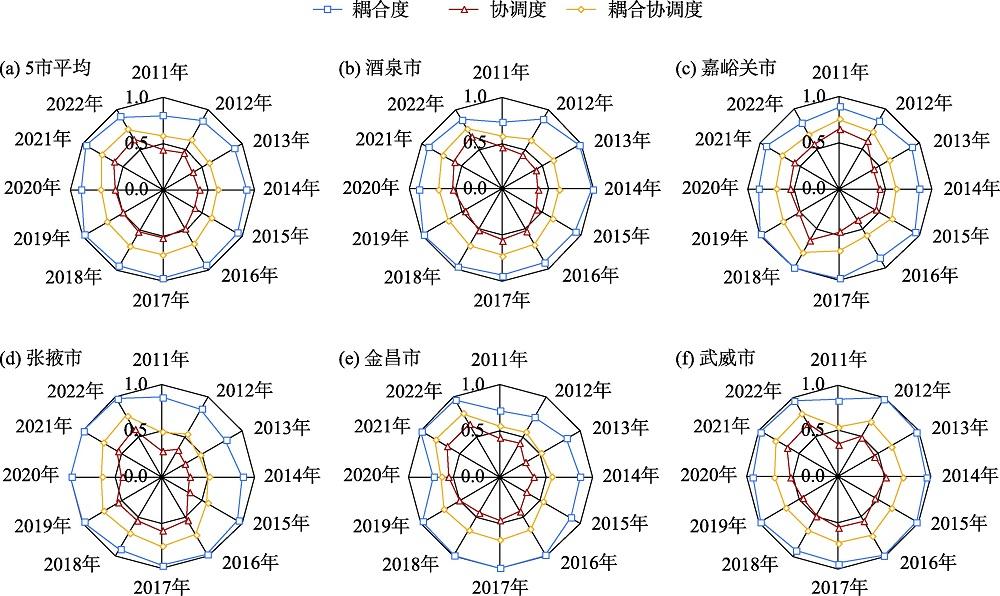
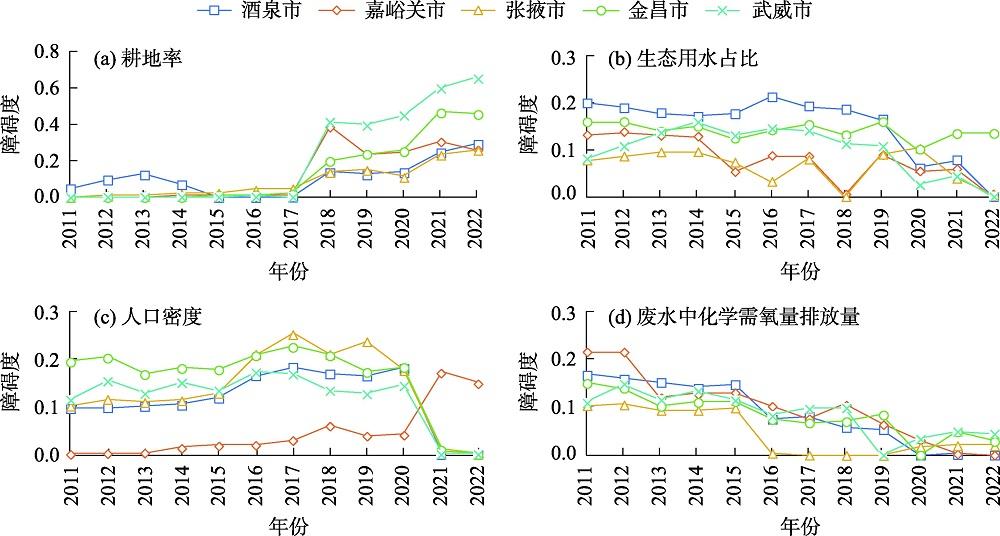
甘肃省内陆河流域作为丝绸之路的重要通道,水资源承载能力是影响当地社会经济可持续发展的重要因素。通过构建“水资源-社会-经济-生态”评价指标体系,基于CRITIC法和熵权法确定评价指标综合权重,利用TOPSIS模型、耦合协调度模型和障碍度函数模型,开展甘肃省内陆河流域水资源承载能力评价,分析各子系统耦合协调状况及影响水资源承载能力水平的主要障碍因素。结果表明:2011—2022年甘肃省内陆河流域酒泉、嘉峪关、张掖、金昌、武威5市水资源承载能力的水资源子系统和社会子系统的发展水平滞后于经济子系统和生态子系统。同时,甘肃省内陆河流域水资源承载能力水平总体上呈缓慢增加趋势,由短缺状态逐步转换至合理状态。从2011—2022年相对接近度均值来看,酒泉、金昌、张掖水资源承载能力等级处于短缺状态,嘉峪关、武威水资源承载能力等级处于合理状态。5市4个子系统间耦合协调性均处于初级协调阶段,提高水资源子系统、社会子系统的水资源承载能力是提升甘肃省内陆河流域水资源综合承载能力的关键所在。耕地率、生态用水占比、人口密度以及废水中化学需氧量排放量4项指标为主要障碍指标。
李常亮 , 雒天峰 , 康燕霞 . 甘肃省内陆河流域水资源承载能力[J]. 干旱区研究, 2025 , 42(1) : 63 -71 . DOI: 10.13866/j.azr.2025.01.06
As an important passage of the Silk Road, the water resources carrying capacity of the inland river basin is a key factor impacting the sustainable development of society and economy in the Gansu Province. Therefore, by constructing an evaluation index system of “water resources-society-economy-ecology,” based on the CRITIC and the entropy methods for calculating the comprehensive weight of the evaluation index, this study evaluated the carrying capacity of the water resources of the region. The study involved analyzing the coupling and coordination situation of each subsystem and the main obstacle factors affecting the capacity by using the TOPSIS model, the coupling and coordination function model, and the obstacle factors function model, respectively. The results suggested that the water resources and social subsystem development of the water resources capacity in Jiuquan, Jiayuguan, Zhangye, Jinchang, and Wuwei lagged behind the economic and ecological subsystem development of the region from 2011 to 2022. The water resource carrying capacity of the inland river basin was generally in a slow upward trend in the Gansu Province, thus escalating its shortage state to a reasonable level progressively. Additionally, relative to the average relative proximity degree, the water carrying capacity of Jiuquan, Jinchang, and Zhangye is at a shortage level, whereas the water carrying capacity of Jiayuguan and Wuwei is at a reasonable level. The level of coupling coordination of the four subsystems in the five cities was at its primary coordination stage. The key to improving the water resource carrying capacity of the inland river basin in the Gansu Province is to improve the carrying capacity of water resources and social subsystems. The main obstacles to improving the carrying capacity of water resources are the rate of cultivated land, proportion of ecological water use, population density, and Chemical Oxygen Demand (COD) from wastewater.
表1 甘肃省内陆河流域水资源承载能力评价指标体系Tab. 1 Evaluation index system of water resources carrying capacity of inland river basin in Gansu Province |
| 目标层 | 准则层 | 指标层 | 属性 |
|---|---|---|---|
| 水资源承载能力 | 水资源 子系统 | 人均水资源量/(m3·人-1) | 正向 |
| 产水模数/(104 m3·km-2) | 正向 | ||
| 供水模数/(104 m3·km-2) | 逆向 | ||
| 水资源开发利用率/% | 逆向 | ||
| 社会子 系统 | 人口密度/(人·km-2) | 逆向 | |
| 耕地率/% | 逆向 | ||
| 耕地灌溉率/% | 逆向 | ||
| 经济子 系统 | 农业用水占比/% | 逆向 | |
| 万元工业增加值用水量/[m3·(104元)-1] | 逆向 | ||
| 万元GDP用水量/[m3·(104元)-1] | 逆向 | ||
| 生态子 系统 | 生态用水占比/% | 正向 | |
| 废水中化学需氧量排放量/(104 t·a-1) | 逆向 | ||
| 废水中氨氮排放量/(104 t·a-1) | 逆向 |
表2 水资源承载能力评价分级Tab. 2 Classification standard of water resources carrying capacity |
| 等级 | 匮乏 | 短缺 | 合理 | 协调 | 充裕 |
|---|---|---|---|---|---|
| 综合评价指数 | [0,0.3) | [0.3,0.4) | [0.4,0.5) | [0.5,0.6) | [0.6,1) |
表3 甘肃省内陆河流域5市相对接近度Tab. 3 Relatively proximity degree of five cities in inland river basin in Gansu Province |
| 年份 | 酒泉 | 嘉峪关 | 张掖 | 金昌 | 武威 | 均值 |
|---|---|---|---|---|---|---|
| 2011 | 0.357 | 0.508 | 0.219 | 0.364 | 0.311 | 0.352 |
| 2012 | 0.333 | 0.467 | 0.266 | 0.360 | 0.407 | 0.367 |
| 2013 | 0.315 | 0.349 | 0.216 | 0.268 | 0.361 | 0.302 |
| 2014 | 0.281 | 0.360 | 0.220 | 0.300 | 0.409 | 0.314 |
| 2015 | 0.332 | 0.372 | 0.251 | 0.268 | 0.368 | 0.318 |
| 2016 | 0.425 | 0.332 | 0.437 | 0.341 | 0.444 | 0.396 |
| 2017 | 0.440 | 0.384 | 0.477 | 0.377 | 0.430 | 0.422 |
| 2018 | 0.400 | 0.543 | 0.408 | 0.350 | 0.361 | 0.412 |
| 2019 | 0.363 | 0.414 | 0.441 | 0.419 | 0.347 | 0.397 |
| 2020 | 0.399 | 0.431 | 0.335 | 0.432 | 0.384 | 0.396 |
| 2021 | 0.463 | 0.429 | 0.461 | 0.528 | 0.503 | 0.477 |
| 2022 | 0.494 | 0.385 | 0.482 | 0.522 | 0.515 | 0.480 |
| 均值 | 0.384 | 0.415 | 0.351 | 0.377 | 0.403 | 0.386 |
表4 甘肃省内陆河流域水资源承载能力指标障碍度Tab. 4 Obstacle degrees of water resources carrying capacity of inland river basin in Gansu Province |
| 指标层 | 酒泉市 | 嘉峪关市 | 张掖市 | 金昌市 | 武威市 |
|---|---|---|---|---|---|
| 人均水资源量 | 0.077 | 0.093 | 0.064 | 0.065 | 0.037 |
| 产水模数 | 0.086 | 0.164 | 0.096 | 0.064 | 0.048 |
| 供水模数 | 0.038 | 0.094 | 0.081 | 0.092 | 0.070 |
| 水资源开发利用率 | 0.064 | 0.054 | 0.095 | 0.031 | 0.043 |
| 人口密度 | 0.116 | 0.046 | 0.140 | 0.162 | 0.120 |
| 耕地率 | 0.106 | 0.140 | 0.087 | 0.138 | 0.210 |
| 耕地灌溉率 | 0.048 | 0.056 | 0.076 | 0.035 | 0.112 |
| 农业用水占比 | 0.121 | 0.064 | 0.053 | 0.024 | 0.061 |
| 万元工业增加值用水量 | 0.046 | 0.016 | 0.076 | 0.052 | 0.084 |
| 万元GDP用水量 | 0.047 | 0.022 | 0.033 | 0.065 | 0.020 |
| 生态用水占比 | 0.150 | 0.081 | 0.082 | 0.132 | 0.099 |
| 废水中化学需氧量排放量 | 0.087 | 0.099 | 0.047 | 0.083 | 0.086 |
| 废水中氨氮排放量 | 0.013 | 0.071 | 0.071 | 0.058 | 0.010 |
| [1] |
左其亭, 张修宇. 气候变化下水资源动态承载力研究[J]. 水利学报, 2015, 46(4): 387-395.
[
|
| [2] |
黄楚珩, 蒋志云, 杨志广, 等. 基于熵值法和层次分析法的广东省水资源安全评价及影响因素分析[J]. 水资源与水工程学报, 2019, 30(5): 140-147.
[
|
| [3] |
王金星, 杨银科, 盛强. 基于改进TOPSIS模型的甘肃省水资源承载力评价[J]. 水电能源科学, 2022, 40(11): 35-39.
[
|
| [4] |
|
| [5] |
|
| [6] |
|
| [7] |
姜锋, 张百祖. 基于层次分析法和变异系数法的酒泉市水资源承载能力分析评价研究[J]. 节水灌溉, 2023, 46(9): 94-99.
[
|
| [8] |
李龙, 蒋天乐, 李磊, 等. 基于模糊综合评价及TOPSIS模型的武威市水资源承载力评价及预测[J]. 水利规划与设计, 2023, 36(1): 69-74, 107, 122.
[
|
| [9] |
黄博, 李博文, 雷正烨, 等. 基于TOPSIS模型及综合权重的武威市水资源承载力和水安全评价[J]. 水利规划与设计, 2023, 36(2): 56-63.
[
|
| [10] |
谭豪, 脱云飞, 王倩, 等. 基于CRITIC-VIKOR法的云南省水资源承载力综合评价[J]. 水资源与水工程学报, 2023, 34(4): 118-126.
[
|
| [11] |
刘庆芳, 王小坤, 朱青, 等. 基于“三生”功能的西藏自治区水资源承载力系统耦合关系[J]. 自然资源学报, 2023, 38(6): 1618-1631.
[
|
| [12] |
唐家凯, 丁文广, 李玮丽, 等. 黄河流域水资源承载力评价及障碍因素研究[J]. 人民黄河, 2021, 43(7): 73-77.
[
|
| [13] |
雷加强, 高鑫, 赵永成, 等. 河西走廊-塔克拉玛干沙漠边缘阻击战: 风沙形势与防治任务[J]. 中国科学院院刊, 2023, 38(7): 966-977.
[
|
| [14] |
赵豫芝, 杨建军. 南疆地区水资源承载力及子系统耦合协调性时空格局[J]. 干旱区研究, 2023, 40(2): 213-223.
[
|
| [15] |
孙钦珂, 周亮, 唐相龙, 等. 干旱区绿洲城镇扩张对耕地空间影响及预测——以河西走廊区域为例[J]. 自然资源学报, 2021, 36(4): 1008-1020.
[
|
| [16] |
梁川. 甘肃省河西内陆河流域农业高效节水灌溉现状分析与对策研究[J]. 水利发展研究, 2021, 21(8): 84-87.
[
|
| [17] |
|
| [18] |
邹志红, 孙靖南, 任广平. 模糊评价因子的熵权法赋权及其在水质评价中的应用[J]. 环境科学学报, 2005, 25(4): 552-556.
[
|
| [19] |
李少朋, 赵衡, 王富强, 等. 基于AHP-TOPSIS模型的江苏省水资源承载力评价[J]. 水资源保护, 2021, 37(3): 20-25.
[
|
| [20] |
田培, 张志好, 许新宜, 等. 基于变权TOPSIS模型的长江经济带水资源承载力综合评价[J]. 华中师范大学学报(自然科学版), 2019, 53(5): 755-764.
[
|
| [21] |
王勇, 孙瑞欣. 土地利用变化对区域水-能源-粮食系统耦合协调度的影响——以京津冀城市群为研究对象[J]. 自然资源学报, 2022, 37(3): 582-599.
[
|
| [22] |
马勇, 李丽霞, 任洁. 神农架林区旅游经济-交通状况-生态环境协调发展研究[J]. 经济地理, 2017, 37(10): 215-220, 227.
[
|
| [23] |
孙才志, 吴永杰, 刘文新. 基于熵权TOPSIS法的大连市水贫困评价及障碍因子分析[J]. 水资源保护, 2017, 33(4): 1-8.
[
|
| [24] |
史紫薇, 冯文文, 钱会. 基于流域尺度的甘肃省水资源承载力评价[J]. 生态科学, 2021, 40(3): 51-57.
[
|
| [25] |
吴明艳, 曾晓春, 刘兴德, 等. 基于熵权TOPSIS模型的西北五省区水资源承载力评价研究[J]. 中国农村水利水电, 2022, 64(12): 78-85, 92.
[
|
/
| 〈 |
|
〉 |