



新疆绿洲生态系统固碳潜力研究
|
张皓哲(2003-),男,主要从事植被遥感生态水文相关研究. E-mail: zhz1231123@163.com |
收稿日期: 2023-09-17
修回日期: 2024-01-02
网络出版日期: 2025-08-12
基金资助
新疆维吾尔自治区重点研发任务专项计划(2022B01012)
Carbon sequestration potential of oasis ecosystem in Xinjiang, China
Received date: 2023-09-17
Revised date: 2024-01-02
Online published: 2025-08-12
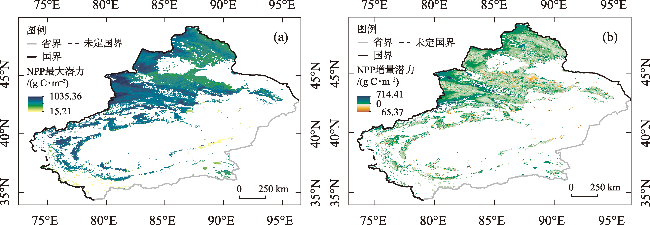
净初级生产力(Net Primary Productivity,NPP)是表征陆地碳循环的重要指标,它可以反映陆地生态系统的碳汇能力。面对我国实现“碳达峰”与“碳中和”的“双碳”目标,提升陆地生态系统固碳能力是重要途径之一。新疆地域面积广阔、植被恢复潜力巨大,评估新疆生态系统碳固存现状,挖掘碳固存潜力,对积极响应并实现国家“双碳”目标具有重要的现实意义。本研究基于Carnegie Ames Stanford Approach(CASA)模型,结合土地利用数据、遥感数据以及气象(气温、降水和太阳辐射)数据,模拟2001—2020年新疆NPP,通过Sen-MK方法分析NPP的变化特征趋势,并利用Pearson相关分析法分析NPP变化与气候因子之间的影响关系,进一步采用2001年和2020年不同土地利用及植被情景,以及Miami模型模拟的纯气候情景下NPP的变化格局,最终获取新疆NPP的最大潜力及NPP的最大增量。结果表明:(1) 2001—2020年间新疆NPP总体表现为波动上升趋势;(2) 在气候因素的影响中降水对新疆NPP产生的影响最大;(3) 新疆的主要土地利用类型中耕地的NPP较大且耕地面积呈现增加趋势;(4) 新疆整体NPP的增量潜力达79.43 g C·m-2。本研究可以为新疆实施生态恢复以及耕地保护措施等提供参考依据。
张皓哲 , 薛亚永 , 马圆圆 , 薛国玄 . 新疆绿洲生态系统固碳潜力研究[J]. 干旱区研究, 2024 , 41(6) : 998 -1009 . DOI: 10.13866/j.azr.2024.06.09
Net Primary Productivity (NPP) is an essential indicator of the terrestrial carbon (C) cycle, which can reflect the carbon sink capacity of terrestrial ecosystems. In the face of China’s “double carbon” goal of “carbon peak” and “carbon neutrality,” improving the carbon sequestration capacity of the terrestrial ecosystems is one of the crucial ways. Due to its vast geographical area and considerable vegetation restoration potential, it is of great practical significance to evaluate the current situation of carbon sequestration in Xinjiang and explore the potential of carbon sequestration so as to respond positively and realize the national “double carbon” goal. This study combined the Carnegie Ames Stanford Approach (CASA) model with the land use, remote sensing, and meteorological (temperature, precipitation, and solar radiation) data, and NPP in Xinjiang from 2001 to 2020 for the simulation. The Sen-MK method was used to analyze the trend in NPP changes. Pearson correlation analysis was used to identify the relationship between NPP variations and climatic factors. Further, different land use and vegetation scenarios from 2001 to 2020, as well as the pattern of NPP variations under pure climate scenarios simulated by the Miami model, were used to derive the final maximum potential of NPP and the maximum increment of NPP in Xinjiang. The results showed that: (1) The NPP in Xinjiang showed an upward trend with fluctuations from 2001 to 2020; (2) Among the climatic factors, precipitation had the maximal impact on NPP in Xinjiang; (3) Among the primary land use types in Xinjiang, cultivated land had a large NPP which showed an increasing trend; (4) The increment potential of NPP in Xinjiang was 79.43 g C·m-2. This study can provide a reference for Xinjiang to respond to the national call for “carbon peak” and “carbon neutrality” and to implement ecological restoration and cultivated land protection measures.
| [1] |
赵俊芳, 曹云, 马建勇, 等. 基于遥感和FORCCHN的中国森林生态系统NPP及生态服务功能评估[J]. 生态环境学报, 2018, 27(9): 1585-1592.
[
|
| [2] |
刘宪锋, 任志远, 林志慧. 青藏高原生态系统固碳释氧价值动态测评[J]. 地理研究, 2013, 32(4): 663-670.
[
|
| [3] |
|
| [4] |
|
| [5] |
|
| [6] |
|
| [7] |
|
| [8] |
|
| [9] |
|
| [10] |
|
| [11] |
|
| [12] |
闫敏, 李增元, 田昕, 等. 黑河上游植被总初级生产力遥感估算及其对气候变化的响应[J]. 植物生态学报, 2016, 40(1): 1-12.
[
|
| [13] |
|
| [14] |
|
| [15] |
|
| [16] |
陈春波, 李刚勇, 彭建. 近20 a新疆天然草地NPP时空分析[J]. 干旱区地理, 2022, 45(2): 522-534.
[
|
| [17] |
刘卫国, 魏文寿, 刘志辉. 新疆气候变化下植被净初级生产力格局分析[J]. 干旱区研究, 2009, 26(2): 206-211.
[
|
| [18] |
万华伟, 李灏欣, 高吉喜, 等. 我国植被生态系统固碳能力提升潜力空间格局研究[J]. 生态学报, 2022, 42(21): 8568-8580.
[
|
| [19] |
王昭生. 基于ERA5的1982—2020年中国太阳净辐射数据集[EB/OL]. https://cstr.cn/15732.11.ecodb.000582022.
[
|
| [20] |
|
| [21] |
骆成凤, 王长耀, 刘永洪, 等. 利用BP算法进行新疆MODIS数据土地利用分类研究[J]. 干旱区地理, 2005, 28(2): 258-262.
[
|
| [22] |
米尔扎提江·木艾塔尔江, 古丽米热·艾尔肯, 阿依吐尔逊·沙木西. 基于MODIS数据的新疆土地利用/覆被时空变化及驱动因素分析[J]. 湖北农业科学, 2022, 61(16): 58-63.
[
|
| [23] |
卜祥, 张永福, 梁田田, 等. 基于MODIS数据2001—2019年NDVI时空变化及驱动力分析——以阿克苏地区为例[J]. 中国农学通报, 2022, 38(11): 75-83.
[
|
| [24] |
王祎婷, 邹蕊, 王欣悦, 等. 塔拉滩地区光伏电站建设对植被净初级生产力的影响[J]. 农业工程学报, 2022, 38(24): 153-161.
[
|
| [25] |
|
| [26] |
朱文泉. 中国陆地生态系统植被净初级生产力遥感估算及其与气候变化关系的研究[D]. 北京: 北京师范大学, 2005.
[
|
| [27] |
张镱锂, 祁威, 周才平, 等. 青藏高原高寒草地净初级生产力(NPP)时空分异[J]. 地理学报, 2013, 68(9): 1197-1211.
[
|
| [28] |
邹德富. 基于CASA模型的青藏高原NPP时空分布动态研究[D]. 兰州: 兰州大学, 2012.
[
|
| [29] |
张金亭, 董艳超, 叶宗达. 基于地形改进NPP指数的县域耕地产能测算[J]. 农业工程学报, 2020, 36(10): 227-234, 326.
[
|
| [30] |
周刊社, 杜军, 沈旭, 等. 气候变化背景下羌塘国家自然保护区植被净初级生产力时空变化[J]. 中国农业气象, 2021, 42(8): 627-641.
[
|
| [31] |
赵俊芳, 孔祥娜, 姜月清, 等. 基于高时空分辨率的气候变化对全球主要农区气候生产潜力的影响评估[J]. 生态环境学报, 2019, 28(1): 1-6.
[
|
| [32] |
文想成, 张泰, 王学梅, 等. 长江中下游地区气候生产潜力及粮食产量响应[J]. 江苏农业科学, 2021, 49(6): 196-203.
[
|
| [33] |
|
| [34] |
|
| [35] |
黄观荣, 杜晓阳, 郭永婷, 等. 粤北NPP时空分布特征及其对降水和气温的响应[J]. 气象与环境科学, 2023, 46(3): 38-46.
[
|
| [36] |
贾俊鹤, 刘会玉, 林振山. 中国西北地区植被NPP多时间尺度变化及其对气候变化的响应[J]. 生态学报, 2019, 39(14): 5058-5069.
[
|
| [37] |
徐虹, 程晋昕, 何雨芩, 等. 气候变化和人类活动对云南省植被净初级生产力的影响[J/OL]. 高原气象. https://link.cnki.net/urlid/62.1061.p.20231008.1002.0022023-10-10.
[
|
| [38] |
陈玉森, 艾柯代·艾斯凯尔, 王永东, 等. 1994—2018年哈萨克斯坦首都圈植被NPP时空变化特征及驱动因素[J]. 干旱区研究, 2022, 39(6): 1917-1929.
[
|
| [39] |
张赟鑫, 郝海超, 范连连, 等. 中亚草地NPP时空动态及其驱动因素研究[J]. 干旱区研究, 2022, 39(3): 698-707.
[
|
| [40] |
刘婵, 刘冰, 赵文智, 等. 中亚地区植被净初级生产力时空动态及其与气候因子关系[J]. 遥感技术与应用, 2020, 35(4): 924-933.
[
|
| [41] |
|
| [42] |
王莺, 夏文韬, 梁天刚, 等. 基于MODIS植被指数的甘南草地净初级生产力时空变化研究[J]. 草业学报, 2010, 19(1): 201-210.
[
|
| [43] |
陈宸, 井长青, 邢文渊, 等. 近20年新疆荒漠草地动态变化及其对气候变化的响应[J]. 草业学报, 2021, 30(3): 1-14.
[
|
| [44] |
|
| [45] |
徐丽萍, 李鹏辉, 李忠勤, 等. 新疆山地冰川变化及影响研究进展[J]. 水科学进展, 2020, 31(6): 946-959.
[
|
| [46] |
|
| [47] |
|
| [48] |
常学礼, 吕世海, 冯朝阳, 等. 地形对草甸草原植被生产力分布格局的影响[J]. 生态学报, 2015, 35(10): 3339-3348.
[
|
/
| 〈 |
|
〉 |