



竖管地表滴灌土壤水热分布特征模拟及影响因素
|
范严伟(1982-),男,副教授,主要从事节水灌溉理论与新技术研究. E-mail: fanyanwei24@163.com |
收稿日期: 2024-12-06
修回日期: 2025-03-15
网络出版日期: 2025-08-12
基金资助
国家自然科学基金项目(52369007)
国家自然科学基金项目(51969013)
Simulation of soil hydrothermal distribution characteristics and analysis of the influencing factors of vertical tube surface drip irrigation
Received date: 2024-12-06
Revised date: 2025-03-15
Online published: 2025-08-12
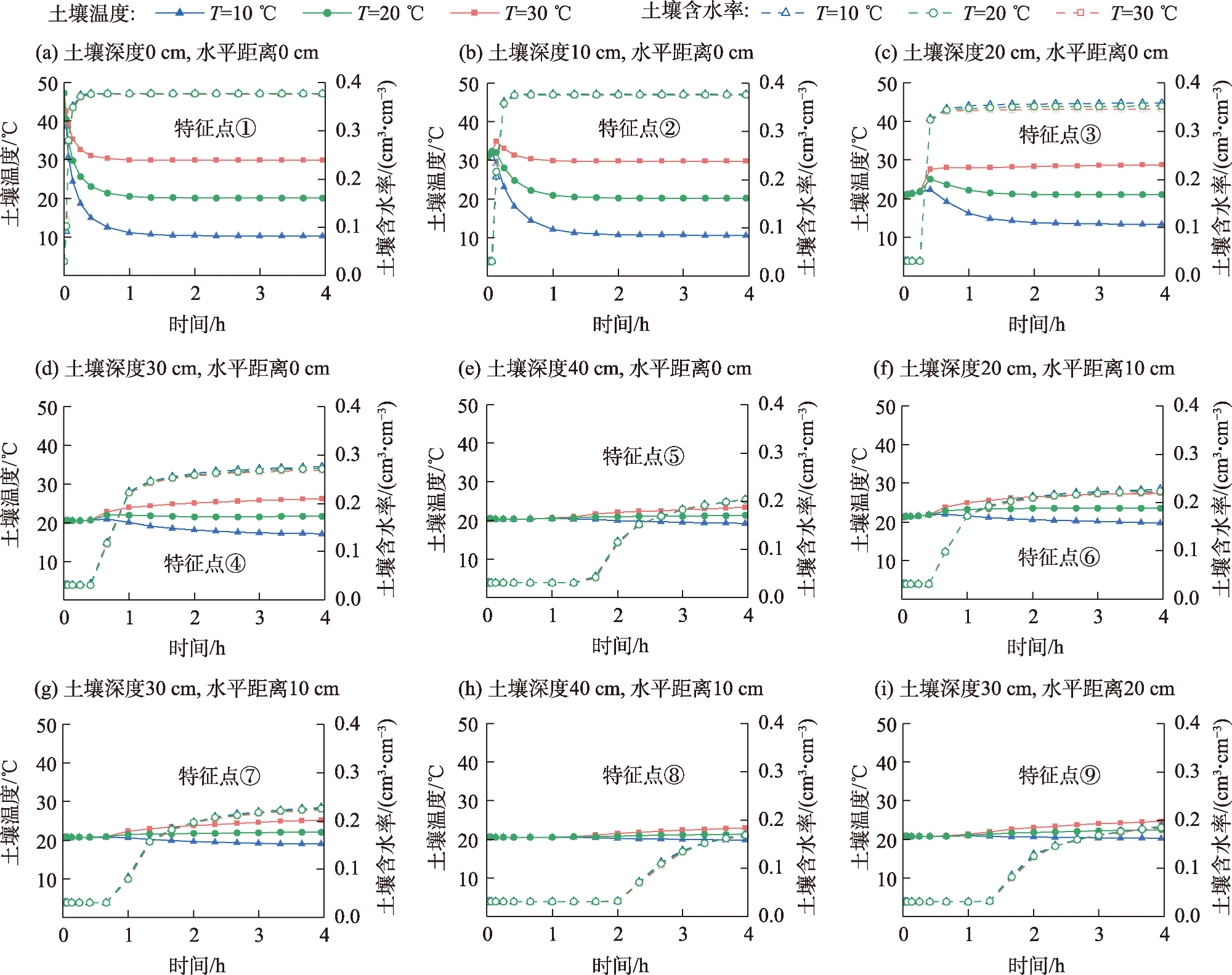
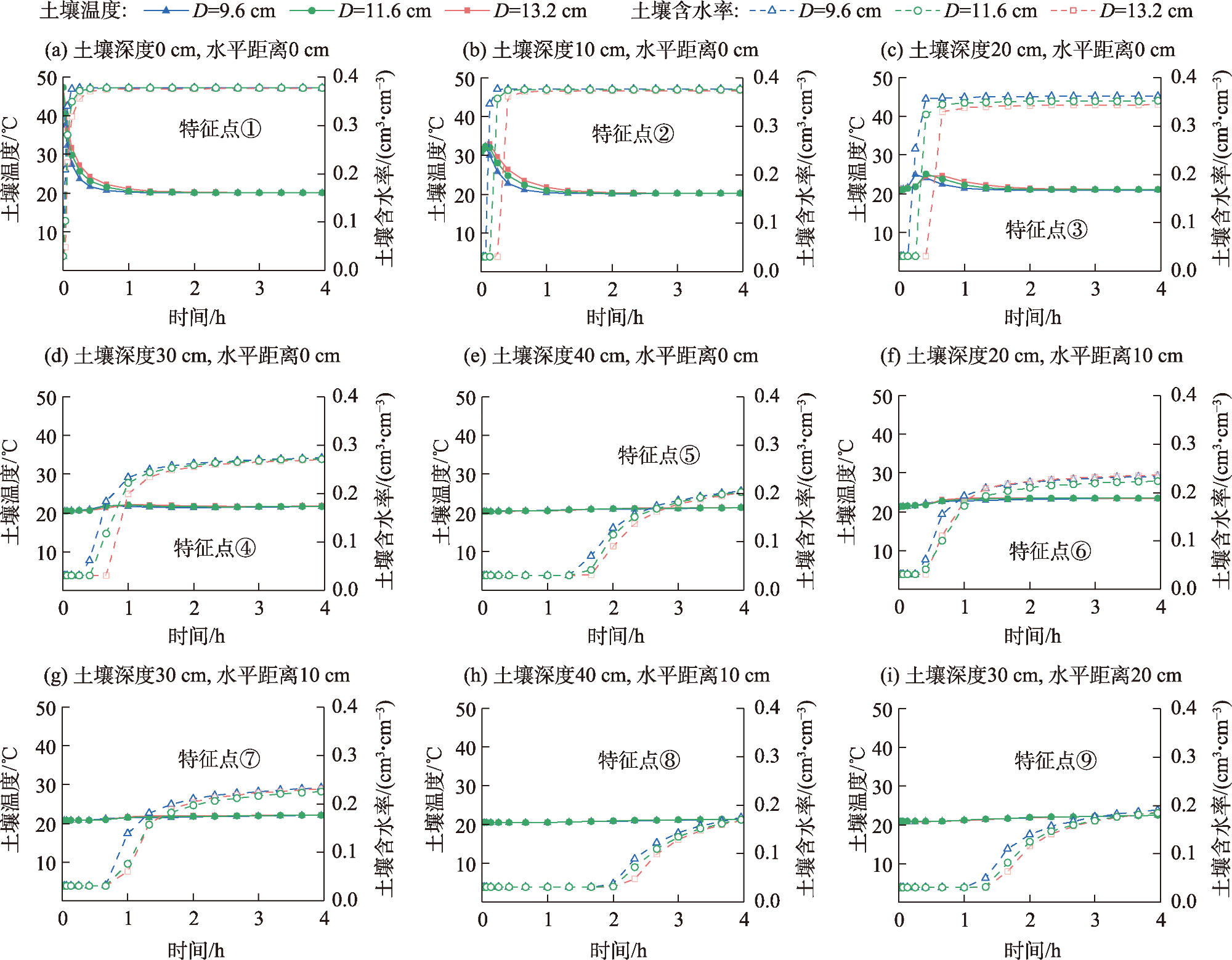
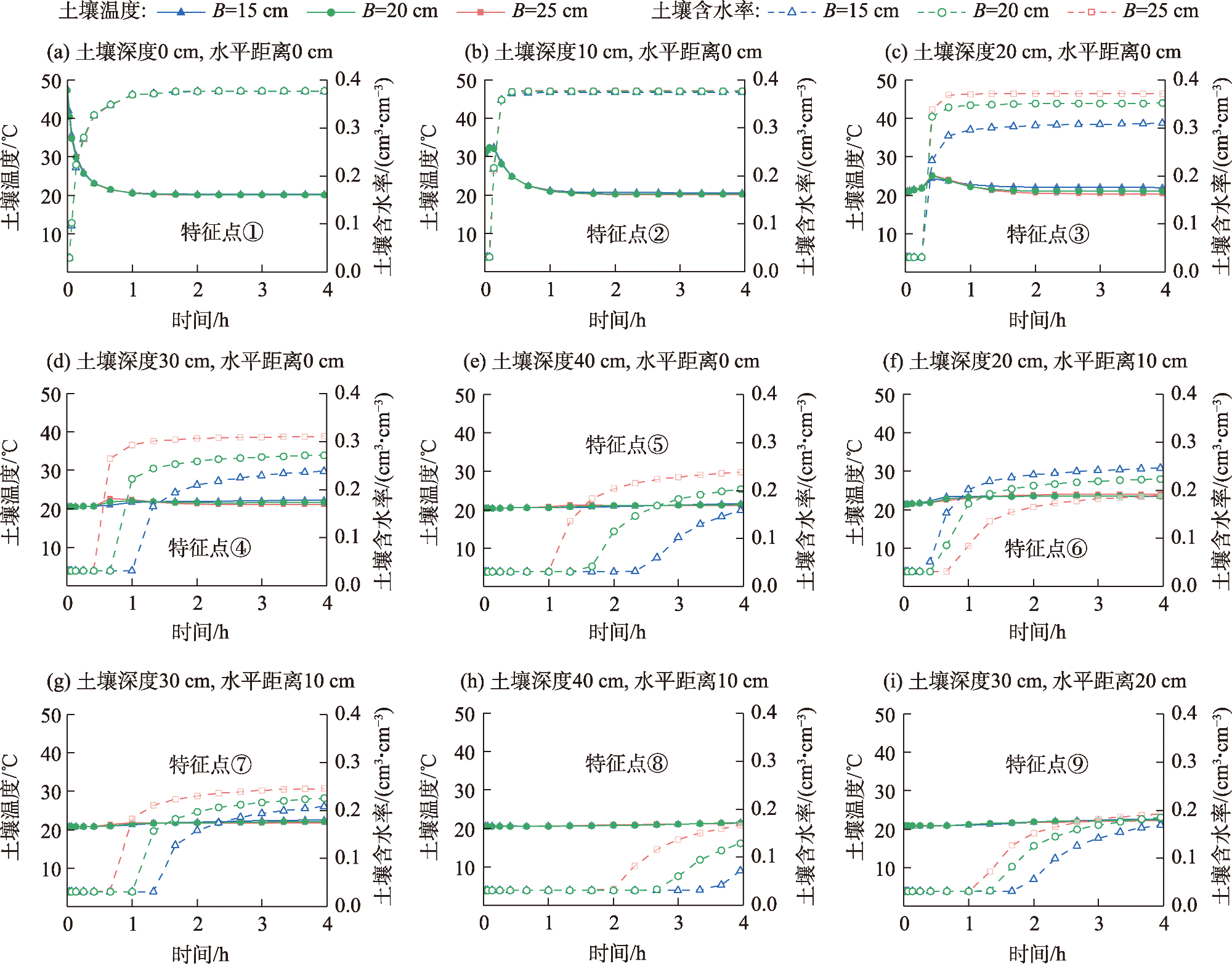
在沙漠环境中实施植物固沙工程,土壤水热状况是影响固沙植物健康生长的关键因素。竖管地表滴灌是为缓解土壤干旱和地表高温对固沙植物幼苗的复合胁迫而提出的一种节水控温保育新技术,其土壤水热分布及迁移状况尚不清晰,推广应用到植物固沙区缺乏理论基础。为探明竖管地表滴灌模式下灌溉参数(滴头流量和灌溉水温)和竖管参数(竖管直径和竖管埋深)对土壤水热分布及迁移状况的影响,基于HYDRUS-2D软件,构建了竖管地表滴灌土壤水热迁移数学模型,通过室内试验,验证了所建模型及其求解方法的可靠性。在此基础上,采用单因素分析法,考虑滴头流量(1、2、3 L·h-1)、灌溉水温(10、20、30 ℃)、竖管直径(9.6、11.6、13.2 cm)及竖管埋深(15、20、25 cm)4个影响因素,设计9组模拟方案,获得竖管地表滴灌不同影响参数组合下的土壤水热分布特征及迁移规律。 结果表明:(1) 整个灌水过程湿润体内取9个有代表性的点位,其土壤水热变化均是通过以水调温实现的水热耦合,灌水初期竖管内土壤水热动态变化最为明显,尤其是管内地表层;随着灌水时间的延长,管内土壤水热状况逐渐稳定,水分通过管底孔向四周渗透,管外各点位土壤水分快速增加并趋于稳定,而温度则受灌溉水温的影响而略有增减。(2) 滴灌期间竖管直径对土壤水热状况的影响不显著,竖管埋深主要是影响土壤的水分状况,对土壤热环境的影响也不明显。不同竖管埋深情况下管外土壤湿润体水分分布以管底为分界线,其上部同一点位处的土壤含水率随埋深的增大而减小,其下部同一点位处的土壤含水率则随埋深的增大而增大。(3) 滴头流量对土壤温度分布的影响相对有限,但其是影响土壤水分状况的关键参数,滴头流量越大,管外同一点位处的土壤含水率越高。(4) 灌溉水温对土壤水分分布的影响相对微弱,但其是影响土壤温度状况的直接因素,灌溉水温越高,管内外同一点位处的土壤温度越高。(5) 在竖管直径和埋深固定难以调整的情况下,通过调整滴头流量和灌溉水温,可有效实现根区土壤水热调控。该研究可为固沙植物竖管地表滴灌工程设计、运行和管理提供科学依据。
范严伟 , 吕自杰 , 张尧 , 王磊 , 石雯 . 竖管地表滴灌土壤水热分布特征模拟及影响因素[J]. 干旱区研究, 2025 , 42(6) : 1138 -1150 . DOI: 10.13866/j.azr.2025.06.16
The success of sand fixation projects in deserts is dependent on soil hydrothermal conditions, which are essential for the healthy growth of sand fixation plants. Vertical pipe surface drip irrigation is a new water-saving and temperature-control conservation technology focused on combating soil drought and surface heat stress on seedlings. However, the mechanisms regulating hydrothermal distribution and migration status remain unclear, and its widespread application in sand-fixing areas lacks a theoretical formulation. Thus, this study constructed a mathematical model of soil water-heat migration for vertical tube surface drip irrigation using HYDRUS-2D software. The study investigated the effects of key irrigation parameters (drip head flow rate and irrigation water temperature) and vertical tube parameters (tube diameter and burial depth) on soil water-heat distribution and migration. The accuracy of the constructed model was confirmed through indoor experiments. Consequently, a single-factor analysis was conducted involving nine simulation scenarios to study the impacts of four influencing factors—drip head flow rate (1, 2, and 3 L·h-1), irrigation water temperatures (10, 20, and 30 ℃), riser diameter (9.6, 11.6, and 13.2 cm), and riser depth (15, 20, and 25 cm) to obtain the distributions and migration patterns of the soil hydrothermal properties. The results showed the following. (1) Soil hydrothermal changes during irrigation occurred through water-heat coupling influenced by irrigation water temperature. Dynamic changes were most pronounced in the early stage of irrigation, particularly in the inner surface layer of the tube. Over time, these changes stabilized. Water infiltration from the bottom holes of the tube into the surrounding soil increased the soil moisture rapidly before stabilizing. Further, the soil temperature was affected by the irrigation water temperature, exhibiting slight increases or decreases. (2) The diameter of the vertical tube had a minimal effect on the soil hydrothermal changes during drip irrigation. However, the burial depth had a significant influence on the soil moisture but minimal impact on the thermal environment. Outside the tube, the soil moisture distribution around the tube formed a distinct pattern, with the bottom of the tube functioning as a dividing line. Above this line, the soil moisture content at the same point decreased as the burial depth increased, while below this line, the soil moisture content increased with greater burial depth. (3) The drip head flow was a critical factor in determining the soil moisture status although its impact on the soil temperature distribution was limited. The larger the drip head flow, the higher the soil moisture content at the same points outside the pipe. (4) The influence of the irrigation water temperature on the soil moisture distribution was relatively weak; however, it directly influenced the soil temperature. Higher irrigation water temperatures resulted in increased soil temperature at the same points inside and outside the pipe. (5) When adjustments to the vertical tube’s diameter and burial depth were not feasible, soil hydrothermal conditions in the root zone could be effectively regulated by adjusting the drip head flow rate and irrigation water temperature. Thus, this study offers a scientific basis for the design, operation, and management of a vertical pipe surface drip irrigation project for sand fixation plants.
表1 土壤水力特性和热运动参数Tab. 1 Soil hydraulic characteristics and thermal movement parameters |
| θr | θs | α | n | Ks | Solid | Org | DL | DT | b1 | b2 | b3 | Cn | Co | Cw |
|---|---|---|---|---|---|---|---|---|---|---|---|---|---|---|
| 0.010 | 0.377 | 0.04 | 2.2 | 0.228 | 0.61 | 0 | 5 | 1 | 5.12E+06 | -5.39E+07 | 1.18E+08 | 6.57E+07 | 9.04E+07 | 1.62E+08 |
注:θr为土壤残余含水率;θs为土壤饱和含水率;α为进气值倒数;n为土壤物理特性有关的拟合参数;Ks为土壤饱和导水率;Solid为土壤固相占总体积的比率;Org为有机质占总体积的比率;DL为土壤纵向热扩散率;DT为土壤横向热扩散率;b1、b2、b3为热导率函数中系数;Cn为土壤固相的热容;Co为土壤有机质的热容;Cw为土壤液相的热容。 |
表2 数值模拟方案Tab. 2 Numerical simulation scheme |
| 方案 编号 | 滴头流量(Q)/(L·h-1) | 灌溉水温(T)/℃ | 竖管直径(D)/cm | 竖管埋深(B)/cm |
|---|---|---|---|---|
| 1 | 1.0 | 20 | 11.6 | 20 |
| 2 | 2.0 | 10 | 11.6 | 20 |
| 3 | 2.0 | 20 | 11.6 | 20 |
| 4 | 2.0 | 30 | 11.6 | 20 |
| 5 | 3.0 | 20 | 11.6 | 20 |
| 6 | 2.0 | 20 | 9.6 | 20 |
| 7 | 2.0 | 20 | 13.2 | 20 |
| 8 | 2.0 | 20 | 11.6 | 15 |
| 9 | 2.0 | 20 | 11.6 | 25 |
| [1] |
|
| [2] |
卢琦, 雷加强, 李晓松, 等. 大国治沙:中国方案与全球范式[J]. 中国科学院刊, 2020, 35(6): 656-664.
[
|
| [3] |
|
| [4] |
|
| [5] |
|
| [6] |
纪平, 邵全琴, 王敏, 等. 中国三北防护林工程第二阶段生态效益综合评价[J]. 林业科学, 2022, 58(11): 31-48.
[
|
| [7] |
|
| [8] |
许疆维, 孙万豪, 吴文博, 等. 高温-干旱对沙漠植物花花柴光合作用的影响[J]. 分子植物育种, 2019, 17(12): 4089-4095.
[
|
| [9] |
麻浩, 张桦, 马林, 等. 无灌溉管件防护梭梭荒漠造林新技术及其示范推广[J]. 中国科学: 生命科学, 2014, 44(3): 248-256.
[
|
| [10] |
张俊, 马迎梅, 王树森, 等. 不同温度条件下沙冬青幼树对土壤失水及复水的生理响应过程[J]. 干旱区资源与环境, 2023, 37(3): 150-161.
[
|
| [11] |
范严伟, 王延祥, 朱鹏程, 等. 竖管地表滴灌下风沙土稳定入渗率与湿润体估算模型[J]. 农业工程学报, 2021, 37(7): 103-111.
[
|
| [12] |
范严伟, 王延祥, 史金红, 等. 竖管地表滴灌与普通地表滴灌土壤水分运移特性对比试验研究[J]. 水土保持学报, 2022, 36(6): 163-170.
[
|
| [13] |
范严伟, 史金红, 唐兴鹏. 不同防护措施下流沙地表层温湿度日变化特征[J]. 水土保持通报, 2023, 43(6): 72-80.
[
|
| [14] |
|
| [15] |
|
| [16] |
王建东, 龚时宏, 马晓鹏, 等. 地下滴灌条件下水热运移数学模型与验证[J]. 水利学报, 2010, 41(3): 368-373, 378.
[
|
| [17] |
王建东, 龚时宏, 许迪, 等. 地表滴灌条件下水热耦合迁移数值模拟与验证[J]. 农业工程学报, 2010, 26(12): 66-71.
[
|
| [18] |
|
| [19] |
|
| [20] |
|
| [21] |
虎军宏, 赵文举, 刘贵元, 等. 滴灌条件下水土温度对覆砂土壤水热运移影响的数值模拟[J]. 水土保持学报, 2020, 34(5): 349-354, 360.
[
|
| [22] |
|
| [23] |
魏建涛, 张建新, 范文波, 等. 不同犁底层深度土壤水热运移过程试验与模拟[J]. 石河子大学学报(自然科学版), 2022, 40(1): 41-47.
[
|
| [24] |
|
| [25] |
|
| [26] |
|
| [27] |
|
| [28] |
Van Genuchten M T,
|
| [29] |
|
| [30] |
|
| [31] |
谭军利, 马永鑫, 王西娜, 等. 微咸水灌溉下滴头流量及灌水量对压砂土壤入渗及水盐分布的影响[J]. 干旱地区农业研究, 2022, 40(3): 113-120.
[
|
| [32] |
刘利华, 费良军, 朱红艳. 水温对滴灌土壤水分入渗特性的影响[J]. 排灌机械工程学报, 2019, 37(2): 166-173.
[
|
| [33] |
俞明涛, 张科峰. 基于HYDRUS-2D软件的土壤水力特征参数反演及间接地下滴灌的土壤水分运动模拟[J]. 浙江农业学报, 2019, 31(3): 458-468.
[
|
| [34] |
范严伟, 史金红, 唐兴鹏, 等. 不同灌溉防护措施下梭梭根系生物量及形态特征[J]. 生态学报, 2024, 44(16): 7278-7289.
[
|
| [35] |
朱红艳, 刘利华, 费良军. 滴灌水温对土壤入渗和土壤温度的影响[J]. 排灌机械工程学报, 2019, 37(10): 902-908.
[
|
/
| 〈 |
|
〉 |