



Spatiotemporal evolution characteristics and its influencing factors of net primary productivity of vegetation in Mongolia form 2000 to 2020
Received date: 2024-10-11
Revised date: 2024-12-04
Online published: 2026-03-11
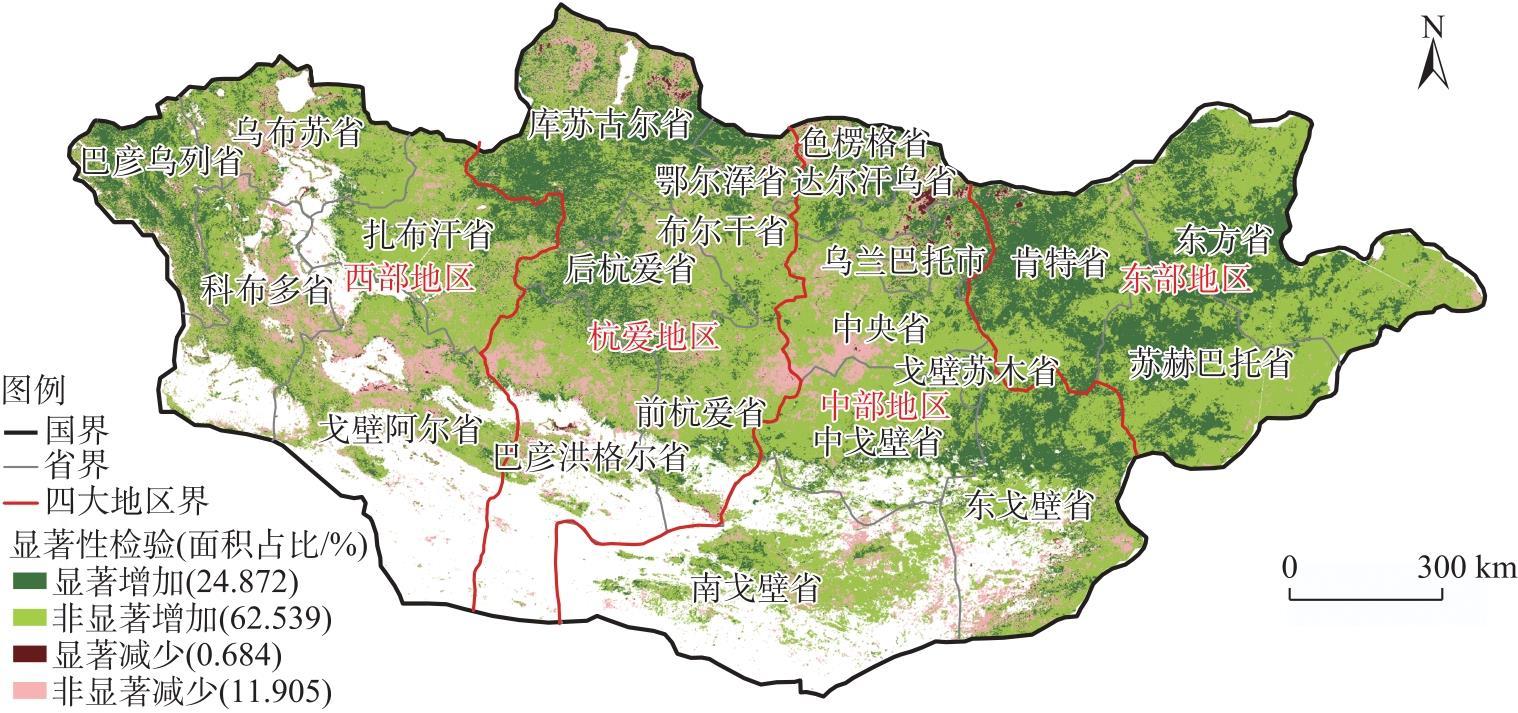
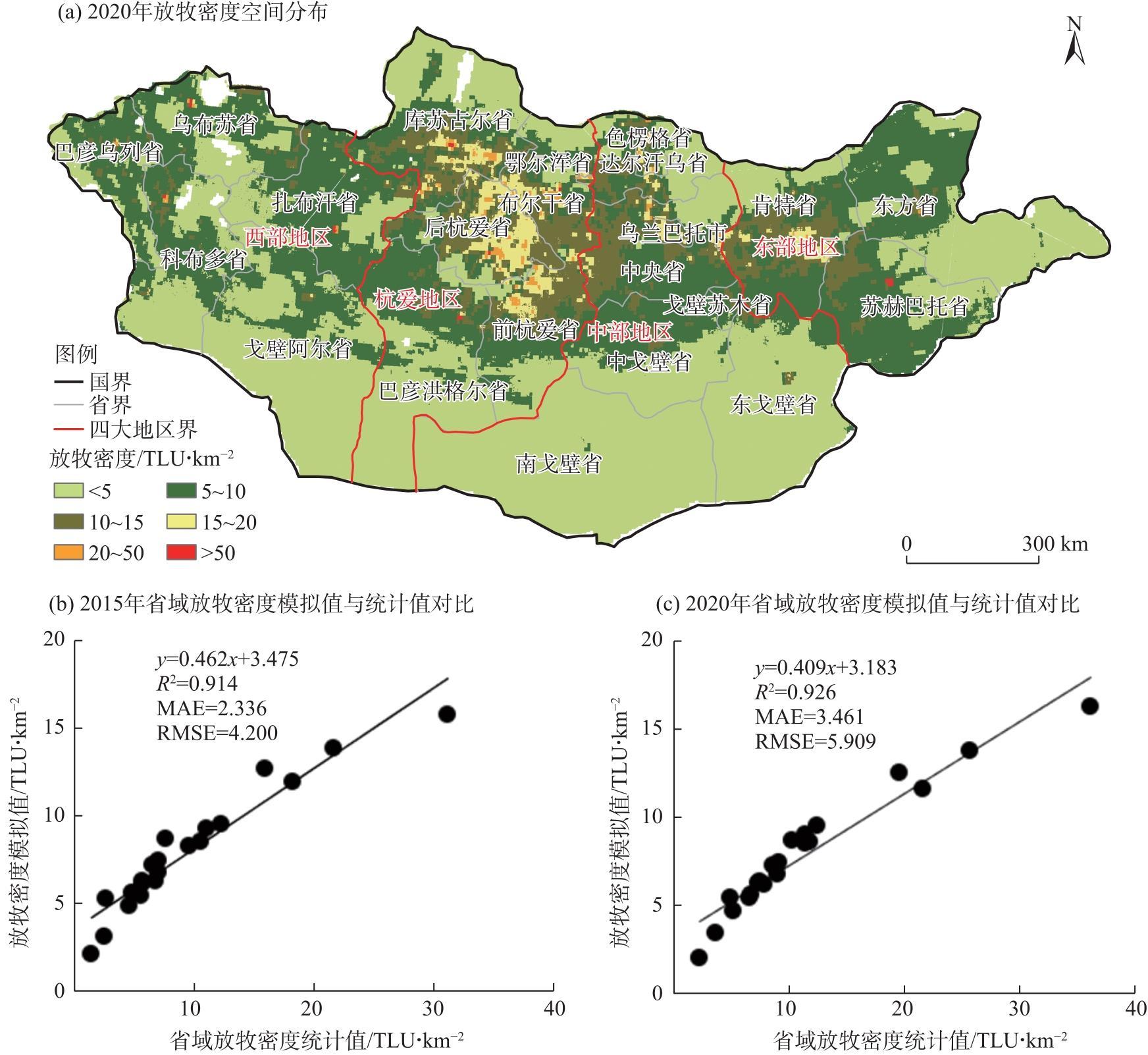
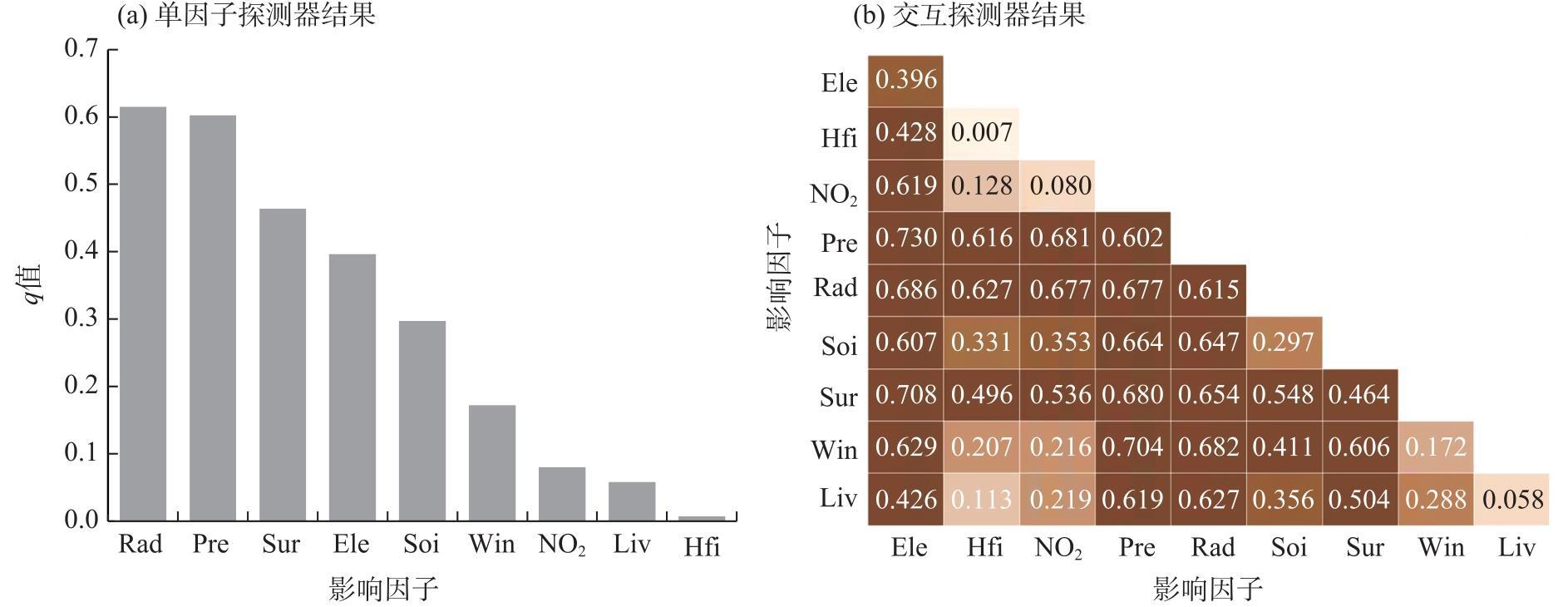
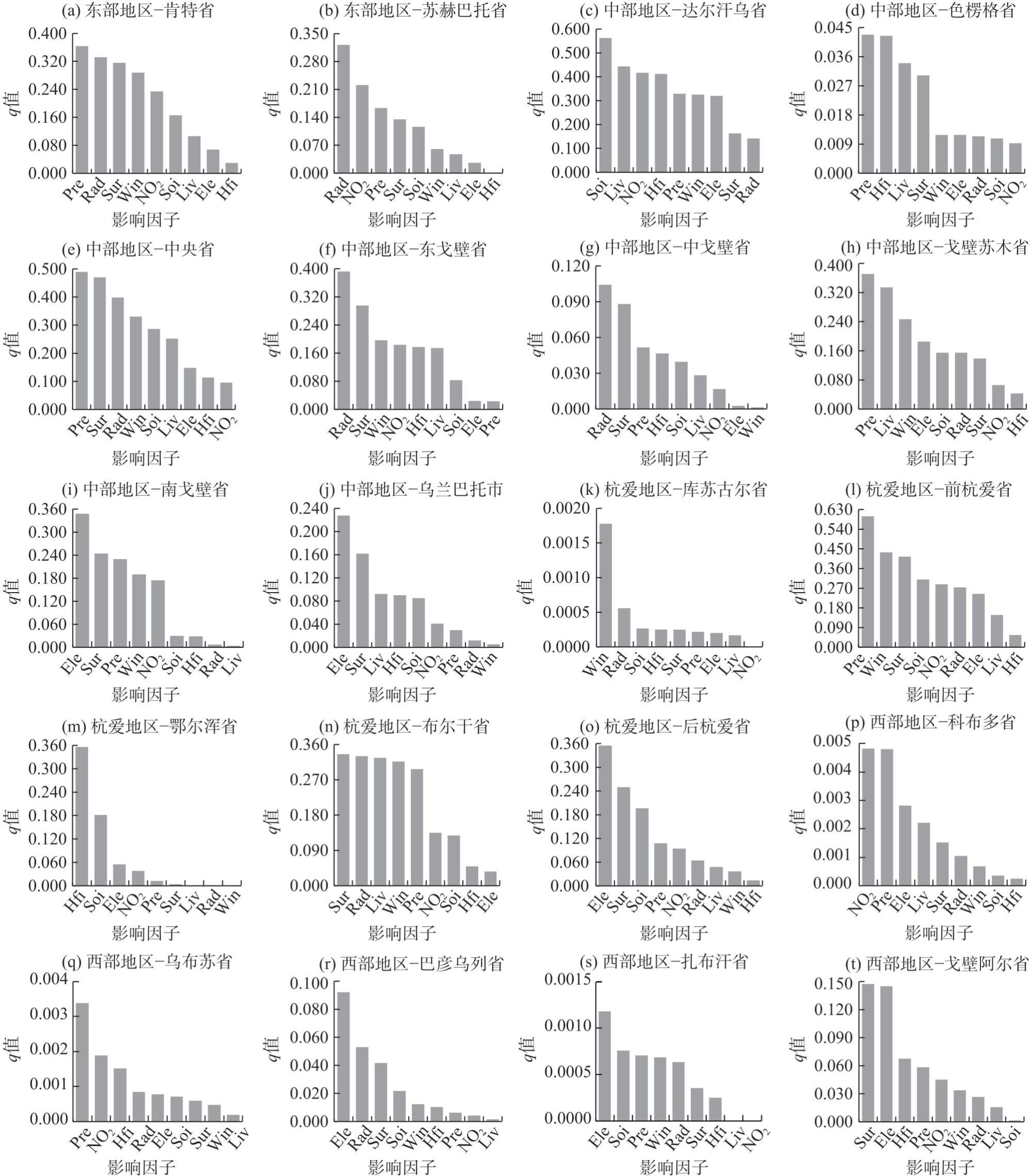
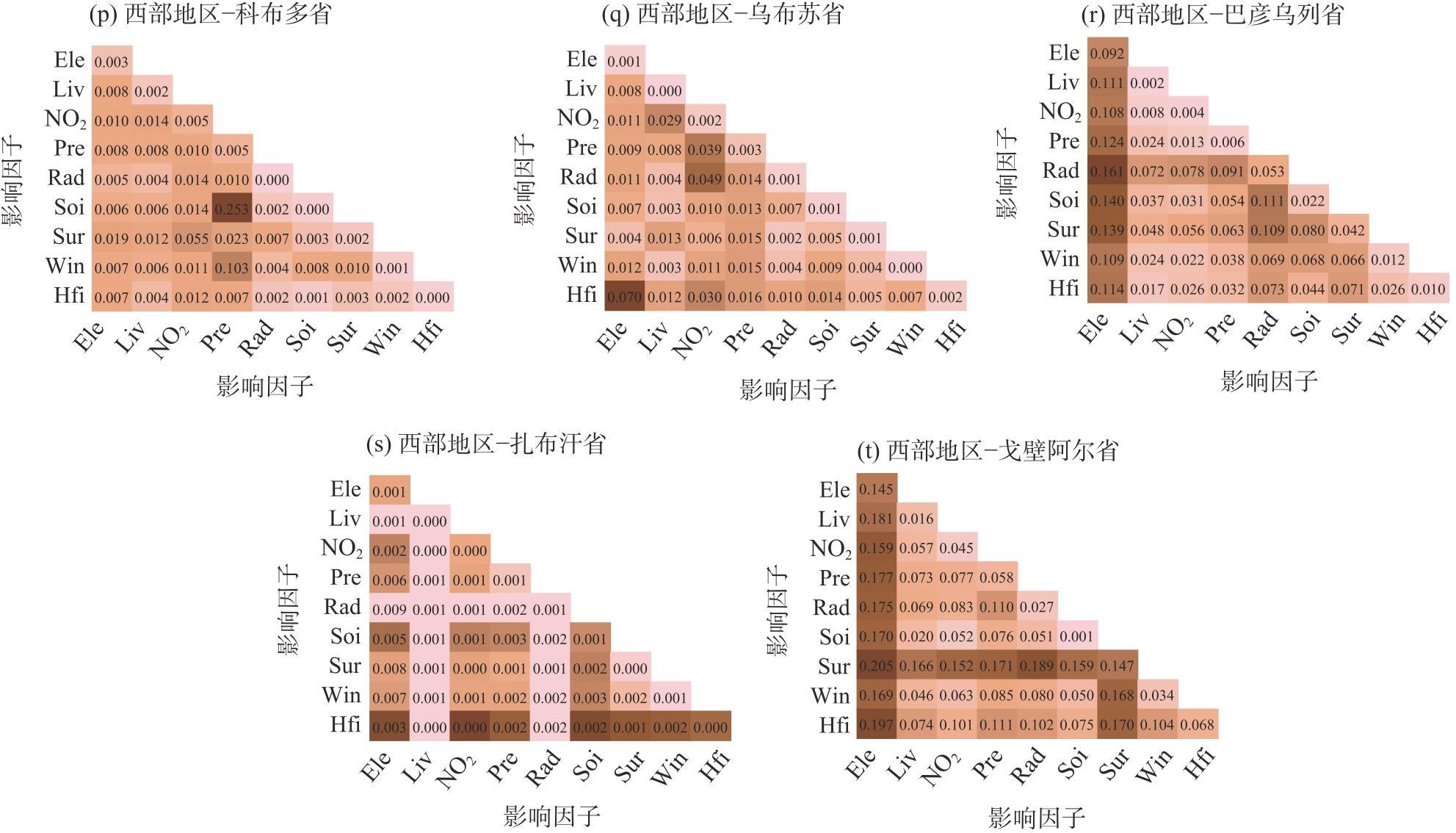
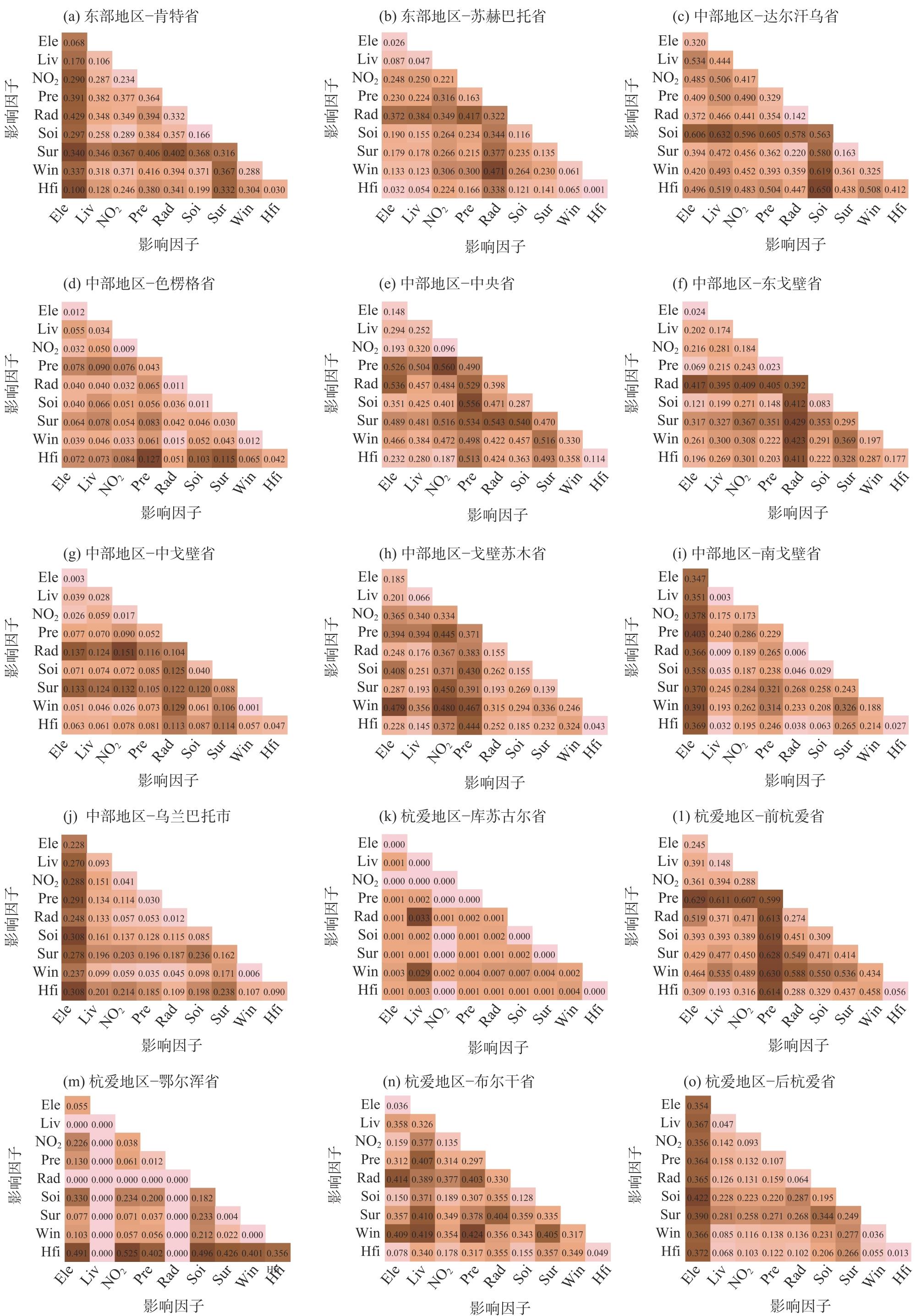
Mongolia, China’s northern neighbor, has a grassland ecosystem that is highly susceptible to natural factors and human activities. A univariate linear regression model was used to analyze the spatiotemporal variations in net primary productivity (NPP) of vegetation in Mongolia from 2000 to 2020. A random forest regression model, combined with the Gridded Livestock of the World (GLW) dataset, was used to simulate livestock grazing density in Mongolia for 2020. The geographic detector method was then utilized to examine the factors influencing NPP changes at both national and provincial scales, incorporating indicators such as average annualland surface temperature, average annual precipitation, downward shortwave radiation, soil moisture, NO2 emissions, and the human footprint index. The results indicated that: (1) From 2000 to 2020, the NPP in Mongolia exhibited spatial characteristics of increasing in the east and north and decreasing in the west and south. There is an overall increasing trend, dominated by nonsignificant increases, with nonsignificantly increasing areas accounting for 62.539% of Mongolia’s land area. (2) Single-factor analysis revealed that climatic factors were the primary drivers of NPP changes in Mongolia, with downward shortwave radiation (q=0.615) and average annual precipitation (q=0.602) showing the highest contribution. However, the interactions between the human footprint index or NO2 emissions and climatic factors exceeded the explanatory power of individual factors. (3) At the provincial-scale, climate and topography remained the main drivers of NPP changes in the eastern and western regions of Mongolia. In contrast, NPP changes in the Central and Khangai regions of Mongolia were more influenced by the interaction between human activities (grazing density and NO2 emissions) and natural factors, making these areas critical for the prevention and control of future grassland degradation risk. These findings provide scientific insights for the effective management of grassland ecosystems in various regions of Mongolia and for the formulation of sustainable development strategies.
Key words: NPP; spatial and temporal changes; influencing factors; grazing density; Mongolia
Jing HUANG , Ting LI , Pengfei LI , OCHIR Altansukh , Meihuan YANG , Tao WANG , Sha LI . Spatiotemporal evolution characteristics and its influencing factors of net primary productivity of vegetation in Mongolia form 2000 to 2020[J]. Arid Land Geography, 2025 , 48(9) : 1541 -1554 . DOI: 10.12118/j.issn.1000-6060.2024.609
表1 数据描述Tab. 1 Data decription |
| 数据类型 | 数据年份 | 空间分辨率 | 数据来源 |
|---|---|---|---|
| 蒙古国省域边界 | - | - | 蒙古国国家统计信息服务网(http://www.1212.mn/) |
| 净初级生产力(NPP) | 2000—2020 | 500 m | 国家地球系统科学数据中心(https://www.geodata.cn/aboutus.html) |
| NO2排放量 | 2000—2020 | 0.008° | 美国国家航空航天局(NASA)(https://science.nasa.gov/solar-system/) |
| 世界网格化牲畜数据集 | 2015 | 1 km | 联合国粮食及农业组织(https://dataverse.harvard.edu/) |
| 风速 | 2000—2020 | 1 km | 谷歌地球引擎(https://code.earthengine.google.com/) |
| 数字高程模型(DEM) | 2020 | 30 m | 国家冰川冻土沙漠科学中心(http://www.ncdc.ac.cn/portal/) |
| 年均地表温度 | 2003—2019 | 1 km | 青藏高原数据中心(https://data.tpdc.ac.cn/home) |
| 实际蒸散发 | 2000—2020 | 1 km | 青藏高原数据中心(https://data.tpdc.ac.cn/home) |
| 年均降水量 | 2000—2020 | 1 km | 欧洲气象卫星局(https://cds.climate.copernicus.eu/cdsapp#!/search?type=dataset) |
| 土壤水分 | 2000—2020 | 1 km | 谷歌地球引擎(https://code.earthengine.google.com/) |
| 人类足迹指数 | 2000—2020 | 1 km | 科学数据银行(https://www.scidb.cn/list) |
| 夜间灯光 | 2000—2020 | 500 m | 国家地球系统科学数据中心(https://www.geodata.cn/aboutus.html) |
| 土地利用/覆盖 | 2000—2020 | 30 m | 地球大数据科学与工程数据中心(https://data.casearth.cn/) |
| 人口密度 | 2000—2020 | 1 km | 美国国家实验室(https://landscan.ornl.gov/) |
| 下行短波辐射 | 2000—2020 | 1 km | 欧洲气象中心(https://www.ecmwf.int) |
表2 交互作用类型Tab. 2 Types of interaction |
| 判断标准 | 交互作用类型 |
|---|---|
| 非线性减弱 | |
| 双因子增强 | |
| 独立 | |
| 非线性增强 | |
| 单因子非线性减弱 |
注:q为驱动因素解释力。 |
| [1] |
|
| [2] |
|
| [3] |
|
| [4] |
爽武, 冯险峰, 孔玲玲, 等. 气候变化及人为干扰对西藏地区草地退化的影响研究[J]. 地理研究, 2021, 40(5): 1265-1279.
[
|
| [5] |
United Nations Convention to Combat Desertification (Secretariat). United Nations convention to combat desertification in those countries experiencing serious drought and/or desertification, particulary in Africa[M]. New York: Secretariat of the United Nations Convention to Combat Desertification, 1999: 1-56.
|
| [6] |
|
| [7] |
|
| [8] |
|
| [9] |
|
| [10] |
|
| [11] |
|
| [12] |
|
| [13] |
|
| [14] |
王川, 王丽莎, 张勇勇, 等. 2000—2020年祁连山植被净初级生产力时空变化及其驱动因素[J]. 生态学报, 2023, 43(23): 9710-9720.
[
|
| [15] |
|
| [16] |
|
| [17] |
布仁高娃. 蒙古国荒漠化现状、成因及草原畜牧业前景研究[D]. 呼和浩特: 内蒙古大学, 2011.
[
|
| [18] |
|
| [19] |
[
|
| [20] |
孟小玉, 齐晓明, 佟宝全. 蒙古国矿产资源开发对经济发展的影响研究[J]. 干旱区资源与环境, 2021, 35(12): 100-105.
[
|
| [21] |
吕振涛, 李生宇, 彭中敏, 等. 蒙古国植被对干旱响应的敏感性研究[J]. 地理研究, 2021, 40(11): 3016-3028.
[
|
| [22] |
李一凡, 王卷乐, 祝俊祥. 基于地理分区的蒙古国景观格局分析[J]. 干旱区地理, 2016, 39(4): 817-827.
[
|
| [23] |
|
| [24] |
|
| [25] |
王劲峰, 徐成东. 地理探测器: 原理与展望[J]. 地理学报, 2017, 72(1): 116-134.
[
|
| [26] |
夏婷婷, 薛璇, 王灏伟. 昆仑山北坡陆地水储量变化及其驱动因素分析[J]. 干旱区地理, 2024, 47(8): 1292-1303.
[
|
| [27] |
朱磊, 李燕楠, 徐佳慧. 中国冰雪旅游地空间分布格局及成因[J]. 干旱区地理, 2024, 47(8): 1399-1410.
[
|
| [28] |
齐小天, 张质明, 赵鑫, 等. 降雨径流污染风险等级识别与优化方法[J]. 环境科学, 2022, 43(3): 1500-1511.
[
|
| [29] |
邵嘉豪, 李晶, 闫星光, 等. 基于地理探测器的山西省2000—2020年NPP时空变化特征及驱动力分析[J]. 环境科学, 2023, 44(1): 312-322.
[
|
| [30] |
|
| [31] |
郭泽呈, 魏伟, 石培基, 等. 中国西北干旱区土地沙漠化敏感性时空格局[J]. 地理学报, 2020, 75(9): 1948-1965.
[
|
| [32] |
|
| [33] |
张皓哲, 薛亚永, 马圆圆. 新疆绿洲生态系统固碳潜力研究[J]. 干旱区研究, 2024, 41(6): 998-1009.
[
|
| [34] |
|
| [35] |
|
| [36] |
|
| [37] |
叶中华. 中蒙两国交通运输领域合作成果丰硕[N]. 中国城市报, 2023-10-23(A07).
[
|
| [38] |
|
| [39] |
|
| [40] |
李兰晖, 黄聪聪, 张镱锂, 等. 基于地理加权随机森林的青藏地区放牧强度时空格局模拟[J]. 地理科学, 2023, 43(3): 398-410.
[
|
| [41] |
乌达巴拉, 何亭漪, 李秀男, 等. 蒙古国畜牧业发展现状[J]. 当代畜禽养殖业, 2022(1): 28-29, 37.
[Udabala,
|
| [42] |
任小玢, 张东海, 俞鸿千, 等. 气候变化和人为活动在宁夏草地变化中的相对作用[J]. 生态学报, 2022, 42(19): 7989-8001.
[
|
| [43] |
李霞, 张乐艺, 吴晨. 基于GEE和地理探测器的河南省不同流域植被变化及影响因素[J]. 应用生态学报, 2024, 35(7): 1887-1896.
[
|
| [44] |
|
| [45] |
甘南, 宝音都仍, 闫晶晶. 蒙古国经济增长构成、动力及其影响因素[J]. 内蒙古农业大学学报(社会科学版), 2015, 17(1): 26-31.
[
|
| [46] |
|
| [47] |
吴雪晴, 张乐乐, 高黎明, 等. 青海湖流域NPP动态变化及驱动力[J]. 干旱区研究, 2023, 40(11): 1824-1832.
[
|
| [48] |
韩蕾, 齐晓明, 郝军. 基于资源环境承载力约束的蒙古国资源开发水平研究[J]. 干旱区资源与环境, 2021, 35(12): 93-99.
[
|
| [49] |
尹超华, 罗敏, 孟凡浩. 蒙古高原植被碳水利用效率时空变化特征及其影响因素[J]. 生态学杂志, 2022, 41(6): 1079-1089.
[
|
| [50] |
朱思佳, 冯徽徽, 邹滨, 等. 2000—2019年洞庭湖流域植被NPP时空特征及驱动因素分析[J]. 自然资源遥感, 2022, 34(3): 196-206.
[
|
| [51] |
张艳珍, 王钊齐, 杨悦, 等. 蒙古高原草地退化程度时空分布定量研究[J]. 草业科学, 2018, 35(2): 233-243.
[
|
| [52] |
黄纤玉, 郝新, 陈静, 等. 基于博弈论的蒙古国经济社会-生态环境耦合协调度驱动因素及其特征研究[J]. 北京师范大学学报(自然科学版), 2024, 60(4): 499-508.
[
|
| [53] |
|
/
| 〈 |
|
〉 |