



Ecological security status of Inner Mongolia based on ecological niche and the Lotka-Volterra model
Received date: 2024-11-20
Revised date: 2025-03-29
Online published: 2026-03-11
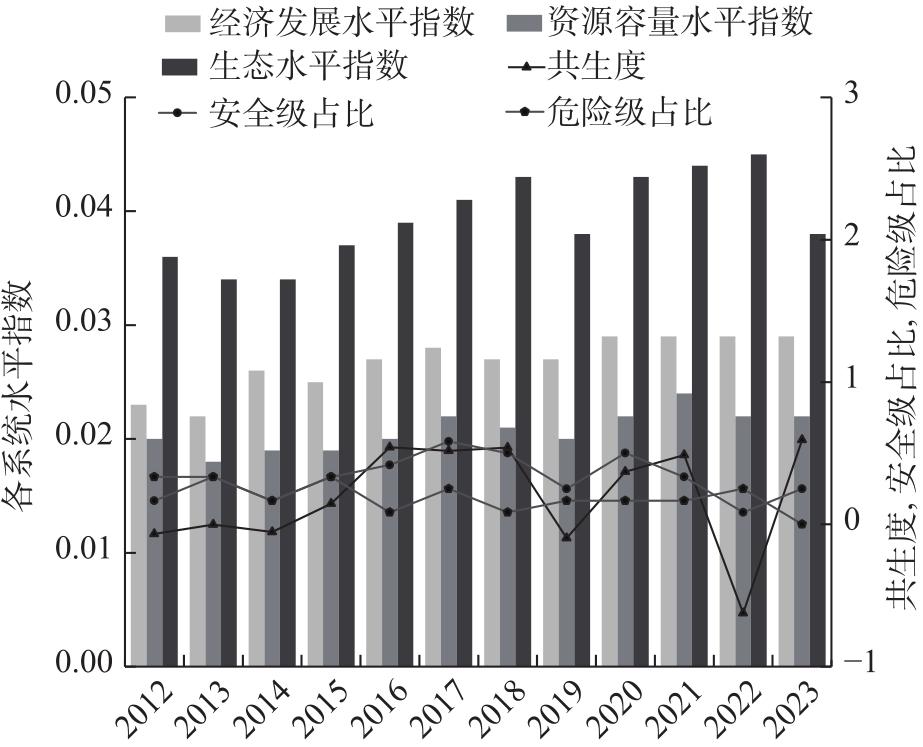
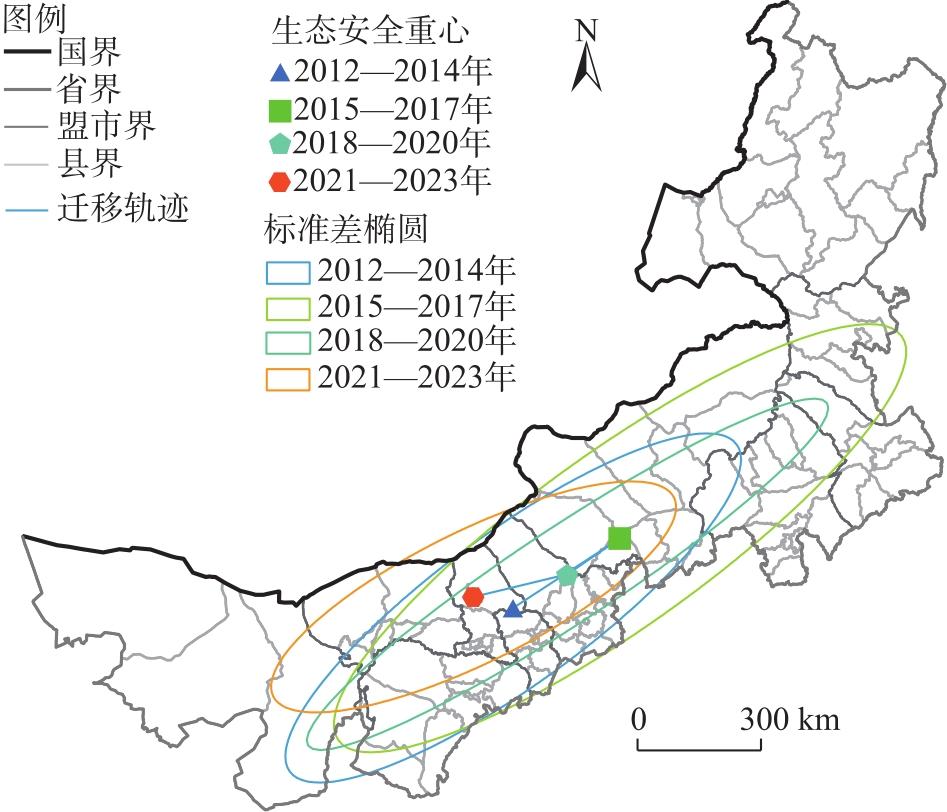
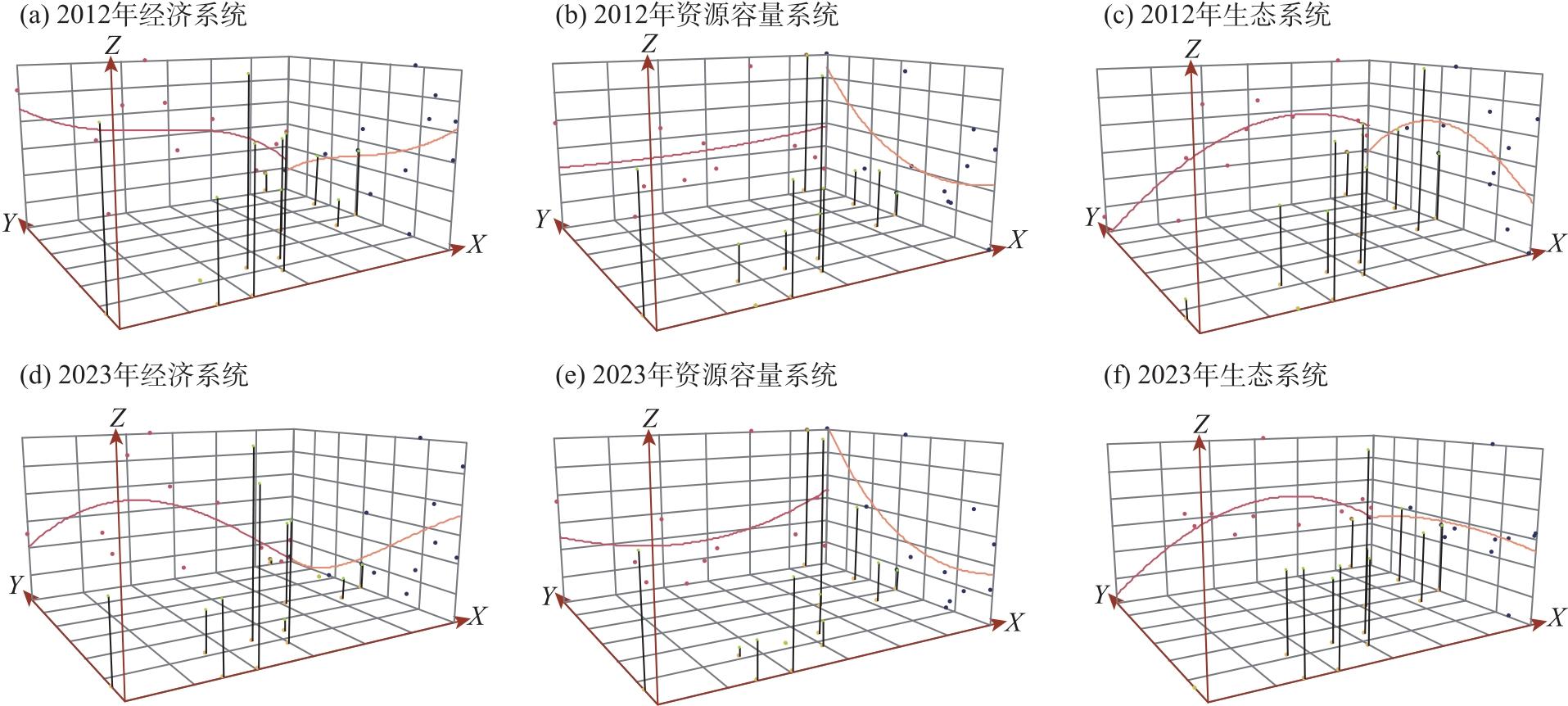
Ecological security is a key component of national security. It is very important to scientifically assess the state of ecological security to optimize the scientific management of regional ecosystems, enhancing ecological conservation and promoting high-quality development. This study constructs an ecological security evaluation index system based on the driving forces-pressures-state-impacts-responses (DPSIR) framework, introduces the ecological niche width into the Lotka-Volterra model, and uses the center-of-gravity standard deviation ellipse analysis, radar charts, and trend surface analysis to identify the temporal and spatial characteristics of ecological security in Inner Mongolia of China, as well as the trade-off relationship between the ecological and economic systems, from 2012 to 2023. The findings indicate the following: (1) The ecological security situation in Inner Mongolia showed an overall improvement from 2012 to 2023. The type of ecological security gradually shifted from red-risk to blue sub-security, with the proportion of safe areas increasing from 16.67% in 2012 to 25.00% in 2023 and the proportion of dangerous areas decreasing from 33.33% in 2012 to 0% in 2023. The level of ecological and economic symbiosis showed an upward trend. (2) In terms of spatial distribution of safety, the number of red-risk leagues and cities has decreased across the eastern, central, and western regions Inner Mongolia. By 2023, all regions had transitioned to at least the sensitive zone or higher, predominantly distributed in recovery and safe zones. Both Alagxa League in the west and Hulun Buir City in the east showed significant fluctuations, indicating unstable ecological security. (3) The ecological security center of gravity witnessed a trend of migration from the northeast to the southwest. Likewise, the ecological security standard deviation ellipse also exhibited an evolution trend, first expanding to the northeast and then becoming concentrated in the southwest. (4) The ecological niche widths of economic and ecological systems were relatively high in the central leagues and cities, with a good overall symbiotic condition between ecology and economy, with the ecological and economic systems of the eastern and western leagues being still in a competitive state, where the symbiosis between systems requires further improvement. These findings provide actionable insights for the optimization of ecological security governance in Inner Mongolia, and they offer an important reference value for assessments of ecological vulnerability in analogous regions nationwide.
Xuemin LI , Feifei WANG , Zhenguo WU , Yunkai ZHANG , Yueming PAN . Ecological security status of Inner Mongolia based on ecological niche and the Lotka-Volterra model[J]. Arid Land Geography, 2025 , 48(11) : 1995 -2004 . DOI: 10.12118/j.issn.1000-6060.2024.709
表1 生态安全测度指标体系Tab. 1 Indicator system of ecological security measurement |
| 系统层 | 子系统层 | 指标层 | 属性 |
|---|---|---|---|
| 经济发展 水平指数 | 驱动力 | 常住人口城镇化率/% | 正 |
| 第三产业与第二产业增加值之比/% | 正 | ||
| 城市建设用地占市区面积比例/% | 正 | ||
| 工业企业数/个 | 正 | ||
| 人均GDP/元·人-1 | 正 | ||
| 农牧区居民人均可支配收入/元·人-1 | 正 | ||
| 城镇居民人均可支配收入/元·人-1 | 正 | ||
| 就业率/% | 正 | ||
| 固定资产投资/108元 | 正 | ||
| 资源环境 容量指数 | 状态 | 人均城市建设用地面积/km2·(104人)-1 | 正 |
| 人均水资源占有量/m3·人-1 | 正 | ||
| 人均公园绿地面积/m2·人-1 | 正 | ||
| 人均城市道路面积/m2·人-1 | 正 | ||
| 优良天数比例/% | 正 | ||
| 人均草原面积/hm2·人-1 | 正 | ||
| 影响 | 人口自然增长率/% | 负 | |
| 常住人口密度/人·km-2 | 负 | ||
| 森林覆盖率/% | 正 | ||
| 降水量/mm | 正 | ||
| 草地固碳量/t CO2·hm-2 | 正 | ||
| 水源涵养量/t CO2·hm-2 | 正 | ||
| 第三产业比重/% | 正 | ||
| 生态保护 水平指数 | 压力 | 万元GDP能耗/t·(104元)-1 | 负 |
| 万元GDP废水排放量/t·(104元)-1 | 负 | ||
| 万元GDP废气排放量/t·(104元)-1 | 负 | ||
| 人均生活用水量/t·人-1 | 负 | ||
| 人均生活用电量/kW·h·人-1 | 负 | ||
| 响应 | 建成区绿化覆盖率/% | 正 | |
| 节能环保财政支出占GDP比重/% | 正 | ||
| 污水处理厂集中处理率/% | 正 | ||
| 生活垃圾无害化处理率/% | 正 | ||
| 工业固体废物综合利用率/% | 正 |
表2 生态安全状态和颜色表征Tab. 2 Ecological security status and color representation |
| 生态系统受力指数 | 共生度指数 | 对应关系 | 生态安全状态 | 颜色表征 |
|---|---|---|---|---|
| >0 | 1< < | 二者互利共生 | 安全级 | 绿色 |
| >0 | 0< <1 | 生态获强利经济受弱害 | 亚安全级 | 蓝色 |
| <0 | 0< <1 | 生态受弱害经济获强利 | 康复级 | 黄色 |
| >0 | -1< <0 | 生态获弱利经济受强害 | 敏感级 | 橙色 |
| <0 | -1< <0 | 生态受强害经济获弱利 | 风险级 | 紫色 |
| <0 | - < <1 | 二者互相损害 | 危险级 | 红色 |
注: 为生态系统受力指数; 为共生度指数。 |
| [1] |
陈振, 张宇, 郭杰, 等. 基于生态安全格局优化的土地利用及生态系统服务价值情景模拟[J]. 水土保持研究, 2025, 32(4): 375-385.
[
|
| [2] |
赵隆莲, 曹广超, 闫欣, 等. 基于InVEST模型和电路理论的生态安全格局识别——以青海省海南藏族自治州为例[J]. 水土保持通报, 2025, 45(1): 137-146.
[
|
| [3] |
|
| [4] |
|
| [5] |
|
| [6] |
|
| [7] |
|
| [8] |
李伊彤, 荣丽华, 李文龙, 等. 生态重要性视角下东北林区县域生态安全格局研究——以呼伦贝尔市阿荣旗为例[J]. 干旱区地理, 2022, 45(5): 1615-1625.
[
|
| [9] |
何刚, 阮君, 赵杨秋, 等. 基于Lotka-Volterra共生模型的区域生态安全动态评价[J]. 安全与环境学报, 2022, 22(3): 1641-1650.
[
|
| [10] |
李杨, 李海东, 施卫省, 等. 基于神经网络的土壤重金属预测及生态风险评价[J]. 长江流域资源与环境, 2017, 26(4): 591-597.
[
|
| [11] |
徐美, 刘春腊. 张家界市旅游生态安全评价及障碍因子分析[J]. 长江流域资源与环境, 2018, 27(3): 605-614.
[
|
| [12] |
曹新向. 旅游地生态安全评价模型及实证研究——基于生态足迹模型的分析[J]. 经济地理, 2006, 26(6): 1062-1066.
[
|
| [13] |
李子君, 王硕, 马良, 等. 基于熵权物元模型的沂蒙山区土地生态安全动态变化及其影响因素研究[J]. 土壤通报, 2021, 52(2): 425-433.
[
|
| [14] |
杨屹, 胡蝶. 生态脆弱区榆林三维生态足迹动态变化及其驱动因素[J]. 自然资源学报, 2018, 33(7): 1204-1217.
[
|
| [15] |
李姣, 周翠烟, 张灿明, 等. 基于生态足迹的湖南省洞庭湖生态经济区全要素生态效率研究[J]. 经济地理, 2019, 39(2): 199-206.
[
|
| [16] |
吴艳霞, 李宇殊, 王彦龙. 黄河流域生态城镇化水平测度[J]. 环境科学与技术, 2020, 43(7): 224-236.
[
|
| [17] |
吴艳霞, 罗恒, 梁志康. 长江经济带生态安全测度研究[J]. 生态学报, 2020, 40(19): 6761-6775.
[
|
| [18] |
胡悦, 马静, 李雪燕, 等. 京津冀地区生态安全评价及障碍因子诊断[J]. 环境污染与防治, 2021, 43(2): 206-210, 236.
[
|
| [19] |
穆学青, 郭向阳, 明庆忠, 等. 黄河流域旅游生态安全的动态演变特征及驱动因素[J]. 地理学报, 2022, 77(3): 714-735.
[
|
| [20] |
周甜甜, 王文平. 基于Lotka-Volterra模型的省域产业生态经济系统协调性研究[J]. 中国管理科学, 2014, 22(增刊1): 240-246.
[
|
| [21] |
李欣, 方斌, 殷如梦, 等. 江苏省县域“三生”功能时空变化及协同/权衡关系[J]. 自然资源学报, 2019, 34(11): 2363-2377.
[
|
| [22] |
戴文渊, 张清华, 史权, 等. 2003—2022年黄河流域甘肃段水生态安全协同驱动机制研究[J/OL]. 干旱区地理. [2025-05-22]. http://kns.cnki.net/kcms/detail/65.1103.x.20250318.1109.00-1.html.
[
|
| [23] |
王松茂, 牛金兰. 山东半岛城市群城市生态韧性的动态演化及障碍因子分析[J]. 经济地理, 2022, 42(8): 51-61.
[
|
| [24] |
周杰, 高芬. 草原生态环境与畜牧业经济耦合协调关系分析——以内蒙古自治区为例[J]. 生态经济, 2019, 35(5): 170-176.
[
|
| [25] |
修晓敏, 吴波, 费兵强, 等. 基于Meta分析的毛乌素沙地荒漠化动态研究[J]. 干旱区地理, 2024, 47(12): 2051-2063.
[
|
| [26] |
望元庆, 宋书愉, 王杰, 等. 2000—2018年内蒙古沙区“生态-经济-社会”复合系统脆弱性演变及关键影响因素[J]. 生态学报, 2023, 43(6): 2271-2286.
[
|
| [27] |
邓祥征, 钟海玥, 白雪梅, 等. 中国西部城镇化可持续发展路径的探讨[J]. 中国人口·资源与环境, 2013, 23(10): 24-30.
[
|
/
| 〈 |
|
〉 |