
Climatology and Hydrology

Variation characteristics and influencing factors of air negative ion concentration in summer residential areas of Xining City

  • Honglu MA , 1, 2 ,
  • Donglin QI , 1, 2 ,
  • Tong ZHAO 1, 2 ,
  • Xiaoyun CAO 1, 2 ,
  • Quanning ZHAO 1, 2 ,
  • Rui ZHANG 1, 2
Expand
  • 1. Institute of Qinghai Meteorological Science Research, Xining 810001, Qinghai, China
  • 2. Qinghai Key Laboratory of Disaster Preventing and Reducing, Xining 810001, Qinghai, China

Received date: 2023-08-14

  Revised date: 2023-10-10

  Online published: 2026-03-11

Abstract

Positive and negative air ion concentrations were monitored in a typical residential area of Xining City, Qinghai Province, China, from May to October 2022. The temporal distribution characteristics of negative air ion concentration were analyzed, and air freshness and cleanliness were evaluated. The correlation between negative air ion concentration and concurrent meteorological conditions and air pollutant concentrations was investigated. The following are the study findings: (1) The negative air ion concentration in a typical residential areas of Xining City is higher in the morning than in the afternoon and night. The negative air ion concentrations from August to October are higher than those from May to July. (2) The change in the negative air ion concentrations in the Xining residential area is closely related to weather conditions during monitoring, following the pattern of “rainy>cloudy>sunny”. (3) High concentrations of negative air ions indicate that air is fresh but do not necessarily mean that air is clean. On sunny days, the negative air ion concentration in plateau cities are not high and air freshness is moderate; however, air cleanliness is high. (4) Relative humidity, sunshine hours, water vapor pressure, precipitation, and wind speed mainly affect the change in negative air ion concentration. Concentrations of NO2, PM10, CO, and PM2.5 inhibit the increase of negative air ion concentration. The results provide scientific data supporting living environment improvement, tourism health management, and ecological environmental protection in plateau areas.

Cite this article

Honglu MA , Donglin QI , Tong ZHAO , Xiaoyun CAO , Quanning ZHAO , Rui ZHANG . Variation characteristics and influencing factors of air negative ion concentration in summer residential areas of Xining City[J]. Arid Land Geography, 2024 , 47(8) : 1358 -1366 . DOI: 10.12118/j.issn.1000-6060.2023.428

空气负离子是空气中带负电荷的单个气体分子和轻离子团总称[1],空气负离子被誉为“空气维生素”,不仅能够抑尘杀菌,改善空气质量,还能促进人体新陈代谢,增强机体免疫力,成为评判空气新鲜度和人居环境质量的正向指标[2-4]
目前,有关空气负离子的研究多聚焦于生态功能区域不同植被、绿地类型的浓度变化规律及其气象影响因素[5-13],监测地点多布设在景区、森林公园等植被覆盖度较高区域,有关城市居民区空气负离子的观测研究相对较少。由于空气负离子受到植被类型、水源分布、人类活动、气象、环境要素等多种因素影响[14-15],其浓度时空分布规律和影响因子具有显著的区域性差异。刘晴等[12]观测2015年泰安市居民住宅区4月晴天空气负离子浓度发现,空气负离子最大值和最小值分别出现在上午10:00和下午18:00,气温和相对湿度是影响其变化的主要气象因子。袁相洋等[16]在北京市生活区连续观测3 d空气负离子浓度变化发现,北京市生活区负离子浓度峰值出现在上午9:00—10:00和午后14:00,且空气负离子浓度与空气湿度呈正相关,与气温呈负相关。韦朝领等[17]在晴天的研究发现,合肥市生活居住区空气负离子浓度最大值出现的时间具有季节性,春季最大值出现在上午8:00—10:00,夏、秋、冬季最大值出现在下午14:00,影响合肥市空气负离子浓度的最主要气象因子是空气相对湿度,其次是光照强度和气温。
尽管已有研究开展了居民生活区空气负离子浓度时空变化规律及影响因素研究,然而研究城市大多集中在平原地区且观测时间较短,观测时段大都选择晴天,有关高原地区居民生活区域空气负离子浓度变化及其影响因素的长时序人工观测研究相对较少。本研究在青藏高原东北部的青海省西宁市典型居民区设置观测点位,于2022年5—10月进行人工观测,评价其空气清新度和清洁度,探讨了同期气象因素和环境污染物浓度对空气负离子浓度的影响,以期为当地居民日常生活出行提供参考,为综合评价城市大气环境质量提供科学依据。

1 数据与方法

1.1 研究区概况

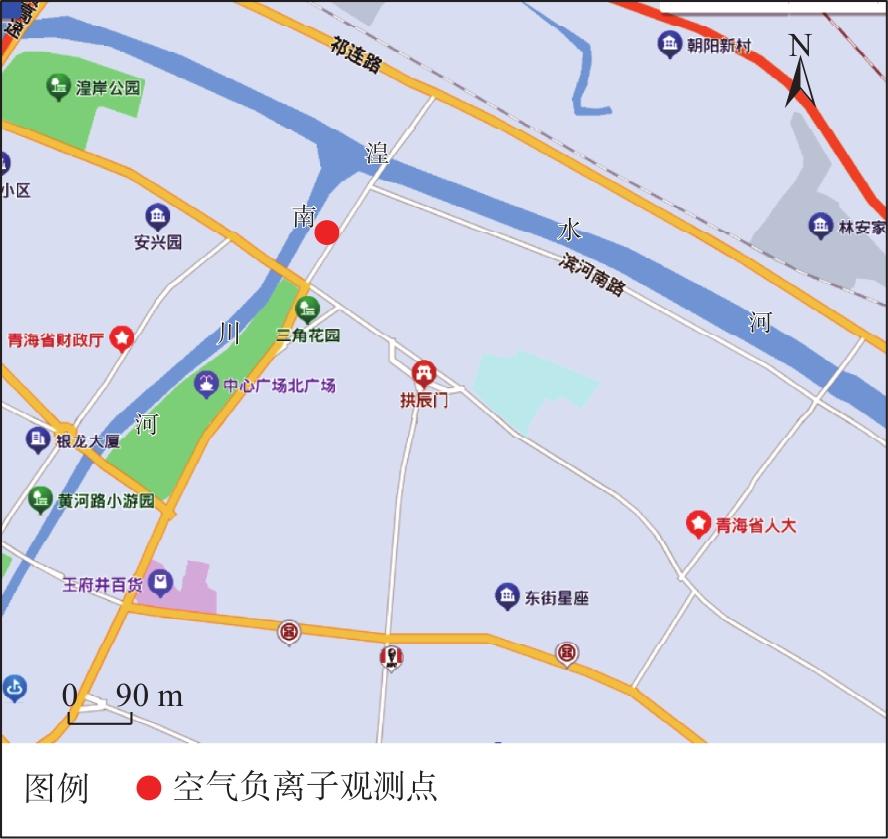
青海省西宁市位于青藏高原东北部,属于大陆性高原半干旱气候,平均海拔2261 m,全年平均日照时数2510.1 h,年平均降水量500 mm左右,蒸发量1363.6 mm,年平均气温5.5 ℃,最高气温34.6 ℃,最低气温-18.9 ℃,夏季平均气温17~19 ℃,气候宜人,是消夏避暑胜地,有“中国夏都”之称。本研究中空气离子观测点设在西宁市报社家属院(36.6304°N,101.7803°E,海拔2195.4 m),报社家属院地处西宁市城中区,西邻南川河,北靠湟水河,南有植被较茂盛的三角花园和中心广场(图1),周边生态环境较好。
图1 西宁居民区空气负离子观测点位示意图

Fig. 1 Monitoring point location of negative air ion in residential areas of Xining City

1.2 数据来源

采用日本COM-3200PRO空气负离子检测仪进行测定,该仪器的离子测量范围为0~2×10⁶ 个·cm-3,离子分解能力为10 个·cm-3,温度测量范围为0~50 ℃,精度为1.0 ℃,相对湿度测量范围为0~100%,精度为5%,每月进行一次仪器归零校正,保证仪器进风口封堵后正、负(氧)离子浓度值为零,每周用无水酒精对仪器进风口清洁一次。采样高度为距离地面1.5 m,每次测定记录同一位置东南西北4个方向的瞬时数值,取4个方向的平均值作为正、负离子值,同步记录温度及相对湿度。2022年5月1日—10月31日期间,每天6:00—21:00(北京时)进行不定时人工观测。主要观测指标为空气正、负离子浓度、空气温度及相对湿度,共获取814组有效数据。不同时段空气负离子平均浓度由该时段内不同时刻瞬时浓度之和除以观测次数所得,日均浓度由每日观测值之和除以观测次数所得,月均浓度由该月逐日平均值之和除以月内观测日数所得。观测同期气压、水汽压、风速、降水量和日照时数等气象数据来源于西宁市小酉山气象站(36.6667°N,101.7333°E,海拔2334.2 m),PM2.5、PM10、SO2、NO2、O3和CO等空气污染物浓度来源于西宁市环境监测站(36.6395°N,101.7471°E,海拔2261.3 m)。

1.3 研究方法

本研究参照中国气象行业标准QX/T380-2017《空气负(氧)离子浓度等级》[18]进行空气负离子浓度等级划分和清新度评价,采用安倍空气离子评价系数模型法(CI法)对空气清洁度进行评价[19]。本研究中以云的面积占据天空的百分比作为不同天气状况的判别依据,云量在0~10%为晴天,10%~30%为少云,30%~70%为多云,大于70%为阴天。采用SPSS软件进行相关性分析,因观测数据不符合正态分布,也非等间隔数据,不满足Pearson和Spearman相关性分析前提条件,故采用肯德尔相关性分析,并运用Origin软件进行绘图。
中国气象行业标准QX/T380-2017《空气负(氧)离子浓度等级》规定(表1),每立方厘米空气中负离子含量在1200个以上为空气清新,500~1200个为空气较清新,100~500个为空气一般,小于100为空气不够清新。
表1 空气负离子浓度等级

Tab. 1 Grade of negative air ion concentration

浓度等级 空气负离子浓度(N 说明
Ⅰ级 N≥1200 浓度高,空气清新
Ⅱ级 500≤N<1200 浓度较高,空气较清新
Ⅲ级 100≤N<500 浓度中,空气一般
Ⅳ级 0<N<100 浓度低,空气不够清新
单级系数指空气中正离子数与负离子数的比值:
q = n + n -
式中:q为单级系数; n +为空气中正离子数; n -为空气中负离子数。
安倍空气离子评价系数指空气中接近自然界空气离子化水平的程度:
C I = n - 1000 × q
式中:CI为安倍空气离子评价系数。1000个·cm-3的负氧离子数为人体最基本的需要标准,CI值越大,空气质量越好,空气清洁度等级标准见表2
表2 空气清洁度等级标准

Tab. 2 Air cleanliness class standard

评价指标 清洁度等级
A B C D E
空气清洁度 最清洁 清洁 中等 容许 临界值
CI ≥1.00 (1.00, 0.70] (0.70, 0.50] (0.50, 0.30] <0.30

注:CI为安倍空气离子评价系数。下同。

2 结果与分析

2.1 空气负离子浓度时间变化特征

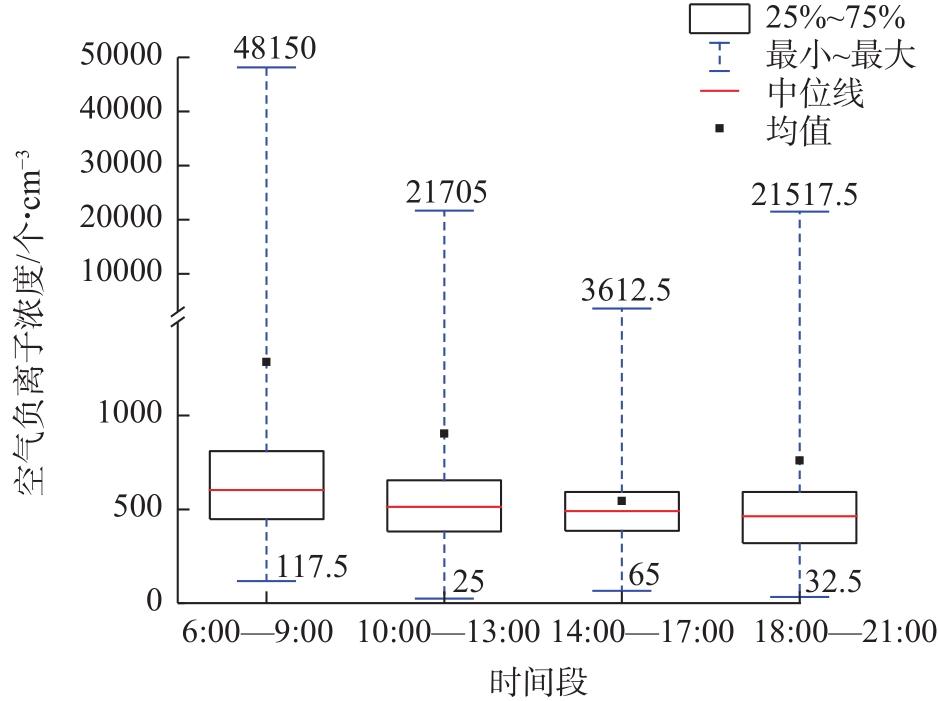
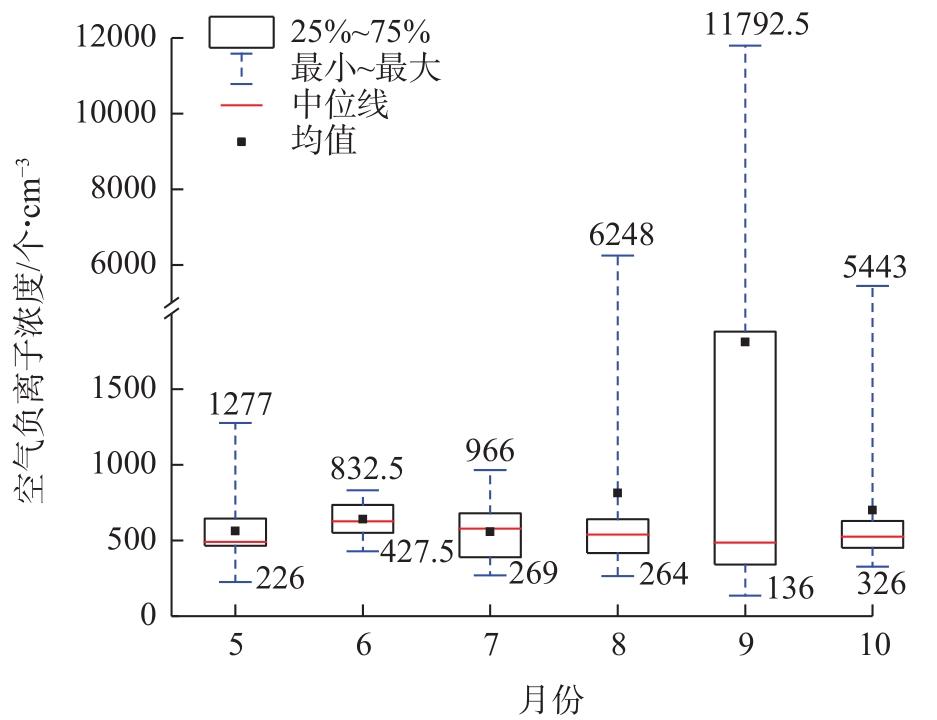
2022年5—10月西宁市报社家属院空气负离子浓度变化具有明显的时间差异。图2为西宁市报社家属院5—10月不同时段空气负离子浓度变化。可以看出,不同时段空气负离子浓度变化特征差异较大,空气负离子浓度最大值为48150 个·cm-3,出现在6:00—9:00,空气负离子浓度最小值为25 个·cm-3,出现在10:00—13:00。空气负离子平均浓度日变化呈倒对钩型曲线,上午6:00—9:00出现峰值,谷值出现在14:00—17:00,空气负离子浓度大小排序为6:00—9:00(1286 个·cm-3)>10:00—13:00(904 个·cm-3)>18:00—21:00(759 个·cm-3)>14:00—17:00(545 个·cm-3)。从西宁市报社家属院5—10月空气负离子日均浓度变化可知(图3),空气负离子日均浓度变化存在季节性差异,浓度大小排序为9月(1811.2 个·cm-3)>8月(812.4 个·cm-3)>10月(700 个·cm-3)>6月(640.9 个·cm-3)>5月(562.4 个·cm-3)>7月(556.8 个·cm-3)。整体上,2022年5—10月西宁市报社家属院上午的空气负离子浓度高于下午及晚上,8—10月的空气负离子浓度高于5—7月。影响空气负离子浓度变化的因素众多,本研究主要探究气象条件和空气污染情况对其浓度变化的敏感性。
图2 西宁市居民区不同时段空气负离子浓度变化

Fig. 2 Daily variations of negative air ion concentration in residential region of Xining City

图3 西宁市居民区空气负离子日均浓度变化

Fig. 3 Monthly variations of daily everage negative air ion concentration in residential areas of Xining City

2.2 不同天气状况下空气负离子浓度变化特征

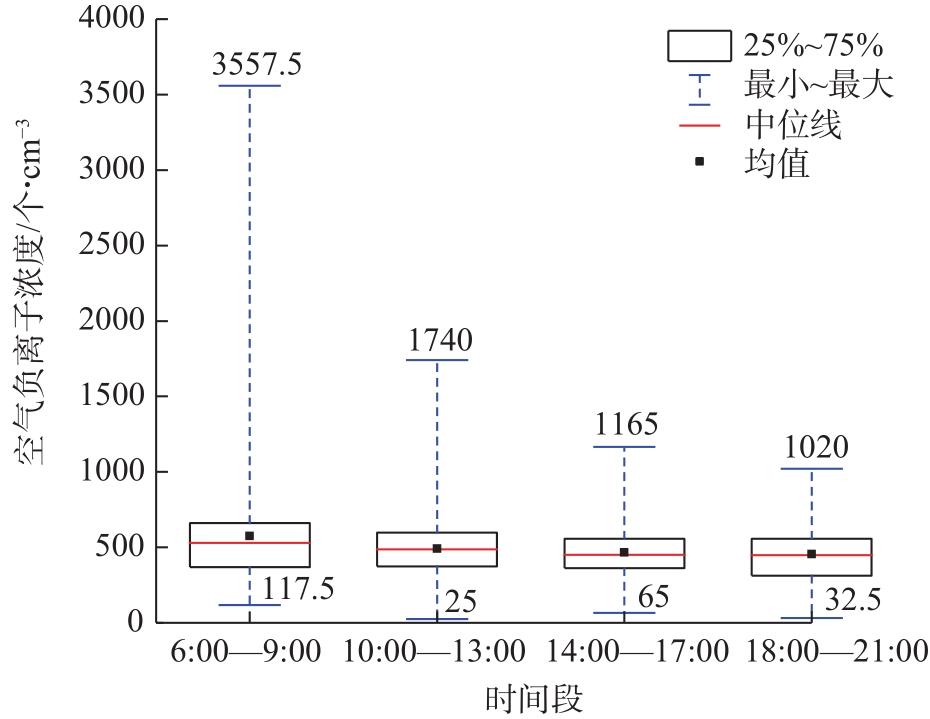
研究发现,天气状况对空气负离子浓度有显著影响[19-20]。通过对比西宁市报社家属院5—10月不同天气状况下的空气负离子浓度发现,空气负离子浓度最大值出现时天气状况为雨天,最小值出现时天气状况为多云,引起不同时段空气负离子浓度变化特征差异较大的原因可能跟监测时的天气状况有关。因此,接着对比分析不同月份空气负离子浓度及监测时的天气状况。表3为5—10月不同天气状况下空气负离子浓度。从表中发现,西宁市报社家属院9月空气负离子日均浓度高于其他月份,9月空气负离子浓度监测时段常为雨天,且雨天监测的负离子浓度均大于5000 个·cm-3,均值为8299.5 个·cm-3图4为5—10月晴天不同时段空气负离子浓度变化。晴天不同时段空气负离子平均浓度相差不大,空气负离子浓度最大值同样出现在早上6:00—9:00,该时段空气负离子浓度变化范围为117.5~3557.5 个·cm-3,平均浓度为574.5 个·cm-3,相比其他时段平均浓度高约100 个·cm-3,进一步说明天气状况对空气负离子浓度影响较大。耿生莲等[21]于2014年晴天观测西宁市省委家属院空气负离子浓度变化,发现7:00—19:00期间空气负离子浓度变化范围为305~742.8 个·cm-3。本研究中晴天空气负离子浓度最大值为3557.5 个·cm-3,相比耿生莲等[21]的研究结果约高出4.8倍,这可能与本研究居民区观测点靠近水体有关。
表3 不同天气状况下西宁市居民区空气负离子浓度

Tab. 3 Negative air ion concentration of residential areas of Xining City in different weather condition /个·cm-3

月份 晴天 多云 阴天 雨天 平均
5 (85~922.5)
477.17
(120~1545)
516.62
(82.5~1565)
639.46
(240~2300)
804.55
(82.5~2300)
558.89
6 (365~757.5)
588.17
(290~912.5)
627.8
(400~1135)
711.09
(477.5~1097.5)
787.5
(290~1135)
645.19
7 (65~1020)
440.61
(130~1232.5)
606.81
(122.5~1870)
563.8
(322.5~1365)
775
(65~1870)
536.12
8 (257.5~640)
391.56
(192.5~2170)
450.65
(225~13310)
986.9
(672.5~48150)
5880
(182.5~48150)
1347.14
9 (102.5~3557.5)
495.22
(25~28270)
969.63
(157.5~14302.25)
2083.75
(632.5~26250)
8299.5
(25~28270)
2003.31
10 (177.5~755)
475.63
(50~1165)
590.66
(272.5~7257.5)
700.75
(357.5~21705)
7392.08
(50~21705)
835.79
平均 478.06 627.03 947.63 3989.77 -

注:括号中数值为空气负离子浓度变化范围,括号下方数值为空气负离子浓度平均值。

图4 晴天下西宁市居民区不同时段空气负离子浓度变化

Fig. 4 Daily variations of negative air ion concentration of residential areas of Xining City in sunny days

2022年5—10月西宁市报社家属院不同天气状况下空气负离子平均浓度分别为晴天478.06 个·cm-3、多云627.03 个·cm-3、阴天947.63 个·cm-3、雨天3989.77 个·cm-3,遵循“雨天>阴天>多云>晴天”的变化规律。雨水从空中降落至地面过程中与空气产生摩擦,与地面树木、建筑等发生碰撞产生勒纳德效应[22],加快了空气中的正负电荷分离,从而使空气中的负离子浓度增加。综上所述,监测时段的天气状况对西宁市报社家属院的空气负离子浓度影响较大,且雨天空气负离子浓度最高,晴天空气负离子浓度最低,具体影响因子可进一步探究监测时段气象条件与空气负离子浓度的关系。

2.3 空气清新度和清洁度评价

空气中的正、负离子浓度能够反映当地的空气清新度和清洁度。使用2022年5—10月西宁市报社家属院空气正负离子浓度数据,对其进行浓度等级划分和清新度评价并使用CI法进行空气清洁度评价。表4为西宁市报社家属院不同时段及天气状况下空气负离子浓度等级、单极系数(q)以及CI法空气清洁度评价结果。结果表明,8—10月西宁市报社家属院雨天空气中正、负离子浓度差异极大,负离子浓度远高于正离子浓度。8—9月西宁市报社家属院空气清新度高于5—7月和10月。5—10月各种天气状况下空气负离子平均浓度分别为558.89 个·cm-3、645.19 个·cm-3、536.12 个·cm-3、1347.14 个·cm-3、2003.31 个·cm-3和835.79 个·cm-3表3)。其中,8—9月空气负离子平均浓度大于1200 个·cm-3,空气清新;5—7月和10月空气负离子平均浓度处于500~1200 个·cm-3之间,空气较为清新。从不同时段来看,5—6月空气清新度较稳定,6:00—21:00空气均较清新;7月6:00—21:00空气清新度变化趋势为“较清新-一般-较清新-较清新”;8月上午6:00—9:00空气清新,10:00—21:00空气清新度有所下降;9月6:00—21:00空气清新度变化趋势为“清新-较清新-较清新-清新”;10月6:00—21:00空气清新度变化起伏最大,为“较清新-清新-较清新-一般”。从不同天气状况来看,西宁市报社家属院5—10月晴天空气清新度一般,雨天条件下,8—10月空气清新度高于5—7月。
表4 西宁市居民区空气负离子浓度等级及清洁度评价结果

Tab. 4 Assessment result of negative air ion concentration grade and cleanliness for residential areas of Xining City

月份 天气状况 6:00—9:00 10:00—13:00 14:00—17:00 18:00—21:00 雨天 阴天 多云 晴天 平均
5
浓度等级 Ⅱ级 Ⅱ级 Ⅱ级 Ⅱ级 Ⅱ级 Ⅱ级 Ⅱ级 Ⅲ级 Ⅱ级
q 1.64 1.75 1.47 1.54 1.14 1.56 1.57 1.73 1.59
CI 0.45 0.49 0.46 19.34 117.30 0.56 0.43 0.38 5.77
清洁度等级 D D D A A C D D A
6 浓度等级 Ⅱ级 Ⅱ级 Ⅱ级 Ⅱ级 Ⅱ级 Ⅱ级 Ⅱ级 Ⅱ级 Ⅱ级
q 1.21 1.02 1.47 1.15 1.54 1.13 1.24 1.28 1.24
CI 0.64 0.85 0.42 0.63 0.57 0.71 0.59 0.53 0.60
清洁度等级 C B D C C B C C C
7 浓度等级 Ⅱ级 Ⅲ级 Ⅲ级 Ⅱ级 Ⅱ级 Ⅱ级 Ⅱ级 Ⅲ级 Ⅱ级
q 1.26 1.79 2.37 1.01 1.11 1.36 1.31 1.71 1.48
CI 6.46 0.54 2.02 0.93 9.22 5.85 0.58 0.43 2.67
清洁度等级 A C A B A A C D A
8 浓度等级 Ⅰ级 Ⅱ级 Ⅱ级 Ⅱ级 Ⅰ级 Ⅱ级 Ⅲ级 Ⅲ级 Ⅰ级
q 0.74 1.24 1.48 1.20 0.39 0.98 1.38 1.70 1.08
CI 14914.71 0.81 1.10 1363.30 42807.48 818.12 35.54 0.33 5341.15
清洁度等级 A B A A A A A D A
9 浓度等级 Ⅰ级 Ⅱ级 Ⅱ级 Ⅰ级 Ⅰ级 Ⅰ级 Ⅱ级 Ⅲ级 Ⅰ级
q 0.63 2.92 1.56 1.38 0.01 0.61 2.42 1.10 1.42
CI 5476.50 273.64 144.74 3339.30 26980.20 2918.55 2779.51 119.42 4976.14
清洁度等级 A A A A A A A A A
10 浓度等级 Ⅱ级 Ⅰ级 Ⅱ级 Ⅲ级 Ⅰ级 Ⅱ级 Ⅱ级 Ⅲ级 Ⅱ级
q 0.38 0.75 0.98 1.01 0.17 0.82 0.66 0.86 0.77
CI 23.52 4616.10 1.05 0.91 28006.13 235.59 11.26 0.80 1104.39
清洁度等级 A A A B A A A B A

注:q为单级系数。

使用CI法评价的空气清洁度与使用空气负离子浓度等级划分的空气清新度有所不同。西宁市报社家属院5—10月不同时间段的空气清洁度变化存在季节性差异。从7月开始,西宁市报社家属院空气清洁度明显高于5—6月。整体上,8—10月空气清洁度均较高,明显高于5—7月。从天气状况来看,西宁市报社家属院5—10月空气清洁度均表现为“雨天>阴天>多云>晴天”,该变化规律与上文不同天气状况下的空气负离子浓度变化保持一致。
综上所述,西宁市报社家属院8—10月空气负离子浓度高于5—7月,8—10月空气清洁度高于5—7月,而空气清新度变化与之有所不同,8—9月空气清新度高于5—7月和10月,造成空气清新度和清洁度评价结果不同的主要原因是空气中的正离子浓度。

2.4 空气负离子浓度与气象环境因素的关系

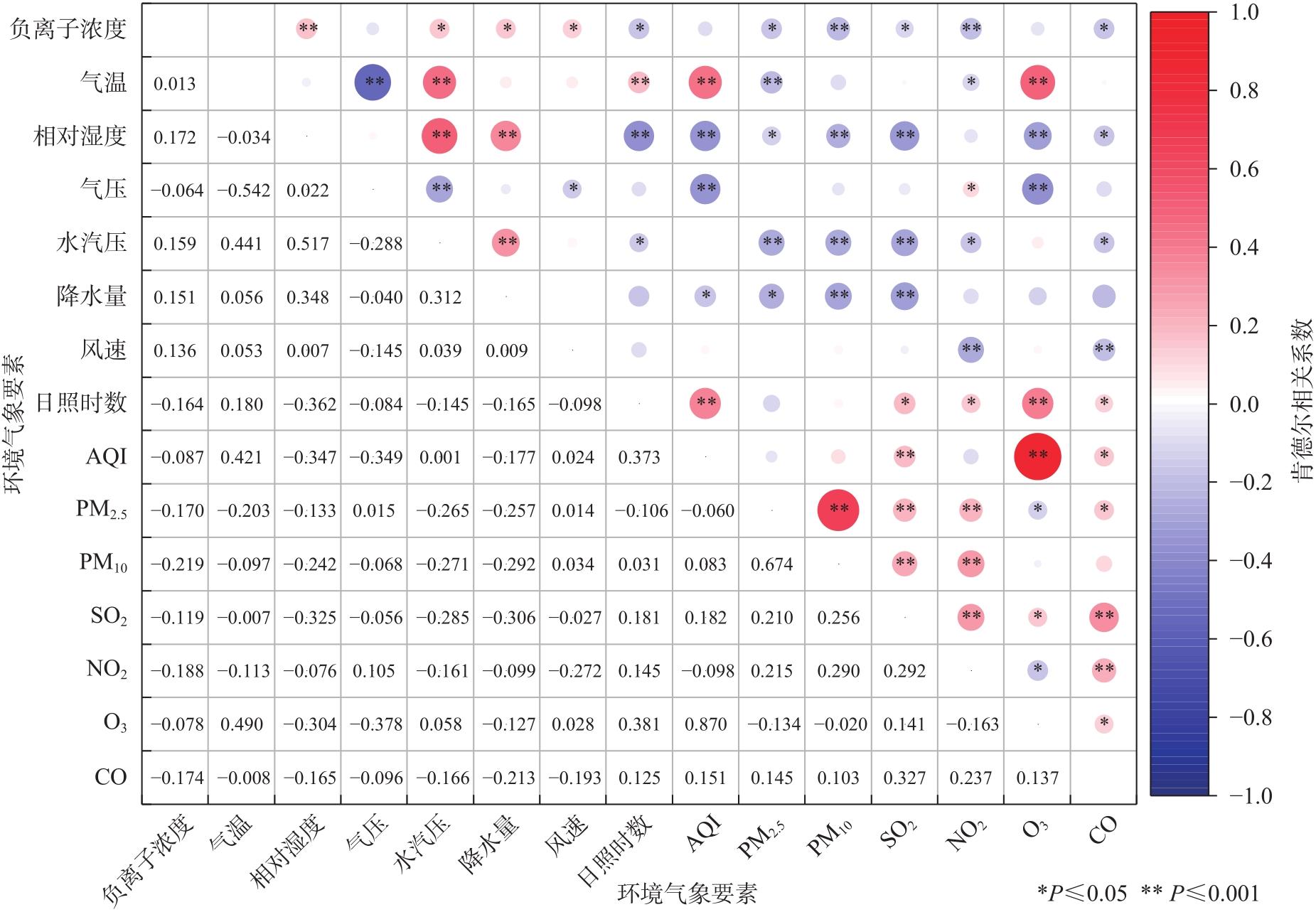
2022年5—10月西宁市报社家属院阴雨天空气负离子浓度高于晴天和多云天气,气象条件的不同可能会引起空气负离子浓度变化。为了进一步探究气象因素对西宁市报社家属院空气负离子浓度变化的影响,对空气负离子日均浓度与监测同期气温、气压、相对湿度、水汽压、降水量、风速和日照时数进行肯德尔相关性分析。空气负离子浓度与气象、环境因素之间的肯德尔相关系数(图5)可知,2022年5—10月西宁市报社家属院空气负离子浓度与相对湿度、水汽压、降水量和风速呈显著正相关,相关系数分别为0.172(P<0.001)、0.159(P<0.05)、0.151(P<0.05)和0.136(P<0.05)。空气负离子浓度与日照时数呈显著负相关相关系数为-0.164(P<0.05),这与上文提到的上午空气负离子浓度高于下午的现象一致。空气中的部分负离子来自于植物尖端放电和光合作用产生的光电效应[23],夏季下午气温高、光照强,植物叶片气孔关闭,光合作用强度减弱,空气中的负离子浓度随之降低,从而产生下午空气负离子浓度低于上午的现象。降水量与相对湿度(相关系数0.348,P<0.001)、水汽压(相关系数0.312,P<0.001)呈显著正相关,表明降水过程会使空气湿度增大、水汽压增高。由此可见,与晴天相比,雨天空气中的负离子浓度更高,且空气湿度越大、水汽压越高、风速越大,空气负离子浓度越高,空气越清新。
图5 西宁市居民区空气负离子浓度与环境气象要素相关系数

注: AQI表示空气质量指数。

Fig. 5 Meteorological and environmental correlation coefficient of negative air ion concentration in residential areas of Xining City

除了气象条件会影响空气负离子浓度,环境因素对空气负离子浓度也有一定程度的影响。其中,空气污染物对空气负离子有吸附作用[24-29],空气污染物浓度较高时会在一定程度上降低空气中的负离子浓度。对空气负离子日均浓度、同期AQI指数和空气污染物浓度做肯德尔相关性分析。由图5可知,2022年5—10月西宁市报社家属院的空气负离子日均浓度与同期PM2.5、PM10、SO2、NO2、CO浓度存在显著负相关,其相关系数分别为-0.170(P<0.05)、-0.219(P<0.001)、-0.119(P<0.05)、-0.188(P<0.001)和-0.174(P<0.05),与AQI指数也存在负相关关系但相关关系不显著。降水量与空气污染物浓度之间也存在显著的负相关性,其与PM2.5的相关系数为-0.257(P<0.05),与PM10的相关系数为-0.292(P<0.001),与SO2的相关系数为-0.306(P<0.001)。以上显著的相关性表明,高浓度的空气污染物能在一定程度上抑制空气负离子浓度的升高,其中PM10、NO2、CO和PM2.5对西宁市报社家属院空气负离子浓度升高的抑制作用更大。降水过程能降低空气污染物浓度,从而增加空气中的负离子浓度。

3 结论

(1) 2022年5—10月西宁市报社家属院空气负离子浓度变化具有明显的时间差异,上午空气负离子浓度高于下午及晚上;空气负离子月均浓度存在季节性变化特征,空气负离子浓度9月最高,7月最低。
(2) 2022年5—10月西宁市报社家属院空气负离子浓度变化跟观测时的天气状况密切相关,不同月份晴天空气负离子浓度变化不大,而阴雨天空气中的负离子浓度会显著升高,空气负离子浓度变化遵循“雨天>阴天>多云>晴天”的规律。
(3) 与空气负离子浓度变化保持一致,西宁市报社家属院5—10月空气清洁度均表现为“雨天>阴天>多云>晴天”,空气负离子浓度高代表空气清新,却不等同于空气清洁,高原地区城市居民区晴天空气负离子浓度虽然不高,空气清新度一般,空气清洁度却较高。
(4) 影响西宁市报社家属院空气负离子浓度波动的主要气象因素为相对湿度、日照时数、水汽压、降水量和风速,其中日照时数与空气负离子浓度呈显著负相关,相对湿度、水汽压、风速和降水量与空气负离子浓度呈显著正相关,其正相关程度依次减弱;抑制西宁市报社家属院空气负离子浓度升高的主要空气污染物为NO2、PM10、CO和PM2.5
[1]
余娟, 高占冬, 王德远, 等. 天缘洞空气负离子时空分布特征及影响因素分析[J]. 环境化学, 2021, 40(4): 1078-1087.

[Yu Juan, Gao Zhandong, Wang Deyuan, et al. Analysis of temporal and spatial distribution characteristics and influencing factors of air anions in Tianyuan cave[J]. Environmental Chemistry, 2021, 40(4):1078-1087.]

[2]
王薇, 余庄, 凤全. 基于空气负离子浓度的城市环境空气清洁度评价[J]. 生态环境学报, 2013, 22(2): 298-303.

[Wang Wei, Yu Zhuang, Feng Quan. Evaluation of air cleanness degree of the urban environment based on negative air ion concentration[J]. Ecology and Environmental Sciences, 2013, 22(2): 298-303.]

[3]
Liu S, Li C, Chu M T, et al. Associations of forest negative air ions exposure with cardiac autonomic nervous function and the related metabolic linkages: A repeated-measure-panel study[J]. Science of the Total Environment, 2022, 850: 158019, doi: 10.1016/j.scitotenv.2022.158019.

[4]
Liu S, Huang Q Y, Wu Y, el al. Metabolic linkages between indoor negative air ions, particulate matter and cardiorespiratory function: A randomized, double-blind crossover study among children[J]. Environment International, 2020, 138: 105663, doi: 10.1016/j.envint.2020.105663.

[5]
刘燕, 王业成, 王让会, 等. 南京浦口区大气负离子的时空特征及其与气象条件的关系[J]. 长江流域资源与环境, 2017, 26(5): 706-712.

[Liu Yan, Wang Yecheng, Wang Ranghui, et al. Spatiotemporal characteristics of negative air ions and its relationship with meteorological conditions in Pukou, Nanjing[J]. Resources and Environment in the Yangtze Basin, 2017, 26(5): 706-712.]

[6]
王一荃, 周璋, 李意德, 等. 不同热带森林空气负离子浓度评价研究[J]. 生态环境学报, 2021, 30(5): 898-906.

DOI

[Wang Yiquan, Zhou Zhang, Li Yide, et al. The spatial-temporal pattern and influencing factors of negative air ions in tropical forests, Hainan, China[J]. Ecology and Environmental Sciences, 2021, 30(5): 898-906.]

[7]
彭巍, 李明文, 王慧, 等. 空气负离子国内外研究进展及其在森林康养方面的积极作用综述[J]. 温带林业研究, 2020, 3(3): 11-14, 54.

[Peng Wei, Li Mingwen, Wang Hui, et al. A review of the research progress of negative air ion at home and abroad and its positive role in forest health[J]. Journal of Temperate Forestry Research, 2020, 3(3): 11-14, 54.]

[8]
Niu X, Li Y, Li M N, et al. Understanding vegetation structures in green spaces to regulate atmospheric particulate matter and negative air ions[J]. Atmospheric Pollution Research, 2022, 13: 101534, doi: 10.1016/j.apr.2022.101534.

[9]
Yan X J, Wang H R, Hou Z Y, et al. Spatial analysis of the ecological effects of negative air ions in urban vegetated areas: A case study in Maiji, China[J]. Urban Forestry & Urban Greening, 2015, 14: 636-645.

[10]
李少宁, 李嫒, 鲁绍伟, 等. 北京西山国家森林公园中空气负离子浓度与气象因子的相关性研究[J]. 生态环境学报, 2021, 30(3): 541-547.

DOI

[Li Shaoning, Li Yuan, Lu Shaowei, et al. Correlation between air anion concentration and meteorological factors in Beijing Xishan National Forest Park[J]. Ecology and Environmental Sciences, 2021, 30(3): 541-547.]

[11]
冯鹏飞, 于新文, 张旭. 北京地区不同植被类型空气负离子浓度及其影响因素分析[J]. 生态环境学报, 2015, 24(5): 818-824.

DOI

[Feng Pengfei, Yu Xinwen, Zhang Xu. Variations in negative air ion concentrations associated with different vegetation types and influencing factors in Beijing[J]. Ecology and Environmental Sciences, 2015, 24(5): 818-824.]

[12]
刘晴, 高鹏, 李成, 等. 泰安市典型生态功能区空气负离子的时空分布及影响因素分析[J]. 环境化学, 2019, 38(1): 169-176.

[Liu Qing, Gao Peng, Li Cheng, et al. Spatial-temporal distribution of negative air ions and its influencing factors in the typical ecological functional zones of Tai’an City[J]. Environmental Chemistry, 2019, 38(1): 169-176.]

[13]
张毓涛, 李吉玫. 新疆主要城市不同生态功能区夏季空气负离子特征[J]. 干旱区地理, 2012, 35(6): 864-874.

[Zhang Yutao, Li Jimei. Characteristics of air anion concentration in different ecological functional zones in summer in main cities of Xinjiang[J]. Arid Land Geography, 2012, 35(6): 864-874.]

[14]
Li A B, Li Q L, Zhou B Z, et al. Temporal dynamics of negative air ion concentration and its relationship with environmental factors: Results from long-term on-site monitoring[J]. Science of the Total Environment, 2022, 832: 155057, doi: 10.1016/j.scitotenv.2022.155057.

[15]
Wang H, Wang B, Niu X, et al. Study on the change of negative air ion concentration and its influencing factors at different spatio-temporal scales[J]. Global Ecology and Conservation, 2020, 23: e01008, doi: 10.1016/j.gecco.2020.e01008.

[16]
袁相洋, 孙迎雪, 田媛, 等. 北京市不同功能区空气负氧离子及影响因素研究[J]. 环境科学与技术, 2014, 37(6): 97-102.

[Yuan Xiangyang, Sun Yingxue, Tian Yuan, et al. Experimental research of air negative oxygen ion and their affecting factors in different ecological functional areas of Beijing[J]. Environmental Science & Technology, 2014, 37(6): 97-102.]

[17]
韦朝领, 王敬涛, 蒋跃林, 等. 合肥市不同生态功能区空气负离子浓度分布特征及其与气象因子的关系[J]. 应用生态学报, 2006, 17(11): 2158-2162.

[Wei Chaoling, Wang Jingtao, Jiang Yuelin, et al. Air negative charge ion concentration and its relationships with meteorological factors in different ecological functional zones of Hefei City[J]. Chinese Journal of Applied Ecology, 2006, 17(11): 2158-2162.]

PMID

[18]
QX/R 380-2017. 中华人民共和国气象行业标准: 空气负(氧)离子浓度等级[S]. 北京: 气象出版社, 2017.

[QX/R 380-2017. Meteorological Industry Standard of the People’s Republic of China: Grade of air negative (oxygen) ion concentration[S]. Beijing: China Meteorological Press, 2017.]

[19]
郁珍艳, 李正泉, 樊高峰, 等. 浙江省气象及环境因子对负氧离子浓度的影响分析[J]. 中国环境科学, 2023, 43(2): 514-524.

[Yu Zhenyan, Li Zhengquan, Fan Gaofeng, et al. Effects of meteorological and environmental factors on negative oxygen ions concentration in Zhejiang Province[J]. China Environmental Science, 2023, 43(2): 514-524.]

[20]
王薇, 余庄. 中国城市环境中空气负离子研究进展[J]. 生态环境学报, 2013, 22(4): 705-711.

[Wang Wei, Yu Zhuang. Research progress on negative air ions in urban environment in China[J]. Ecology and Environmental Sciences, 2013, 22(4): 705-711.]

[21]
耿生莲, 王志涛, 辛永清, 等. 西宁市城市典型绿地空气负氧离子浓度特征研究[J]. 山西林业科技, 2016, 45(4): 4-9.

[Geng Shenglian, Wang Zhitao, Xin Yongqing, et al. Characteristics study on atmospheric negative oxygen ions concentration of typical urban green space in Xining City[J]. Shanxi Forestry Science and Technology, 2016, 45(4): 4-9.]

[22]
卢振礼, 杨成芳, 崔广暑, 等. 雷雨天气对负氧离子浓度的影响[J]. 气象科技, 2021, 49(2): 284-290.

[Lu Zhenli, Yang Chengfang, Cui Guangshu, et al. Effect of thunderstorms on negative oxygen ion concentration[J]. Meteorological Science and Technology, 2021, 49(2): 284-290.]

[23]
施光耀, 桑玉强, 张劲松, 等. 不同光照强度下植物电信号变化特征及其与空气负离子的关系[J]. 应用生态学报, 2022, 33(2): 439-447.

DOI

[Shi Guangyao, Sang Yuqiang, Zhang Jinsong, et al. Variation characteristics of plant electrical signal and their relationship with negative air ion under different light intensities[J]. Chinese Journal of Applied Ecology, 2022, 33(2): 439-447.]

DOI

[24]
侯秀娟, 闫晓云, 王波, 等. 夏季干旱半干旱城市公园绿地空气负离子与空气颗粒物变化特征[J]. 南京林业大学学报(自然科学版), 2022, 46(4): 212-220.

DOI

[Hou Xiujuan, Yan Xiaoyun, Wang Bo, et al. Variation characteristics of the air anion and air particulate matter in arid and semi-arid urban park green spaces during summer[J]. Journal of Nanjing Forestry University (Natural Sciences Edition), 2022, 46(4): 212-220.]

[25]
Nadali A, Arfaeinia H, Asadgol Z, et al. Indoor and outdoor concentration of PM10, PM2.5 and PM1 in residential building and evaluation of negative air ions (NAIs) in indoor PM removal[J]. Environmental Pollutants and Bioavailability, 2020, 32(1): 47-55.

[26]
黄向华, 王健, 曾宏达, 等. 城市空气负离子浓度时空分布及其影响因素综述[J]. 应用生态学报, 2013, 24(6): 1761-1768.

[Huang Xianghua, Wang Jian, Zeng Hongda, et al. Spatiotemporal distribution of negative air ion concentration in urban area and related affecting factors: A review[J]. Chinese Journal of Applied Ecology, 2013, 24(6): 1761-1768.]

PMID

[27]
王薇, 陈明. 城市绿地空气负离子和PM2.5及其与微气候关系——以合肥天鹅湖为例[J]. 生态环境学报, 2016, 25(9): 1499-1507.

DOI

[Wang Wei, Chen Ming. Distribution characteristics of negative air ion and PM2.5 and their relationships with the microclimate in different urban greenlands: Case study of Hefei Swan Lake[J]. Ecology and Environment Science, 2016, 25(9): 1499-1507.]

[28]
Peng J X, Wei Z H, Li X, et al. Towards control strategies of particulate matter concentration in subway platforms: A case study in Beijing[J]. Atmospheric Pollution Research, 2023, 14(4): 101702, doi: 10.1016/j.apr.2023.101702.

[29]
曹建新, 张宝贵, 张友杰. 海滨森林环境中空气负离子分布特征及其与环境因子的关系[J]. 生态环境学报, 2017, 26(8): 1375-1383.

DOI

[Cao Jianxin, Zhang Baogui, Zhang Youjie. Characteristics of air anion distribution in beach and forest environment and the correlation between air anion and the environmental factors[J]. Ecology and Environmental Sciences, 2017, 26(8): 1375-1383.]

Outlines

/