
Regional Development

Identification of the key areas of ecological restoration based on the ecological network: A case study of Yan’an City

  • Zhongyang XU ,
  • Cheng WANG ,
  • Tong GU ,
  • Shiyu WANG ,
  • Chenyang PEI ,
  • Qingfeng ZHANG
Expand
  • College of Natural Resources and Environment, Northwest A & F University, Xianyang 712000, Shaanxi, China

Received date: 2023-05-27

  Revised date: 2023-08-10

  Online published: 2026-03-11

Abstract

Delimiting key areas of ecological restoration is the prerequisite and foundation for implementing differentiated ecological restoration strategies. Taking Yan’an City, Shaanxi Province, China as an example, this paper employs morphological spatial pattern analysis to construct landscape patterns and integrate the probability of connectivity index to identify ecological sources. In addition, it utilizes the minimum cumulative resistance model based on impact factors like land use and normalized difference vegetation index to calculate the minimum cumulative resistance difference, extract ecological corridors, construct an ecological network, divide corridor levels by cost connectivity, and analyze network structure characteristics using graph theory. Finally, ecological corridors and landscape patterns are superimposed to identify the critical areas for ecological restoration in Yan’an City. The results show that: (1) Yan’an City has an extensive coverage of forest and grassland, although with scattered overall coverage and poor landscape connectivity. (2) Ecological sources in Yan’an City are mainly distributed in the southwest and southeast, while the northeast has poor habitat quality and is unsuitable for species habitat. (3) Ecological corridors mainly comprised forest landscapes, including 10% of the crucial corridors, with extremely uneven spatial distribution of the ecological networks. (4) Ecological networks’ closure, complexity, and connectivity are low, and the network stability is poor. (5) Islets in Yan’an City are mainly distributed in Luochuan County, with key areas of ecological restoration mainly concentrated in Fu County and Huanglong County, including 21.93% of the Level 1 restoration areas. These results can provide a reference and basis for identifying the critical areas of ecological restoration and constructing ecological networks in Yan’an City.

Cite this article

Zhongyang XU , Cheng WANG , Tong GU , Shiyu WANG , Chenyang PEI , Qingfeng ZHANG . Identification of the key areas of ecological restoration based on the ecological network: A case study of Yan’an City[J]. Arid Land Geography, 2024 , 47(6) : 1073 -1083 . DOI: 10.12118/j.issn.1000-6060.2023.242

2021年,我国城镇化率已高达64.72%,建筑、工业用地的高速扩张,物种栖息地被不断分割,景观破碎化程度日益加剧[1]。如何识别生态修复关键区,针对性地实施生态修复建设,提高生物多样性水平,是当前研究的热点之一[2]。目前有关生态修复分区的研究主要集中在对生境质量、服务水平和生态风险的评价[3],而忽略区域景观连通性水平和物种迁移对修复优先等级划定的影响。
生态网络是连接破碎斑块的网状结构,它基于斑块景观连通性,精确识别对物种栖息和迁移至关重要的生态敏感区,为物种迁移和交流提供渠道[4],成为评定区域生态修复优先等级、缓解城镇化发展与生态保护矛盾的有效途径。在生态网络构建的研究中,Forman等提出景观阻力[5]概念,用来衡量斑块间的隔离程度;Knaapen等[6]提出最小累积阻力(Minimum cumulative resistance,MCR)模型,仍是构建生态网络的主流方法;俞孔坚在Forman景观理论基础上,提出生态安全格局的概念,并提出“确定生态源地”“建立阻力面”“构建生态安全格局”的基本模式[7]
生态修复关键区识别的科学性取决于生态网络构建的合理性,而生态网络是否合理的关键在于生态源地识别和生态廊道提取[8]。以往研究中,源地识别主要有经验判断法和综合评价法[9],前者直接选取植被覆盖较高的林区等作为备选源地;后者是从生态服务水平、生境敏感性等[10]方面进行综合评价来划分生态源地。但是这2种方法普遍忽略斑块间的整体性和连通性[11-12]。近年来,Soille等[13]提出形态学空间格局分析法(Morphological spatial pattern analysis,MSPA),结合景观连通性指数,从像元尺度高效、精确、定量识别生态源地[14]。另一方面,MCR模型[15]通过构建阻力面,模拟生成生物迁移最佳路径,提取生态廊道,因其充分考虑地理特征和生物行为而被称为最接近自然的生态网络构建方法[16-17]。利用MCR模型,构建生态源地和城镇扩张阻力面,计算最小累积阻力差值[18],更加充分考虑人类活动对生态网络构建的影响,并通过成本连通性划分廊道等级[19],利用图论法[20]分析网络稳定性,提高生态修复关键区识别的可靠性。
延安市被誉为全国“退耕还林”第一市,自1999年开展大规模退耕还林以来,将植被覆盖率由46%提升至81.3%[21]。但是,延安市属黄土高原地貌,又处于林草过渡地带,生态自我维持能力弱,需要及时对破损生境进行监控和修复[22]。鉴于此,本研究以延安市为例,基于MSPA和MCR模型构建生态网络,识别生态修复关键区,以期为延安市生态网络构建及生态修复优先等级划分提供科学依据。

1 研究区概况

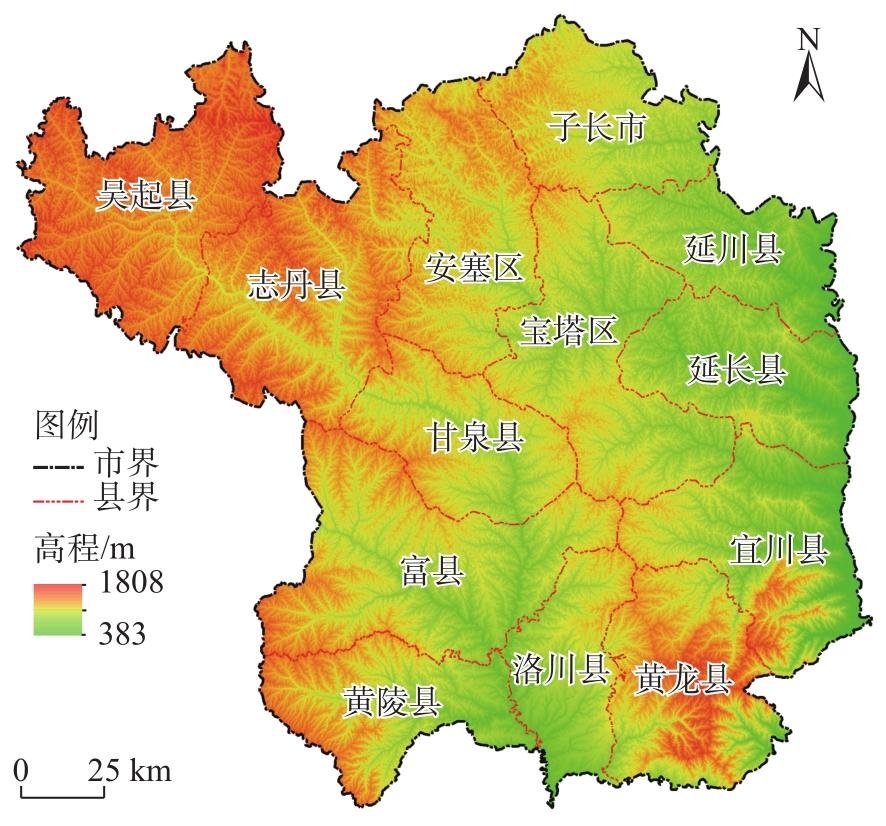
延安市位于陕西省北部(35°21′~37°31′N,107°41′~110°31′E),属暖温带半湿润易旱气候区,北部属半干旱地区,南部属半湿润地区。地处黄土高原丘陵沟壑区,地势西北高东南低,平均海拔约1200 m(图1),且地处林、草交错区,生态敏感性较高,生态系统易退化,被称为“生态危机带”[23]。截至2021年11月,延安市总面积3.7×10⁴ km2,其中优先保护面积1.4×10⁴ km2,占全市面积的37%,重点管控面积0.9×10⁴ km2,占比25%,生态本底脆弱,生态维护任务重。
图1 研究区示意图

Fig. 1 Schematic diagram of the study area

2 数据与方法

2.1 数据来源

2020年延安市行政区划、河流水系、道路交通矢量数据来源于Open Street Map平台(https://download.geofabrik.de/asia.html);土地利用数据来源于全国地理信息资源目录服务系统(https://www.webmap.cn/);数字高程模型来源于地理空间数据云平台(https://www.gscloud.cn/);坡度数据从数字高程模型数据中提取;归一化植被指数、夜间灯光数据来源于中国科学院资源环境科学数据服务中心(https://www.resdc.cn/)。所有数据的空间分辨率均为30 m×30 m。

2.2 研究方法

首先,根据研究区实地现状和数据可获得性,选取土地利用、归一化植被指数(Normalized difference vegetation index,NDVI)、数字高程模型(Digital elevation model,DEM)等影响因子,基于MSPA和MCR模型,识别生态源地和计算最小累积阻力差值,构建延安市生态网络。利用成本连通性和图论法,划分廊道等级和分析网络结构,通过叠加生态廊道和MSPA景观格局,识别生态修复关键区。

2.2.1 景观格局构建

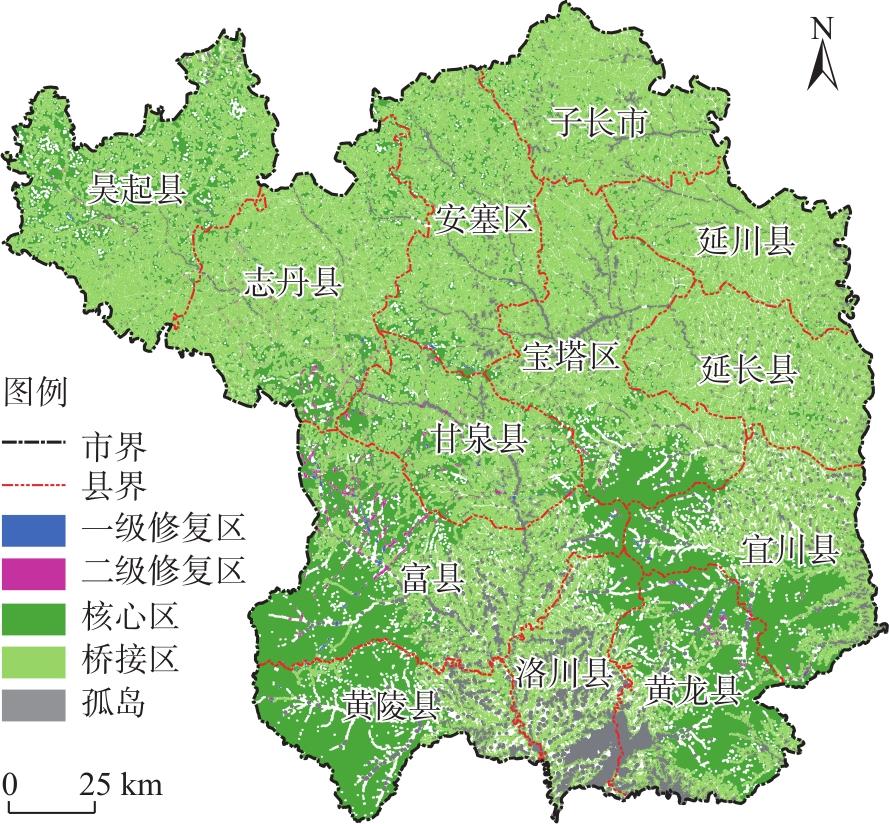
基于土地利用数据,将水域、草地、灌木和森林设为前景,将裸地、农田和不透水面设为背景。利用MSPA将前景划分为核心区、孤岛等7种景观类型(表1)。
表1 MSPA景观类型及其生态学含义

Tab. 1 Ecological meaning of landscape types based on MSPA

景观类型 生态学含义
核心区
前景像元中较大的生境斑块,可作为生态网络中“源地”
孤岛
彼此不相连的孤立、破碎的小斑块,斑块内外连通作用极弱
孔隙
核心区与内部非潜在源地之间的过渡区域,即核心区内边界
边缘
核心区与外部非潜在源地之间的过渡区域,即核心区外边界
环道
核心区内部物质交换、能量转化和信息传递的通道,具有廊道的特征
桥接
核心区之间物质交换、能量转化和信息传递的通道,具有廊道的特征
支线 只有一端与环道、孔隙、边缘区或桥接区相连的区域

2.2.2 阻力面创建

(1) 生态源地和城镇扩张阻力面创建
MCR模型是对物种在不同生境间迁移难易程度的量化,MCR值越大,说明生物迁移的难度越高[24]。结合实地情况,选取土地利用、距主要河流距离等8个阻力因子,参考国内外相关研究及层次分析法确定各因子阻力值及权重[25]表2),利用MCR模型分别构建生态源地和城镇扩张阻力面。公式如下:
M C R = f m i n j = n i = m D i j × R i
式中: M C R为源斑块到其他各点的最小累积阻力值; f m i n M C R与生态过程之间存在的某一正相关函数; D i j为源地斑块 j到景观空间单元 i的距离; R i为空间单元 i的综合阻力系数。
表2 生态源地(左)和城镇(右)扩张阻力因子系数及权重设定

Tab. 2 Resistance coefficient and weight setting of ecological source (left) and cities and towns (right) expansion

阻力因子 分级指标 阻力值 权重 阻力因子 分级指标 阻力值 权重
土地利用类型 水体、草地 10 0.38 土地利用类型 水体、草地 50 0.33
森林、灌木 20 森林、灌木 40
农田 30 农田 30
裸地 40 裸地 20
不透水面 50 不透水面 10
距源地距离/km <1 10 0.22 距建筑用地距离/km <0.5 10 0.25
1~3 20 0.5~1.5 20
3~5 30 1.5~3 30
5~8 40 3~5 40
>8 50 >5 50
NDVI 0.04~0.17 50 0.13 距源地距离/km <1 50 0.19
0.17~0.29 40 1~3 40
0.29~0.42 30 3~5 30
0.42~0.55 20 5~8 20
0.55~0.68 10 >8 10
距主要河流距离/km <1 10 0.10 坡度/(°) <13.3 10 0.10
1~3 20 13.3~26.6 20
3~5 30 26.6~40.0 30
5~8 40 40.0~53.3 40
>8 50 53.3~66.6 50
距建筑用地距离/km <0.5 50 0.07 NDVI 0.04~0.17 10 0.06
0.5~1.5 40 0.17~0.29 20
1.5~3 30 0.29~0.42 30
3~5 20 0.42~0.55 40
>5 10 0.55~0.68 50
距主要道路距离/km <1 50 0.05 距主要道路距离/km <1 10 0.04
1~2 40 1~2 20
2~4 30 2~4 30
4~7 20 4~7 40
>7 10 >7 50
DEM/km 0.38~0.67 10 0.03 距主要河流距离/km <1 50 0.03
0.67~0.95 20 1~3 40
0.95~1.24 30 3~5 30
1.24~1.52 40 5~8 20
1.52~1.81 50 >8 10
坡度/(°) <13.3 10 0.02 DEM/km 0.38~0.67 10 0.01
13.3~26.6 20 0.67~0.95 20
26.6~40.0 30 0.95~1.24 30
40.0~53.3 40 1.24~1.52 40
53.3~66.6 50 1.52~1.81 50

注:NDVI为归一化植被指数;DEM为数字高程模型。

(2) 阻力面修正
由于划分自然和人造地类时存在误差,会影响阻力面的构建[26]。因此,采用夜间灯光数据,分别对生态源地和城镇扩张阻力面进行修正。公式如下:
R * = T L I i T L I a × R 0
式中: R *为夜间灯光数据校正后的综合阻力值; T L I i为栅格 i的夜间灯光系数; T L I a为土地利用类型 a的平均夜间灯光系数; R 0为栅格 i校正前的阻力值。
(3) 最小累积阻力差值计算
基于修正后的生态源地和城镇扩张阻力数据,计算最小累积阻力差值。公式如下:
M C R * = M C R s - M C R c
式中: M C R *为最小累积阻力差值,值越大,说明物种迁移阻力越大; M C R s为生态源地扩张阻力值; M C R c为城镇扩张阻力值。

2.2.3 生态网络构建

(1) 生态源地识别及等级划分
选取面积较大的核心区斑块进行景观连通性评价,划分生态源地等级[27]。可能连通性指数(Probability of connectivity,PC)因其即可反应斑块的连通性,又可衡量各斑块的连通性重要程度,而被广泛应用于景观连通性评价[28]。公式如下:
P C = i = 1 n j = 1 n a i a j p i j * A L 2
d P C = P C - P C - k P C × 100
式中: n为斑块总数; a i a j分别为斑块 i和斑块 j的面积; A L为区域景观总面积; p i j *为物种从斑块 i扩散到斑块 j的最大概率; P C - k为去除斑块 k后的 P C值; d P C为斑块 k对景观连通性的贡献水平, d P C值越大,斑块 k对整体景观连通性贡献越大。0<PC<1,PC值越大,说明区域内景观连通性越高。
(2) 生态廊道提取
生态廊道是物种在生境之间迁移的线性或带状通道[29]。基于生态源地和最小累积阻力差值数据,依次提取单一源地到其他源地的最小成本路径,然后将所有路径合并、去冗,得到完整区域的生态廊道。
(3) 生态节点和障碍点识别
生态节点是指生态网络中对物种栖息或迁移至关重要的点状斑块,起到“踏脚石”的作用[30]。生态障碍点是指生态网络中严重阻碍物种迁移的区域[31]。选取生态廊道的交汇处作为生态节点,生态廊道和主要道路的交汇处作为生态障碍点。

2.2.4 生态网络分析

(1) 生态廊道重要性分析
基于成本连通性提取各源地之间的最优化路径,作为重要生态廊道,其余均为一般廊道。
(2) 生态网络结构分析
图论法将斑块看作节点,再将斑块间物种迁移的路径看作连接节点的线段,进而将生态系统简化为点线组成的网络,最后计算相应的连接度指标来分析网络结构特征[32]。基于图论法计算生态节点和生态廊道组成的点线网络闭合度(α)、点线率(β)和连接度(γ),定量分析生态网络结构的闭合程度、复杂程度和连通程度。公式如下:
α = n 1 - n 2 + 1 2 n 2 - 5
β = n 1 n 2
γ = n 1 3 n 2 - 2
式中:α为网络闭合度,一般情况下0≤α≤1,值越大代表网络闭合环路越多; n 1为廊道总数; n 2为节点总数; β为网络点线率,0≤β≤3,值越大代表网络内节点连接廊道数量越多,网络结构复杂程度越高,生态网络越稳定;γ为网络连接度,0≤γ≤1,值越大代表节点实际连接的廊道数量与可能连接的廊道数量越接近,网络连通程度越高。
此外,叠加生态廊道与土地利用数据,解析廊道景观要素组成,对生态网络的构建及生态修复关键区的保护治理具有重要意义。

2.2.5 生态修复关键区识别

生态修复关键区是指退化严重且在生态过程中起着重要作用的区域,是区域内优先修复的区域。叠加生态廊道和MSPA景观要素,提取除核心区、桥接区和孤岛以外的廊道区域,作为生态修复关键区。

3 结果与分析

3.1 生态网络构建

3.1.1 景观格局构建

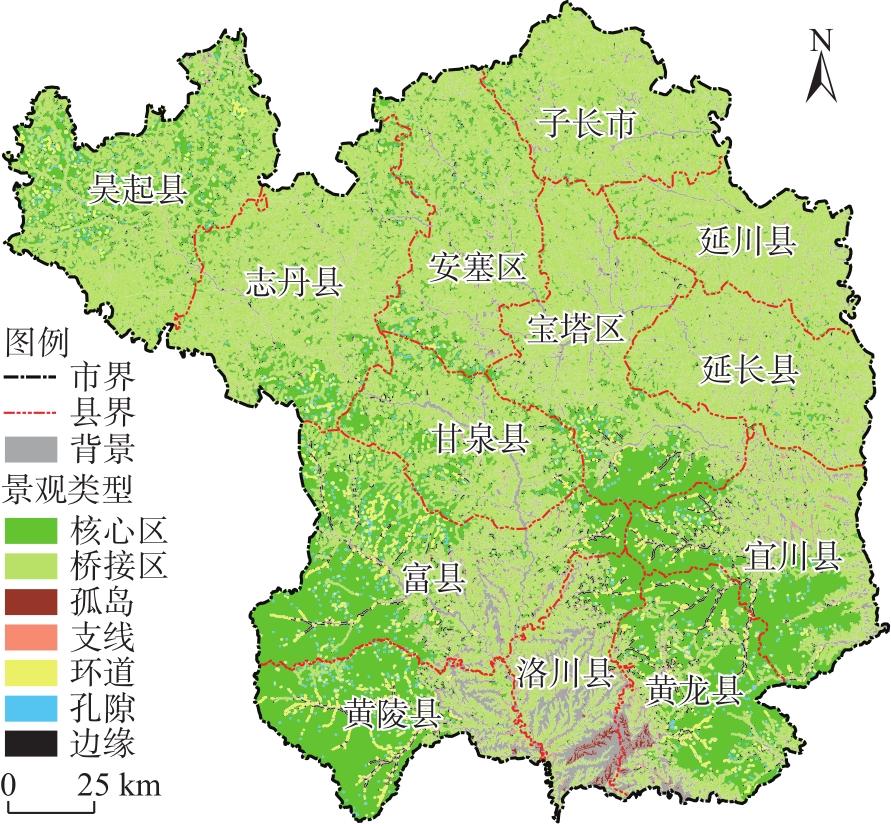
基于MSPA构建景观格局,结果表明(图2表3),2020年延安市森林、灌木、水域和草地规模较大,面积为32732.18 km2,占全域总面积的88.37%。其中,核心区面积9485.37 km2,占前景比例的28.98%;孤岛面积134.37 km2,占比0.41%;桥接区面积20859.85 km2,占比最大,为63.73%;孔隙、边缘区等其他景观要素面积为2252.56 km2,占比6.88%。整体来说,延安市核心区面积较小,多分布在东南和西南部,市内景观连片度较小,缺乏大型生境斑块,但桥接区面积较大,说明相邻核心区之间的连通性较好,退耕还林效果显著。根据以上分析,延安市水域、草地、灌木和森林覆盖基数虽大,但整体较分散,物种栖息和扩散仍受到威胁。
图2 基于MSPA的延安市景观格局

Fig. 2 Landscape pattern of Yan’an City based on MSPA

表3 基于MSPA的各景观类型面积

Tab. 3 Area of each landscape type based on MSPA

景观类型 面积/km2 占前景比例/% 占总体比例/%
桥接区 20859.85 63.73 56.31
核心区 9485.37 28.98 25.61
环道 914.38 2.79 2.47
边缘 761.27 2.33 2.06
孔隙 351.24 1.07 0.95
支线 225.67 0.69 0.61
孤岛 134.37 0.41 0.36
总计 32732.18 100.00 88.37

3.1.2 生态源地识别

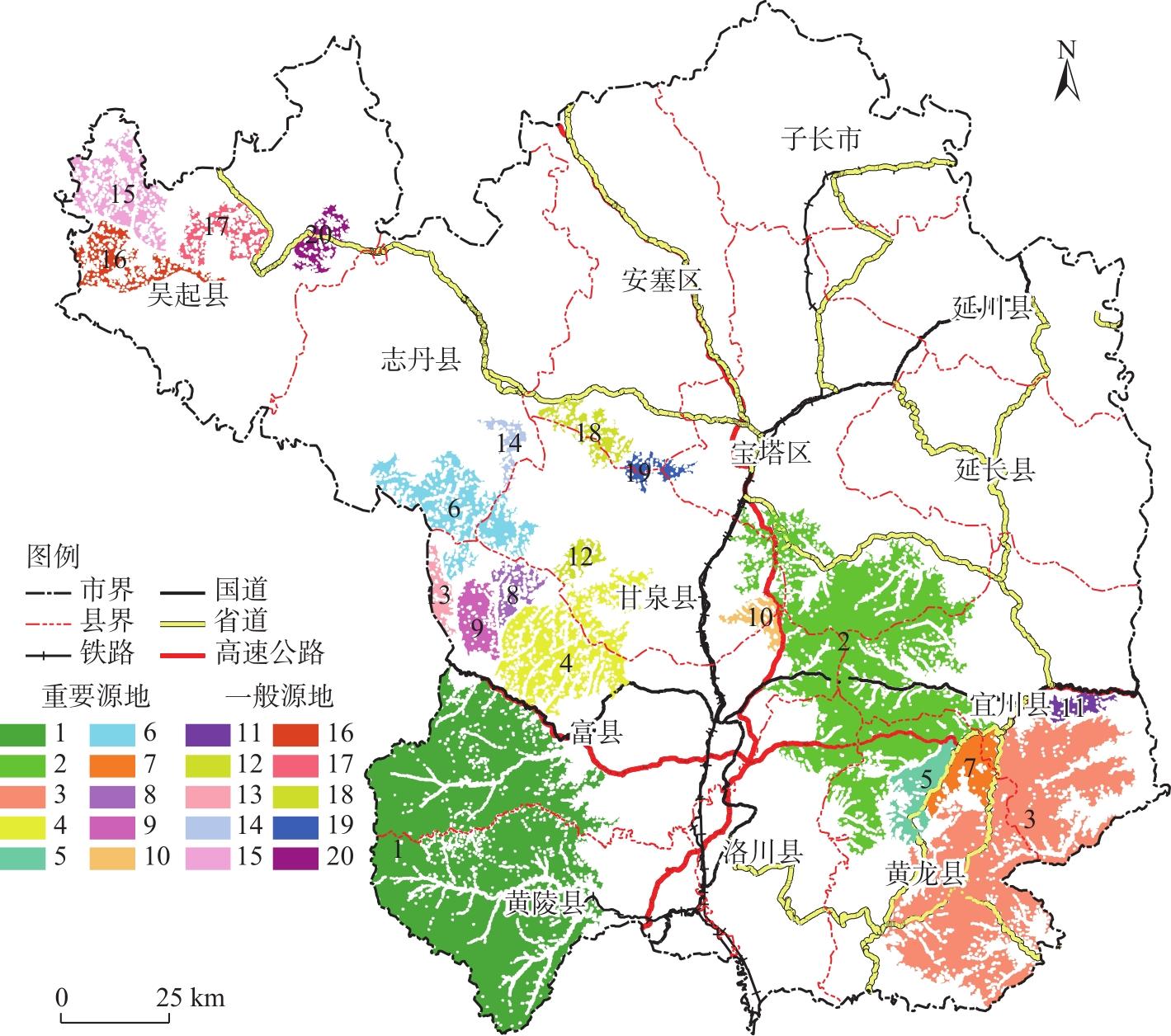
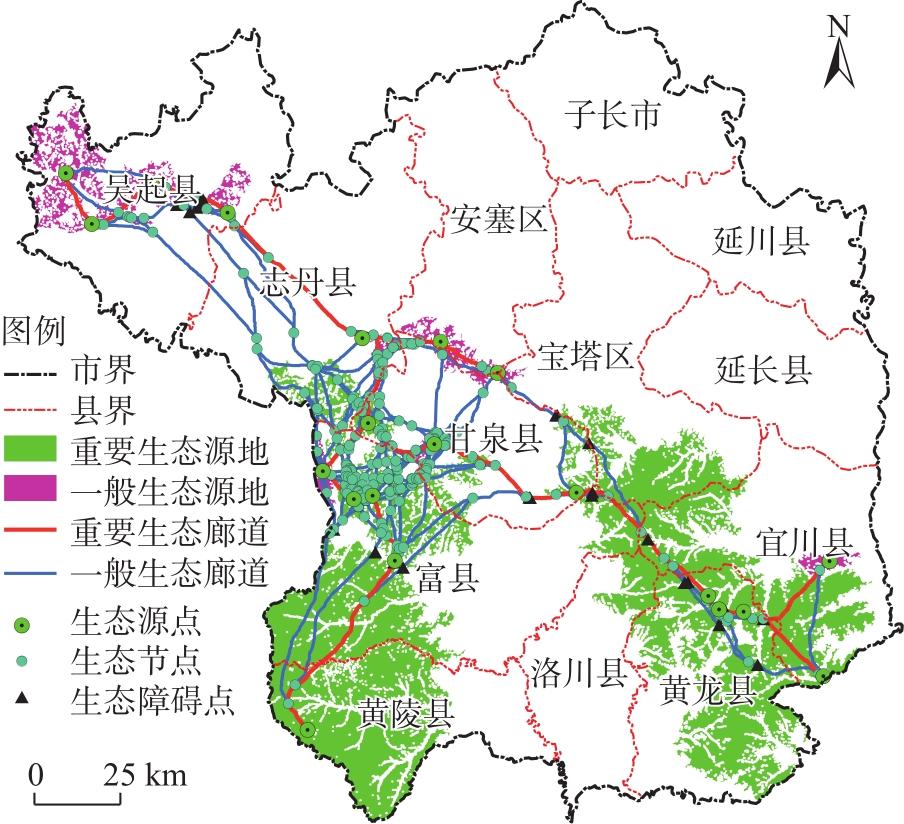
核心区植被覆盖度高且水资源丰富,适合物种栖息,具备生态源地的特征。但景观格局分析结果表明,延安市核心区破碎化严重,因此选取面积前20的核心区作为潜在生态源地(表4),并基于景观连通性选取dPC值前10的源地作为重要生态源地,其余为一般源地(图3)。生态源地总面积7029.80 km2,占核心区面积的74.11%,主要分布在西南和东南部,该区人类活动较少,植被覆盖度高,而以黄土梁茆、沟壑为主的北部源地分布极少。铁路、高速公路等对源地间的连通性影响较大,起到源地分割的作用。
表4 生态源地重要性排序

Tab. 4 Importance ranking of ecological sources

斑块编号 dPC 面积/km2 占核心区比例/%
1 42.43 2264.83 23.89
2 38.71 1604.91 16.92
3 33.82 1352.44 14.29
4 16.38 379.91 4.01
5 7.12 121.86 1.28
6 5.47 271.07 2.86
7 3.81 124.98 1.32
8 2.73 47.20 0.50
9 2.14 99.01 1.04
10 1.61 51.50 0.54
11 1.55 51.50 0.54
12 0.95 41.30 0.44
13 0.81 47.41 0.50
14 0.55 39.04 0.41
15 0.39 165.19 1.74
16 0.37 106.35 1.12
17 0.19 79.59 0.84
18 0.07 80.44 0.85
19 0.04 44.57 0.47
20 0.02 56.75 0.60

注:dPC为某斑块对区域景观连通性的贡献水平,值越大,斑块对整体景观连通性贡献越大。

图3 延安市生态源地分布及等级排序

Fig. 3 Distribution and ranking of ecological sources in Yan’an City

3.1.3 最小累积阻力差值计算

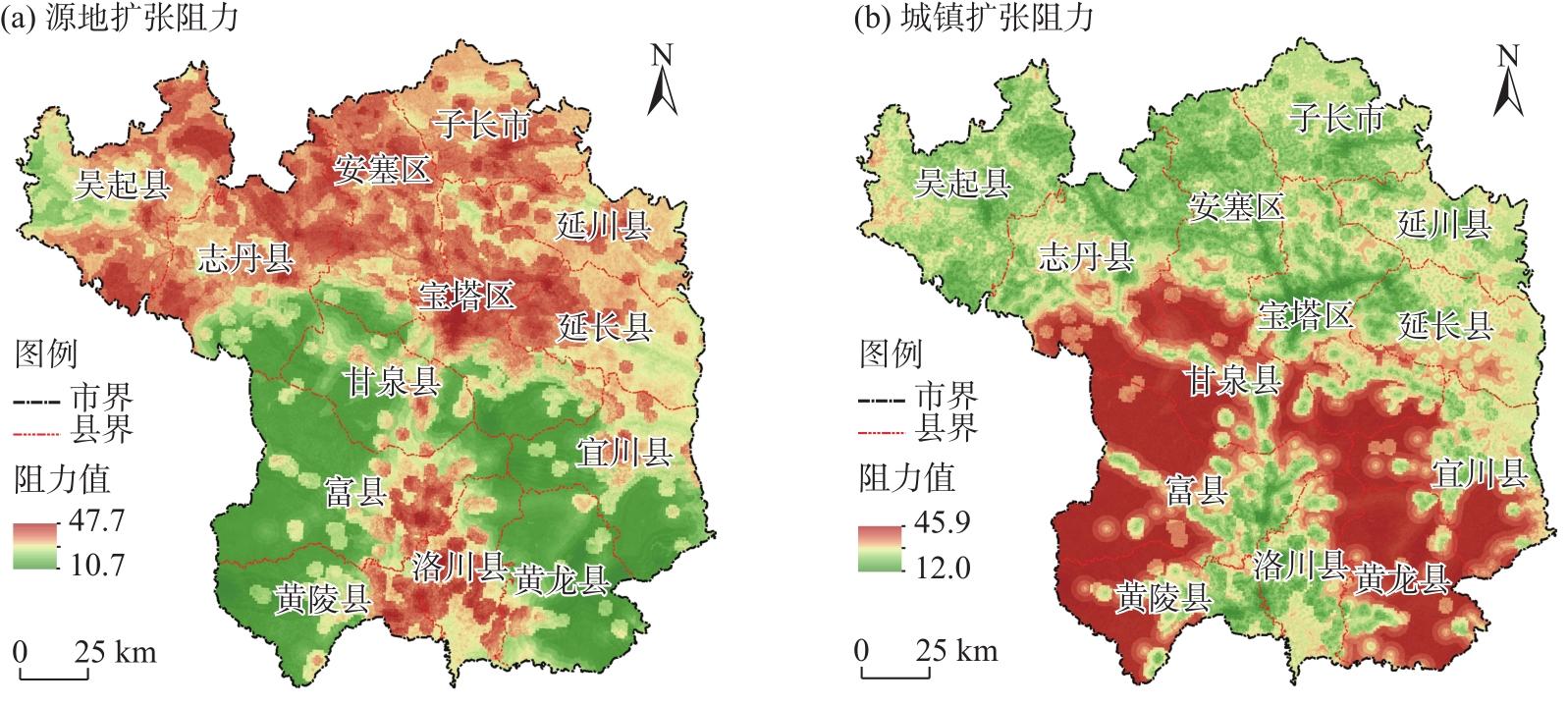
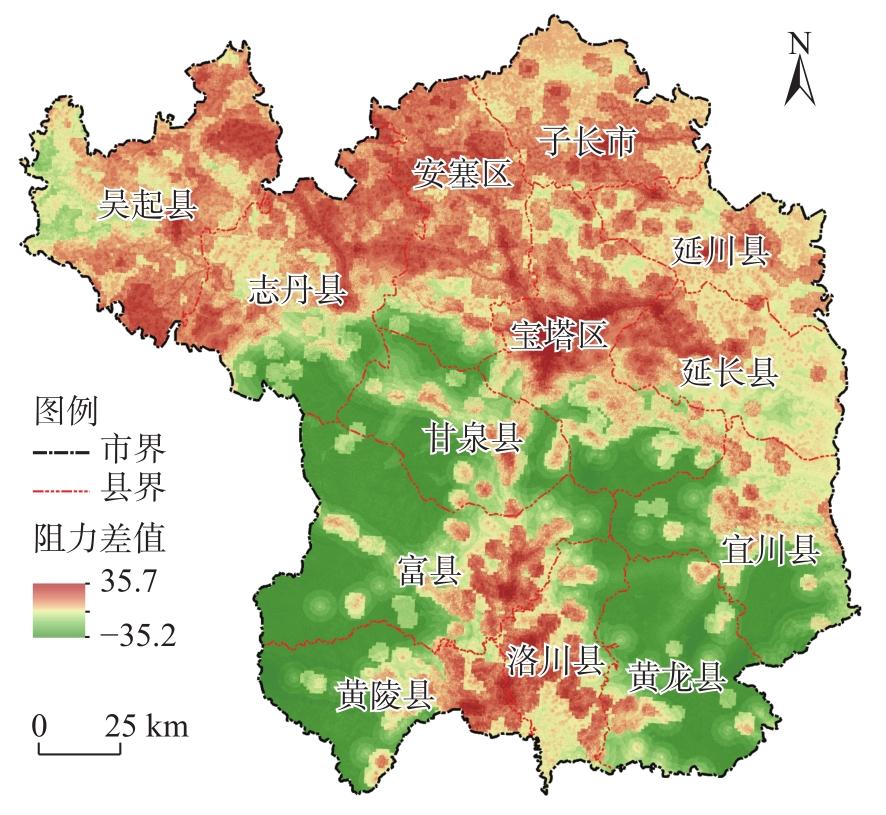
基于夜间灯光修正后的生态源地和城镇扩张阻力数据,计算最小累积阻力差值(图4~5)。延安市北部和中南部阻力较高,该地区工业发达,人口密度大;而西南和东南部阻力较低,生境质量高,生物多样性丰富。
图4 延安市源地和城镇扩张阻力面

Fig. 4 Resistance surface of source and cities and towns expansion in Yan’an City

图5 延安市最小累积阻力面

Fig. 5 Minimum cumulative resistance surface in Yan’an City

3.1.4 生态廊道提取

基于最小累积阻力差值及20处生态源地,提取生态廊道190条(图6),总长度3095.67 km,主要集中在西部和南部。而东北部廊道分布极少,进一步说明延安市整体景观格局较分散,南北连通性较差。生态节点和生态障碍点是生态网络中不可或缺的组成部分,共识别生态节点231处,生态障碍点29处,主要集中在廊道较密集的甘泉县、富县等地。
图6 延安市生态网络

Fig. 6 Ecological network in Yan’an City

总体来看,延安市生态网络分布极不均匀,主要集中在西部和南部,尤其是甘泉县和富县交界处,廊道分布极为密集,说明该地区林草覆盖率高,适宜物种栖息。而东北部分布极少,子长市、延川县和延长县三地生态网络覆盖度均为0,受人类活动影响大,生态系统退化严重。

3.2 生态网络分析

3.2.1 生态廊道重要性分析

基于成本连通性分级后生态网络中重要廊道19条,总长度为655.15 km,其余均为一般廊道。

3.2.2 生态网络结构分析

基于图论法计算得到延安市生态网络闭合度 α =-0.088,说明该生态网络闭合环路极少,内部流通性极差;点线率 β =0.82,说明该生态网络复杂程度较低,稳定性较差;连接度 γ =0.28,说明该生态网络内部连通程度较低,斑块之间缺乏联系。经过分析可知,延安市生态网络结构质量较差,稳定性较弱,需要加强对天然生态网络系统的保护与修复。
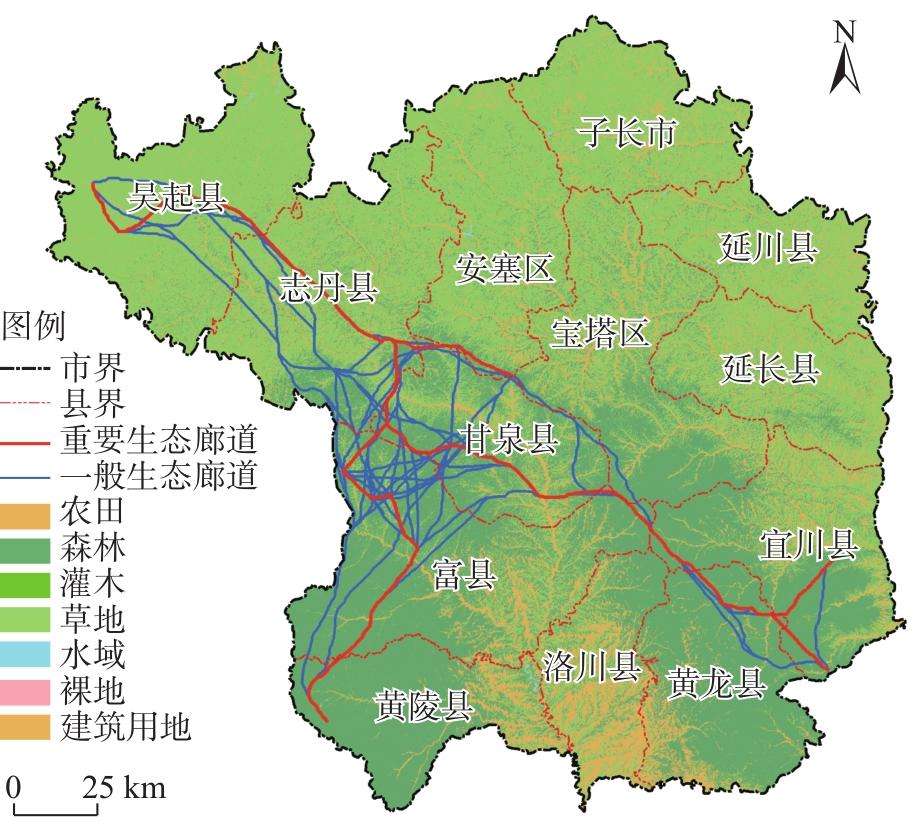
生态廊道作为生态网络的“血管”,连接各个生态源地,提升区域整体连通性。参考现有文献,量化廊道宽度为1 km[33],叠加土地利用数据,分析廊道结构特征(图7)。生态廊道中森林占比最大,为67.63%;其次为草地,占比28.61%;而水域和裸地占比较少,仅为0.01%和0.003%。森林和草地是物质、能量和信息在各源地之间运输和传递的良好介质,应加大还林还草力度,推进天然生态廊道建设。
图7 延安市生态廊道分布

Fig. 7 Distribution of ecological corridors in Yan’an City

3.3 生态修复关键区识别

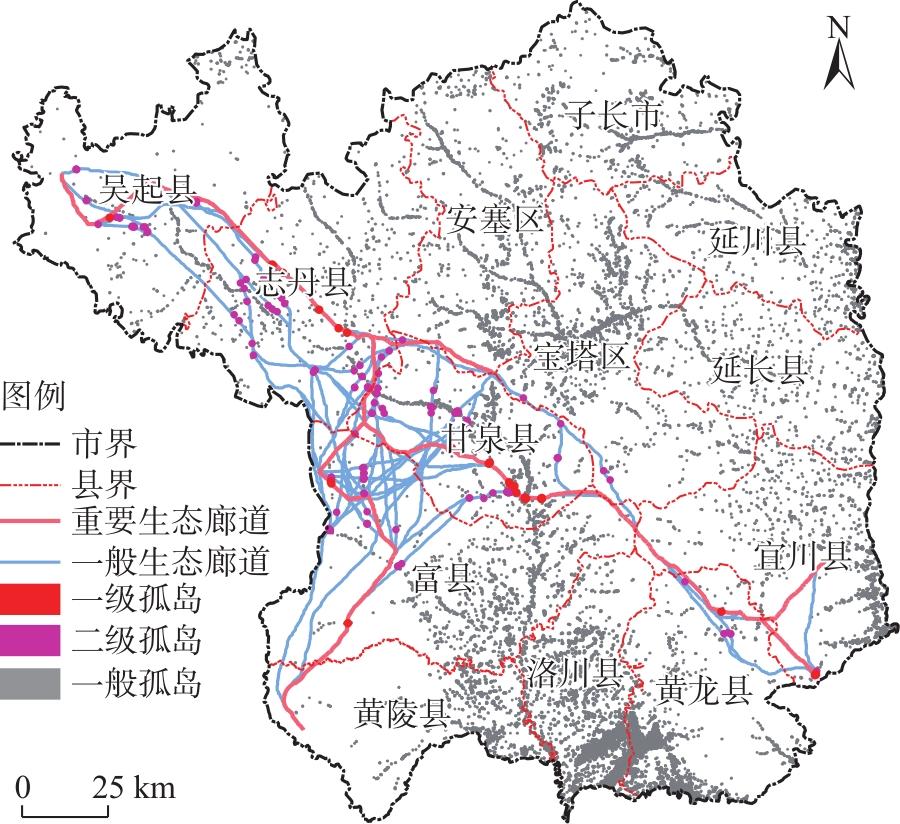
孤岛是景观破碎化形成的“岛状”斑块,其数量和分布状况可进一步反应区域内景观连通性水平。孤岛与核心区之间形成的断裂带,会阻碍生态廊道中物质、能量和信息的流通,应作为优先修复区域。由图8可知,延安市孤岛总数17179个,总面积134.36 km2,主要分布在中南部的洛川县和黄龙县交界处,而其他区域孤岛分布较零散。
图8 延安市孤岛分布

Fig. 8 Distribution of islets in Yan’an City

延安市孤岛分布较零散,增加了修复的难度,因此将生态廊道和MSPA景观要素进行叠加分析,识别孤岛与核心区之间的断裂带,划分生态修复关键区,针对性实施生态修复工程。提取质心位于重要和一般廊道内部的孤岛,分别设为一级和二级孤岛,其余设为一般孤岛(图8),然后分别将重要和一般廊道中的断裂带设为一级和二级修复区。如图9所示,延安市生态修复关键区总面积248.42 km2,主要集中在富县和黄龙县。其中一级修复区面积54.49 km2,占比21.93%,二级修复区面积193.93 km2。优先保护生态修复关键区,推进林草建设进程,是提高源地连通性、构建区域生态网络的重要举措。
图9 延安市生态修复关键区分布

Fig. 9 Distribution of key areas of ecological restoration in Yan’an City

4 讨论

科学划定生态修复分区,是有效开展生态修复的关键和难题[34]。融合MSPA和PC指数识别生态源地,相较于经验判断和综合评价等方法,充分考虑斑块在景观空间内的整体性和连通性。但MSPA在不同空间尺度上会形成不同的景观格局,分辨率过高或过低以及邻域分析原则和边缘宽度的设定等都会影响景观要素的划分,进而降低景观格局构建结果的可靠性[35-36]。为降低景观类型划分的误差,选择30 m×30 m空间尺度、8邻域分析原则及1像素(30 m)边缘宽度,但延安市景观格局构建的最适尺度、边缘宽度等仍需进一步探究。
MCR模型缺乏考虑人类活动以及自然和人造地类划分误差对阻力面构建的影响[37]。引入多源阻力因素,分别构建生态源地和城镇扩张阻力面,并以同期夜间灯光数据加以修正,计算最小累积阻力差值,降低人类活动及自然地类划分对生态网络构建的影响。此外,阻力因子选择及分值和权重划定仍存在较大的主观性,且不同物种的生境适应能力和迁移扩散能力不同,都会影响生态网络构建的科学性和可行性。传统的ArcGIS距离分析工具,不能划分廊道等级以及量化廊道宽度,利用成本连通性工具提取重要生态廊道,相较于重力模型[38]和电路理论[39]等方法更加实用、易操作,但是该方法只能将廊道划为2个等级,且不能分析廊道之间的相互作用。当前有关廊道宽度的研究较少,本研究将廊道宽度设为1 km,实际应用根据不同廊道情境有待进一步调整。
斑块间的连通性和物种迁移扩散能力会直接影响生态修复关键区划定的科学性。本研究叠加生态廊道与MSPA景观要素,识别核心区和孤岛之间的生态断裂带,划分生态修复关键区,为延安市生态网络建设及生态修复分区划定提供思路。在今后研究中有必要探究廊道宽度的适宜量化,并针对不同物种的扩散能力构建相应的生态网络,更加科学且具有针对性的识别生态修复关键区域。

5 结论

(1) 2020年延安市森林、草地等前景景观规模较大,但核心区面积较小,多分布在东南和西南部,可见延安市森林、草地等覆盖基数虽大,但整体较分散,景观连通性较差。
(2) 延安市生态源地占核心区面积的74.11%,主要分布在西南和东南部,而位于东北部的子长市、延川县和延长县三地,生态源地占比为0,不宜物种栖息,应加强该区生态修复建设,提高生境质量。
(3) 延安市生态廊道主要集中在西部和南部,其中重要廊道占比10%,生态网络空间分布极不均匀。
(4) 生态网络的闭合度、复杂度和连通度均较低,网络稳定性较差;廊道结构以森林景观为主,可见林草建设仍是提高区域景观连通性的最有效措施。
(5) 延安市孤岛总数主要分布在中南部,生态修复关键区主要集中在富县和黄龙县,其中一级修复区占比21.93%。应加强廊道断裂带的建设和保护,提高源地间的连通性,维持区域内高生物多样性水平。
[1]
王杰云, 罗志军, 齐松. 城镇空间扩张与景观生态风险的耦合关联——以江西省袁州区为例[J]. 水土保持研究, 2021, 28(5): 142-151.

[Wang Jieyun, Luo Zhijun, Qi Song. Coupling relationship between urban spatial expansion and landscape ecological risk: A case study of Yuanzhou District in Jiangxi Province[J]. Research of Soil and Water Conservation, 2021, 28(5): 142-151.]

[2]
包玉斌, 黄涛, 王耀宗, 等. 基于生态重要性与敏感性的六盘山区生态保护修复分区[J]. 干旱区地理, 2023, 46(11): 1778-1791.

[Bao Yubin, Huang Tao, Wang Yaozong, et al. Ecological protection and restoration zoning of Liupan Mountain area based on ecological importance and sensitivity[J]. Arid Land Geography, 2023, 46(11): 1778-1791.]

[3]
张绍良, 张黎明, 侯湖平, 等. 生态自然修复及其研究综述[J]. 干旱区资源与环境, 2017, 31(1): 160-166.

[Zhang Shaoliang, Zhang Liming, Hou Huping, et al. Research overview on natural restoration of ecosystem[J]. Journal of Arid Land Resources and Environment, 2017, 31(1): 160-166.]

[4]
王志强, 姜文桓, 卢诗月. 基于生态网络分析的新疆“水-能-碳”耦合系统特征研究[J]. 干旱区地理, 2023, 46(12): 2005-2016.

[Wang Zhiqiang, Jiang Wenhuan, Lu Shiyue. Characteristics of “water-energy-carbon” coupling system in Xinjiang based on ecological network analysis[J]. Arid Land Geography, 2023, 46(12): 2005-2016.]

[5]
刘世梁, 侯笑云, 尹艺洁, 等. 景观生态网络研究进展[J]. 生态学报, 2017, 37(12): 3947-3956.

[Liu Shiliang, Hou Xiaoyun, Yin Yijie, et al. Research progress on landscape ecological networks[J]. Acta Ecologica Sinica, 2017, 37(12): 3947-3956.]

[6]
Knaapen J P, Scheffer M, Harms B. Estimating habitat isolation in landscape planning[J]. Landscape and Urban Planning, 1992, 23(1): 1-16.

[7]
俞孔坚. 生物保护的景观生态安全格局[J]. 生态学报, 1999, 19(1): 10-17.

[Yu Kongjian. Landscape ecological security pattern in biological conservation[J]. Acta Ecologica Sinica, 1999, 19(1): 10-17.]

[8]
陈南南, 康帅直, 赵永华, 等. 基于MSPA和MCR模型的秦岭(陕西段)山地生态网络构建[J]. 应用生态学报, 2021, 32(5): 1545-1553.

DOI

[Chen Nannan, Kang Shuaizhi, Zhao Yonghua, et al. Construction of ecological network in Qinling Mountains of Shaanxi, China based on MSPA and MCR model[J]. Chinese Journal of Applied Ecology, 2021, 32(5): 1545-1553.]

DOI

[9]
范春苗, 王志泰, 汤娜, 等. 基于形态学空间格局和空间主成分的贵阳市中心城区生态网络构建[J]. 生态学报, 2022, 42(16): 6620-6632.

[Fan Chunmiao, Wang Zhitai, Tang Na, et al. Construction of ecological network in downtown of Guiyang City based on morphologically spatial pattern and spatially principal component analysis[J]. Acta Ecologica Sinica, 2022, 42(16): 6620-6632.]

[10]
刘泓君, 牛腾, 于强, 等. 基于“重要性—敏感性—景观特征”的黄土高原生态屏障带生态空间网络构建[J]. 水土保持通报, 2022, 42(3): 103-111.

[Liu Hongjun, Niu Teng, Yu Qiang, et al. Construction of ecological security pattern in ecological barrier zone of Loess Plateau based on “importance-sensitivity-landscape features”[J]. Bulletin of Soil and Water Conservation, 2022, 42(3): 103-111.]

[11]
Laura C, Céline C, Karine T, et al. How much can highway stormwater ponds contribute to amphibian ecological network connectivity?[J]. Impact Assessment and Project Appraisal, 2022, 40(6): 517-530.

[12]
Yang C H, Guo H J, Huang X Y, et al. Ecological network construction of a national park based on MSPA and MCR models: An example of the proposed national parks of “Ailaoshan-Wuliangshan” in China[J]. Land, 2022, 11(11): 1913, doi: 10.3390/land11111913.

[13]
Soille P. Morphological image analysis: Principles and applications[J]. Sensor Review, 2000, 20(3): 800-801.

[14]
Wang T, Ren Y Y. Optimization of green infrastructure network in Fengdong New Town based on MSPA and MCR model[J]. Science Discovery, 2021, 9(5): 226-233.

[15]
戴璐, 刘耀彬, 黄开忠. 基于MCR模型和DO指数的九江滨水城市生态安全网络构建[J]. 地理学报, 2020, 75(11): 2459-2474.

DOI

[Dai Lu, Liu Yaobin, Huang Kaizhong. Construction of an ecological security network for waterfront cities based on MCR model and DO index: A case study of Jiujiang City[J]. Acta Ecologica Sinica, 2020, 75(11): 2459-2474.]

[16]
Liu J, Chen J J, Yang Y P, et al. Construction and optimization of an ecological network in the Yellow River source region based on MSPA and MCR modelling[J]. International Journal of Environmental Research and Public Health, 2023, 20(4): 3724, doi: 10.3390/ijerph20043724.

[17]
Zhou S K, Song Y H, Li Y J, et al. Construction of ecological security pattern for plateau lake based on MSPA-MCR model: A case study of Dianchi Lake area[J]. Sustainability, 2022, 14(21): 14532, doi: 10.3390/su142114532.

[18]
朱陇强, 郭泽呈, 肖敏, 等. 半干旱区县域生态安全格局构建——以临洮县为例[J]. 生态学报, 2022, 42(14): 5799-5811.

[Zhu Longqiang, Guo Zecheng, Xiao Min, et al. Construction of county ecological security pattern in semi-arid area: A case study of Lintao County[J]. Acta Ecologica Sinica, 2022, 42(14): 5799-5811.]

[19]
杜雨阳, 王征强, 于庆和, 等. 基于生境质量模型和电路理论的区域生态安全格局构建——以秦岭(陕西段)为例[J]. 农业资源与环境学报, 2022, 39(5): 1069-1078.

[Du Yuyang, Wang Zhengqiang, Yu Qinghe, et al. Construction of a regional ecological security pattern based on a habitat quality model and circuit theory: A case study of the Qinling Mountains (Shaanxi section)[J]. Journal of Agricultural Resources and Environment, 2022, 39(5): 1069-1078.]

[20]
张利, 何玲, 闫丰, 等. 基于图论的两栖类生物栖息地网络规划——以黑斑侧褶蛙为例[J]. 应用生态学报, 2021, 32(3): 1054-1060.

DOI

[Zhang Li, He Ling, Yan Feng, et al. Amphibian habitat network planning based on the graph theory: A case study of Pelophylax nigromaculata[J]. Chinese Journal of Applied Ecology, 2021, 32(3): 1054-1060.]

[21]
孙亚荣, 白应飞, 王亚娟, 等. 1999—2018年延安市各区县退耕还林草实施效果分析[J]. 水土保持研究, 2023, 30(1): 209-215.

[Sun Yarong, Bai Yingfei, Wang Yajuan, et al. Analysis on the implementation effect of returning farmland to forestland and grassland in various districts and counties of Yan’an City from 1999 to 2018[J]. Research of Soil and Water Conservation, 2023, 30(1): 209-215.]

[22]
杜国明, 孙晓兵, 刘彦随, 等. 黄土高原生态退耕的时空分异特征[J]. 地球信息科学学报, 2017, 19(3): 355-364.

DOI

[Du Guoming, Sun Xiaobing, Liu Yansui, et al. Temporal and spatial-differentiation characteristics of ecological restoration in Loess Plateau[J]. Journal of Geo-information Science, 2017, 19(3): 355-364.]

[23]
段艺芳, 任志远, 周晓, 等. 延安市土地生态风险时空格局演变研究[J]. 国土资源遥感, 2020, 32(1): 120-129.

[Duan Yifang, Ren Zhiyuan, Zhou Xiao, et al. Spatio-temporal variation in the land ecological risk of Yan’an City[J]. Remote Sensing for Land and Resources, 2020, 32(1): 120-129.]

[24]
冯琰玮, 甄江红, 马晨阳. 干旱区城市生态安全格局优化研究——以内蒙古呼和浩特市为例[J]. 水土保持研究, 2020, 27(4): 336-341.

[Feng Yanwei, Zhen Jianghong, Ma Chenyang. Analysis of spatial optimization of urban ecological security pattern in arid area: A case study of Hohhot City Inner Mongolia[J]. Research of Soil and Water Conservation, 2020, 27(4): 336-341.]

[25]
Wei L, Zhou L, Sun D Q, et al. Evaluating the impact of urban expansion on the habitat quality and constructing ecological security patterns: A case study of Jiziwan in the Yellow River Basin, China[J]. Ecological Indicators, 2022, 145: 109544, doi: 10.1016/j.ecolind.2022.109544.

[26]
刘晓阳, 魏铭, 曾坚, 等. 闽三角城市群生态网络分析与构建[J]. 资源科学, 2021, 43(2): 357-367.

DOI

[Liu Xiaoyang, Wei Ming, Zeng Jian, et al. Ecological network analysis and construction: A case study of the urban agglomeration of the Min River Delta, China[J]. Resources Science, 2021, 43(2): 357-367.]

DOI

[27]
Xiao Z T, Zhang W Y, Hao L J. Retraction note: The evolution of spatial and temporal patterns of Zhengzhou ecological network based on MSPA[J]. Arabian Journal of Geosciences, 2022, 15(8): 747, doi: 10.1007/S12517-022-10068-8.

[28]
Víctor R, Javier V, Javier G, et al. Proposal of new Natura 2000 network boundaries in Spain based on the value of importance for biodiversity and connectivity analysis for its improvement[J]. Ecological Indicators, 2021, 129: 461-468.

[29]
Irene P, Marta D, Federica P, et al. Macro-moth (lepidoptera) diversity of a newly shaped ecological corridor and the surrounding forest area in the western Italian Alps[J]. Diversity, 2023, 15(1): 95, doi: 10.3390/D15010095.

[30]
Saura S, Bodin O, Fortin M. Editor’s choice: Stepping stones are crucial for species’ long-distance dispersal and range expansion through habitat networks[J]. Journal of Applied Ecology, 2014, 51(1): 171-182.

[31]
潘越, 龚健, 杨建新, 等. 基于生态重要性和MSPA核心区连通性的生态安全格局构建——以桂江流域为例[J]. 中国土地科学, 2022, 36(4): 86-95.

[Pan Yue, Gong Jian, Yang Jianxin, et al. Construction of ecological security pattern based on ecological importance and connectivity of MSPA-core area: A case study of the Guijiang River Basin[J]. China Land Science, 2022, 36(4): 86-95.]

[32]
Rastegar H, Hassan D. The review of ecological network indicators in graph theory context: 2014—2021[J]. International Journal of Environmental Research, 2022, 16(2): 24, doi: 10.1007/S41742-022-00404-X.

[33]
王玉莹, 沈春竹, 金晓斌, 等. 基于MSPA和MCR模型的江苏省生态网络构建与优化[J]. 生态科学, 2019, 38(2): 138-145.

[Wang Yuying, Shen Chunzhu, Jin Xiaobin, et al. Developing and optimizing ecological networks based on MSPA and MCR model[J]. Ecological Science, 2019, 38(2): 138-145.]

[34]
张海铃, 叶长盛, 胡梦姗. 基于生态安全格局的环鄱阳湖城市群生态修复关键区域识别及修复策略[J]. 水土保持研究, 2023, 30(2): 393-402.

[Zhang Hailing, Ye Changsheng, Hu Mengshan. Identification and restoration strategy of key areas of ecological restoration in urban agglomeration around Poyang Lake based on ecological security pattern[J]. Research of Soil and Water Conservation, 2023, 30(2): 393-402.]

[35]
Wang Y, Zhang L, Song Y H. Study on the construction of the ecological security pattern of the Lancang River Basin (Yunnan section) based on InVEST-MSPA-circuit theory[J]. Sustainability, 2022, 15(1): 477, doi: 10.3390/SU15010477.

[36]
Zhang J B, Zhu H R, Zhang P Y, et al. Construction of GI network based on MSPA and PLUS model in the main urban area of Zhengzhou: A case study[J]. Frontiers in Environmental Science, 2022, 10: 878656, doi: 10.3389/fenvs.2022.878656.

[37]
李恒凯, 刘玉婷, 李芹, 等. 基于MCR模型的南方稀土矿区生态安全格局分析[J]. 地理科学, 2020, 40(6): 989-998.

DOI

[Li Hengkai, Liu Yuting, Li Qin, et al. Analysis of ecological security pattern of southern rare earth mining area based on MCR model[J]. Scientia Geographica Sinica, 2020, 40(6): 989-998.]

DOI

[38]
史娜娜, 韩煜, 王琦, 等. 青海省保护地生态网络构建与优化[J]. 生态学杂志, 2018, 37(6): 1910-1916.

[Shi Nana, Han Yu, Wang Qi, et al. Construction and optimization of ecological network for protected areas in Qinghai Province[J]. Chinese Journal of Ecology, 2018, 37(6): 1910-1916.]

[39]
倪庆琳, 丁忠义, 侯湖平, 等. 基于电路理论的生态格局识别与保护研究——以宁武县为例[J]. 干旱区资源与环境, 2019, 33(5): 67-73.

[Ni Qinglin, Ding Zhongyi, Hou Huping, et al. Ecological pattern recognition and protection based on circuit theory: A case study of Ningwu County[J]. Journal of Arid Land Resources and Environment, 2019, 33(5): 67-73.]

Outlines

/