



Dynamics of water use efficiency and its response to drought and land surface temperature on the Loess Plateau
Received date: 2023-12-19
Revised date: 2024-01-25
Online published: 2026-03-11
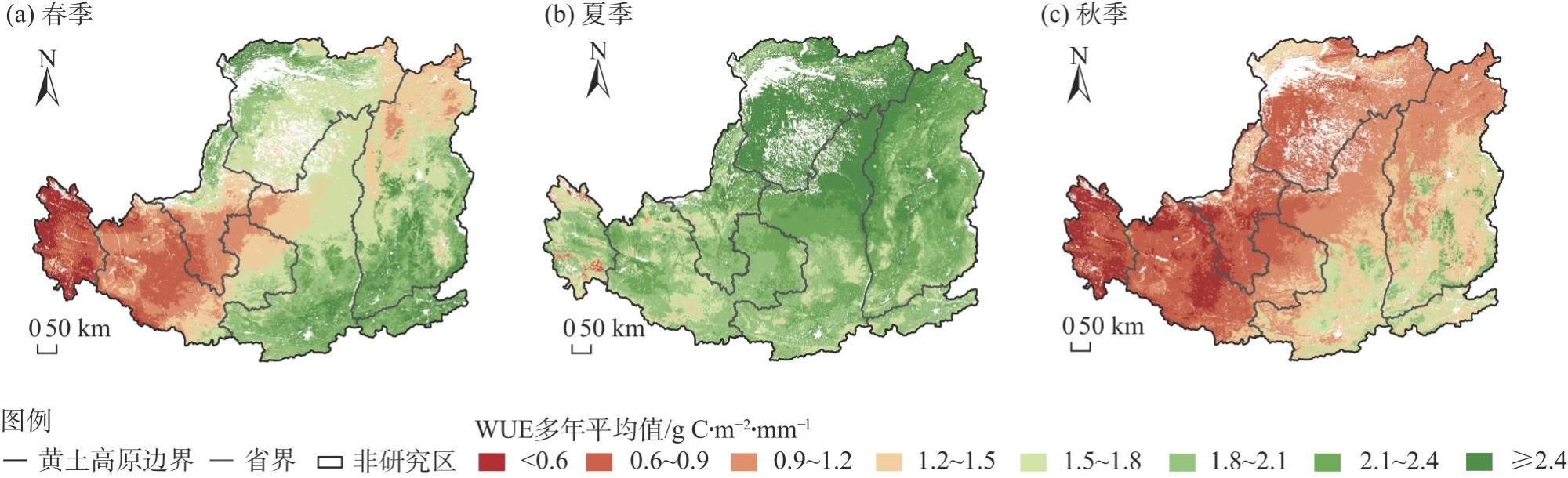
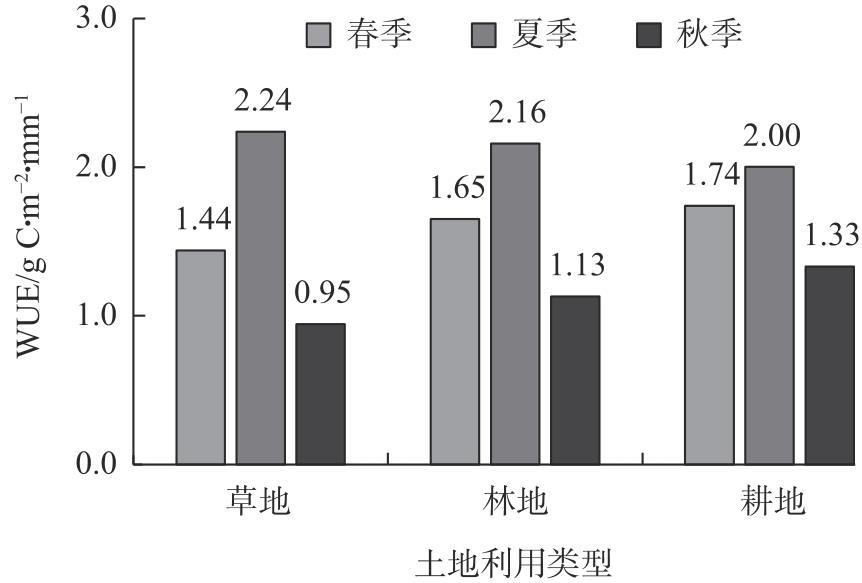
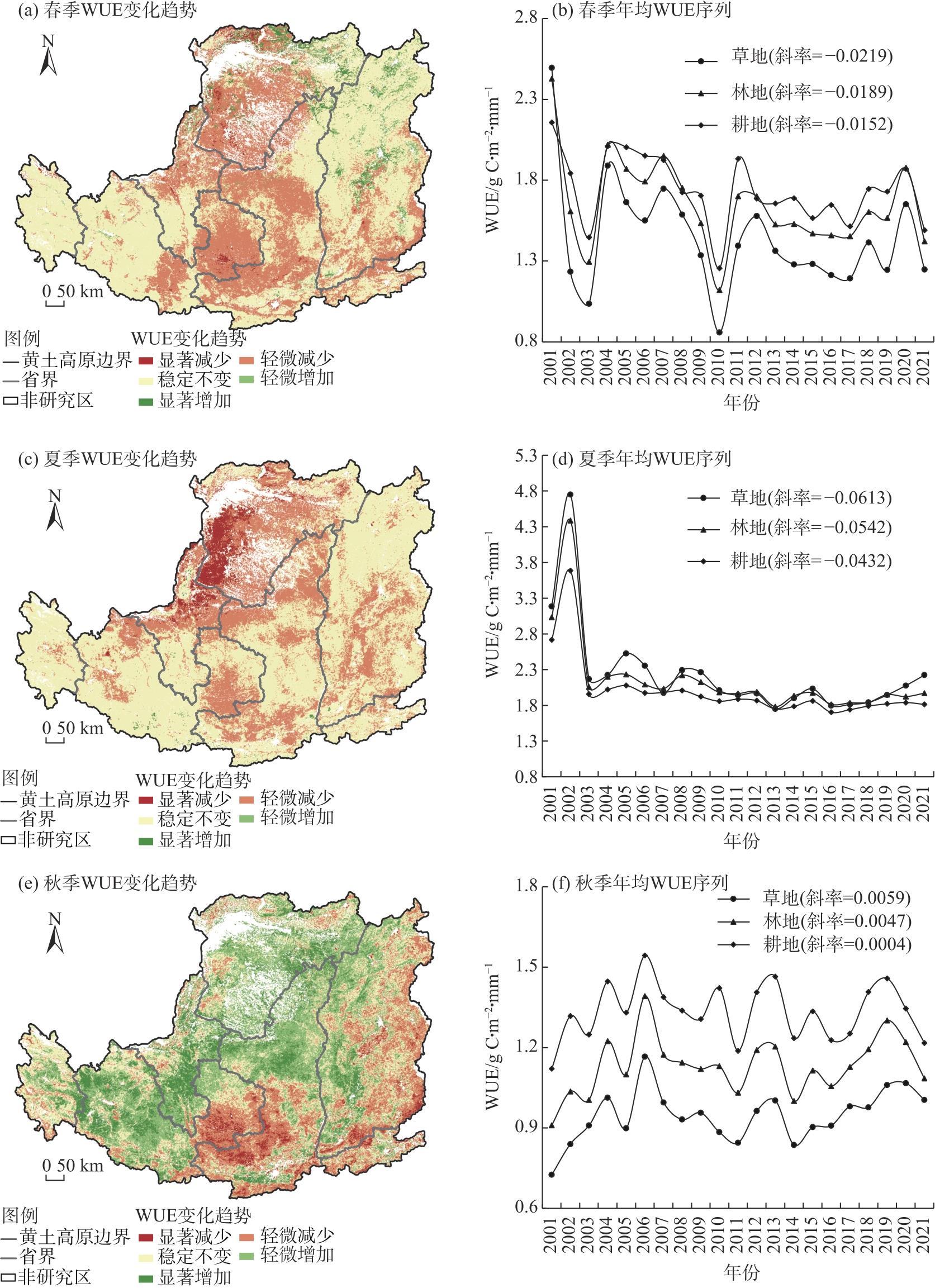
The spatiotemporal variations of water use efficiency (WUE) and its relationship with drought and land surface temperature (LST) on the Loess Plateau are crucial for assessing the maximum vegetation carrying capacity in this region, known as the most severely eroded area globally and the largest greening area in China. This study employed Theil-Sen trend analysis and the first-order differencing relative contribution method to examine the spatiotemporal changes in WUE across different seasons on the Loess Plateau from 2001 to 2021 and to evaluate the contributions of drought and LST to these changes. The results reveal that: (1) The average WUE values in spring and autumn are below 2.0 g C·m-2·mm-1, while in summer, the average WUE exceeds 2.0 g C·m-2·mm-1. In spring and autumn, WUE is higher in cultivated land and forest areas compared to grassland areas, whereas in summer, WUE is lowest in cultivated land, followed by forest areas, and highest in grassland. (2) WUE remains stable in spring and summer, displaying a spatial distribution of “reduction in the central part, stability in the western and eastern parts.” The rate of decline in WUE is greater in grassland areas than in forest and cultivated land areas. In autumn, WUE shows an increasing trend, with a higher rate of increase observed in grassland areas than in forest and cultivated land areas, exhibiting a spatial pattern of “increase in the northwest, decrease in the southeast.” (3) In spring and summer, LST positively contributes to WUE changes, with the most significant impacts in grassland areas. In autumn, LST negatively affects WUE in grassland and forest areas but positively influences WUE in cultivated land areas. Drought positively contributes to WUE changes in spring and autumn, while it negatively affects WUE in summer. These findings enhance the understanding of the interactions between drought, LST, and water resources in the context of climate change and ecological restoration efforts on the Loess Plateau.
Key words: water use efficiency; drought; land surface temperature; Loess Plateau
Gexia QIN , Zhiyuan MENG , Ni LI . Dynamics of water use efficiency and its response to drought and land surface temperature on the Loess Plateau[J]. Arid Land Geography, 2024 , 47(11) : 1887 -1898 . DOI: 10.12118/j.issn.1000-6060.2023.719
表1 新中国成立以来黄土高原实施的重点生态修复工程Tab. 1 Key ecological restoration projects in the Yellow River Basin since the founding of the People’s Republic of China |
| 生态问题 | 实施的生态工程 | 实施期限 | 涉及区域 |
|---|---|---|---|
| 水土流失 | 水土保持工程 | 1949年至今 | 黄河流域全域 |
| 林草退化 | 三北防护林体系建设工程 | 1978年至今 | 青海、甘肃、宁夏、内蒙古、陕西、山西 |
| 林草退化 | 天然林资源保护工程 | 1998—2020年 | 陕西、甘肃、青海、宁夏、内蒙古、河南、山西 |
| 林草退化 | 退耕还林还草 | 1999至今 | 黄河流域全域 |
| 土地沙化 | 京津唐风沙源治理工程 | 2000—2022年 | 陕西、山西、内蒙古 |
| 矿山破坏 | 废弃矿山治理工程 | 2005年至今 | 甘南黄河上游、内蒙古矿山、河南黄河三门峡段 |
| 湿地萎缩 | 湿地保护与修复工程 | 2006年至今 | 山东黄河河口、若尔盖湿地、黄河三角洲湿地 |
| 系统治理 | 山水林田湖草生态保护修复工程 | 2016至今 | 黄土高原、黄河三角洲、黄河中上游 |
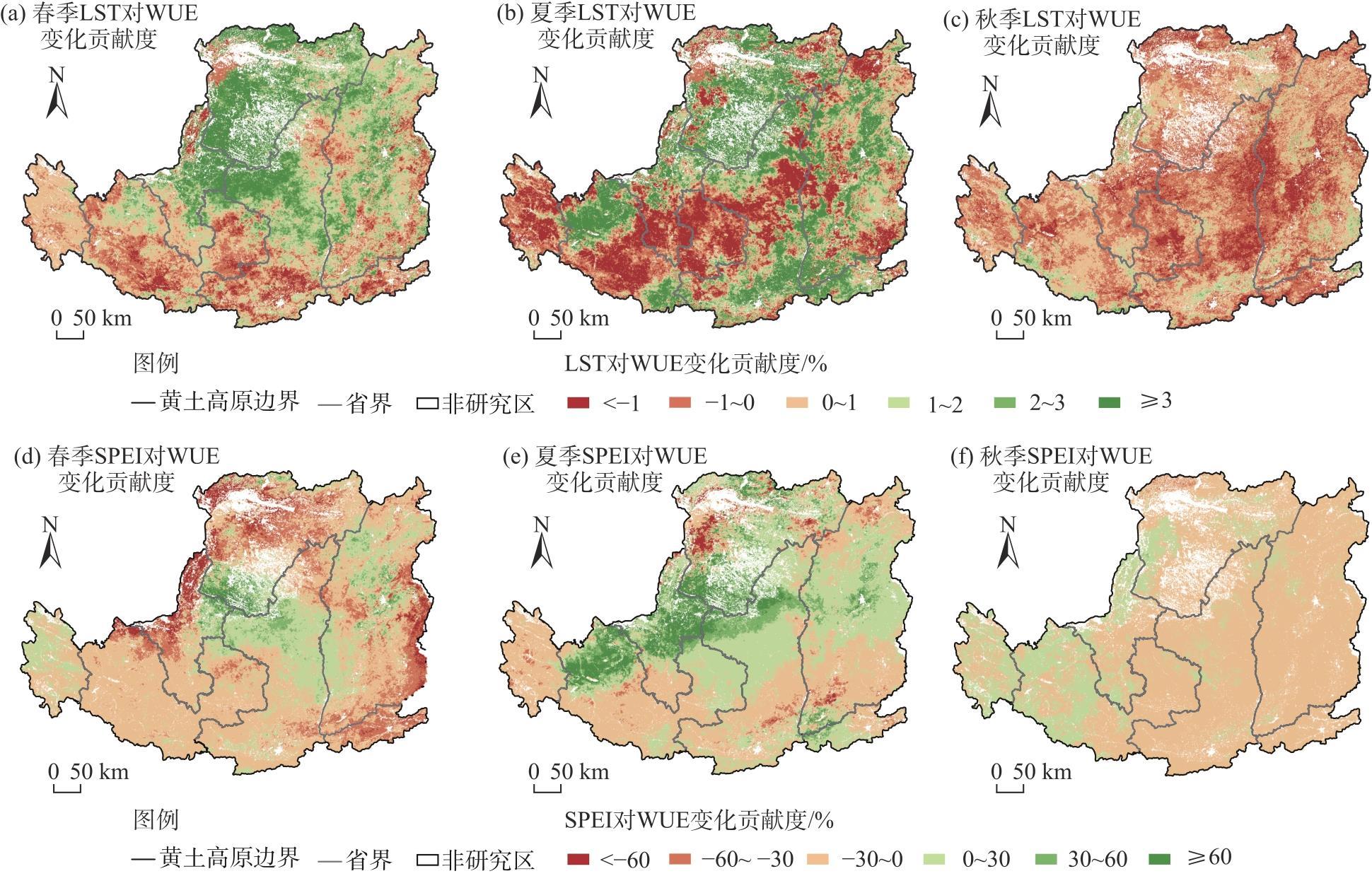
图5 春、夏、秋季LST和SPEI对WUE变化的贡献度分布注:LST为地表温度;SPEI为标准化降水蒸散发指数。下同。 Fig. 5 Contribution distributions of LST and SPEI to the variation of WUE in spring, summer, and autumn |
表2 春、夏、秋季LST和SPEI对WUE变化的贡献度Tab. 2 Contributions of LST and SPEI to the variation of WUE in spring, summer, and autumn /% |
| 季节 | LST对WUE变化贡献度面积占比 | SPEI对WUE变化贡献度面积占比 | |||||||||||
|---|---|---|---|---|---|---|---|---|---|---|---|---|---|
| <-1% | -1%~0 | 0~1% | 1%~2% | 2%~3% | ≥3% | <-60% | -60%~-30% | -30%~0 | 0~30% | 30%~60% | ≥60% | ||
| 春季 | 5.28 | 15.88 | 27.84 | 20.92 | 13.14 | 16.94 | 4.44 | 13.81 | 55.13 | 21.74 | 3.58 | 1.30 | |
| 夏季 | 21.48 | 16.53 | 15.34 | 12.58 | 10.07 | 24.00 | 1.14 | 3.14 | 42.44 | 35.13 | 10.18 | 7.97 | |
| 秋季 | 13.58 | 41.98 | 35.68 | 7.35 | 1.18 | 0.23 | 0.01 | 0.33 | 79.91 | 19.70 | 0.05 | 0.00 | |
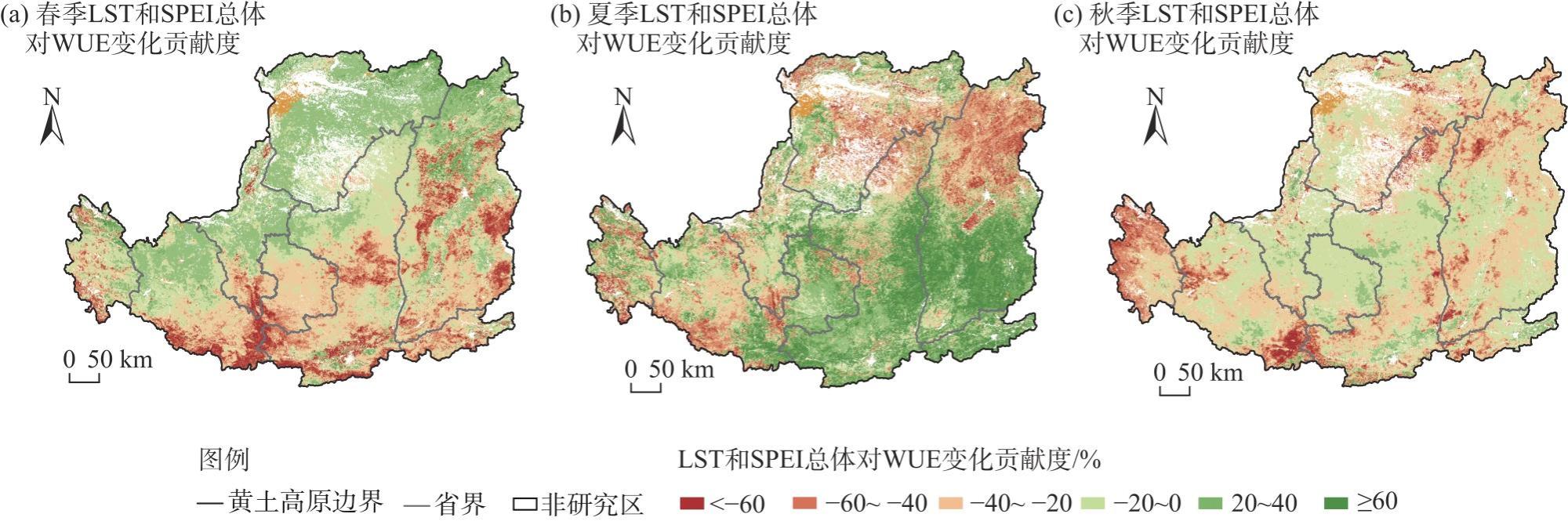
图6 春、夏、秋季LST和SPEI总体对WUE的贡献度分布Fig. 6 Distributions of the overall contributions of LST and SPEI to WUE in spring, summer and autumn |
表3 春、夏、秋季LST和SPEI总体对WUE的贡献度Tab. 3 Overall contributions of LST and SPEI to WUE in spring, summer and autumn /% |
| 季节 | LST和SPEI总体对WUE变化贡献度面积占比 | |||||||
|---|---|---|---|---|---|---|---|---|
| <-60% | -60%~-40% | -40%~-20% | -20%~0 | 0~20% | 20%~40% | 40%~60% | ≥60% | |
| 春季 | 4.75 | 4.58 | 9.43 | 21.79 | 25.83 | 26.97 | 3.32 | 3.33 |
| 夏季 | 2.12 | 3.75 | 10.61 | 35.83 | 42.33 | 4.99 | 0.29 | 0.08 |
| 秋季 | 3.01 | 4.52 | 12.27 | 17.33 | 16.75 | 16.92 | 13.99 | 15.21 |
表4 不同土地利用类型区域春、夏、秋季LST和SPEI对WUE的贡献度Tab. 4 Contributions of LST and SPEI to WUE in spring, summer and autumn in different land use types /% |
| 贡献度 | 草地 | 林地 | 耕地 | ||||||||
|---|---|---|---|---|---|---|---|---|---|---|---|
| 春季 | 夏季 | 秋季 | 春季 | 夏季 | 秋季 | 春季 | 夏季 | 秋季 | |||
| LST对WUE的贡献度 | 1.28 | 1.39 | -0.13 | 0.99 | 1.08 | -0.15 | 1.13 | 0.90 | 0.01 | ||
| SPEI对WUE的贡献度 | -17.33 | 22.59 | -5.50 | -24.26 | 10.59 | -7.84 | -22.26 | 2.44 | -7.63 | ||
| LST和SPEI总体对WUE的贡献度 | 6.80 | -5.09 | 10.82 | 1.93 | -2.12 | 20.31 | -11.60 | -5.83 | 18.92 | ||
| [1] |
|
| [2] |
郜国明, 田世民, 曹永涛, 等. 黄河流域生态保护问题与对策探讨[J]. 人民黄河, 2020, 42(9): 126-130.
[
|
| [3] |
|
| [4] |
|
| [5] |
|
| [6] |
裴婷婷, 李小雁, 吴华武, 等. 黄土高原植被水分利用效率对气候和植被指数的敏感性研究[J]. 农业工程学报, 2019, 35(5): 119-125.
[
|
| [7] |
邵薇薇, 杨大文, 孙福宝, 等. 黄土高原地区植被与水循环的关系[J]. 清华大学学报(自然科学版), 2009, 49(12): 1958-1962.
[
|
| [8] |
刘宪锋, 胡宝怡, 任志远. 黄土高原植被生态系统水分利用效率时空变化及驱动因素[J]. 中国农业科学, 2018, 51(2): 302-314.
[
|
| [9] |
张良侠, 胡中民, 樊江文, 等. 区域尺度生态系统水分利用效率的时空变异特征研究进展[J]. 地球科学进展, 2014, 29(6): 691-699.
[
|
| [10] |
陈凌伟. 2001—2020年黄河流域水分利用效率时空变化及其对环境因素的响应[J]. 水土保持通报, 2022, 42(5): 222-230.
[
|
| [11] |
|
| [12] |
卓静, 胡皓, 何慧娟, 等. 陕北黄土高原生态脆弱性时空变异及驱动因素分析[J]. 干旱区地理, 2023, 46(11): 1768-1777.
[
|
| [13] |
|
| [14] |
|
| [15] |
|
| [16] |
|
| [17] |
|
| [18] |
|
| [19] |
|
| [20] |
|
| [21] |
|
| [22] |
张永瑞, 张岳军, 靳泽辉, 等. 基于SPEI指数的黄土高原夏季干旱时空特征分析[J]. 生态环境学报, 2019, 28(7): 1322-1331.
[
|
| [23] |
|
| [24] |
刘佳琪, 周璐红, 席小雅. 2000—2020年黄河流域土地生态质量及其变化趋势预测[J]. 干旱区地理, 2023, 46(10): 1654-1662.
[
|
| [25] |
|
| [26] |
|
| [27] |
|
| [28] |
|
| [29] |
|
| [30] |
|
| [31] |
|
| [32] |
|
| [33] |
|
/
| 〈 |
|
〉 |