Consistency analysis of mapping products for wetlands of international importance in China

  • LIAO Yuanhong , 1 ,
  • BAI Yuqi , 1, 2
Expand
  • 1. Department of Earth System Science, Ministry of Education Ecological Field Station for East Asian Migratory Birds and Their Habitatses, Institute for Global Change Studies, Tsinghua University, Beijing 100084, China
  • 2. Tsinghua Urban Institute, Tsinghua University, Beijing 100084, China

Received date: 2022-09-15

  Revised date: 2023-08-17

  Online published: 2026-06-03

Abstract

Monitoring wetland changes based on land cover mapping serves as a significant means for supervising contracting parties to the Convention on Wetlands of International Importance Especially as Waterfowl Habitat (also referred to as the Ramsar Convention) in fulfilling their obligations. However, substantial land cover mapping products available show significant differences in spatiotemporal characteristics, classification systems, and quality. This study conducted a consistency analysis of land cover mapping products for 40 wetlands of international importance in China from 2015 to 2019, aiming to provide a reference for selecting wetland mapping products and monitoring wetlands in Ramsar reserves. Using long time-series land cover mapping products CCI_LC, CGLS_LC, and MCD12Q1, this study preprocessed the data in terms of spatial and category consistency. Based on wetland classification areas, it conducted regression analysis and calculated the accuracy and uncertainty indicators of the mapping products. The results indicate that these products exhibited significant inconsistencies in wetland classification areas, with area differences averaging 6 to 10 times. Moreover, their wetland classification results were marked by low accuracy and high uncertainty. For most regions, the user accuracy (UA), producer accuracy (PA), and Kappa coefficient were below 0.1, and the standard deviation exceeded the mean. Overall, the three land cover mapping products fail to support credible monitoring of changes in wetlands of international importance.

Cite this article

LIAO Yuanhong , BAI Yuqi . Consistency analysis of mapping products for wetlands of international importance in China[J]. Remote Sensing for Natural Resources, 2025 , 37(6) : 41 -48 . DOI: 10.6046/zrzyyg.2022503

0 引言

根据Ramsar公约的定义,湿地指天然或人工、常久或暂时之沼泽地、湿原、泥炭地或水域地带,带有或静止或流动,或为淡水、半咸水或咸水水体者,包括低潮时水深不超过6 m的水域[1]。作为一种重要的地表类型,湿地在自然生态系统中具有维持生物多样性、涵养及净化水源、调节气候等功能,也在运输、渔猎、粮食等社会经济活动中起到重要作用[2]。但是由于农耕开垦[3-5]、城市扩张[6-7]等人类活动和气候变化[3,8-10]的影响,全球湿地正在持续地损失和退化。自1900年以来,全球湿地面积损失了64%~71%[11]。在中国,1990—2000年约有30%的自然湿地遭受损失[12]
Ramsar公约,又称湿地公约,是最早的多边环境协议之一[2],旨在通过地方和国家行动以及国际合作,保护和合理利用所有湿地,为实现全世界的可持续发展做出贡献[13]。至今,Ramsar公约已有172个缔约方,登记了2 471处国际重要湿地,总面积达到256 192 356 hm2,大于全球13%的湿地面积[14]。但是自公约签署以来,全球仍有约35%的湿地发生退化或损失[14-15],湿地的生态特征也普遍呈现出退化的趋势[16-17]。其原因在于公约主要关注湿地站点数量的持续增加,而各缔约方对湿地及其生态特征的有效监测、管理和报告并未得到充分的执行[16,18]。因此,为了更好地监督国家和地方履行Ramsar公约,督促其及时且有效地管理国际重要湿地,对国际湿地进行实时、准确的动态监测至关重要[13]
随着遥感科学技术和计算机科学技术的发展,基于遥感影像进行地表覆盖制图已经成为了实现低成本、大范围、高动态监测湿地的手段。当前已有数量众多的地表覆盖制图产品,包括全球地表覆盖制图产品[19-29]、全球湿地专题制图产品[30-37]和区域尺度的地表覆盖或湿地专题制图产品[38-43]。其中,张海英等[44]基于中分辨率成像光谱仪(moderate resolution imaging spectroradiometer, MODIS) 250 m分辨率的数据,采用支持向量机研制出了2001年和2013年全球100处国际重要湿地遥感分类数据集; Xing 等[45]基于MODIS时序数据,使用景观完整性、景观干扰和退化指数等景观指标评估了2001年和2003年中国20个国际重要湿地的环境,揭示了用水需求和农业发展导致湿地景观退化的现状; Mao等[38]基于其研发的高精度、类别精细的中国30 m湿地分类制图CAS_Wetlands,分析了1980—2018年中国57处国际重要湿地的面积变化情况,证实了中国政府对Ramsar保护区的管理成效并揭示了农业活动、养殖业以及互花米草的入侵对湿地的威胁[46]
但总体而言,不同的制图产品之间在时空分辨率、时空范围、分类体系和质量上可能存在较大的差异,现今没有在各个维度上都表现最好的制图产品,另一方面,因为湿地类别复杂,景观异质性较强[47],分类难度较高,地表覆盖产品在湿地分类精度上普遍比较低[21-28],因此基于不同产品的湿地监测研究可能得到不同的结论。系统地开展产品间在湿地分类成效的比较分析,对于选择遥感制图数据,开展Ramsar湿地监测,监督国家和地方履约情况,有着很重要的参考意义。在地表覆盖产品比较验证方面,Liu等[48]对多套30 m全球地表覆盖制图产品以及30 m全球不透水面、农作物、内陆水体、森林4类专题制图产品分别开展了产品间一致性评估; Gao等[49]基于LUCAS数据库对30 m全球地表覆盖制图产品开展了欧洲区域的比较验证,但是至今尚未有对长时序地表覆盖产品的湿地分类开展系统的一致性评估的研究。
本文旨在基于遥感产品真实性检验导则[50]和土地覆被遥感真实性检验国家标准[51],通过空间和类别的一致性转换,系统地开展2015—2019年中国区域的40处国际重要湿地上长时序制图产品MCD12Q1[19],CCI_LC[20]和CGLS_LC[21]间的一致性评估,分析产品湿地分类面积一致性并开展准确度指标和不确定度指标的计算。评估结果可为湿地产品研发、湿地数据选择和湿地变化监测等研究提供参考。

1 研究区域概况与数据源

1.1 研究区域概况

中国共有64处国际重要湿地,其中有40处可在Ramsar公约的官网(https://www.ramsar.org/)中获取边界矢量数据,包括31处内陆湿地、7处滨海湿地和2处人工湿地。这些湿地提供着调节、供给和文化等生态服务,且其中大部分在2015年之前登记为国际重要湿地。湿地面积分布在3.25×102~1.9×106 hm2,经纬度范围为81.39°~133.75°E,21.56°~51.59°N。

1.2 数据源及其预处理

1.2.1 Ramsar湿地边界

Ramsar公约官网上提供了全球2 471处国际重要湿地站点的元数据和其中的1 225处湿地的边界矢量数据,其中元数据包含站点的地理位置、所属国家或地区、湿地的类型、湿地提供的生态系统服务等信息。使用ArcMap软件,对湿地边界矢量数据按湿地编号进行消融,再按编号与元数据进行匹配,筛选出中国区域内的湿地,整合成新的湿地边界矢量数据。考虑到湿地保护区可能在政府治理下恢复从而面积扩张的情况,参考Mao等[46]的研究,本文对边界数据作10 km的缓冲带。

1.2.2 长时序地表覆盖制图

考虑到湿地变化的监测依赖长时序的制图产品,本文选择使用MCD12Q1[19],CCI_LC[20]和CGLS_LC[21] 3套使用较广泛的开放的长时序地表覆盖制图产品开展一致性比较。产品的基本属性如表1所示,其中UA为使用者精度,PA为生产者精度。MCD12Q1是美国国家航空航天局(National Aeronautics and Space Administration,NASA)基于MODIS研发的长时序全球地表覆盖产品,具有8套分类体系,总体分类精度达73.6%; CCI_LC是欧空局(European Space Agency,ESA)基于多源遥感时序数据研制的包含22个类别的制图产品,精度达到71.1%; CGLS_LC是哥白尼组织基于100 m分辨率的PROBA-V(Project for On-Board Autonomy-Vegetation)卫星时序数据经机器学习算法研制的包含23个类别的全球地表覆盖制图,总体分类精度达80%。3套数据集重叠的时间范围为2015—2019年,分辨率在100~500 m,在分类体系上,CGLS_LC中的草本植被包括草本、木本植物,MCD12Q1的LC_Type3分类体系划分出了草本湿地和木本湿地2类湿地,CCI_LC则更进一步分类了2种木本湿地。
表1 3种地表覆盖制图产品的特性

Tab.1 Characteristics of 3 kinds of land cover mapping products

数据集 湿地/水体
分类体系
数据源 时间范围 空间分辨率/m 准确度评估
MCD12Q1[19] LC_Type1(11:永久湿地);
LC_Type3(3:水体; 27:木本湿地; 50:草本湿地)
MODIS 2001—2020年 500 LC_Type1 11 (UA: 96.4%; PA: 70.6%)
CCI_LC[20] 160:被淡水或微咸水淹没的树;
170:被咸水淹没的树;
180:被咸水、微咸水、淡水淹没的灌木或草本植被;
210:水体
MERIS,
SPOT,
PROBA
1992—2020年 300 160 (UA: 26%; PA: 86%)
170 (UA: 75%; PA: 86%)
180 (UA: 53%; PA: 24%)
CGLS_LC[21] 80:永久水体;
90:草本植被
PROBA-V 2015—2019年 100 90 (UA: 44.9%; PA:
46.9%)
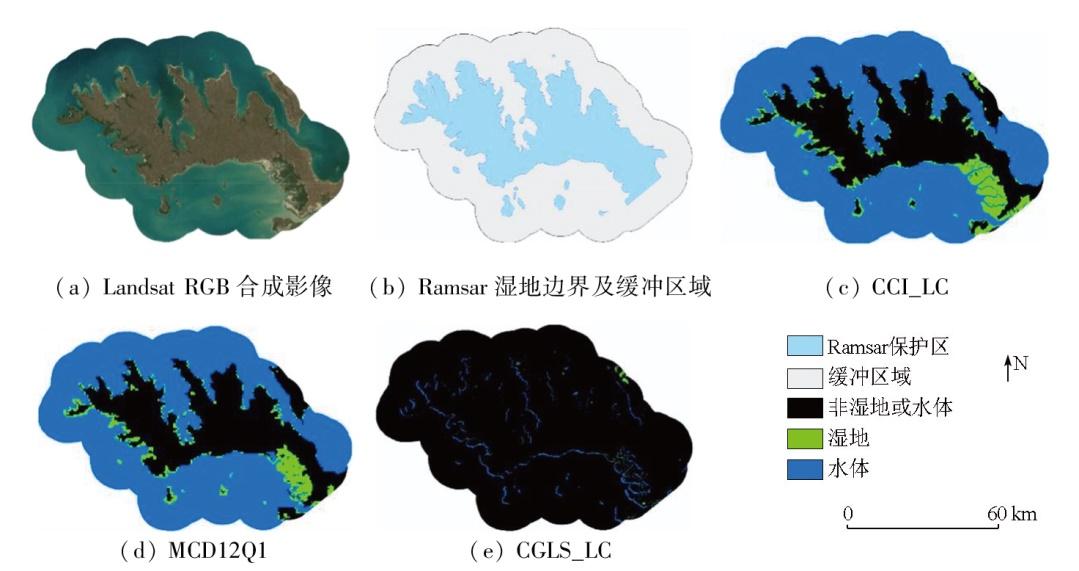
3套地表覆盖制图产品在空间和类别属性上存在较大差异,因此本文参考遥感产品真实性检验导则[50]和土地覆被遥感真实性检验国家标准[51]中交叉检验的步骤,利用Python的地理栅格数据处理库 rasterio(https://rasterio.readthedocs.io/en/latest/)对制图数据开展预处理。首先根据中国区域内国际重要湿地边界对制图数据进行裁剪,将栅格数据重投影到WGS84坐标系,并基于地表覆盖的面积占比将制图数据重采样到100 m的分辨率,实现空间一致性的转换。再者根据各产品的分类体系,将产品分类体系转换到“无数值”“非水体或湿地”“湿地”“水体”4个类别的体系下,实现类别一致性转换。如图1所示,经处理后的数据在空间、时间和类别上对齐,即可用于一致性评估指标的定量计算。
图1 预处理后的时空属性、分类体系的制图数据示意图

Fig.1 Schematic diagram of the preprocessed mapping data with the same spatio-temporal characteristics and category system

2 研究方法

本文主要以制图产品的湿地分类面积和制图产品间湿地分类的准确度来评估空间一致性。假设共有L处国际重要湿地,评估的2个产品分别记为PmPn,对于第i处(i=1,2,…,L)国际重要湿地,2个产品在国际重要湿地上的逐年湿地分类面积分别为$({A}_{i,1}^{m},{A}_{i,2}^{m},\dots,{A}_{i,t}^{m})$$({A}_{i,1}^{n},{A}_{i,2}^{n},\dots,{A}_{i,t}^{n})$,tPmPn重叠的年份数量。

2.1 面积回归分析

考虑到数值和结果的稳定性,本文选用面积的对数进行线性回归拟合,即使用最小二乘法求解下面模型中的参数${\beta }_{0}$${\beta }_{1}$:
$\mathrm{l}\mathrm{g}({\stackrel{-}{A}}_{i}^{m}+1)={\beta }_{1}\times \mathrm{l}\mathrm{g}({\stackrel{-}{A}}_{i}^{n}+1)+{\beta }_{0}$
式中${\stackrel{-}{A}}_{i}$为湿地分类面积在时间尺度上的均值。
在线性回归的基础上,进一步计算均方根误差(root of mean square error,RMSE)、相关系数r和决定系数R2,作为定量评估面积一致性的指标。

2.2 准确度指标和不确定度指标计算

由于评估的3个地表覆盖产品均属于硬分类产品,本文参考土地覆被遥感真实性检验国家标准[51],基于误差矩阵,计算UAPA作为准确度指标,此外本文还计算Kappa系数用于评估用户测定2幅图之间的吻合度[50]。对于不确定度分析,本文采用准确度指标对应的标准差作为不确定度指标。具体的准确度指标和不确定度指标的计算公式详见《遥感产品真实性检验导则》的附录A[50]与《土地覆被遥感产品真实性检验》国家标准的附录A[51]

3 结果与分析

3.1 分类面积回归分析

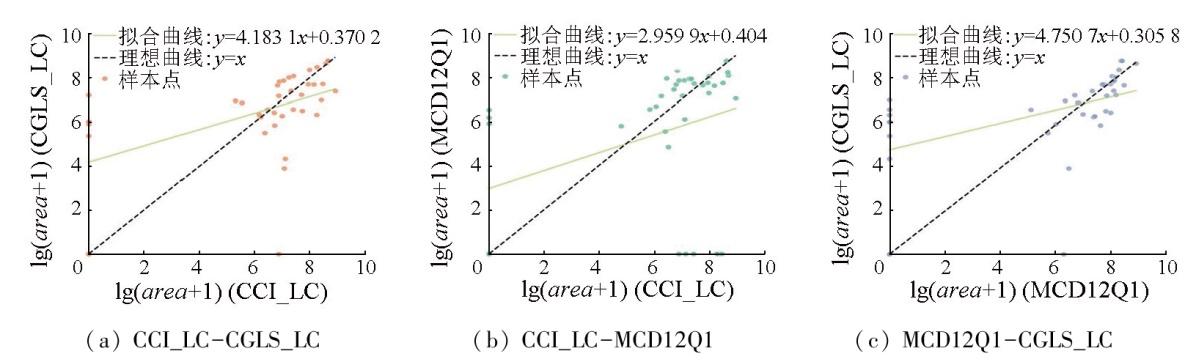
产品间湿地分类面积的回归分析结果如图2所示,3套长时序制图产品都在部分国际重要湿地上未能分类出湿地,导致这些区域的湿地分类面积为0,对数变换后数值也为0(即图中靠近横坐标轴或纵坐标轴的样本),原因可能是产品分类错误或是产品分类体系定义的湿地与该国际重要湿地所认定的湿地类别不一致。
图2 产品间的湿地分类面积的回归曲线拟合结果

Fig.2 Fitting results of regression curve between classification area of wetlands from different products

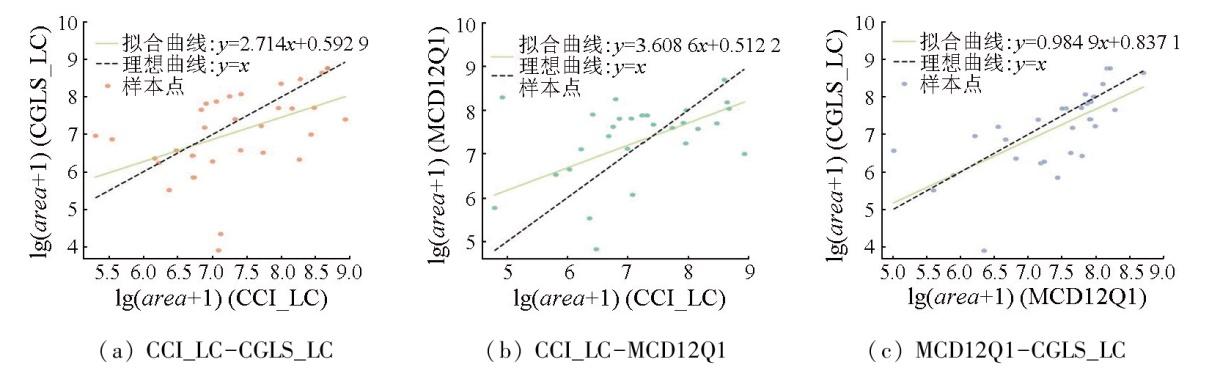
由于未分类出湿地的区域的面积数值可能对拟合得到的参数产生较大影响,进而影响指标的计算,本文尝试剔除未分类出湿地的区域后再进行回归分析,结果如图3所示。由拟合曲线的斜率和截距可知,CCI_LC分类出的湿地面积相对于其他2个产品都比较大,而MCD12Q1相对于CGLS_LC在斜率上相当接近,但截距接近1,故估算的湿地面积也偏大。总体而言,大部分的区域的湿地分类面积分布在直线x=y距离为1的区域内,即产品间湿地分类面积数值差别大约为10倍。由表2可知各产品湿地分类面积的RMSE为0.8~1,即面积相差6~10倍,因此总体而言面积存在比较大的不一致性。RMSEr最优的一对产品是MCD12Q1和CGLS_LS,R2最高的一对产品为CCI_LC和MCD12Q1。
图3 剔除未分类出湿地的区域后产品间的湿地分类面积的回归分析结果

Fig.3 Regression result between classification area of wetlands from different products after removing unclassified wetland areas

表2 剔除未分类出湿地的区域后产品间回归分析的评估结果

Tab.2 Evaluation result of regression analysis among products after removing unclassified wetland areas

产品 RMSE r R2
CCI_LC-CGLS_LC 1.109 7 0.476 5 -0.457 6
CCI_LC-MCD12Q1 0.872 4 0.571 2 0.214 3
MCD12Q1-CGLS_LC 0.821 1 0.679 8 0.097 6

3.2 准确度与不确定度指标评估

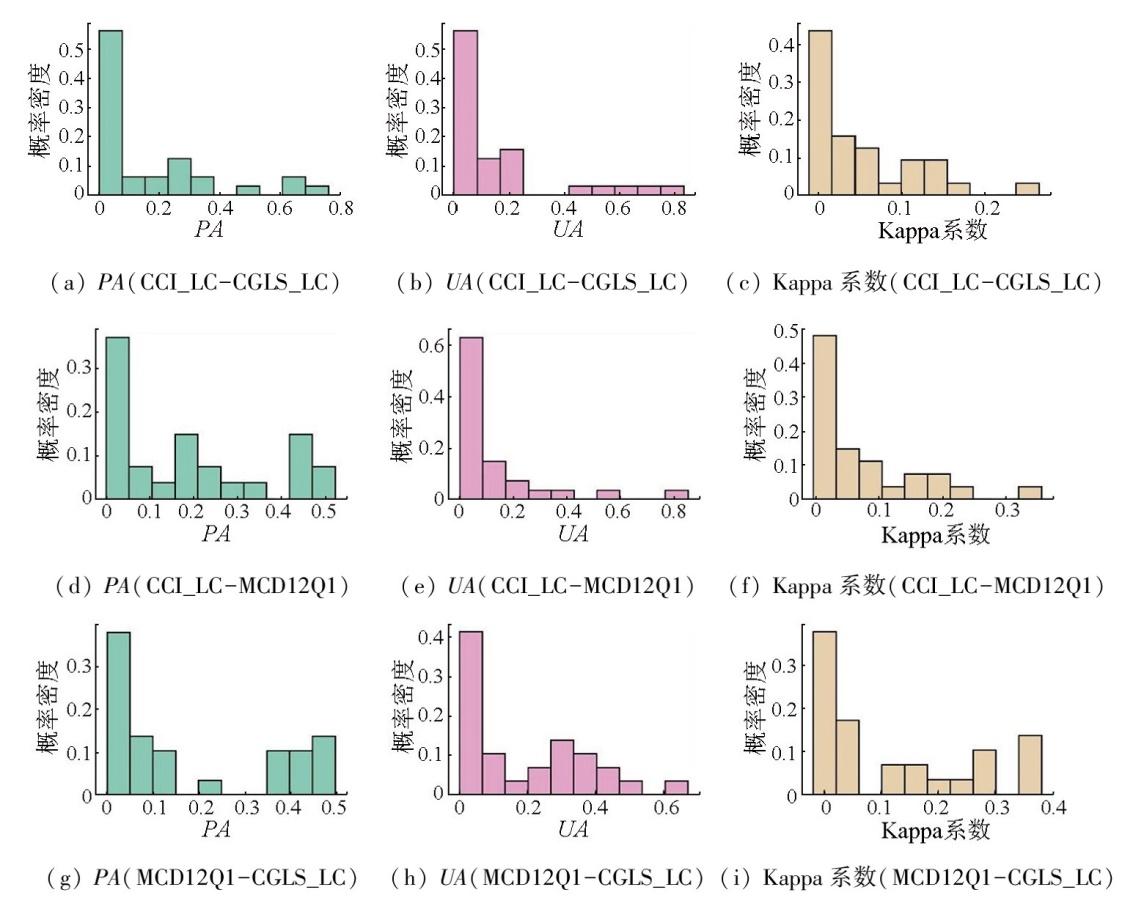
3套产品两两之间的湿地分类的准确度指标PA,UA和Kappa系数的分布如图4所示。对于CCI_LC和CGLS_LC,有50%的区域的湿地分类结果的PAUA接近0,只有少于10%的区域的湿地分类结果的UAPA能够大于0.6,约70%的区域的湿地分类结果的Kappa系数小于0.1。对于CCI_LC和MCD12Q1,PA的分布情况相对于前者比较好,但大部分区域的分类结果的UA分布在0.4以下。对于MCD12Q1和CGLS-LC,准确度的指标相比于前两者会更高一点,大于30%的区域湿地分类结果的PA大于0.35、UA大于0.25、Kappa系数大于0.2。
图4 产品间的湿地分类准确度指标分布直方图

Fig.4 Histogram of the distribution of wetland classification accuracy metrics among products

产品间湿地分类结果准确度的均值与标准差见表3。对于约20%~32.5%的国际重要湿地,产品对中两类产品均未能分类出湿地。例如,对于MODIS产品,至少未能在27.5%的Ramsar湿地中分类出湿地类别。这种情况下无法在产品间计算准确度指标,需要将未分类出湿地的样本剔除。MCD12Q1和CGLS_LC的UA和Kappa系数的均值最高,CCI_LC和MCD12Q1的PA的均值最高,这与3.1的分析结果一致。但总体而言,产品之间湿地分类结果的准确度都很低,且准确度指标的不确定度很大。除了MCD12Q1和CGLS_LC的UA和CCI_LC和MCD12Q1的PA指标,其他产品之间准确度指标的标准差均大于均值。
表3 产品间准确度与不确定度指标结果

Tab.3 Result of accuracy and uncertainty metrics among products

产品 未分类出湿
地的样本数
未分类出湿地
的样本的占比/%
UA PA Kappa系数
均值 标准差 均值 标准差 均值 标准差
CCI_LC-CGLS_LC 8 20.0 0.158 6 0.230 3 0.156 1 0.217 1 0.051 9 0.665 0
CCI_LC-MCD12Q1 13 32.5 0.130 6 0.202 5 0.192 5 0.130 6 0.074 1 0.091 1
MCD12Q1-CGLS_LC 11 27.5 0.190 1 0.186 7 0.182 9 0.195 9 0.121 5 0.138 0

4 讨论与结论

地表覆盖制图产品对于监测湿地变化、监督Ramsar公约缔约方履行公约至关重要,但当前制图产品数量众多,在时空特性、分类体系和质量上存在较大差异,且当前尚未有对长时序地表覆盖产品的湿地分类开展系统的一致性评估的研究。本文对中国区域40处国际重要湿地在3套长时序地表覆盖制图产品CCI_LC,MCD12Q1和CGLS_LC的湿地分类上开展系统的一致性评估,包括基于湿地分类面积的回归分析以及基于湿地分类结果的UA,PA和Kappa系数3个指标的准确度评估和不确定度分析,得到的相关结论如下:
1)3套地表覆盖产品间的湿地分类面积存在较大的不一致性,对于大于20%国际重要湿地区域,3个产品未能够分类出湿地,湿地分类面积差距较大,平均在6~10倍。
2)3套地表覆盖产品湿地分类结果的准确度很低,对于大多数的国际重要湿地区域,产品之间的UA,PA和Kappa系数小于0.1,且准确度的标准差很大,不确定度高,大部分产品的准确度的标准差大于均值。
总体而言,本文中的3套地表覆盖产品不能支撑比较可信的国际重要湿地变化的监测工作,用户在选择制图数据产品时不能仅考虑产品的自检精度,还需要参考其他研究关于该产品在湿地区域上的验证结果,比如MCD12Q1的UAPA分别为0.96和0.70,但本文3.2节部分的结果说明在大于27.5%的Ramsar保护区内,MCD12Q1未能分类湿地。因此,建设开放共享的全球湿地样本库尤为重要,需要联合更多比如Murray等的公开的全球滨海湿地样本的数据库,这将能够为所有的制图产品提供公共的基于真值检验的基准。从湿地制图产品研发的角度上来说,为督促各缔约方对国际重要湿地保护区履行公约,做到切实有效保护湿地,还需要集结比如GEO Wetland Initiative的专家团队,研发支持Ramsar公约政策建议的制图产品。
本文在空间范围和产品数量上还存在不足,未来的研究可以尝试拓展到全球的国际重要湿地,开展大洲之间的评估结果的对比分析; 在分析的产品方面,本文选用了长时序粗分辨率地表覆盖产品,但未考虑区域尺度的湿地类别精细的产品,如CLC或中分辨率的全球湿地专题制图产品GWL_FCS30等,这些产品类别更精细,精度更高,在单个年份或局部区域的情景下有较大的研究价值。此外,制图产品中未分类出湿地的区域也值得详细研究,可能是异质性较强的重要湿地,可以帮助完善湿地分类算法的研究。
[1]
Ramsar Convention Secretariat. The Ramsar Convention Manual:A guide to the Convention on Wetlands (Ramsar,Iran,1971),6th ed[R]. Gland, Switzerland: Ramsar Convention Secretariat, 2013.

[2]
Ramsar Convention Secretariat. The Fourth Ramsar Strategic Plan 2016—2024[R]// Ramsar Handbooks for the Wise Use of Wetlands,5th Edition,Vol.2.Gland, Switzerland: Ramsar Convention Secretariat, 2016.

[3]
Ramsar Convention Secretariat. Global Wetland Outlook:Special Edition 2021[R]. Gland, Switzerland: Ramsar Convention Secretariat, 2021.

[4]
Mao D H, Luo L, Wang Z M, et al. Conversions between natural wetlands and farmland in China:A multiscale geospatial analysis[J]. Science of The Total Environment, 2018,634:550-560.

[5]
Hu S J, Niu Z G, Chen Y F, et al. Global wetlands:Potential distribution,wetland loss,and status[J]. Science of The Total Environment, 2017,586:319-327.

[6]
Mao D H, Wang Z M, Wu J G, et al. China’s wetlands loss to urban expansion[J]. Land Degradation & Development, 2018, 29(8):2644-2657.

DOI

[7]
Rojas C, Munizaga J, Rojas O, et al. Urban development versus wetland loss in a coastal Latin American city:Lessons for sustainable land use planning[J]. Land Use Policy, 2019,80:47-56.

[8]
Mao D H, Yang H, Wang Z M, et al. Reverse the hidden loss of China’s wetlands[J]. Science, 2022, 376(6597):1061.

[9]
Mao D H, Tian Y L, Wang Z M, et al. Wetland changes in the Amur River Basin:Differing trends and proximate causes on the Chinese and Russian sides[J]. Journal of Environmental Management, 2021,280:111670.

[10]
Xi Y, Peng S S, Ciais P, et al. Future impacts of climate change on inland Ramsar wetlands[J]. Nature Climate Change, 2021, 11(1):45-51.

DOI

[11]
Davidson N C. How much wetland has the world lost? Long-term and recent trends in global wetland area[J]. Marine and Freshwater Research, 2014, 65(10):934-941.

DOI

[12]
Cyranoski D. Putting China’s wetlands on the map[J]. Nature, 2009, 458(7235):134.

DOI

[13]
Kingsford R T, Bino G, Finlayson C M, et al. Ramsar wetlands of international importance-improving conservation outcomes[J]. Frontiers in Environmental Science, 2021,9:643367.

[14]
Ramsar Convention Secretariat. Global Wetland Outlook:State of the World’s Wetlands and Their Services to People[R]. Gland, Switzerland: Ramsar Convention Secretariat, 2018.

[15]
Bridgewater P, Kim R E. The Ramsar convention on wetlands at 50[J]. Nature Ecology & Evolution, 2021, 5(3):268-270.

[16]
Davidson N C, Dinesen L, Fennessy S, et al. Trends in the ecological character of the world’s wetlands[J]. Marine and Freshwater Research, 2019, 71(1):127-138.

DOI

[17]
Davidson N C, Dinesen L, Fennessy S, et al. A review of the adequacy of reporting to the Ramsar Convention on change in the ecological character of wetlands[J]. Marine and Freshwater Research, 2019, 71(1):117-126.

DOI

[18]
Valuing wetlands[J/OL]. Nature Geoscience, 2021, 14(3):111-111.doi:10.1038/s41561-021-00713-4.

[19]
Friedl M A, Sulla-Menashe D, Tan B, et al. MODIS Collection 5 global land cover:Algorithm refinements and characterization of new datasets[J]. Remote Sensing of Environment, 2010, 114(1):168-182.

DOI

[20]
Arino O, Ramoino F. Land Cover CCI Product User Guide Version 2.0[EB/OL]. 2017(2017-04-10) [2023-06-18].http://maps.elie.ucl.ac.be/CCI/viewer/download/ESACCI-LC-Ph2-PUGv2_2.0.pdf.

[21]
Defourny P, Bicheron P, Brockmann C, et al. The first 300 m global land cover map for 2005 using ENVISAT MERIS time series:A product of the GlobCover system[M]. Ispra (Italy): Joint Research Centre of the European Commission, 2009.

[22]
Buchhorn M, Bertels L, Smets B, et al. Copernicus Global Land Service:Land Cover 100 m:Version 3 Globe 2015—2019:Algorithm Theoretical Basis Document[R/OL]. Zenodo, 2020(2020-09-08)[2022-08-23].https://zenodo.org/record/3938968.

[23]
Gong P, Wang J, Yu L, et al. Finer resolution observation and monitoring of global land cover:First mapping results with Landsat TM and ETM+ data[J]. International Journal of Remote Sensing, 2013, 34(7):2607-2654.

DOI

[24]
Zhang X, Liu L Y, Chen X D, et al. GLC_FCS30:Global land-cover product with fine classification system at 30 m using time-series Landsat imagery[J]. Earth System Science Data, 2021, 13(6):2753-2776.

DOI

[25]
Chen J, Chen J, Liao A P, et al. Global land cover mapping at 30 m resolution:A POK-based operational approach[J]. ISPRS Journal of Photogrammetry and Remote Sensing, 2015,103:7-27.

[26]
Liu H, Gong P, Wang J, et al. Production of global daily seamless data cubes and quantification of global land cover change from 1985 to 2020 - iMap World 1.0[J]. Remote Sensing of Environment, 2021,258:112364.

[27]
Gong P, Liu H, Zhang M N, et al. Stable classification with limited sample:Transferring a 30-m resolution sample set collected in 2015 to mapping 10-m resolution global land cover in 2017[J]. Science Bulletin, 2019, 64(6):370-373.

DOI

[28]
Zanaga D, Van De Kerchove S R, De Keersmaecker W, et al. ESA WorldCover 10 m 2020 v100[R/OL]. Zenodo, 2021(2021-10-20).https://zenodo.org/record/5571936.

[29]
Brown C F, Brumby S P, Guzder-Williams B, et al. Dynamic World,Near real-time global 10 m land use land cover mapping[J]. Scientific Data, 2022,9:251.

[30]
Zhang X, Liu L Y, Zhao T T, et al. GWL_FCS30:A global 30 m wetland map with a fine classification system using multi-sourced and time-series remote sensing imagery in 2020[J]. Earth System Science Data Discussions, 2023, 15(1):265-293.

[31]
Murray N J, Phinn S R, DeWitt M, et al. The global distribution and trajectory of tidal flats[J]. Nature, 2019, 565(7738):222-225.

DOI

[32]
Bunting P, Rosenqvist A, Lucas R M, et al. The global mangrove watch:A new 2010 global baseline of mangrove extent[J]. Remote Sensing, 2018, 10(10):1669.

DOI

[33]
Pekel J F, Cottam A, Gorelick N, et al. High-resolution mapping of global surface water and its long-term changes[J]. Nature, 2016, 540(7633):418-422.

DOI

[34]
Lehner B, Döll P. Development and validation of a global database of lakes,reservoirs and wetlands[J]. Journal of Hydrology, 2004, 296(1-4):1-22.

DOI

[35]
McOwen C, Weatherdon L, Bochove J W, et al. A global map of saltmarshes[J]. Biodiversity Data Journal, 2017,5:e11764.

[36]
Hu S J, Niu Z G, Chen Y F. Global wetland datasets:A review[J]. Wetlands, 2017, 37(5):807-817.

DOI

[37]
Murray N J, Worthington T A, Bunting P, et al. High-resolution mapping of losses and gains of Earth’s tidal wetlands[J]. Science, 2022, 376(6594):744-749.

DOI

[38]
Mao D H, Wang Z M, Du B J, et al. National wetland mapping in China:A new product resulting from object-based and hierarchical classification of Landsat 8 OLI images[J]. ISPRS Journal of Photogrammetry and Remote Sensing, 2020,164:11-25.

[39]
Niu Z G, Gong P, Cheng X, et al. Geographical characteristics of China’s wetlands derived from remotely sensed data[J]. Science in China Series D:Earth Sciences, 2009, 52(6):723-738.

[40]
Peng K F, Jiang W G, Hou P, et al. Continental-scale wetland mapping:A novel algorithm for detailed wetland types classification based on time series Sentinel-1/2 images[J]. Ecological Indicators, 2023,148:110113.

[41]
Zhang Z, Xu N, Li Y F, et al. Sub-continental-scale mapping of tidal wetland composition for East Asia:A novel algorithm integrating satellite tide-level and phenological features[J]. Remote Sensing of Environment, 2022,269:112799.

[42]
Yang L M, Jin S M, Danielson P, et al. A new generation of the United States National Land Cover Database:Requirements,research priorities,design,and implementation strategies[J]. ISPRS Journal of Photogrammetry and Remote Sensing, 2018,146:108-123.

[43]
Gong P, Niu Z G, Cheng X, et al. China’s wetland change (1990—2000) determined by remote sensing[J]. Science China Earth Sciences, 2010, 53(7):1036-1042.

DOI

[44]
张海英, 牛振国, 许盼盼. 大型国际重要湿地边界及遥感分类数据集(2001、2013)[J]. 全球变化数据学报, 2017, 1(2):230-238.

Zhang H Y, Niu Z G, Xu P P, et al. The boundaries and remote sensing classification datasets on large wetlands of international importance in 2001 and 2013[J]. Journal of Global Change Data & Discovery, 2017, 1(2):230-238.

[45]
Xing L W, Niu Z G, Xu P P, et al. Wetlands classification and assessment of Ramsar sites in China based on time series Moderate Resolution Imaging Spectroradiometer (MODIS) imagery[J]. Marine and Freshwater Research, 2018,69:658-668.

[46]
Mao D H, Wang Z M, Wang Y, et al. Remote observations in China’s Ramsar sites:Wetland dynamics,anthropogenic threats,and implications for sustainable development goals[J]. Journal of Remote Sensing, 2021,2021:9849343.

[47]
Gallant A. The challenges of remote monitoring of wetlands[J]. Remote Sensing, 2015, 7(8):10938-10950.

DOI

[48]
Liu L Y, Zhang X, Gao Y, et al. Finer-resolution mapping of global land cover:Recent developments,consistency analysis,and prospects[J]. Journal of Remote Sensing, 2021,2021:5289697.

[49]
Gao Y, Liu L Y, Zhang X, et al. Consistency analysis and accuracy assessment of three global 30-m land-cover products over the European Union using the LUCAS dataset[J]. Remote Sensing, 2020, 12(21):3479.

DOI

[50]
国家市场监督管理总局, 国家标准化管理委员会. GB/T 36296—2018 遥感产品真实性检验导则[S]. 北京: 中国标准出版社, 2018.

State Administration for Market Regulation, National standardization Administration. GB/T 36296—2018 Guide for the validation of remote sensing products[S]. Beijing: Standards Press of China, 2018.

[51]
国家市场监督管理总局, 国家标准化管理委员会. GB/T 41536—2022土地覆被遥感产品真实性检验[S]. 北京: 中国标准出版社, 2022.

State Administration for Market Regulation, National standardization Administration. GB/T 41536—2022 Validation of land cover remote sensing products[S]. Beijing: Standards Press of China, 2022.

Outlines

/